Econlib

The Library

Other Sites

Front Page arrow Titles (by Subject) arrow CHAPTER IV. - An Historical and Moral View of the Origin and Progress of the French Revolution and the Effect it Has Produced in Europe

Return to Title Page for An Historical and Moral View of the Origin and Progress of the French Revolution and the Effect it Has Produced in Europe

Search this Title:

Also in the Library:

Subject Area: History
Topic: The French Revolution
Debate: The Debate about the French Revolution

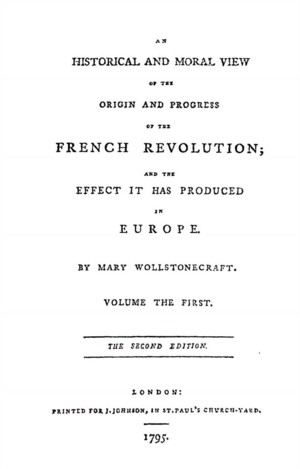
CHAPTER IV. - Mary Wollstonecraft, An Historical and Moral View of the Origin and Progress of the French Revolution and the Effect it Has Produced in Europe [1795]

Edition used:

An Historical and Moral View of the Origin and Progress of the French Revolution and the Effect it Has Produced in Europe (London: J. Johnson, 1795).

About Liberty Fund:

Liberty Fund, Inc. is a private, educational foundation established to encourage the study of the ideal of a society of free and responsible individuals.


CHAPTER IV.

progress of reform. the encyclopedie. liberty of the press. capitals. the french not properly qualified for the revolution. savage compared with civilized man. effects of extravagance—of commerce—and of manufactures. excuse for the ferocity of the parisians.

PEOPLE thinking for themselves have more energy in their voice, than any government, which it is possible for human wisdom to invent; and every government not aware of this sacred truth will, at some period, be suddenly overturned. Whilst men in a savage state preserve their independence, they adopt no regular system of policy, nor ever attempt to digest their rude code of laws into a constitution, to ensure political liberty. Consequently we find in every country, after it’s civilization has arrived at a certain height, that the people, the moment they are displeased with their rulers, begin to clamour against them; and, finally rejecting all authority but their own will, in breaking the shackles of folly or tyranny, they glut their resentment by the mischievous destruction of the works of ages, only considering them as the moments of their servitude.

From the social disposition of man, in proportion as he becomes civilized, he will mingle more and more with society. The first interest he takes in the business of his fellow-men is in that of his neighbour; next he contemplates the comfort, misery, and happiness of the nation to which he belongs, investigates the degree of wisdom and justice in the political system, under which he lives, and, striding into the regions of science, his researches embrace all human kind. Thus he is enabled to estimate the portion of evil or good which the government of his country produces, compared with that of others; and the comparison, granting him superiour powers of mind, leads him to conceive a model of a more perfect form.

This spirit of inquiry first manifests itself in hamlets; when his views of improvement are confined to local advantages: but the approximation of different districts leading to further intercourse, roads of communication are opened, until a central or favourite spot becomes the vortex of men and things. Then the rising spires, pompous domes, and majestic monuments, point out the capital; the focus of information, the reservoir of genius; the school of arts, the seat of voluptuous gratification, and the hot-bed of vice and immorality.

The centrifugal rays of knowledge and science now stealing through the empire, the whole intellectual faculties of man partake of their influence, and one general sentiment governs the civil and political body. In the progress of these improvements the state undergoing a variety of changes, the happiness or misery produced occasions a diversity of opinions; and to prevent confusion, absolute governments have been tolerated by the most enlightened part of the people. But, probably, this toleration was merely the effect of the strong social feelings of men; who preferred tranquillity, and the prosperity of their country, to a resistance, which, judging from the ignorance of their fellow citizens, they believed would bring more harm than good in it’s train. In short, however long a combination of tyranny has retarded the progress, it has been one of the advantages of the large cities of Europe, to light up the sparks of reason, and to extend the principles of truth.

Such is the good and evil flowing from the capitals of states, that during the infancy of governments, though they tend to corrupt and enervate the mind, they accelerate the introduction of science, and give the tone to the national sentiments and taste.

But this influence is extremely gradual; and it requires a great length of time, for the remote corners of the empire to experience either the one, or the other of these effects. Hence we have seen the inhabitants of a metropolis feeble and vitiated, and those of the provinces robust and virtuous. Hence we have seen oppositions in a city (riots as they are called) to illegal governments instantly defeated, and their leaders hanged or tortured; because the judgment of the state was not sufficiently matured to support the struggle of the unhappy victims in a righteous cause. And hence it has happened, that the despots of the world have found it necessary to maintain large standing armies, in order to counteract the effects of truth and reason.

The continuation of the feudal system, however, for a great length of time, by giving an overgrown influence to the nobility of France, had contributed, in no small degree, to counteract the despotism of her kings. Thus it was not until after the arbitrary administration of Richelieu, who had terrified the whole order by a tyranny peculiar to himself, that the insidious Mazarine broke the independent spirit of the nation by introducing the sale of honours; and that Louis XIV, by the magnificence of his follies, and the meretricious decorations of stars, crosses, and other marks of distinction, or badges of slavery, drew the nobles from their castles; and, by concentrating the pleasures and wealth of the kingdom in Paris, the luxury of the court became commensurate to the product of the nation. Besides, the encouragement given to enervating pleasures, and the venality of titles, purchased either with money, or ignoble services, soon rendered the nobility as notorious for effeminacy as they had been illustrious for heroism in the days of the gallant Henry.

The arts had already formed a school, and men of science and literature were hurrying from every part of the kingdom to the metropolis, in search of employment and of honour; and whilst it was giving it’s tone to the empire, the parisian taste was pervading Europe.

The vanity of leading the fashions, in the higher orders of society, is not the smallest weakness produced by the sluggishness into which people of quality naturally fall. The depravity of manners, and the sameness of pleasure, which compose a life of idleness, are sure to produce an insupportable ennui; and, in proportion to the stupidity of the man, or as his sensibility becomes deadened, he has recourse to variety, finding a zest only from a new creation of charms; and commonly the most unnatural are necessary to rouse sickly, fastidious senses. Still in the same degree as the refinement of sentiment, and the improvement of taste advance, the company of celebrated literary characters is sought after with avidity; and from the prevalence of fashion, the empire of wit succeeds the reign of formal insipidity, after the squeamish palate has been rendered delicate even by the nauseous banquets of voluptuousness.

This is the natural consequence of the improvement of manners, the harbinger of reason; and from the ratio of it’s advancement throughout society, we are enabled to estimate the progress of political science. For no sooner had the disquisition of philosophical subjects become general in the select parties of amusement, extending by degrees to every class of society, than the rigour of the ancient government of France began to soften; till it’s mildness became so considerable, that superficial observers have attributed the exercise of lenity in the administration to the wisdom and excellence of the system itself.

A confederacy of philosophers, whose opinions furnished the food of colloquial entertainment, gave a turn for instructive and useful reading to the leaders of circles, and drew the attention of the nation to the principles of political and civil government. Whilst by the compilation of the Encyclopedia, the repository of their thoughts, as an abstract work, they eluded the dangerous vigilance of absolute ministers; thus in a body disseminating those truths in the economy of finance, which, perhaps, they would not have had sufficient courage separately to have produced in individual publications; or, if they had, they would most probably have been suppressed.

This is one of the few instances of an association of men becoming useful, instead of being cramped by joint exertions. And the cause is clear:—the work did not require a little party spirit; but each had a distinct subject of investigation to pursue with solitary energy. His destination was traced upon a calm sea, which could not expose him to the Scylla or Charybdis of vanity or interest.

The economists, carrying away the palm from their opponents, showed that the prosperity of a state depends on the freedom of industry; that talents should be permitted to find their level; that the unshackling of commerce is the only secret to render it flourishing, and answer more effectually the ends for which it is politically necessary; and that the imposts should be laid upon the surplus remaining, after the husbandman has been reimbursed for his labour and expences.

Ideas so new, and yet so just and simple, could not fail to produce a great effect on the minds of frenchmen; who, constitutionally attached to novelty and ingenious speculations, were sure to be enamoured with a prospect of consolidating the great advantages of such a novel and enlightened system; and without calculating the danger of attacking old prejudices; nay, without ever considering, that it was a much easier task to pull down than to build up, they gave themselves little trouble to examine the gradual steps by which other countries have attained their degree of political improvement.

The many vexatious taxes, which under the french government not only enervated the exertions of unprivileged persons, stagnating the live stream of trade, but were extremely teasing inconveniences to every private man, who could not travel from one place to another without being stopped at barriers, and searched by officers of different descriptions, were almost insuperable impediments in the way of the improvements of industry: and the abridgment of liberty was not more grievous in it’s pecuniary consequences, than in the personal mortification of being compelled to observe regulations as troublesome as they were at variance with sound policy.

Irritations of the temper produce more poignant sensations of disgust than serious injuries. Frenchmen, indeed, had been so long accustomed to these vexatious forms, that, like the ox who is daily yoked, they were no longer galled in spirit, or exhaled their angry ebullitions in a song. Still it might have been supposed, that after reflecting little, and talking much, about the sublimity and superiour excellence of the plans of french writers above those of other nations, they would become as passionate for liberty, as a man restrained by some idle religious vow is to possess a mistress, to whose charms the imagination has lent all it’s own world of graces.

Besides, the very manner of living in France gives a lively turn to the character of the people; for by the destruction of the animal juices, in dressing their food, they are subject to none of that dulness, the effect of more nutritive diet in other countries; and this gaiety is increased by the moderate quantity of weak wine, which they drink at their meals, bidding defiance to phlegm. The people also living entirely in villages and towns are more social; so that the tone of the capital, the instant it had a note distinct from that of the court, became the key of the nation; though the inhabitants of the provinces polished their manners with less danger to their morals, or natural simplicity of character. But this mode of peopling the country tended more to civilize the inhabitants, than to change the face of the soil, or lead to agricultural improvements. For it is by residing in the midst of their land, that farmers make the most of it, in every sense of the word—so that the rude state of husbandry, and the awkwardness of the implements used by these ingenious people, may be imputed solely to this cause.

The situation of France was likewise very favourable for collecting the information, acquired in other parts of the world. Paris, having been made a thoroughfare to all the kingdoms on the continent, received in it’s bosom strangers from every quarter; and itself resembling a full hive, the very drones buzzed into every corner all the sentiments of liberty, which it is possible for a people to possess, who have never been enlightened by the broad sunshine of freedom; yet more romantically enthusiastic, probably, for that very reason. Paris, therefore, having not only disseminated information, but presented herself as a bulwark to oppose the despotism of the court, standing the brunt of the fray, seems with some reason, to pride herself on being the author of the revolution.

Though the liberty of the press had not existed in any part of the world, England and America excepted, still the disquisition of political questions had long occupied the intelligent parts of Europe; and in France, more than in any other country, books written with licentious freedom were handed from house to house, with the circumspection that irritates curiosity. Not to lay great stress on the universality of the language, which made one general opinion on the benefits arising from the advancement of science and reason pervade the neighbouring states, particularly Germany; where original compositions began to take place of that laborious erudition, which being employed only in the elucidation of ancient writers, the judgment lies dormant, or is merely called into action to weigh the import of words rather than to estimate the value of things. In Paris, likewise, a knot of ingenious, if not profound writers, twinkled their light into every circle; for being caressed by the great, they did not inhabit the homely recesses of indigence, rusticating their manners as they cultivated their understandings; on the contrary, the finesse required to convey their free sentiments in their books, broken into the small shot of innuendoes, gave an oiliness to their conversation, and enabled them to take the lead at tables, the voluptuousness of which was grateful to philosophers, rather of the epicurean than the stoic sect.

It had long been the fashion to talk of liberty, and to dispute on hypothetical and logical points of political economy; and these disputations disseminated gleams of truth, and generated more demagogues than had ever appeared in any modern city.—The number exceeded, perhaps, any comparison with that of Athens itself.

The habit also of passing a part of most of their evenings at some theatre gave them an ear for harmony of language, and a fastidious taste for sheer declamation, in which a sentimental jargon extinguishes all the simplicity and fire of passion: the great number of play-houses* , and the moderate prices of the pit and different ranges of boxes, bringing it within the compass of every citizen to frequent the amusement so much beloved by the french.

The arrangement of sounds, and the adjustment of masculine and feminine rhymes, being the secrets of their poetry, the pomp of diction gives a semblance of grandeur to common observations and hackneyed sentiments; because the french language, though copious in the phrases that give each shade of sentiment, has not, like the italian, the english, the german, a phraseology peculiar to poetry; yet it’s happy turns, equivocal, nay even concise expressions, and numerous epithets, which, when ingeniously applied, convey a sentence, or afford matter for half a dozen, make it better adapted to oratorical flourishes than that of any other nation. The french therefore are all rhetoricians, and they have a singular fund of superficial knowledge, caught in the tumult of pleasure from the shallow stream of conversation; so that if they have not the depth of thought which is obtained only by contemplation, they have all the shrewdness of sharpened wit; and their acquirements are so near their tongue’s end, that they never miss an opportunity of saying a pertinent thing, or tripping up, by a smart retort, the arguments with which they have not strength fairly to wrestle.

Every political good carried to the extreme must be productive of evil; yet every poison has it’s antidote; and there is a pitch of luxury and refinement, which, when reached, will overturn all the absolute governments in the world. The ascertainment of these antidotes is a task the most difficult; and whilst it remains imperfect, a number of men will continue to be the victims of mistaken applications. Like the empirics, who bled a patient to death to prevent a mortification from becoming fatal, the tyrants of the earth have had recourse to cutting off the heads, or torturing the bodies, of those persons who have attempted to check their sway, or doubt their omnipotence. But, though thousands have perished the victims of empirics, and of despots, yet the improvements made both in medicine and moral philosophy have kept a sure, though gradual pace.—And, if men have not clearly discovered a specific remedy for every evil, physical, moral, and political, it is to be presumed, that the accumulation of experimental facts will greatly tend to lessen them in future.

Whilst, therefore, the sumptuous galas of the court of France were the grand source of the refinement of the arts, taste became the antidote to ennui; and when sentiment had taken place of chivalrous and gothic tournaments, the reign of philosophy succeeded that of the imagination. And though the government, enveloped in precedents, adjusted still the idle ceremonials, which were no longer imposing, blind to the imperceptible change of things and opinions, as if their faculties were bound by an eternal frost, the progress was invariable; till, reaching a certain point, Paris, which from the particular formation of the empire had been such an useful head to it, began to be the cause of dreadful calamities, extending from individuals to the nation, and from the nation to Europe. Thus it is, that we are led to blame those, who insist, that, because a state of things has been productive of good, it is always respectable; when, on the contrary, the endeavouring to keep alive any hoary establishment, beyond it’s natural date, is often pernicious and always useless.

In the infancy of governments, or rather of civilization, courts seem to be necessary to accelerate the improvement of arts and manners, to lead to that of science and morals. Large capitals are the obvious consequences of the riches and luxury of courts; but as, after they have arrived at a certain magnitude and degree of refinement, they become dangerous to the freedom of the people, and incompatible with the safety of a republican government, it may be questioned whether Paris will not occasion more disturbance in settling the new order of things, than is equivalent to the good she produced by accelerating the epocha of the revolution.

However, it appears very certain, that should a republican government be consolidated, Paris must rapidly crumble into decay. It’s rise and splendour were owing chiefly, if not entirely, to the old system of government; and since the foundation of it’s luxury has been shaken, and it is not likely that the disparting structure will ever again rest securely on it’s basis, we may fairly infer, that, in proportion as the charms of solitary reflection and agricultural recreations are felt, the people, by leaving the villages and cities, will give a new complexion to the face of the country—and we may then look for a turn of mind more solid, principles more fixed, and a conduct more consistent and virtuous.

The occupations and habits of life have a wonderful influence on the forming mind; so great, that the superinductions of art stop the growth of the spontaneous shoots of nature, till it is difficult to distinguish natural from factitious morals and feelings; and as the energy of thinking will always proceed, in a great measure, either from our education or manner of living, the frivolity of the french character may be accounted for, without taking refuge in the old hiding place of ignorance—occult causes.

When it is the object of education to prepare the pupil to please every body, and of course to deceive, accomplishments are the one thing needful; and the desire to be admired ever being uppermost, the passions are subjugated, or all drawn into the whirlpool of egotism* . This gives to each person, however different the temper, a tincture of vanity, and that weak vacillation of opinion, which is incompatible with what we term character.

Thus a frenchman, like most women, may be said to have no character distinguishable from that of the nation; unless little shades, and casual lights, be allowed to constitute an essential characteristic. What then could have been expected, when their ambition was mostly confined to dancing gracefully, entering a room with easy assurance, and smiling on and complimenting the very persons whom they meant to ridicule at the next fashionable assembly? The learning to fence with skill, it is true, was useful to a people, whose false notions of honour required that at least a drop of blood should atone for the shadow of an affront. The knack also of uttering sprightly repartees became a necessary art, to supply the place of that real interest only to be nourished in the affectionate intercourse of domestic intimacy, where confidence enlarges the heart it opens. Besides, the desire of eating of every dish at table, no matter if there were fifty, and the custom of separating immediately after the repast, destroy the social affections, reminding a stranger of the vulgar saying—‘every man for himself, and God for us all.’ After these cursory observations, it is not going too far to advance, that the french were in some respects the most unqualified of any people in Europe to undertake the important work in which they are embarked.

Whilst pleasure was the sole object of living among the higher orders of society, it was the business of the lower to give life to their joys, and convenience to their luxury. This cast-like division, by destroying all strength of character in the former, and debasing the latter to machines, taught frenchmen to be more ingenious in their contrivances for pleasure and show, than the men of any other country; whilst, with respect to the abridgment of labour in the mechanic arts, or to promote the comfort of common life, they were far behind. They had never, in fact, acquired an idea of that independent, comfortable situation, in which contentment is fought rather than happiness; because the slaves of pleasure or power can be roused only by lively emotions and extravagant hopes. Indeed they have no word in their vocabulary to express comfort—that state of existence, in which reason renders serene and useful the days, which passion would only cheat with flying dreams of happiness.

A change of character cannot be so sudden as some sanguine calculators expect: yet by the destruction of the rights of primogeniture, a greater degree of equality of property is sure to follow; and as Paris cannot maintain it’s splendour, but by the trade of luxury, which can never be carried to the same height it was formerly, the opulent having strong motives to induce them to live more in the country, they must acquire new inclinations and opinions.—As a change also of the system of education and domestic manners will be a natural consequence of the revolution, the french will insensibly rise to a dignity of character far above that of the present race; and then the fruit of their liberty, ripening gradually, will have a relish not to be expected during it’s crude and forced state.

The late arrangement of things seems to have been the common effect of an absolute government, a domineering priesthood, and a great inequality of fortune; and whilst it completely destroyed the most important end of society, the comfort and independence of the people, it generated the most shameful depravity and weakness of intellect; so that we have seen the french engaged in a business the most sacred to mankind, giving, by their enthusiasm, splendid examples of their fortitude at one moment, and at another, by their want of firmness and deficiency of judgment, affording the most glaring and fatal proofs of the just estimate, which all nations have formed of their character.

Men so thoroughly sophisticated, it was to be supposed, would never conduct any business with steadiness and moderation: but it required a knowledge of the nation and their manners, to form a distinct idea of their disgusting conceit and wretched egotism; so far surpassing all the calculations of reason, that, perhaps, should not a faithful picture be now sketched, posterity would be at loss to account for their folly; and attribute to madness, what arose from imbecility.

The natural feelings of man seldom become so contaminated and debased as not sometimes to let escape a gleam of the generous fire, an ethereal spark of the soul; and it is these glowing emotions, in the inmost recesses of the heart, which have continued to feed feelings, that on sudden occasions manifest themselves with all their pristine purity and vigour. But, by the habitual slothfulness of rusty intellects, or the depravity of the heart, lulled into hardness on the lascivious couch of pleasure, those heavenly beams are obscured, and man appears either an hideous monster, a devouring beast; or a spiritless reptile, without dignity or humanity.

Those miserable wretches who crawl under the feet of others are seldom to be found among savages, where men accustomed to exercise and temperance are, in general, brave, hospitable, and magnanimous; and it is only as they surrender their rights, that they lose those noble qualities of the heart. The ferocity of the savage is of a distinct nature from that of the degenerate slaves of tyrants. One murders from mistaken notions of courage; yet he respects his enemy in proportion to his fortitude, and contempt of death: the other assassinates without remorse, whilst his trembling nerves betray the weakness of his affrighted soul at every appearance of danger. Among the former, men are respected according to their abilities; consequently idle drones are driven out of this society; but among the latter, men are raised to honours and employments in proportion as a talent for intrigue, the sure proof of littleness of mind, has rendered them servile. The most melancholy reflections are produced by a retrospective glance over the rise and progress of the governments of different countries, when we are compelled to remark, that flagrant follies and atrocious crimes have been more common under the governments of modern Europe, than in any of the ancient nations, if we except the jews. Sanguinary tortures, insidious poisonings, and dark assassinations, have alternately exhibited a race of monsters in human shape, the contemplation of whose ferocity chills the blood, and darkens every enlivening expectation of humanity: but we ought to observe, to reanimate the hopes of benevolence, that the perpetration of these horid deeds has arisen from a despotism in the government, which reason is teaching us to remedy. Sometimes, it is true, restrained by an iron police, the people appear peaceable, when they are only stunned; so that we find, whenever the mob has broken loose, the fury of the populace has been shocking and calamitous. These considerations account for the contradictions in the french character, which must strike a stranger: for robberies are very rare in France, where daily frauds and fly pilfering prove, that the lower class have as little honesty as sincerity. Besides, murder and cruelty almost always show the dastardly ferocity of fear in France; whilst in England, where the spirit of liberty has prevailed, it is usual for an highwayman, demanding your money, not only to avoid barbarity, but to behave with humanity, and even complaisance.

Degeneracy of morals, with polished manners, produces the worst of passions, which floating through the social body, the genial current of natural feelings has been poisoned; and, committing crimes with trembling inquietude, the culprits have not only drawn on themselves the vengeance of the law, but thrown an odium on their nature, that has blackened the face of humanity. And whilst it’s temple has been sacrilegiously profaned by the drops of blood, which have issued from the very hearts of the sad victims of their folly; a hardness of temper, under the veil of sentiment, calling it vice, has prevented our sympathy from leading us to examine into the sources of the atrocity of our species, and obscured the true cause of disgraceful and vicious habits.

Since the existence of courts, whose aggrandisement has been conspicuous in the same degree as the miseries of the debased people have accumulated, the convenience and comfort of men have been sacrificed to the ostentatious display of pomp and ridiculous pageantry. For every order of men, from the beggar to the king, has tended to introduce that extravagance into society, which equally blasts domestic virtue and happiness. The prevailing custom of living beyond their income has had the most baneful effect on the independence of individuals of every class in England, as well as in France; so that whilst they have lived in habits of idleness, they have been drawn into excesses, which, proving ruinous, produced consequences equally pernicious to the community, and degrading to the private character. Extravagance forces the peer to prostitute his talents and influence for a place, to repair his broken fortune; and the country gentleman becomes venal in the senate, to enable himself to live on a par with him, or reimburse himself for the expences of electioneering, into which he was led by sheer vanity. The professions, on the same account, become equally unprincipled. The one, whose characteristic ought to be integrity, descends to chicanery; whilst another trifles with the health, of which it knows all the importance. The merchant likewise enters into speculations so closely bordering on fraudulency, that common straight forward minds can scarcely distinguish the devious art of selling any thing for a price far beyond that necessary to ensure a just profit, from sheer dishonesty, aggravated by hard-heartedness, when it is to take advantage of the necessities of the indigent.

The destructive influence of commerce, it is true, carried on by men who are eager by overgrown riches to partake of the respect paid to nobility, is felt in a variety of ways. The most pernicious, perhaps, is it’s producing an aristocracy of wealth, which degrades mankind, by making them only exchange savageness for tame servility, instead of acquiring the urbanity of improved reason. Commerce also, overstocking a country with people, obliges the majority to become manufacturers rather than husbandmen; and then the division of labour, solely to enrich the proprietor, renders the mind entirely inactive. The time which, a celebrated writer says, is sauntered away, in going from one part of an employment to another, is the very time that preserves the man from degenerating into a brute; for every one must have observed how much more intelligent are the blacksmiths, carpenters, and masons in the country, than the journeymen in great towns; and, respecting morals, there is no making a comparison. The very gait of the man, who is his own master, is so much more steady than the slouching step of the servant of a servant, that it is unnecessary to ask which proves by his actions he has the most independence of character.

The acquiring of a fortune is likewise the least arduous road to pre-eminence, and the most sure: thus are whole knots of men turned into machines, to enable a keen speculator to become wealthy; and every noble principle of nature is eradicated by making a man pass his life in stretching wire, pointing a pin, heading a nail, or spreading a sheet of paper on a plain surface. Besides, it is allowed, that all associations of men render them sensual, and consequently selfish; and whilst lazy friars are driven out of their cells as stagnate bodies that corrupt society, it may admit of a doubt whether large work-shops do not contain men equally, tending to impede that gradual progress of improvement, which leads to the perfection of reason, and the establishment of rational equality.

The deprivation of natural, equal, civil and political rights, reduced the most cunning of the lower orders to practise fraud, and the rest to habits of stealing, audacious robberies, and murders. And why? because the rich and poor were separated into bands of tyrants and slaves, and the retaliation of slaves is always terrible. In short, every sacred feeling, moral and divine, has been obliterated, and the dignity of man sullied, by a system of policy and jurisprudence as repugnant to reason, as at variance with humanity.

The only excuse that can be made for the ferocity of the parisians is then simply to observe, that they had not any confidence in the laws, which they had always found to be merely cobwebs to catch small flies. Accustomed to be punished themselves for every trifle, and often for only being in the way of the rich, or their parasites; when, in fact, had the parisians seen the execution of a noble, or priest, though convicted of crimes beyond the daring of vulgar minds?—When justice, or the law, is so partial, the day of retribution will come with the red sky of vengeance, to confound the innocent with the guilty. The mob were barbarous beyond the tiger’s cruelty: for how could they trust a court that had so often deceived them, or expect to see it’s agents punished, when the same measures were pursuing?

Let us cast our eyes over the history of man, and we shall scarcely find a page that is not tarnished by some foul deed, or bloody transaction. Let us examine the catalogue of the vices of men in a savage state, and contrast them with those of men civilized; we shall find, that a barbarian, considered as a moral being, is an angel, compared with the refined villain of artificial life. Let us investigate the causes which have produced this degeneracy, and we shall discover, that they are those unjust plans of government, which have been formed by peculiar circumstances in every part of the globe.—Then let us coolly and impartially contemplate the improvements, which are gaining ground in the formation of principles of policy; and I flatter myself it will be allowed by every humane and considerate being, that a political system more simple than has hitherto existed would effectually check those aspiring follies, which, by imitation, leading to vice, have banished from governments the very shadow of justice and magnanimity.

Thus had France grown up, and sickened on the corruption of a state diseased. But, as in medicine there is a species of complaint in the bowels which works it’s own cure, and, leaving the body healthy, gives an invigorated tone to the system, so there is in politics: and whilst the agitation of it’s regeneration continues, the excrementitious humours exuding from the contaminated body will excite a general dislike and contempt for the nation; and it is only the philosophical eye, which looks into the nature and weighs the consequences of human actions, that will be able to discern the cause, which has produced so many dreadful effects.

END OF THE FIRST VOLUME.

Lately published, RIGHTS OF WOMAN.

By Mary Wollstonecraft.

the second edition:

(price six shillings in boards.)

printed for j. johnson in st. paul’s church-yard.

Where may be had,

1. MARY: A Fiction. 3s. sewed.

2. THOUGHTS on the EDUCATION of DAUGHTERS. 2s. 6d. sewed.

3. ORIGINAL STORIES from REAL LIFE; calculated to regulate the Affections, and form the Mind to Truth and Goodness. 2s. 6d. bound, with cuts; or 2s. without.

4. ELEMENTS of MORALITY, with fifty copper-plates. 3 vols. 10s. 6d. bound.

5. YOUNG GRANDISON: Letters from Young Persons to their Friends. 2 vols. 6s. bound.

6. The FEMALE READER: Select Pieces in Prose and Verse, from the best Writers, for the Improvement of Young Women. With a Preface on Female Education. 3s. 6d. bound.

[* ]There are upwards of thirty scattered throughout the city.

[* ]I use this word according to the french acceptation, because we have not one to express so forcibly the same signification.