Econlib

The Library

Other Sites

Front Page arrow Titles (by Subject) arrow CHAPTER I. - An Historical and Moral View of the Origin and Progress of the French Revolution and the Effect it Has Produced in Europe

Return to Title Page for An Historical and Moral View of the Origin and Progress of the French Revolution and the Effect it Has Produced in Europe

Search this Title:

Also in the Library:

Subject Area: History
Topic: The French Revolution
Debate: The Debate about the French Revolution

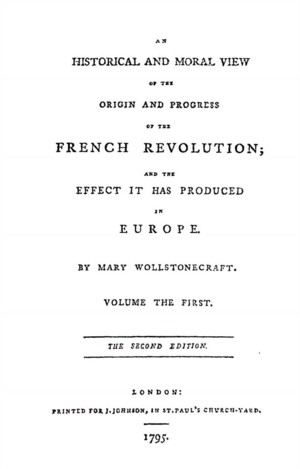
CHAPTER I. - Mary Wollstonecraft, An Historical and Moral View of the Origin and Progress of the French Revolution and the Effect it Has Produced in Europe [1795]

Edition used:

An Historical and Moral View of the Origin and Progress of the French Revolution and the Effect it Has Produced in Europe (London: J. Johnson, 1795).

About Liberty Fund:

Liberty Fund, Inc. is a private, educational foundation established to encourage the study of the ideal of a society of free and responsible individuals.


CHAPTER I.

errour of the national assembly in neglecting to secure the freedom of france. it’s conduct compared with that of the american states. necessity of forming a new constitution as soon as an old government is destroyed. the declaring the king inviolable a wrong measure. security of the french against a counter-revolution. the flight of the king meditated.

The conduct of the assembly in losing so much time—the most precious time to secure the happiness of their country, and enable the present generation to participate in the blessings they were preparing for posterity, instead of having to encounter all the miseries of anarchy, can never be sufficiently lamented. France had already gained her freedom; the nation had already ascertained certain, and the most important, political truths: it ought, therefore, to have been the next consideration, how these were to be preserved, and the liberty of the empire consolidated on a basis that time would only render more firm.

Moderate men, or real patriots, would have been satisfied with what had been gained, for the present, allowing the rest to follow progressively. It was the most political and the most reasonable way to secure the acquisition. In this situation France had to contend with the prejudices of half Europe, at least, and to counteract the influence of the insidious intriguers, who were opposing themselves to her regeneration; to facilitate which the assembly ought to have made it one of their main objects to render the king contented with the change; and then the machinations of all the underminers of the revolution, would not have loosened one fundamental stone, to endanger the rising edifice.

Such is the difference between men acting from a practical knowledge, and men who are governed entirely by theory, or no principle whatever. Most of the United States of America formed their separate constitutions within a month, and none took more than three, after the declaration of their independence by congress. There certainly was a vast distinction between those States, then the colonies of Great Britain, and France after the 14th of july; but both countries were without a government. America with an enemy in the heart of their empire, and France threatened with an attack. The leading men of America, however, knew, that there was a necessity of having some kind of government, and seem to have perceived the ease, with which any subsequent alterations could be effected. The members of the national assembly, on the contrary, found themselves surrounded with ruins; and aiming at a state of perfection for which the minds of the people were not sufficiently mature; affecting likewise to be directed by a magnanimous disinterestedness, they not only planted the germ of the most dangerous and licentious spirit, but they continued to irritate the desperate courtiers, who, having determined to oppose stratagem to force, and not succeeding, rested all their future hopes on the king’s escape.

The liberty of the press, which had been virtually established, at this period, was a successful engine employed against the assembly. And to a nation celebrated for epigrammatic fancy, and whose taste had been so refined by art, that they had lost the zest of nature, the simplicity of some of the members, their awkward figures, and rustic gait, compared with the courtly mien, and easy assurance of the chevaliers of Versailles, afforded an excellent subject. Some of these satires were written with considerable wit, and such a happy turn of caricature, that it is impossible not to laugh with the author, though indirectly ridiculing the principles you hold sacred. The most respectable decrees, the most important, and serious discussions, were twisted into jests; which divided the people without doors into two distinct parties; one, speaking of the assembly with sovereign contempt, as a set of upstarts and babbling knaves; and the other, setting up new thrones for their favourites, and viewing them with blind admiration, as if they were a synod of demi-gods. The contenancing of this abuse of freedom was ill-judged. The different parties were already sufficiently heated; yet it would have been impossible, perhaps, to have restrained the temper of the times, so strong is the intoxication of a new folly, though it would have been easy for the assembly to have passed a decree respecting libels. But so ardent was become their passion for liberty, that they were unable to discriminate between a licentious use of that important invention, and it’s real utility. Treating then with an untimely disdain the many abusive publications, which were sold within the very walls where they were sitting, they were not aware of the effect which they produced on the minds of mock heroes, who, having no principle but honour, were ready to risk their lives to sooth distressed beauty, no matter what produced it; or to alleviate the sufferings of a king, though the consequence of his turpitude or tergiversation.

After the wreck of a government the plan of a new constitution ought to be immediately formed, that is, as soon as circumstances will possibly admit, and presented to the citizens for their acceptance; or rather the people should depute men for that purpose, and give them a limited time for framing one. A constitution is a standard for the people to rally round. It is the pillar of a government, the bond of all social unity and order. The investigation of it’s principles makes it a fountain of light; from which issue the rays of reason, that gradually bring forward the mental powers of the whole community. And whenever the wheels of government, like the wheels of any other machine, are found clogged, or do not move in a regular manner, they equally require alteration and improvement: and these improvements will be proportionably perfect as the people become enlightened.

The authority of the national assembly had been acknowledged nearly three months previous to this epocha, without their having taken any decided steps to secure these important ends. Indeed it does not appear to have been their first object. They seem not to have known, or at least not to have been apprehensive, that, in proportion to the length of time that the people are without an established government, anarchists gain an ascendency over their minds; and it then becomes no easy task to form a constitution adapted to their wayward tempers.

When a few fundamental principles are ascertained, and the state has determined that they shall form the basis of it’s polity, it seems to be no difficult matter to give motion to the new springs of government. It is true, that many of the prejudices of frenchmen were still inveterate, and in some measure influenced them; and it is also certain, that their total ignorance of the operations of any rational system of government was an impediment to this motion; but it is nevertheless to be presumed, that, the liberty of frenchmen having been previously secured by the establishment of the declaration of rights, if the assembly had formed some kind of a constitution, and proposed it to the nation, and to the king, if he were considered as forming a part of it, for their acceptation, the dispute between the people and court would have been brought to a speedy issue; and the public attention directed to a point would have given dignity and respectability to their proceedings. If such measures had been followed, and it appears a little strange they were not, most probably the king and court, perceiving that their future consequence wholly depended on their acquiescence with the state of reason, and temper of the times, would have relinquished all those absurd and dangerous projects for overturning the rising political fabric of the nation, which anarchy fostered.

It is the pillars of a building, which indicate it’s durability, and not the minor beams that are inserted through them, in order to rear the structure. The natural, civil, and political rights of man are the main pillars of all social happiness; and by the firm establishment of them, the freedom of men will be eternally secured. The moment, therefore, a state has gained those important and sacred privileges, it is clear, that it ought to form some kind of government, grounded upon this firm and broad basis, that being the only possible way to give them permanency. But the constituent assembly, unmindful of the dreadful effects beginning to flow from an unbounded licentiousness, continued to pursue a romantic sublimity of character, dangerous to all sublunary laws; whilst most interestedly attentive to things that should have been subordinate to their first object, they were led into a procrastination, which in it’s consequence has been fatal in the extreme.

The decree which made the king inviolable, passed on the 15th of september, at the time the crown was declared hereditary, and the empire indivisible, was the most idle, if not the most dangerous measure, both for him and France, which could have been devised. The former life of Louis had exhibited a series of follies, and displayed an insincerity not to be tolerated, much less encouraged; and it was likely, if this doctrine, a relict of the abasement of ignorance, that kings can do no wrong, should be carried into a law, forming part of the constitution, that he would avail himself of the decree of the assembly to cover his contempt of the national sovereignty. When kings are considered by the government of a country merely as ciphers, it is very just and proper, that their ministers should be responsible for their political conduct: but at the moment when a state is about to establish a constitution on the basis of reason, to undermine that foundation by a master-piece of absurdity, appears a solecism as glaring as the doctrine itself is laughable, when applied to an enlightened policy. In fact, whilst Mirabeau contended for the infallibility of the king, he seems to have had no right from reason to deride those who respected that of the church: for, if the government must necessarily be supported by a pious fraud, one was as respectable as the other.

The bigotry of Louis was well known; nay, it was notorious, that he employed his confessor to erase from his tender conscience the remembrance of the vices he resolved to indulge, and to reconcile the meanest dissimulation with a servile fear of the Being whose first attribute is truth.—This man, whose bestiality had been carefully pampered by the queen and count d’Artois, because in those moments of revelry, prolonged to the most disgusting excess of gluttony and intoxication, he would sanction all their demands, was made in his person and conduct sacred and unimpeachable. This was the extreme folly of weakness. But, when it is also kept in view, that, at the very period when he was declared inviolable, he was suspected, in concert with the court, to be actually meditating his flight, there seems to be a pusillanimity in it as contemptible as the pretended dignity of the assembly was ridiculous.

True firmness consists in doing whatever is just and reasonable, uninfluenced by any other consideration. The defining the power of the crown in the assembly to be subordinate to the authority of the people must have appeared to the kings of Europe a dangerous encroachment on their indefeasible rights:—a heresy tending to undermine their privileges, should such audacity pass unchastized, and to destroy the splendour of royalty by presuming to control it’s omnipotence. It was then scarcely to be expected, that their resentment would be appeased by shielding the person of Louis against the danger of intrigue and violence. It was not, indeed, the preservation of the life of this unfortunate man, that interested them so sensibly as to appall the sycophants of Europe.—No; it was the attack made on despotism; and the attempt to draw aside the splendid curtain which concealed it’s folly, that threw them into a general ferment and agitation. This agitation could not fail to inspire the court of Versailles with hope, and they stood prepared to take advantage of the gathering storm, as eagerly as a distressed mariner, who has long laid becalmed, perceiving at length a gentle heaving of the sea, and feeling the undulating motion of his bark, foresees the approaching breeze, and spreads his sails to catch the first breath of wind. The effect of the feigned or real pity of many of the admirers of the old system, who were deeply wounded by the wrong done, as they insisted, to their king, was to be dreaded; for it was not to be supposed, that the chivalrous spirit of France would be destroyed in an instant, though swords had ceased to leap out of their scabbards when beauty was not deified. It was then undoubtedly to be feared, that they would risk their lives and fortunes to support the glory of their master, and their own notions of honour: and the assembly, by making Louis not accountable for any of his actions, however insincere, unjust, or atrocious, was affording all his abettors a shelter, encouraging at the same time his hypocrisy, and relaxing the little energy of character, which his misfortune seemed to be calling into play.

Mistaken lenity in politics is not more dangerous than a false magnanimity is palpable littleness in the eyes of a man of simple integrity. Besides, had the representatives of the people considered Louis merely as a man, it is probable he would have acted more like one. Instead of palliating the matter, they should, on the contrary, have proclaimed to all Europe, with a tone of dignified firmness, that the french nation, willing for themselves, regardless of the rights and privileges of others, though respecting their prejudices, finding that no compromise could be formed between the court and people, whose interest neither justice nor policy ever required should be distinct, do not consider themselves accountable to any power or congress on earth, for any measure they may choose to adopt in framing a constitution to regulate their own internal polity. That treating their monarch like a man, and not as a mere idol for state pageantry, they would wish, by establishing the dignity of truth and justice, to give stability to the freedom of frenchmen, and leave a monument in their institutions to immortalize a sincere and acquiescing king. But that, though their ideas might differ greatly from those of their neighbours, with whom they desired to live on the most amicable terms, they would pursue the path of eternal reason in consolidating the rights of man; and by a striking example lay the foundation of the liberty of the whole globe, of that liberty which had hitherto been confined to the small island of England, and enjoyed imperfectly even there.

The house of Austria was at this period engaged in a war with the turks, which obliged it to withdraw most of it’s troops from Flanders; and the intelligence, that the flemings, highly discontented with the innovations, which the vain weathercock Joseph the Second had made in their form of worship, were on the eve of an insurrection, more against the folly of the man than the despotism of his court, calmed the fears of the french, as to the danger of being immediately attacked by Germany. This security, for they had no dread of Sardinia, made them consider the possibility of a counter-revolution being effected by foreign enemies as far from alarming. It is true, there was not any just cause of apprehension, unless they took into the calculation, that the policy of Europe for ages past had been subject to sudden changes; a state of profound tranquillity giving place to sanguinary scenes of confusion, and inhuman butcheries—often about such trifling insults and idle pretentions, as individuals would be ashamed to make a pretext for quarrelling; and having reason to expect these changes as long as the systems of courts preserve their existence, France could not reckon, with any degree of certainty, on the continuation of peace.—Neither did the national assembly appear to have calculated upon it; for they undoubtedly betrayed symptoms of pusillanimity, when they suffered their conduct to be in the smallest degree influenced by the apprehension of a combination of the crowned heads of Europe to replace the royal diadem of France, should the most brilliant of it’s jewels be touched by profane hands.

These fears, perhaps, were the secret cause, combined with the old habit of adoring the king, as a point of honour, and loving the court, as an affair of taste, that induced them to preserve the shadow of monarchy in the new order of things. It’s preservation might have been politically necessary; because, before abolishing any ancient form, it is necessary to secure whatever political good may have flowed from it, and guard against being exhausted by cutting off an excrescence.—But, if the continuance of a king in the new system were expedient to avert present evil, they should have allowed him the power necessary to give energy to the government; and making him responsible for the rectitude of his actions, the man would have had a fair trial, and posterity, judging of his conduct, would have been enabled to form a just estimate of a kingly government.

Machiavelian cunning, however, still directed the movements of all the courts of Europe; and these political moles, too well perceiving the timidity that was mixed with the blustering courage of the assembly, only waited for a favourable season to overturn the rising edifice. Their agents had private instructions to promote the escape of Louis, as the surest mode of making a decided schism in the national politics; and they firmly believed, that the affection still subsisting for his christian majesty would facilitate the execution of their plan. The court also presuming on the divisions and lenity of the assembly, took the most indefatigable pains to foster in the mind of the public, nay, in that of all Europe, pity for the degraded person of the king, and detestation of the sacrilege, which had been committed on the dignity of royalty. Their continual theme was the ignominious state to which the most mild of the Bourbons was reduced, by men, who usurped the reins of government, and trampled on the honours of that august and ancient family. Restraining the authority of a throne, which supported the most abominable tyranny, they were shaking the despotism, which held in bondage nine-tenths of the inhabitants of the world. These were alarming signals to a certain class of men, to the drones and myrmidons who live on the spoil and blood of industry and innocence. The intrusion of knowledge, which was sure to render them an useless set of beings in society, was to be prevented by ingenious clamours, whilst a great number of weak, well-meaning people, and still more knaves, enlisted under their banner.

The universal damp, which the revolution had given to the courts of Europe, producing among them a lively sympathy for the sombre atmosphere of Versailles, a general sorrow was consequently expressed by all their minions, and expressed with unfeigned concern; for the want of the usual routine of amusements tended to make it real. Hope, indeed, began again to animate them, when the king was prevailed on to concert his escape; yet their eagerness to accelerate his departure for the frontiers, where they purposed to erect the royal standard, to avail themselves of the proximity of german connections, was in a great degree the cause of defeating that illcontrived design.

A design formed very early, and systematically pursued, was probably rendered entirely abortive by the obstinacy of the court; who still persisted to cherish the belief, that the public opinion was changed only for the moment, and that their deeply rooted love of royalty would bring them back to what they termed their duty, when the effervescence excited by novelty had subsided. And thinking, that the cordial reception given by the parisians to the soldiery had contributed to estrange them, and effect the revolution, they determined to regain their lost ground, and dazzle them by feasts, instead of stealing on their affections by hospitality.—Still, bearing impatiently their humiliating situation, the courtiers could not help vauntingly exposing their project; and the babbling of joy showed the weakness of the heads, that could so soon be intoxicated by hope.

A preparatory step was thought necessary to awaken a sense of allegiance in the breasts of the people, and to promote a division amongst them, if not their entire concurrence, after the cabinet should have securely in their possession the person of the king; and this division would then enable them to calculate their strength, and act accordingly. For this purpose, in spite of the comments that had been made on the festivity at Versailles, which seemed before to insult the misery of the people, and greatly tended to provoke the exertions that overturned the Bastille and changed the whole face of things, they projected another entertainment to seduce the military, encouraged to throng round the court, whilst famine was at the very gates of Paris. But previously the old french guards, who had been incorporated with the garde bourgeoise, began to manifest some symptoms of discontent at not being allowed to guard the person of the king. Whether they considered their honour as wounded, or were spirited up to aspire at regaining this privilege, is not decided; but it is clear, that the court, either to facilitate the entrance of fresh troops, or from a real dislike to men, who had taken such an active part in disconcerting their first plot, opposed their wish; and even the municipality, as has been already noticed, was induced to request, that a regiment of fresh troops might be called in to guard the person of the king, and keep the peace, which this trifling dispute, swelled into an insurrection in the report, threatened to disturb.

The king’s body-guards, whose time of service expired the first of october, were still retained with those who came to replace them; and an immense crowd of supernumeraries continued daily to increase this corps, which had not yet sworn allegiance to the nation. The officers, in particular, flocked to Versailles, amounting to between eleven or twelve hundred, constantly parading together. The universal topic was commiseration of the king’s fate, and insinuations respecting the ambition of the assembly. Yet, oven there the court party seemed to be prevailing: a president attached to loyalty was elected; and Mirabeau’s remonstrances, respecting the augmentation of the troops, were disregarded.

Mean time, not only the officers of the new regiment, but those of the national guards, were caressed by the court, whilst the citizens, with more sagacity, were lavish of their attention to the soldiers. The cabinet had not sufficient discernment to perceive, that the people were now to be led, not driven; and the popular promoters of anarchy, to serve their private interest, availed themselves, unfortunately, but too well of this want of judgment.—Thus whilst one party, declaiming on the necessity of order, seemed to be endeavouring to rivet on them the chains of servitude, the other lifted them above the law with vain glorious notions of their sovereignty.—And this sovereignty of the people, the perfection of the science of government, only to be attained when a nation is truly enlightened, consisted in making them tyrants; nay the worst of tyrants, because the instruments of mischief of the men, who pretended to be subordinate to their will, though acting the very part of the ministers whom they execrated.