EconlibThe LibraryOther Sites |
Front Page Titles (by Subject) CHAPTER III. - An Historical and Moral View of the Origin and Progress of the French Revolution and the Effect it Has Produced in Europe
Return to Title Page for An Historical and Moral View of the Origin and Progress of the French Revolution and the Effect it Has Produced in EuropeThe Online Library of LibertyA project of Liberty Fund, Inc.Search this Title:Also in the Library:
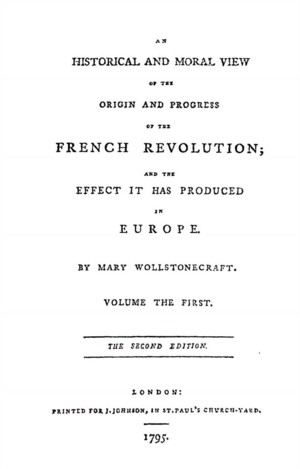
CHAPTER III. - Mary Wollstonecraft, An Historical and Moral View of the Origin and Progress of the French Revolution and the Effect it Has Produced in Europe [1795]Edition used:An Historical and Moral View of the Origin and Progress of the French Revolution and the Effect it Has Produced in Europe (London: J. Johnson, 1795).
About Liberty Fund:Liberty Fund, Inc. is a private, educational foundation established to encourage the study of the ideal of a society of free and responsible individuals. Copyright information:The text is in the public domain. Fair use statement:This material is put online to further the educational goals of Liberty Fund, Inc. Unless otherwise stated in the Copyright Information section above, this material may be used freely for educational and academic purposes. It may not be used in any way for profit.
CHAPTER III.reflections on the new mode of raising supplies. no just system of taxation yet established. paper money. necessity of gradual reform. THE task certainly was very difficult, at this crisis, for a minister to give satisfaction to the people, and yet supply the wants of the state; for it was not very likely that the public, who had been exclaiming against the incessant demands of the old government, would have been pleased with new burdens, or patiently endured them. Still it is always the height of folly in a financier, to attempt to supply the exigencies of government by any but specific and certain means: for such vague measures will ever produce a deficit, the consequences of which are most pernicious to public credit and private comfort. A man, who has a precise sum to live upon, generally takes into his estimate of expences a certain part of his income as due to the government, for the protection and social advantages it secures him. This proportion of his income being commonly the same from period to period, he lays it by for that particular purpose, and contentedly enjoys the remainder. But, should a weak minister, or a capricious government, call on him for an additional sum, because the taxes have proved unproductive, either through the inability of some of the members of the state, or that they were laid on articles of consumption, and the consumption has not been equal to the calculation; it not only deranges his schemes of domestic economy, but may be the cause of the most serious inconvenience. A man who has a limited income, and a large family, is not only obliged to be very industrious to support them, but he is likewise necessitated to make all his arrangements with the greatest circumspection and exactness; because a trifling loss, by involving him in debt, might lead to his ruin, including that of his family. The rich man, indeed, seldom thinks of these most cruel misfortunes; for a few pounds, more or less, are of no real importance to him. Yet the poor man, nay even the man of moderate fortune, is liable to have his whole scheme of life broken by a circumstance of this kind, and all his future days embittered by a perpetual struggle with pecuniary vexations. Governments, which ought to protect, and not oppress mankind, cannot be too regular in their demands; for the manner of levying taxes is of the highest importance to political economy, and the happiness of individuals. No government has yet established a just system of taxation* : for in every country the expences of government have fallen unequally on the citizens; and, perhaps, it is not possible to render them perfectly equal, but by laying all the taxes on land, the mother of every production. In this posture of affairs, the enthusiasm of the french in the cause of liberty might have been turned to the advantage of a new and permanent system of finance. An able, bold minister, who possessed the confidence of the nation, might have recommended with success the taking of the national property under the direct management of the assembly; and then endeavouring to raise a loan on that property, he would have given respectability to the new government, by immediately procuring the supplies indispensably necessary not only to keep it, but to put it in motion. In times of civil commotion, or during a general convulsion, men who have money, and they are commonly most timid and cautious, are very apt to take care of it, even at the expence of their interest; and, therefore, it was to be presumed, that the monied men of France would not have been very ready to subscribe to the different loans proposed by the minister, unless the security had been obvious, or the speculative advantages exorbitant. But if Necker, whom the prudent usurer adored as his tutelar god, had said to the nation ‘there is a property worth 4,700,000,000 l. independent of the property of the emigrants, take it into your immediate possession; and, whilst the sales are going on, give it as a guarantee for the loan you want. This just and dignisied measure will not only relieve your present necessities, but it will be sufficient to enable you to fulfil great part of your former engagements.’ There would have been then no need of the eloquence of Mirabeau; reason would have done the business; and men, attending to their own interest, would have promoted the public good, without having their heads turned giddy by romantic flights of heroism. The immediate and incessant wants of a state must always be supplied; prudence therefore, requires, that the directors of the finances should rather provide by anticipation for it’s wants than suffer a deficit. The government being once in arrears, additional taxes become indispensable to bring forward the balance, or the nation must have recourse to paper notes; an expedient, as experience has shown, always to be dreaded, because by increasing the debt it only extends the evil. And this increasing debt, like a ball of snow, gathering as it rolls, soon attains a wonderful magnitude. Every state, which has unavoidably accumulated it’s debt, ought, provided those at the helm wish to preserve the government, and extend the security and comforts of it’s citizens, to take every just measure to render the interest secure, and to fund the principal; for as it augments, like the petrifying mass, it stands in the way of all improvement, spreading the chilling miseries of poverty around—till the evil baffling all expedients, a mighty crash produces a new order of things, overwhelming, with the ruins of the old, thousands of innocent victims. The precious metals have been considered as the best of all possible signs of value, to facilitate the exchange of commodities, to supply our reciprocal wants: and they will ever be necessary to our comfort, whilst by the common consent of mankind they are the standards of exchange. Gold and silver have a specific value, because it is not easy to accumulate them beyond a certain quantity. Paper, on the contrary, is a dangerous expedient, except under a well established government: and even then the business ought to be conducted with great moderation and sagacity.—Perhaps it would be wise, that it’s extent should be consistent with the commerce of the country, and the quantity of species actually in it—But it is the spirit of commerce to stretch credit too far. The notes, also, which are issued by a state before it’s government is well established, will certainly be depreciated; and in proportion as they grow precarious, the gold and silver, which was formerly in circulation will vanish, and every article of trade, and all the comforts of life, will bear a higher price. These are considerations, which ought to have occurred to the french minister, and have led him to take decided measures. The interest of the national debt was 255,395,141 l. by a report for the year 1792.—Necker, by his account dated the 1st of may, 1789, states the income at 475,294,000 l., and the expences at 531,533,000 l.: consequently there was a deficiency of 56,239,000 l.; and it was not probable, it could not even be expected, that during the convulsions of a revolution, the taxes would be regularly paid: the debt, then, and the demands of the state, must increase. The credit of every government greatly depends on the regulation of it’s finances; and the most certain way to have given stability to the new system, would have been by making such arrangements as would have insured promptitude of payment. No minister ever had it so much in his power to have taken measures glorious for France, beneficial to Europe, happy for the people of the day, and advantageous to posterity. No epocha, since the inflated system of paper (the full blown bladders of public credit, which may be destroyed by the prick of a pin) was invented, ever appeared so favourable as that juncture in France, to have overturned it completely: and by overlooking these circumstances, the nation has probably lost most of the advantages, which her finances might have gained by the revolution. Such mistakes, whilst they involve in them a thousand difficulties, prove the necessity of gradual reform; lest the light, suddenly breaking-in on a benighted people, should overpower the understanding it ought to direct. The line in which Necker had been accustomed to move, by restraining what little energy his mind was capable of exerting, precluded the possibility of his seeing the faint lines marked on an expansive scale, which afforded the data for calculations; and the nation, confiding to him the direction of a business for which he had not sufficient talents, seems to have contemplated in imagination a prospect, which has not yet been realized; and whilst expectation hovered on it’s margin, the dazzling scenery was obscured by clouds the most threatening and tremendous. These are evils that from the beginning of time have attended precipitate and great changes. The improvements in philosophy and morals have been extremely tardy. All sudden revolutions have been as suddenly overturned, and things thrown back below their former state. The improvements in the science of politics have been still more slow in their advancement than those of philosophy and morals; but the revolution in France has been progressive. It was a revolution in the minds of men; and only demanded a new system of government to be adapted to that change. This was not generally perceived; and the politicians of the day ran wildly from one extreme to the other, without recollecting, that even Moses sojourning forty years in the wilderness could but conduct the jews to the borders of the promised land, after the first generation had perished in their prejudices; the most inveterate sins of men. This is not a discouraging consideration. Our ancestors have laboured for us; and we, in our turn, must labour for posterity. It is by tracing the mistakes, and profiting from the discoveries of one generation, that the next is able to take a more elevated stand. The first inventor of any instrument has scarcely ever been able to bring it to a tolerable degree of perfection; and the discoveries of every man of genius, the optics of Newton excepted, have been improved, if not extended, by their followers.—Can it then be expected, that the science of politics and finance, the most important, and most difficult of all human improvements; a science which involves the passions, tempers, and manners of men and nations, estimates their wants, maladies, comforts, happiness, and misery, and computes the sum of good or evil flowing from social institutions; will not require the same gradations, and advance by steps equally slow to that state of perfection necessary to secure the sacred rights of every human creature? The vanity and weakness of men have continually tended to retard this progress of things: still it is going forward; and though the fatal presumption of the headstrong french, and the more destructive ambition of their foreign enemies, have given it a check, we may contemplate with complacent serenity the approximation of the glorious era, when the appellations of fool and tyrant will be synonymous. BOOK V.[* ]In Holland almost all the taxes are collected in the shape of excise. |

Titles (by Subject)