Econlib

The Library

Other Sites

Front Page arrow Titles (by Subject) arrow CHAPTER I. - An Historical and Moral View of the Origin and Progress of the French Revolution and the Effect it Has Produced in Europe

Return to Title Page for An Historical and Moral View of the Origin and Progress of the French Revolution and the Effect it Has Produced in Europe

Search this Title:

Also in the Library:

Subject Area: History
Topic: The French Revolution
Debate: The Debate about the French Revolution

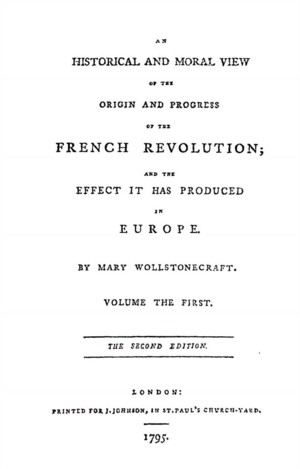
CHAPTER I. - Mary Wollstonecraft, An Historical and Moral View of the Origin and Progress of the French Revolution and the Effect it Has Produced in Europe [1795]

Edition used:

An Historical and Moral View of the Origin and Progress of the French Revolution and the Effect it Has Produced in Europe (London: J. Johnson, 1795).

About Liberty Fund:

Liberty Fund, Inc. is a private, educational foundation established to encourage the study of the ideal of a society of free and responsible individuals.


CHAPTER I.

opinions on the transactions of the fourth of august. disorders occasioned by those transactions. necker demands the assembly’s sanction to a loan. a loan decreed. tithes abolished. debate on the declaration of rights. the formation of a constitution. debate on the executive power. the suspensive vlto adopted. pretended and real views of the combination of despots against france. debate on the constitution of a senate. means of peaceably effecting a reform should make a part of every constitution.

The numerous offerings made to their country by the deputies, on the 4th of august, excited loud applause; but not without a mixture of sarcastic censure, and murmurs of disapprobation.

Some blamed the decrees, which, said they, have sacrificed the property of several thousand families to the vain desire of popularity.—Others complained of the neglect of those forms, by which every assembly, that aspires at putting some maturity into it’s decrees, ought to direct it’s debates;—they disapproved of an afternoon sitting;—of the rapid succession of subjects, not allowing time for any to be weighed;—of the multiplicity of them;—and of the continual acclamations, which rendered a calm discussion physically impossible.—‘What!’ they continued, ‘shall the most important business always be treated with the levity, which characterized us before we deserved to be termed a nation? Eternally the sport of our vivacity, a happy turn decides with us the most serious point; and gay fallies are ever our substitutes for arguments.—We do madly the wisest things; and even our reason is always connected by some filament or other to inconsistency.—The national assembly had been a long time reproached for dwelling on trifling objects; and not attending sufficiently to the promotion of general good.—When suddenly—in a single night, more than twenty important laws are decided by an uproar. So much done, in such a short time, is so astonishing, that it appears like a dream.’

In reply it was said—‘Why deliberate, when all are agreed?—Does not a general good always appear self-evident?—Was it not sufficient to declare these patriotic propositions to prove their justness?—The first person, who pointed out a new tribute to the public interest, only gave utterance to what we all before felt—there was no need then of discussion or eloquence, to make that be adopted, which had already been resolved by the greater number of the deputies, and commanded by the awful authority of the nation, in their mandates.—The assembly might have proceeded more methodically; but the result could not have been more advantageous. It seemed as if all the old effects, all the mouldering titles of feudal oppressions were then put up to auction; and the kind of mistrust of the different orders, which provoked reciprocal concessions, was still for the public good.’

The nobles and clergy of the provinces, who had not been carried away by the enthusiasm of the 4th of august, felt themselves particularly aggrieved. Those who were recently noble did not like to mix again on equal terms in towns where they had received the homage paid to princes; and the people, eager to exercise their liberty, began to hunt down the game, regardless of the mischief they did to the standing corn. The very concessions of the nobility seemed to rouse the vengeance it ought to have allayed; and the populace vented their rage by burning the castles, which had been, as it were, legally dismantled of their feudal fortifications.

The clergy, in particular, complained, that their deputies had exceeded all bounds in voting away the private property of the body; for they would not allow, that tithes came within the description of feudal tenures. The want of provision, likewise, tended to make the people clamour about present grievances, without suffering the prospect of future comfort and respectability to have it’s due force towards calming their minds. All, therefore, flew to arms, and three millions of men wearing the military garb, showed the natural disposition of the nation; and their present resolve, no longer to couch supinely under oppression. Many excesses were the consequence of this sudden change; and it is notorious, that the people, in some instances, became the instruments of the routed party; who continued to use every stratagem to render the nation dissatisfied with the revolution.

It is the nature of man, either in a savage state or living in society, to protect his property; and it is wise in a government to encourage this spirit. For the example now displayed by France is a notable proof of the inexpediency of standing armies, so long as the people have an interest in supporting the political system under which they live. The national assembly, aware of this, invited the militia and the municipalities, to endeavour to quell the disorders which did violence to persons and property; and they were particularly requested to take the most watchful care, that the convoys of wheat and flour were not stopped by the idle and lawless. For several of the most fatal tumults had originated from this cause.

The decrees of the 4th of august, were then brought forward to be examined and explained; and some attempts were made to argue away the essence of many of the vaunted sacrifices.—But the discussion was interrupted, to attend to business of a more pressing nature. The present state of the nation was most alarming; and the ministers, not knowing how to act under the new trammels of responsibility, came to represent to the assembly;—that the laws were without force;—the courts of justice without activity;—and they requested them, immediately to point out the coercive measures necessary to give to the executive authority the influence it had lost.—‘For,’ observed they, ‘whether the irritated sense of the abuses, which the king wishes to reform, and you desire to proscribe for ever, have led the people astray; or, the declaration of an universal regeneration have shaken the various powers upon which the social order reposed—or whatever, in fact, be the cause, gentlemen, the truth is, that public order and tranquillity are disturbed in almost every part of the kingdom.’

Necker, afterwards, having explained the deplorable state of the finances, the extraordinary expences, and the diminution in the produce of the revenue, demanded, in the name of the king, that the assembly would sanction a loan of thirty millions of livres, to fulfil the engagements, and discharge the inevitable expenditure of the two approaching months; by which time, he presumed, the constitution would be nearly established. Thinking also, that the patriotism of moneylenders was not to be reckoned upon, he proposed to add to the five per cent. he mentioned some allurements of speculation, to quicken the determination of the lenders—and he further inferred, that private interest would then tend to quiet the kingdom, whilst they were advancing in the formation of the constitution, which was to secure it’s future tranquillity, and provide a permanent revenue.

This proposal produced the most warm and loud applause.—One member proposed, that the loan should instantly be voted in the presence of the minister, as a mark of their entire satisfaction — another offered six hundred thousand livres as a security, that he would raise the loan in his own province. This effervescence, so contagious, which is after all only physical sensibility, excited by a commotion of the animal spirits, proves, that a considerable length of time is necessary to accustom men to exercise their rights with deliberation; that they may be able to defend themselves from a kind of instinctive confidence in men; and to make them substitute respect for principles, to a blind faith in persons, even of the most distinguished abilities.—But to elevate a numerous assembly to this calm grandeur; to that permanent dignity, which represses the emotions of the moment, demands, it is probable, a more advanced state of reason.

Lally Tolendal supported the necessity of adopting the measures proposed for the obtaining a loan to supply the exigencies of government, which were become very urgent; and he refuted the objection, made by several deputies, who were against the grant, that in their instructions they had been strictly enjoined not to sanction any tax or loan before the constitution was formed. On this side Mirabeau ranged himself; for with all his great talents and superiority of genius, he could not avoid envying inferiour abilities, when they attracted the least popularity. He therefore, with plausible rhetoric, but shallow arguments, opposed the loan; and with great parade moved, that the deputies should offer their individual credit, instead of departing from the very letter of their instructions. This was one of those instances of pretended disinterestedness, or false patriotism, calculated to dazzle the people, whilst it involved the nation in fresh embarrassments.

The plan was referred to the consideration of the committee, appointed to make financial reports: and they accordingly acknowledged the necessity of a prompt supply; but thought, that the loan might now be obtained without the additional advantages, which Necker mentioned as a necessary bait. The discussion was then renewed with great heat, and even personality; till at last the interest of the loan was sixed at four and an half per cent.; and to slip through the knot they were afraid to cut, it was to be sanctioned under the wing of the decrees of the 4th of august.

It did not, however, prove productive; for in the course of three weeks, only two millions, six hundred thousand livres were subscribed. And this delay of business induced the assembly to adopt, with less scruple, another proposal for a fresh loan, instead of the one that did not promise to answer, at a rate less advantageous to the nation: or rather they yielded to the necessity, into which they had plunged themselves; and left the mode of obtaining it to the executive power, in spite of their former objection. But it was not an easy task to inspire the bankers and money-holders with sufficient faith in the new government, to induce them to come forward to support it; besides, the previous discussion had converted caution into timidity; and the more desperate the state of the finances appeared, the stronger grew the suspicion, that threw insurmountable obstacles in the way of a temporary relief.

Settling the precise terms of the decrees, which were to abolish feudal vassalage, the question respecting the including of tithes was agitated with most earnestness; and the objections urged against the abolition were not only ingenious, but reasonable* . The abbé Sieyes spoke with great good sense, asserting, ‘that the tithes were not a tax levied on the nation; but a rent-charge, for which a proper allowance had been made to the present possessors of the estates, to not one of whom they actually belonged. He, therefore, insisted, that, if the sacrifice were necessary, it ought to be made to the public, to relieve the people, and not to enrich the proprietors; who were, generally speaking, of the most opulent part of the community.’ He advised the assembly to be on their guard, lest avarice, under the mask of zeal, should deceive them, leading the nation to reward rather than indemnify the nobility. The fact was, that the landed interest were only resigning obsolete privileges, which they scarcely dared exercise, to secure a solid advantage. Society has hitherto been constructed in such a vicious manner, that to relieve the poor you must benefit the rich. The present subject was a delicate one; the abolition of tithes would remove a very heavy vexatious clog, that had long hung on the neck of industry; yet it were to be wished, that it could have been settled in such a way as not to have secured a great pecuniary advantage to the nobility. For though it was physically impossible, to make this sacrifice to society at large immediately; because the proprictors, and more particularly the lease-holders of the estates, could not have redeemed the tithes, without distressing themselves to a degree, that would nearly have stopped the course of husbandry; not to mention agricultural improvements, so necessary in France, and to be looked for as the fruit of liberty:—yet a gradual tax on the original landlord would have prevented the nobility from being the great gainers by their so much extolled disinterestedness, in their fallacious sacrifice of privileges. Because, for all real property they were to be reimbursed; and for the obnoxious feudal tenures, such as personal servitude, with others they were ashamed to enumerate as being due from man to man, the tithes were an ample indemnity; or more properly speaking clear profit, except to those who parted with the plumes which raised them above their fellows with great regret. It was, indeed, very difficult to separate the evil from the good, that would redound to the nation by the doing away of this tax.—The clergy, however, cut the debate short, by resigning their right, offering to trust to the justice of the public for the stipend in return necessary to enable them to support the dignity of their function.

On the 13th, therefore, the whole discussion closed; for the other articles did not admit of much disputation. The president accordingly waited on the king, who received his new title with the decrees, to which he afterwards made some objections, though the assembly considered them as virtually sanctioned* .

A committee of five had been employed to digest a declaration of rights, to precede the constitution. The opinion of those, who thought that this declaration ought to have been kept back, has already been alluded to; yet the subject seems to require a little further consideration. And, perhaps, it will appear just to separate the character of the philosopher, who dedicates his exertions to promote the welfare, and perfection of mankind, carrying his views byond any time he chooses to mark; from that of the politician, whose duty it is to attend to the improvement and interest of the time in which he lives, and not sacrifice any present comfort to a prospect of future perfection or happiness. If this definition be just, the philosopher naturally becomes a passive, the politician an active character. For though the desire of loudly proclaiming the grand principles of liberty to extend them quickly, be one of the most powerful a benevolent man, of every description of mind, feels; he no sooner wishes to obey this impulse, than he finds himself placed between two rocks.—Truth commands him to say all; wisdom whispers to him to temporize.—A love of justice would lead him to bound over these cautious restraints of prudence; did not humanity, enlightened by a knowledge of human nature, make him dread to purchase the good of posterity too dearly, by the misery of the present generation.

The debates respecting the adoption of the declaration of rights became very spirited; and much heterogeneous matter was introduced, to lengthen the discussion, and heat the disputants, as the different articles were reviewed. The article respecting religion particularly arrested the attention of the assembly, and produced one of those tumultuous scenes, which have so often disgraced their deliberations. The intolerant sentiments uttered; and even the insertion of some amendments, which could not, without a contradiction in terms, find a place in a declaration of rights; proved, that the assembly contained a majority, who were still governed by prejudices inimical to the full extent of that liberty, which is the unalienable right of each citizen, when it does not infringe on the equal enjoyment of the same portion by his neighbour* . The most sensible part of the assembly asserted, that religion ought not to be mentioned, unless to declare, that the free exercise of it was a right in common with the free utterance of all opinions; which came under civil cognizance only when they assumed a form, namely, when they produced effects, that clashed with the laws; and even then it was the criminal action, not the passive opinion, which was proscribed by the penalty of punishment.

In this declaration are found the principles of political and civil liberty, introduced by a very solemn exordium:—Declaring ‘that, as ignorance, forgetfulness, and contempt of the rights of men, are the sole causes of public grievances, and of the corruption of governments, the assembly had resolved to re-establish, in a solemn declaration, the natural, imprescriptible, and sacred rights of man; in order that this declaration, constantly present to all the members of the social body, may continually remind them of their rights, and of their duties; that, having it in their power every moment to compare the acts of the legislative and executive authorities with the purpose of all political institutions, they may the more respect them; and that the remonstrances of the citizens, founded, in future, on simple and incontestible principles, may always tend to support the constitution, and to promote the happiness of the whole community.’

Some temporary business, towards restoring public tranquillity, and to give force to the laws, insulted by the licentious conduct of men inebriated merely by the expectation of freedom, scented from a-far, being dispatched, the formation of a constitution became the standing labour of the assembly.

The first question naturally fell under this head—what share of power ought the king to be allowed to possess in the legislature? This was an important consideration for men, who were all politicians in theory; and many of whom, having suffered under the absolute sway of the king’s ministers, still felt the smart of their oppression, and a contempt for the power that authorized their dominion: whilst the blind zealots for the indefeasible rights of kings, though they were ashamed of the phrase, heated the imagination of their party, by the most inflated encomiums on the benefits arising from extensive kingly prerogatives, and vapid remarks on the british constitution, and other forms of government, obviously to display their erudition. The most noisy indecorus debates ensued, and the assembly seemed to meet rather to quarrel than deliberate. A division the most decided consequently took place; which, under different appellations, and professing different principles, has ever since continued to convulse the senate; if the legislative assembly, or the convention, deserve a name so dignified.

In discussing whether the royal sanction should be necessary to the validity of the acts of the legislative body, a variety of extraneous subjects, and others prematurely brought forward, so entangled the main question, as to render it difficult to give a clear and brief account of the debates; without lending a degree of reasonableness to them, that the manner of arguing, rudely personal, and loudly uncivil, seemed to destroy. For good lungs soon became more necessary in the assembly than sound arguments, to enable a speaker to silence the confusion of tongues; and make known his opinion to men, who were eager only to announce their own. Thus modest men had no chance to be heard, though persuasion dwelt on their lips: and even Mirabeau, with his commanding eloquence, and justness of thought, procured attention as much by the thundering emphasis, which he gave to his periods, as by his striking and forcible association of ideas.

As a nation, the french are certainly the most eloquent people in the world; their lively feelings giving the warmth of passion to every argument they attempt to support. And speaking fluently, vanity leads them continually to endeavour to utter their sentiments, without considering whether they have any thing to recommend them to notice, beside a happy choice of expressions. Only thinking then of speaking, they are the most impatient of hearers, coughing, hemming, and scraping with their feet, most audibly, to beguile the time. Laying aside also, in the assembly, not only their national politeness, but the common restraints of civility; good manners seldom supply the place of reason, when they are angry. And as the slightest contradiction sets them on sire, three parts out of four of the time, which ought to have been employed in serious investigation, was consumed in idle vehemence. Whilst the applauses and hisses of the galleries increased the tumult; making the vain still more eager to mount the stage. Thus every thing contributing to excite the emotions, which lead men only to court admiration, the good of the people was too often sacrificed to the desire of pleasing them. And so completely was the tide of their affection for the king turned, that they seemed averse to his having any portion of legislative authority in the new constitution.

The duke de Liancourt divided the question respecting the share of power he was to enjoy as a part of the government. 1st. Is the royal sanction indispensably necessary, to give the actual force of law to the decrees of the national assembly? 2dly. Ought the king to bean integrant portion of the legislature? In England the phrase royal assent has been adopted, as expressive of a positive act; but the french, rather choosing to distinguish the same act of power by a negative, fixed on the latin word veto, I forbid. And then it became a question, how far this veto ought to extend, supposing the prince to be invested with it.—Was it decisively to obstruct the enaction of a law passed by the legislative body? or only to suspend it, till an appeal could be made to the people by a new election?

The assembly in this instance seem to have acted with strange confusion of mind, or a total ignorance of the nature of a mixed government: for either the question was nugatory, or a king useless. Lally-Tolendal, Mounier, and Mirabeau, argued for the absolute veto.—‘Two powers,’ says Mirabeau, ‘are necessary to the existence of the body-politic, in the orderly discharge of it’s functions:—To will—and to act. By the first, society establishes the regulations which ought all to conspire to one end—the good of all:—By the second, these regulations are carried into execution; and public authority is exerted, to make society triumph over the obstacles, which might arise from the opposite wills of individuals. In a great nation, these two powers cannot be exercised by the people: whence comes the necessity of representatives, to exercise the faculty of willing, or the legislative power; and also of another species of representation, to exercise the faculty of acting; or, the executive power.’

He further insists, that ‘the possession of this power is the only way to render a king useful, and to enable him to act as a check on the legislative body: the majority of which might tyrannize in the most despotic manner, even in the senate, to the very expulsion of the members, who dared to thwart the measures they could not approve. For under a weak prince, a little time and address alone would be necessary, to establish legally the dominion of an army of aristocrats; who, making the royal authority only the passive instrument of their will, might replunge the people into their old state of debasement.

‘The prince, therefore, being the perpetual representative of the people, as the deputies are their representatives elected at certain periods, is equally their safe-guard.

‘No person exclaims against the veto of the national assembly; which is, in reality, only a right the people have confided in their representatives, to oppose every proposition, that would tend to re-establish ministerial despotism. Why then object to the veto of the prince, which is but another right, especially confided in him by the people, because he and they are equally interested to prevent the establishment of an aristocracy?’

He proceeds to prove, ‘that, whilst the legislative body is respectable, the veto of the king cannot do harm, though it is a salutary check on their deliberations; and granting, that the influence of the crown has a tendency to increase, a permanent assembly would be a sufficient counterpoise for the royal negative. Let us,’ he concludes, ‘have an annual national assembly, let ministers be made responsible; and the royal sanction, without any specified restrictions, but, in fact, perfectly limited, will be the palladium of national liberty, and the most precious exercise of the liberty of the people.’

Having suffered by the abuse of absolute power, many of the deputies, afraid to entrust their constitutional monarchs with any, opposed the veto; lest it should palsy the operations of the national assembly, and bring back the old despotism of the cabinet. The discussion likewise extending beyond it’s walls, was as superficially and as warmly treated by those, who thought only of the old government, when they talked of framing a new one. And as the people were now led by hot-headed men, who found it the shortest way to popularity, to deliver exaggerated elogiums on liberty, they began to look for a degree of freedom in their government, incompatible with the present state of their manners; and of which they had no perfect idea. It is not then surprising, that it should become a mark of patriotism, to oppose the veto; though Mirabeau never gave a stronger proof of his, than in supporting it; convinced that it was the interest of the people he was espousing, whilst he risked their favour.

The will of the public was, in reality, so decided, that they would scarcely allow the veto to be mentioned; and the assembly, to steer a middle course, adopted the suspensive veto; after considering some other important elements of the constitution, which seemed to them to be intimately connected with the royal prerogative.

Certainly a few of the most judicious deputies must have perceived the impolicy of the suspensive veto; and they could only have agreed to fall into the measure, under an idea that the minds of the people not being completely ripe for a total change of government—from absolute despotism to complete republicanism, it was politically necessary still to maintain the shadow of monarchy. ‘To assign,’ says one of the deputies, ‘a term to the veto, is at last to force the king to execute a law of which he disapproves: and making him thus a blind and passive instrument, a secret war is fomented between him and the national assembly. It is, in short, to refuse him the veto; though those who refuse it have not the courage openly to say, that France has no longer any need of a king.’

But, from the commencement of the revolution, the misery of France has originated from the folly or art of men, who have spurred the people on too fast; tearing up prejudices by the root, which they should have permitted to die gradually away. Had they, for example, allowed the king to have enjoyed the share in the government promised by the absolute veto, they would have let him gently down from the altitude of unlimited sway, without making him feel the ground he lost in the descent. And this semblance of his former authority would have gratified him; or rather, breaking his fall, have induced him to submit patiently to other restraints, less humiliating to him, though more beneficial to the people. For it is evident from experience, and might have been foreseen, that the determination on this question was one grand source of the continual bickerings of the assembly with the court and ministry; who took care to make the king see, that he was set up as an idol, merely to receive the mock respect of the legislative body, till they were quite sure of the people.

Could it, indeed, have been ascertained, that Louis, or rather the queen, would have tamely born with such a diminution of power, this measure might have been deemed prudent; because it was then morally certain, that the monarchy would have expired naturally with the dissolution of the king. But, when the pride and restless spirit of the queen were well known; and that it was probable, from the whole tenour of her former life, she would contrive to have the ministry composed of the most dissolute and headstrong men; it must appear the height of folly only to have lest the king the power of perplexing their proceedings, after they had piqued his pride. And when, to give, as it were, efficiency to the conspiracies, which would naturally be formed by the courtiers, to recover the authority rest from them, we find they afterwards voted such an enormous sum to defray the civil list, as was sufficient to move like puppets hundreds of the corrupt french; it must be confessed, that their absurdity and want of discernment appear not less reprehensible, than the subsequent conduct of the court flagitious.

The constitutional committee had given it as their opinion, that the contested veto did not concern the national assembly then existing; which, being a constituting body, it was their duty to see that the constitution was accepted, not sanctioned. This report carries with it an air of imbecility, which renders it almost incredible: for, if the assembly were determined to oblige the king to accept their decrees, they had better have told him so with becoming dignity, and made provision for his retiring from a post in which he was useless. Instead of this, he was in a manner shuffled off the throne; and treated with cruelty as well as contempt. It would have been at least ingenuous, and might be deemed magnanimous, had they allowed him to retire with a third of the stipend, which they afterwards voted him, when he continued to appear like a theatrical king, only to excite the pity of the vulgar, and to serve as a pretext for the despots of Europe to urge in justification of their interference. The liberating an imprisoned monarch was a plausible motive, though the real one was obviously to stop the progress of principles, which, once permitted to extend themselves, would ultimately sap the foundation of their tyranny, and overturn all the courts in Europe. Pretending then only to have in view the restoration of order in France, and to free an injured king, they aimed at crushing the infant brood of liberty.

Similar sentiments must have occurred to every thinking person, who ever seriously reflected on the conduct of the germanic courts, which has actually destroyed the tranquillity of Europe for centuries past. War is the natural consequence of their wretched systems of government.—They are supported by military legions; and without wars they could not have veteran soldiers. Their aggrandisement then, and half-lived pleasures, cast in a mould of ceremony, spring out of the miseries, and are fostered by the blood of human beings; whom they have sacrificed with as much sang froid, sending them in herds to slaughter, as the hard-hearted savage romans viewed the horrid spectacle of their prize-fighters; from the bare idea of which the mind turns, disgusted with the whole empire, and particularly with the government that dared to boast of it’s heroism and respect for justice, when not only tolerating, but encouraging such enormities.

To the sympathizing princes of the continent, therefore, the king should have been given up: or, if it were necessary to humour the prejudice of the nation, and still suffer frenchmen to have a most christian king, or grand monarque, to amuse them by devouring capons or partridges before them; it would have been but just, both in reason and policy, to have allowed him such a portion of liberty and power, as would have formed a consistent government. This would have prevented those clamours, which were sure to draw together an host of enemies, to impede the settlement of rational laws; flowing from a constitution, that would peaceably have undermined despotism, had it been allowed gradually to change the manners of the people. Though had this power been granted, it might have been productive perhaps of great inconveniences; as it is not likely, that a court accustomed to exercise unbridled sway would contentedly have co-operated with the legislature, when possessing only reasonable prerogatives.

Some apprehensions of this kind may have occurred to the assembly: though it rather appears, that they were either influenced by a ridiculous pride, not being willing to take the british constitution, so far as it respected the prerogative, for their model; or intimidated by the people, who, during the long debate, had outrageously expressed their will, and even handed about a list of proscriptions, in which the vetoists were denounced as traitors worthy of death. Be this as it may, they determined on a half-way measure, that irritated the court without appeasing the people. Having previously decreed, that the national assembly should be permanent, that is always existing, instead of being dissolved at the close of every session, they resolved, that the veto of the king should suspend the enaction of a law only during two legislatures. ‘The wisdom of this law,’ says Rabaud, ‘was universally acknowledged:’ though the folly of it rather merited universal reprobation.

From the manner indeed, in which the assembly was constituted, it was to be dreaded, that it’s members would not long sustain the dignity, with which they commenced the career of their business: because the party, that opposed with such bitterness the junction of the three orders, still opposing with rancorous heat, and wily stratagems, every measure proposed by the really patriotic members, were indirectly seconded by the insincere and wavering; who, having no motive to govern their conduct, but the most detestable selfishness, the offspring of vanity or avarice, always took the side best calculated to gratify the crude wishes of the multitude. And this unyoked multitude, now suddenly initiated into the science of civil and natural rights, all become consummate politicians, began to control the decisions of a divided assembly, rendered timid by intestine broils.

There were besides many circumstances, which tended to make any attempt to counteract this influence very difficult. At the meeting of the states-general, the whole court-party, with the greater proportion of both the nobility and clergy, were in opposition to the third estate: and though the number of the latter was equal to that of the other two orders, they had also to contend with the inveterate prejudices of ages. The court had thought only of devising means to crush them; and had the soldiery acted with the blind zeal common to men of this profession, it would of itself have been sufficient to have completely disconcerted their views. This conduct of the cabinet, and the discovery of the atrocious conspiracy, which had been formed against the people and their idolized representatives, provoking the resentment and vengeance of the nation, palsied all authority, and rendered the laws that had emanated from it contemptible. To oppose this torrent of opinions, like an impetuous current, that after heavy rains, defying all resistance, bears away on it’s raging bosom every obstacle, required the most enlightened prudence and determined resolution.

So much wisdom and firmness seldom fall to the lot of any country: and it could scarcely have been expected from the depraved and volatile french; who proudly, or ignorantly, determining to follow no political track, seem to have fixed on a system proper only for a people in the highest stage of civilization:—a system of itself calculated to disorganize the government, and throw embarrassments into all it’s operations. This was an errour so gross, as to demand the severest animadversions. For this political plan, ever considered as utopian by all men who had not traced the progress of reason, or calculated the degree of perfectibility the human faculties are capable of attaining, was, it might be presumed, the most improper for the degenerate society of France. The exertions of the very admirers of the revolution were, likewise, far from being permanent; and they could hardly have been expected to possess sufficient virtue to support a government, the duration of which they at least feared would be short. The men termed experienced believed it physically impossible; and no arguments were cogent enough to convince them of the contrary: so that, they leaving the task to mock patriots and enthusiasts, a fresh odium has been thrown on principles, which, notwithstanding are gaining ground. Things must be left to their natural course; and the accelerating progress of truth promises to demonstrate, what no arguments have hitherto been able to prove.

The foundation of liberty was laid in the declaration of rights; the first three articles of which contain the great principles of natural, political, and civil liberty.—First, that men are born, and always continue, free, and equal in respect to their rights:—civil distinctions, therefore, can be founded only on public utility. Secondly, the end of all political associations is the preservation of the natural and imprescriptible rights of man: which rights are—liberty, property, security, and resistance of oppression. Thirdly, the nation is the source of all sovereignty: no body of men, no individual, can then be entitled to any authority, which is not derived from it. The first article, establishing the equality of man, strikes at the root of all useless distinctions:—the second, securing his rights against oppression, maintains his dignity:—and the third, acknowledging the sovereignty of the nation, confirms the authority of the people.—These are the essential points of a good government: and it is only necessary, when these points are ascertained by a nation, and solemnly ratified in the hearts of it’s citizens, to take care, in the formation of a political system, to provide against the abuse of the executive part; whilst equal caution should be observed, not to destroy it’s efficiency, as on that depend it’s justice, vigour, and promptitude. The other articles are explanatory of the nature and intent of these rights, and ought to have had more attention paid to them, when the structure was raised, to which they served as a basis.

Whilst defining the authority of the king, or rather determining, that he should have no authority, unless the option of disturbing the legislation deserve that name, they debated the question of two chambers with equal inconsideration, and all the puerile self-sufficiency of ignorance. The opposers of two chambers, without allowing, that there was any political wisdom in appointing one house of representatives to reconsider the resolves of the other, ridiculed the idea of a balance of power, and instanced the abuses of the english government to give force to their objections. At the same time fearing, that the nobles of the court would contend for an hereditary senate, similar to the british house of peers; or, at least, for a seat during life, paramount to the representatives who they determined should be elected every two years; they sought to bring the business to a speedy issue. The very division of the nobility served to hasten it, and strengthened the arguments of the popular members; who finding that they could rely on the concurrence of the parish priests, whose wishes in favour of the unity of the assembly were quickly betrayed by the opinions of their leading orators, demanded the decision of a question, that had been agitated in the most tumultuous manner.

Mirabeau wished to prove, that the decision of the question respecting the permanency of the assembly had prejudged that of the two chambers; and the plan of a senate, proposed by the constitutional committee, only excited fresh apprehensions, that the ancient hydra would again rear it’s head. They represented this senate as the cradle of a new aristocracy; as a dangerous counterpoize to popular violence, because it would still foster the prejudices, which produced inequalities amongst men, and give continual play to the overbearing passions, that had hitherto degraded mankind. And to show previously their entire disinterestedness, as well as fear of allowing the exercise of power to become familiar, much less necessary to any members of the community, they unanimously voted, that for each legislature, the name given to the meeting of the representatives, a total change of the deputies should take place.

The very nobility, in fact, were far from being united in support of two chambers. The order was a numerous one: and to establish an equality of privileges, it was necessary, that they should all concur to elect the upper chamber, as the representatives of the whole body; whilst the nobles of the court, and of the ancient houses, secretly indulged the hope of establishing a peerage; which would not only raise them above the commons, but keep at a proper distance the upstart nobility, with whom they had heretofore impatiently jostled. There was even another cause of jealousy: for it was presumed, that the forty-seven nobles, who first joined the assembly, would now be rewarded. In short, the idle fears and more contemptible vanity of the different parties now operated so much in favour of an indivisible senate, that the question was decided by a great majority, to the intire satisfaction of the public, who were almost as eager for one chamber, as averse to the veto.

The deputies, who opposed the upper chamber to promote the good of society, did it from a belief, that it would be the asylum of a new aristocracy; and from a total ignorance, or obscurity of ideas, respecting it’s utility. Whilst the oppressions of the feudal system being still present to the minds of the people, they considered a division of the legislative body as inconsistent with the freedom and equality they were taught to expect as the prime blessings of a new constitution. The very mention of two chambers carried them back to the old dispute, respecting the negative of the different orders; and seemed to subvert the revolution. Such fears, degenerating into weakness, can only be accounted for by recollecting the many cruel thraldoms, from which they had so recently escaped. Besides, the remembrance of their former servitude, and the resentment excited by the late struggle to prove they were men, created in their enthusiastic imaginations such a multitude of horrours, and fantastic images of new dangers, as did not allow them to exercise the full powers of their reason. So that to convince them of the propriety of a new institution, and heat the supporters of it, nothing more was necessary, than to show, that it was the very reverse of those maintained by the partizans of the old government.

The wisdom of giving to the executive part of a government an absolute veto might very justly have been questioned; as it seems to be giving a power to one man to counteract the will of a whole people—an absurdity too gross to merit refutation. Still, whilst crowns are a necessary bauble to please the multitude, it is also necessary, that their dignity should be supported, in order to prevent an overweening aristocracy from concentrating all authority in themselves. This seems to have been expedient, likewise, as long as the manners of barbarians remained: as savages are naturally pleased with glass and beads, in proportion as they afford a striking contrast to the rude materials of their own fabrication.

In the progressive influence of knowledge on manners, both dress and governments appear to be acquiring simplicity; it may therefore be inferred, that, as the people attain dignity of character, their amusements will flow from a more rational source than the pageantry of kings, or the view of the fopperies exhibited at courts. If these have been supported hitherto by childish ignorance, they seem to be losing their influence, as the understanding of the world approaches to manhood: for, as they grow wiser, the people will look for the solid advantages of society; and watching with sufficient vigilance their own interest, the veto of the executive branch of the government would become perfectly useless; though in the hands of an unprincipled, bold chief magistrate, it might prove a dangerous instrument. In forming a representative plan of government it appears necessary then to take care only, that it be so constructed, as to prevent hasty decisions; or the carrying into laws dangerous, impolitic measures, which have been urged by popular declaimers, who are too apt to gain an ascendancy in a numerous assembly. Until the principles of governments become simplified, and a knowledge of them be disseminated, it is to be feared, that popular assemblies will often be influenced by the fascinating charms of eloquence: and as it is possible for a man to be eloquent without being either wise or virtuous, it is but a common precaution of prudence in the framers of a constitution, to provide some check to the evil.

Besides, it is very probable, in the same state of reason, that a faction may arise, which will control the assembly; and, acting contrary to the dictates of wisdom, throw the state into the most dangerous convulsions of anarchy: consequently, it ought to form a primary object with a constituting assembly, to prevent, by some salutary contrivance, the mischief flowing from such sources. The obvious preventative is a second chamber, or senate, which would not, it is most likely, be under the influence of the same faction; and it is at least certain, that it’s decisions would not be directed by the same orators. The advantage would be more certain if business were not conducted in the two chambers in a similar manner. Thus by making the most numerous assembly the most active, the other would have more time to weigh the probable consequence of any act or decree, which would prevent those inconveniences; or, at least, many of them, the consequence of haste or faction.

This system in an old government is susceptible of improvement. The minds of young men generally having more fire, activity, and invention, it would be politically wise to restrict the age of the senators to thirty-five, or forty years; at which period of life they most likely would have gone through a certain routine of business; and become more sage, and steady, they would be better calculated to decide respecting the policy, or wisdom of the acts of the chamber of representatives.

It is true France was in such a state at the time of the revolution, that a like improvement could not have been instantly carried into execution, because the aristocratical influence was justly to be dreaded. The constituting assembly then should have remained indivisible; and as the members became in some measure acquainted with legislative business, they would have prepared senators for the upper chamber. All the future legislatures being divided into two chambers, a house of representatives, and a senate, the members of the national assembly might have been permitted to be elected for the senate, though they should not have attained the age prescribed; for the restriction needed not to have taken place until the government found it’s level, and even then, the members of the preceding house of representatives might have been allowed to be returned for the senate.

It has been a common remark of moralists, that we are the least acquainted with our own characters. This has been literally the case with the french: for certainly no people stand in such great need of a check; and, totally destitute of experience in political science, it must have been clear to all men of sound understanding, that some such plan alone would have enabled them to avoid many fatal errours.

The first efforts of the national assembly were truly magnanimous; but the character of the men was too light, to maintain the same heroism, when not warmed by passion—too giddy, to support with grave dignity the splendour of sudden glory. Their vanity was also unbounded; and their false estimate of disinterestedness of conduct, whilst they betrayed puerility of sentiment, was not among the least of the misfortunes, which have befallen that unhappy country. Their hearts had been too long sophisticated, to suggest the best mode of communicating freedom to millions; and their heads were still less calculated to lay down a practicable plan of government, adapted to the state of knowledge of the age. So much so, that they seem to have selected from books only the regulations proper for a period of perfect civilization.

The revolutions of states ought to be gradual; for during violent or material changes it is not so much the wisdom of measures, as the popularity they acquire by being adapted to the foibles of the great body of the community, which gives them success.—Men are most easily led away by the ingenious arguments, that dwell on the equality of man, and these are always employed by the different leaders of popular governments.

Whilst the most ingenious theorists, or desperate partizans of the people, take advantage of this infirmity of our nature, the consequences must sometimes prove destructive to society, if they do not end in the most dreadful anarchy. For when the members of a state are not directed by practical knowledge, every one produces a plan of polity, till the confusion becomes general, and the nation plunges into wretchedness, pursuing the schemes of those philosophers of genius who, advancing before their age, have sketched the model of a perfect system of government. Thus it happened in France, that Hume’s idea of a perfect commonwealth, the adoption of which would be eligible only when civilization has arrived at a much greater degree of perfection, and knowledge is more generally diffused than at the present period, was nevertheless chosen as the model of their new government, with a few exceptions, by the constituent assembly: which choice doubtless proceeded from the members not having had an opportunity to acquire a knowledge of practical liberty. Some of the members, it is true, alluded to the improvements made by the americans on the plan of the english constitution; but the great majority, despising experience, were for forming, at once, a system much more perfect. And this self-sufficiency has produced those dreadful outrages, and attacks, made by the anarchists of that country, on personal liberty, property, and whatever else society holds sacred.

These melancholy considerations seem to me to afford irrefragable arguments, to prove that it is necessary for all governments, which have for their object the happiness of the people, to make the power of altering peaceably a fundamental principle of their constitution.

Still, if the attempt to carry prematurely into execution the sublime theory, which has occupied some of the best heads to form, have afforded an opportunity to superficial politicians, to condemn it as absurd and chimerical, because it has not been attended with immediate success, the advocates for the extension of truth and reason ought not to despair. For when we contemplate the slow improvement, that has been made in the science of government; and, that even the system of the british constitution was considered, by some of the most enlightened ancients, as the sublimest theory the human mind was able to conceive, though not reducible to practice, they should not relax in their endeavours to bring to maturity a polity more simple—which promises more equal freedom, and general happiness to mankind.

[* ]‘It is worthy of remark, that the divine right of tithes was never insisted on,’ says a french writer, ‘even by the clergy, during this debate. Yet the year before, when the same question was brought forward in the irish house of parliament, great stress was laid on this gothic idea of their origin.’

[* ]It is observable, that the satisfaction of the people was by no means equal to the discontent manifested by the privileged orders.

[* ]See the article 10. ‘No man ought to be molested on account of his opinions, not even on account of his religious opinions, provided his avowal of them does not disturb the public order established by law.’