EconlibThe LibraryOther Sites |
Front Page Titles (by Subject) CHAPTER I. - An Historical and Moral View of the Origin and Progress of the French Revolution and the Effect it Has Produced in Europe
Return to Title Page for An Historical and Moral View of the Origin and Progress of the French Revolution and the Effect it Has Produced in EuropeThe Online Library of LibertyA project of Liberty Fund, Inc.Search this Title:Also in the Library:
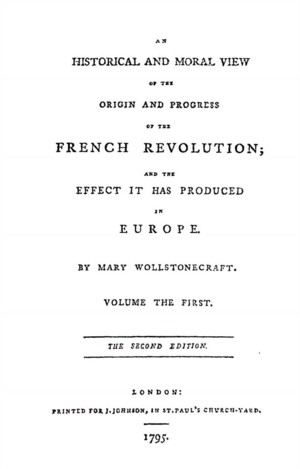
CHAPTER I. - Mary Wollstonecraft, An Historical and Moral View of the Origin and Progress of the French Revolution and the Effect it Has Produced in Europe [1795]Edition used:An Historical and Moral View of the Origin and Progress of the French Revolution and the Effect it Has Produced in Europe (London: J. Johnson, 1795).
About Liberty Fund:Liberty Fund, Inc. is a private, educational foundation established to encourage the study of the ideal of a society of free and responsible individuals. Copyright information:The text is in the public domain. Fair use statement:This material is put online to further the educational goals of Liberty Fund, Inc. Unless otherwise stated in the Copyright Information section above, this material may be used freely for educational and academic purposes. It may not be used in any way for profit.
CHAPTER I.retrospective view of grievances in france—the nobles—the military—the clergy—the farmers general. election of deputies to the states-general. arts of the courtiers. assembly of the states. riots excited at paris. opening of the states-general. the king’s speech, answer to it by the keeper of the seals, speech of mr. necker. contest respecting the mode of assembling. tacit establishment of the liberty of the press. attempt of the court to restrain it. the deputies declare themselves a national assembly. Before we enter on the grand business produced by the meeting of the states-general, it is necessary to take a retrospective glance over the oppressions of which frenchmen so loudly complained; and, whilst we trace their justness, the question will only be, why they did not sooner raise their shoulders to heave off the mighty load. To ascertain this truth, we need not enter into deep researches, though it may be difficult to collect all the parts of the feudal chain, which linked the despotism of sixty thousand nobles, who not only exercised all the tyranny that the system authorized, but countenanced the still more extensive depredations of their numerous dependents. What, indeed, could equal the slavery of the poor husbandman; not only pillaged by the tythe and game laws, but even obliged to let whole flocks of pigeons devour his grain, without daring to destroy them, because those pigeons belonged to the chateau; and afterwards forced to carry the scanty crop to be tolled at the mill of monseigneur, which, to follow a frenchman’s staff of life through all it’s stages of taxation, must then be baked at the privileged oven? It would be captious, perhaps, to dwell on some of the abominable tenures of personal servitude, which, though grown obsolete, were not abrogated; especially as more specious, if not less grinding, not less debasing exactions were in force, to deprave every moral feeling of the two divisions of society; the governing, and governed. When chased from the country, of which the chief charm is independence, by such worrying restraints, a man wished to pursue any occupation in a town, he must previously purchase a patent of some privileged person, to whom this tax had been sold by a farmer-general, or the parasite of a minister. All lived by plunder; and it’s universality gave it a sanction, that took off the odium, though nothing could varnish the injustice. Yet, such was the insensibility of the great, the pleasures these extortions procured were not less grateful to the senses, because paid by the sweat of industry.—No; like Vespasian’s obnoxious tax, money was money; and who cared on what it was levied? Thus the rich necessarily became robbers, and the poor thieves. Talking of honour, honesty was overlooked; and, custom giving a soft name to different atrocities, few thought it a duty to investigate disregarded principles; or to relinquish their share of the plunder, to satisty a romantic singularity of opinion, which excited ridicule rather than imitation. The military, a pest in every country, were here also all noble, and leagued with a hundred thousand privileged persons, of different descriptions, to support their prerogative of receiving a revenue, which was a dead weight on agriculture; whilst they were not obliged, in a direct way, to advance any thing towards defraying the public expenditure. The gabelle, the corvée, the obligation to supply horses to transport the troops from one part of the kingdom to another, even when most necessary at the farm; clogs on husbandry, equally unjust and vexatious; were riveted only on the ankles of labour. Activity then being continually damped by such various restrictions, instead of being braced by encouragement, an invincible impediment was thrown in the way of agricultural improvements; for each individual, insulated by oppression, lived, strictly speaking, from hand to mouth; not caring to store up comforts, at the expence of extraordinary toil, when the enjoyment depended on so many casualties. Yet, never beginning to be sensible of the effect, the people were not, probably, aware of the cause; and only exclaimed against new impositions, because they did not think sufficiently deep to detect the old. Beside which, France maintained two hundred thousand priests, united in the same spirit of licentiousness; who indulged themselves in all the depraved pleasures of cloaked immorality, at the same time they embruted the people by sanctifying the most diabolical prejudices; to whose empire every consideration of justice and political improvement was sacrificed. Added to evils of this magnitude, there were the canker-worms that lurked behind monastic walls. For sixty thousand persons, who by renouncing the world cut the thread of nature, served as a prop to the priesthood that enjoyed more than a fourth of the produce of all France; independent of the estates it possessed, which were immense. And this body of men, the leeches of the kingdom, the idols of the ignorant, and the palladium of tyranny, contributed not a farthing to the support of the hydra, whom they were anxious to protect, as a guard to themselves. Ostentatiously boasting of their charity, whilst revelling on the spoil of fraud, by a sacrilege the most nefarious, their whole lives were a mockery of the doctrines, which they taught, and pretended to reverence. Beside these, and other vexations, almost innumerable, one entangled in another; each petty monopoly contributed to strengthen the massy fabric of despotism, which reared it’s head in defiance of time and reason. Much, indeed, depended on the caprice of the individuals of the privileged orders, whom the court could actuate at will, giving them occasionally a sop to silence any peevish growl. There were also the farmers general, with their army of fifty thousand collectors, who, by their manner of levying and amassing the revenue, gave an additional gripe to an oppression, the most wringing that could be invented, because it’s very principles led to the exercise of the vilest peculation; and impunity was secured by a coalition of robbers, that multitude of men in office, whose families and flatterers all lived, and fattened on the spoil of their continual war with justice. And, whilst the interest of the people was continually sacrificed by the parliaments, the inferiour courts of law were still more venal, because composed of those litigious practitioners, who thicken like spawn on putrid bodies, when a state is become corrupt. Such were the grievances!—Such the impositions, ‘that, taken together, levied a tax on the kingdom,’ says Rabaud, ‘which the imagination is afraid to calculate.’ This body of men we may consider as constituting France, till the great bulk of the people, who were slaves and dwarfs, bursting their shackles and rising in stature, suddenly appeared with the dignity and pretentions of human beings: Yes; with the same feelings; or perhaps stronger, because more natural; and claiming equal rights with those nobles, who, like the giants of old, were only great by the courtesy of the imagination. Who is so callous to the interest of humanity as to say it was not a noble regeneration? Who is so benumbed by selfish fears, as not to feel a glow of warmth, at seeing the inhabitants of a vast empire exalted from the lowest state of beastly degradation to a summit, where, contemplating the dawn of freedom, they may breathe the invigorating air of independence; which will give them a new constitution of mind? Who is so much under the influence of prejudice, as to insist, that frenchmen are a distinct race, formed by nature, or by habit, to be slaves; and incapable of ever attaining those noble sentiments, which characterize a free people? When the dawn of them appeared conspicuously at the elections for the states-general, which were the preparatory struggles to make a change of opinion produce an essential alteration in government. Six millions of men were now in motion to choose the deputies, and prepare their instructions; and in these assemblies the commons commenced their political career; discussing, on new ground, subjects that quickly became the only interesting topics throughout the kingdom. In some few places, the three orders meeting together seemed to decide the important question respecting the equality of the representatives; but, in general, the first two chambered themselves to guard tenaciously their trembling prerogatives; and the third, with a cautious jealousy, to demand the redress of grievances, which they could scarcely expect the others to denominate by so harsh a name. Great decorum reigned in the chamber of the nobility, though split into various ranks; the lower of which had ill brooked, for a long time, the overbearing insolence of those princes and peers, who haughtily contested every step of honour. Still all agreed, to resign their pecuniary privileges, and joined in vague terms, with the public voice, to demand a constitution. The same divisions produced more visible effects amongst the clergy: for considerable tumults were the consequence of the struggle of the parish-priests, the commons of this order, to have their due weight in the scale; and their success seemed a sure prognostic of the turn things were going to take in the nation. In fact, every diocess was become the centre of a petty despotism, more galling than the great, because at each man’s elbow; and the parish-priests, who were not in the high road to preferment, most oppressed, led the van in the new contest for equality; whilst disrespect for the mitre paved the way to a contempt for the crown. Indivisible as had hitherto been the clerical body, the indecent pride of the dignitaries of the church, at this juncture, produced the schism, which induced the majority of the clergy to side with the people; whilst only a small minority of the nobility deserted the common cause of the party. The parish-priests, in fact, appeared, from the time of their election, a corps in reserve for the third-estate; where they sought for the consequence they were denied in their own chamber, finding themselves more nearly allied by interest, as well as inclination, to this order than to the rich pastors, who, separating the sheep from the goats, bade them stand aloof, as possessing less riches—the holiness of that body, as of all others. The electing of so many of the inferiour clergy, in spite of the menaces and intrigues of their numerous superiours, was a striking proof, that the power of the church was in the wane; and that the people were beginning to feel their own strength. The disturbances at this time seemed the rumbling of the approaching tempest; and orators, formed in these provincial assemblies, to figure afterwards in national, were encouraged by applause to persevere. Having the same mark in view, an uniformity of sentiment breathed throughout the instructions of the third-estate; principally levelled at the privileges of the two other orders: for on these abuses the most popular publications had hinged, rivetting conviction in the minds of the suffering people. A celebrated pamphlet, written by the abbé Sieyes, went through sixty editions; and the duke of Orleans, piqued at the royal family, took great pains to spread abroad opinions, which were far from being congenial with his own; thus, with purblind ambition, labouring to overturn a court, the ruins of which have rebounded on his own head. But the temper of the nation, sore with suffering, and warmed by these discussions, so ran a-head of their judgment, as to lead the electors, with hasty zeal, to instruct their representatives, to demand the immediate suppression of a host of abuses, without guarding against the consequences.—Such, unfortunately, is always the conduct pursued by exasperated passions; for, during the rage to correct abuses, one is, too frequently, only exchanged for another. So difficult is it to impress the salutary lessons of experience on irritated minds!—And so apt are men, in the moment of action, to fly from one extreme to the other, without considering, that the strongest conviction of reason cannot quickly change a habit of body; much less the manners that have been gradually produced by certain modes of thinking and acting. With one voice, however, the whole nation called for a constitution, to establish equal rights, as the foundation of freedom; and to guard against the depredations of favourites, whether they attacked person or property. So that the liberty of the press, and the abolition of lettres de cachet, were, in general, the articles that followed the positive injunction of confining the right of taxation to the representative body of the nation. The institution of juries was recommended, and the deputies were requested to take into consideration, whether the number of capital punishments could not be lessened, or totally abolished; remarks were made on the evil tendency of lotteries, and on the vexatious impediments thrown in the way of trade, by barriers and monopolies. In short, against the tyranny and injustice of the court, the nobility, and the clergy, all remonstrated; unmasking one species of oppression, and dilating on another; yet, among these numerous animadversions, prayers and praises alone were addressed to the king; and nothing like a glance at republicanism rendered their sincerity doubtful. To divert the gathering storm from breaking over their heads, the cabal determined to rest all their hopes on the aid of the foreign troops; which they were collecting from different parts of the kingdom, not caring to trust to the french soldiery, who were assuming the character of citizens. Mean while, with the usual chicanery of courtiers, they continued to amuse the deputies, till they could crush them at once; and effectually blast the hopes of the people. The human heart is naturally good, though so often the dupe of passion,—For though it’s feelings be sophisticated, or stifled; though the head contrives the blackest machinations; even in the silence of solitude, who will whisper to himself that he is a villain? Will he not rather try, like Milton’s devil, to find out a damned plea of necessity, to cover his guilt?—paying homage, in spite of himself, to the eternal justice he violates under the pretext of self-preservation. But, it is not alone the virtues of man, those changing hues, of which the colour is undecided, that proclaim his native dignity. No; his vices have the same stamp of the divinity: and it is necessary to pervert the understanding, before the heart can be led astray. Men, likewise, indolently adopt the habits of thinking of their day, without weighing them. Thus these very courtiers, who could coolly contemplate the massacre, which must be the consequence of assembling the foreign troops, because it was a continuance of the established course of things, have since started, probably with real horrour, from the contemplation of the butcheries, which their very tenacity produced. Such is the deceitfulness of the human heart, and so necessary is it to render the head clear to make the principles of action pure. The deputies, however, who were mostly collected from remote parts of the country, had become in their villages the hale sons of independence. And, though the french mania, of adoring their monarch, extended to every part of the kingdom, it only gave hilarity to the cheering glass at the homely tables of which they were masters; or activity to the dance, that was a real burst of animal spirits. Very different from the lascivious provocations to vice, exhibited at the opera, which, by destroying the social affections that attach men to each other, stifle all public spirit; for what is patriotism but the expansion of domestic sympathy, rendered permanent by principle? Besides, the writings that had awakened the spirit of these men had a little inebriated their brain. Such is, for the most part, the baneful effect of eloquence, that, persuading instead of convincing, the glory of the enthusiasm it inspires is sullied by that false magnanimity, which vanity and ignorance continually mistake for real elevation of soul; though, like the scorching rays of the sun after rain, it dries into sterility the heart, whose emotions are too quickly exhaled. The courtiers, despising their rusticity, and still considering the people as ciphers, continued to discharge the usual routine of office, by adjusting the ceremonials of reception; all which tended to insult the third-estate, and show, that the deputies of the privileged orders were to be still treated as if they were a distinct class of beings. The insolence of such proceedings could not fail to provoke the honest indignation, and pique the vanity of those, who had been discussing on a broad scale the rights of man; whilst a little disconcerted by the ceremony that constrained them, they were obliged, every moment, to recollect, that they were the equals of these courtiers; and blushed even to own to themselves, that they could for an instant have been awed by such childish pomp. Nor were they more astonished at the pageantry of Versailles, than disgusted with the haughtiness of a court, whose magnificence was a proof how much they had impoverished the people, who now demanded emancipation. Full, therefore, of the new notions of independence, which made them spurn at every idea of a distinction of men, they took advantage of the majority accorded them by the council, and began to rally their forces. Perceiving also, as they acted decidedly, that they possessed the confidence of the people, who, forgetting vive le roi, exclaimed only vive le tiers-etat!—they every day became more firm. The courtiers immediately fixed on a house of rendezvous, where they were regularly to concert the best measures to crush the rising power of the commons; and these, not without a portion of the mistrust, which characterizes the nation, assembled in different places, till a mutual interest united them in that chosen by the deputies from Brittany. The disrespect, likewise, which the orders relative to their dress announced, prepared them for the contempt they were destined to receive, when separated like the indian casts, amongst whom a man fears to be polluted by the touch of an inferiour: for true to the inveterate prejudice in favour of precedents* , the nobility were gaudily caparisoned for the show, whilst the commons were stupidly commanded to wear the black mantle, that distinguishes the lawyers. But, the tide of opinion once turned, every thing contributes to accelerate it’s course. Before the meeting of the states-general, the question that was first to agitate the various interests, whether they were to vote by orders or poll, had been so thoroughly discussed, that it made, in many of the instructions, one of the foremost articles. For it was evident to the nation, were the different orders allowed to assemble in their separate chambers, each invested with the old privilege of putting a negative on the decisions of the other two, that they should be gulled with promises of reform, whilst the coffers of the court were replenished with a show of legality. It was, in fact, prudent in the court party to maintain this ground, because it appeared to be the only way to render abortive all the plans of reformation that struck at their authority. This then was the prefatory business, by which they were to measure their strength; and, would to God! the vigour manifested on this occasion had always been displayed by the representatives of those misled people. We have seen the plots of this weak, headstrong cabinet every where defeated, and traced their bloody footsteps; but we shall find them still true to their scent, having recourse again to violence, when fraud was of no avail. To furnish a pretext to introduce adroitly a considerable military force, at the time of the assembling of the states-general, two or three riots had been excited at Paris, in which many of the thoughtless populace were killed. One in particular, though still involved in the shades of mystery, occasioned great confusion and considerable slaughter, just at the eve of their meeting. A respectable manufacturer in the suburbs of Paris, with the fairest character, employed a number of poor, whom he paid liberally; yet against this man some idle stories were industriously circulated, well contrived to mislead and exasperate the people, because they touched their vanity, and their most pressing want, the want of bread. The scarcity, real or factitious, of this article, has always been taken advantage of by those who wished to excite tumults in Paris; and at this juncture the duped parisians rose, at the instigation of the court agents, to destroy themselves. The riot was permitted to get a-head before any serious attempts to quell it were taken, which rendered the interference of a little army, the point aimed at, necessary; and established an opinion, that the turbulent mob required to be awed by the presence of troops, whilst the states-general deliberated. During this effervescence, or, at least, when it was subsiding, the states-general was opened, the 5th of may, 1789, by a speech from the throne, to which courtiers, in the usual phraseology, would naturally tack the epithet—gracious. The king commenced with a heartless declaration of his satisfaction at seeing himself surrounded by the representatives of the people; and then enumerating the heavy debts of the nation, a great part of which had been accumulated during his reign, he added one of those idle falsehoods, which swelled his declamation without throwing dust into any one’s eyes, that it was in an honourable cause; when it was notorious, that the cause ought to have been reckoned most dishonourable, if power had not hitherto been the true philosopher’s stone, that transmuted the basest actions into sterling honour. He afterwards alluded to the spirit of innovation, that had taken possession of the minds of the people, and the general discontent that agitated the nation: but, in the true cant of courts, dictating whilst complimenting, he assured them, that he depended on their wisdom and moderation; concluding with the words of course, the humble servant of kings, a declaration of his attachment to the public welfare. The disregarded speech of the keeper of the seals was, like the reply usually made to the king’s, in the house of commons in England, merely an echo of his majesty’s, recommending moderation in the measures adopted to reform the abuses of government, with the necessary quantum of panegyric on the goodness of the king. Attention and applause, however, awaited Necker, though followed by weariness and disgust. He spoke for three hours, introducing, with his customary pomp of words, a number of trivial observations; trying thus to escape, in a mist of rhetorical flourishes, from the subject he feared to bring forward, because he was equally apprehensive of ossending the court, and desirous of maintaining his reputation with the people. Not a word was uttered relative to the sole right of the states-general to levy taxes, the first demand of the nation. And men who sor some time had been talking of nothing but liberty and reform, were astonished, and dissatisfied, that he avoided all mention of a new constitution. Leaning to the side of the privileged orders, he asserted, that the mode of deliberating and voting in separate assemblies was the pillar of the nation—yet, cautiously adding a salvo, to have a pretext to use another language should it be necessary, he remarked, that sometimes it was better to poll. This ill-timed management naturally displeased both parties, as is always the case, when men of weak, compound characters, who have not the courage to act right, want effrontery to brave the censure, that would follow an open avowal of their undecided opinions; or rather, their determination to keep well with the strongest. Dwelling on the arrangement of the finances, he assured them, that a public bankruptcy might easily be avoided; and that even the deficit, which had been exaggerated by France, and Europe, was only fifty-six millions; and would appear of less consequence, when they recollected, that, since his administration, the revenue was augmented twenty-five millions. It is true, that, on entering into details, the greater part of this sum was found to be still in perspective; and at the same time was to be raised by taxes, which all good citizens hoped would soon disappear. In short, the french, after applauding with rapture this brilliant bird’s-eye view, observed, with the shrug of sang froid, ‘that these hypothetical resources were merely faith and hope, on condition that they should be charitable.’ With respect to the abolishing of privileges, that warred with humanity, he made use of some of the same species of jesuitical arguments, which are employed by the opposers of the abolition of the infamous traffic for slaves; that, as these privileges were a kind of property, it was necessary to find out a compensation, an indemnity, before they could be done away—with justice. Thus has the spirit of justice—it is difficult to keep down indignation when attacking such sophisms—been always outraged by the mock respect of selfishness; for, without parrying off tergiversation, it is sufficient to prove, that certain laws are not just, because no government had a right to make them; and, though they may have received what is termed a legal sanction during the times of ignorance, “the duty lies in the breach and not in the observance.” Besides, these pitiful arguments are an insult to the common sense, and to the distress of a people.—Where, indeed, could the french, or english, find a fund to indemnify the privileged orders or the planters? The abuses then, must continue to the end of time—out of sheer respect to the sacredness of public faith! Thus spoke the king and Necker; but these addresses, instead of conciliating, only rendered both parties more obstinate; so that the smothering dispute respecting the manner of voting broke out immediately, when they met to constitute themselves a legal assembly. For the next day, even the deputies of the third-estate repaired to the common hall, and agreed, that the three orders should proceed to verify their powers together; clearly perceiving, that, were the orders once allowed to do business separately, an union would be impracticable, and all their efforts to obtain a constitution null, should they attempt to make equality of rights the basis. The nobility and clergy not joining the commons, they resolved to renew their meeting the following morning; only as an aggregate of individuals, who had no power to act, not having yet a political character. This very contest seemed to call upon them to support their claim to equality, because it emphatically warned them, that all their operations would be rendered perfectly nugatory, should they permit the orders to be a check on each other. The most sensible men of the commons being of opinion, that all expectations of a permanent reform were chimerical, unless the whole representation was formed into an indivisible assembly, encouraged the more undecided to persevere; though the nobles signified to them, the 13th, that they had ascertained the legality of their election. The clergy, however, divided in their interest, proceeded with more caution; and the most discerning of them, perceiving that their order was becoming obnoxious to the people, who now deified the third estate, proposed a committee of conciliation, with a view, as they pretended, to promote a good understanding between all parties. The king also, in his turn, when the nobles rejected the mediation of the clergy, offered a plan of accommodation; a mighty nothing, that the court brought forth.—But this tub, thrown out to the whale, did not divert the attention of either party from the main object; though the nobles, many of whom were in the secret of the approach of the army, should things be carried to extremes, pretended to acquiesce; yet guarding carefully at the same time all their ancient pretentions: and this insincerity drew on them the universal odium they merited, mixed with the contempt which ineffectual struggles always produce. Conciliatory measures, in fact, were only a solemn farce at this time; though the clergy, rather insidiously, to ingratiate themselves with the people, lamenting the high price of bread, requested, that deputies from the three orders should meet to deliberate how this grievance might be lessened. The deputies of the commons, with becoming dignity, tempered with prudence, adhered to their point; and dexterously parrying off the artful stroke levelled at their popularity, they represented to the clergy, that this was another powerful motive, to make them entreat all parties to rally round the same point, to remedy evils, which excited equal sympathy in their bosoms. The inactivity occasioned by these disputes could not fail to inflame the public mind, especially as fresh publications were daily affording it fuel. For the liberty of the press was now tacitly established, and the freest sentiments uttered, with the heat of superficial knowledge, in defiance of court manifestoes. Still, as a proof that the court merely endured, for a season, what they could not prevent, the journal of the proceedings of the states-general was stopped, by an express order; to evade which it was continued in the form of letters from Mirabeau to his constituents. This prohibition was probably dictated by a desire of keeping the provinces quiet in the stupor of ignorance, in which they had so long dozed; but it was injudicious to awaken attention by rigorous steps, that, quickly abandoned, had the very contrary effect, exciting, instead of intimidating, the spirit of opposition. In reality, the eyes of all France were at present directed towards the commons. The hopes of the nation rested on their magnanimity; and the future happiness of millions depended upon their perseverance. It was in this slate of things, that they afforded a convincing proof to the whole world, and to posterity, that vigour and precision alone are requisite in the representatives of a people, to give dignity to their proceedings, and to secure them against the machinations of all the combined powers of despotism. Almost five weeks having elapsed, and the patience of the nation being quite exhausted by the delay, the commons resolved to present an address to the king, written by Mirabeau, explanatory of their motives, and then to proceed to business. But, previously, they sent a deputation to the other orders, for the last time, to invite them once more to repair to the common-hall, that their powers might be verified together; adding, that in default of their appearance, they should constitute themselves, and act accordingly. This determination was a deadly blow to the power of the two other chambers, and struck directly at the root of all distinction. The nobles, whose inveterate pride and ignorance had prevented them from joining the third-estate at the first assembling of the deputies, now saw with dismay, that their power and influence, like the musty rolls of their pedigree, were mouldering into common dust. The clergy, however, more adroit, or rather a few of the parochial priests, by degrees, attended the summons, and repaired to the hall. There can be little doubt, but that the commons, at the first meeting, and for a long time after, would gladly have coalesced with the nobles; by which means the latter would have retained many of their privileges, and preserved a weight in the nation, necessary to hinder that preponderance, on the side of the people, which it was easy to foresee would be productive of many excesses. This conclusion continual experience warranted; because it generally happens, that men, who are not directed by practical knowledge, in whatever business they engage, run precipitately from one extreme to the other. And certainly, from the state of servility in which the french nation was sunk, retaliation was to be expected; or, at least, dreaded, from unbridled liberty. Like boys dismissed from school, they might wish to ascertain their freedom by acts of mischief; and by showing a total disregard of the arbitrary commands, that kept down their spirits without exercising their understandings. However, the stupid arrogance of the nobles stript them, before the time reason would have determined, of those idle distinctions of opinion, the symbols of barbarism, which were not completely worn out of esteem. The minister, still afraid to act independent of the court, blamed this spirited conduct of the commons, as an act of temerity, which the king ought not to sanction. Yet they, firm and resolute, though fearing that the court, like a dying savage, mortally wounded by his enemy, might, during the agonies of death, aim a desperate stroke at them, took the most prudent precautions, to avoid exasperating the falling soe. But these mild resolutions having been mistaken by the infatuated nobles, who confounded the true fortitude of moderation with cowardice, the die was cast, and the deputies declared themselves a national assembly. Enthusiasm fired every heart, and extended itself like thought from one end of the kingdom to the other. The very novelty of this measure was sufficient to animate a people less volatile than the french; and, perhaps, it is impossible to form a just conception of the transports which this decision excited in every corner of the empire. Europe also heard with astonishment what resounding through France excited the most lively emotions; and posterity must read with wonder the recital of the follies and atrocities committed by the court and nobles at that important crisis. The Social Contract of Roussean, and his admirable work on the origin of the inequalities amongst mankind, had been in the hands of all France, and admired by many, who could not enter into the depth of the reasoning. In short, they were learned by heart, by those whose heads could not comprehend the chain of argument, though they were sufficiently clear to seize the prominent ideas, and act up to their conviction. Perhaps, the great advantage of eloquence is, that, impressing the results of thinking on minds alive only to emotion, it gives wings to the slow foot of reason, and fire to the cold labours of investigation: Yet it is observable, that, in proportion as the understanding is cultivated, the mind grows attached to the exercise of investigation, and the combination of abstract ideas. The nobles of France had also read these writings for amusement; but they left not on their minds traces of conviction sufficiently strong to overcome those prejudices self-interest rendered so dear, that they easily persuaded themselves of their reasonableness. The nobility and clergy, with all their dependents under the influence of the same sentiments, formed a considerable proportion of the nation, on the rest of which they looked down with contempt, considering them as merely the grass of the land, necessary to clothe nature; yet only sit to be trodden under foot. But these despised people were beginning to feel their real consequence, and repeated with emphasis the happy comparison of the abbé Seiyes, ‘that the nobility are like vegetable tumours, which cannot exist without the sap of the plants they exhaust.’ Nevertheless, in treating with the nobles, the angles of pride, which time alone could have smoothed silently away, were, perhaps, too rudely knocked off, for the folly of distinctions was rapidly wearing itself out, and would probably have melted gradually before the rational opinions, that were continually gaining ground, fructifying the soil as they dissolved; instead of which it was drifted by a hurricane, to spread destruction around as it fell. Many of the officers, who had served in America during the late war, had beheld the inhabitants of a whole empire living in a state of perfect equality; and returned, charmed with their simplicity and integrity, the concomitants of a just government, erected on the solid foundation of equal liberty, to scan the rectitude, or policy of a different system. Convinced of their inutility as nobles, these, when fired with the love of freedom, seconded the views of the commons with heart and voice. But the sycophants of the court, and the greater part of the nobility, who were grossly ignorant of every thing that was not comprised in the art of living in a continual round of pleasure, insensible of the precipice on which they were standing, would not, at first, recede a single step to save themselves; and this obstinacy was the chief cause that led to the entire new organization of the constitution, framed by the national assembly. The french in reality were arrived, through the vices of their government, at that degree of false refinement, which makes every man, in his own eyes, the centre of the world; and when this gross selfishness, this complete depravity, prevails in a nation, an absolute change must take place; because the members of it have lost the cement of humanity, which kept them together. All other vices are, properly speaking, superfluous strength, powers running to waste; but this morbid spot shows, that there is death in the heart. Whatever, indeed, may be the wisdom or folly of a mixed government of king, lords, and commons, is of no consequence in the present history; because it appears sufficiently obvious, that the aristocracy of France destroyed itself, through the ignorant arrogance of it’s members; who, bewildered in a thick fog of prejudices, could discern neither the true dignity of man, nor the spirit of the times. It also deserves to be noted, that the regeneration of the french government, at this crisis, depended on the fortitude of the national assembly at the outset of the contest; for, if the court party had prevailed, the commons would have rested in their usual state of insignificancy, and their whole proceedings proved only a solemn farce. They would have wrapped themselves up in their black mantles, like the herd of undertaker’s men at a funeral, merely to follow with servile steps the idle cavalcade to it’s resting place; and the people would only have seen their ancient tyranny revive, tricked out in new habiliments. [* ]‘The code of étiquette’, says Mirabeau, ‘has been hitherto the sacred fire of the court and privileged orders.’ |

Titles (by Subject)