Econlib

The Library

Other Sites

Front Page arrow Titles (by Subject) arrow BOOK II. - An Historical and Moral View of the Origin and Progress of the French Revolution and the Effect it Has Produced in Europe

Return to Title Page for An Historical and Moral View of the Origin and Progress of the French Revolution and the Effect it Has Produced in Europe

Search this Title:

Also in the Library:

Subject Area: History
Topic: The French Revolution
Debate: The Debate about the French Revolution

BOOK II. - Mary Wollstonecraft, An Historical and Moral View of the Origin and Progress of the French Revolution and the Effect it Has Produced in Europe [1795]

Edition used:

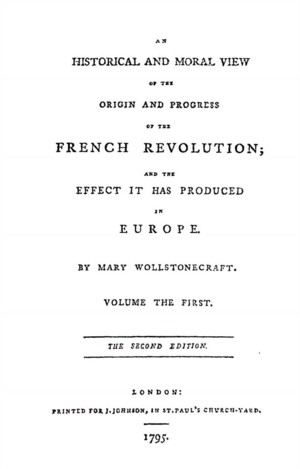
An Historical and Moral View of the Origin and Progress of the French Revolution and the Effect it Has Produced in Europe (London: J. Johnson, 1795).

About Liberty Fund:

Liberty Fund, Inc. is a private, educational foundation established to encourage the study of the ideal of a society of free and responsible individuals.


BOOK II.

CHAPTER I.

retrospective view of grievances in france—the nobles—the military—the clergy—the farmers general. election of deputies to the states-general. arts of the courtiers. assembly of the states. riots excited at paris. opening of the states-general. the king’s speech, answer to it by the keeper of the seals, speech of mr. necker. contest respecting the mode of assembling. tacit establishment of the liberty of the press. attempt of the court to restrain it. the deputies declare themselves a national assembly.

Before we enter on the grand business produced by the meeting of the states-general, it is necessary to take a retrospective glance over the oppressions of which frenchmen so loudly complained; and, whilst we trace their justness, the question will only be, why they did not sooner raise their shoulders to heave off the mighty load. To ascertain this truth, we need not enter into deep researches, though it may be difficult to collect all the parts of the feudal chain, which linked the despotism of sixty thousand nobles, who not only exercised all the tyranny that the system authorized, but countenanced the still more extensive depredations of their numerous dependents. What, indeed, could equal the slavery of the poor husbandman; not only pillaged by the tythe and game laws, but even obliged to let whole flocks of pigeons devour his grain, without daring to destroy them, because those pigeons belonged to the chateau; and afterwards forced to carry the scanty crop to be tolled at the mill of monseigneur, which, to follow a frenchman’s staff of life through all it’s stages of taxation, must then be baked at the privileged oven?

It would be captious, perhaps, to dwell on some of the abominable tenures of personal servitude, which, though grown obsolete, were not abrogated; especially as more specious, if not less grinding, not less debasing exactions were in force, to deprave every moral feeling of the two divisions of society; the governing, and governed.

When chased from the country, of which the chief charm is independence, by such worrying restraints, a man wished to pursue any occupation in a town, he must previously purchase a patent of some privileged person, to whom this tax had been sold by a farmer-general, or the parasite of a minister.

All lived by plunder; and it’s universality gave it a sanction, that took off the odium, though nothing could varnish the injustice. Yet, such was the insensibility of the great, the pleasures these extortions procured were not less grateful to the senses, because paid by the sweat of industry.—No; like Vespasian’s obnoxious tax, money was money; and who cared on what it was levied? Thus the rich necessarily became robbers, and the poor thieves. Talking of honour, honesty was overlooked; and, custom giving a soft name to different atrocities, few thought it a duty to investigate disregarded principles; or to relinquish their share of the plunder, to satisty a romantic singularity of opinion, which excited ridicule rather than imitation.

The military, a pest in every country, were here also all noble, and leagued with a hundred thousand privileged persons, of different descriptions, to support their prerogative of receiving a revenue, which was a dead weight on agriculture; whilst they were not obliged, in a direct way, to advance any thing towards defraying the public expenditure.

The gabelle, the corvée, the obligation to supply horses to transport the troops from one part of the kingdom to another, even when most necessary at the farm; clogs on husbandry, equally unjust and vexatious; were riveted only on the ankles of labour. Activity then being continually damped by such various restrictions, instead of being braced by encouragement, an invincible impediment was thrown in the way of agricultural improvements; for each individual, insulated by oppression, lived, strictly speaking, from hand to mouth; not caring to store up comforts, at the expence of extraordinary toil, when the enjoyment depended on so many casualties. Yet, never beginning to be sensible of the effect, the people were not, probably, aware of the cause; and only exclaimed against new impositions, because they did not think sufficiently deep to detect the old.

Beside which, France maintained two hundred thousand priests, united in the same spirit of licentiousness; who indulged themselves in all the depraved pleasures of cloaked immorality, at the same time they embruted the people by sanctifying the most diabolical prejudices; to whose empire every consideration of justice and political improvement was sacrificed.

Added to evils of this magnitude, there were the canker-worms that lurked behind monastic walls. For sixty thousand persons, who by renouncing the world cut the thread of nature, served as a prop to the priesthood that enjoyed more than a fourth of the produce of all France; independent of the estates it possessed, which were immense. And this body of men, the leeches of the kingdom, the idols of the ignorant, and the palladium of tyranny, contributed not a farthing to the support of the hydra, whom they were anxious to protect, as a guard to themselves. Ostentatiously boasting of their charity, whilst revelling on the spoil of fraud, by a sacrilege the most nefarious, their whole lives were a mockery of the doctrines, which they taught, and pretended to reverence. Beside these, and other vexations, almost innumerable, one entangled in another; each petty monopoly contributed to strengthen the massy fabric of despotism, which reared it’s head in defiance of time and reason. Much, indeed, depended on the caprice of the individuals of the privileged orders, whom the court could actuate at will, giving them occasionally a sop to silence any peevish growl.

There were also the farmers general, with their army of fifty thousand collectors, who, by their manner of levying and amassing the revenue, gave an additional gripe to an oppression, the most wringing that could be invented, because it’s very principles led to the exercise of the vilest peculation; and impunity was secured by a coalition of robbers, that multitude of men in office, whose families and flatterers all lived, and fattened on the spoil of their continual war with justice. And, whilst the interest of the people was continually sacrificed by the parliaments, the inferiour courts of law were still more venal, because composed of those litigious practitioners, who thicken like spawn on putrid bodies, when a state is become corrupt.

Such were the grievances!—Such the impositions, ‘that, taken together, levied a tax on the kingdom,’ says Rabaud, ‘which the imagination is afraid to calculate.’ This body of men we may consider as constituting France, till the great bulk of the people, who were slaves and dwarfs, bursting their shackles and rising in stature, suddenly appeared with the dignity and pretentions of human beings: Yes; with the same feelings; or perhaps stronger, because more natural; and claiming equal rights with those nobles, who, like the giants of old, were only great by the courtesy of the imagination. Who is so callous to the interest of humanity as to say it was not a noble regeneration? Who is so benumbed by selfish fears, as not to feel a glow of warmth, at seeing the inhabitants of a vast empire exalted from the lowest state of beastly degradation to a summit, where, contemplating the dawn of freedom, they may breathe the invigorating air of independence; which will give them a new constitution of mind? Who is so much under the influence of prejudice, as to insist, that frenchmen are a distinct race, formed by nature, or by habit, to be slaves; and incapable of ever attaining those noble sentiments, which characterize a free people? When the dawn of them appeared conspicuously at the elections for the states-general, which were the preparatory struggles to make a change of opinion produce an essential alteration in government.

Six millions of men were now in motion to choose the deputies, and prepare their instructions; and in these assemblies the commons commenced their political career; discussing, on new ground, subjects that quickly became the only interesting topics throughout the kingdom.

In some few places, the three orders meeting together seemed to decide the important question respecting the equality of the representatives; but, in general, the first two chambered themselves to guard tenaciously their trembling prerogatives; and the third, with a cautious jealousy, to demand the redress of grievances, which they could scarcely expect the others to denominate by so harsh a name.

Great decorum reigned in the chamber of the nobility, though split into various ranks; the lower of which had ill brooked, for a long time, the overbearing insolence of those princes and peers, who haughtily contested every step of honour. Still all agreed, to resign their pecuniary privileges, and joined in vague terms, with the public voice, to demand a constitution.

The same divisions produced more visible effects amongst the clergy: for considerable tumults were the consequence of the struggle of the parish-priests, the commons of this order, to have their due weight in the scale; and their success seemed a sure prognostic of the turn things were going to take in the nation. In fact, every diocess was become the centre of a petty despotism, more galling than the great, because at each man’s elbow; and the parish-priests, who were not in the high road to preferment, most oppressed, led the van in the new contest for equality; whilst disrespect for the mitre paved the way to a contempt for the crown.

Indivisible as had hitherto been the clerical body, the indecent pride of the dignitaries of the church, at this juncture, produced the schism, which induced the majority of the clergy to side with the people; whilst only a small minority of the nobility deserted the common cause of the party. The parish-priests, in fact, appeared, from the time of their election, a corps in reserve for the third-estate; where they sought for the consequence they were denied in their own chamber, finding themselves more nearly allied by interest, as well as inclination, to this order than to the rich pastors, who, separating the sheep from the goats, bade them stand aloof, as possessing less riches—the holiness of that body, as of all others. The electing of so many of the inferiour clergy, in spite of the menaces and intrigues of their numerous superiours, was a striking proof, that the power of the church was in the wane; and that the people were beginning to feel their own strength. The disturbances at this time seemed the rumbling of the approaching tempest; and orators, formed in these provincial assemblies, to figure afterwards in national, were encouraged by applause to persevere.

Having the same mark in view, an uniformity of sentiment breathed throughout the instructions of the third-estate; principally levelled at the privileges of the two other orders: for on these abuses the most popular publications had hinged, rivetting conviction in the minds of the suffering people. A celebrated pamphlet, written by the abbé Sieyes, went through sixty editions; and the duke of Orleans, piqued at the royal family, took great pains to spread abroad opinions, which were far from being congenial with his own; thus, with purblind ambition, labouring to overturn a court, the ruins of which have rebounded on his own head.

But the temper of the nation, sore with suffering, and warmed by these discussions, so ran a-head of their judgment, as to lead the electors, with hasty zeal, to instruct their representatives, to demand the immediate suppression of a host of abuses, without guarding against the consequences.—Such, unfortunately, is always the conduct pursued by exasperated passions; for, during the rage to correct abuses, one is, too frequently, only exchanged for another. So difficult is it to impress the salutary lessons of experience on irritated minds!—And so apt are men, in the moment of action, to fly from one extreme to the other, without considering, that the strongest conviction of reason cannot quickly change a habit of body; much less the manners that have been gradually produced by certain modes of thinking and acting.

With one voice, however, the whole nation called for a constitution, to establish equal rights, as the foundation of freedom; and to guard against the depredations of favourites, whether they attacked person or property. So that the liberty of the press, and the abolition of lettres de cachet, were, in general, the articles that followed the positive injunction of confining the right of taxation to the representative body of the nation. The institution of juries was recommended, and the deputies were requested to take into consideration, whether the number of capital punishments could not be lessened, or totally abolished; remarks were made on the evil tendency of lotteries, and on the vexatious impediments thrown in the way of trade, by barriers and monopolies. In short, against the tyranny and injustice of the court, the nobility, and the clergy, all remonstrated; unmasking one species of oppression, and dilating on another; yet, among these numerous animadversions, prayers and praises alone were addressed to the king; and nothing like a glance at republicanism rendered their sincerity doubtful.

To divert the gathering storm from breaking over their heads, the cabal determined to rest all their hopes on the aid of the foreign troops; which they were collecting from different parts of the kingdom, not caring to trust to the french soldiery, who were assuming the character of citizens. Mean while, with the usual chicanery of courtiers, they continued to amuse the deputies, till they could crush them at once; and effectually blast the hopes of the people. The human heart is naturally good, though so often the dupe of passion,—For though it’s feelings be sophisticated, or stifled; though the head contrives the blackest machinations; even in the silence of solitude, who will whisper to himself that he is a villain? Will he not rather try, like Milton’s devil, to find out a damned plea of necessity, to cover his guilt?—paying homage, in spite of himself, to the eternal justice he violates under the pretext of self-preservation. But, it is not alone the virtues of man, those changing hues, of which the colour is undecided, that proclaim his native dignity. No; his vices have the same stamp of the divinity: and it is necessary to pervert the understanding, before the heart can be led astray. Men, likewise, indolently adopt the habits of thinking of their day, without weighing them. Thus these very courtiers, who could coolly contemplate the massacre, which must be the consequence of assembling the foreign troops, because it was a continuance of the established course of things, have since started, probably with real horrour, from the contemplation of the butcheries, which their very tenacity produced. Such is the deceitfulness of the human heart, and so necessary is it to render the head clear to make the principles of action pure.

The deputies, however, who were mostly collected from remote parts of the country, had become in their villages the hale sons of independence. And, though the french mania, of adoring their monarch, extended to every part of the kingdom, it only gave hilarity to the cheering glass at the homely tables of which they were masters; or activity to the dance, that was a real burst of animal spirits. Very different from the lascivious provocations to vice, exhibited at the opera, which, by destroying the social affections that attach men to each other, stifle all public spirit; for what is patriotism but the expansion of domestic sympathy, rendered permanent by principle? Besides, the writings that had awakened the spirit of these men had a little inebriated their brain. Such is, for the most part, the baneful effect of eloquence, that, persuading instead of convincing, the glory of the enthusiasm it inspires is sullied by that false magnanimity, which vanity and ignorance continually mistake for real elevation of soul; though, like the scorching rays of the sun after rain, it dries into sterility the heart, whose emotions are too quickly exhaled.

The courtiers, despising their rusticity, and still considering the people as ciphers, continued to discharge the usual routine of office, by adjusting the ceremonials of reception; all which tended to insult the third-estate, and show, that the deputies of the privileged orders were to be still treated as if they were a distinct class of beings. The insolence of such proceedings could not fail to provoke the honest indignation, and pique the vanity of those, who had been discussing on a broad scale the rights of man; whilst a little disconcerted by the ceremony that constrained them, they were obliged, every moment, to recollect, that they were the equals of these courtiers; and blushed even to own to themselves, that they could for an instant have been awed by such childish pomp. Nor were they more astonished at the pageantry of Versailles, than disgusted with the haughtiness of a court, whose magnificence was a proof how much they had impoverished the people, who now demanded emancipation. Full, therefore, of the new notions of independence, which made them spurn at every idea of a distinction of men, they took advantage of the majority accorded them by the council, and began to rally their forces. Perceiving also, as they acted decidedly, that they possessed the confidence of the people, who, forgetting vive le roi, exclaimed only vive le tiers-etat!—they every day became more firm.

The courtiers immediately fixed on a house of rendezvous, where they were regularly to concert the best measures to crush the rising power of the commons; and these, not without a portion of the mistrust, which characterizes the nation, assembled in different places, till a mutual interest united them in that chosen by the deputies from Brittany. The disrespect, likewise, which the orders relative to their dress announced, prepared them for the contempt they were destined to receive, when separated like the indian casts, amongst whom a man fears to be polluted by the touch of an inferiour: for true to the inveterate prejudice in favour of precedents* , the nobility were gaudily caparisoned for the show, whilst the commons were stupidly commanded to wear the black mantle, that distinguishes the lawyers. But, the tide of opinion once turned, every thing contributes to accelerate it’s course.

Before the meeting of the states-general, the question that was first to agitate the various interests, whether they were to vote by orders or poll, had been so thoroughly discussed, that it made, in many of the instructions, one of the foremost articles. For it was evident to the nation, were the different orders allowed to assemble in their separate chambers, each invested with the old privilege of putting a negative on the decisions of the other two, that they should be gulled with promises of reform, whilst the coffers of the court were replenished with a show of legality. It was, in fact, prudent in the court party to maintain this ground, because it appeared to be the only way to render abortive all the plans of reformation that struck at their authority. This then was the prefatory business, by which they were to measure their strength; and, would to God! the vigour manifested on this occasion had always been displayed by the representatives of those misled people.

We have seen the plots of this weak, headstrong cabinet every where defeated, and traced their bloody footsteps; but we shall find them still true to their scent, having recourse again to violence, when fraud was of no avail.

To furnish a pretext to introduce adroitly a considerable military force, at the time of the assembling of the states-general, two or three riots had been excited at Paris, in which many of the thoughtless populace were killed. One in particular, though still involved in the shades of mystery, occasioned great confusion and considerable slaughter, just at the eve of their meeting.

A respectable manufacturer in the suburbs of Paris, with the fairest character, employed a number of poor, whom he paid liberally; yet against this man some idle stories were industriously circulated, well contrived to mislead and exasperate the people, because they touched their vanity, and their most pressing want, the want of bread. The scarcity, real or factitious, of this article, has always been taken advantage of by those who wished to excite tumults in Paris; and at this juncture the duped parisians rose, at the instigation of the court agents, to destroy themselves. The riot was permitted to get a-head before any serious attempts to quell it were taken, which rendered the interference of a little army, the point aimed at, necessary; and established an opinion, that the turbulent mob required to be awed by the presence of troops, whilst the states-general deliberated.

During this effervescence, or, at least, when it was subsiding, the states-general was opened, the 5th of may, 1789, by a speech from the throne, to which courtiers, in the usual phraseology, would naturally tack the epithet—gracious. The king commenced with a heartless declaration of his satisfaction at seeing himself surrounded by the representatives of the people; and then enumerating the heavy debts of the nation, a great part of which had been accumulated during his reign, he added one of those idle falsehoods, which swelled his declamation without throwing dust into any one’s eyes, that it was in an honourable cause; when it was notorious, that the cause ought to have been reckoned most dishonourable, if power had not hitherto been the true philosopher’s stone, that transmuted the basest actions into sterling honour. He afterwards alluded to the spirit of innovation, that had taken possession of the minds of the people, and the general discontent that agitated the nation: but, in the true cant of courts, dictating whilst complimenting, he assured them, that he depended on their wisdom and moderation; concluding with the words of course, the humble servant of kings, a declaration of his attachment to the public welfare.

The disregarded speech of the keeper of the seals was, like the reply usually made to the king’s, in the house of commons in England, merely an echo of his majesty’s, recommending moderation in the measures adopted to reform the abuses of government, with the necessary quantum of panegyric on the goodness of the king.

Attention and applause, however, awaited Necker, though followed by weariness and disgust. He spoke for three hours, introducing, with his customary pomp of words, a number of trivial observations; trying thus to escape, in a mist of rhetorical flourishes, from the subject he feared to bring forward, because he was equally apprehensive of ossending the court, and desirous of maintaining his reputation with the people. Not a word was uttered relative to the sole right of the states-general to levy taxes, the first demand of the nation. And men who sor some time had been talking of nothing but liberty and reform, were astonished, and dissatisfied, that he avoided all mention of a new constitution. Leaning to the side of the privileged orders, he asserted, that the mode of deliberating and voting in separate assemblies was the pillar of the nation—yet, cautiously adding a salvo, to have a pretext to use another language should it be necessary, he remarked, that sometimes it was better to poll. This ill-timed management naturally displeased both parties, as is always the case, when men of weak, compound characters, who have not the courage to act right, want effrontery to brave the censure, that would follow an open avowal of their undecided opinions; or rather, their determination to keep well with the strongest. Dwelling on the arrangement of the finances, he assured them, that a public bankruptcy might easily be avoided; and that even the deficit, which had been exaggerated by France, and Europe, was only fifty-six millions; and would appear of less consequence, when they recollected, that, since his administration, the revenue was augmented twenty-five millions. It is true, that, on entering into details, the greater part of this sum was found to be still in perspective; and at the same time was to be raised by taxes, which all good citizens hoped would soon disappear. In short, the french, after applauding with rapture this brilliant bird’s-eye view, observed, with the shrug of sang froid, ‘that these hypothetical resources were merely faith and hope, on condition that they should be charitable.’ With respect to the abolishing of privileges, that warred with humanity, he made use of some of the same species of jesuitical arguments, which are employed by the opposers of the abolition of the infamous traffic for slaves; that, as these privileges were a kind of property, it was necessary to find out a compensation, an indemnity, before they could be done away—with justice.

Thus has the spirit of justice—it is difficult to keep down indignation when attacking such sophisms—been always outraged by the mock respect of selfishness; for, without parrying off tergiversation, it is sufficient to prove, that certain laws are not just, because no government had a right to make them; and, though they may have received what is termed a legal sanction during the times of ignorance, “the duty lies in the breach and not in the observance.” Besides, these pitiful arguments are an insult to the common sense, and to the distress of a people.—Where, indeed, could the french, or english, find a fund to indemnify the privileged orders or the planters? The abuses then, must continue to the end of time—out of sheer respect to the sacredness of public faith!

Thus spoke the king and Necker; but these addresses, instead of conciliating, only rendered both parties more obstinate; so that the smothering dispute respecting the manner of voting broke out immediately, when they met to constitute themselves a legal assembly. For the next day, even the deputies of the third-estate repaired to the common hall, and agreed, that the three orders should proceed to verify their powers together; clearly perceiving, that, were the orders once allowed to do business separately, an union would be impracticable, and all their efforts to obtain a constitution null, should they attempt to make equality of rights the basis. The nobility and clergy not joining the commons, they resolved to renew their meeting the following morning; only as an aggregate of individuals, who had no power to act, not having yet a political character. This very contest seemed to call upon them to support their claim to equality, because it emphatically warned them, that all their operations would be rendered perfectly nugatory, should they permit the orders to be a check on each other. The most sensible men of the commons being of opinion, that all expectations of a permanent reform were chimerical, unless the whole representation was formed into an indivisible assembly, encouraged the more undecided to persevere; though the nobles signified to them, the 13th, that they had ascertained the legality of their election.

The clergy, however, divided in their interest, proceeded with more caution; and the most discerning of them, perceiving that their order was becoming obnoxious to the people, who now deified the third estate, proposed a committee of conciliation, with a view, as they pretended, to promote a good understanding between all parties. The king also, in his turn, when the nobles rejected the mediation of the clergy, offered a plan of accommodation; a mighty nothing, that the court brought forth.—But this tub, thrown out to the whale, did not divert the attention of either party from the main object; though the nobles, many of whom were in the secret of the approach of the army, should things be carried to extremes, pretended to acquiesce; yet guarding carefully at the same time all their ancient pretentions: and this insincerity drew on them the universal odium they merited, mixed with the contempt which ineffectual struggles always produce. Conciliatory measures, in fact, were only a solemn farce at this time; though the clergy, rather insidiously, to ingratiate themselves with the people, lamenting the high price of bread, requested, that deputies from the three orders should meet to deliberate how this grievance might be lessened. The deputies of the commons, with becoming dignity, tempered with prudence, adhered to their point; and dexterously parrying off the artful stroke levelled at their popularity, they represented to the clergy, that this was another powerful motive, to make them entreat all parties to rally round the same point, to remedy evils, which excited equal sympathy in their bosoms.

The inactivity occasioned by these disputes could not fail to inflame the public mind, especially as fresh publications were daily affording it fuel. For the liberty of the press was now tacitly established, and the freest sentiments uttered, with the heat of superficial knowledge, in defiance of court manifestoes. Still, as a proof that the court merely endured, for a season, what they could not prevent, the journal of the proceedings of the states-general was stopped, by an express order; to evade which it was continued in the form of letters from Mirabeau to his constituents.

This prohibition was probably dictated by a desire of keeping the provinces quiet in the stupor of ignorance, in which they had so long dozed; but it was injudicious to awaken attention by rigorous steps, that, quickly abandoned, had the very contrary effect, exciting, instead of intimidating, the spirit of opposition. In reality, the eyes of all France were at present directed towards the commons. The hopes of the nation rested on their magnanimity; and the future happiness of millions depended upon their perseverance. It was in this slate of things, that they afforded a convincing proof to the whole world, and to posterity, that vigour and precision alone are requisite in the representatives of a people, to give dignity to their proceedings, and to secure them against the machinations of all the combined powers of despotism.

Almost five weeks having elapsed, and the patience of the nation being quite exhausted by the delay, the commons resolved to present an address to the king, written by Mirabeau, explanatory of their motives, and then to proceed to business. But, previously, they sent a deputation to the other orders, for the last time, to invite them once more to repair to the common-hall, that their powers might be verified together; adding, that in default of their appearance, they should constitute themselves, and act accordingly. This determination was a deadly blow to the power of the two other chambers, and struck directly at the root of all distinction.

The nobles, whose inveterate pride and ignorance had prevented them from joining the third-estate at the first assembling of the deputies, now saw with dismay, that their power and influence, like the musty rolls of their pedigree, were mouldering into common dust. The clergy, however, more adroit, or rather a few of the parochial priests, by degrees, attended the summons, and repaired to the hall. There can be little doubt, but that the commons, at the first meeting, and for a long time after, would gladly have coalesced with the nobles; by which means the latter would have retained many of their privileges, and preserved a weight in the nation, necessary to hinder that preponderance, on the side of the people, which it was easy to foresee would be productive of many excesses. This conclusion continual experience warranted; because it generally happens, that men, who are not directed by practical knowledge, in whatever business they engage, run precipitately from one extreme to the other. And certainly, from the state of servility in which the french nation was sunk, retaliation was to be expected; or, at least, dreaded, from unbridled liberty. Like boys dismissed from school, they might wish to ascertain their freedom by acts of mischief; and by showing a total disregard of the arbitrary commands, that kept down their spirits without exercising their understandings. However, the stupid arrogance of the nobles stript them, before the time reason would have determined, of those idle distinctions of opinion, the symbols of barbarism, which were not completely worn out of esteem.

The minister, still afraid to act independent of the court, blamed this spirited conduct of the commons, as an act of temerity, which the king ought not to sanction. Yet they, firm and resolute, though fearing that the court, like a dying savage, mortally wounded by his enemy, might, during the agonies of death, aim a desperate stroke at them, took the most prudent precautions, to avoid exasperating the falling soe. But these mild resolutions having been mistaken by the infatuated nobles, who confounded the true fortitude of moderation with cowardice, the die was cast, and the deputies declared themselves a national assembly.

Enthusiasm fired every heart, and extended itself like thought from one end of the kingdom to the other. The very novelty of this measure was sufficient to animate a people less volatile than the french; and, perhaps, it is impossible to form a just conception of the transports which this decision excited in every corner of the empire. Europe also heard with astonishment what resounding through France excited the most lively emotions; and posterity must read with wonder the recital of the follies and atrocities committed by the court and nobles at that important crisis.

The Social Contract of Roussean, and his admirable work on the origin of the inequalities amongst mankind, had been in the hands of all France, and admired by many, who could not enter into the depth of the reasoning. In short, they were learned by heart, by those whose heads could not comprehend the chain of argument, though they were sufficiently clear to seize the prominent ideas, and act up to their conviction. Perhaps, the great advantage of eloquence is, that, impressing the results of thinking on minds alive only to emotion, it gives wings to the slow foot of reason, and fire to the cold labours of investigation: Yet it is observable, that, in proportion as the understanding is cultivated, the mind grows attached to the exercise of investigation, and the combination of abstract ideas. The nobles of France had also read these writings for amusement; but they left not on their minds traces of conviction sufficiently strong to overcome those prejudices self-interest rendered so dear, that they easily persuaded themselves of their reasonableness. The nobility and clergy, with all their dependents under the influence of the same sentiments, formed a considerable proportion of the nation, on the rest of which they looked down with contempt, considering them as merely the grass of the land, necessary to clothe nature; yet only sit to be trodden under foot. But these despised people were beginning to feel their real consequence, and repeated with emphasis the happy comparison of the abbé Seiyes, ‘that the nobility are like vegetable tumours, which cannot exist without the sap of the plants they exhaust.’ Nevertheless, in treating with the nobles, the angles of pride, which time alone could have smoothed silently away, were, perhaps, too rudely knocked off, for the folly of distinctions was rapidly wearing itself out, and would probably have melted gradually before the rational opinions, that were continually gaining ground, fructifying the soil as they dissolved; instead of which it was drifted by a hurricane, to spread destruction around as it fell.

Many of the officers, who had served in America during the late war, had beheld the inhabitants of a whole empire living in a state of perfect equality; and returned, charmed with their simplicity and integrity, the concomitants of a just government, erected on the solid foundation of equal liberty, to scan the rectitude, or policy of a different system. Convinced of their inutility as nobles, these, when fired with the love of freedom, seconded the views of the commons with heart and voice. But the sycophants of the court, and the greater part of the nobility, who were grossly ignorant of every thing that was not comprised in the art of living in a continual round of pleasure, insensible of the precipice on which they were standing, would not, at first, recede a single step to save themselves; and this obstinacy was the chief cause that led to the entire new organization of the constitution, framed by the national assembly. The french in reality were arrived, through the vices of their government, at that degree of false refinement, which makes every man, in his own eyes, the centre of the world; and when this gross selfishness, this complete depravity, prevails in a nation, an absolute change must take place; because the members of it have lost the cement of humanity, which kept them together. All other vices are, properly speaking, superfluous strength, powers running to waste; but this morbid spot shows, that there is death in the heart. Whatever, indeed, may be the wisdom or folly of a mixed government of king, lords, and commons, is of no consequence in the present history; because it appears sufficiently obvious, that the aristocracy of France destroyed itself, through the ignorant arrogance of it’s members; who, bewildered in a thick fog of prejudices, could discern neither the true dignity of man, nor the spirit of the times.

It also deserves to be noted, that the regeneration of the french government, at this crisis, depended on the fortitude of the national assembly at the outset of the contest; for, if the court party had prevailed, the commons would have rested in their usual state of insignificancy, and their whole proceedings proved only a solemn farce. They would have wrapped themselves up in their black mantles, like the herd of undertaker’s men at a funeral, merely to follow with servile steps the idle cavalcade to it’s resting place; and the people would only have seen their ancient tyranny revive, tricked out in new habiliments.

CHAPTER II.

the national assembly proceed to business. opposition of the nobles, bishops, and court. a seance royale proclaimed, and the hall of the assembly surrounded by soldiers. the members adjourn to the tennis court, and vow never to separate till a constitution should be completed. the majority of the clergy and two of the nobles join the commons. seance royale. the king’s speech. spirited behaviour of the assembly. speech of mirabeau. persons of the deputies declared inviolable. minority of the nobles join the commons. at the request of the king, the minority of the clergy do the same,—and are at length followed by the majority of the nobles. character of the queen of france,—of the king,—and of the nobles. lectures on liberty at the palais royal. paris surrounded by troops. spirit of liberty infused into the soldiers. eleven of the french guards imprisoned because they would not fire on the populace, and liberated by the people. remonstrance of the national assembly. the king proposes to remove the assembly to noyon, or soissons. necker dismissed. city militia proposed. the populace attacked in the garden of the thuilleries by the prince of lambesc. nocturnal orgies at versailles.

The third-estate, having constituted themselves a national assembly, now proceeded to business, with calm prudence, taking into consideration the urgent necessities of the state. Closely also attending to their instructions, they first pronounced, that all taxes not enacted by the consent of the representatives of the people were illegal; and afterwards gave a temporary sanction to the present levies, to avoid dissolving one government before they had framed another. They then turned their attention to the object next in importance, and declared, that, as soon as, in concert with his majesty, they should be able to fix the principles of national regeneration, they would employ themselves to examine and liquidate the national debt; mean time the creditors of the state were declared to be under the safe-guard of the honour of the french nation. These decrees concluded with a resolve, that the assembly, now become active, should dedicate it’s first moments to inquire into the cause of the scarcity that afflicted the kingdom; and to search for a remedy the most prompt and effectual.

The nobles, bishops, and, in fact, the whole court, now seriously began to rally all their forces; convinced that it was become necessary, to oppose their united strength against the commons, to prevent their carrying every thing before them.

The chamber of the clergy had been engaged for several days, in discussing the question, where they should verify their powers. A number of them, during this discussion, appear to have advanced, feeling their way; for when they now came to divide, the majority decided to join the national assembly.

Alarmed by the prospect of this junction, one of the members of the chamber, which almost arrogated to itself the prerogative of legislation, that of the nobles, proposed an address to the king, beseeching him to dissolve the states-general; whilst the cause of the people was there vigorously supported by a minority, feeble as to numbers, but powerful in argument, animated by the popularity, which their bold declaration could not fail to produce during the reign of enthusiasm.

This was a moment pregnant with great events. The court still trusted to subterfuge, and, holding the representatives of the people in superlative contempt, affected in some degree to yield to the prayer of the nation; though signifying, that the king was the only fountain of justice, and that he would grant every thing which his faithful subjects could reasonably demand. A trick as palpable as the design was flagrant; for at the instant they were pretending to see some reason in their requisitions, they were guarding against their obtaining the only thing that could secure their rights, an equal representation; holding for this purpose mischievous councils, composed of characters most obnoxious in the eyes of the people. In these meetings it was resolved, to amuse the commons, until the army could be assembled; and then, in case of obstinacy, they would draw on themselves the consequence. Accordingly the 20th of june, the day on which the majority of the clergy was to join the commons, the herald proclaimed a séance royale; and a detachment of guards surrounded the hall of the national assembly, to take care (such was the shallow pretext) that it should be properly prepared for the reception of the king. The deputies came to the door at the usual hour; but only the president (Baillie) and the secretaries were permitted to enter to take away their papers; and they saw, that the benches were already removed, and that all the entrances were guarded by a great number of soldiers.

Courage is seldom relaxed by persecution; and the firm and spirited proceedings of the assembly on this day, gave the decided blow to the stratagems of the court. During the first tumult of surprise, it is true, some of the deputies talked of going immediately to Marly, to invite the king to come among them, and in a truly paternal manner to unite his power with their’s to promote the public good; and thus by an energetic appeal to his heart and understanding, to convince him that they spoke the language of truth and reason. But others, more experienced in ministerial wiles, calmly advised to adjourn the sittings to the neighbouring tennis-court. For they knew, that the hearts of courtiers are fortified with icy prejudices; and that, though a moment of sympathy, a flow of life-blood, may thaw them at the instant, it is only to render them more hard, when the glow of genial heat is passed.

Assembled at the tennis-court, they encouraged each other; and one mind actuating the whole body, in the presence of an applauding crowd, they joined hands solemnly, and took God to witness, that they would not separate, till a constitution should be completed. The benedictions that dropped from every tongue, and sparkled in tears of joy from every eye, giving fresh vigour to the heroism which excited them, produced an overflow of sensibility that kindled into a blaze of patriotism every social feeling. The dungeons of despotism and the bayonets sharpened for massacre, were then equally disregarded even by the most fearful; till, in one of those instants of disinterested forgetfulness of private pursuits, all devoted themselves to the promotion of public happiness, promising to resist, to the last extremity, all the efforts of such an inveterate tyranny. The absent deputies were sent for; and one, who happened to be sick, had himself carried to unite his feeble voice with the general cry. The very soldiers also, disobeying their officers, came to be willing centinels at the entrance of the sanctuary of liberty, eagerly imbibing the sentiments, which they afterwards spread through their garrisons.

This indignity offered to the third-estate could not fail to excite new sensations of disgust at Paris; and give a fresh spring to the animation of the people at large. Yet, this spirited behaviour of the commons excited only supercilious contempt at court. For the gay circles there were so far sunk in fastidious delicacy, and squeamish respect for polished manners, that they could not even discover magnanimity in the conduct of a peasant, or a shopkeeper; much less grandeur in an assembly regardless of ceremonials. And not to be deficient themselves in these respects, the séance royale was put off another day, in order that the galleries, which had been erected for the accommodation of spectators by the national assembly, might be removed.

This was another injudicious step on the part of the cabinet; because it afforded time for the clergy to unite with the commons, who were in search of a place sufficiently capacious to contain such a body. At length, collected in a church, the clergy, with several bishops at their head, and two nobles of Dauphiné, joined them; and the place, seeming to reflect a sanctity on their union, tended to consolidate, under a nobler concave, the resolution taken in the tennis-court.

The following day, the séance royale really took place, with all the exterious splendour usually exhibited at these shows; which hitherto could scarcely be termed empty, because they produced the desired effect. But the public, having their attention turned to other things, now viewed with contempt, what had formerly inspired almost idolatrous respect. The deputies of the third estate were again ordered to enter by a separate door, and even left a considerable time standing exposed to a heavy shower. The people, who were totally excluded, formed themselves into groups, making indignant comments on the repeated affronts offered to their representatives, whose minds likewise recoiled at the idle attempt to impress them with an opinion of their insignificancy; when the very pains taken to do it proclaimed their growing importance in the state.

The object of the king’s speech, on this occasion, was to annul the whole proceedings of the national assembly, and to hold out certain benefits, as lures to submission, which the king meant to grant to the people; as if, observes Mirabeau, ‘the rights of the people, were the favours of the king.’ A declaration of his sovereign will and pleasure was then read, in which, making an insidious attempt to withdraw from the assembly the confidence of the public, he declared, that, if they abandoned him, he would provide for the happiness of his people, without their assistance, knowing the purport of the instructious given to the deputies. The first article of the king’s benevolent intentions, was to grant to the states-general the power of furnishing supplies; carefully specifying, however, that it was to consist of the three orders, who were to vote according to the ancient mode. Some other salutary plans of reform were also brought forward; but always with artful modifications, that would enable the old abuses to keep a sure footing. For example, the taxes were to be levied equally; yet a cautious respect for property sanctioned almost every other feudal privilege; and the absolute abolition of lettres de cachet,* though his majesty wished to secure personal freedom, was hinted at as incompatible with public safety, and the preservation of the honour of private families. The liberty of the press was allowed to be necessary; but the states general were requested to point out a mode of rendering it compatible with the respect due to religion, to morality, and to the honour of the citizens. The tenour of all the rest of the articles was the same; commencing with a plan of reform, and concluding with the ifs and buts, that were to render it void.—Then, winding round to the grand object of the meeting, the king terminated his discourse, with saying, forgetful that this was not the period to imagine himself reigning at Constantinople, ‘I command you to separate immediately, and to attend, each of you, to-morrow, at the chamber appropriated for your order, there to resume your sittings; and I have commanded, in consequence, the grand master of the ceremonies to order the halls to be prepared.’

The majority of the nobles, and the minority of the clergy, obeyed this peremptory order, and obsequiously followed the king, like the trained horses of his court. The members of the national assembly, however, remained sitting, preserving a silence, more menacing and terrible, than the I will, or I command, of the cabinet; when the grand master of the ceremonies entered, and addressing himself to the president, reminded him, in the king’s name, of the order given to separate immediately. The president answered, ‘that the assembly was not constituted to receive orders from any person;’ but Mirabeau, who thought this reply too tame, started up, and addressing the messenger, said: ‘yes; we have heard the intentions which the king has been induced to utter; and you cannot be his organ in this assembly.—You, who have neither seat, nor right to speak, ought not to remind us of his discourse. However, to avoid all equivocation or delay, I declare to you, that if you are charged to make us go from hence, you should demand orders to employ force; for only the bayonet can oblige us to quit our places.’ It is difficult to conceive the ardour inspired by this prompt eloquence. It’s sire flew from breast to breast, whilst a whisper ran round, that what Mirabeau had just uttered, gave a finishing stroke to the revolution.

A warm debate ensued; and the assembly declaring their adherence to their former decrees, the abbé Siéyes said, in his dry, cogent manner: ‘gentlemen, you are to day what you were yesterday.’ A motion was then made, by Mirabeau, who suggested, as a prudent precaution against the measures of a desperate cabal, that the person of each deputy should be pronounced inviolable; and, after a slight discussion, it was carried unanimously.

From this moment we may consider the nation and court at open war. The court had at their command the whole military force of the empire, amounting, at least, to 200,000 men. The people, on the contrary, had only their bare arms, invigorated, it is true, by the new-born love of freedom, to oppose to the various weapons of tyranny. But the army, partaking of the common misery, were not deaf to the complaints or arguments of their fellow citizens: and they were particularly led to consider them with complacency, because a just apprehension, or prudent foresight, had induced many of the popular assemblies, to insert a clause in their instructions, recommending, that the pay of the soldiers should be augmented. Thus recognized as fellow citizens, this class of men, whom it had been the policy of the despots of Europe to keep at a distance from the other inhabitants, making them a distinct class, to oppress and corrupt the rest, began to feel an interest in the common cause. But the court, who either could not, or would not, combine these important facts, rashly precipitated themselves into the very quicksand, into which they were vainly endeavouring to drive the commons.

As Necker had not attended in his place, at the séance royale, it gave colour to the rumour, which had for some time prevailed, that he purposed to retire from the ministry: so that, when the king returned, he was followed by an immense crowd, who could not conceal their discontent. Under the influence also of the same fear, a number of the deputies hastened to Necker, to entreat him not to resign. And the consternation increasing, the queen, who has ever been the first to desert her own plans, when there appeared a shadow of personal danger, sent for him; and, the better to cover the project of the cabinet, prevailed on him not to quit his post. The object of the cabinet he either had not the penetration to discover; or he had not sufficient magnanimity to resign a place, that gratified equally his pride and his avarice. This measure tended to tranquillize the minds of the people, though it was undermining their cause; for trusting to the integrity of this minister, who promised, ‘to live or die with them,’ they did not perceive, that he wanted the energy of soul necessary to enable him to act up to the principles he professed. However, the cause of liberty, as circumstances have proved, did not depend on the talents of one or two men.—It was the fiat of the nation; and the machinations of the tyrants of Europe have not yet been able to overturn it; though false patriots have led them, in their ardour for reform, to the commission of actions the most cruel and unjust. Every thing was effected by natural causes; and we shall find, if we take a cursory view of the progress of knowledge, that it’s advance towards simple principles is invariably in a ratio, which must speedily change the tangled system of european politics.

The séance royale produced so little effect, that the assembly, as if their sittings had never been interrupted, met the next day at the old hall; and the day after, the minority of the nobles. which consisted of forty-seven members, came to incorporate themselves with the commons. All of these, and particularly the duke of Orleans, who led them, acquired by this popular conduct, the love and confidence of the nation. How far they merited it, deceiving the public, or themselves, their future conduct will best explain.

The interesting events, in fact, which almost daily occurred, at the commencement of the revolution, fired the fancies of men of different descriptions; till, forgetting every selfish consideration, the rich and poor saw through the same focus. But, when the former had time to cool, and felt more forcibly than the latter the inconveniences of anarchy, they returned with fresh vigour to their old ground; embracing, with redoubled ardour, the prejudices which passion, not conviction, had chased from the field, during the heat of action. This was a strong reinforcement for the staunch aristocrats; because these were mostly good, but short-sighted people, who really wished, that justice might be established, as the foundation of the new government, though they flinched when their present ease was disturbed; and it was necessary to give more than good wishes.

This minority of nobles must certainly be allowed to have acted more prudently than their peers; and several of them, the most respectable men of that class, both in talents and morals, were probably actuated by half comprehended principles. The great body of the nobles, nevertheless, and the minority of the clergy, continued to meet in different chambers, where their idle deliberations marked their decayed influence. For, shrinking into nothing, their present struggles to regain their power were as fruitless, as their former efforts had been presumptuous. Yet the jealousies and contumely of the nobility continued to agitate the commons; who, animated by a consciousness of the justice of their cause, and feeling, that they possessed the confidence of the public, determined to proceed with the objects of their meeting, without the concurrence of the first order; proving to them, when it was too late to preserve their factitious distinctions, that their power and authority were at an end. In vain were they told, that they were acting contrary to their true interest, and risking the salvation of their privileges. In vain did one of the most moderate of the deputies* remonstrate with them, on what, most probably, would be the consequence of their obstinacy. No argument could move them; and, blind to the danger with which they were threatened, they persisted to attend their councils, without any determinate rule of action. It is true, the duke of Luxembourg declared, in a private committee held by the king, the 26th of june, that ‘the division of the orders would controul the exorbitant claims of the people, and preserve those of the monarch; united,’ added he, ‘they know no master, divided, they are your subjects:’ and he concluded, with emphatically saying, that ‘it would save the independence of the crown, and stamp with nullity the proceedings of the national assembly.’ These were manly, though not patriotic sentiments; and if the court had rallied round them, and defended them to the last extremity, they would at any rate have prevented their disgrace, by avoiding the crooked path of treachery. But abandoning all dignity of conduct, they trusted to the art of manœuvring, which defeated by the people, they were left entirely at their mercy.

With respect to the improvement of society, since the destruction of the roman empire, England seems to have led the way, rendering certain obstinate prejudices almost null, by a gradual change of opinion. This observation, which facts will support, may be brought forward, to prove, that just sentiments gain footing only in proportion as the understanding is enlarged by cultivation, and freedom of thought, instead of being cramped by the dread of bastilles and inquisitions. In Italy and France, for example, where the mind dared to exercise itself only to form the taste, the nobility were, in the strictest sense of the word, a cast, keeping aloof from the people; whilst in England they intermingled with the commercial men, whose equal or superiour fortunes made the nobles overlook their inequality of birth: thus giving the first blow to the ignorant pride that retarded the formation of just opinions respecting true dignity of character. This monied interest, from which political improvement first emanates, was not yet formed in France; and the ridiculous pride of her nobles, which led them to believe, that the purity of their families would be sullied, if they agreed to act in the same sphere with the people, was a prevailing motive, that prevented their junction with the commons. But the more licentious part of the clergy, who followed with a truer scent their own interest, thought it expedient to espouse, in time, the cause of the power, from whence their influence derived its greatest force; and from which alone they could hope for support. This schism proved, as it promised, dangerous to the views of the court.

The desertion of the clergy rendered the nobility outrageous, and hastened the crisis when the important contest was to be brought to an issue.—Then it was that the king perceived how contemptible his undecided conduct had been, and exclaiming, it is said confidently, ‘that he remained alone in the midst of the nation, occupied with the establishment of concord.’ Vain words! and this affectation was particularly reprehensible, because he had already given orders for the assembling of the foreign troops: the object of which was to establish concord with the point of the bayonet.

This total want of character caused him to be flattered by all parties, and trusted by none. Insignificancy had distinguished his manners in his own court. Actions without energy, and professions without sincerity, exhibiting a conduct destitute of steadiness, made the cabinet concert all their measures regardless of his opinion, leaving to the queen the task of persuading him to adopt them. The evil did not rest even here; for the different parties following separate views, the flexibility of his temper led him to sanction things the most at variance, and most dangerous to his future honour and safety. For it appears obvious, that whatever party had prevailed, he could only be considered as an instrument; which, becoming useless when the object should be achieved, would be treated with disrespect. Periods of revolution drawing into action the worst as well as the best of men; and as audacity, in general, triumphs over modest merit, when the political horizon is russled by tempest; it amounted to a moral certainty, that the line of conduct pursued by the king would lead to his disgrace and ruin.

Seeing, however, that the people were unanimous in their approbation of the conduct of their representatives, and watchful to discover the designs of their enemies; it could not but occur to the cabinet, that the only way to lull attention to sleep, was to affect to submit to necessity. Besides, fearing, if they continued to resort to their different chambers, that their plot would take wind before all the agents were assembled, a fresh instance of dissimulation evinced, that their depravity equalled their stupidity. For the king was now prevailed on to write to the presidents of the nobility, and the minority of the clergy, requesting them, to represent to those two orders the necessity of uniting with the third, to proceed to the discussion of his proposals, made at the séance royale.

The clergy immediately acquiesced; but the nobility continued to oppose a junction so humiliating, till the court invented a pretext of honour to save the credit of their mock dignity, by declaring, that the life of the king would be in imminent danger, should the nobles continue to resist the desire of the nation. Pretending to believe this report, for the secret of the cabinet was buzzed amongst them, and appearing to wish to bury all rivalry in royalty, they attended at the common hall, the 27th. Yet even there, the first step they took was to enter a protest, in order to guard against this concession being made a precedent.

A general joy succeeded the terrour which had been engendered in the minds of the people by their contumelious perverseness; and the parisians, cherishing the most sanguine expectations, reckoned, that an unity of exertions would secure to them a redress of grievances.

It is perhaps unnecessary to dwell, for a moment, on the insensibility of the court, and the credulity of the people; as they seem the only clues, that will lead us to a precise discrimination of the causes, which completely annihilated all confidence in the ministers, who have succeeded the directors of those infamous measures, that swept away the whole party; measures which involved thousands of innocent people in the same ruin, and have produced a clamour against the proceedings of the nation, that has obscured the glory of her labours. It is painful to follow, through all their windings, the crimes and follies produced by want of sagacity, and just principles of action. For instance, the séance royale was held on the 23d, when the king, not deigning to advise, commanded the deputies to repair to their different chambers; and only four days after he implored the nobility and clergy to wave every consideration, and accede to the wish of the people. Acting in this contradictory manner, it is clear, that the cabal thought only of rendering sure the decided blow, which was to level with the dust the power, that extorted such humiliating concessions.

But the people, easy of belief, and glad to be light-hearted again, no sooner heard that an union of the orders had taken place, by the desire of the king, than they hurried from all quarters, with good-humoured confidence, called for the king and queen, and testified, in their presence, the grateful joy this acquiescence had inspired. How different was this frankness of the people, from the close hypocritical conduct of the cabal!

The courtly, dignified politeness of the queen, with all those complacent graces which dance round flattered beauty, whose every charm is drawn forth by the consciousness of pleasing, promised all that a sanguine fancy had pourtrayed of future happiness and peace. From her fascinating smiles, indeed, was caught the careless hope, that, expanding the heart, makes the animal spirits vibrate, in every nerve, with pleasure:—yet, she smiled but to deceive; or, if she felt some touches of sympathy, it was only the unison of the moment.

It is certain, that education, and the atmosphere of manners in which a character is formed, change the natural laws of humanity; otherwise it would be unaccountable, how the human heart can be so dead to the tender emotions of benevolence, which most forcibly teach us, that real or lasting felicity flows only from a love of virtue, and the practice of sincerity.

The unfortunate queen of France, beside the advantages of birth and station, possessed a very fine person; and her lovely face, sparkling with vivacity, hid the want of intelligence. Her complexion was dazzlingly clear; and, when she was pleased, her manners were bewitching; for she happily mingled the most insinuating voluptuous softness and affability, with an air of grandeur, bordering on pride, that rendered the contrast more striking. Independence also, of whatever kind, always gives a degree of dignity to the mien; so that monarchs and nobles, with most ignoble souls, from believing themselves superiour to others, have actually acquired a look of superiority.

But her opening faculties were poisoned in the bud; for before she came to Paris, she had already been prepared, by a corrupt, supple abbé, for the part she was to play; and, young as she was, became so firmly attached to the aggrandizement of her house, that, though plunged deep in pleasure, she never omitted sending immense sums to her brother, on every occasion. The person of the king, in itself very disgusting, was rendered more so by gluttony, and a total disregard of delicacy, and even decency in his apartments: and, when jealous of the queen, for whom he had a kind of devouring passion, he treated her with great brutality, till she acquired sufficient finesse to subjugate him. Is it then surprizing, that a very desirable woman, with a sanguine constitution, should shrink abhorrent from his embraces; or that an empty mind should be employed only to vary the pleasures, which emasculated her circean court? And, added to this, the histories of the Julias and Messalinas of antiquity, convincingly prove, that there is no end to the vagaries of the imagination, when power is unlimited, and reputation set at defiance.

Lost then in the most luxurious pleasures, or managing court intrigues, the queen became a profound dissembler; and her heart hardened by sensual enjoyments to such a degree, that when her family and favourites stood on the brink of ruin, her little portion of mind was employed only to preserve herself from danger. As a proof of the justness of this assertion, it is only necessary to observe, that, in the general wreck, not a scrap of her writing has been found to criminate her; neither has she suffered a word to escape her to exasperate the people, even when burning with rage, and contempt. The effect that adversity may have on her choked understanding time will show* ; but during her prosperity, the moments of languor, that glide into the interstices of enjoyment, were passed in the most childish manner; without the appearance of any vigour of mind, to palliate the wanderings of the imagination.—Still she was a woman of uncommon address; and though her conversation was insipid, her compliments were so artfully adapted to flatter the person she wished to please or dupe, and so eloquent is the beauty of a queen, in the eyes even of superiour men, that she seldom failed to carry her point when she endeavoured to gain an ascendancy over the mind of an individual. Over that of the king she acquired unbounded sway, when, managing the disgust she had for his person, she made him pay a kingly price for her favours. A court is the best school in the world for actors; it was very natural then for her to become a complete actress, and an adept in all the arts of coquetry that debauch the mind, whilst they render the person alluring.

Had the hapless Louis possessed any decision of character, to support his glimmering sense of right, he would from this period have chosen a line of conduct, that might have saved his life by regulating his future politics. For this returning affection of the people alone was sufficient to prove to him, that it was not easy to eradicate their love for royalty; because, whilst they were contending for their rights with the nobility, they were happy to receive them as acts of beneficence from the king. But the education of the heir apparent of a crown must necessarily destroy the common sagacity and feelings of a man; and the education of this monarch, like that of Louis XV, only tended to make him a sensual bigot.

Priests have, in general, contrived to become the preceptors of kings; the more surely to support the church, by leaning it against the throne. Besides; kings, who without having their understandings enlarged, are set above attending to the forms of morality, which sometimes produce it’s spirit, are always particularly fond of those religious systems, which, like a sponge, wipe out the crimes that haunt the terrified imagination of unsound minds.

It has been the policy of the court of France, to throw an odium on the understanding of the king, when it was lavishing praises on the goodness of his heart. Now it is certain, that he possessed a considerable portion of sense, and discernment; though he wanted that firmness of mind, which constitutes character; or, in more precise words, the power of acting according to the dictates of a man’s own reason. He was a tolerable scholar; had sufficient patience to learn the english language; and was an ingenious mechanic. It is also well known, that in the council, when he followed only the light of his own reason, he often fixed on the most sage measures, which he was afterwards persuaded to abandon. But death seems to be the sport of kings, and, like the roman tyrant, whose solitary amusement was transfixing flies, this man, whose milkiness of heart has been perpetually contrasted with the pretended watriness of his head, was extremely fond of seeing those grimaces, made by tortured animals, which rouse to pleasure sluggish, gross sensations. The queen, however, prevailed on him not to attempt to amuse her, or raise a forced laugh, in a polite circle, by throwing a cat down the chimney, or shooting an harmless ass. Taught also to dissemble, from his cradle, he daily practised the despicable shifts of duplicity; though led by his indolence to take, rather than to give the tone to his domineering parasites.

The french nobility, perhaps, the most corrupt and ignorant set of men in the world, except in those objects of taste, which consist in giving variety to amusement, had never lived under the controul of any law, but the authority of the king; and having only to dread the Bastille for a little time, should they commit any enormity, could not patiently brook the restraints, the better government of the whole society required. Haughtily then disregarding the suggestions of humanity, and even prudence, they determined to subvert every thing, sooner than resign their privileges; and this tenacity will not appear astonishing, if we call to mind, that they considered the people as beasts of burden, and trod them under foot with the mud. This is not a figure of rhetoric; but a melancholy truth! For it is notorious, that, in the narrow streets of Paris, where there are no footways to secure the walkers from danger, they were frequently killed, without slackening, by the least emotion of fellow-feeling, the gallop of the thoughtless being, whose manhood was buried in a factitious character.

I shall not now recapitulate the feudal tyrannies, which the progress of civilization has rendered nugatory; it is sufficient to observe, that, as neither the life nor property of the citizens was secured by equal laws, both were often wantonly sported with by those who could do it with impunity. Arbitrary decrees have too often assumed the sacred majesty of law; and when men live in continual fear, and know not what they have to apprehend, they always become cunning and pusillanimous. Thus the abject manners, produced by despotism of any species, seem to justify them, in the eyes of those who only judge of things from their present appearance. This leads, likewise, to an observation, that partly accounts for the want of industry and cleanliness in France; for people are very apt to sport away their time, when they cannot look forward, with some degree of certainty, to the consolidation of a plan of future ease.

Every precaution was taken to divide the nation, and prevent any ties of affection, such as ought always to unite man with man, in all the relationships of life, from bringing the two ranks together with any thing like equality to consolidate them. If, for instance, the son of a nobleman happened so far to forget his rank, as to marry a woman of low birth; what misery have not those unfortunate creatures endured!—confined in prisons, or hunted out of the common nest, as contagious intruders. And if we remember also, that, while treated with contempt, only a twentieth part of the profit of his labour fell to the share of the husbandman, we shall cease to inquire, why the nobles opposed innovations, that must necessarily have overturned the fabric of despotism.

The inveterate pride of the nobles, the rapacity of the clergy, and the prodigality of the court, were, in short, the secret springs of the plot, now almost ripe, aimed at the embryo of freedom through the heart of the national assembly. But Paris, that city which contains so many different characters—that vortex, which draws every vice into it’s centre—that repository of all the materials of voluptuous degeneracy—that den of spies and assassins—contained likewise a number of enlightened men, and was able to raise a very formidable force, to defend it’s opinions.

The cabinet saw it’s rising spirit with suspicion; and, resorting to their old wiles, produced a scarcity of bread, hoping that, when the people should be disheartened, the approaching army under Broglio would bring the whole affair to a speedy issue. But circumstances seemed favourable to the people; for the electors of Paris, after they had chosen their deputies, the election having been protracted very late, continued to meet at the Hôtel-de-Ville, to prepare the instructions, which they had not time to digest before the assembling of the states-general.

At this juncture also, a spacious square, equally devoted to business and pleasure, called the Palais Royale, became the rendezvous of the citizens. There the most spirited gave lectures, whilst more modest men read the popular papers and pamphlets, on the benefits of liberty, and the crying oppressions of absolute governments. This was the centre of information; and the whole city flocking thither, to talk or to listen, returned home warmed with the love of freedom, and determined to oppose, at the risk of life, the power that should still labour to enslave them—and when life is put on the cast, do not men generally gain that for which they strive with those, who, wanting their enthusiasm, set more value on the stake?

The turbulence of the metropolis, produced in great measure by the continual arrival of foreign troops, furnished, nevertheless, a plausible pretext for blockading it; and thirty-five thousand men, at least, mostly consisting of hussars and mercenary troops, were drawn from the frontiers, and collected round Versailles. Camps were traced out for still more; and the posts, that commanded the roads leading to Paris, were filled with soldiers. The courtiers, then unable to repress their joy, vaunted, that the national assembly would soon be dissolved, and the rebellious deputies silenced by imprisonment, or death. And should even the french soldiers abandon them, among whom there were some symptoms of revolt, the court depended on the foreign troops, to strike terrour into the very heart of Paris and Versailles. The gathering army was already a very formidable force; but the spirit of enthusiasm, and a keen sense of injuries, rendered more sharp by insults, had such an effect on the people, that, instead of being intimidated, they coolly began to prepare for defence.

All had heard, or were now informed, of the efforts made by the americans to maintain their liberty.—All had heard of the glorious firmness of a handful of raw bostonian militia, who, on Bunker’s-hill, resisted the british disciplined troops, crimsoning the plains of Charles-town with the blood of the flower of their enemy’s army. This lesson for tyrants had resounded through the kingdom; and it ought to have taught them, that men determined to be free are always superiour to mercenary battalions even of veterans.

The popular leaders had also taken the surest means to ingratiate themselves with the soldiery, by mixing with them, and continually insinuating, that citizens ought not to allow the base ministers of power, to treat them like passive instruments of mischief. Besides, it was natural to expect, that the military, the most idle body of men in the kingdom, should attend to the topics of the day, and profit by the discussions, that disseminated new political principles. And such an influence had the arguments in favour of liberty on their minds, that, so early as the 23d of june, during a slight riot, two companies of the grenadiers refused to fire on the people, whom they were sent to disperse. But these symptoms of refractoriness roused the resentment of the court, instead of putting it on it’s guard: consequently several were sent to prison, and the troops were confined to their barracks; yet, regardless of these orders, they came in crowds to the Palais Royale, a day or two after, eager to unite their voices with the general shout, vive la nation, which spoke the present sentiments of the people. The regiments of french, also, that now arrived, to be stationed with the foreign troops round Paris, were conducted to this hot-bed of patriotism; and, meeting with the most cordial reception, they listened with interest to the lively representations of the enormities committed by their old government, and of the meanness of those men, who could live on the bread earned by butchering their fellow citizens.

Whilst these opinions were taking root, the people heard, that eleven of the french guards, confined in the abbey, because they would not obey the order to fire on the populace, were to be transferred to the Bicetre, the most ignominious of all the prisons. The contest now commenced; for the people hastened to deliver them, and, forcing their way, emancipated their friends; and even the hussars, who were called out to quell the disturbance, laid down their arms. Yet, attentive to justice, they sent back to confinement a soldier, who had been previously committed by the police, for some other misdemeanour.

Exasperated as they were, the people, not yet become lawless, guarded the men they had rescued; whilst they sent a deputation to the national assembly, to intercede with the king in their behalf. This spirited, yet prudent, behaviour produced the desired effect; and the assembly named a certain number of the deputies, who with scrupulous decorum were to demand this grace of the king: and he accordingly granted their pardon, laying a cautious stress on it’s being the first request made by the assembly. Put it was still questionable, whether this extorted act of lenity were not done, like the other actions of the court, only to blind the preparations that were making, to humble effectually the soldiery, the metropolis, and the assembly.

During this period of general suspicion, the presence of such a considerable sorce, as now was encamped on every side of the capital, particularly alarmed the electors, who held their deliberations very constantly to watch over the public peace; and, in order to avert the threatening storm, they proposed raising the city militia. Yet, before they determined, they sent to apprise the national assembly of their intention; wishing the king to be informed, that, if an armed force were necessary to secure the public tranquillity, the citizens themselves were the most proper persons to be entrusted with the commission.

The unsettled state of Paris, now suffering from a scarcity of bread, furnished, however, a plausible pretext for the augmentation of the troops, which increased the calamity. ‘When it is with the greatest difficulty,’ says one of the electors, ‘that we can procure provision for the inhabitants, was it necessary to increase the famine and our fears, by calling together a number of soldiers, who were dispersed through all the provinces? These troops,’ he adds, ‘were destined to guard the frontiers, whilst the representatives of the nation are deliberating on the formation of a constitution. But this constitution, desired by the king, and demanded by all the provinces of France, has to cope with dangerous interiour enemies.’

The national assembly, likewise, could not but perceive, that more soldiers were stationed near them, than would have been sufficient to repel a foreign invasion; and Mirabeau, with his usual fervour, animated them to action, by a lively picture of their situation. ‘Thirty-five thousand men,’ he observed, ‘are now distributed between Paris and Versailles; and twenty thousand more are expected. Trains of artillery follow them; and places are already marked out for batteries. They have made sure of all the communications.—All our entrances are intercepted; our roads, our bridges, and our public walks, are changed into military posts. The notorious events, the secret orders, and precipitate counter-orders—in short, preparations for war, strike every eye, and fill with indignation every heart. Gentlemen, if the question were only the insulted dignity of the assembly, it would demand the attention of the king himself; for should he not take care, that we be treated with decency, since we are deputies of the nation from which his glory emanates, which alone constitutes the splendour of the throne?—Yes; of that nation, who will render the person of the king honourable in proportion as he respects himself? Since his wish is to command free men, it is time to banish the old odious forms, those insulting proceedings, which too easily persuade the courtiers, who surround the prince, that royal majesty consists in the abasing relation of master and slave; that a legitimate and beloved king ought on all occasions to show himself with the aspect of an irritated tyrant; or, of those usurpers condemned by their melancholy fate, to mistake the tender and flattering sentiments of confidence.—And who will dare to say, that circumstances have rendered necessary these menacing measures? On the contrary, I am going to demonstrate, that they are equally useless and dangerous, considered either with respect to good order, the quieting of the public, or the safety of the throne: and, far from appearing the fruit of a sincere attachment to the person of the monarch, they can only gratify private passions, and cover perfidious designs. Undoubtedly I do not know every pretext, every artifice of the enemies of reformation, since I cannot divine with what plausible reason they have coloured the pretended want of troops, at a moment, when not only their inutility, but their danger strikes every mind.

‘With what eye will the people, harrassed by so many calamities, see this swarm of idle soldiers come to dispute with them their morsel of bread? The contrast of the plenty enjoyed by one, with the indigence of the other; of the security of the soldiers, to whom the manna falls, without it’s being necessary for them to think of to-morrow, with the anguish of the people, who obtain nothing but by hard labour and painful sweat; is sufficient to make every heart sink with despondency. Added to this, gentlemen, the presence of the troops heats the imagination of the populace; and, by continually presenting new fears, excites an universal effervescence, till the citizens are at their very fire-sides a prey to every kind of terrour. The people, roused and agitated, form tumultuous assemblies; and, giving way to their impetuosity, precipitate themselves into danger—for fear neither calculates nor reasons!’ He concluded with moving an address to the king, representing, that the people were extremely alarmed by the assembling of such a number of troops, and the preparations made to form camps during this season of scarcity; and to remonstrate respecting the conduct of those, who sought to destroy the confidence that ought to subsist between the king and the representatives of the people—a confidence, which alone can enable them to fulfil their functions, and establish the reform expected from their zeal by a suffering nation.

This speech produced the desired effect; and the motion being carried, Mirabeau was requested to prepare an address for their consideration.

The purport of the address was an abridgement of the above speech; respectful; nay, even affectionate; but spirited and noble.

Yet this remonstrance, so well calculated to preserve the dignity of the monarch, and appease the agitation of the public, produced no other effect than a supercilious answer, that only tended to increase the want of confidence, to which disgust gave a new edge. For, instead of attending to the prayer of the nation, the king asserted, that the tumultuous and scandalous scenes, which had passed at Paris, and at Versailles, under his own eyes, and those of the national assembly, were sufficient to induce him, one of whose principal duties it was to watch over the public safety, to station troops round Paris.—Still, he declared, that, far from intending to interrupt their freedom of debate, he only wished to preserve them even from all apprehension of tumult and violence. If, however, the necessary presence of the troops continue to give umbrage, he was willing, at the request of the assembly, to transfer the states-general to Noyon or Soissons; and to repair himself to Compiégne, in order to maintain the requisite intercourse with the assembly. This answer signified nothing; or, rather, it formally announced, that the king would not send away the troops. Obvious as was the meaning, and contemptible as was the dissimulation; yet, as it came from the sovereign, the fountain of fortune and honours, some of the supple hands of the deputies applauded.—But, Mirabeau was not to be cajoled by such shallow fallacy. ‘Gentlemen,’ said he, impatiently, ‘the goodness of the king’s heart is so well known, that we might tranquilly conside in his virtue, did he always act from himself.—But, the assurances of the king are no guarantee for the conduct of his ministers, who have not ceased to mislead his good disposition.—And have we yet to learn, that the habitual confidence of the french in their king is less a virtue than a vice, if it extend to all parts of the administration?

‘Who amongst us is ignorant, in fact, that it is our blind, giddy inconsideration, which has led us from century to century, from fault to fault, to the crisis that now afflicts us, and which ought at last to open our eyes, if we have not resolved to be headstrong children and slaves, till the end of time?

‘The reply of the king is a pointed refusal. The ministry would have it regarded only as a simple form of assurance and goodness; and they have affected to think, that we have made our demand, without attaching much interest to it’s success, and only to appear to have made it. It is necessary to undeceive the ministry—Certainly, my opinion is, not to fail in the confidence and respect which we owe to the virtues of the king; but I likewise advise, that we be no more inconsistent, timid, and wavering in our measures.—Certainly, there is no need to deliberate on the removal proposed; for, in short, notwithstanding the king’s answer, we will not go to Noyon, nor to Soissons—We have not demanded this permission; nor will we, because it is scarcely probable, that we should ever desire to place ourselves between two or three bodies of troops; those which invest Paris, and those which might fall upon us from Flanders and Alsace. We have demanded the removal of the troops—that was the object of our address!—We have not asked permission to flee before them; but only that they should be sent from the capital. And it is not for ourselves, that we have made this demand; for they know very well, that it was suggested by a concern for the general interest, not by any sentiment of fear. At this moment, the presence of the troops disturbs the public order, and may produce the most melancholy events.—Our removal, far from preventing, would, on the contrary, only aggravate the evil. It is necessary, then, to restore peace, in spite of the friends of disorder; it is necessary, to be consistent with ourselves; and to be so, we have only to adhere to one line of conduct, which is to insist, without relaxing, that the troops be sent away, as the only sure way to obtain it.’

This speech, delivered on the 11th of july, produced no further decision in the assembly, though it kept the attention of the members fixt to a point.

But things were now drawing rapidly to a crisis; for this very day Necker, who had been retained in place, only to hoodwink the people, was dismissed, with an injunction not to mention his dismission; and to leave the kingdom in twenty-four hours. These orders he servilely obeyed; and, with all the promptitude of personal fear, said, without the least emotion, to the nobleman, who brought the king’s commands, ‘we shall meet this evening at the council;’ and continued to converse, in his usual strain of smoothness, with the company at dinner. Miserable weakness! This man, who professed himself the friend of the people, and who had so lately promised ‘to live or die with them,’ had not, when brought to the test, sufficient magnanimity to warn them where danger threatened—For he must have known, that this dismission was the signal of hostilities: yet, fleeing like a felon, he departed in disguise, keeping the secret with all the caution of cowardice.*

The next day, the appointment of the new ministry, men particularly obnoxious to the public, made it known to the people; who viewed with melancholy horrour the awsul horizon, where had long been gathering the storm, now ready to burst on their devoted heads. The agitation of the public mind, indeed, resembled a troubled sea; which, having been put in motion by a raging tornado, gradually swells, until the whole element, wave rolling on wave, exhibits one unbounded commotion. All eyes were now opened, all saw the approaching blast; the hollow murmurs of which had inspired a confused terrour for some time past.

It had been proposed on the 10th, at the Hôtel-de-Ville, as a regulation of the Garde-Bourgeoise, that twelve hundred men should be raised at a time, to be relieved every week; and the capital having been divided, at the election, into sixty districts, only twenty would be called out of each. And it was further resolved, that the districts should rest embodied until the entire evacuation of the troops, excepting those who formed the common compliment of the guards. The following day it was decreed; an address was voted to the national assembly, to request their mediation with the king, to sanction immediately the city militia; and the sittings of the committee were adjourned till monday, the 13th. But some of the electors, having heard on sunday, that the populace were all repairing to the Hôtel-de-Ville, hastened there about six o’clock in the evening, and found the hall indeed crowded with people of all conditions. A thousand confused voices demanded arms, and orders to found the tocsin.

At eight o’clock, the patrol guard was relieved, at the Hôtel-de-Ville, and the multitude pressed on the soldiers to disarm them; redoubling the cry for arms at the moment; and even threatened to set fire to the hall. But, still observing some respect for subordination, they demanded, a little imperiously, it is true, an order, in virtue of which, the citizens might arm themselves to repulse the danger that menaced the capital—and amidst these clamours, several precipitate reports painted, in the most lively colours, this danger.

One of the crowd said, that, no sooner had the news of the dismission of Necker reached Paris, than the people hastened to a sculptor’s, and, seizing the busts of that minister, and of the duke of Orleans, they were now actually carrying them through the streets:—Another informed them, that the multitude had rushed into the different theatres, at the hour of opening them, and required, that they should be instantly shut;* and that in consequence all the spectators had been sent away:—A third announced four cannons, placed at the entrance of the Champs Elysées, with their cannoneers ready to light their matches, which were to begin the combat; and that these four cannons were supported by a regiment of cavalry, which, advancing under the command of the prince de Lambese to the place of Louis 15th, was stationed by the bridge that leads to the Thuilleries. He added also, that a cavalier of this regiment, passing by a soldier of the french guards, had fired his pistol at him; and, that the prince de Lambese himself had galloped into the garden, sabre in hand, followed by a detachment, who put to flight the old men, women, and children, that were peaceably taking their customary walk; nay, that he had actually killed, with his own hand, an old man, who was escaping from the tumult. The reporter, it is true, forgot to notice, that the populace had begun to pelt the prince with the stones, that were lying ready, near the buildings which were not finished. Startled, perhaps, by this resistance, and despising the mob, that he expected, only by his presence, to have intimidated, in a delirium, most probably, of terrour and astonishment, he wounded an unarmed man, who fled before him. Be that as it may, this wanton outrage excited the indignation necessary to fire every spirit.

The electors being still pressed for arms, and unable to furnish them, at eleven o’clock decreed, that the districts should be immediately convoked; and that they would repair to all the posts of armed citizens, to beg them, in the name of their country, to avoid all species of riot.—But this was not the moment to talk of peace, when all were making ready for battle.—The tumult now became general. To arms! To arms! re-echoed from all quarters—and the whole city was instantly in motion, seeking for weapons of defence. Whilst the women and children rent the air with shrieks and lamentations, the cannons were fired; and the tocsins of the different parish churches joined by degrees, to excite, and continue, the universal alarm.

Still all their thoughts were turned on defensive measures. Many of the citizens, by ransacking the warehouses of arms, and catching up spits and pokers, appeared with weapons in their hands to second their determinate countenances; and being joined by some of the french guards, more completely accoutred, forced those foreign mercenaries, who had first awakened their fury, to retreat, fleeing like the beasts of the desert, before the bold and generous lion. Though victorious in this midnight fray, because determined to conquer, still they had scarcely any fire arms; and were as inexpert in the use of those they found, as the inhabitants of capitals commonly are—But indignation made each of them, so restless was their courage, seize something to defend himself with: hammers, axes, shovels, pikes, all were sought for, and clenched in hands nerved by heroism; yes, by true heroism, for personal safety was disregarded in the common danger. Wives assisted to beat out pikes for their husbands, and children ran about to pile up stones in readiness for tomorrow. To increase the apprehensions of the night, one of the barriers was set on fire; and a band of desperate robbers, taking advantage of the confusion, began to pillage some houses. To arms! was the cry of danger, and the watch-word of the city—for who could close their eyes? Whilst the tocsin drowning the murmurs of rage, and distress, made the confusion solemn.

Different sounds excited different emotions at Versailles; for there the heart, beating high with exultation, gave way to the most intemperate joy.—Already the courtiers imagined, that the whole mischief was crushed, and that they had the assembly at their mercy.

Intoxicated by success, a little too soon reckoned on, the queen, the count d’Artois, and their favourites, visited the haunt of the bribed ruffians, who were lurking in ambush, ready to fall upon their prey; encouraging them by an engaging affability of behaviour, and more substantial marks of favour, to forget every consideration, but their commands. And so flattered were they by the honied words, and coquetish smiles of the queen, that they promised, as they drained the cup in her honour, not to sheath their swords, till France was compelled to obedience, and the national assembly dispersed. With savage ferocity they danced to the sound of music attuned to slaughter, whilst plans of death and devastation gave the zest to the orgies, that worked up their animal spirits to the highest pitch. After this account, any reflections on the baneful effects of power, or on the unrestrained indulgence of pleasure, that could thus banish tenderness from the female bosom, and harden the human heart, would be an insult to the reader’s sensibility.

How silent is now Versailles!—The solitary foot, that mounts the sumptuous stair-case, rests on each landing-place, whilst the eye traverses the void, almost expecting to see the strong images of fancy burst into life.—The train of the Louises, like the posterity of the Banquoes, pass in solemn sadness, pointing at the nothingness of grandeur, fading away on the cold canvass, which covers the nakedness of the spacious walls—whilst the gloominess of the atmosphere gives a deeper shade to the gigantic figures, that seem to be sinking into the embraces of death.

Warily entering the endless apartments, half shut up, the fleeting shadow of the pensive wanderer, reflected in long glasses, that vainly gleam in every direction, slacken the nerves, without appalling the heart; though lascivious pictures, in which grace varnishes voluptuousness, no longer seductive, strike continually home to the bosom the melancholy moral, that anticipates the frozen lesson of experience. The very air is chill, seeming to clog the breath; and the wasting dampness of destruction appears to be stealing into the vast pile, on every side.

The oppressed heart seeks for relief in the garden; but even there the same images glide along the wide neglected walks—all is fearfully still; and, if a little rill creeping through the gathering moss down the cascade, over which it used to rush, bring to mind the description of the grand water works, it is only to excite a languid smile at the futile attempt to equal nature.

Lo! this was the palace of the great king!—the abode of magnificence! Who has broken the charm?—Why does it now inspire only pity?—Why;—because nature, smiling around, presents to the imagination materials to build farms, and hospitable mansions, where, without raising idle admiration, that gladness will reign, which opens the heart to benevolence, and that industry, which renders innocent pleasure sweet.

Weeping—scarcely conscious that I weep, O France! over the vestiges of thy former oppression; which, separating man from man with a sence of iron, sophisticated all, and made many completely wretched; I tremble, lest I should meet some unfortunate being, fleeing from the despotism of licentious freedom, hearing the snap of the guillotine at his heels; merely because he was once noble, or has assorded an asylum to those, whose only crime is their name—and, if my pen almost bound with eagerness to record the day, that levelled the Bastille with the dust, making the towers of despair tremble to their base; the recollection, that still the abbey is appropriated to hold the victims of revenge and suspicion, palsies the hand that would fain do justice to the assault, which tumbled into heaps of ruins walls that seemed to mock the resistless force of time.—Down fell the temple of despotism; but—despotism has not been buried in it’s ruins!—Unhappy country!—when will thy children cease to tear thy bosom?—When will a change of opinion, producing a change of morals, render thee truly free?—When will truth give life to real magnanimity, and justice place equality on a stable seat?—When will thy sons trust, because they deserve to be trusted; and private virtue become the guarantee of patriotism? Ah!—when will thy government become the most perfect, because thy citizens are the most virtuous!

CHAPTER III.

preparations of the parisians for the defence of the city. the guards, and city watch, join the citizens. the armed citizens appoint a commander in chief. conduct of the national assembly during the disturbances at paris. they publish a declaration of rights,—and offer their mediation with the citizens,—which is haughtily refused by the king. proceedings at paris on the fourteenth of july. taking of the bastille. the mayor shot. proceedings of the national assembly at versailles. appearance of the king in the assembly. his speech.

Early in the morning of the 13th, the electors hastened to the centre of the general alarm, the hôtel-de-ville, and, urged by the necessity of the moment, passed the decrees, under deliberation, for the immediate embodying the garde-bourgeoise, without waiting for the requested sanction of the national assembly. The greater number then withdrew, to convoke their districts; whilst the few that remained endeavoured to calm the tumult, that was every moment augmenting, by informing the people of this decree; representing at the same time, to the citizens, the cogent motives which should induce them to separate, and each repair to his own district to be enrolled. But the crowd again called for arms, pretending, that there was a great number concealed in an arsenal, which nobody could point out. To quiet these clamours for a moment, the people were referred to the prévot des marchands* . He accordingly came, and requested, that the multitude would confirm his nomination to the function, which his majesty had confided to him. A general acclamation was the signal of their consent; and the assembled electors immediately turned their attention to the serious business before them.

They then established a permanent committee, to keep up a constant intercourse with the different districts, to which the citizens were again exhorted instantly to return, with all the arms they had collected; that those arms might be properly distributed amongst the parisian militia. But, it was impossible to pursue these important deliberations, with any degree of order, for a fresh multitude was continually rushing forward, to report fresh intelligence; often false or exaggerated, and always alarming. The barriers, they were told, were on fire; a religious house had been pillaged; and a hostile force was on the road, in full march, to fall upon the citizens. An immense number of coaches, waggons, and other carriages, were actually brought to the door of the hotel; and the demands of the concourse, who had been stopped going out of Paris, mingling with the cries of the multitude, eager to be led towards the troops, whose approach had been announced, were only drowned by the more lively instances of the deputies of the sixty districts, demanding arms and ammunition, to render them active. To appease them, and gain time, the mayor promised, if they would be tranquil till five o’clock in the evening, then to distribute a number of fusils; which were to be furnished by the director of a manufactory.

These assurances produced a degree of calm. Taking advantage of it, the committee determined, that the parisian militia, for the present, should consist of 48,000 citizens; and that the officers should be named by each district. Many subordinate decrees also passed, all tending to prevent the disasters naturally produced by confusion; and to provide for the subsistence of the city. The french guards, who had during the night assisted the citizens, now came to testify their attachment to the common cause; and to beg to be enrolled with them. The commander of the city watch, a military body, likewise presented himself; to assure the committee, that the troops under his direction were disposed to obey their orders, and assist in defending the city.

Among the carriages stopped was one of the prince de Lambesc. The people imagined, that they had caught the prince himself; and, when they were convinced of their mistake, it was impossible to save the coach, though the horses were put into a neighbouring stable; and the portmanteau, carefully detached, was lodged in the hall. This trivial circumstance is worthy of notice, because it shows the respect then paid to property; and that the public mind was entirely fixed on those grand objects, which absorb private passions and interests. Stung also to the quick by the insulting disregard of their claims, the people forcibly felt an indignant sense of injustice, which rendered the struggle heroic.

Preparations of a warlike cast were made during the whole course of this day; and every thing was conducted with a degree of prudence scarcely to have been expected from such impetuosity. Trenches were thrown up, several of the streets unpaved, and barricadoes formed in the suburbs—Defence was the sole object of every person’s thoughts, and deriding personal danger, all were preparing to sell their lives at a dear rate, furb