EconlibThe LibraryOther Sites |
Front Page Titles (by Subject) CHAPTER THIRD.: MARCHAMONT NEDHAM. ERRORS OF GOVERNMENT AND RULES OF POLICY. - The Works of John Adams, vol. 6 (Defence of the Constitutions Vol. III cont'd, Davila, Essays on the Constitution)
Return to Title Page for The Works of John Adams, vol. 6 (Defence of the Constitutions Vol. III cont’d, Davila, Essays on the Constitution)The Online Library of LibertyA project of Liberty Fund, Inc.Search this Title:Also in the Library:
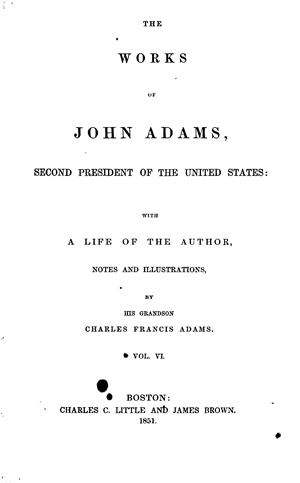
CHAPTER THIRD.: MARCHAMONT NEDHAM. ERRORS OF GOVERNMENT AND RULES OF POLICY. - John Adams, The Works of John Adams, vol. 6 (Defence of the Constitutions Vol. III cont’d, Davila, Essays on the Constitution) [1851]Edition used:The Works of John Adams, Second President of the United States: with a Life of the Author, Notes and Illustrations, by his Grandson Charles Francis Adams (Boston: Little, Brown and Co., 1856). 10 volumes. Vol. 6.
Part of: The Works of John Adams, 10 vols.About Liberty Fund:Liberty Fund, Inc. is a private, educational foundation established to encourage the study of the ideal of a society of free and responsible individuals. Copyright information:The text is in the public domain. Fair use statement:This material is put online to further the educational goals of Liberty Fund, Inc. Unless otherwise stated in the Copyright Information section above, this material may be used freely for educational and academic purposes. It may not be used in any way for profit.
CHAPTER THIRD.MARCHAMONT NEDHAM.
“The first error in ancient Christian policy, which hath indeed been a main foundation of tyranny, is that corrupt division of a state into ecclesiastical and civil.” Our author enlarges upon this error, and his speculations are worth reading; but as this is not likely to be the error of America, I shall leave it to be read when such danger approaches. “The second error is very frequent under all forms of government. It is this,—that care hath not been taken, upon all occasions of alteration, to prevent the passage of tyranny out of one form into another, in all the nations of the world. The interest of absolute monarchy and its inconveniences have been visible and fatal under the other forms, and given undeniable proof of this maxim by experience, in all times, that the interest of monarchy may reside in the hands of many as well as of a single person.” The interest of absolute monarchy he defines to be,— “An unlimited, uncontrollable, unaccountable station of power and authority in the hands of a particular person, who governs only according to the dictates of his own will and pleasure; and though it hath often been disguised by sophisters in policy, so as it hath lost its own name by shifting forms, yet the thing in itself hath been discovered under the artificial covers of every form, in the various revolutions of government. In Athens, when they had laid aside their king, the kingly power was retained still in all the after turns of government; for their decimal governors and their thirty tyrants were but a multiplied monarchy, the people being in a worse condition than before; for their kings had supervisors and senatic assemblies that did restrain and correct them; but the new governors having none, ran into all the heats and fits and wild extravagancies of an unbounded prerogative. Necessity and extremity opening the people’s eyes, they at length saw all the inconveniences of kingship wrapt up in new forms, and rather increased than diminished; so that (as the only remedy) they dislodged the power out of those hands, putting it into their own, and placing it in a constant, orderly revolution of persons elective by the community. And now, one would have thought there was no shelter for a monarchal interest, under a popular form too. But alas! they found the contrary; for the people not keeping a strict watch over themselves, according to the rules of a free state, but being won by specious pretences, and deluded by created necessities to intrust the management of affairs into some particular hands, such an occasion was given thereby to those men to frame parties of their own, that by this means they in a short time became able to do what they list without the people’s consent; and, in the end, not only discontinued, but utterly extirpated their successive assemblies.” I have given this at length, in our author’s own words, because it is an exact compendium of the whole history of Athens, and shows that he had read it attentively, and understood it perfectly well; and because it is a complete refutation of his own system, his Right Constitution of a Commonwealth. Absolute monarchy, unlimited power in a particular person, who governed by his own will, run through all the history and changes in Athens, according to his own account, even when the people had placed the supreme power in an orderly revolution of persons elective by themselves. Why? “Because the people did not keep a watch over themselves.” Did any other people keep a strict watch over themselves? Will any people ever keep a strict watch over themselves? No, surely. Is not this, then, a sufficient reason for instituting a senate to keep a strict watch over them? Is not this a sufficient reason for separating the whole executive power from them, which they know will, and must corrupt them, throw them off their guard, and render it impossible to keep a strict watch over themselves?” “They did not observe the rules of a free state.” Did any people, that ever attempted to exercise unlimited power, observe the rules of a free state? Is it possible they should, any more than obey, without sin, the law of nature and nature’s God? When we find one of these sorts of obedience, we may expect the other. If this writer had been one of the enthusiasts of that day, and told the people they must pray to God for his omnipotent grace to be poured out upon them, to distinguish them from all the rest of mankind as his favorite people, more even than the Jews were, that they might be enabled to observe the rules of a free state, though all history and experience, even that of the Hebrews themselves, and the constitution of human nature, proved it impossible without a miracle; or if he had told them that they were a chosen people, different from all other men, numbers would have believed him, and been disappointed; for it is impious presumption to suppose that Providence will thus distinguish any nation; but it would have been more sensible than thus to acknowledge in effect, as he does repeatedly, the impracticability of his scheme, and still insist upon it. “The people were won by specious pretences, and deluded by created necessities, to intrust the management of affairs into some particular hands.” And will not the people always be won by specious pretences, when they are unchecked? Is any people more sagacious or sensible than the Athenians, those ten thousand citizens, who had four hundred thousand slaves to maintain them at leisure to study? Will not a few capital characters in a single assembly always have the power to excite a war, and thus create a necessity of commanders? Has not a general a party of course? Are not all his officers and men at his devotion so long as to acquire habits of it? When a general saves a nation from destruction, as the people think, and brings home triumph, peace, glory, and prosperity to his country, is there not an affection, veneration, gratitude, admiration, and adoration of him, that no people can resist? It is want of patriotism not to adore him; it is enmity to liberty; it is treason. His judgment, which is his will, becomes the only law; reason will allay a hurricane as soon; and if the executive and judicial power are in the people, they at once give him both, in substance at first, and not long afterwards in form. The representatives lose all authority before him. If they disoblige him, they are left out by their constituents at the next election, and one of his idolaters is chosen. “In Rome, also, the case was the same, under every alteration; and all occasioned by the crafty contrivances of grandizing parties, and the people’s own facility and negligence in suffering themselves to be deluded; for with the Tarquins (as it is observed by Livy and others) only the name king was expelled, but not the thing; the power and interest of kingship was still retained in the senate, and engrossed by the consuls; for besides the rape of Lucretia, among the other faults objected against Tarquin, this was most considerable, that he had acted all things after his own head, and discontinued consultations with the senate, which was the very height of arbitrary power; but yet as soon as the senate was in the saddle, they forgot what was charged by themselves upon Tarquin, and ran into the same error, by establishing an arbitrary, hereditary, unaccountable, power in themselves and their posterity, not admitting the people (whose interest and liberty they had pleaded) into any share in consultation or government, as they ought to have done, by a present erecting of their successive assemblies; so that you see the same kingly interest, which was in one before, resided then in the hands of many. Nor is it my observation only, but pointed out by Livy, in his second book, and in many other places, ‘Cum a patribus non consulem sed carnificem, &c.’ when the senators strove to create, not consuls, but executioners and tormentors, to vex and tear the people, &c. And in another place of the same book, ‘Consules, immoderatâ infinitaque potestate, omnes metus legum, &c.’ the consuls, having an immoderate and unlimited power, turned the terror of laws and punishments only upon the people, themselves (in the mean while) being accountable to none but themselves, and their confederates in the senate. Then, the consular government being cashiered, came on the decemviri: ‘Cum consulari imperio ac regio, sine provocatione,’ saith my author; being invested with a consular and kingly power, without appeal to any other. And in his third book he saith, ‘Decem regum species erat,’ it was a form of ten kings; the miseries of the people being increased ten times more than they were under kings and consuls. For remedy, therefore, the ten were cashiered also; and consuls being restored, it was thought fit, for the bridling of their power, to revive also the dictatorship (which was a temporary kingship, used only now and then upon occasion of necessity) and also those deputies of the people, called tribunes, which one would have thought had been sufficient bars against monarchic interest, especially being assisted by the people’s successive assemblies; but yet, for all this, the people were cheated through their own neglect, and bestowing too much confidence and trust upon such as they thought their friends; for when they swerved from the rules of a free state, by lengthening the dictatorship in any hand, then monarchic interest stept in there, as it did under Sylla, Cæsar, and others, long before it returned to a declared monarchal form; and when they lengthened commands in their armies, then it crept in there, as it did under the aforenamed persons, as well as Marius, Cinna, and others also; and even Pompey himself, not forgetting the pranks of the two triumvirates, who all made a shift under every form, being sometimes called consuls, sometimes dictators, and sometimes tribunes of the people, to outact all the flagitious enormities of an absolute monarchy.” This valuable passage, so remarkable as an abridgment of the Roman history, as containing the essence of the whole that relates to the constitution, as a profound judgment of what passes in all societies, has been transcribed in the author’s own words; and, it may be truly said, it contains a full confutation of his own system, and a complete proof of the necessity of the composition of three branches. It is strictly true, that there is a strong and continual effort in every society of men, arising from the constitution of their minds, towards a kingly power; it is as true in a simple democracy, or a democracy by representation, as it is in simple aristocracy, oligarchy, or monarchy, and in all possible combinations and mixtures of them. This tendency can never be eradicated; it can only be watched and controlled; and the whole art of government consists in combining the powers of society in such a manner, that it shall not prevail over the laws. The excellence of the Spartan and Roman constitutions lay in this; that they were mixtures which did restrain it, in some measure, for a long period, but never perfectly. Why? Because the mixture was not equal. The balance of three branches is alone adequate to this end; and one great reason is, because it gives way to human nature so far, as to determine who is the first man. Such is the constitution of men’s minds, that this question, if undecided, will forever disorder the state. It is a question that must be decided, whatever blood or wounds it may occasion, in every species of gregarious animals, as well as men. This point, in the triple division of power, is always determined; and this alone is a powerful argument in favor of such a form. Our author’s Right Constitution is the worst of all possible forms in this respect. There are more pretenders; the choice of means is multiplied; the worst men have too much influence in the decision, more, indeed, than the best; and the whole executive and judicial powers, and the public treasure too, will be prostituted to the decision of this point. In the state of nature, when savage, brutal man ranged the forests with all his fellow-creatures, this mighty contest was decided with nails and teeth, fists, stones, and clubs, in single combats, between all that dared to pretend. Amidst all the refinements of humanity, and all the improvements of civil life, the same nature remains, and war, with more serious and dreadful preparations, and rencounters of greater numbers, must prevail, until the decision takes place. “The people,” says our author, “were cheated through their own neglect, and bestowing too much confidence and trust upon such as they thought their friends.” And could he quote an instance from all history of a people who have not been cheated; who have not been negligent; who have not bestowed too much confidence and trust upon such as they thought their friends; who have not swerved from the rules of a free state, by lengthening power in hands that hold it? Can he give a plausible reason to hope that such a people will ever appear? On the contrary, is it not demonstrable that such a people is impossible, without a miracle and a renovation of the species? Why, then, should the people be bribed to betray themselves? Putting the executive power into their hands is bribing them to their own destruction; putting it into the hands of their representatives is the same thing, with this difference for the worse, that it gives more opportunity to conceal the knavery. Giving the executive power to the senate is nearly the same, for it will be in that case used in bribes, to elevate certain senatorial families. All projects of government, formed upon a supposition of continual vigilance, sagacity, and virtue, firmness of the people, when possessed of the exercise of supreme power, are cheats and delusions. The people are the fountain of power; they must, in their constitution, appoint different orders to watch one another, and give them the alarm in time of danger. When a first magistrate, possessed of the executive, can appeal to the people in time of danger; when a senate can appeal to the people; and when a house of commons can appeal to the people; when it is the interest of each, in its turn, to appeal to the people; when self-preservation causes such appeal; then, and then only, can the people hope to be warned of every danger, and be put constantly on their guard, kept constantly vigilant, penetrating, virtuous, and steady. When their attention, too, is fixed only upon the preservation of the laws, and they cannot be diverted like apes, by throwing the nuts of the executive power among them, to divide them. When they have any thing to do with the executive power, they think of nothing else but scrambling for offices, and neglect altogether the legislature and the laws, which are their proper department. All the flagitious enormities of absolute monarchy will be practised by the democratical despot, triumvirs, decemvirs, who get possession of the confidence of the majority. Florence testifies the same truth. “Even when it seemed most free, it was ever the business of one upstart or other, either in the senate or among the people, to make way to their own ambitious ends, and hoist themselves into a kingly posture through the people’s favor; as Savonarola, Soderini, and the Medici, whose family fixed itself in a dukedom. Nor can it be forgotten how much of monarchy, of late, crept into the United Provinces.” The conclusion is that, “since the interest of monarchy” (that is, arbitrary power, or the government of men) “may reside in a consul as well as in a king; in a dictator as well as in a consul; in the hands of many as well as of a single person; and that its custom hath been to lurk under every form, in the various turns of government; therefore it concerns every people in a state of freedom, to keep close to the rules of a free state for the turning out of monarchy, whether simple or compound, both name and thing, in one or many; so they ought ever to have a reverend and noble respect of such founders of free states and commonwealths, as shall block up the way against monarchic tyranny, by declaring for the liberty of the people, as it consists in a due and orderly succession of authority in their supreme assemblies;” that is, for himself, Oliver Cromwell, and their party, for no other such founders of commonwealths had then ever existed. The true conclusion from all the reasoning and all the examples, under this second head of Error in Policy, ought to have been, that arbitrary power, or the interest of monarchy, or the government of men, cannot be prevented, nor the government of laws supported, but by mixing the powers of the one, the few, and the many, in equal proportions, in the legislature; by separating the executive from the legislative power, and the judicial department from both. The third error in policy is, “keeping the people ignorant of those ways and means that are essentially necessary for the preservation of their liberty; for implicit faith and blind obedience hath hitherto passed current, and been equally pressed and practised by grandees, both spiritual and temporal, upon the people.” Under this head, our author merits all the approbation and praise that can be bestowed upon him. The instruction of the people, in every kind of knowledge that can be of use to them in the practice of their moral duties, as men, citizens, and Christians, and of their political and civil duties, as members of society and freemen, ought to be the care of the public, and of all who have any share in the conduct of its affairs, in a manner that never yet has been practised in any age or nation. The education here intended is not merely that of the children of the rich and noble, but of every rank and class of people, down to the lowest and the poorest. It is not too much to say, that schools for the education of all should be placed at convenient distances, and maintained at the public expense. The revenues of the state would be applied infinitely better, more charitably, wisely, usefully, and therefore politically, in this way, than even in maintaining the poor. This would be the best way of preventing the existence of the poor. If nations should ever be wise, instead of erecting thousands of useless offices, or engaging in unmeaning wars, they will make a fundamental maxim of this, that no human being shall grow up in ignorance. In proportion as this is done, tyranny will disappear, kings and nobles will be made to feel their equitable equality with commoners, and commoners will see their interest and duty to respect the guardians of the laws; for guardians they must have as long as human nature endures. There is no room to doubt that the schools, academies, aud universities, the stage, the press, the bar, pulpit, and parliament, might all be improved to better purpose than they have been in any country for this great purpose. The emanations of error, folly, and vice, which proceed from all these sources, might be lessened, and those of wisdom, virtue, and truth, might be increased; more of decency and dignity might be added to the human character in high and low life; manners would assist the laws, and the laws reform manners; and imposture, superstition, knavery, and tyranny, be made ashamed to show their heads before the wisdom and integrity, decency and delicacy, of a venerable public opinion. But it is in vain that our author endeavors to throw the blame of impressing implicit faith and blind obedience upon grandees, spiritual and temporal; for the grandees he contends for, both spiritual and temporal, I mean the first man and other principal members of his successive representative assemblies, will have as much occasion to keep the people in ignorance, and more opportunity to conceal truth and propagate falsehood, than those whom he calls standing powers. All intelligence and information will be directed to them; they may conceal what they will, and they will conceal every thing they can from their adversaries, the minority, and even much from their own followers. It is a mixed government alone that can bear that truth and knowledge should be communicated freely to the people; and in a mixed government alone can the people compel all men to communicate such information as ought to be laid before them. The majority in a single assembly can conceal much from the minority, indeed almost what they will; but the crown, or its ministers, can conceal nothing from a house of representatives which they ought to know. It is very true, that a people who have declared themselves “a free state should know what freedom is, and have it represented in all its lively and lovely features, that they may grow zealous and jealous over it. They should also be made acquainted and thoroughly instructed in the means and rules of its preservation against the adulterous wiles and rapes of any projecting sophisters that may arise.” How different from this, alas! is the deplorable state of mankind! “Ce n’est qu’en Angleterre, où l’on pourroit faire ou avoir des livres sur les constitutions,” said one of the most enlightened ambassadors in Europe; and it is but a very few years since a French gentleman answered a foreigner, who inquired for the best book upon the constitution of France, “Monsieur, c’est l’Almanach Royal.”1 “The fourth error in policy hath been the regulation of affairs by reason of state, not by the strict rule of honest.” It is unnecessary to follow our author through Greece and Italy, the Old Testament and the New, through France, Spain, and England, for instances of this raggione di stato, this kingcraft and priestcraft; it is well enough known; but it may be practised with more facility in a simple democracy than in any other government. The leaders of a majority have only to allege “reason of state” to justify themselves to their partisans for every species of tyranny and oppression over the minority, until they become strong enough to allege the same “reason of state” to justify their tyranny over their own party. “Fifth Error. Permitting of the legislative and executive powers of a state to rest in one and the same hands and persons. By the legislative power we understand the power of making, altering, or repealing laws, which, in all well-ordered governments, hath ever been lodged in a succession of the supreme councils or assemblies of a nation. By the executive power we mean that power which is derived from the other, and by their authority transferred into the hands of one person, called a prince, or into the hands of many, called states, for the administration of government in the execution of those laws. In the keeping of these two powers distinct, flowing in distinct channels, so that they may never meet in one, save upon some short, extraordinary occasion, consists the safety of a state. The reason is evident; because, if the law-makers (who ever have the supreme power) should be also the constant administrators and dispensers of law and justice, then, by consequence, the people would be left without remedy in case of injustice, since no appeal can lie under heaven against such as have the supremacy; which, if once admitted, were inconsistent with the very intent and natural import of true policy, which ever supposeth that men in power may be unrighteous, and therefore, presuming the worst, points always, in all determinations, at the enormities and remedies of government, on the behalf of the people. For the clearing of this, it is worthy your observation, that in all kingdoms and states whatsoever, where they have had any thing of freedom among them, the legislative and executive powers have been managed in distinct hands; that is to say, the law-makers have set down laws as rules of government, and then put power into the hands of others, not their own, to govern by those rules; by which means the people were happy, having no governors but such as were liable to give an account of government to the supreme council of law-makers. And, on the other side, it is no less worthy of a very serious observation, that kings and standing states never became absolute over the people, till they brought both the making and execution of laws into their own hands; and as this usurpation of theirs took place by degrees, so unlimited, arbitrary power crept up into the throne, there to domineer over the world, and defy the liberties of the people.” Let us pause here with astonishment. A person who had read the former part of the book with attention, would think these words a complete refutation of his whole “Right Constitution of a Commonwealth.” The whole drift of the book before this was to prove, that all authority should be collected into one centre; that the whole legislative and judicial power, as well as the executive, was to be vested in successive, supreme sovereign assemblies of the people’s representatives; and our endeavor has been to show, that this would naturally be applied to corruption in election, to promote division, faction, sedition, and rebellion. All this is now very frankly admitted, and “the safety of the state” depends upon placing the power of making laws, of executing them, and administering justice, in different hands. But how is this to be done? “The executive power,” our author tells us, “is derived from the legislative; and by their authority transferred into the hand of one person, called a prince, or into the hands of many, called states, for the administration of government in the execution of those laws.” This is totally denied. The executive power is not naturally, nor necessarily, and ought never to be in fact, derived from the legislative. The body of the people, according to our author and to truth, is the fountain and original of all power and authority, executive and judicial, as well as legislative; and the executive ought to be appointed by the people, in the formation of their constitution, as much as the legislative. The executive represents the majesty, persons, wills, and power of the people in the administration of government and dispensing of laws, as the legislative does in making, altering, and repealing them. The executive represents the people for one purpose, as much as the legislative does for another; and the executive ought to be as distinct and independent of the legislative, as the legislative is of that. There is no more truth, nature, or propriety, in saying that the executive is derived from the legislative, than that the legislative is derived from the executive; both are derived from the people. It is as untrue to say that the executive power is transferred by the authority of the legislative into the hands of a prince, as it would be to say that the legislative power was transferred by the authority of the prince into the hands of a legislative assembly. The people may, indeed, by their constitution, appoint the house of representatives, to represent them in watching the executive magistrates, and in accusing them of misrule and misdemeanors; they may appoint a senate to represent them, in hearing and determining upon those accusations. The people are represented by every power and body in the state, and in every act they do. So the people are represented in courts of justice by the judges and juries, grand and petit, in hearing and determining complaints against ministers of the executive power, as well as members of the senate and the house. It is true the body of the people have authority, if they please, to empower the legislative assembly or assemblies to appoint the executive power, by appointing a prince, president, governor, podestà, doge, or king, and to call him by which of these names they please; but it would be a fatal error in policy to do it, because it would in fact amount to the same thing which our author seemed to contend for through his whole book, and which he now allows to be inconsistent with the safety of the state, namely,—a union of the legislative and executive powers in the same hands. Whoever appoints bishops and judges will dictate law and gospel. Whoever appoints a general will command the army; an admiral, the fleet. Any executor of the law will have it executed as he will. It makes the executive power a mere tool of the legislative, and the prince a weathercock blown about by the leading member of the house. Every commission will be disposed of as the lord and master in the house shall direct; military discipline will bow before his nod; and the judicial power must have the same complaisance; so that both executive and judicial powers will be prostituted to corrupt the people in elections, and the members of the house, as much as if all these powers were exercised in the house, and all the legislative, executive, and judicial powers in the same hands, the state unsafe, the people left without remedy, in case of injustice, but by an appeal to Heaven, by our author’s own confession. “In all free states, the legislative and executive powers have been managed in distinct hands,” says our author; “that is, the law-makers have set down rules, and then put power into the hands of others to govern by those rules.” I wonder where. In Sparta, the executive power was in the kings, hereditary kings, not appointed by the senate, or either of the popular assemblies, that of the city, or that for the country; in Athens, the executive power was in the archons; in Rome, first in kings, and then in consuls, through all the period of the republic; but, what is worse, some important executive powers were reserved in the hands of the senate in Sparta, in the popular assemblies in Athens, in the senate in Rome; that is, the executive and legislative powers were so far united, which finally produced the ruin of all of them. In short, our author is perfectly right in his rule, that the two powers ought to be distinct, and in the fatal effects of their union; but totally wrong in deriving one from the other, and in his examples to show they ever were so derived. But as the separation and division of authority, for the preservation of equity, equality, and liberty, in opposition to the union of it simply in one, the few, or the many, is the end of all the pains we have taken upon this subject, not a word of assistance afforded us by our author ought to be lost. He goes on,— “Cicero, in his second book, De Officiis, and his third, De Legibus, speaking of the first institution of kings, tells us, how they were at first left to govern at their own discretion, without laws. Then their wills and their words were law; the making and execution of laws were in one and the same hands. But what was the consequence? Nothing but injustice, and injustice without remedy, till the people were taught by necessity to ordain laws, as rules whereby they ought to govern. Then began the meeting of the people successively in their supreme assemblies to make laws, whereby kings, in such places as continued under the kingly form, were limited and restrained, so that they could do nothing in government but what was agreeable to law, for which they were accountable, as well as other officers were in other forms of government, to those supreme councils and assemblies. Witness all the old stories of Athens, Sparta, and other countries of Greece, where you shall find, that the law-making and the law-executing powers were placed in distinct hands under every form of government; for so much of freedom they retained still under every form, till they were both swallowed up, as they were several times, by an absolute domination. “In old Rome we find Romulus, their first king, cut in pieces by the senate, for taking upon him to make and execute laws at his own pleasure; and Livy tells us, that the reason why they expelled Tarquin, their last king, was, because he took the executive and legislative powers both into his own hands, making himself both legislator and officer, inconsulto senatu, ‘without advice, and in defiance of the senate.’ “Kings being cashiered, then their standing senates came in play, who, making and executing laws by decrees of their own, soon grew intolerable, and put the people upon divers desperate adventures, to get the legislative power out of their hands, and place it in their own, that is, in a succession of their supreme assemblies; but the executive power they left, part in the hands of officers of their own, and part in the senate; in which state it continued some hundreds of years, to the great happiness and content of all, till the senate, by sleights and subtilties, got both powers into their own possession again, and turned all into confusion. “Afterwards, their emperors (though usurpers) durst not at first turn both these powers into the channel of their own unbounded will; but did it by degrees, that they might the more insensibly deprive the people of their liberty, till at length they openly made and executed laws at their own pleasure, being both legislators and officers, without giving an account to any; and so there was an end of the Roman liberty. “To come nearer home, let us look into the old constitution of the commonwealths and kingdoms of Europe. We find in the Italian states, Venice, which having the legislative and executive power confined within the narrow pale of its nobility in the senate, is not so free as once Florence was, with Siena, Milan, and the rest, before their dukes, by arrogating both those powers to themselves, wormed them out of their liberty. “Of all those states, only Genoa remains in a free posture, by keeping the power of legislation only in their supreme assemblies, and leaving the execution of law in a titular duke and a council. The keeping of these powers asunder, within their proper sphere, is one principal reason why they have been able to exclude tyranny out of their own state, while it hath run the round in Italy. “What made the Grand Signor absolute of old, but his engrossing both these powers? and of late the kings of Spain and France? In ancient times, the case stood far otherwise; for in Ambrosio Morales his Chronicle you will find, that in Spain the legislative power was lodged only in their supreme council, and their king was no more but an elective officer, to execute such laws as they made, and, in case of failing, to give them an account, and submit to their judgments, which was the common practice, as you may see also in Mariana. It was so, also, in Arragon, till it was united to Castile by the marriage of Ferdinand and Isabella; and then both states soon lost their liberty by the projects of Ferdinand and his successors, who drew the powers of legislation and execution of law within the verge and influence of the prerogative royal; whilst these two powers were kept distinct, then these states were free; but the engrossing of them in one and the same hands, was the loss of their freedom. “France, likewise, was once as free as any nation under heaven; though the king of late hath done all, and been all in all, till the time of Louis XI. he was no more but an officer of state, regulated by law, to see the laws put in execution, and the legislative power rested in the assembly of the three estates; but Louis, by snatching both these powers into the single hands of himself and his successors, rooked them out of their liberty, which they may now recover again, if they have but so much manhood as to reduce the two powers into their ancient, or into better channels. “This pattern of Louis was followed close by the late king of England (Charles I.) who, by our ancient laws, was the same here that Louis ought to have been in France, an officer in trust, to see to the execution of the laws; but by aiming at the same ends which Louis attained, and straining, by the ruin of parliaments, to reduce the legislative power, as well as the executive, into his own hands, he, instead of an absolute tyranny, which might have followed his project, brought a swift destruction upon himself and his family. “Thus you see it appears, that the keeping of these two powers distinct hath been a ground preservative of the people’s interest, whereas their uniting hath been its ruin all along in so many ages and nations.” This passage at large, in the author’s own words, has been quoted with pleasure, because, although the accuracy of it in every particular cannot be answered for, the principle and examples are good, and he might have added as many more examples as there were or had been simple governments in the world. It is in mixed governments alone where these two powers are separated. But the misfortune is, that our author contends for a mixed government, and a separation of the legislative and executive powers, in name and appearance only. If the executive is appointed by, or derived from, the legislative, it is still in essence but one power, and in the same hands. It is inaccurate to say, that in “Athens and Sparta” the law-making and law-executing powers were placed in distinct hands under every form of government. It would be nearer the truth to say, that they were free and happy in proportion as they separated these powers. But the fact is, these powers were never wholly separated; part of the executive always was in the legislative, and sometimes all of it, and these errors proved their ruin. When “the executive power was left by the people of Rome partly in the hands of officers of their own, and partly in the senate,” it was a continual object of jealousy and contention between the senate and people. Whether France was ever “as free as any nation under heaven,” or not, may be learned from Boulainvilliers,* the Abbé de Mably,† and M. Moreau.‡ To read through the voluminous histories of Father Daniel, Mezeray, Velly, and consult original authorities, as Gregory of Tours, Froissart, &c. would be a tedious enterprise, and, after all, the controversy would remain. Boulainvilliers contends that France was a republic, and that the feudal lords had a right to make war upon the kings and upon one another; but it was, according to him, but an aristocracy. M. Moreau, who examines all the other writers, as Boulainvilliers, Du Bos, De Mably, &c. contends that the monarchs have ever been absolute; but at what period the common people, such as farmers, mechanics, merchants, &c. were admitted to a vote in the choice of their rulers, even of the procurators of cities and boroughs which composed the third estate, the public would yet be glad to be informed. Louis XVI. has the unrivalled glory of admitting the people to a share in the government. Upon what grounds our author could pretend that France was ever as free as any nation under heaven is utterly incomprehensible. The kings, nobles, and clergy, were such standing powers as our author detested; and the third estate was very far from being an adequate representation of the people; so that the assemblies of the states, and the ancient parliaments, were by no means successions of the people’s sovereign assemblies. The constitutions of the cortes in Castile, Arragon, Portugal, and all the other kingdoms now united under the kings of Spain or Portugal, were equally repugnant to our author’s system, and equally destructive of it.* “Sixth Error. Reducing transactions and the interests of the public into the disposition and power of a few particular persons. The ill consequences have been, that matters were not carried by fair debate, but by design and surprise; not by deliberation of the people in their open assemblies, but according to the premeditated resolutions and forestalments of crafty projectors in private juntos; not according to the true interest of state, but in order to the serving of men’s ends; not for the benefit and improvement of the people, but to keep them under, as ignorant of true liberty as the horse and mule, to be bridled, saddled, and ridden, under the wise pretences of being governed and kept in order. But the grand and worse consequence of all hath been this; that such colleagues, partners, and engrossers of power, having once brought about their ends by lying practices upon the people, have ever fallen into fits of emulation against themselves, and their next design hath ever been to rook their fellows and rid themselves of competitors, so that at length they have been their own executioners, and ruined one another. And the people having by this means been torn with civil dissensions and the miseries of war, by being drawn into parties, according to their several humors and affections, the usual event ever was, that in the end they have been seized as the prey of some single tyrant.” It must be confessed our author understands himself and his subject very well. He is aware of all the difficulties and dangers, but yet he will not see, or will not confess, that his own Right Constitution remains exposed to all their ravages, without the smallest provision to defend it. How will it be possible, in a single sovereign assembly, to prevent transactions and public interests falling into the disposition of a few? How will it be possible that matters should always be carried by friendly debate, and not by design and surprise, by premeditated resolutions of crafty projectors in private cabinets; not according to public interest, but private ends; not for the benefit of the people, but to keep them in ignorance, to be bridled and ridden? How can such colleagues and partners be prevented from imposing lying practices on the people, from emulation, envy, and jealousy among themselves, and from rooking one another? How shall the people be prevented from being torn with civil dissensions, and drawn into parties, by their several humors, principles, superstitions, prejudices, fancies, and affections? and how shall all this be prevented from ending in a single tyranny? Not one check, not the least restraint, no appearance of balance or control, is once mentioned or thought of. For an executive appointed by the legislative will be none at all; it will only facilitate intrigue and artifice, to disguise and conceal the blackest designs. The example of the thirty tyrants of Athens is a proof of this. “Xenophon tells us they drew the determinations of all things into their own closets, but seemed to manage them ‘calculis et suffragiis populi,’ by the votes of the people, which they had brought to their own devotion in the assembly, to countenance their proceedings. And their custom was, if any sort of men complained and murmured at their doings, or appeared for the public, immediately to snap them off by the loss of life or fortune, under a pretence of being seditious and turbulent fellows against the peace of their tyranny.” But will not such thirty or less number of tyrants arise in every single sovereign assembly and behave in the same manner? In a representative assembly they may take off a troublesome member in an easier manner, by applying the executive and judicial powers and the public treasure among his constituents, to have him rejected or left out at the next election. “The event of the thirty tyrants’ combination was a civil war, which ended in their banishment; but a new junto of ten men got into their places, whose government proving little less odious than the former, gave occasion to new changes, which never left shifting till they fell into a single tyranny.” If “the wilder sort of people, having by a sad experience felt the fruits of their own error, in following the lusts of particular powerful persons, grew wise, and combining with the honester sort, they all, as one man, set their shoulders to the work, and restored the primitive majesty and authority of their supreme assemblies,” how long did it last? Aristides himself began to destroy it, Themistocles did more, Pericles more still, and Alcibiades finished the ruin. It is not possible to say that the Athenian constitution operated as a steady system of liberty for one moment; because, although a multitude of checks played in it, there was no settled balance. The example cited from Herodotus is still more decisive in our favor, and against our author. “Monarchy being abolished in Egypt after the death of King Setho, and a declaration published for the freedom of the people, immediately the administration of all affairs was engrossed in the hands of twelve grandees” (or popular men, principes populi) “who, having made themselves secure against the people, in a few years fell to quarrelling with one another (as the manner is) about their share in the government. This drew the people into several parties, and a civil war ensued, wherein Psammeticus (one of the twelve) having slain all his partners, left the people in the lurch, and instead of a free state, seated himself in the possession of a single tyranny.” Our author might have quoted the example of the apostles themselves, who fell into disputes who should be the first in the kingdom they thought approaching. The two triumvirates are illustrious among thousands of other examples equally apposite. “Pompey, Cæsar, and Crassus, drew the affairs of the world into their hands, determining all in a private junto, without the advice or the consent of the senate or people, unless it were now and then to make stalking-horses of them, for the more clear conveyance of some unpleasing design. These men, having made an agreement among themselves, that nothing should be done in the commonwealth but what pleased their own humor, it was not long ere the spirit of ambition set them flying at the faces of one another, and drew the whole world upon the stage to act that bloody tragedy, whose catastrophe was the death of Pompey and the dominion of Cæsar. The second triumvirate was between Octavius, Lepidus, and Antony. These having shared the world between them, presently fell a bandying against one another. Augustus, picking a quarrel with Lepidus, gave him a lift out of his authority, and confined him to a close imprisonment in the city; next he picks a quarrel with Antony, begins a new civil war, in which he ruined Antony, and seated himself in the enjoyment of a single tyranny.” But our author should have remembered, that all this was after the senate had lost its authority, and the people, in their assemblies, assumed all power; and he should have been sensible, that thus it will and must ever be, in all simple governments, to the end of the world. “In the great contest between Henry III. and the barons, about the liberties of themselves and the people, the king being forced at length to yield, the lords, instead of freeing the nation, indeed, engrossed all power into their own hands, under the name of the twenty-four conservators of the kingdom, and behaved themselves like totidem tyranni, acting all in their own names, neglecting or overruling parliaments. But then, not agreeing among themselves, there were three or four of them defeated the other twenty, and drew the entire management of affairs into their own hands, namely,—the Earls of Leicester, Gloucester, Hereford, and Spencer. Yet it continued so not long; for Leicester getting all into his power, fell at enmity with Gloucester, and was defeated by him. “At length Leicester, putting his fortune to a battle, was slain; and the king thereupon getting all power back again, took advantage of that opportunity for the greatening himself and his prerogative. “And so you see all that the people got by the effusion of their blood and loss of their peace was, that instead of one tyrant they had twenty-four, and then four; and after them a single usurper (Montfort, Earl of Leicester); and he being gone, they were forced to serve their old tyrant Henry III. again, who by this means became the more secure and firm in his tyranny.” And are not all these examples, and millions of others that happen in every village, hamlet, and burgade in the world (for in all these there are contentions for precedence, and men who would rather be there the first than the second in Rome, as sincerely as Cæsar) enough to convince the people and popular writers of the necessity of more than one branch of power, and indeed of more than two? The single struggle for the first place must eternally distract every simple government, and must disturb every one that has only two branches. Unless there is a legal, constitutional, and habitual mode of always determining who shall be foremost, there can be no tranquillity among mankind. Grave exhortations to single assemblies, whether senates or representatives, not to permit public transactions to be engrossed, and rest in the power of a few particular persons, will be thrown away; for such are the contradictions in the human character, the multitude who have no hopes of being intrusted, are as servile as the few who have, are aspiring; and, upon the whole, there is more superiority in the world given than assumed. “Seventh Error. Driving of factions and parties. Faction destroyed Rome. The factions, headed by the two potent families of Hannibal and Hanno, destroyed Carthage. Faction made Rome stoop to Cæsar; Athens to Pisistratus. Faction let the Turk into Constantinople and Hungary; the Goths and Vandals into Spain and Italy; the Romans into Jerusalem. It subjected Genoa to the family of Sforza, Dukes of Milan; brought the Spaniard into Sicily and Naples; and the French into Milan, where they ousted Sforza.” To these instances might be added as many as you please; but it is amazing that all that have happened have not been sufficient to show the necessity of a government so mixed that factions may always be ruled. There can be no faction but of the one, the few, or the many; and a triple balance of equal powers affords a never-failing remedy against either; and if either of these is wanting, there is always not only a possibility and a probability, but an absolute certainty, of one species of faction arising, against which the constitution affords no defence. “Eighth Error. Violation of faith, principles, promises, and engagements, an impiety that ought to be exploded out of all nations that bear the name of Christians; and yet we find it often pass among the less discerning sort of men for admirable policy; and those impostors that used it, have had the luck to be esteemed the only politicians.” Our author wisely and nobly condemns the reasoning of Machiavel, in his Prince, “that, because the greatest part of the world being wicked, unjust, deceitful, full of treachery and circumvention, there is a necessity that those who are downright, and confine themselves to the strict rule of honesty, must ever look to be overreached by the knavery of others.” He quotes, too, from Machiavel: “This part hath been covertly showed to princes by ancient writers, who say that Achilles, and many others of those ancient princes, were intrusted to Chiron the Centaur, to be brought up under his discipline. The moral of this having for their teacher one that was half a beast and half a man, was nothing else, but that it was needful for a prince to understand how to make his advantage of the one and other nature, because neither could submit without the other.” Without condemning our species so far as Machiavel, by pronouncing the greatest part wicked; or going the length of the ancients, in supposing them half beasts; or of some moderns, in calling them half devils, candor, and charity itself, must allow, that in all great nations, at least, there are many both wicked, brutal, and diabolical; and enough of both to trample on the laws, and disturb the peace, liberty, and property of the good and humane, unless provision is made in the constitution to restrain them. In all simple governments, the worst part of the species are least controlled and have most temptations; and from hence arises a new and strong argument in favor of such a mixture, as shall guard every avenue to imposture and every inlet to vice. Although the vices and follies of mankind, no more than their diseases and bodily infirmities, can never be wholly eradicated in this mixed state of good and evil, and we cannot rationally hope that policy will ever change the earth into heaven, yet the balance of three branches appears to afford all that the constitution and course of things will admit; at least, all that have hitherto been discovered. It would be folly to say, that no further improvements can be discovered. The moral and intellectual world is as little known as the physical. We may hope, from education, inquiry, and experiment, great advances; but, until they are further pursued, let us adopt such as have already been found practicable and useful. There is one alteration which will be found indispensable, before any great meliorations can be made in society and government, some more rational method of determining the people’s votes in elections, and some effectual provision against corruption. The cry of family fortune, some prejudice of superstition, some habitual fondness, a prejudice, a whim, a name, too often determine the votes of multitudes, even when grosser profligacy has no share. The people must be taught to be governed more by reason, and less by sounds. The word king, like magic, excites the adoration of some, and execration of others; some, who would obey the lawful orders of a king, would rebel against the same orders, given by the same authority, under the name of governors or president; others would cheerfully submit to a governor or president, but think rebellion against a king with only the same authority, virtue, and merit, and obedience to God. Until the nature of things is more generally understood by the people, and mere sounds have less influence, it will be in vain to expect any great improvements. There is another particular, too, in which, I suspect, the people must change the fundamental maxim of their policy throughout the world, before much further improvements will be made. The people, in all ages and countries, have laid it down as a rule, that their service must be perfectly disinterested. No man deserves to be employed by them, who will not serve them gratis, at least, if not put himself to great expense to procure their votes. The consequences of this are many. 1. No man can serve them who is not rich. This is giving up at once their own right of election into the hands of an aristocracy, and that characteristic of aristocracy, too, which has the least merit in it, mere wealth. 2. This introduces a universal system of Machiavelian hypocrisy into popular elections; and those who are most interested, most corrupted, and most determined to carry the commodity to market, are the most liberal in their offers of a price to purchase it, the most ostentatious in professions of disinterested motives. Aristides, Fabricius, and Cincinnatus are eternally quoted, as if such characters were always to be found in sufficient numbers to protect the people’s liberties, and a cry and show of pure virtue is set up by the most profligate and abandoned of human kind, such as would sell their fathers, their country, and their God, for profit, place, and power. Hypocrisy, simulation, finesse, are not more practised in the courts of princes, than they are in popular elections; nor more encouraged by kings than people. Unless some means can be discovered to reform the people, and to enlighten them, to make rectitude, instead of chicanery, the visible, obvious interest both of governors and governed, it will be in vain to expect great changes for the better in government. To improve this, morals and science must be improved, extended, and made more general, if not universal; and, after all, perfection, we know, can never be attained in either. “First Rule of Policy. To educate the young fry in principles of dislike and enmity against kingly government, and enter into an oath of abjuration, to abjure a toleration of kings and kingly power in time to come.” This rule was made for Charles Stuart. Brutus made the Romans swear, “that they never should suffer any man again to reign at Rome. The Hollanders abjured Philip, his family, and all kings, forever.” These were inventions of aristocratical cunning, and the people were dupes for taking them. A king, meaning a single person vested with the whole executive, is the only remedy for the people, whenever the nobles get the better of them, and are on the scramble for unlimited power. Let every people have a care how they enslave themselves by such an oath, or lay themselves under the necessity of committing perjury. Let them swear, if they will, never to be governed by an absolute monarch; but even this had better be omitted, for there are cases in which an absolute monarch is a less evil than a crowd of lawless lords. A better oath for the common people would be, never to intrust any part of the executive power to a senate, or, in other words, to the body of the gentlemen. I am not without apprehensions that I have not made myself fully understood. The people, in all nations, are naturally divided into two sorts, the gentlemen and the simplemen, a word which is here chosen to signify the common people. By gentlemen are not meant the rich or the poor, the high-born or the low-born, the industrious or the idle; but all those who have received a liberal education, an ordinary degree of erudition in liberal arts and sciences, whether by birth they be descended from magistrates and officers of government, or from husbandmen, merchants, mechanics, or laborers; or whether they be rich or poor. We must, nevertheless, remember, that generally those who are rich, and descended from families in public life, will have the best education in arts and sciences, and therefore the gentlemen will ordinarily, notwithstanding some exceptions to the rule, be the richer, and born of more noted families. By the common people we mean laborers, husbandmen, mechanics, and merchants in general, who pursue their occupations and industry without any knowledge in liberal arts or sciences, or in any thing but their own trades or pursuits; though there may be exceptions to this rule, and individuals may be found in each of these classes who may really be gentlemen. Now it seems to be clear, that the gentlemen in every country are, and ever must be, few in number, in comparison of the simplemen. If you please, then, by the democratical portion of society we will understand the common people, as before explained; by the aristocratical part of the community we will understand the gentlemen. The distinctions which have been introduced among the gentlemen, into nobility greater or lesser, are perfectly immaterial to our present purpose; knights, barons, earls, viscounts, marquises, dukes, and even princes and kings, are still but gentlemen, and the word noble signifies no more than knowable, or conspicuous. But the gentlemen are more intelligent and skilful, as well as generally richer and better connected, and therefore have more influence and power than an equal number of the common people. There is a constant energy and effort in the minds of the former to increase the advantages they possess over the latter, and to augment their wealth and influence at their expense. This effort produces resentments and jealousies, contempt, hatred, and fear, between the one sort and the other. Individuals among the common people endeavor to make friends, patrons, and protectors among the gentlemen. This produces parties, divisions, tumults, and war. But as the former have most address and capacity, they gain more and more continually, until they become exorbitantly rich, and the others miserably poor. In this progress, the common people are continually looking up for a protector among the gentlemen, and he who is most able and willing to protect them acquires their confidence. They unite together by their feelings, more than their reflections, in augmenting his power, because the more power he has, and the less the gentlemen have, the safer they are. This is a short sketch of the history of that progress of passions and feelings which has produced every simple monarchy in the world; and, if nature and its feelings have their course without reflection, they will produce a simple monarchy forever. It has been the common people, then, and not the gentlemen, who have established simple monarchies all over the world. The common people, against the gentlemen, established a simple monarchy in Cæsar at Rome, in the Medici at Florence, &c., and are now in danger of doing the same thing in Holland; and if the British constitution should have its euthanasia in simple monarchy, according to the prophecy of Mr. Hume, it will be effected by the common people, to avoid the increasing oppressions of the gentlemen. If this is the progress and course of things (and who does not know that it is?) it follows, that it is the true interest and best policy of the common people to take away from the body of the gentlemen all share in the distribution of offices and management of the executive power. Why? Because if any body of gentlemen have the gift of offices, they will dispose of them among their own families, friends, and connections; they will also make use of their votes in disposing of offices, to procure themselves votes in popular elections to the senate or other council, or to procure themselves appointments in the executive department. It is the true policy of the common people to place the whole executive power in one man, to make him a distinct order in the state, from whence arises an inevitable jealousy between him and the gentlemen; this forces him to become a father and protector of the common people, and to endeavor always to humble every proud, aspiring senator, or other officer in the state, who is in danger of acquiring an influence too great for the law or the spirit of the constitution. This influences him to look for merit among the common people, and to promote from among them such as are capable of public employments; so that the road to preferment is open to the common people much more generally and equitably in such a government than in an aristocracy, or one in which the gentlemen have any share in appointments to office. From this deduction it follows, that the precept of our author, “to educate children (of the common people) in principles of dislike and enmity against kingly government, and enter into an oath of abjuration to abjure a toleration of kings and kingly powers,” is a most iniquitous and infamous aristocratical artifice, a most formal conspiracy against the rights of mankind, and against that equality between the gentlemen and the common people which nature has established as a moral right, and law should ordain as a political right, for the preservation of liberty. By kings and kingly power is meant, both by our author and me, the executive power in a single person. American common people are too enlightened, it is hoped, ever to fall into such a hypocritical snare; the gentlemen, too, it is hoped, are too enlightened, as well as too equitable, ever to attempt such a measure; because they must know that the consequence will be, that, after suffering all the evils of contests and dissensions, cruelty and oppression, from the aristocratics, the common people will perjure themselves, and set up an unlimited monarchy instead of a regal republic. The second rule of policy is, “not to suffer particular persons to grandize or greaten themselves more than ordinary; for that by the Romans was called ‘affectatio regni,’ an aspiring to kingship.” Mælius and Manlius are again cited. “The name of the latter was ever after disowned by his whole family, that famous family of the Manlii, and both the name and memory of him and of his consulship were razed out of all public records by decree of the senate.” It is certainly an essential rule in a free government, to suffer no man to greaten himself above the law. But it is impossible it should ever be observed in a simple democracy or aristocracy. What might not Manlius have done, if Rome had been governed by a single sovereign assembly of representatives? It was the aristocracy that murdered Manlius, much against the will of the democracy, so that the instance is against the author. The Orange family in Holland are mentioned too; but it is the common people who have supported that family for their protection against the aristocracy. It is agreed, however, by many respectable writers, that the family of Orange have been dangerous in that state, because the people have no constitutional share in the government, and the authority exercised by the stadtholder is not legally defined. If the people, therefore, in their anger, should augment the power of that house too much above the aristocracy, it would be absolute; but if the people should expel that house, they must set up another, as well as demand a share in the legislature for themselves, or become slaves and a prey to the aristocracy. It is a good rule for Holland to beware of too great a man; but it is equally necessary to beware of five thousand men, who may easily become too great. But in our author’s Right Constitution the observance of the rule is impossible. The people, if unrestrained by a senate or a king, will set up some one man, and advance him to a greatness of dignity and authority inconsistent with liberty. As soon as any one in such a government gets the command-in-chief of an army, he has the state in his power. The common people in Holland would assist the army in making the prince absolute (if, indeed, the prince would accept of a gift that would ruin his country as well as his house) if they were not restrained by a standing aristocratical power, which our author abhors. “Third Rule. Non diurnare imperia; not to permit a continuation of command and authority in the hands of particular persons or families.” This rule is undoubtedly necessary to preserve a simple aristocracy or democracy; but it is impracticable in both, and, therefore, it is impracticable to preserve an aristocracy or democracy. But this is by no means a necessary or proper rule in a well constituted free government. Command and authority may be continued for any number of years, or for life, in the same person, without the least danger; because, upon the smallest symptom of an inclination to abuse his power, he may be displaced by the executive, without danger or inconvenience. But in a simple aristocracy or democracy he cannot be removed at all; the majority will support him at all events; or, if they do not, the majority that removes him will be so small, that the minority who are his friends may often raise convulsions. It is a necessary rule, too, in such a mixed government as that of Rome, where, in the best of times, the people had an authority nearly equal to that of the senate. Where the mixture is of two powers only, and the executive is wholly in one of them, or partly in one and partly in another, they are in continual danger of the tyranny of a single person, on account of the frequent disputes between the two branches about the exercise of the executive and judicial power; but where the executive is in one hand, the legislative in three, and the judicial in hands different from both, there is rarely, if ever, any danger from a continuance of command in any one. Livy had good reason in the Roman state to say, “Libertatis magna custodia est, si magna imperia esse non sinas, et temporis modus imponatur; it is a grand preservative of liberty, if you do not permit great powers and commands to continue long, and if you limit in point of time.” And to this purpose the Æmilian law, if it could have been observed, would have been a good one. The noble Roman, in the ninth book, spoke in character, when he said, “Hoc quidem regno simile est,” and this indeed is like a kingship, that I alone should bear this great office of censorship triennium et sex menses three years and six months, contrary to the Æmilian law.” Livy, too, speaks in character, as a good citizen of an aristocratical government, when “in his third book he speaks of a monstrous business, that the ides of May were come (which was the time of their year’s choice) and yet no new election appointed. Id vero regnum haud dubie videri; deploratur in perpetuum libertas; it without doubt seems no other than a kingdom, and liberty is lost for ever. It was treason for any man to hold that high office of the dictatorship in his own hand beyond six months. Cicero’s Epistles to Atticus, concerning Cæsar, contain notable stuff to this purpose. The care of that people, in not permitting any man to bear the same office twice together,” was all in character, because continuance in high office constantly exposed the state and constitution to the danger of being overturned and converted into an absolute monarchy. In this constitution, too, in consequence of the checks between the senate, the tribunes, and the people, there was some chance for having this law observed. But an Æmilian law, in our author’s “Right Constitution,” would be made to no purpose; it would be set aside, without ceremony, when nothing but a vote of an all-powerful majority would be wanting to set it at defiance. But in a mixed constitution of three branches, such a law, if made, would be punctually executed, much more exactly and certainly than in the Roman constitution; but in such a constitution such a law would be unnecessary, as no danger can arise from the continuance of any general or admiral in command. The same reasoning is applicable to the free states of Greece, where “Aristotle tells us this rule was observed. The speech of Cincinnatus to the people, to persuade them to let him lay down his command, now the time was come, though the enemy was almost at the gates, and never more need than at that time of his valor and prudence,” is a terrible example against our author’s system. For, though “no persuasion would serve the turn, resign he would, telling them there would be more danger to the state in prolonging his power than from the enemy, since it might prove a pernicious precedent to the Roman freedom;” yet, as no more than two or three such characters as Cincinnatus appeared in seven hundred years, a statesman would be mad who should place the existence of his form of government upon the presumption that a succession of characters so disinterested would appear to resist the people themselves in their desire to violate a law. If the people at that period could forget a rule so essential to their safety, what are we to expect when they and their idols too are more corrupt? “M. Rutilius Censorinus, although he too made a speech against it, gave way to the people, when they forced him to undergo the office of censor twice together, contrary to the intent and practice of their ancestors, and accepted it upon this condition, that a law might pass against the title in that and other officers, lest it should be drawn into precedent in time to come.” But our author all along mistakes the spirit of this rule; it was an aristocratical regulation altogether; it was the senate and patricians who procured it to be observed, from an aristocratical motive and principle; from a jealousy of the people on one side, and of kingly power on the other. It is the same spirit which precipitated Cassius and Manlius from the rock, and put Mælius to death without ceremony. The people, or their representatives, if uncontrolled, would not probably ever make such a law; if they did, they would never long observe it. The people would not suffer it to be much or long observed in Rome, notwithstanding all the exertions of the aristocracy. The times soon came when Cincinnatuses and Censorinuses were not found to refuse power and office offered them against law, any more than Horatii and Valerii were found to postpone their private fortune to plebeian liberty. Even the Grecian aristocracies could not observe this rule. It was a law of Sparta that no man should be twice admiral; but Lysander had address enough to persuade his countrymen to give the title to Aratus, but the real command to himself, under the title of vice-admiral. Even in that which was in appearance the most democratical state of Greece, Achaia, Aratus had the real power and command when he was out of place as much as when he was in. Our author mistakes, too, the spirit of the law, “that no tribune should be continued two years together.” This law was a mere aristocratical artifice, to weaken the influence of the tribunes and their constituents, by preventing them from acquiring confidence, skill, and influence by experience. If the people had understood their own cause, they would have insisted upon the privilege of choosing the same tribune as long as they approved his conduct. “Fourth Rule. Not to let two of one family to bear offices of high trust at one time, nor to permit a continuation of great powers in any one family.” This rule is indispensable in aristocracies, where the sovereignty is in continual danger from individuals of great influence and powerful connections, where a jealousy of popular men and measures must be constantly kept up to its highest pitch. The Roman rule, “Ne duo vel plures ex unâ familiâ magnos magistratus gerant eodem tempore, let not two or more of one family bear great offices at the same time;” and the other, “Ne magna imperia ab unâ familiâ prescribantur, let not great commands be prescribed or continued in one family;” were necessary aristocratical rules, because, as the patricians were always afraid of the people, who were continually urging for more power, a very powerful family, by joining with the people, might have changed the constitution. It is a wise and useful rule in general in all governments; but in a simple democracy, though it may be more necessary than in any other form, it is always impracticable; the people will set it aside whenever they please, and will always be sure to depart from it in favor of a favorite man or family. But in a mixed constitution of three branches there is less necessity of observing the rule with strictness, and more facility of observing it when necessary. It is very doubtful whether the constitution of Rome could have been longer preserved, if Cicero had joined Antony instead of Octavius. The people were now uncontrolled and the senate had lost its authority; and the people behaved as they always do, when they pretend to exercise the whole executive and legislative power; that is, they set up immediately one man and one family for an emperor, in effect, sometimes respecting ancient forms at first, and sometimes rejecting them altogether. But of all rules, this is the least possible to persuade them to observe in such a case. The Florentine family of the Medici were set up in this manner by the people, who, as Machiavel informs us, aimed at all power, and a simple democracy; and in such cases, “Cosimus is always easily admitted to succeed his cousin Alexander.” It is not to be wondered at, that “Pompeius Columba stood up in the conclave, and showed them how dangerous and prejudicial it must of necessity prove to the liberties of Italy, that the popedom should be continued in one house, in the hands of two brothers, one after another;” but if the election of a pope had depended upon the people of Florence, Julian de Medici would have been chosen to succeed his brother, though Columba had harangued them with ever so much eloquence against it. A conclave of cardinals, and a body of people in a city, are very different electors. The continuation of power in the House of Orange, is another instance in point; that family have been continued in power by the will of the people, very often expressed in outrageous fury, and very often much against the inclination of the aristocracy. In every nation, under every form of government, public affairs were always managed by a very small number of families, compared with the whole number. In a simple democracy they will ever be conducted by the smallest number of all; the people will confer all upon a very few families at first, and upon one alone at length. “The Roman senate carried all by families; so does the senate of Venice;” but the number is greater than will ever be intrusted by a people who exercise the whole executive and legislative power in one assembly. But the largest number of families that can be introduced into actual confidence and service, in any combination of the powers of society, is in the composition of three branches; because here as many families are employed to represent the people by numbers, as to represent property in the senate; and it is in such a form alone, that so many families may be employed without confusion and sedition. Here, then, this rule of policy may be best observed, not to let two or more, unnecessarily, bear high offices at once; or, if there are several of a family, whose merit is acknowledged, they may be employed without the smallest danger. “Fifth Rule. To hold up the majesty and authority of their suffrages or votes, entire in their senators or supreme assemblies;” or, in other words, to maintain the free suffrages of senates or people, untainted with the influence or mixture of any commanding power; “for, if this were not secured from control or influence of any other power, then, actum erat de libertate.” To maintain the independence and integrity of suffrages, without corruption from flattery, artifice, bribes, or fear, is no doubt a good rule; but if the author here means that the power of the people should be absolute, and without control from a senate or a first executive magistrate, it is begging the question, and, what is more, it is notoriously false and destructive. “So long,” says our author, “as the Roman people kept up their credit and authority as sacred in their tribunes and supreme assemblies, so long they continued really free.” But how long was this? While they were only defending themselves from the tyranny of the senate; while they were greatly inferior to the senate in power; while they were increasing their own power by obtaining the office of tribune, by obtaining liberty to marry into patrician families, to be appointed ædiles, consuls, censors, &c. In short, while their power was inferior to that of the senate, and controllable by it, they enjoyed as much liberty as ever was enjoyed under that government; but the moment they obtained an equality of power with the senate, they began to exercise more than their half, and to give it to their idols. “When, by their own neglect, they gave Sylla, and his party in the senate, an opportunity of power to curb them, then their suffrages (once esteemed sacred) were trodden under foot; for immediately after, they came to debate and act but by courtesy, the authority being left by Sylla, after the expiration of his dictatorship, in the hands of the standing senate, so that it could never after be regained by the people. Cæsar, when he marched to Rome, deprived them also of the authority of their suffrages; only in a formal way made use of them; and so, under a shadow of legality, he assumed that power unto himself which they durst not deny him.” Our author is never weary of producing anecdotes and examples from history, which prove his own system to be infallibly destructive of liberty. It is a miserable consolation to a virtuous citizen who has lost his liberty, to tell him that he has lost it “by the neglect and fault of his fellow-citizens in general;” it is the most humiliating and desperate slavery of all. If he had lost it by the simple usurpation of a single man or senate, without the fault of the people (if that, indeed, is a possible or supposable case,) he might still entertain a hope of regaining it; but when we are told that a people lost their liberty by a neglect or fault that we know they will always commit when uncontrolled, is it not a conclusive argument for providing in the constitution for an effectual control? When the people exercise all powers in single assemblies, we know that the power of Sylla and Cæsar will always mix in, and influence and control; it is impossible, then, that in our author’s form of government this fifth rule of policy ever should be observed, or the suffrages kept pure and upright. “Just in the same manner dealt Cosmus in the Florentine senate. He made use of their suffrages; but he had so played his cards beforehand, that they durst not but yield to his ambition. So, also, Tiberius first brought the suffrages of the senate at his own devotion, that they durst not but consent to his establishment; and then so ordered the matter, that he might seem to do nothing, not only without their consent, but to be forced to accept the empire by their intreaty; so that you see there was an empire in effect, long before it was declared in formality.” Will duplicity be less practicable, or less common, in an assembly of the people than in a senate? May not an empire or despotism in effect, though democratical in form, be less difficult to accomplish than even under an aristocratical form? Empire of particular men will exist in effect under every simple form and every unequal mixture. An empire of laws in reality can be maintained only in an equal mixture of all three. Sixth Rule. “That the people be continually trained up in the exercise of arms, and the militia lodged only in the people’s hands, or that part of them which are most firm to the interest of liberty, that so the power may rest fully in the disposition of their supreme assemblies.” The limitation to “that part most firm to the interest of liberty” was inserted here, no doubt, to reserve the right of disarming all the friends of Charles Stuart, the nobles and bishops. Without stopping to inquire into the justice, policy, or necessity of this, the rule in general is excellent. All the consequences that our author draws from it, however, cannot be admitted. One consequence was, according to him,— “That nothing could at any time be imposed upon the people but by their consent,” that is, by the consent of themselves, or of such as were by them intrusted. “As Aristotle tells us, in his fourth book of Politics, the Grecian states ever had special care to place the use and exercise of arms in the people, because the commonwealth is theirs who held the arms. The sword and sovereignty ever walk hand in hand together.” This is perfectly just. “Rome, and the territories about it, were trained up perpetually in arms, and the whole commonwealth, by this means, became one formal militia. There was no difference in order between the citizen, the husbandman, and the soldier.” This was the “usual course, even before they had gained their tribunes and assemblies; that is, in the infancy of the senate, immediately after the expulsion of their kings.” But why does our author disguise that it was the same under the kings? This is the truth; and it is not honest to conceal it here. In the times of Tarquin, even, we find no standing army, “not any form of soldiery;” “nor do we find, that in after times they permitted a deposition of the arms of the commonwealth in any other way, till, their empire increasing, necessity constrained them to erect a continued stipendiary soldiery (abroad in foreign parts) either for the holding or winning of provinces.” Thus we have the truth from himself; the whole people were a militia under the kings, under the senate, and after the senate’s authority was tempered by popular tribunes and assemblies; but after the people acquired power, equal, at least, if not superior to the senate, then “forces were kept up; the ambition of Cinna, the horrid tyranny of Sylla, the insolence of Marius, and the self ends of divers other leaders, both before and after them, filled all Italy with tragedies, and the world with wonder.” Is not this an argument for the power of kings and senates, rather than the uncontrollable power of the people, when it is confessed that the two first used it wisely, and the last perniciously? The truth is, as he said before, “the sword and sovereignty go together.” While the sovereignty was in the senate under kings, the militia obeyed the orders of the senate given out by the kings; while the sovereignty was in the senate, under the consuls, the militia obeyed the orders of the senate given out by consuls; but when the sovereignty was lost by the senate, and gained by the people, the militia was neglected, a standing army set up, and obeyed the orders of the popular idols. “The people, seeing what misery they had brought on themselves by keeping their armies within the bowels of Italy, passed a law to prevent it, and to employ them abroad, or at a convenient distance. The law was, that if any general marched over the river of Rubicon, he should be declared a public enemy; and in the passage of that river this following inscription was erected, to put the men of arms in mind of their duty: ‘Imperator, sive miles, sive tyrannus armatus quisquis, sistito vexillum, armaque deponito, nec citra hunc amnem trajicito;’ general, or soldier, or tyrant in arms, whosoever thou be, stand, quit thy standard, and lay aside thy arms, or else cross not this river.” But to what purpose was the law? Cæsar knew the people now to be sovereign, without control of the senate, and that he had the confidence both of them and his army, and cast the die, and “erected a prætorian band, instead of a public militia; and was followed in it by his successors, by the Grand Signor, by Cosmus, the first great duke of Tuscany, by the Muscovite, the Russian, the Tartar, by the French,” and, he might have added, by all Europe, “who by that means are all absolute, excepting England, because the late king Charles I., who attempted it, did not succeed;” and because our author’s “Right Constitution of a Commonwealth” did not succeed. If it had, Oliver Cromwell and his descendants would have been emperors of Old England, as the Cæsars were of Old Rome. The militia and sovereignty are inseparable. In the English constitution, if the whole nation were a militia, there would be a militia to defend the crown, the lords, or the commons, if either were attacked. The crown, though it commands them, has no power to use them improperly, because it cannot pay or subsist them without the consent of the lords and commons; but if the militia are to obey a sovereignty in a single assembly, it is commanded, paid, and subsisted, and a standing army, too, may be raised, paid, and subsisted, by the vote of a majority; the militia, then, must all obey the sovereign majority, or divide, and part follow the majority, and part the minority. This last case is civil war; but, until it comes to this, the whole militia may be employed by the majority in any degree of tyranny and oppression over the minority. The constitution furnishes no resource or remedy; nothing affords a chance of relief but rebellion and civil war. If this terminates in favor of the minority, they will tyrannize in their turn, exasperated by revenge, in addition to ambition and avarice; if the majority prevail, their domination becomes more cruel, and soon ends in one despot. It must be made a sacred maxim, that the militia obey the executive power, which represents the whole people in the execution of laws. To suppose arms in the hands of citizens, to be used at individual discretion, except in private self-defence, or by partial orders of towns, counties, or districts of a state, is to demolish every constitution, and lay the laws prostrate, so that liberty can be enjoyed by no man; it is a dissolution of the government. The fundamental law of the militia is, that it be created, directed, and commanded by the laws, and ever for the support of the laws. This truth is acknowledged by our author, when he says: “The arms of the commonwealth should be lodged in the hands of that part of the people which are firm to its establishment.” “Seventh Rule. Children should be educated and instructed in the principles of freedom. Aristotle speaks plainly to this purpose, saying, ‘that the institution of youth should be accommodated to that form of government under which they live; forasmuch as it makes exceedingly for the preservation of the present government, whatsoever it be.’ ” It is unnecessary to take pains to show that the “impression men receive in youth are retained in full age, though never so bad, unless they happen, which is very rare, to quell the corrupt principles of education by an excellent reason and sound judgment;” nor is it necessary to cite the testimonies “of Plutarch or Isocrates,” Plato or Solomon, or “Cæsar’s Commentaries,” nor the examples of “Greece or Gallia,” and her “Druids.” The example of the difficulty the Romans found to establish their aristocracy upon the ruins of monarchy, arising from the education of their youth (even the sons of Brutus) in different principles, and the obstructions experienced by the Cæsars in establishing despotism among a people educated under a commonwealth, are apposite enough. Education is more indispensable, and must be more general, under a free government than any other. In a monarchy, the few who are likely to govern must have some education, but the common people must be kept in ignorance; in an aristocracy, the nobles should be educated, but here it is even more necessary that the common people should be ignorant; but in a free government knowledge must be general, and ought to be universal. Yet such is the miserable blindness of mankind, that in our author’s “Right Constitution” it is very doubtful whether the pitiful motive of saving the expense would not wholly extinguish public education. If there were not a senate, but the people in one assembly ruled all, it is a serious question, whether there is one people upon earth so generally generous and intelligent, as to maintain schools and universities at the public expense. The greater number of every people are still ignorant; and although their leaders might artfully persuade them to a thousand idle expenses, they would not be able to persuade them to this. Education, then, must be supported by private munificence; and this source, although sufficient to maintain a few schools and a university in a great nation, can never be sufficient to maintain schools in sufficient numbers to educate a whole people. Where a senate is preserved, it is always a maxim with them to respect learning and educate their own families; their example is followed by all others, who are any way in easy circumstances. In a government of three branches, commoners as well as nobles are under a necessity of educating their children, because they hope to be called to public service, where it is necessary. In all the mixed governments of antiquity, education was necessary, and where the people had a share it was the most generally practised; but in a simple government it never was general. In Sparta it was far from being general; it was confined to youth of family; so it was under the aristocracy in Rome. And although we have no examples of simple democracy to recur to, we need only consider, that the majority must be ignorant and poor; and recollect the murmurs and opposition made by numbers of the lowest classes, who are often joined for sinister purposes by some men of consequence, to be convinced that a general public education never can long exist in a simple democracy; the stinginess, the envy, and malignity of the base and ignorant would be flattered by the artful and designing, and the education of every family left to its own expense, that the rich only might have their children educated. “Eighth Rule. To use liberty with moderation, lest it turn to licentiousness; which, as it is a tyranny itself, so in the end it usually occasions the corruption and conversion of a free state into monarchical tyranny.” This is a caution to the people, and can do no harm; but will do little more good, than “be ye warmed and be ye clothed,” will relieve the wants of the poor. Lectures and sermons and admonitions will never be sufficient to make all men virtuous; political, as well as moral writers and exhorters will spend their ink and breath, not in vain, it is to be hoped, but without completely reforming the world and restoring innocence and purity to all mankind. How then is the tyranny of licentiousness to be avoided? By the energy of laws. And where will be the energy of law, when a majority may set it aside upon every question? Will not the licentious rich man, who has perhaps greater influence in elections for his licentiousness, be protected from punishment by his party in the house? Will not the continual prostitution of judgment in the executive courts, to the views of a political party, increase and propagate licentiousness? Will not the daily prostitution of the executive power, by bestowing offices, not for virtue or abilities, but merely for party merit, daily increase licentiousness? Will not the appropriation of the public money to elections increase the means of debauchery among the vicious? Will not the minor party be necessitated to imitate the majority in these practices as much as possible, in order to keep themselves in any hopes? When their hopes are gone, they must join the other side in worshipping the same idols, who then become complete despots. In our author’s plan of government, then, his caution against licentiousness will be thrown away; but in a mixed government it will be extremely useful. The laws may be made to concur with sermons; and the scourge, the pillory, and the gallows may enforce the precepts of moral writers. The magistrate may be a terror to evil doers and a praise to them that do well, instead of being a terror only to the minority and a praise to those who oppress them. As cautions and admonitions, therefore, are undoubtedly useful in a government truly free, though idle and trifling in a simple democracy, let us proceed to consider those of our author. His first caution under this eighth rule of policy is, “It is above all things necessary to avoid civil dissension;” and “the uttermost remedy is not to be used upon every distemper or default of those that shall be intrusted with the people’s power and authority.” How charming it is for brothers to live in harmony! The smallest things increase by concord! How many beautiful sentiments, in heavenly numbers, from writers sacred and profane, might be said or sung in honor of peace, concord, harmony, and brotherly love! Repetitions of them from age to age have been made, no doubt, to the edification and comfort of many; but, alas! dissensions still exist and daily arise in every nation, city, village, and, I fear I may add, family, in the whole world. Something more efficacious, then, than moral song, ingenious fable, philosophic precept, or Christian ordinance, with reverence be it spoken, must be employed in society, or dissensions will still ravage and desolate the world. In a simple democracy the citizens will not all think alike; various systems of policy will be approved by different persons; parties will be formed, even with the best intentions and from the purest motives; others will be formed from private views and from base motives. The majority must decide, and, to obtain this, the good will be obliged to unite with the bad, and probably there will be no circle or combination, no club or party in the house, but will be composed partly of disinterested men and partly of interested ones, partly by the virtuous and partly by the vicious; honest men and knaves, wise men and fools will be kneaded together in every mass. Out of the collisions of these, dissensions unavoidably grow, and, therefore, some provision must be made to decide them. An upright, independent tribunal, to judge of controversies, is indispensable; and an upright, independent, judiciary tribunal, in a simple democracy, is impossible. The judges cannot hold their commissions but durante bene placito of the majority; if a law is made that their commissions shall be quamdiu se bene gesserint, this may be repealed whenever the majority will, and, without repealing it, the majority only are to judge when the judges behave amiss, and, therefore, have them always at mercy. When disputes arise between the rich and poor, the higher and the lower classes, the majority in the house must decide them; there is no possibility, therefore, of having any fixed rule to settle disputes and compose contentions. But in a mixed government the judges cannot be displaced but by the concurrence of two branches, who are jealous of each other, and can agree in nothing but justice; the house must accuse and the senate condemn; this cannot be without a formal trial and a full defence. In the other, a judge may be removed or condemned to infamy without any defence or hearing or trial. This part of our author’s caution, then, is vain, useless, and idle, in his own form of government, but wise, just, and excellent, in a government properly mixed. Such cautions are provided by the constitution itself, that civil dissensions can scarcely ever arise; or, if they do, may be easily composed. The other part of the caution, “that the uttermost remedy is not to be used upon every distemper or default of those that shall be intrusted with the people’s power and authority,” is, in a simple democracy, totally useless and impracticable. There is no other remedy but the uttermost for any distemper or default. The courts of justice, being tools of the majority, will give no remedy to any of the minority; petitions and remonstrances to the house itself, against its own proceedings, will be despised or resented; so that there can be absolutely no remedy but in arms or by the enormity of tumult, dissension, and sedition, which I suppose are meant by “the uttermost remedy.” It is very true, as our author says, “if one inconvenience happen in government, the correction or curing of it by violence introduceth a thousand; and for a man to think civil war or the sword is a way to be ordinarily used for the recovery of a sick state, it were as great a madness as to give strong waters in a high fever; or as if he shall let himself blood in the heart to cure the aching of his head.” This is perfectly just, and expressed with great beauty, propriety, and force; yet it is certain, that a member of the minor party, in Nedham’s and Turgot’s government, has no chance for any other remedy; and even this is often as desperate as it is always dreadful, because the weaker must attack the stronger. If the only expedient to “confute the arguments” against such a collection of authority in one centre be, that such a people “give them the lie by a discreet and moderate behavior in all their proceedings, and a due reverence of such as they have once elected and made their superiors,” these arguments will never be confuted, and the cause of liberty is desperate; because it is as desperate to expect that a majority uncontrolled should behave always discreetly and moderately, as to expect that all men will be wise and good. Our author’s criterion for determining the cases in which the people (in whom “all majesty and authority fundamentally resides, being only ministerially in their trustees or representatives) may use sharp and quick remedies for the cure of a commonwealth,” is very judicious, and has been the rule in all English revolutions since; “in such cases only as appear to be manifest intrenchments, either in design or in being, by men of power, upon the fundamentals or essentials of their liberty, without which liberty cannot consist.” This rule is common to him and Milton, and has been adopted by Sidney, Locke, Burnet, Hoadley; but this rule is useless in a simple democracy. The minority have no chance for justice in smaller cases, because every department is in the hands of their enemies; and when the tyranny arrives at this last extremity, they have no hope, for all the means, at least the most of the means, of quick and sharp remedies, are in the hands of their enemies too; so that the most desperate, irremediable, and forlorn condition of liberty, is in that very collection of all authority into one centre, that our author calls “a Right Constitution of a Commonwealth.” The instance brought by our author to illustrate his meaning, proves the same thing. In that contention of three hundred years in Rome, between the senate and people, about the division of the conquered lands, the people made a law that no citizen should possess above five hundred acres of land. The senators cried it was an abridgment of liberty; the people cried it was inconsistent with liberty, that the senators should engross too much wealth and power. Livy says, “the people were right, and the senators wrong, but that both did ill in making it a ground of civil dissension;” for the Gracchi, instead of finding out moderate expedients to reduce the senators to reason, proceeded with such heat and violence, that the senate was forced to choose Sylla for their general; which being observed by the people, they also raised an army, and made Marius their general, and herein came to a civil war, “which, through fines, banishment, inhuman cruelties acted on both sides, defeats in the open field, and massacres within the city, cost the best blood and estates of the nobility and commons, and in the end, cost them their liberty, for out of the root of this sprang that civil war between Pompey and Cæsar.” All this again, which is true and just, shows that our author had read the Roman history with discernment, and renders it more unaccountable that he should have perverted so much good sense and learning to support a fantastical image, that he must have seen could not endure. The example in question shows more than the impracticability of liberty in a simple democracy; it shows the imperfection of a mixture of two powers, a senate and people. In a simple democracy, whatever dispute arises, whether about a division of lands, or any thing else, must be decided by the majority; and if their decree is unjust, there is no remedy but to appoint Sylla and Marius generals. In the Roman mixture of two powers there is no remedy to decide the dispute, but to appoint Sylla and Marius, Pompey and Cæsar; but when there are three branches, after two have offered all possible arguments, and cannot agree, the third has only to consider which is nearest justice, and join with that, to decide the controversy and restore the peace. It shall readily be granted, that the civil war between Marius and Sylla was needless, and about an object which did not immediately affect the fundamentals of the constitution; yet indirectly it did; and the fact is, that the struggle now began to be serious which should be master. It was no longer a question, whether the senate should be restrained, but whether the people should be masters. The army under Pompey was necessary. Why? To prevent the people from being masters, and to defend the existence of the senate. The people indeed were already masters, and would have an idol. The instance of Charles I. may be equally applicable; but those times afford as melancholy an example of a dominatio plebis, as they do a successful one of resistance to a tyrant. But if any one thinks these examples and cautions, without a balance in the constitution, will instruct people how to demean themselves, and avoid licentiousness, tumult, and civil dissension, and in all the “necessary points of prudence and forbearance which ought to take place in respect of superiors, till it shall evidently appear unto a people, that there is a design on foot to surprise and seize their liberties,” he will be miserably mistaken. In a simple democracy they will rise in arms, a thousand times, about common affairs of meum and tuum, between the major and minor party, before any fundamental attack shall be made on the constitution. “Second Caution. That in all elections of magistrates, they have an especial eye upon the public, in making choice of such persons only as have appeared most eminent and active in the establishment and love of freedom.” But suppose any of the people should love their friends better than liberty, and themselves better than the public, as nine tenths of the people did in the purest moments of Grecian and Roman liberty, even when Aristides appeared as a rare phenomenon in one, and Cincinnatus in the other? In such case they will vote for their friends, though royalists, papists, malignants, or call them by what name you will. In our author’s “Right Constitution” many will vote for a treat, many for a job, some for exemption from punishment for a crime, some for a monopoly, and some for the promise of an office. This will not be virtuous, but how can you help that? “In the hands of those,” says our author, “who have appeared most eminent and active in the establishment of freedom, may be safely placed the guardianship of liberty; because such men have made the public interest and their own all one, and therefore will neither betray nor desert it in prosperity or adversity.” This was modestly bespeaking unlimited confidence for Oliver Cromwell and his associates; and such blind, rash confidence has surrendered the liberties of all nations; but it is not the language nor the maxim of liberty; her universal precept should be, trust not to human nature, without a control, the conduct of my cause. To lay it down “as a certain rule, that if any person be admitted into power that loves not the commonwealth above all other considerations, such a man is (as we say) every man’s money; any state-merchant may have him for a factor; and for good consideration he will often make returns upon the public interest, have a stock going in every party, and with men of every opinion; and, if occasion serve, truck with the common enemy and commonwealth, both together,” is perhaps to rely upon a patriotism that never existed in any whole nation. It is to be feared |

Titles (by Subject)