Econlib

The Library

Other Sites

Front Page arrow Titles (by Subject) arrow APPENDIX I - Lectures on Modern History

Return to Title Page for Lectures on Modern History

Search this Title:

APPENDIX I - John Emerich Edward Dalberg, Lord Acton, Lectures on Modern History [1906]

Edition used:

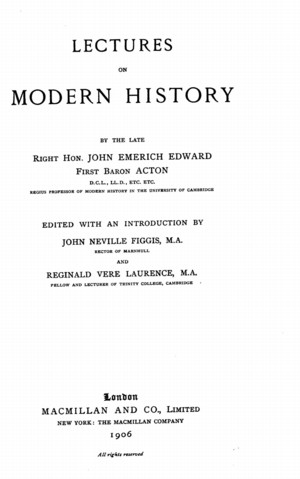
Lectures on Modern History, ed. John Neville Figgis and Reginald Vere Laurence (London: Macmillan, 1906).

About Liberty Fund:

Liberty Fund, Inc. is a private, educational foundation established to encourage the study of the ideal of a society of free and responsible individuals.


APPENDIX I

The following letter was sent out to the contributors to the Cambridge History. It will interest many, as giving characteristic expression to Acton’s ideals as a historian. The paragraphs are left as in the original.

[From the Editor of the Cambridge Modern History.]

1. Our purpose is to obtain the best history of modern times that the published or unpublished sources of information admit.

The production of material has so far exceeded the use of it in literature that very much more is known to students than can be found in historians, and no compilation at second hand from the best works would meet the scientific demand for completeness and certainty.

In our own time, within the last few years, most of the official collections in Europe have been made public, and nearly all the evidence that will ever appear is accessible now.

As archives are meant to be explored, and are not meant to be printed, we approach the final stage in the conditions of historical learning.

The long conspiracy against the knowledge of truth has been practically abandoned, and competing scholars all over the civilised world are taking advantage of the change.

By dividing our matter among more than one hundred writers we hope to make the enlarged opportunities of research avail for the main range of modern history.

Froude spoke of 100,000 papers consulted by him in manuscript, abroad and at home; and that is still the price to be paid for mastery, beyond the narrow area of effective occupation.

We will endeavour to procure transcripts of any specified documents which contributors require from places out of reach.

2. It is intended that the narrative shall be such as will serve all readers, that it shall be without notes, and without quotations in foreign languages.

In order to authenticate the text and to assist further research, it is proposed that a selected list of original and auxiliary authorities shall be supplied in each volume, for every chapter or group of chapters dealing with one subject.

Such a bibliography of modern history might be of the utmost utility to students, and would serve as a substitute for the excluded references.

We shall be glad if each contributor will send us, as early as he finds it convenient, a preliminary catalogue of the works on which he would rely; and we enclose a specimen, to explain our plan, and to show how we conceive that books and documents might be classified.

3. Our scheme requires that nothing shall reveal the country, the religion, or the party to which the writers belong.

It is essential not only on the ground that impartiality is the character of legitimate history, but because the work is carried on by men acting together for no other object than the increase of accurate knowledge.

The disclosure of personal views would lead to such confusion that all unity of design would disappear.

4. Some extracts from the editor’s Report to the Syndics will show the principles on which the Cambridge History has been undertaken.

“The entire bulk of new matter which the last forty years have supplied amounts to many thousands of volumes. The honest student finds himself continually deserted, retarded, misled by the classics of historical literature, and has to hew his own way through multitudinous transactions, periodicals, and official publications, where it is difficult to sweep the horizon or to keep abreast. By the judicious division of labour we should be able to do it, and to bring home to every man the last document, and the ripest conclusions of international research. . . .

“All this does not apply to our own time, and the last volumes will be concerned with secrets that cannot be learned from books, but from men. . . .

“The recent Past contains the key to the present time. All forms of thought that influence it come before us in their turn, and we have to describe the ruling currents, to interpret the sovereign forces, that still govern and divide the world. . . .

“By Universal History I understand that which is distinct from the combined history of all countries, which is not a rope of sand, but a continuous development, and is not a burden on the memory, but an illumination of the soul. It moves in a succession to which the nations are subsidiary. Their story will be told, not for their own sake, but in reference and subordination to a higher series, according to the time and the degree in which they contribute to the common fortunes of mankind. . . .

“If we treat History as a progressive science, and lean specially on that side of it, the question will arise, how we justify our departure from ancient ways, and how we satisfy the world that there is reason and method in our innovations. . . .

“To meet this difficulty we must provide a copious, accurate, and well–digested catalogue of authorities. . . .

“Our principle would be to supply help to students, not material to historians. But in critical places we must indicate minutely the sources we follow, and must refer not only to the important books, but to articles in periodical works, and even to original documents, and to transcripts in libraries. The result would amount to an ordinary volume, presenting a conspectus of historical literature, and enumerating all the better books, the newly acquired sources, and the last discoveries. It would exhibit in the clearest light the vast difference between history, original and authentic, and history, antiquated and lower than high–water mark of present learning. . . .

“We shall avoid the needless utterance of opinion, and the service of a cause.

“Contributors will understand that we are established, not under the Meridian of Greenwich, but in Long. 30° W.; that our Waterloo must be one that satisfies French and English, Germans and Dutch alike; that nobody can tell, without examining the list of authors, where the Bishop of Oxford laid down the pen, and whether Fairbairn or Gasquet, Liebermann or Harrison took it up.”

APPENDIX II
NOTES TO THE INAUGURAL LECTURE ON THE STUDY OF HISTORY

Works by E. A. FREEMAN

HISTORICAL ESSAYS. 8vo. 10s. 6d.

HISTORICAL ESSAYS. Third Series. 8vo. 12s.

HISTORICAL ESSAYS. Fourth Series. 8vo. 12s. 6d.

PRIMER OF THE HISTORY OF EUROPE. With Maps. Pott 8vo. 1s.

HISTORY OF THE CATHEDRAL CHURCH OF WELLS. Globe 8vo. 3s. 6d.

THE OFFICE OF THE HISTORICAL PROFESSOR. Crown 8vo. 2s.

OLD ENGLISH HISTORY FOR CHILDREN. Globe 8vo. 6s.

LIFE OF WILLIAM I. Crown 8vo. 2s. 6d.

WESTERN EUROPE IN THE FIFTH CENTURY. An Aftermath. 8vo. 10s. net.

WESTERN EUROPE IN THE EIGHTH CENTURY AND ONWARD. 8vo. 10s. net.

COMPARATIVE POLITICS. 8vo. 8s. 6d.

DISESTABLISHMENT AND DISENDOWMENT, WHAT ARE THEY? Crown 8vo. 1s.

GENERAL SKETCH OF EUROPEAN HISTORY. Pott 8vo. 3s. 6d.

GREATER GREECE AND GREATER BRITAIN, AND GEORGE WASHINGTON THE EXPANDER OF ENGLAND. Crown 8vo. 3s. 6d.

GROWTH OF THE ENGLISH CONSTITUTION FROM THE EARLIEST TIMES. Crown 8vo. 5s.

Works by Sir J. R. SEELEY

LECTURES AND ESSAYS. Globe 8vo. 4s. net.

THE EXPANSION OF ENGLAND. Two Courses of Lectures. Globe 8vo. 4s. net.

OUR COLONIAL EXPANSION. Extracts from the above. Crown 8vo. 1s.

INTRODUCTION TO POLITICAL SCIENCE. Globe 8vo. 4s. net.

HISTORY OF THE UNITED STATES FROM THE COMPROMISE OF 1850 TO 1880. By Dr. J. F. Rhodes. 8vo. Vols. I., II., 24s. Vols. III. and IV., 12s. each. Vol. V., 12s.

HISTORY OF MODERN ENGLAND IN FIVE VOLUMES. By Herbert Paul. Vols. I. and II. (from 1846 to the Death of Palmerston). Vol. III. (1865 to 1876). Vol. IV. (1875 to 1885). Vol. V. (1885 to 1895). 8vo. 8s. 6d. net each.

MACMILLAN AND CO., Ltd., LONDON.

Works by JOHN RICHARD GREEN

A SHORT HISTORY OF THE ENGLISH PEOPLE. Edited by Mrs. J. R. Green and Miss Kate Norgate. With 1400 Illustrations. In Four Volumes. Super Royal 8vo. 10s. net each. Also in 40 Parts, at 1s. net each.

A SHORT HISTORY OF THE ENGLISH PEOPLE. With Maps and Tables. Crown 8vo. 8s. 6d.

A SHORT HISTORY OF THE ENGLISH PEOPLE. With Maps, Tables, and an Analysis by C. W. A. Tait, M.A., Assistant Master in Clifton College. Part I. Chap. I. The English Kingdoms, 607–1013. Chap. II. England under Foreign Kings, 1013–1204. Chap. III. The Great Charter, 1204–1265. Crown 8vo. 3s. Part II. Chap. IV. The Three Edwards, 1265–1360. Chap. V. The Hundred Years’ War, 1336–1431. Chap. VI. The New Monarchy, 1422–1553. Crown 8vo. 3s. Part III. Chap. VII. The Reformation, 1540–1610. Chap. VIII. Puritan England, 1583–1660. Chap. IX. The Revolution, 1660–1689. Crown 8vo. 3s. Part IV. Chap. IX. The Revolution, 1660–1742. Chap. X. Modern England, 1742–1873. Crown 8vo. 3s.

HISTORY OF THE ENGLISH PEOPLE. In Eight Volumes. Globe 8vo. 4s. net each. [Eversley Series.

THE MAKING OF ENGLAND. With Map. Two Volumes. Globe 8vo. 8s. net. [Eversley Series.

THE CONQUEST OF ENGLAND. Two Volumes. Globe 8vo. 8s. net. [Eversley Series.

STRAY STUDIES FROM ENGLAND AND ITALY. Second and Cheaper Edition. Globe 8vo. 4s. net. [Eversley Series.

STRAY STUDIES. Second Series. Globe 8vo. 4s. net. [Eversley Series.

OXFORD STUDIES. Globe 8vo. 4s. net. [Eversley Series.

HISTORICAL STUDIES. Globe 8vo. 4s. net. [Eversley Series.

READINGS FROM ENGLISH HISTORY. Selected and Edited by John Richard Green, LL.D. Part I. From Hengist to Cressy. Globe 8vo. 1s. 6d. Part II. From Cressy to Cromwell. Globe 8vo. 1s. 6d. Part III. From Cromwell to Balaklava. Globe 8vo. 1s. 6d.

THE LETTERS OF J. R. GREEN. Edited by Sir Leslie Stephen. 8vo. 15s. net.

A SHORT GEOGRAPHY OF THE BRITISH ISLANDS. By John Richard Green, M.A., LL.D., and Alice Stopford Green. With Maps. Fcap. 8vo. 3s. 6d.

TOWN LIFE IN THE FIFTEENTH CENTURY. By Alice Stopford Green. Two Vols. 8vo. 32s.

FRANCE. By J. E. C. Bodley, M.A. New and Revised Edition. Extra Crown 8vo. 10s. net.

THE AMERICAN COMMONWEALTH. By James Bryce, M.P. Third Edition. Extra Crown 8vo. Two Vols. 12s. 6d. each.