Econlib

The Library

Other Sites

Front Page arrow Titles (by Subject) arrow State Soldier Essays: III-IV - Friends of the Constitution: Writings of the Other Federalists, 1787-1788

Return to Title Page for Friends of the Constitution: Writings of the “Other” Federalists, 1787-1788

Search this Title:

“State Soldier” Essays: III-IV - Colleen A. Sheehan, Friends of the Constitution: Writings of the “Other” Federalists, 1787-1788 [1998]

Edition used:

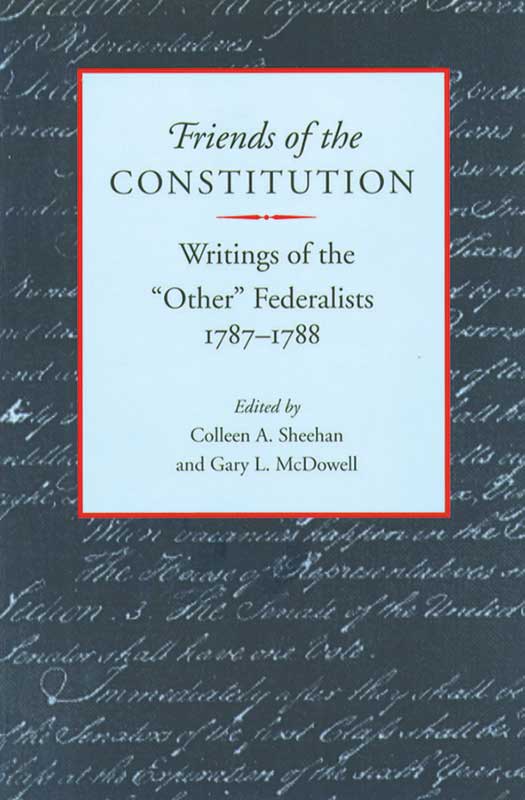
Friends of the Constitution: Writings of the “Other” Federalists, 1787-1788, edited by Colleen A. Sheehan and Gary L. McDowell (Indianapolis: Liberty Fund, 1998).

About Liberty Fund:

Liberty Fund, Inc. is a private, educational foundation established to encourage the study of the ideal of a society of free and responsible individuals.


“State Soldier”

Essays: III-IV

III

To the GOOD PEOPLE of Virginia, on the new FŒDERAL CONSTITUTION, by an old STATE SOLDIER, respecting the influence of great names.

When I first entered the list among the patriotic advocates for the new constitution, which I look up to now as the salvation of America, I had nothing else in view than just to expose the folly of those who made use of the names and characters of private men to support the insignificance of their own arguments.

But alarmed at the thoughts of a dissolution of the UNION, which I consider the greatest curse that could befall America, I determined to suspend my answer to those authors, to which my first address was only an introduction, until I cautioned you against laying the foundation of your own destruction by electing men for the approaching convention, who, under a pretence of amending and perfecting this new work, mean to dissolve the confederation.

And having in the fullest manner, I trust, proved to you in my last the impossibility of amending this new plan of government, at this time, without disuniting the states, I shall now return to my first design.

The adversaries to the constitution have not only held up the chief heroes of their party as the infallible guides on this occasion, but have spoken of some of its friends with such asperity and* disingenuousness as would induce those who were unacquainted with the dispute, to suppose, that it was nothing more than a private quarrel among some leading individuals, under whose standards all the rest of America had servilely enlisted as their vassals.

If in answering those ingenuous, polite, and liberal authors, I should bring to view some truths which have not yet appeared, by using their own method of arguing as the only means to refute their folly, I trust I shall be excused, as they have not only taught the useful lesson, but absolutely driven those who attempt to answer them into the necessity.

But notwithstanding all that has been said about the liberty of the press being destroyed by the new constitution, I scarcely expect to find a sufficient remnant of that great blessing even in our present system to bring this paper to your view.

For to those very causes which some attribute the destruction of the liberty of the press, I look up for its becoming more unbounded—since clear it is, there are great restraints of that sort already, nor can any thing else be expected in a government as popular as this is.

The liberty of the press is not always one of the most lovely traits of the freest governments:—for as the most popular kinds have generally been thought the most free, it follows that the most free will not be the most favorable to that spirit which is necessary to constitute the liberty of the press.

It is in popular governments that men obtain that very superiority over others, by consent, which is held in other governments by hereditary right; with this only difference, that as the one is always the attainment of superior abilities, and the other too often the right of fools, the just sense we have of the one’s being capable of doing us more real good or harm than the other, renders the influence of merit much greater than that of birth.

Whence it follows that men in popular repute over-awe the actions of others much more than those who are only the favorites of fortune. For in kingly governments where men are statesmen by birth, and perhaps only revered for their empty titles, dignity remains protected no longer than it is unattacked—which in general is not long—for superior merit ever anxious to float uppermost in the stream of life, those who possess it necessarily strive to sink others who have only risen above them by the partial hand of fortune. When instantly, that same superiority of talents which adheres to the side of government in the one instance, shifts its influence to the side of liberty in the other.

And thus the press becomes influenced, not by the absolute interference of any government, but by the mere complexion of it—and is nothing more at last than an adherence to the popular side.

In those governments whose heads are the free choice of the people, it is ever to be found on the side of the state, as the same voice which promotes will protect its favorite; and where the success of an author depends on the breath of those who have thus promoted the man at whose character he aims, it would be deemed madness to make the attempt, and nothing less than treason to aid him in it.

When on the other hand, in those governments whose heads are the establishment of birth, and the detestation of the majority, the assistance of the press is to be found on the side of the people. And this it is that is called the liberty of the press.

In England where government has always had some of the ablest men for its opponents, with the popular voice of the people on their side, the liberty of the press is such that even the dignity of the crown does not protect men from ridicule and abuse.

But in America where the dignity of an individual depends on the voice of the people at large, the very reverse has already been seen.

In the course of the late war many attempts were made by General Lee to publish different pieces in abuse of General Washington, only one of which ever made its appearance, and for publishing that, the printer was severely handled, not by government, but by the populace. Which we cannot now but consider as improper:—for sacred as the character of any individual may be, yet the voice of another should be fairly heard—since ridicule, when unconnected with truth, not only ceases to be severe, but degenerating into scurrility, renders the author, and not the person pointed at, the object of contempt.

Under this consideration no good man could object to seeing his character fully stated to the world—and much less would HE whose merits like the purest gold could only become the brighter by being the more frequently handled;—and whose character when held up to public view would only serve to dazzle the eye of envy itself.

That however justly General Lee might have merited our hatred on that occasion, we cannot but lament the consequences of such a disposition. For as no one can judge of the merits of another before he hears them fairly investigated, it would be wrong to shut our eyes against an attack on any one until we were convinced thereby of his purity. The impropriety of which however will be still more clearly seen in a much more recent affair—The recital of which will bring me to the principal object of this paper, from which I have already too long digressed.

As late as in the contest now subsisting about the constitution under consideration, a printer in this state for some time refused to publish a piece because it contained some reflections on one Richard Henry Lee—when, had he measured the dignity of that name by the merits of the letter to which we have lately seen it annexed, he would have had no such scruples perhaps.1

But it is not at all surprising that folly should come off with impunity where even vice itself meets with protection.

Fortunately however for this country, we are now likely to profit from both. This gentleman at length, led by his vanity to give us a true attested copy of the powers of his genius, has relieved us from any fear we might have had of being deluded by his abilities; and being long convinced how far we might rely on his integrity, we feel ourselves more and more at ease under any political opinions he may advance. From the commencement of his political career until the publication of his letter, we have been in doubt about the one; but from the stamp-act until the present day, we have been clear in the other.

But whatever could have induced the opponents to the constitution, and Mr. Lee above all, to hint at the designs of its friends, I cannot conceive. Did they expect that the mere name of Lee or Mason would be sufficient protection to such barefaced impudence and folly? Did they expect that no enquiry would be made, and no return given to such uncharitable methods?—Or did they expect their characters, abilities, or designs would bear a stricter scrutiny than those aimed at on the other side?—Nothing but the vain manner in which one of those gentlemen ushered his pamphlet forth, could make us suspect either of them of such ill-grounded hopes.

It is not at all surprising however that Mr. Lee should be opposed to a government, which will probably begin with a man at its head, to procure whose disgrace he has once before convinced us he would cheerfully have sacrificed all America. This is a circumstance too fresh in the minds of all to be forgotten, though it might not have been mentioned at this time, had not this gentleman’s own imprudence forced it from me.

Had those two great statesmen but sent forth their objections to the new constitution through the verbal medium of their friends; or, had they, like another author of the same stamp, but sent them forth in the more important form of parables for others to comment* upon, they would have had much more weight, I suspect, than even the objections of a Lycurgus or a Solon, supported by the printed arguments of a Lee or a Mason.

But how far the dignity of names may go towards making up for a deficiency of argument, I am incapable of ascertaining—Or how far the name of Lee may be considered as such, I only shall appeal to his own pamphlet to determine—where, whenever it shall be seen deprived of every other ornament but the genius of the man, the mighty name of—Lee—in weight, as well as size, will only be found to be the picture of greatness in miniature at best.

Mr. Lee begins his objections to the constitution by observing that “to say (as many do) that a bad government must be established for fear of anarchy, is really saying that we must kill ourselves for fear of dying.”—From which, as simplicity of thought generally denotes a goodness of heart, I should suppose this gentleman to be one of the best creatures in nature, and if considered as similar only to what he meant should follow after, was as just as it is inelegant and inapplicable if intended to answer any other end.

For how does he prove this to be a bad government?—Is it by comparing it with the perfection of his own scheme, for I observe he has been graciously pleased to offer us his amendments to the constitution?

It is a pity this gentleman had not given a sample of what he could do before the appointment to the grand convention was made, that he might have offered his amendments in a more seasonable place. For had he convinced the world that he was superior to either of the nine, who were in the course of the business appointed by this state, I have no doubt but he would have been in that honorable Assembly, where he might have shewn that superiority, of which he thinks himself possessed over the thirty nine who signed the constitution, without exposing his name at this time to the ridicule of the world.

In respect to the tyranny those gentlemen paint in such horrid colours, it appears to me, but little need be said; for it is not only true, that those who are the loudest about liberty, have always been the greatest tyrants themselves when they have had it in their power; but it is also clear that while in the very act of the one, they are even then exercising the very worst kind of the other. For it being a fixed point that human nature cannot exist without the assistance of government, and there being no power to which mankind are incident, more terrible than fear, it follows, that to keep men under a perpetual alarm about what they cannot, agreeable to their own natures, get rid of, is to worry them out with one oppression and thereby fit them for every other. And this too being generally done by the most insignificant members of the community, renders the tyranny of popular alarm much worse than the fixed oppressions of the most formidable government—and in the present instance far more degrading, as it would be much more honorable to be devoured alive by a LION, than frightened to death by a monkey.

But I should not deal thus in trifles were it not for two reasons: The first is, having set out solely with a view of exposing in this paper the meanness and folly of being led away by the mere sound of names, I could not pass by this self-sufficient politician in silence—and the other is, that were we determined to pay no attention to trifles, Mr. Lee’s whole letter would go unnoticed—which would be rather mortifying, after the hints he dropped to get it printed;—notwithstanding which, however, it had nearly died in manuscript. For unfortunately that gentleman’s correspondent was either too good a judge of literary performances to suppose, as he did, that the mere name of Richard Henry Lee would stamp it with the title of perfection; or else, he had not clearly determined, at that time, on taking his side of the question, as he has since prudently taken both:—and that being the case, I shall say nothing to caution you against relying on his opposition to the constitution; as there are few I presume willing to rely much on the command of a general who will not openly head his own army for fear of offending the enemy.

As for Mr. Mason, poor old man, he appears to have worn his judgment entirely thread-bare and ragged in the service of his country.3 But however faint his present endeavors may be to render public good, his past services can never be forgot while his great zeal in the Indiana cause remains so lasting a monument of his righteous endeavors, and happy effects of his land-office scheme have shewn themselves so clearly—at least in favor of his own fortune.

To a man thus zealous, the want of authority to pass ex post facto laws may be a great objection to the new constitution indeed, as they might be rendered highly useful to, and a great improvement on, the art of speculation. But in all other cases they have ever been considered a great curse, since they can only be productive of a halter to the innocent and ignorant.

Whatever this gentleman might have intended when he said that this government would “vibrate for some time between aristocracy and monarchy,” and then that “it will settle at last between the one and the other,” I will not undertake to say, as I would not presume to dive into the meanings of so profound a man. But if its vibrating between the two—and then settling between the two, proves any thing, it must be that it will not end in either—and this is what we wish.

But what do you suppose are the real motives of such gentlemen for advocating the cause of liberty so strenuously at this time?—Is it that Mr. Mason, who is a man of immense fortune, and Mr. Lee, who possesses as much pride and ambition as he does fortune, are really anxious to see all men raised up to an equality with themselves?—Or is it not rather from a fear that they themselves shall be reduced below the level of some others?

Two things appear to me to operate most powerfully against the adoption of this constitution. The one is dignity—the other debt. And to both of those causes I attribute the opposition of a man whose designs and ingenuity are much more to be dreaded than any I have yet mentioned. The constant propensity he has ever shewn to soar upwards on the breath of popular applause, justifies my surmising the one; and his uniform opposition to the payment of certain debts, in which the majority of this country are little interested, and the establishment of this government will certainly bring about, warrants me in asserting the other.

For he who was willing but a few years ago to vest Congress with the power of raising taxes by the absolute assistance of* armies, could have little objection to a plan at this time, which only proposes to raise them by moderate means, was there not something of secret consequence involved in it.

But as this gentleman has been too wise to trust his objections to the new constitution to the eyes of the public, I shall not mention his name; though I should have little scruple in exposing to view the name of a man, who after all his patriotic canting and whining has been among the first to speculate on the unfortunate credit of his country, and that too when he enjoyed one of the first posts in government. And should a proper opening ever offer, I shall let loose such a train of hyprocricy and deceit upon you, as will astonish you to behold.

But admitting all the enemies to the constitution to be equally honest in their opposition, that in itself is the strongest proof of the necessity there is of adopting it before we attempt to amend it. For if their different designs cannot be offered as an excuse for their differing so widely as they do about the faults of the constitution, nothing I am sure but an acknowledgement that some of them are wrong can account for it; and since we know not on which to rely, nothing but experience can teach us which is right.

Thus having remarked on the designs of some of the principal enemies to the constitution with that freedom which becomes the spirit of an independent man, to which none of those gentlemen themselves can with propriety object, since they are all such great friends to the Liberty of the press, I shall return again to the more pleasing subject of the constitution, and endeavor in my next to answer, in as plain a manner as I can, such objections to it as I think worthy of notice.

IV

To the GOOD PEOPLE ofVirginia,on the new FŒDERAL CONSTITUTION, by an old STATE SOLDIER, in answer to the objections.

I have now shewn you the effects which an attempt to amend the new constitution, at this time, would have on the Union; and also the meanness there is in being influenced by the mere sound of names on this important occasion.

And in doing this, I have been unavoidably led to answer some of the individual objections to the constitution themselves—among these are the want of a bill of rights, the equality in the senate, and the liberty of the press—all of which I shall avoid recapitulating at this time, with an intention of confining myself wholly to those objections which I have not heretofore entered fully into.

All the objections to the constitution appear to be contained under two heads—the one respects our liberties, the other our interests. To those which respect our liberties, only, I mean to reply in this paper; and in order the more effectually to do that, I shall head this first class of objections under that assertion, which holds forth, that by the adoption of this constitution we shall be deprived of our liberties.

And considering that as the ne plus ultra of antifœderal workmanship, I shall, after viewing it in the light of a slender fabrick built in air, and filled with imaginary bugbears, first examine into its foundation as a general assertion; and then prove its feebleness by trying the arguments on which it depends for support.

The only desirable purpose of any government, is, the security of men’s persons and property; and that which advances farthest that way, is not only the most perfect, but the most free.

Chimerical and speculative enjoyments may amuse the imagination; but justice and safety alone can ensure real happiness—and liberty without happiness is but emptiness and sound.

The more independent a government is therefore of the people, under proper restraints, the more likely it is to produce that justice; and the more substantial and efficient under such restraints, the better calculated to protect both the persons and property of mankind. And the efficiency and energy, of this government being acknowledged in this general objection itself, the only necessary enquiry will be, whether the restraints are sufficient to prevent its becoming too formidable in the end.

In respect to restraints on government, there are but three things necessary to be guarded against, the first is a power to deprive men of their personal rights or property by direct laws; the second, is, a power to depress those natural rights into a meanness of person by preventing men from acquiring property from loading them unequally with the public burthens of the state; and the third is, a power to destroy the equality of right by a partial administration of justice. That government which is guarded against those powers, may be said to have all the restraints necessary to constitute a rational happiness under any society.

Let us examine then how far the proposed constitution may be valued on that head.

Under this government neither the Congress nor state legislature could, by direct laws, deprive us of any property we might hold under the general law of the land, or punish us for any offence committed previous to the passage of such laws, since they are prohibited from passing ex post facto laws. Nor could they injure the value of any species of property by partial taxes, since from the proportion laid down in that government, to affect the value of slaves, for instance, in this state, they must ruin all the free persons in several others. Nor could they injure the property of an individual in any state, since the same proportion must be observed throughout a part as well as the whole.

Neither could they in the third instance destroy the equality of right, or injure the value of property in a particular state, or belonging to any individual by a partial administration of justice, since the same doors of one general tribunal would be opened to all—which would on the contrary enhance the value of all property on the continent by giving confidence to foreign creditors, and an equal security to citizens of every state.

Under such restraints and useful regulations, it cannot be denied but that the authorities contained in a firm and efficient government are necessary to procure safety, and give to that machine a proper motion; unless there be those so chimerical and speculative as to expect government, like a windmill, to go on by airy efforts only.

But in order the more clearly to view that great objection still on general principles, as I first proposed to examine it, let us next try it by the simple test of facts.

That there will go no more power out of the peoples’ hands by the adoption of this constitution than what is already given up, is obvious, because the state legislature and Congress together have in their hands, at this time, every authority which is proposed to be given to the new head, and that too without any restraints on those of the state. The right of passing ex post facto laws, the power of administering partial taxation, and a right to procrastinate justice, or interfere, in their legislative capacity, in private affairs, make up the only compound necessary to give a dismal hue to the finest features of any government. Yet such are the powers already given into the hands of government as to justify and produce all those acts.

The only difference therefore between our present situation and under the new government will be, that the most of the powers already given up will be in the hands of Congress instead of the legislature of the state; which change will only be felt by the leading men in each state, and not by the people. Whence we shall experience all the security which an efficient government can afford, without being subject to its oppressions. For in the proposed plan will be exercised all the useful authorities which already belong to the state, with all the salutary and safe restraints inseparable from the new system.

Thus having shewn on general principles the fallacy of that doctrine which holds out that we shall be deprived of our liberties by the adoption of this constitution, I shall now examine how this general assertion stands supported by the individual objections themselves.

The first I shall touch upon, is, that to the authorities of the supreme court.

There were three things in the first place which made it necessary to establish this court—the first is, the disputes that might arise between the different states, which could not otherwise [have] been determined but by a recourse to arms—the second is, in disputes between foreigners and citizens, without which general and impartial mode of trial under a fœderal government, an end would soon be put to foreign credit, and of course to that extensive commerce which alone can ensure a lasting value to our property—and the third is, in disputes between citizens of different states, which alone could prevent that jealousy that must have been excited by trials in the state where only one of the parties resided; and which would have been destructive of that confidence and harmony which will ever be requisite to preserve that union and agreement, without which, this new government itself would cease to exist. And the two last are the only cases in which the people can be much affected; and that in most instances only by appeal.

The next objection I shall take notice of, is, that against standing armies.

There are but two ways in which armies are ever employed, the one is defending, the other abusing, mens’ rights; and in order to do the one, they must first begin with a pretence of intending the other. Nor can they long go undiscovered in acting thus, as the difference between the two is very easily observed; and as it will only become necessary to make the discovery to put an end to its progress, so in order to become a lasting evil, they must have some other foundation to depend on, than the will of those they are to injure. Either the separate interests or popular influence of those who employ them, have ever been the causes of their being used for a bad purpose. Hence it follows that a body of men so numerous as to make a division of power but a small object to any; and who only enjoy that power under the will of those they would endeavor to enslave, would neither wish to succeed in such a design, even were it practicable, nor expect to find it practicable should they make the attempt. As long therefore as the representatives of a people are elected by them, and under the necessity of returning among them at stated periods, when they will be liable to their resentments, there is but little danger of their committing an open outrage on their liberties. It cannot be then for the abuse of our rights that Congress are to have a power of raising armies, as it is clearly on the will of the people the right of creating them depends—and therefore for our protection alone can be employed.

The right of laying direct taxes is also objected to, though this is among the powers already given up by the people, and necessary for the existence of every government. Whether it extends itself over the whole continent or only a single state therefore, the effects will be the same to the people; and all the difference there will be, is, that less will be collected by the states individually, and more by the continent than now is.—But this, like all the other powers to be exercised by a representative who holds his authority under the will of those he is to govern; cannot be exercised but for their immediate benefit.

But then “the laws made under this constitution are to be the supreme laws of the land.” Under this clause it is said every authority is included.

It is with this objection however as with that about taxation; it would [have] availed but little to have attempted altering our system, and at the same time withhold from the new plan every thing that was useful. The great object which we had in view when we first called for the assistance of a convention, was, the strengthening the hands of the UNION; and if there are to be left in the hands of the different states sufficient powers to supersede those of Congress, little after all has been effected. At least a contention for supremacy between the different states and Congress would have been the consequence, had not some such distinguishing mark been set up to decide the superiority; the consequence of which would have been, that each in vieing with the other would be provoked to make daily experiments of its power, while the people would be left between the two rival authorities as the subject of their anatomy.

But this objection is a contradiction in itself; and if of any weight, only serves to operate against every other objection that has been made to the constitution; for if there be an objection to any other part of the constitution, it must be because there is an authority some where else besides in that general clause, which is a contradiction, because, an absolute and unbounded authority admits of no rivalship—And on the other hand, by viewing it in the light of a general authority given to Congress without controul, we render null and void all the other authorities, of which, in the same breath are so loudly complained; and in doing that, we destroy at a single blow every other objection, since there can be no objection to any part, where there is to be no power.

But to view it in a still more serious light, the saying that the laws made under that constitution shall be the supreme laws of the land, never could [have] been intended to bear that construction which has been put on it by some, because, if it had been intended or wished that Congress should have possessed such an unbounded power as is said, it would have been needless to run the risk of losing that desirable point, by adding to it, things which were to be of no use. And as it is not, that the laws made under that particular clause of the constitution, but the laws made under the whole system, of which that is but a small part, shall be the supreme laws of the land, so any law made in contradiction to any other clause, will be as void of effect as another made in direct compliance with that will be binding.

That this part of the constitution is neither so contradictory in itself as it appears when made an objection, nor are the other parts so useless and insignificant as they are made by giving that particular clause absolute power—but each in their several places form the different useful authorities and checks which are necessary to give both stability to our laws and safety to the people.

These, together with the other three assertions which I have endeavored to refute in some previous papers, form the most important supports of that grand objection to the constitution which respects our liberties; though there are many others which might have come under the same head; for it is a rule with artists, that in rearing the superstructure of all fabrics, to have as good a foundation and as firm supporters as possible; but when they cannot support the edifice by strength of braces, they naturally have recourse to [a] number of posts; and when they far exceed the number, which if found, would answer, it does not require much reasoning to prove that they themselves have but little confidence in any.

That from what has been said already on either side, it may I think be concluded that our liberties so far from being diminished, will be increased by the adoption of the new constitution, as it will be a means of depriving the states of the right of exercising the most unbounded acts of injustice, under which, both the persons and property of men are insecure; and under such insecurity, every earthly consideration is lessened in its value. Whence, as there is no species of liberty but what is connected either with the person or property of mankind, so there is no species of it also but what is increased by adding confidence and safety to the one, and permanence and value to the other. And that government therefore which is best calculated to ensure both, is most consistent with every rational idea of liberty and happiness.

[* ]The Am. Off. The Centinel, etc. of Gen. Washington, Franklin, and Wilson.

[1. ]See Storing, 5:6; Allen, 22-27.

[* ]The present Governor, who gave out his objections to the constitution, and then left them like a parcel of poor little helpless orphans to be supported by a contribution of arguments from his friends.2

[3. ]See Mason’s “Objections,” Storing, 2:7; Allen, 11-13.

[* ]See Journals of Assembly of Virginia 1784, resolution proposing to give Congress a right to compel the states to comply with their requisitions by force of arms—Who by?

[* ]The present Governor, who gave out his objections to the constitution, and then left them like a parcel of poor little helpless orphans to be supported by a contribution of arguments from his friends.2

[2. ]Letter of Edmund Randolph, Storing, 2:5.