EconlibThe LibraryOther Sites |
Front Page Titles (by Subject) Popular Government and Civic Virtue - Friends of the Constitution: Writings of the Other Federalists, 1787-1788
Return to Title Page for Friends of the Constitution: Writings of the “Other” Federalists, 1787-1788The Online Library of LibertyA project of Liberty Fund, Inc.Search this Title:Also in the Library:
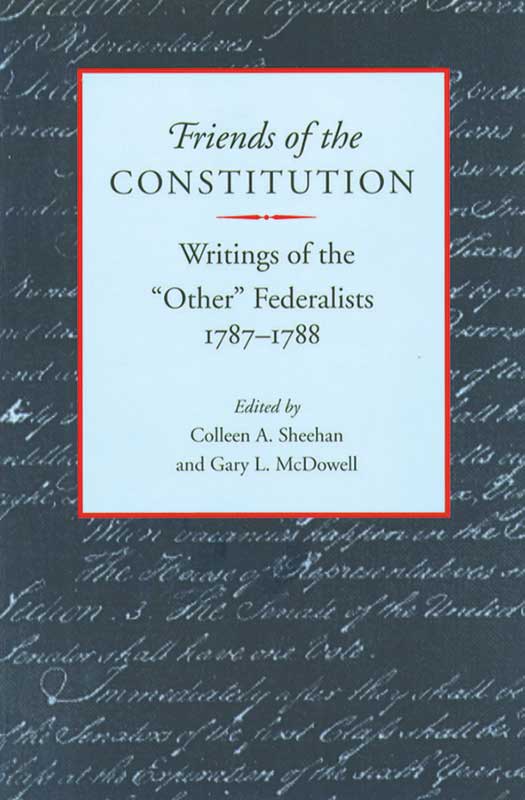
Popular Government and Civic Virtue - Colleen A. Sheehan, Friends of the Constitution: Writings of the “Other” Federalists, 1787-1788 [1998]Edition used:Friends of the Constitution: Writings of the “Other” Federalists, 1787-1788, edited by Colleen A. Sheehan and Gary L. McDowell (Indianapolis: Liberty Fund, 1998).
About Liberty Fund:Liberty Fund, Inc. is a private, educational foundation established to encourage the study of the ideal of a society of free and responsible individuals. Copyright information:The copyright to this edition, in both print and electronic forms, is held by Liberty Fund, Inc. Fair use statement:This material is put online to further the educational goals of Liberty Fund, Inc. Unless otherwise stated in the Copyright Information section above, this material may be used freely for educational and academic purposes. It may not be used in any way for profit.
Popular Government and Civic VirtueDespite numerous Anti-Federalist accusations that the Federalists were advancing aristocratic government in America, virtually all Federalists defended the cause of popular government. The Federalist case for popular government rested on both the natural right of the people to institute government and the concomitant duty to establish and preserve good government. Even “Caesar,” who with “blunt and ungracious reasoning” fully admitted that he considered the “unthinking masses” ill qualified to evaluate the Constitution, and that he was “not much attached to the majesty of the multitude,” nonetheless recognized the inherent right of the people to receive or reject the Constitution. He simply exhorted them to look to the opinions of their more learned superiors in deciding the case. In contrast to the deferential role “Caesar” advised the people to take, Noah Webster argued that “it is not only the right, but the indispensable duty of every citizen to examine the principles” of the proposed government. Though strongly committed to popular government, the Federalists were not inattentive to the problems and excesses of democracy. Unwilling to defend “popular government with a vengeance” or “licentious democracy,” they sought a way to retain the principles and spirit of democratic government and at the same time avoid the defects toward which it tended. In response to the Anti-Federalist view that a large territory is unfit for popular government and that only in small territories are the republican virtues of public spiritedness and moderation possible, Federalists charged that the small republic thesis was flawed. The problem of small republics, they said, is that they are prone to turbulence, licentiousness, and faction. To counteract these diseases, Federalists asserted the need for a large republic. How did the Federalists understand the purpose of republican government? How did they think such a government was to be preserved and perpetuated? Was there a Federalist vision of republicanism that was more than a defense against Anti-Federalist criticisms? The following selections demonstrate that many of the Federalists did not simply react to their opponents’ charges, but presented philosophically thoughtful, albeit sometimes competing, views about the nature of republican government. The “State Soldier” ridicules the “chimerical and speculative enjoyments” that amused the political imaginations of his opponents and declares that “the only desirable purpose of any government is, the security of men’s persons and property.” According to Noah Webster, a general distribution of property is “the very soul of a republic.” Indeed, Montesquieu was wrong; it is not virtue that provides the sturdiest support of free government but property and dominion. In contrast, Nicholas Collin warns against an “overdriven spirit of commerce,” for the desire to accumulate wealth and dominion, left unchecked by moral and religious principles, fosters base passions. Put simply “there can be no liberty without virtue.” In his view, the moral and intellectual qualities that ennoble men and make them capable of self-government are the very soul of the republic. A people of good manners, morals, and learning make the political union stronger, animating it “by the same generous spirit.” In turn, a noble republican civilization gradually enhances “the dispositions necessary for civil government.” John Dickinson agreed. He believed that while government ought to safeguard the liberty and property of the people, the perpetuation of the people’s virtue and the advancement of their happiness is the final purpose of government. Dickinson’s understanding of the rights of man places the individual “in a close connection with all his duties.” The right of the people to establish a constitution and institute government is inextricably bound to the purpose of a constitution and government: to advance the general welfare and happiness of the people in the way ordained by the Creator and the law of nature. The competing views on the nature of republican government represent two different poles of political science in the eighteenth century. According to the narrower vision, not only is free government limited in its powers, but it is also limited in its purpose. The aim of republican government is the security of the individual and his property, or in other words the prevention of injustice; republican government neither attempts to form nor depends upon a virtuous citizenry. Proponents of the broader vision agreed that republican government must be limited in its powers, for only a government of constitutionally limited authority is consistent with the rights of man. They did not, however, believe that the recognition of man’s natural rights reduced the ends of politics. Rather than lowering the ends of political association, the discovery and recognition of the rights of man offered the just basis on which to construct the political community and to accomplish the highest of political tasks. There can be no self-government without liberty, they believed, but further there can be no genuine liberty and self-government without virtue. Despite the lack of unanimity about the purpose of republican government, most Federalists understood that the regime they were about to establish would affect the manners and souls of the citizens. They also generally agreed that the perpetuation of republicanism depends ultimately on the character of the citizens. The need for ethical and religious instruction in the polity was widely felt and frequently spoken of, though as a whole the Federalists did not draw a detailed roadmap for the journey of moral education in the United States. Instead, they tended to speak to their fellow citizens in generalities, almost in matter-of-fact tones, about the need for and the benefits that would derive from religion, education, good statesmanship, and law. Having said this, it is important to point out that there were indeed some Federalists who confronted certain moral and religious matters explicitly. It is not sufficient to assume a common consensus on the “universally established principles of humanity and common equity,” Collin said. These principles must be applied in practice. Thus he, Tench Coxe, “Crito,” and others raised their voices in condemnation of the cruel, inhuman practice of slavery in America. Presaging the poignant appeal of Abraham Lincoln during the Civil War era, “Crito” reminds his fellow citizens of the principles to which the American union is dedicated. “It was repeatedly declared,” he says, “ . . . that all men are created equal; That they are endowed by their Creator with certain unalienable rights. That among these are life, liberty, and the pursuit of happiness.” Pointing out the striking contradiction between the sacred principles and the profane practices of America, “Crito” continues: The Africans, and the blacks in servitude among us, were really as much included in these assertions as ourselves; and their right, unalienable right to liberty, and to procure and possess property, is as much asserted as ours, if they be men. And if we have not allowed them to enjoy these unalienable rights, but violently deprive them of liberty and property, and are still taking, as far as in our power, all liberty, and property from the nations in Africa, we are guilty of a ridiculous wicked contradiction and inconsistence: and practically authorize any nation or people, who have power to do it, to make us their slaves. It would seem that David Ramsay of South Carolina could not hear the pleas of “Crito,” or the “bitter sighs, groans, and tears” of the distressed men and women held in bondage. Congress is prohibited from outlawing the slave trade for twenty-one years, Ramsay points out. It does not follow that they must or will forbid it after 1808; indeed, “it is probable that they will not.” Ramsay’s prediction is premised on his calculation of the economic self-interest of both the South and the North, implying that the desire for wealth will decide the question of the future of the slave trade in the United States. “One of the People Called Quakers” saw things very differently. The Virginia delegates to the Constitutional Convention, he says, were obdurately opposed to slavery and agreed to the limited importation of slaves only because it was the best compromise they could then attain. “The new federal government,” he concludes, “ . . . would eagerly embrace the opportunity not only of putting an end to the importation of slaves, but of abolishing slavery forever.” In matters of religious conviction, the Federalists concurred that liberty requires the unrestrained exercise of the conscience and prohibits religious tests for office. This did not mean to “Elihu” that the impious and the immoral were not fools nor to Oliver Ellsworth that the law must be indifferent to gross impieties and immoralities. Indeed in matters of morality the law serves not only to punish indiscretions but also to induce good habits and educate to virtue. For the vast majority of the Founders, liberty was compatible with morality; it was not compatible with, or even secure in, a polity that failed or refused to make moral distinctions. The concern for the relationship between liberty and morality was also applied to economic matters. Some of the Federalists viewed the life of commerce and manufacturing as incompatible with an independent, simple-mannered, virtuous republican citizenry. More often than not, however, Federalists concluded that there is no incongruity between scientific progress and commercial prosperity on the one hand, and the preservation of a virtuous citizenry on the other. In fact according to Collin, Dickinson, Ellsworth, and Wilson, the moderate and just pursuit of wealth is perfectly compatible with, and may even provide a mutual support for, the ethical life. Many leading Federalists contended that adherence to the just principles of republican government requires both a dependence on the character of the citizenry and guidance from intelligent and virtuous leaders. The call for a republican spirit throughout the government and across the land is echoed by a host of voices in choral array. Dickinson tells of how this may be achieved, teaching that a popular government in a large territory acting according to the principles of representation and federalism can be characterized by an “animated moderation.” Similarly Wilson calls for the union of public-spiritedness and moderation. In his Fourth of July oration of 1788 he exhorts the American people to the cause of their celebrated independence and union, demonstrating at once the profoundly popular character of the American polity and the crucial task that must be performed by statesmen-educators if republican government is to endure. One can almost hear the sonorous echoes of the Federalists sounding across the many July Fourths that separate us in time but connect us in spirit, calling out their hope for a “constellation of noble minds” to continue the trial of self-government and thus shedding “a bright day over American till time is no more.” “One of Four Thousand”
Independent Gazetteer, Philadelphia, 15 October 1787 To the Freemen of Pennsylvania.A publication has lately appeared in several of our papers, said to be signed by sixteen members of the late Assembly of Pennsylvania, which challenges a few remarks.1 The first remark that occurs is, that the paper was neither written by any one of them, nor signed by all of them. They are too illiterate to compose such an address, and it can be proved that several of the persons whose names are subscribed to it left the city on Saturday, before there was time to collect the materials of the address, or to receive it from the person who is well known to have written it. A second remark that occurs in this place is, that there was a fixed resolution of the anti-federal junto to oppose the federal government, long before it made its appearance. In the month of July last, at a meeting of this junto, it was agreed, “that if the new constitution of Congress interfered in the least with the constitution of Pennsylvania, it ought to be opposed and rejected, and that even the name of a Washington should not carry it down.” Happily it requires a reduction of the enormous expenses, and some other alterations of our constitution. Hence the reason of their opposition. Had it been much more perfect, or had it, like the Jewish theocracy, been framed by the hand of the Supreme Being himself, it would have been equally unpopular among them, since it interferes with their expensive hobby-horse, the Constitution of Pennsylvania. The address, and all the opposition to the new government, originate from the officers of government, who are afraid of losing their salaries or places. This will not surprise those of us who remember the opposition which our Independence received from a few officers of government in the years 1775 and 1776. Recollect the Friendly Addresses and the Catos, which appeared in those years in all our newspapers. Remember too, that these publications came from men of as great understandings, and of more extensive influence, than Randolph, Mason or Gerry. Which of them is fit to be named with Hutchinson, Bernard, Tryon or Kemp? The Address begins with two palpable falsehoods. “We lamented (it says) at the time, that a majority of our legislature appointed men to represent this state, who were all citizens of Philadelphia, and none of them calculated to represent the landed interest of Pennsylvania.” It is a well known fact, that a seat in the Convention was offered to William Findley, and that he objected to it, because no wages were to be connected with it. It became, therefore, a matter of economy, as well as convenience, to fill up the delegation with members from Philadelphia. If this was a crime, the sixteen concurred in it, for they all voted for five of the delegation, and for three other men who were at that time citizens of Philadelphia, viz. Thomas McKean, Charles Pettit, and John Boyard, Esquires. The story of the delegates from Pennsylvania having no interest in the landed property of the state is equally groundless with the foregoing. They are all land holders, and one of them alone owns a greater landed estate than the whole sixteen absconders; and has for many years past punctually and justly paid more taxes on it, than are paid by the whole antifederal junto—and, unfortunately, for the support of the men who compose this junto. The address confesses that the sixteen absconded, to prevent the majority of the House from calling a convention, to consider the new form of government. Is this right, Freemen of Pennsylvania?—Is it agreeable to democratic principles, that the Minority should govern the Majority?—Is not this aristocracy in good earnest?—Is it not tyranny, that a few should govern the many?—By absconding, and thereby obstructing the public business, they dissolved the constitution. They annihilated the first principles of government, and threw the commonwealth into a state of nature. Under these circumstances, the citizens of Philadelphia appealed to the first of nature’s laws, viz. self-preservation. They seized two of the sixteen absconders, and compelled them to form a House by their attendance. In this they acted wisely and justly—as much so as the man who seizes a highwayman, who is about to rob him. If they were wrong in this action, then the men who drove Galloway, Skinner, Delancey, and other miscreants, from our states, by force, in the year 1776, were wrong likewise. What justified all the outrages that were committed against the tories in the beginning of the war? Nothing but the dissolution of our governments.—What was the foundation of the dissolution of these governments? Nothing but a resolution of Congress.—What determined us to establish new governments on the ruins of the old? Nothing but a recommendation of Congress.—Why, then, do these men fly in the faces of the Convention and Congress?—It was from similar bodies of men, similarly constituted, that their present form of government derived its independence. It cannot exist without a Congress—it is meet, therefore, that it should harmonize with it. The objections to the federal government are weak, false, and absurd. The neglect of the Convention to mention the Liberty of the Press arose from a respect to the state constitutions, in each of which this palladium of liberty is secured, and which is guaranteed to them as an essential part of their republican forms of government. But supposing this had not been done, the Liberty of the Press would have been an inherent and political right, as long as nothing was said against it. The Convention have said nothing to secure the privilege of eating and drinking, and yet no man supposes that right of nature to be endangered by their silence about it. Considering the variety of interests to be consulted, and the diversity of human opinions upon all subjects, and especially the subject of government, it is a matter of astonishment, that the government formed by the Convention has so few faults. With these faults, it is a phenomenon of human wisdom and virtue, such as the world never saw before. It unites in its different parts all the advantages, without any of the disadvantages of the three well known forms of government, and yet it preserves the attributes of a republic. And lastly, if it should be found to be faulty in any particular, it provides an easy and constitutional method of curing its faults. I anticipate the praise with which this government will be viewed by the friends of liberty and mankind in Europe. The philosophers will no longer consider a republic as an impracticable form of government, and pious men of all denominations will thank God for having provided in our federal constitution, an Ark for the preservation of the remains of the justice and liberties of the world. Freemen of Pennsylvania, consider the character and services of the men who made this government. Behold the venerable Franklin, in the 70th year of his age, cooped up in the cabin of a small vessel, and exposing himself to the dangers of a passage on the ocean, crowded with British cruisers, in a winter month, in order to solicit from the court of France that aid, which finally enabled America to close the war with so much success and glory—and then say, is it possible that this man would set his hand to a constitution that would endanger your liberties? From this aged servant of the public, turn your eyes to the illustrious American hero, whose name has ennobled human nature—I mean our beloved Washington. Behold him, in the year 1775, taking leave of his happy family and peaceful retreat, and flying to the relief of a distant, and at that time an unknown part of the American continent. See him uniting and cementing an army, composed of the citizens of thirteen states, into a band of brothers. Follow him into the field of battle, and behold him the first in danger, and the last out of it. Follow him into his winter quarters, and see him sharing in the hunger, cold and fatigues of every soldier in his army. Behold his fortitude in adversity, his moderation in victory, and his tenderness and respect upon all occasions for the civil power of his country. But above all, turn your eyes to that illustrious scene he exhibited at Annapolis in 1782, when he resigned his commission, and laid his sword at the feet of Congress, and afterwards resumed the toils of an American farmer on the banks of the Potomac. Survey, my countrymen, these illustrious exploits of patriotism and virtue, and then say, is it possible that the deliverer of our country would have recommended an unsafe form of government for that liberty, for which he had for eight long years contended with such unexampled firmness, constancy and magnanimity? Pardon me, if I here ask—Where were the sixteen absconders and their advisers, while these illustrious framers of our federal constitution were exposing their lives and exerting their talents for your safety and happiness? Some of them took sanctuary in offices, under the constitution of Pennsylvania, from the dangers of the year 1776, and the rest of them were either inactive, or known only on the muster-rolls of the militia during the war. Look around you, my fellow citizens, and behold the confusion and distresses which prevail in every part of our country.2 Behold, from the weakness of the government of Massachusetts, the leaders of rebellion making laws to exempt themselves from punishment. See, in Rhode Island, the bonds of society and the obligations of morality dissolved by paper money and tender laws. See the flames of courthouses in Virginia, kindled by debtors to stop the course of justice. Hear the complaints of our farmers, whose unequal and oppressive taxes in every part of the country amount to nearly the rent of their farms. Hear too the complaints of every class of public creditors. Look at the records of bankruptcies that fill every newspaper. Look at the melancholy countenances of our mechanics, who now wander up and down the streets of our cities without employment. See our ships rotting in our harbors, or excluded from nearly all the ports in the world. Listen to the insults that are offered to the American name and character in every court of Europe. See order and honor everywhere prostrate in the dust, and religion, with all her attending train of virtues, about to quit our continent forever. View these things, my fellow citizens, and then say that we do not require a new, a protecting, and efficient federal government, if you can. The picture I have given you of the situation of our country is not an exaggerated one. I challenge the boldest enemy of the federal constitution to disprove any one part of it. It is not to be wondered at, that some of the rulers and officers of the government of Pennsylvania are opposed to the new constitution of the United States. It will lessen their power, number and influence—for it will necessarily reduce the expenses of our government from nearly 50,000 l. to 10,000 l., or, at most, 15,000 l. a year. I am very happy in being able to except many worthy officers of our government from concurring in this opposition. Their names, their conduct, and their characters, are well-known to their Fellow Citizens, and I hope they will all be rewarded by a continuance and accumulation of public favor and confidence. The design of this address is not to inflame the passions of my fellow citizens; I know the feelings of the people of Pennsylvania are sufficiently keen. It becomes me not, therefore (to use the words of the address of the sixteen absconders), to add to them, by dwelling longer “upon the distresses and dangers of our country. I have laid a real state of facts before you; it becomes you, therefore, to judge for yourselves.” The absconders have endeavored to sanctify their false and seditious publication by a solemn address to the Supreme Being. I shall conclude the truths I have written, by adopting some of their own words, with a short addition to them. “May He, who alone has dominion over the passions and understandings of men, preserve you from the influence of rulers, who have upon many occasions held fellowship with iniquity, and established mischief by law.” The author of this Address is one of the Four Thousand Citizens of Philadelphia and its neighborhood, who subscribed the petition to the late Assembly, immediately to call a Convention, in order to adopt the proposed Federal Constitution. “Caesar”
Daily Advertiser, New York, 17 October 1787 In his editorial notes to Essays on the Constitution of the United States, Paul L. Ford identifies Alexander Hamilton as the author of the Caesar letters. But as Jacob E. Cooke has shown, Ford’s reasons are “not altogether convincing.” Cooke has cast enough doubt on Hamilton’s authorship to attribute the letters simply to the effort of an anonymous Caesar. See Cooke, “Alexander Hamilton’s Authorship of the Caesar Letters,” William and Mary Quarterly 17 (1960): 78. II“The great source of all the evils which afflict Republics, is, that the people are too apt to make choice of rulers, who are either Politicians without being Patriots, or Patriots without being Politicians.” Mr. Childs: When I took notice of Cato’s1 prefatory address to the Citizens of the State of New York, in your paper of the first instant, I had no serious intention of becoming a controversial defendant of the new constitution. Indeed, if the system required defence, I was neither so weak nor so vain as to suppose myself competent to the task. To obviate difficulties which may arise, when such weighty affairs as the principles of legislation are under discussion, I am sensible requires talents far beyond my limited abilities. When I offered a few remarks on Cato’s introduction, I was strongly impressed with the idea that even the most substantial criticisms, promulgated by the most influential avowed Citizens, could have no good tendency at this time. I viewed the public mind as wound up to a great pitch of dissatisfaction, by the inadequacy of the powers of the present Congress to the general good and conversation of the union. I believed then, as I do now, that the people were determined and prepared for a change. I conceived, therefore, that the wish of every good man would be, that this change might be peaceably effected. With this view I opposed myself to Cato. I asserted, in my last, that the door of recommendation was shut, and cannot be opened by the same men—that the Convention was dissolved. If I am wrong, it will be of great importance to Cato’s future remarks that he make it appear. If he will declare from sufficient authority, that the members of the late Convention have only adjourned to give time to hear the sentiments of every political disputant, that after the numerous presses of America have groaned with the heavy productions of speculative politicians, they will again meet, weigh their respective merits, and accommodate accordingly—I say, if Cato can do this, I make no hesitation in acknowledging the utility of his plan. In the mean time, I positively deny having any, the most distant desire of shutting the door of free discussion, on any subject which may benefit the people; but I maintain (until Cato’s better information refutes me) that the door, as far as relates to this subject, is already shut, not by me, but by the highest possible authority which the case admits, even by those great Patriots who were delegated by the people of the United States to open such a door, as might enable them to escape from impending calamities and political shipwreck. This distinction is clear, I conceive, and ought to have some weight even with Cato, as well as those for whom he writes. I am not one of those who gain an influence by cajoling the unthinking mass (tho’ I pity their delusions), and ringing in their ears the gracious sound of their absolute Sovereignty. I despise the trick of such dirty policy. I know there are Citizens, who, to gain their own private ends, enflame the minds of the well-meaning, tho’ less intelligent parts of the community, by sating their vanity with that cordial and unfailing specific, that all power is seated in the people. For my part, I am not much attached to the majesty of the multitude, and therefore waive all pretensions (founded on such conduct), to their countenance. I consider them in general as very ill qualified to judge for themselves what government will best suit their peculiar situations; nor is this to be wondered at. The science of government is not easily understood. Cato will admit, I presume, that men of good education and deep reflection, only, are judges of the form of a government; whether it is constituted on such principles as will restrain arbitrary power, on the one hand, and equal to the exclusion of corruption and the destruction of licentiousness on the other; whether the New Constitution, if adopted, will prove adequate to such desirable ends, time, the mother of events, will show. For my own part, I sincerely esteem it a system, which, without the finger of God, never could have been suggested and agreed upon by such a diversity of interests. I will not presume to say that a more perfect system might not have been fabricated; but who expects perfection at once? And it may be asked, who are judges of it? Few, I believe, who have leisure to study the nature of Government scientifically, but will frequently disagree about the quantum of power to be delegated to Rulers, and the different modifications of it. Ingenious men will give every plausible, and, it may be, pretty substantial reasons, for the adoption of two plans of Government, which shall be fundamentally different in their construction, and not less so in their operation; yet both, if honestly administered, might operate with safety and advantage. When a new form of government is fabricated, it lies with the people at large to receive or reject it—that is, their inherent right. Now, I would ask (without intending to triumph over the weaknesses or follies of any men), how are the people to profit by this inherent right? By what conduct do they discover that they are sensible of their own interests in this situation? Is it by the exercise of a well-disciplined reason, and a correspondent education? I believe not. How then? As I humbly conceive, by a tractable and docile disposition, and by honest men endeavoring to keep their minds easy, while others, of the same disposition, with the advantages of genius and learning, are constructing the bark that may, by the blessing of Heaven, carry them to the port of rest and happiness, if they will embark without diffidence and proceed without mutiny. I know this is blunt and ungracious reasoning; it is the best, however, which I am prepared to offer on this momentous business; and, since my own heart does not reproach me, I shall not be very solicitous about its reception. If truth, then, is permitted to speak, the mass of the people of America (any more than the mass of other countries) cannot judge with any degree of precision concerning the fitness of this New Constitution to the peculiar situation of America; they have, however, done wisely in delegating the power of framing a government to those every way worthy and well-qualified; and, if this Government is snatched, untasted, from them, it may not be amiss to inquire into the causes which will probably occasion their disappointment. Out of several, which present to my mind, I shall venture to select one, baneful enough, in my opinion, to work this dreadful evil. There are always men in society of some talents, but more ambition, in quest of that which it would be impossible for them to obtain in any other way than by working on the passions and prejudices of the less discerning classes of citizens and yeomanry. It is the plan of men of this stamp to frighten the people with ideal bugbears, in order to mould them to their own purposes. The unceasing cry of these designing croakers is, My friends, your liberty is invaded! Have you thrown off the yoke of one tyrant to invest yourselves with that of another? Have you fought, bled and conquered for such a change? If you have—go—retire into silent obscurity, and kiss the rod that scourges you. To be serious: These state empirics leave no species of deceit untried to convince the unthinking people that they have power to do—what? Why truly to do much mischief, and to occasion anarchy and wild uproar. And for what reason do these political jugglers incite the peaceably disposed to such extravagant commotions? Because until the people really discover that they have power, by some outrageous act, they never can become of any importance. The misguided people never reflect during this frenzy, that the moment they become riotous, they renounce, from that moment, their independence, and commence vassals to their ambitious leaders, who instantly, and with a high hand, rob them of their consequence, and apply it to their own present or future aggrandisement; nor will these tyrants over the people stick at sacrificing their good, if an advantageous compromise can be effected for themselves. Before I conclude, I cannot refrain from observing that Cato states very disingenuously the manner in which the Federal System came abroad. He tells us, Congress were sensible that the late Convention exercised a power which no authority could delegate to them. The Convention, says Cato, have taken upon them to make a perfectly new system, which by its operations will absorb the sovereignties of the individual States; this new government founded on usurpation, (Cato, this expression is very indecent—but I will rouse no passions against you) this consolidated system Congress did not approve and therefore have been silent on its character. That Congress was silent on its character is true, but could Cato find no other reason for their silence than that of disapprobation? I believe Congress were by no means dissatisfied with the freedom the Convention took with the Articles of Confederation; I believe further that with very few exceptions, that honorable body approves of the New Constitution; and that they did not accompany it to the States with a recommendatory capitation or circular letter, proceeded from a delicate attention to the members of the late Convention, to a few of their own body, and to the people of America at large. That the Convention went so earnestly into the business committed to their care ought, instead of being matter of chagrin, to occasion the liveliest expressions of approbation and gratitude—as matters stand just now. I think it may be fairly said, that no generous plan of government for the United States has ever been constructed, (the plan only excepted which is under consideration) so that it seems quite unnecessary in Cato to disturb the peace of society by a bombast appeal to their feelings, on the generous plan of power delivered down by their renowned forefathers. I venerate the memory of the slaughtered patriots of America, and rejoice as much as Cato that they did not bleed in vain, but I would have America profit by their death in a different manner from him. I believe they sought to obtain liberty for no particular State, but for the whole Union, indissolubly connected under one controlling and supreme head. Cato complains of my anticipating parts of his subject which he intended for future periods. I shall break in no more upon his arrangements. All he can say against the New Constitution has been already disseminated in a neighboring State by the glorious defenders of Shayism. I shall therefore leave Cato to the wicked influences of his own heart, in the fullest persuasion that all good citizens will combine their influence to establish the fair fabric of American liberty beyond the reach of suspicion, violence, anarchy, and tyranny. When this glorious work is accomplished, what may America not hope to arrive at? I will venture to prophesy that the day on which the Union under the new government shall be ratified by the American States, that that day will begin an era which will be recorded and observed by future ages as a day which the Americans had marked by their wisdom in circumscribing the power and ascertaining the decline of the ancient nations in Christendom. “Atticus”
Independent Chronicle and the Universal Advertiser, Boston, 9 August, 18 October, 22 November, and 27 December 1787 IFor the Independent Chronicle.Mess’rs. PRINTERS. If you think the following worth the public notice, please to insert it in your paper.
—K. of PRUSSIA. IT will often be the lot of him, who is a calm, and Philosophical Spectator of the movements of human beings, to remark the sudden changes of their sentiments, and passions. The first observations will create great surprize; but the vehemence of wonder will abate, when a variety of experiments shall have proved the truth of my motto, viz. That man is a being governed by custom, whose frequent changes make her a true Proteus. Did the capricious power of fashion only extend to regulating the attire of ladies and petit-maitres, the Philosopher would have no cause to complain. But it requires a good degree of patience, calmly to behold her interfering in the province of wisdom, subverting the sciences and perplexing the most important concerns of human kind. What but fashion teaches the smart and popular divine to talk, in these days, of the absolute necessity of human actions; and that God has acted out his wisdom and goodness, that is, done his utmost in the formation of the universe. But a few years ago, the Deity was thought unsearchable, and man a free agent. Newtonianism was not long since the fashionable Philosophy; but now is scarcely to be admitted by the beaux-esprits. No, without some tincture of Cartesian, or Hutchinsonian principles, by tasty Philosophers, a man is thought a novice. Ideas enjoyed a former brilliant day under the patronage of the illustrious Locke. But common sense (the only metaphysics worth a farthing) afterwards seemed to be regaining her authority, supported by Beattie and Reid. But her reign was short; for men will not long be contented with such a homespun mistress as common sense. Ideas have revived their reign, in all their tinsel and splendor. In physic, not long since, the hot regimen was all in all for the small-pox, and other eruptive disorders. To this succeeded the Suttonian system, and fevers were to be cooled by frost. A simple process indeed! Of late some Physicians have practised inoculation, on the temperate regimen, with great success. And perhaps, after all, this is the very dictate of nature. Republicanism, a few years ago, was all the vogue of politicians. “A government of laws and not of men.” But now the aristocratics and monarchy-men on the one hand, and the insurgent party on the other, are with different views contending for a “government of men, and not of laws.” The weakness of republics is become the everlasting theme of speculative politicians. While a man of less enthusiasm, on remarking the extravagancies of parties, is ready to say,
—POPE.1 But even this is not strictly true. A government may be deficient in its form: and afford no principles on which the executive power shall proceed. We may therefore define a good government thus. It is that which contains a good system of laws, with provision suitable and sufficient, for the putting them into execution. By whatever name such a government be called, it is a good one. The goodness of forms of government is, however, almost wholly relative. Some agree with one nation, with respect to their temper and circumstances, some with another. Habit and actual experience alone, can absolutely determine that which is fit for any individual State. Liberty, when considered as a power, is the unrestrained power of acting reasonably: As a privilege, it is the security which a man feels in acting rightly and enjoying the fruit of his own labor. When either of these are wanting, the people are not free, although their government may be called a democracy. When these exist, the people are free, although the government may be stiled an absolute monarchy. For an absolute, and arbitrary government, are very different things.2 If a government shall contain a good system of laws, then it is a good one, if these laws can be executed, and guarded from abuse. The form of government is then such as it ought to be; and the evils of such a government are either only accidental, or such as no form can remedy. If false opinions prevail among the people, let common-sense have fair play; and matters will come right again. If the temper and principles of the nation be wholly corrupt, their ruin is certain in the nature of things. They must of necessity be slaves.3 In vain did Brutus think to make the Romans free by killing Caesar. The spirit of Romans had so totally forsaken them, that any man, who could assemble an army of desperadoes, might be a Caesar if he pleased. In all these things the form of the government was not at fault. Such as above defined is the system of government we enjoy. The laws are indisputably good. The provision for executing them amply sufficient. We have evidently seen the force of our government, in the surprising rapidity and success, with which the active powers of the State, demolished a rebellion, which, from late facts, appears to have comprehended, in one form or another, a full third part of the people in the State. If any say it is weak, because certain persons under sentence of death, are not executed; let them ask themselves, Whether the Executive are not able to do it? That the government is afraid, or unable, to execute the laws, can only enter the head of some distracted party-man. They, who could bring a man to the gallows, and keep him there, till within two minutes of the time of execution, doubtless could have suggested their authority two minutes longer. You will then say, There is a faulty remissness in the Executive.—So there might be if the government were absolutely despotic. But perhaps we are too positive, when we affirm this absolutely—we may not see all that they do—we have not seen the full result of their administration—when we have, we may be better judges. To publish inflammatory libels in news-papers; or revile, and oppose, the present government, is doing, ourselves what we before censured in others. It is insurrection and rebellion. If the present Executive, acquired, hold, and exercise their powers constitutionally, they cannot lawfully be reviled or opposed. The spirit of all parties is the same, and it ought to be received as a political maxim, that no violent party-man can be a good citizen.4 As for the perfection of monarchies, in force, in wisdom, in dispatch of operations, in security of private property, it is merely ideal, the fashionable cant of the day, which experience abundantly refutes. No government, in these respects, can claim a preference to our own if we consider its form. Did not the government of France under the administration of the despotic Louis XIV, with an army of 80,000 men, dally with a body of insurgents, for several years; and finally treat with the leaders, give them full indemnity, and admission to places in the government? Who claimed to be more despotic, yet who governed with less force, than the three last Kings of France, of the family of Valois? Who claimed to be more despotic in England, and who governed with less force, than the family of the Stuarts? Did not the whole army of James II. desert him, tho’ raised in his name, supported by his bread, and paid by his order? Even the all powerful Sultan of Turkey, whose subjects scarcely dare whisper of politics, often sees his favourite minister torne in pieces by the populace; and his hands and feet respectfully laid before the door of his palace. While HE trembles from within; and dares not assist his dearest friend. The folly of Ishbosheth King of Israel; the uxoriousness of Ahab; the inconsistency of James II. of England, Lewis XIV. and XV. of France, governed by women; the madness of Caligula the Roman Emperor, who made his horse a Consul; the South Sea bubble of England when the king was the head of the company; the madness of France in pursuing the schemes of LAW, the Scotch financier, (the very paper money whim of our own country) sufficiently shew, that wisdom is not intailed on monarchies. What nation ever made more glorious marches, and more quick and vigourous expeditions, than the Greeks? ’Twas the custom of the Romans, according to Virgil, to meet their enemies before they thought of it. Lincoln’s expedition of last winter, proves what republics can do—when the administration is equal to the form. Property is so insecure in France that the cultivation of lands is greatly neglected. The great men trample on the peasants. The merchant in England is secure, but the tenant often sees his fields destroyed without remedy, if the Squire be fond of hunting. For Spain, Germany, and the dominions of the Pope, no advocate will appear. Let the people of this Commonwealth, give up their idle whim of tender-acts, and legal alteration of bargains;5 let us lay aside all violence of party spirit, and esteem the laws which we ourselves have adopted; then our government will appear wise, good, and sufficiently forceable. If we will destroy ourselves, not all the despotism on earth, could save us. IIFor the Independent Chronicle.Letter II. From a gentleman in the Country to his friend in town.
—POPE. YES, as I observed sometime ago, no violent party man can ever be a good citizen. He seeks to destroy all interests but his own; and to ride triumphant over the prostrate necks of his opposers. Such is his delirium and fury, that he pays no regard to the wisest laws, or the most unquestionable rights of mankind. Yet, by the wisdom of Patriots, occasional good may be drawn from the storm of party-rage. The wrath of parties, when not suffered to reach the extreme to which it tends, shall work the good of the State. When the troops which were ordered to Concord, the last September, to support the Court of Common Pleas, were countermanded, it was not difficult for a person of but moderate skill in political movements, to foresee, that thenceforth there would be two parties, or factions, in the State. That one of these, that of the populace, would tend to general levelism, and democratic turbulence. That the other, that of the rich, and of men of austere political principles, would tend to an alteration of the constitution of our State, and the subjection of the people to a rigid aristocracy. The first of these factions arises from the impatience and uneasiness, which they who compose it feel, under their embarrassed circumstances, which they commonly attribute to rich men, and officers of the State. From this uneasiness arises their licentious humour and their envy of the rich, and powerful—The latter of these factions arises from the love of property and the desire of preserving it. The reason why these appeared distinct, at the time above mentioned, was this; that then the populace tho’t they might, without fear of punishment, shake off subjection to those laws, which obliged them to fulfil their obligations to men of property. And perhaps some even wished to seize on that wealth which was not their own. While the men of wealth judged from the countermanding of the troops, that the laws were not sufficient to defend them in the possession of that property which they had acquired. Thus both parties, with mortal animosity against each other, agreed in reprobating the then present system of government.6 Here it will be instructive to inspect the basis on which each party is formed. That of the first is composed, (unless we have been deceived in our attentive observations) of men of some, but small property, much embarrassed, and devoured by the interest of their debts. That of the latter, of men of large estates, especially those which consist in money. And to these parties are joined many, not immediately interested; but as their relations in life, their dependence, their mode of education, or caprice may lead them. They, we think, properly speaking, are the factions of the m[e]n of large estates, and the men of small estates; but for convenience, we shall call them by names, invented long ago, the democratic and aristocratic factions. And they will exist, as long as uneasiness at embarrassments will dare to express itself on the one hand; or the love of property have scope to exert itself on the other—nor can they be stilled so long as laws, and not men, claim dominion. They will not be silent, till despotism render all subjects of government as silent as the grave. The tears of a patriot are worthily shed for dying laws. Nothing represents mankind to a true philosopher in so pityable a situation, as their rising in wrath, against those laws, which defend to them their lives, their liberty, their religion, their possessions, and all that is dear to the human heart. Yet for a professed politician, to turn pale at the rise of parties, while the laws are preserved, is as much out of character, as for a veteran soldier to tremble at the discharge of cannon. Parties are the materials of which the most perfect societies are formed. As in the making of PUNCH the ingredients are perfect contradictions; and each in excessive quantities, would disturb, if not destroy, the human frame, but the composition is generally thought excellent. The most opposite interests rightly blended, make the harmony of the State.7 Parties give life to the moving powers of the State, and when properly checked and balanced, are productive of much good. The dishonest, and ambitious, excite the rage of parties, to promote their own designs; but the patriot directs their force, like that of fire, to the profit of the State, and not to its destruction. Fire in its own nature tends to dissipate the most solid bodies. But the skilful artist suffers it not to proceed so far. When the iron becomes pliable by means of heat, he shapes it according to his wisdom; and then leaves it to cool. Thus a patriot deals with parties. Parties always keep alive, an attention to public measures. While men are immersed in their own concerns, public officers may act as they please. The materials of which the Commonwealth is composed, become like the waters of a stagnant pool. They must be ruffled by the hurricane of parties, before they will become wholesome. Parties produce great attendance and carefulness respecting elections. Among the various evils, arising from the disturbances of the last year, this hopeful symptom appear’d. The people were never so attentive to elections before. And, if the effect was not in every case, what a judicious person would wish for; it ought to be ascribed to the agitation of their minds at the time of election. This great attention to elections, if continued, will one day produce excellent effects. Parties keep any one interest from swallowing up the rest. The idea of an opposite party influence, renders every part of the community anxious to secure itself. And a warm emulation is excited. Each wishes to recommend itself by illustrious deeds, which shall increase the numbers of its advocates. Each interest equips itself with all kinds of powers, for reducing the exorbitance of other parties, and strengthening itself. The chieftains, seek to excel in all the arts of policy. Each separate interest marks out, and publicly exposes the errors and illegal proceedings of the rest. The history of England, will convince any impartial observer, that, since the rise of the memorable factions of the whigs and tories, the government of that country has been much more mild and favourable to the interests of the whole community, than before. But here lies the danger of parties. Two factions of nearly equal strength, violently played off against each other by ill designing or mistaken men, would either mutually destroy each other, and suffer a third power to prevail, or the contest would terminate in the utter extinction of one, and the insolent triumph of the other. Either event would introduce a most insupportable tyranny. Hence the necessity of a third power sufficient to check the exorbitances of each. Of aristocracy and democracy our State has enough. The partizans are animated sufficiently against each other. Have we a third power sufficient to restrain them? This is the question. But it must be answered at some future day, if you have the candor to read the speculations of ATTICUS. IIIObservationsOn the letter of the Hon. E. G. Esq;8published in the Independent Chronicle, Nov. 8, 1787, and other pieces lately published in opposition to the Federal Constitution: In LETTER III. From a Gentleman in the country, to his friend in town.
—POPE I Must postpone my designed answer to the question, with which I concluded my last letter, (whether there be any power, or principle, in our Commonwealth, sufficient to keep within proper bounds, the contests of the great and little men amongst us?) and must now attend to your favour of November 14th. You have read the letter of the Hon. E[lbridge] G[erry] and it seems to have given you some disturbance. The letter I have several times perused, with great attention; yet find not, that it contains any thing which ought greatly to offend us. It seems to be an excuse for his d[issent] from the federal system. Ought we to resent his apology with anger? We too, must think for ourselves. The only question here, seems to be, Whether, after the business of the delegation was finished, a delegate, any more than any private gentleman, could with propriety, write to the Legislature, either for or against the adopted system? Especially as a State Convention, and not the Legislature, were to decide the important question. His observation, “that the greatest men may err,” is of real importance, and leads to this conclusion, that the Hon. E[lbridge] G[erry] may err. If the authority of a Washington, a Franklin, or a Rufus King, supported by the authority of all the States in Convention, be no good argument in favour of their system; then, by parity of reason, the authority of the Hon. E[lbridge] G[erry] or a Randolph, or a Mason, can be no better argument against it. Between these great Casuists, the people, in Convention assembled, must judge; and to this decision, we hope, they will bring cool heads and pure hearts. The federal system determines, that every branch of its Legislature shall be elective; the qualifications of electors are ascertained; and caution is taken that elections be not held at an inconvenient place. The time, whether in July, May or August, or other month of the year; the manner, whether by ballot or otherwise, is to be regulated by state, or federal laws. Here I can see no great “insecurity of the right of elections.” Nor do I fear, that the federal government will not be as likely as the State Legislatures, to fix on some method, by which the sense of the people shall be fairly taken. As to the representation, it seems to be as large, as the state of our country will well admit of; and as well defined, as numbers can make it. If those observations be just, is “the representation inadequate,” or “elections insecure?” Yet the Hon. E[lbridge] G[erry] has reasons on which his objections are founded, to be divulged when he shall return to Massachusetts. If reasons he hath, by all means let us hear them; and let us confront them by better reasons, if we can. The Hon. E[lbridge] G[erry] and others, complain, that the system has not the security of a bill of rights. That series of propositions commonly called a bill of rights, is taken out of lawbooks, and is only an extract of the rights of persons.—Now let us suppose, that it stands in a law-book, which is appealed to, as an authority, in all the Courts of judicature, or is tacked (without pains or penalty annexed to the violation of it) as a preface to the Constitution. In which case is it likely to afford the greatest security to the rights of persons? Let the unbiased judge. On this point we may appeal to fact. There is a Commonwealth, with which we are not wholly unconnected, which hath a bill of rights prefixed to its Constitution. Yet ask those of either of the great parties, into which that State hath lately been divided, if this bill of rights hath not been frequently violated? If you confide in the zealots of each party, will you not be ready to conceive, that the actual Legislators have had as poor an opinion of the bill of rights, as Cromwell had of Magna Charta? If you speak to the moderate men in that same State, they will perhaps shrug their shoulders, and shake their heads, and give you no answer. When the powers to be exercised, under a certain system, are in themselves consistent with the people’s liberties, are legally defined, guarded and ascertained, and ample provision made for bringing to condign punishment all such as shall overstep the limitations of law,—it is hard to conceive of a greater security for the rights of the people. It hath been said, that the Constitution proposed, “has few federal features, but is rather a system of national government.” Perhaps the features of a confederacy, and of a national government, are happily blended; as a child may have a resemblance of both its parents. If so, may not the event be happy for us? For is it not for want of national government, that commerce, husbandry, mechanics, the arts and manufactures, are now languishing and seem ready to die? was it not for want of this, that the States of Greece, were enslaved by a petty monarchy, that Switzerland is destitute of national importance, and Holland torn with all the distresses of a civil war? Must not the States of America, without this, serve with the fruits of their hardy industry, their enemies in Britain. Dean Tucker (whose political prophecies have mostly been verified) hath predicted concerning America, “that they will be a contemptible people to the end of time.” Without national government, must it not be so in fact? for a confederacy, without energy sufficient to bring the confederates to joint-action, is a mere nullity. Let us not quarrel about words and sounds, national or federal; it is a good system if its tendency be to make us a happy people. It is said that it “dissolves the state governments, because it makes the federal laws supreme in each State.” What bond of union could there be without this? It ought to be allowed, however, that the powers given to Congress in this system, are the utmost extent of the federal legislation. If these relate to matters of merely national concern, they do not interfere, any more than they ought, with the legislative powers of particular States. It is suggested that this system may be “amended” before its adoption. On this two questions arise; when are the people groaning under present burthens, to be eased of the expences of conventions and assemblies, for settling government? and will there probably be fewer dissentients from the amendments, than from the system as it now stands? Should it be received as it now stands, it is suggested “that our liberties may be lost.” The caution expressed in the word may, is commendable, because many persons whose abilities the modesty of the Hon. E[lbridge] G[erry] would not suffer him to undervalue, think quite otherwise. Too, too long it hath been the humour of our countrymen, to be so fearful of giving their rulers power to do hurt, that they never have given them power to do good. This is the very reason why the public authority, hath been so much despised by the people; and why the people have so little attachment to their civil institutions. When such a great affair is depending, parties, disputes, and objections, are to be expected. It is best I believe that they should, in a certain degree, take place. I hope they will not proceed to violent extremes. The State of Massachusetts is not bound to imitate Pennsylvania: Let not our good citizens mistake passion for council; but let them choose men of clear heads, and honest minds, for their State Convention. When the “greatest of men” differ, the assembled people must decide. And let them, after the affair is impartially examined, and thoroughly sifted, receive, amend, or utterly reject the Federal Constitution. Let not the leading characters among us, in the mean time, forget that excellent advice of the Hon. E[lbridge] G[erry] worthy to be written for their use in letters of gold, that they preserve moderation. Further communications and correspondence on those interesting subjects, will be agreeable to your friend ATTICUS. IVLETTER IV,
—SHAKESPEARE. EVERY State, of any considerable magnitude, contains three classes of men. Those who have small estates in land, and little money: those who have large estates in one, or both of these: and those who depend for their support, upon salaries, or wages given for personal service. The influence of the first mentioned class, tends to a mere democracy; that of the second evidently to aristocracy; and, of the last, a monarch is the natural defender, and patron. This latter class will always find, that great men will oppress them; men of small estates will pay them ill; but a monarch will defend them; for they are in turn the instruments of his power.—To make the citizens peaceable, the government of every country, of an considerable extent, should be mixed, and should consist of the combined influence of all these three classes of men. It is certain that in a country like ours, mere democracy can never be the prevailing government. That class of people who favour it, have no regular system of action. Their force is exerted only by starts, and on sudden occasions. Their domestic concerns soon call them back to their ordinary employments.—They cannot become soldiers themselves, unless they leave their families to perish, and they have not money to hire others to fight for them. They cannot bring the rich down to their class, nor prevent the dependant sort from feeling the influence of money. They pay the learned professions ill, and particularly are apt to leave the clergy unsupported. So that the influence of learning and of religious instruction, is against them.—This class is very apt to lose its patrons. If they become eminent, they acquire riches, or power, and their ideas change.—If they are unfortunate, they sink into the dependant part of the community.—Were the people actually brought to an equality, you could not keep them so. An entire massacre of all the great men (were it possible) once in seven years, would not effect the purpose. So that in so large a territory as that of Massachusetts, whose inhabitants are so variously employed, and of such an active, ambitious and enterprising spirit, a pure democracy can never prevail. There are also very great obstacles to the establishment of an aristocracy. We have no intailed estates, no hereditary offices.—Our aristocracies are all, such as nature, personal merit, present office, and not standing laws have made. Offices and estates are continually changing from man to man. If the father of a family shall amass a large estate, it is soon divided thro’ a numerous family, or dissipated by some pamper’d heir. There are only two supposeable cases, in which it is possible for an aristocracy to prevail. Either the people must sink into a state of stupidity and total inattention to public affairs, which I conceive party-spirit must forbid; or they must by insurrections give occasion to the rich and politic to raise an army, and maintain it. Otherwise an aristocracy cannot be established. If the laws under our present Constitution, were allowed to have their full effect, it would forever be impossible. Considering then, the natural obstacles there are to the prevalence of either party: Is not the force of the executive and judicial departments, sufficient to hold the balance between them? Were our state not influenced by the policy of other states, I am certain it would be. Any number of spirited citizens, with law, money, discipline, and experience on their side, would be equal to three times their number without them. That Governour will scarcely be found, who will not dread, more than death, the infamy of having the state subverted when he is at the head. Nor will his dependence on the people for his office utterly enervate the power of that motive for defending the state. Thro’ inexperience of a new government, some of the dependant part of the community lost their places in a late grand contest; but they will soon learn to range themselves under the banners of the executive power. You will find most of the learned professions disposed to give strength to the monarchical principle. And by a most natural connection, the kingdom and the priesthood always go together. Did we consider these principles of reasoning only, we should be ready to pronounce, that our constitution was a most happy one, and calculated for a long duration. But we are in a kind of ambiguous connection with twelve other republics; whose separate interests will often lead them to measures injurious to us. If we enact laws, seemingly wise and wholesome, to prevent unnecessary importations; to oblige our rivals in trade to deal with us on equal footing; to relieve the public wants and establish the state’s credit, by duties and excises; the neighbouring states are sure to counteract us, and take advantage of our laws for their own emolument.—Then an artificial scarcity of money is created; lands depreciate, every kind of business is stagnated, and taxes which compared with estates are not heavy, yet are too severely felt in the collection. All public and private credit is lost. The people at large not seeing whence their evils arise, charge them on the government and laws. They clamor for tender-acts, paper-money, and all the engines of fraud. Harpy speculators join the din of complaint. The democratic party are aroused to arms, and proceed to open rebellion. But here they find themselves weak, being destitute of discipline, and resources for war. They are defeated. But on the field of election they have better success; turn out their former representatives, and executive officers, and choose new ones; and perhaps seem appeased for a while. They find out the weak side of government, and will keep it always in view at their annual elections, and prevent it from ever rising to strength and respectability. Nor do I conceive that it is possible, without a government over the whole thirteen States, invested with the powers to transact all concerns, which are properly national, with Judicial Courts and all the apparatus of civil power, ever to remedy the contentions in particular States, between the great men and the adverse party. But we must be tossing from one wretched measure, and expedient to another; continually quarrelling, and making laws which discourage arts and industry, and discountenance honesty itself; till we, being sick of our boasted equal liberty, shall gladly embrace the offer of some hero, of plausible character, to give us a good government, and establish it by the sword. The Americans are of quick understanding, lively and enterprising: They possess great means of information: They will not therefore be long in finding out that government which shall be a balance to their passions: Under that, and that only, will they rest: From this, I am almost confident that the government, proposed by the Federal Convention, will take place: They who think that it will bear to be much relaxed, or amended, may be honest; but they are short-sighted men. Powers must be adequate to their end.10 And let any man judge from facts that have already appeared, whether any linsey-woolsey, half formed expedients, will deliver us from the wretched perplexity of our affairs. If this does not take place, I am about as certain as I can be of any thing, short of fact and demonstration, that in less than ten years, perhaps in less than five, a bold push will be made to establish a monarchy. And it may succeed to the loss of thousands of lives, and of the liberties of the people. I rather think that a government; either the federal or one very like it, will take place: Or that the states will divide, and the northern establish a mixed government; and the southern a monarchy, or else go to perdition. You seem to be anxious, my friend, lest we should lose all government: Never fear it, we shall have an efficient government, and that very soon: The great first cause has constructed the universe, better than you imagine. He has inserted in it principles which will give us government; and the rage of parties, will only quicken their operation: My fears are, lest we reject the milder government, and be obliged to receive the more severe. The principles, which of late have appeared, are productive of the most efficient governments. The hand of the Supreme is in all these things, and we can do nothing against his established laws. Your love to your country, my friend, must needs be tender, since every trifle alarms you: A Mason,11 angry at being left almost alone in a favourite opinion; and pleading in one breath for a bill of rights, and in the next for expost-facto laws, (which are destructive of all right) alarms you. A plausible and artful Brutus12 alarms you: But pay a little attention to his argument, and you will see it flatly contradicts itself. In one part of his argument, the Federal government is so enormously powerful, that it swallows up all before it, the State governments with all their appurtenances! In the other part it is so weak, that it cannot command the obedience of the people: But if it proves any thing, it proves, that we ought to establish a royal government: For I presume this will not be denied, that these States, as governments, utterly unconnected with each other, cannot subsist. We shall become the prey of every invader. From this proceeds Brutus, and says, We cannot subsist as a national republican government; because the people, in different States, differ in climate, manners, interest, &c.—But for a much stronger reason, we cannot subsist, as confederated sovereign States, differing as we do, in climate, manners, interest, &c.—Therefore we cannot subsist as republican governments at all. And I have known several persons, who oppose the federal Constitution, do it in order to compel us at least to submit to a monarchy. I wish that they and all other politicians were more honest. Of this, however, I am secure, that we shall soon have an effective government. The rich, the wise, the brave, the industrious, and enterprising, I am sure, will not be content to lie at the mercy of the idle, and licentious; and be the prey of harpy speculators. But as to the precise method of bringing it to pass, I cheerfully submit to the power that rules the Glove.—Adieu, remember your friend, ATTICUS. “Cato”
Country Journal and Advertiser, Poughkeepsie, 12 December 1787 IN my address to you in the spring of 1766, on the subject of our political concerns, I promised at a future period to continue my observations; but was happy to find, that the general voice of the nation superseded the necessity of them. The radical defects in the constitution of the confederate government, was too obvious to escape the notice of a sensible, enlightened people—they saw with concern the danger their former caution & jealousy had involved them in; and very wisely called a general Convention of the States to devise a plan to check the mischief of anarchy in its bud—happily for this country many of the wisest men and most distinguished characters, independent in their principles and circumstances, and disconnected with party influence, were appointed to the important trust; and their unanimity in the business affords a pleasing presage of the happiness that will result from their deliberation. It is but a groveling business, and commonly ruinous policy, to repair by peace-meal a shattered defective fabric—it is better to raise the disjointed building to its formation, and begin a new. The confederation was fraught with so many defects, and these so interwoven with its substantial parts, that to have attempted to revise it would have been doing business by the halves, and therefore the Convention with a boldness and decision becoming freemen, wisely carried the remedy to the root of the evil; and have offered a form of government to your consideration on an entire new system—much depends on your present deliberations.—It is easy to foresee that the present crisis will form a principal epoch in the politics of America, from whence we may date our national consequence and dignity, or anarchy, discord and ruin; the arguments made use of by a certain class of political scribblers, I conceive calculated (instead of throwing light on the subject) to deceive the ignorant but perhaps honest part of the community; and to misguide the thoughtless and unweary—in our present enquiry it is of no consequence who are the authors of these inflamatory productions, whether they are the result of the vanity of a northern champion to become the head of a party; the expiring groans of a principal magistrate of a state; or the last effort of the patriotic bower of a Treasury to gain popularity; or all together, I trust will bare equal rights on the minds of the public. It is natural enough to suppose that, when any general plan is proposed, that thwarts the private interests or views of a party, that, such party will draw the most unpleasing picture of the plan, and blacken it with all the false colouring that a gloomy imagination can invent: thus are we told by these evil prospects, that the system is impracticable; smallness of territory being essential to a republican government—in support of this doctrine, Montesquieu (who was born and educated under a monarchical government and knew nothing of any other but in theory) is quoted as an uncontrovertable authority, and after all, I presume they have mistaken the meaning of this author,1 for if I comprehend him right he is speaking of a pure democracy, such as Athens where the people all met in council; to be sure in such a government, extensive territory would be inconvenient, but a remedy to this evil has long since been found out: when the territory of any state became too large for the general assembling of the people, it was thought best to transact the business of the Commonwealth by representation: and thus large states may be governed as well by delegates from twenty districts, as small ones are from two or three; but this is what we are told by the politicians of the day constitutes a dangerous aristocracy, for say they in their learned definition, it is a government of the few; on this shameful quibble they attempt to ketch the attention of the rabble and frighten them into the measure of rejecting the proposed government—if I understand any thing of the meaning of the term, aristocracy signifies a government by a body of Nobles, who derive their power either from hereditary succession or from self appointment; and are no way dependent on the people for their rank in the state. By the plan offered to us, both the legislative and executive, derive their appointments either directly from the people, or from the representatives chosen directly from the people: how this can be called aristocracy exceeds the limits of my comprehension; it is true that we are told that the better sort of people will be appointed to govern; I pray God the prediction may not be a false one. But should that be the case, say these political empirics, we shall not have an equal representation. Why? Because every class of people will not be represented. God knows that fools and knaves have voice enough in government already; it is to be hoped these wise prophesiers of evil would not wish to give them a constitutional privilege to send members in proportion to their numbers. If they mean by classes the different professions in the state, their plan is totally new, and it is to be feared the system once adopted, there would be no end to their democratical purity; to take in every profession from the Clergy to the Chimney-sweep, will besides composing a motley assemblage of heterogeneous particles, enlarge the representation so that it will become burthensome to the Community; had the representation in Massachusetts been no larger than that in the proposed government of the Union, Shays would never have had a follower:—I think my judgment will not be impeached when I say that if our representation in this state was less, we should be better represented, and the public saved a very great expence—to judge of the future by the past, it is easy to perceive, that small states are as subject to aristocratic oppressions, as large ones; witness the small territory of Venice, at present the purest aristocracy in the world: Geneva, the circumference of which may be traversed in an hour’s march is now oppressed by a dangerous aristocracy; while the democratic branch of the legislature in England retains its primitive purity. Who was it that enslaved the extensive empire of Rome, but an abandoned democracy? Who defended the republic at the battle of Pharsallia, but the better sort of people? Caesar can be considered in no other light than a more fortunate Cattiline, and the latter in no other than that of an ambitious demagogue attempting to ruin the Commonwealth, at the head of licentious democracy. In the present crisis of our public affairs I confess with the frankness of a free man and the concern of a patriot, that I apprehend more danger from a licentious democracy, than from aristocratic oppression. I clearly perceive there will be no mid-way in the present business; we must either adopt the advice of these pretended democratical puritans, and then carry their doctrines to the point they evidently lead, viz. To divide the present union into at least five hundred independent sovereign states, build a council-house in the centre of each, and by a general law declare all the servants and apprentices free, and then let the multitude meet and govern themselves—or on the other hand, fall to the plain road of common sense, and govern the union by representatives in one collective council; as pointed-out in the system offered to your consideration: In the first you will possess popular liberty with a vengeance, and like a neighbour* state, no man’s property will be secure, but each one defrauding his neighbor under the sanction of law,—thus subverting every principle of morality and religion.—In the second you will enjoy the blessing of a well balanced government, capable of inspiring credit and respectability abroad, and virtue, confidence, good order and harmony at home.—Should the Author have leisure to attend to it, the dangerous consequences that will inevitably flow from dividing the union, will be the subject of another paper. “A Democratic Federalist”
Independent Gazetteer, Philadelphia, 26 November 1787 Although the evidence is not conclusive, the editors of The Documentary History of the Ratification of the Constitution suggest that “it is possible that Tench Coxe wrote ‘A Democratic Federalist.’ On the address page of a letter he wrote on 26 November, Coxe states: ‘The enclosed paper is also mine. I wish you would have it republished in New York, but do not mention the writer, as my attempt to conciliate our Constitutionals (the design of the paper) may be deemed uniting with them. You know I am of no party.’ ” DH, 2:298 n. 1. The examination of the principle of liberty and civil polity is one of the most delightful exercises of the rational faculties of man. Hence the pleasure we feel in a candid, unimpassioned investigation of the grounds and probable consequences of the new frame of government submitted to the people by the Federal Convention. The various doubts, which the subject has created, will lead us to consider it the more by awakening our minds to that attention with which every freeman should examine the intended constitutions of his country. Several zealous defenders of liberty in America, and some of them of the first reputation, have differed from the bulk of the nation in their speculative opinions on the best constitution for a legislative body. In Pennsylvania this question has formed the line of division between two parties, in each of which are to be found men of sound judgment and very general knowledge. As this diversity of opinion has not arisen from any peculiarity in our situation or circumstances, it must have been produced by the imperfections of our political researches and by the fallibility of the human mind, ever liable to unfavorable influence even from laudable and necessary passions. The sincere and zealous friend of liberty is naturally in love with a refined democracy, beautiful and perfect as a theory, and adapted to the government of the purest beings; and he views with jealousy, apprehension and dislike not only real deviations from democratic principles, but the appearance of aristocracy. Hence the idea of an upper house (a term erroneously adopted from the British constitution) has been disagreeable and even alarming to many, who were equally friends to perfect and real liberty and to an effective government. Among the various regulations and arrangements of the new Federal Constitution the peculiar ground on which the Senate is placed is on this account the most striking and perhaps estimable. A careful comparison of our second branch, as proposed by the Convention, with the upper house in the British constitution, will show, I hope, that there is something like a middle ground on which the wise and good of both opinions may meet and unite. The ancestors of the upper house in England originally derived all their power from the feudal system. Possessed by lawless force of extensive domains, which, after a certain period, became hereditary in their families, they established a permanent power through the military service of their tenants, for upon those terms were all the lands of the kingdom once held under them. When the address and spirit of the people, exerted upon every proper occasion, obtained for them the interesting privileges of holding in their families also the tenanted estates of the lords, and of alienating their tenancies to such as would perform the conditions on which they were held—when, by the extinction of the families of some of the barons, their tenants remained in possession of their lands—when by the increase of the property, the knowledge and the power of the tenants (or Commons of England) and from other favorable circumstances, the people of that country obtained a portion of that independence which Providence intended for them, such of their nobles as stood the shock, which fell from these circumstances on their order, were formed into a separate independent body. They claimed an absolute right to act in their proper persons, and not by representatives, in the formation of the laws. Being from their wealth, their hereditary power to legislate and judge, and their extraordinary learning in those times, perfectly independent of the rest of the nation, they have often been useful in checking the encroachments of the crown, and the precipitation and inadvertance of the people. In that country they have really held the balance between the king and the Commons. But though such a balance may be proper in a royal government, it does not appear necessary merely in that view in a genuine republic—which ought to be a government of laws. Yet there are striking and capital advantages resulting from a second, not an upper house, if they can be obtained without departing, in our practice, from the real principles of liberty. The arts and influence of popular and unworthy men; too hasty, careless, incautious and passionate proceedings; breaches of wholesome order and necessary form are evils we must wish to avoid, if to be effected without the hazard of greater. Let us examine how far the peculiar constitution of our federal Senate will give us the advantages of a second legislative branch without subjecting us to the dangers usually apprehended from such bodies, that the sincere friends of freedom and mankind in America, if there is no longer reason for their differing upon a point of speculation may harmonize and unite. The federal Senate, from the nature of our governments, will not be hereditary, nor will they possess, like the British barons, a power originally usurped by lawless violence and supported by military tenants. They will not necessarily have even an influential property, for they will have a greater number of fellow citizens, as rich as themselves; and no qualification of wealth exists in the Constitution at present, nor can it be introduced without the consent of three-fourths of the people of the Union. It cannot be apprehended, that the people at large of these free commonwealths will consent to disqualify themselves for the senatorial office, which God and the Constitution have intended they should fill. The members of the Senate should certainly be men of very general information, but through the goodness of Providence, numbers will be found in every state, equally well qualified in that respect to execute a trust for which two persons only will be necessary. Instead of their possessing all the knowledge of the state, an equal proportion will be found in some of the members of the House of Representatives, and even a greater share of it will often adorn persons in private walks of life. They will have no distinctions of rank, for the persons over whom a Senator might be weak enough to affect a superiority will be really equal to him and may in a short time change situations with him. The Senator will again become a private citizen and the citizen may become a Senator—may more—a president of the Senate or President of the Union. The upper house in England have an interest different and separate from the people and, whether in the execution of their office or not, are a distinct body of men, a superior order. Many little circumstances tend to favor and promote this unjust and preposterous distinction. If an ambassador is sent to their court by France or Spain, he is a nobleman of his own country, and a nobleman must be sent from England in return, which operates as a deprivation of the rights of every well-qualified commoner in the kingdom. This is a hardship, which cannot arise from our second branch, but exists in Britain not only in the case particularized, but in regard to many other employments of honor and profit. But a greater and more essential distinction between the upper house in England and our federal Senate yet remains. The members of the former claim and possess all their powers and honors in their own right, their own hereditary right, while the new Constitution renders our Senate merely a representative body without one distinction in favor of the birth, rank, wealth or power of the Senators or their fathers. There has arisen out of the particular nature of our affairs, a peculiar happiness in the formation of this body. The federal Senate are the representatives of the sovereignties of their respective states. A second branch, thus constituted, is a novelty in the history of the world. Instead of an hereditary upper house, the American Confederacy has created a body, the temporary representatives of their component sovereignties, dignified only by their being the immediate delegates and guardians of sovereign states selected from the body of the people for that purpose, and for no reasons, but their possessing the qualifications necessary for their station. We find then in this body, none of the evils of aristocracy apprehended by those who have drawn their reasonings from an erroneous comparison with the upper house of Britain, and all the benefits of a second branch, without hazarding the rights of the people in the smallest particular. As our federal Representatives and state legislatures will be composed of men, who, the moment before their election, were a part of the people and who on the expiration of their time, will return to the same private situations, so the members of our federal Senate will be elected from out of the body of the people, without one qualification being made necessary, but mere citizenship, and at the expiration of their term will again be placed in private life. The Senate, therefore, will be as much a democratic body as the House of Representatives, with this advantage, that they will be elected by the state legislatures to whom, on account of their superior wisdom and virtue, the people at large will have previously committed the care of their affairs. The plan of federal government proposed by the Convention has another merit of essential consequence to our national liberties. Under the old Confederation, the people at large had no voice in the election of their rulers. The collected wisdom of the state legislatures will hereafter be exercised in the choice of the Senate, but our federal Representatives will be chosen by the votes of the people themselves. The Electors of the President and Vice President of the Union may also, by laws of the separate states, be put on the same footing. The separation of the judicial power from the legislative and executive has been justly deemed one of the most inestimable improvements in modern polity; yet no country has ever completely accomplished it in their actual practice. The British peers are criminal judges in cases of impeachment, and are a court of appeal in civil cases. The power of impeachment, vested in our federal Representatives, and the right to hear those cases, which is vested in the Senate, can produce no punishment in person or property, even on conviction. Their whole judicial power lies within a narrow compass. They can take no cognizance of a private citizen and can only declare any dangerous public officer no longer worthy to serve his country. To punish him for his crimes, in body or estate, is not within their constitutional powers. They must consign him to a jury and a court, with whom the deprivation of his office is to be no proof of guilt. The size of the Senate has been considered by some, as an objection to that body. Should this appear of any importance it is fortunate that there are reasons to expect an addition to their number. The legislature of Virginia have taken measures preparatory to the erection of their western counties into a separate state, from which another good consequence will follow, that the free persons, which will remain within the Dominion of Virginia, will perhaps be nearly or quite as well represented in the Senate as Pennsylvania or Massachusetts. Should Vermont, at some future time, be also introduced into the Union, a further addition to the number of our Senators will take place. If therefore there is any importance in the objection to the size of our federal Senate, or if any such objection prevails in the minds of the people, it is in a way of being removed. The executive powers of the Union are separated in a higher degree from the legislative than in any government now existing in the world. As a check upon the President, the Senate may disapprove of the officers he appoints, but no person holding any office under the United States can be a member of the federal legislature. How differently are things circumstanced in the two houses in Britain where an officer of any kind, naval, military, civil or ecclesiastical, may hold a seat in either house. This is a most enlightened time, but more especially so in regard to matters of government. The divine right of kings, the force of ecclesiastical obligations in civil affairs, and many other gross errors, under which our forefathers have lain in darker ages of the world, are now done away. The natural, indefeasible and unalienable rights of mankind form the more eligible ground on which we now stand. The United States are in this respect “the favored of Heaven.” The Magna Charta, Bill of Rights, and common law of England furnished in 1776 a great part of the materials out of which were formed our several state constitutions.1All these were more or less recognized in the old Articles of Confederation. On this solid basis is reared the fabric of our new federal government. These taken together form THE GREAT WHOLE OF THE AMERICAN CONSTITUTIONS, the fairest fabric of liberty that ever blessed mankind, immovably founded on a solid rock, whose mighty base is laid at the center of the earth. “Convention”
Massachusetts Centinel, Boston, 13 October 1787 Mr. Russell, “It is impossible but that offenses will come.” The above sentence of holy writ occurred to me on reading some paragraphs in the Massachusetts Gazette of Tuesday last.1 The late Continental Convention could not entertain the idea of suiting the AMERICAN CONSTITUTION to the whims, caprices, prejudices, and self-interest |

Titles (by Subject)