EconlibThe LibraryOther Sites |
Front Page Titles (by Subject) A Landholder [Oliver Ellsworth] The Letters: I-V, VIII - Friends of the Constitution: Writings of the Other Federalists, 1787-1788
Return to Title Page for Friends of the Constitution: Writings of the “Other” Federalists, 1787-1788The Online Library of LibertyA project of Liberty Fund, Inc.Search this Title:Also in the Library:
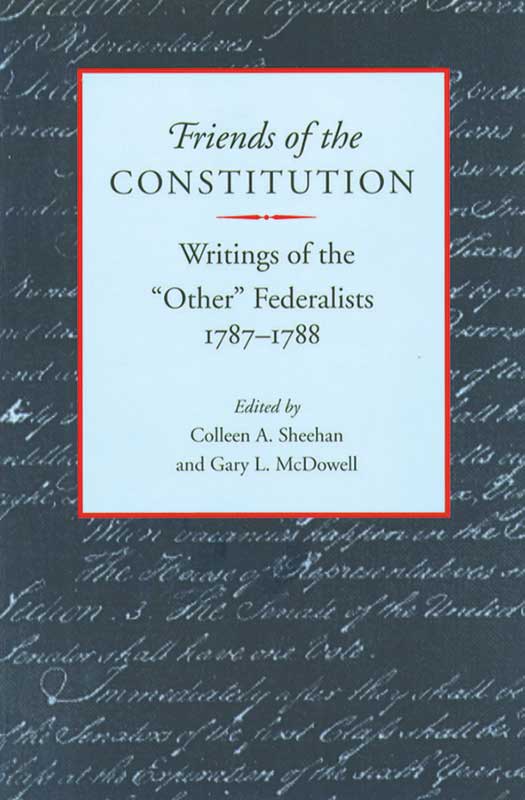
“A Landholder” [Oliver Ellsworth] The Letters: I-V, VIII - Colleen A. Sheehan, Friends of the Constitution: Writings of the “Other” Federalists, 1787-1788 [1998]Edition used:Friends of the Constitution: Writings of the “Other” Federalists, 1787-1788, edited by Colleen A. Sheehan and Gary L. McDowell (Indianapolis: Liberty Fund, 1998).
About Liberty Fund:Liberty Fund, Inc. is a private, educational foundation established to encourage the study of the ideal of a society of free and responsible individuals. Copyright information:The copyright to this edition, in both print and electronic forms, is held by Liberty Fund, Inc. Fair use statement:This material is put online to further the educational goals of Liberty Fund, Inc. Unless otherwise stated in the Copyright Information section above, this material may be used freely for educational and academic purposes. It may not be used in any way for profit.
“A Landholder” [Oliver Ellsworth]
Connecticut Courant, Hartford, 5, 12, 19, 26 November, 3 and 24 December 1787 Delegate to the Continental Congress and Judge of the Connecticut Supreme Court, Ellsworth was a member of the Constitutional Convention of 1787. After ratification he served as U.S. Senator from Connecticut (1789-96) and Chief Justice of the Supreme Court (1796-1800). ITo the Holders and Tillers of Land.The writer of the following passed the first part of his life in mercantile employments and, by industry and economy, acquired a sufficient sum on retiring from trade to purchase and stock a decent plantation on which he now lives in the state of a farmer. By his present employment he is interested in the prosperity of agriculture and those who derive a support from cultivating the earth. An acquaintance with business has freed him from many prejudices and jealousies which he sees in his neighbors, who have not intermingled with mankind nor learned by experience the method of managing an extensive circulating property. Conscious of an honest intention, he wishes to address his brethren on some political subjects which now engage the public attention and will in the sequel greatly influence the value of landed property. The new Constitution for the United States is now before the public; the people are to determine, and the people at large generally determine right when they have had means of information. It proves the honesty and patriotism of the gentlemen who composed the General Convention that they chose to submit their system to the people rather than the legislatures, whose decisions are often influenced by men in the higher departments of government, who have provided well for themselves and dread any change lest they should be injured by its operation. I would not wish to exclude from a state convention those gentlemen who compose the higher branches of the assemblies in the several states, but choose to see them stand on an even floor with their brethren, where the artifice of a small number cannot negative a vast majority of the people. This danger was foreseen by the Federal Convention, and they have wisely avoided it by appealing directly to the people. The landholders and farmers are more than any other men concerned in the present decision; whether the proposed alteration is best they are to determine, but that an alteration is necessary, an individual may assert. It may be assumed as a fixed truth that the prosperity and riches of the farmer must depend on the prosperity and good national regulation of trade. Artful men may insinuate the contrary, tell you let trade take care of itself, and excite your jealousy against the merchant because his business leads him to wear a gayer coat than your economy directs. But let your own experience refute such insinuations. Your property and riches depend on a ready demand and generous price for the produce you can annually spare. When and where do you find this? Is it not where trade flourishes and when the merchant can freely export the produce of the country to such parts of the world as will bring the richest return? When the merchant doth not purchase, your produce is low, finds a dull market—in vexation you call the trader a jockey and curse the men whom you ought to pity. A desire of gain is common to mankind and the general motive to business and industry. You cannot expect many purchasers when trade is restricted, and your merchants are shut out from nine-tenths of the ports in the world. While they depend on the mercy of foreign nations, you are the first persons who will be humbled. Confined to a few foreign ports, they must sell low, or not at all; and can you expect they will greedily buy in at a high price, the very articles which they must sell under every restriction? Every foreign prohibition on American trade is aimed in the most deadly manner against the holders and tillers of the land, and they are the men made poor. Your only remedy is such a national government as will make the country respectable, such a supreme government as can boldly meet the supremacy of proud and self-interested nations. The regulation of trade ever was and ever must be a national matter. A single state in the American Union cannot direct, much less control it. This must be a work of the whole, and requires all the wisdom and force of the continent, and until it is effected our commerce may be insulted by every overgrown merchant in Europe. Think not the evil will rest on your merchants alone; it may distress them, but it will destroy those who cultivate the earth. Their produce will bear a low price and require bad pay, the laborer will not find employment, the value of lands will fall, and the landholder become poor. While our shipping rots at home by being prohibited from ports abroad, foreigners will bring you such articles and at such price as they please. Even the necessary article of salt has the present year been chiefly imported in foreign bottoms, and you already feel the consequence; your flaxseed in barter has not returned you more than two-thirds of the usual quantity. From this beginning learn what is to come. Blame not our merchants; the fault is not in them but in the public. A federal government of energy is the only means which will deliver us, and now or never is your opportunity to establish it on such a basis as will preserve your liberty and riches. Think not that time without your own exertions will remedy the disorder. Other nations will be pleased with your poverty; they know the advantage of commanding trade and carrying in their own bottoms. By these means they can govern prices and breed up a hardy race of seamen to man their ships of war when they wish again to conquer you by arms. It is strange the holders and tillers of the land have had patience so long. They are men of resolution as well as patience, and will I presume be no longer deluded by British emissaries, and those men who think their own offices will be hazarded by any change in the constitution. Having opportunity, they will coolly demand a government which can protect what they have bravely defended in war. IITo the Holders and Tillers of Land.Gentlemen, You were told in the late war that peace and independence would reward your toil, and that riches would accompany the establishment of your liberties, by opening a wider market and consequently raising the price of such commodities as America produces for exportation. Such a conclusion appeared just and natural. We had been restrained by the British to trade only with themselves, who often reexported to other nations, at a high advance, the raw materials they had procured from us. This advance we designed to realize, but our expectation has been disappointed. The produce of the country is in general down to the old price, and bids fair to fall much lower. It is time for those who till the earth in the sweat of their brow to inquire the cause, and we shall find it neither in the merchant or farmer, but in a bad system of policy and government, or rather in having no system at all. When we call ourselves an independent nation, it is false: we are neither a nation, nor are we independent. Like thirteen contentious neighbors, we devour and take every advantage of each other, and are without that system of policy which gives safety and strength, and constitutes a national structure. Once we were dependent only on Great Britain; now we are dependent on every petty state in the world and on every custom-house officer of foreign ports. If the injured apply for redress to the assemblies of the several states, it is in vain, for they are not, and cannot be known abroad. If they apply to Congress, it is also vain, for however wise and good that body may be, they have not power to vindicate either themselves or their subjects. Do not, my countrymen, fall into a passion on hearing these truths, nor think your treatment unexampled. From the beginning it hath been the case that people without policy will find enough to take advantage of their weakness, and you are not the first who have been devoured by their wiser neighbors. But perhaps it is not too late for a remedy; we ought at least to make a trial, and if we still die shall have this consolation in our last hours, that we tried to live. I can foresee that several classes of men will try to alarm your fears, and however selfish their motives, we may expect that liberty, the encroachments of power, and the inestimable privileges of dear posterity will with them be fruitful topics of argument. As Holy Scripture is used in the exorcisms of Romish priests to expel imaginary demons; so the most sacred words will be conjured together to oppose evils which have no existence in the new Constitution, and which no man dare attempt to carry into execution among a people of so free a spirit as the Americans. The first to oppose a federal government will be the old friends of Great Britain, who in their hearts cursed the prosperity of your arms and have ever since delighted in the perplexity of your councils. Many of these men are still among us, and for several years their hopes of a reunion with Britain have been high; they rightly judge that nothing will so soon effect their wishes as the deranged state we are now in, if it should continue. They see that the merchant is weary of a government which cannot protect his property, and that the farmer, finding no benefit from the revolution, begins to dread much evil; and they hope the people will soon supplicate the protection of their old masters. We may therefore expect that all the policy of these men will center in defeating those measures which will protect the people and give system and force to American councils. I was lately in a circle where the new Constitution was discussed. All but one man approved; he was full of trembling for the liberties of poor America. It was strange! It was wondrous strange to see his concern after several of his arguments had been refuted by an ingenious farmer in the company. But says he, it is against the treaty of peace. We received independence from Great Britain on condition of our keeping the old constitution. Here the man come out! We had beat the British with a bad frame of government, and with a good one he feared we should eat them up. Debtors in desperate circumstances, who have not resolution to be either honest or industrious, will be the next men to take the alarm. They have long been upheld by the property of their creditors and the mercy of the public, and daily destroy a thousand honest men who are unsuspicious. Paper money and tender acts is the only atmosphere in which they can breathe and live. This is now so generally known that by being a friend to such measures a man effectually advertises himself a bankrupt. The opposition of these we expect, but for the sake of all honest and industrious debtors, we most earnestly wish the proposed Constitution may pass, for whatever gives a new spring to business will extricate them from their difficulties. There is another kind of people will be found in the opposition. Men of much self-importance and supposed skill in politics, who are not of sufficient consequence to obtain public employment, but can spread jealousies in the little districts of country where they are placed; these are always jealous of men in place and of public measures, and aim at making themselves consequential by distrusting every one in the higher offices of society. It is a strange madness of some persons immediately to distrust those who are raised by the free suffrages of the people to sustain powers which are absolutely necessary for public safety. Why were they elevated but for a general reputation of wisdom and integrity; and why should they be distrusted, until by ignorance or some base action they have forfeited a right to our confidence? To fear a general government on energetic principles lest it should create tyrants, when without such a government all have an opportunity to become tyrants and avoid punishment, is fearing the possibility of one act of oppression more than the real exercise of a thousand. But in the present case, men who have lucrative and influential state offices, if they act from principles of self-interest, will be tempted to oppose an alteration which would doubtless be beneficial to the people. To sink from a controlment of finance, or any other great department of the state, thro want of ability or opportunity to act a part in the federal system must be a terrifying consideration. Believe not those who insinuate that this is a scheme of great men to grasp more power. The temptation is on the other side. Those in great offices never wish to hazard their places by such a change. This is the scheme of the people, and those high and worthy characters who, in obedience to the public voice, offer the proposed amendment of our federal constitution thus esteemed it, or they would not have determined state conventions as the tribunal of ultimate decision. This is the last opportunity you may have to adopt a government which gives all protection to personal liberty and, at the same time, promises fair to afford you all the advantages of a sovereign empire. While you deliberate with coolness, be not duped by the artful surmises of such as from their own interest or prejudice are blind to the public good. IIITo the Holders and Tillers of Land.Gentlemen, When we rushed to arms for preventing British usurpation, liberty was the argument of every tongue. This word would open all the resources of the country and draw out a brigade of militia rapidly as the most decisive orders of a despotic government. Liberty is a word which, according as it is used, comprehends the most good and the most evil of any in the world. Justly understood it is sacred next to those which we appropriate in divine adoration; but in the mouths of some it means any thing, which will enervate a necessary government, excite a jealousy of the rulers who are our own choice, and keep society in confusion for want of a power sufficiently concentered to promote its good. It is not strange that the licentious should tell us a government of energy is inconsistent with liberty, for being inconsistent with their wishes and their vices, they would have us think it contrary to human happiness. In the state this country was left by the war, with want of experience in sovereignty, and the feelings which the people then had; nothing but the scene we had passed thro’ could give a general conviction that an internal government of strength is the only means of repressing external violence, and preserving the national rights of the people against the injustice of their own brethren. Even the common duties of humanity will gradually go out of use, when the constitution and laws of a country, do not insure justice from the public and between individuals. American experience, in our present deranged state, hath again proved these great truths, which have been verified in every age since men were made and became sufficiently numerous to form into public bodies. A government capable of controling the whole, and bringing its force to a point is one of the prerequisites for national liberty. We combine in society, with an expectation, to have our persons and properties defended against unreasonable exactions either at home or abroad. If the public are unable to protect us against the unjust impositions of foreigners, in this case we do not enjoy our natural rights, and a weakness in government is the cause. If we mean to have our natural rights and properties protected, we must first create a power which is able to do it, and in our case there is no want of resources, but only of a civil constitution which may draw them out and point their force. The present question is shall we have such a constitution or not? We allow it to be a creation of power; but power when necessary for our good is as much to be desired as the food we eat or the air we breathe. Some men are mightily afraid of giving power lest it should be improved for oppression; this is doubtless possible, but where is the probability. The same objection may be made against the constitution of every state in the union, and against every possible mode of government; because a power of doing good always implies a power to do evil if the person or party be disposed. The right of the legislature to ordain laws binding on the people, gives them a power to make bad laws. The right of the judge to inflict punishments, gives him both power and opportunity to oppress the innocent; yet none but crazy men will from thence determine that it is best to have neither a legislature nor judges. If a power to promote the best interest of the people, necessarily implies a power to do evil, we must never expect such a constitution in theory as will not be open in some respects to the objections of carping and jealous men. The new Constitution is perhaps more cautiously guarded than any other in the world, and at the same time creates a power which will be able to protect the subject; yet doubtless objections may be raised, and so they may against the constitution of each state in the union. In Connecticut the laws are the constitution by which the people are governed, and it is generally allowed to be the most free and popular in the thirteen states. As this is the state in which I live and write, I will instance several things which with a proper colouring and a spice of jealousy appear most dangerous to the natural rights of the people, yet they never have been dangerous in practice, and are absolutely necessary at some times to prevent much greater evil. The right of taxation or of assessing and collecting money out of the people, is one of those powers which may prove dangerous in the exercise, and which by the new constitution is vested solely in representatives chosen for that purpose. But by the laws of Connecticut, this power called so dangerous may be exercised by the selectmen of each town, and this not only without their consent but against their express will, where they have considered the matter, and judge it improper. This power they may exercise when and so often as they judge necessary! Three justices of the quorum, may tax a whole county in such sums as they think meet, against the express will of all the inhabitants. Here we see the dangerous power of taxation vested in the justices of the quorum and even in Select men, men whom we should suppose as likely to err and tyrannize as the representatives of three millions of people, in solemn deliberation, and amenable to the vengeance of their constituents, for every act of injustice. The same town officers have equal authority where personal liberty is concerned, in a matter more sacred than all the property in the world, the disposal of your children. When they judge fit, with the advice of one justice of the peace, they may tear them from the parents embrace, and place them under the absolute control of such masters as they please; and if the parents reluctance excites their resentment, they may place him and his property under overseers. Fifty other instances fearfull as these might be collected from the laws of the state, but I will not repeat them least my readers should be alarmed where there is no danger. These regulations are doubtless best, we have seen much good and no evil come from them. I adduced these instances to shew, that the most free constitution when made the subject of criticism may be exhibited in frightful colours, and such attempts we must expect against that now proposed. If my countrymen, you wait for a constitution which absolutely bars a power of doing evil, you must wait long, and when obtained it will have no power of doing good. I allow you are oppressed, but not from the quarter that jealous and wrong-headed men would insinuate. You are oppressed by the men, who to serve their own purposes would prefer the shadow of government to the reality. You are oppressed for want of a power which can protect commerce, encourage business, and create a ready demand for the productions of your farms. You are become poor, oppression continued will make wise men mad. The landholders and farmers have long borne this oppression, we have been patient and groaned in secret, but can promise for ourselves no longer; unless relieved madness, may excite us to actions we now dread. IVTo the Landholders and Farmers.Remarks on the objections made by the Honorable ELBRIDGE GERRY to the new Constitution.1 To censure a man for an opinion in which he declares himself honest, and in a matter of which all men have a right to judge, is highly injurious; at the same time, when the opinions even of honorable men are submitted to the people, a tribunal before which the meanest citizen hath a right to speak, they must abide the consequence of public stricture. We are ignorant whether the honorable gentleman possesses state dignities or emoluments which will be endangered by the new system, or hath motives of personality to prejudice his mind and throw him into the opposition; or, if it be so, do not wish to evade the objections by such a charge. As a member of the General Convention, and deputy from a great state, this honorable person hath a right to speak and be heard. It gives us pleasure to know the extent of what may be objected or even surmised, by one whose situation was the best to espy danger, and mark the defective parts of the Constitution, if any such there be. Mr. Gerry, tho in the character of an objector, tells us “he was fully convinced that to preserve the Union, an efficient government was indispensably necessary, and that it would be difficult to make proper amendments to the old Articles of Confederation,” therefore, by his own concession, there was an indispensable necessity of a system in many particulars entirely new. He tells us further “that if the people reject this altogether, anarchy may ensue,” and what situation can be pictured more awful than a total dissolution of all government. Many defects in the Constitution had better be risked than to fall back into that state of rude violence in which every man’s hand is against his neighbor, and there is no judge to decide between them or power of justice to control. But we hope to show that there are no such alarming defects in the proposed structure of government, and that, while a public force is created, the liberties of the people have every possible guard. Several of the honorable gentleman’s objections are expressed in such vague and indecisive terms that they rather deserve the name of insinuations, and we know not against what particular parts of the system they are pointed. Others are explicit and, if real, deserve serious attention. His first objection is “that there is no adequate provision for a representation of the people.” This must have respect either to the number of Representatives or to the manner in which they are chosen. The proper number to constitute a safe representation is a matter of judgment in which honest and wise men often disagree. Were it possible for all the people to convene and give their personal assent, some would think this the best mode of making laws; but, in the present instance, it is impracticable. In towns and smaller districts where all the people may meet conveniently and without expense this is doubtless preferable. The state representation is composed of one or two from every town and district, which composes an assembly not so large as to be unwieldy in acting, nor so expensive as to burden the people. But if so numerous a representation were made from every part of the United States, with our present population, the new Congress would consist of three thousand men; with the population of Great Britain, to which we may arrive in half a century, of ten thousand; and with the population of France, which we shall probably equal in a century and half, of thirty thousand. Such a body of men might be an army to defend the country in case of foreign invasion, but not a legislature, and the expense to support them would equal the whole national revenue. By the proposed Constitution the new Congress will consist of nearly one hundred men. When our population is equal to Great Britain of three hundred men, and when equal to France of nine hundred. Plenty of lawgivers! Why any gentleman should wish for more is not conceivable. Considering the immense territory of America, the objection with many will be on the other side; that, when the whole is populated, it will constitute a legislature unmanageable by its numbers. [The] Convention, foreseeing this danger, have so worded the article that if the people should at any future time judge necessary, they may diminish the representation. As the state legislatures have to regulate the internal policy of every town and neighborhood, it is convenient enough to have one or two men, particularly acquainted with every small district of country, its interests, parties, and passions. But the federal legislature can take cognizance only of national questions and interests, which in their very nature are general, and for this purpose five or ten honest and wise men chosen from each state, men who have had previous experience in state legislation, will be more competent than an hundred. From an acquaintance with their own state legislatures, they will always know the sense of the people at large, and the expense of supporting such a number will be as much as we ought to incur. If the honorable gentleman, in saying “there is no adequate provision for a representation of the people,” refers to the manner of choosing them, a reply to this is naturally blended with his second objection, “that they have no security for the right of election.” It is impossible to conceive what greater security can be given, by any form of words, than we here find. The federal Representatives are to be chosen by the votes of the people. Every freeman is an elector. The same qualifications which enable you to vote for state representatives give you a federal voice. It is a right you cannot lose, unless you first annihilate the state legislature and declare yourselves incapable of electing, which is a degree of infatuation improbable as a second deluge to drown the world. Your own assemblies are to regulate the formalities of this choice, and unless they betray you, you cannot be betrayed. But perhaps it may be said, Congress have a power to control this formality as to the time and places of electing; and we allow they have. But this objection, which at first looks frightful, was designed as a guard to the privileges of the electors. Even state assemblies may have their fits of madness and passion. This, tho not probable, is still possible. We have a recent instance in the State of Rhode Island, where a desperate junto are governing contrary to the sense of a great majority of the people. It may be the case in any other state, and should it ever happen that the ignorance or rashness of the state assemblies in a fit of jealousy should deny you this sacred right, the deliberate justice of the continent is enabled to interpose and restore you a federal voice. This right is therefore more inviolably guarded than it can be by the government of your state, for it is guaranteed by the whole empire. Tho out of the order in which the honorable gentleman proposes his doubts, I wish here to notice some questions which he makes. The proposed plan among others, he tells us, involves these questions: “Whether the several state governments shall be so altered as in effect to be dissolved? Whether in lieu of the state governments the national Constitution now proposed shall be substituted?” I wish for sagacity to see on what these questions are founded. No alteration in the state governments is even proposed, but they are to remain identically the same that they now are. Some powers are to be given into the hands of your federal Representatives, but these powers are all in their nature general, such as must be exercised by the whole or not at all, and such as are absolutely necessary; or your commerce, the price of your commodities, your riches, and your safety will be the sport of every foreign adventurer. Why are we told of the dissolution of our state governments, when by this plan they are indissolubly linked? They must stand or fall, live or die together. The national legislature consists of two houses, a Senate and House of Representatives. The Senate is to be chosen by the assemblies of the particular states; so that if the assemblies are dissolved, the Senate dissolves with them. The national Representatives are to be chosen by the same electors, and under the same qualifications, as choose the state representatives; so that if the state representation be dissolved, the national representation is gone of course. State representation and government is the very basis of the congressional power proposed. This is the most valuable link in the chain of connection and affords double security for the rights of the people. Your liberties are pledged to you by your own state and by the power of the whole empire. You have a voice in the government of your own state and in the government of the whole. Were not the gentleman on whom the remarks are made very honorable, and by the eminence of office raised above a suspicion of cunning, we should think he had, in this instance, insinuated merely to alarm the fears of the people. His other objections will be mentioned in some future number of the LANDHOLDER. VTo the Landholders and Farmers.Continuation of remarks on the Honorable ELBRIDGE GERRY’s objections to the new Constitution. It is unhappy both for Mr. Gerry and the public that he was not more explicit in publishing his doubts. Certainly this must have been from inattention, and not thro any want of ability; as all his honorable friends allow him to be a politician even of metaphysical nicety. In a question of such magnitude, every candid man will consent to discuss objections which are stated with perspicuity; but to follow the honorable writer into the field of conjecture and combat phantoms, uncertain whether or not they are the same which terrified him, is a task too laborious for patience itself. Such must be the writer’s situation in replying to the next objection, “That some of the powers of the legislature are ambiguous, and others indefinite and dangerous.” There are many powers given to the legislature. If any of them are dangerous, the people have a right to know which they are, and how they will operate, that we may guard against the evil. The charge of being ambiguous and indefinite may be brought against every human composition, and necessarily arises from the imperfection of language. Perhaps no two men will express the same sentiment in the same manner, and by the same words; neither do they connect precisely the same ideas with the same words. From hence arises an ambiguity in all languages, with which the most perspicuous and precise writers are in a degree chargeable. Some persons never attain to the happy art of perspicuous expression, and it is equally true that some persons, thro a mental defect of their own, will judge the most correct and certain language of others to be indefinite and ambiguous. As Mr. Gerry is the first and only man who has charged the new Constitution with ambiguousness, is there not room to suspect that his understanding is different from other men’s, and whether it be better or worse, the Landholder presumes not to decide. It is an excellency of this Constitution that it is expressed with brevity and in the plain common language of mankind. Had it swelled into the magnitude of a volume, there would have been more room to entrap the unwary, and the people who are to be its judges would have had neither patience nor opportunity to understand it. Had it been expressed in the scientific language of law, or those terms of art which we often find in political compositions, to the honorable gentleman it might have appeared more definite and less ambiguous, but to the great body of the people altogether obscure, and to accept it they must leap in the dark. The people, to whom in this case the great appeal is made, best understand those compositions which are concise and in their own language. Had the powers given to the legislature been loaded with provisos and such qualifications as a lawyer who is so cunning as even to suspect himself would probably have intermingled, there would have been much more danger of a deception in the case. It would not be difficult to show that every power given to the legislature is necessary for national defense and justice, and to protect the rights of the people who create this authority for their own advantage; but to consider each one particularly would exceed the limits of my design. I shall therefore select two powers given them, which have been more abused to oppress and enslave mankind than all the others with which this or any legislature on earth is clothed: the right of taxation, or of collecting money from the people, and of raising and supporting armies. These are the powers which enable tyrants to scourge their subjects; and they are also the very powers by which good rulers protect the people against the violence of wicked and overgrown citizens, and invasion by the rest of mankind. Judge candidly what a wretched figure the American empire will exhibit in the eye of other nations, without a power to array and support a military force for its own protection. Half a dozen regiments from Canada or New Spain might lay whole provinces under contribution, while we were disputing who has power to pay and raise an army. This power is also necessary to restrain the violence of seditious citizens. A concurrence of circumstances frequently enables a few disaffected persons to make great revolutions unless government is vested with the most extensive powers of self-defense. Had [Daniel] Shays, the malcontent of Massachusetts, been a man of genius, fortune, and address, he might have conquered that state and, by the aid of a little sedition in the other states and an army proud by victory, become the monarch and tyrant of America. Fortunately he was checked, but should jealousy prevent vesting these powers in the hands of men chosen by yourselves and who are under every constitutional restraint, accident or design will in all probability raise up some future Shays to be the tyrant of your children. A people cannot long retain their freedom whose government is incapable of protecting them. The power of collecting money from the people is not to be rejected because it has sometimes been oppressive. Public credit is as necessary for the prosperity of a nation as private credit is for the support and wealth of a family. We are this day many millions poorer than we should have been had a well-arranged government taken place at the conclusion of the war. All have shared in this loss, but none in so great proportion as the landholders and farmers. The public must be served in various departments. Who will serve them without a meet recompense? Who will go to war and pay the charges of his own warfare? What man will any longer take empty promises of reward from those who have no constitutional power to reward or means of fulfilling them? Promises have done their utmost, more than they ever did in any other age or country. The delusive bubble has broke, and in breaking it has beggared thousands and left you an unprotected people, numerous without force and full of resources but unable to command one of them. For these purposes there must be a general treasury with a power to replenish it as often as necessity requires. And where can this power be more safely vested than in the common legislature, men chosen by yourselves from every part of the Union, and who have the confidence of their several states, men who must share in the burdens they impose on others, men who by a seat in Congress are incapable of holding any office under the states, which might prove a temptation to spoil the people for increasing their own income? We find another objection to be “that the executive is blended with and will have an undue influence over the legislative.” On examination you will find this objection unfounded. The supreme executive is vested in a President of the United States. Every bill that hath passed the Senate and Representatives must be presented to the President, and if he approve, it becomes law. If he disapproves, but makes no return within ten days, it still becomes law. If he returns the bill with his objections, the Senate and Representatives consider it a second time, and if two-thirds of them adhere to the first resolution, it becomes law notwithstanding the President’s dissent. We allow the President hath an influence, tho strictly speaking he hath not a legislative voice, and think such an influence must be salutary. In the President, all the executive departments meet, and he will be a channel of communication between those who make and those who execute the laws. Many things look fair in theory which in practice are impossible. If lawmakers in every instance, before their final decree, had the opinion of those who are to execute them, it would prevent a thousand absurd ordinances, which are solemnly made, only to be repealed and lessen the dignity of legislation in the eyes of mankind. The Vice President is not an executive officer while the President is in discharge of his duty; and when he is called to preside, his legislative voice ceases. In no other instance is there even the shadow of blending or influence between the two departments. We are further told “that the judicial department, or those courts of law to be instituted by Congress, will be oppressive.” We allow it to be possible, but from whence arises the probability of this event? State judges may be corrupt, and juries may be prejudiced and ignorant, but these instances are not common; and why shall we suppose they will be more frequent under a national appointment and influence, when the eyes of a whole empire are watching for their detection? Their courts are not to intermeddle with your internal policy and will have cognizance only of those subjects which are placed under the control of a national legislature. It is as necessary there should be courts of law and executive officers, to carry into effect the laws of the nation, as that there be courts and officers to execute the laws made by your state assemblies. There are many reasons why their decisions ought not to be left to courts instituted by particular states. A perfect uniformity must be observed thro the whole Union, or jealousy and unrighteousness will take place; and for a uniformity, one judiciary must pervade the whole. The inhabitants of one state will not have confidence in judges appointed by the legislature of another state, in which they have no voice. Judges who owe their appointment and support to one state will be unduly influenced and not reverence the laws of the Union. It will at any time be in the power of the smallest state, by interdicting their own judiciary, to defeat the measures, defraud the revenue, and annul the most sacred laws of the whole empire. A legislative power without a judicial and executive under their own control is in the nature of things a nullity. Congress under the old Confederation had power to ordain and resolve, but having no judicial or executive of their own, their most solemn resolves were totally disregarded. The little State of Rhode Island was purposely left by Heaven to its present madness for a general conviction in the other states that such a system as is now proposed is our only preservation from ruin. What respect can anyone think would be paid to national laws, by judicial and executive officers who are amenable only to the present Assembly of Rhode Island? The rebellion of Shays and the present measures of Rhode Island ought to convince us that a national legislature, judiciary, and executive must be united or the whole is but a name; and that we must have these or soon be hewers of wood and drawers of water for all other people. In all these matters and powers given to Congress, their ordinances must be the supreme law of the land or they are nothing. They must have authority to enact any laws for executing their own powers, or those powers will be evaded by the artful and unjust, and the dishonest trader will defraud the public of its revenue. As we have every reason to think this system was honestly planned, we ought to hope it may be honestly and justly executed. I am sensible that speculation is always liable to error. If there be any capital defects in this Constitution, it is most probable that experience alone will discover them. Provision is made for an alteration if on trial it be found necessary. When your children see the candor and greatness of mind with which you lay the foundation, they will be inspired with equity to furnish and adorn the superstructure. VIIITo the Hon. ELBRIDGE GERRY, Esquire.Sir, When a man in public life first deviates from the line of truth and rectitude, an uncommon degree of art and attention becomes necessary to secure him from detection. Duplicity of conduct in him requires more than double caution; a caution which his former habits of simplicity have never furnished him the means of calculating; and his first leap into the region of treachery and falshood is often as fatal to himself as it was designed to be to his country. Whether you and Mr. Mason may be ranked in this class of transgressors I pretend not to determine. Certain it is, that both your management and his for a short time before and after the rising of the fœderal convention impress us with a favorable opinion, that you are great novices in the arts of dissimulation. A small degree of forethought would have taught you both a much more successful method of directing the rage of resentment which you caught at the close of the business at Philadelphia, than the one you took. You ought to have considered that you resided in regions very distant from each other, where different parts were to be acted, and then made your cast accordingly. Mr. Mason was certainly wrong in telling the world that he acted a double part—he ought not to have published two setts of reasons for his dissent to the constitution. His New-England reasons would have come better from you. He ought to have contented himself with haranguing in the southern states, that it was too popular, and was calculated too much for the advantage of the eastern states. At the same time you might have come on, and in the Coffee-House at New-York you might have found an excellent sett of objections ready made to your hand; a sett that with very little alteration would have exactly suited the latitude of New-England, the whole of which district ought most clearly to have been submitted to your protection and patronage. A Lamb, a Willet, a Smith, a Clinton, a Yates,2 or any other gentleman whose salary is paid by the state impost, as they had six months the start of you in considering the subject, would have furnished you with a good discourse upon the “liberty of the press,” the “bill of rights,” the “blending of the executive and legislative,” “internal taxation,” or any other topic which you did not happen to think of while in convention. It is evident that this mode of proceeding would have been well calculated for the security of Mr. Mason; he there might have vented his antient enmity against the independence of America, and his sore mortification for the loss of his favorite motion respecting the navigation-act; and all under the mask of sentiments, which with a proper caution in expressing them, might have gained many adherents in his own state. But, although Mr. Mason’s conduct might have been easily guarded in this particular, your character would not have been entirely safe even with the precaution above mentioned. Your policy, Sir, ought to have led you one step farther back. You have been so precipitate and unwary in your proceedings, that it will be impossible to set you right, even in idea, without recurring to previous transactions and recalling to your view the whole history of your conduct in the convention as well as the subsequent display of patriotism contained in your publication. I undertake this business, not that I think it possible to help you out of your present embarrassments; but, as those transactions have evidently slipt your memory, the recollection of the blunder into which your inexperience has betrayed you, may be of eminent service in forming future schemes of popularity, should the public ever give you another opportunity to traduce and deceive them. You will doubtless recollect the following state of facts; if you do not, every member of the Convention will attest them—that almost the whole time during the setting of the Convention, and until the Constitution had received its present form, no man was more plausible and conciliating upon every subject than Mr. Gerry—he was willing to sacrifice every private feeling and opinion—to concede every state interest that should be in the least incompatible with the most substantial and permanent system of general government—that mutual concession and unanimity were the whole burden of his song; and although he originated no ideas himself, yet there was nothing in the system as it now stands to which he had the least objection—indeed Mr. Gerry’s conduct was agreeably surprising to all his acquaintance, and very unlike that turbulent obstinacy of spirit which they had formerly affixed to his character. Thus stood Mr. Gerry; till, towards the close of the business, he introduced a motion respecting the redemption of the old Continental Money—that it should be placed upon a footing with other liquidated securities of the United States. As Mr. Gerry was supposed to be possessed of large quantities of this species of paper, his motion appeared to be founded in such barefaced selfishness and injustice, that it at once accounted for all his former plausibility and concession, while the rejection of it by the Convention inspired its author with the utmost rage and intemperate opposition to the whole system he had formerly praised. His resentment could no more than embarrass and delay the completion of the business for a few days; when he refused signing the Constitution and was called upon for his reasons. These reasons were committed to writing by one of his colleagues and likewise by the Secretary, as Mr. Gerry delivered them. These reasons were totally different from those which he has published, neither was a single objection which is contained in his letter to the legislature of Massachusetts ever offered by him in convention. Now, Mr. Gerry, as this is generally known to be the state of facts, and as neither the reasons which you publish nor those retained on the Secretary’s files can be supposed to have the least affinity to truth, or to contain the real motives which induced you to withhold your name from the constitution, it appears to me that your plan was not judiciously contrived. When we act without principle, we ought to be prepared against embarrassments. You might have expected some difficulties in realizing your continental money; indeed the chance was rather against your motion even in the most artful shape in which it could have been proposed. An experienced hand would therefore have laid the whole plan beforehand, and have guarded against a disappointment. You should have begun the business with doubts, and expressed your sentiments with great ambiguity upon every subject as it passed. This method would have secured you many advantages. Your doubts and ambiguities, if artfully managed, might have passed, like those of the Delphic Oracle, for wisdom and deliberation; and at the close of the business you might have acted either for or against the constitution, according to the success of your motion, without appearing dishonest or inconsistent with yourself. One farther precaution would have brought you off clear. Instead of waiting till the Convention rose, before you consulted your friends at New-York, you ought to have applied to them at an earlier period, to know what objections you should make. They could have instructed you as well in August as October. With these advantages you might have past for a complete politician, and your duplicity might never have been detected. The enemies of America have always been extremely unfortunate in concerting their measures. They have generally betrayed great ignorance of the true spirit and feeling of the country, and they have failed to act in concert with each other. This is uniformly conspicuous, from the first Bute Parliament in London to the last Shays Parliament at Pelham. The conduct of the enemies of the new constitution compares with that of the other enemies above mentioned only in two particulars, its object and its tendency. Its object was self interest built on the ruins of the country, and its tendency is the disgrace of its authors and the final prosperity of the same country they meant to depress. Whether the constitution will be adopted at the first trial in the conventions of nine states is at present doubtful. It is certain however, that its enemies have great difficulties to encounter arising from their disunion; in the different states where the opposition rages the most, their principles are totally opposite to each other and their objections discordant and irreconcilable; so that no regular system can be formed among you, and you will betray each other’s motives. In Massachusetts the opposition began with you, and from motives most pitifully selfish and despicable; you addressed yourself to the feelings of the Shays faction, and that faction will be your only support. In New-York the opposition is not to this constitution in particular, but to the federal impost; it is confined wholly to salary men and their connections, men whose salary is paid by the state impost. This class of citizens are endeavouring to convince the ignorant part of the community that an annual income of fifty thousand pounds, extorted from the citizens of Massachusetts, Connecticut and New-Jersey, is a great blessing to the state of New-York. And although the regulation of trade and other advantages of a federal government would secure more than five times that sum to the people of that state; yet, as this would not come through the same hands, these men find fault with the constitution. In Pennsylvania the old quarrel respecting their state constitution has thrown the state into parties for a number of years. One of these parties happened to declare for the new federal constitution, and this was a sufficient motive for the other to oppose it: the dispute there is not upon the merits of the subject, but it is their old warfare carried on with different weapons, and it was an even chance that the parties had taken different sides from what they have taken, for there is no doubt but either party would sacrifice the whole country to the destruction of their enemies. In Virginia the opposition wholly originated in two principles; the madness of Mason, and the enmity of the Lee faction to General Washington. Had the General not attended the convention nor given his sentiments respecting the constitution, the Lee party would undoubtedly have supported it, and Col. Mason would have vented his rage to his own negroes and to the wind. In Connecticut, our wrongheads are few in number and feeble in their influence. The opposition here is not one half so great to the federal government, as it was three years ago to the federal impost; and the faction, such as it is, is from the same blindfold party. I thought it my duty to give you these articles of information, for the reasons above mentioned. Wishing you more caution and better success in your future manœuvers, I have the honour to be, Sir, with great respect your very humble servant. Popular Government and Civic VirtueDespite numerous Anti-Federalist accusations that the Federalists were advancing aristocratic government in America, virtually all Federalists defended the cause of popular government. The Federalist case for popular government rested on both the natural right of the people to institute government and the concomitant duty to establish and preserve good government. Even “Caesar,” who with “blunt and ungracious reasoning” fully admitted that he considered the “unthinking masses” ill qualified to evaluate the Constitution, and that he was “not much attached to the majesty of the multitude,” nonetheless recognized the inherent right of the people to receive or reject the Constitution. He simply exhorted them to look to the opinions of their more learned superiors in deciding the case. In contrast to the deferential role “Caesar” advised the people to take, Noah Webster argued that “it is not only the right, but the indispensable duty of every citizen to examine the principles” of the proposed government. Though strongly committed to popular government, the Federalists were not inattentive to the problems and excesses of democracy. Unwilling to defend “popular government with a vengeance” or “licentious democracy,” they sought a way to retain the principles and spirit of democratic government and at the same time avoid the defects toward which it tended. In response to the Anti-Federalist view that a large territory is unfit for popular government and that only in small territories are the republican virtues of public spiritedness and moderation possible, Federalists charged that the small republic thesis was flawed. The problem of small republics, they said, is that they are prone to turbulence, licentiousness, and faction. To counteract these diseases, Federalists asserted the need for a large republic. How did the Federalists understand the purpose of republican government? How did they think such a government was to be preserved and perpetuated? Was there a Federalist vision of republicanism that was more than a defense against Anti-Federalist criticisms? The following selections demonstrate that many of the Federalists did not simply react to their opponents’ charges, but presented philosophically thoughtful, albeit sometimes competing, views about the nature of republican government. The “State Soldier” ridicules the “chimerical and speculative enjoyments” that amused the political imaginations of his opponents and declares that “the only desirable purpose of any government is, the security of men’s persons and property.” According to Noah Webster, a general distribution of property is “the very soul of a republic.” Indeed, Montesquieu was wrong; it is not virtue that provides the sturdiest support of free government but property and dominion. In contrast, Nicholas Collin warns against an “overdriven spirit of commerce,” for the desire to accumulate wealth and dominion, left unchecked by moral and religious principles, fosters base passions. Put simply “there can be no liberty without virtue.” In his view, the moral and intellectual qualities that ennoble men and make them capable of self-government are the very soul of the republic. A people of good manners, morals, and learning make the political union stronger, animating it “by the same generous spirit.” In turn, a noble republican civilization gradually enhances “the dispositions necessary for civil government.” John Dickinson agreed. He believed that while government ought to safeguard the liberty and property of the people, the perpetuation of the people’s virtue and the advancement of their happiness is the final purpose of government. Dickinson’s understanding of the rights of man places the individual “in a close connection with all his duties.” The right of the people to establish a constitution and institute government is inextricably bound to the purpose of a constitution and government: to advance the general welfare and happiness of the people in the way ordained by the Creator and the law of nature. The competing views on the nature of republican government represent two different poles of political science in the eighteenth century. According to the narrower vision, not only is free government limited in its powers, but it is also limited in its purpose. The aim of republican government is the security of the individual and his property, or in other words the prevention of injustice; republican government neither attempts to form nor depends upon a virtuous citizenry. Proponents of the broader vision agreed that republican government must be limited in its powers, for only a government of constitutionally limited authority is consistent with the rights of man. They did not, however, believe that the recognition of man’s natural rights reduced the ends of politics. Rather than lowering the ends of political association, the discovery and recognition of the rights of man offered the just basis on which to construct the political community and to accomplish the highest of political tasks. There can be no self-government without liberty, they believed, but further there can be no genuine liberty and self-government without virtue. Despite the lack of unanimity about the purpose of republican government, most Federalists understood that the regime they were about to establish would affect the manners and souls of the citizens. They also generally agreed that the perpetuation of republicanism depends ultimately on the character of the citizens. The need for ethical and religious instruction in the polity was widely felt and frequently spoken of, though as a whole the Federalists did not draw a detailed roadmap for the journey of moral education in the United States. Instead, they tended to speak to their fellow citizens in generalities, almost in matter-of-fact tones, about the need for and the benefits that would derive from religion, education, good statesmanship, and law. Having said this, it is important to point out that there were indeed some Federalists who confronted certain moral and religious matters explicitly. It is not sufficient to assume a common consensus on the “universally established principles of humanity and common equity,” Collin said. These principles must be applied in practice. Thus he, Tench Coxe, “Crito,” and others raised their voices in condemnation of the cruel, inhuman practice of slavery in America. Presaging the poignant appeal of Abraham Lincoln during the Civil War era, “Crito” reminds his fellow citizens of the principles to which the American union is dedicated. “It was repeatedly declared,” he says, “ . . . that all men are created equal; That they are endowed by their Creator with certain unalienable rights. That among these are life, liberty, and the pursuit of happiness.” Pointing out the striking contradiction between the sacred principles and the profane practices of America, “Crito” continues: The Africans, and the blacks in servitude among us, were really as much included in these assertions as ourselves; and their right, unalienable right to liberty, and to procure and possess property, is as much asserted as ours, if they be men. And if we have not allowed them to enjoy these unalienable rights, but violently deprive them of liberty and property, and are still taking, as far as in our power, all liberty, and property from the nations in Africa, we are guilty of a ridiculous wicked contradiction and inconsistence: and practically authorize any nation or people, who have power to do it, to make us their slaves. It would seem that David Ramsay of South Carolina could not hear the pleas of “Crito,” or the “bitter sighs, groans, and tears” of the distressed men and women held in bondage. Congress is prohibited from outlawing the slave trade for twenty-one years, Ramsay points out. It does not follow that they must or will forbid it after 1808; indeed, “it is probable that they will not.” Ramsay’s prediction is premised on his calculation of the economic self-interest of both the South and the North, implying that the desire for wealth will decide the question of the future of the slave trade in the United States. “One of the People Called Quakers” saw things very differently. The Virginia delegates to the Constitutional Convention, he says, were obdurately opposed to slavery and agreed to the limited importation of slaves only because it was the best compromise they could then attain. “The new federal government,” he concludes, “ . . . would eagerly embrace the opportunity not only of putting an end to the importation of slaves, but of abolishing slavery forever.” In matters of religious conviction, the Federalists concurred that liberty requires the unrestrained exercise of the conscience and prohibits religious tests for office. This did not mean to “Elihu” that the impious and the immoral were not fools nor to Oliver Ellsworth that the law must be indifferent to gross impieties and immoralities. Indeed in matters of morality the law serves not only to punish indiscretions but also to induce good habits and educate to virtue. For the vast majority of the Founders, liberty was compatible with morality; it was not compatible with, or even secure in, a polity that failed or refused to make moral distinctions. The concern for the relationship between liberty and morality was also applied to economic matters. Some of the Federalists viewed the life of commerce and manufacturing as incompatible with an independent, simple-mannered, virtuous republican citizenry. More often than not, however, Federalists concluded that there is no incongruity between scientific progress and commercial prosperity on the one hand, and the preservation of a virtuous citizenry on the other. In fact according to Collin, Dickinson, Ellsworth, and Wilson, the moderate and just pursuit of wealth is perfectly compatible with, and may even provide a mutual support for, the ethical life. Many leading Federalists contended that adherence to the just principles of republican government requires both a dependence on the character of the citizenry and guidance from intelligent and virtuous leaders. The call for a republican spirit throughout the government and across the land is echoed by a host of voices in choral array. Dickinson tells of how this may be achieved, teaching that a popular government in a large territory acting according to the principles of representation and federalism can be characterized by an “animated moderation.” Similarly Wilson calls for the union of public-spiritedness and moderation. In his Fourth of July oration of 1788 he exhorts the American people to the cause of their celebrated independence and union, demonstrating at once the profoundly popular character of the American polity and the crucial task that must be performed by statesmen-educators if republican government is to endure. One can almost hear the sonorous echoes of the Federalists sounding across the many July Fourths that separate us in time but connect us in spirit, calling out their hope for a “constellation of noble minds” to continue the trial of self-government and thus shedding “a bright day over American till time is no more.” [1. ]Gerry, a wealthy Massachusetts merchant with vast public securities, was a member of the Philadelphia Convention. Charles Beard argued that the Founding Fathers supported the Constitution because they stood to gain economically under the new regime. However, Gerry, who stood to profit substantially under the new system, refused to sign the Constitution and steadfastly opposed its ratification. As Forrest McDonald has wryly remarked, “except in opposing the Constitution, Gerry fits Professor Beard’s description of suffering personalty interests in every way and on a large scale.” Forrest McDonald, We the People: The Economic Origins of the Constitution (Chicago: University of Chicago Press, 1958), 44. See Storing, 2:1. Gerry’s objections are also in Allen, 20-22. [2. ]John Lamb, Marinus Willetts, Melancton Smith, George Clinton, and Robert Yates were prominent New York Anti-Federalists. See Storing, 6 and passim. In Allen, see Robert Yates and John Lansing’s “Reasons of Dissent,” 14-16, and Melancton Smith’s speech to the New York ratifying convention on 20 June 1788, 171-77. |

Titles (by Subject)