Econlib

The Library

Other Sites

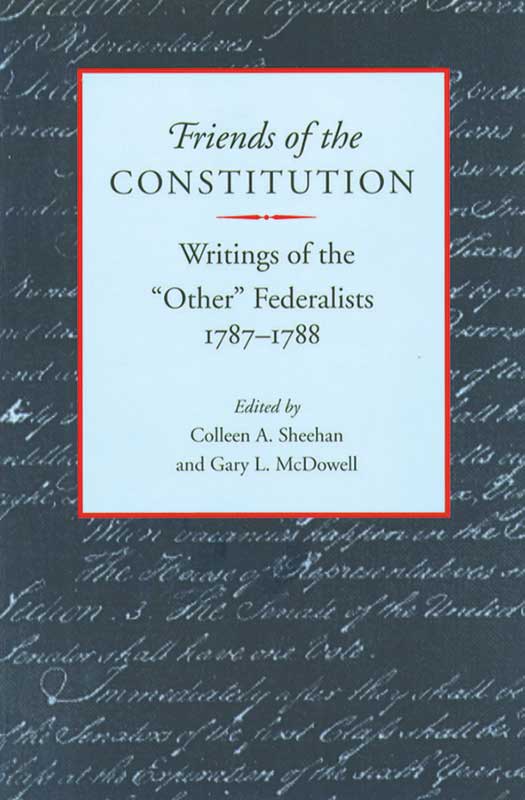
Front Page arrow Titles (by Subject) arrow Fabius [John Dickinson] The Letters: IV-VI - Friends of the Constitution: Writings of the Other Federalists, 1787-1788

Return to Title Page for Friends of the Constitution: Writings of the “Other” Federalists, 1787-1788

Search this Title:

“Fabius” [John Dickinson] The Letters: IV-VI - Colleen A. Sheehan, Friends of the Constitution: Writings of the “Other” Federalists, 1787-1788 [1998]

Edition used:

Friends of the Constitution: Writings of the “Other” Federalists, 1787-1788, edited by Colleen A. Sheehan and Gary L. McDowell (Indianapolis: Liberty Fund, 1998).

About Liberty Fund:

Liberty Fund, Inc. is a private, educational foundation established to encourage the study of the ideal of a society of free and responsible individuals.


“Fabius” [John Dickinson]

The Letters: IV-VI

IV

Another question remains. How are the contributed rights to be managed? The resolution has been in great measure anticipated, by what has been said concerning the system proposed. Some few reflections may perhaps finish it.

If it be considered separately, a constitution is the organization of the contributed rights in society. Government is the exercise of them. It is intended for the benefit of the governed; of course can have no just powers but what conduce to that end: and the awfulness of the trust is demonstrated in this—that it is founded on the nature of man, that is, on the will of his Maker, and is therefore sacred. It is then an offence against Heaven, to violate that trust.

If the organization of a constitution be defective, it may be amended.

A good constitution promotes, but not always produces a good administration.

The government must never be lodged in a single body. From such an one, with an unlucky composition of its parts, rash, partial, illegal, and when intoxicated with success, even cruel, insolent and contemptible edits, may at times be expected. By these, if other mischiefs do not follow, the national dignity may be impaired.

Several inconveniences might attend a division of the government into two bodies, that probably would be avoided in another arrangement.

The judgment of the most enlightened among mankind, confirmed by multiplied experiments, points out the propriety of government being committed to such a number of great departments, as can be introduced without confusion, distinct in office, and yet connected in operation. It seems to be agreed, that three or four of these departments are a competent number.

Such a repartition appears well calculated to express the sense of the people, and to encrease the safety and repose of the governed, which with the advancement of their happiness in other respects, are the objects of government; as thereby there will be more obstructions interposed; against errors, feuds, and frauds, in the administration, and the extraordinary interference of the people need be less frequent. Thus, wars, tumults, and uneasinesses, are avoided. The departments so constituted, may therefore be said to be balanced.

But, notwithstanding, it must be granted, that a bad administration may take place.—What is then to be done? The answer is instantly found—Let the Fasces be lowered before—the supreme sovereignty of the people. It is their duty to watch, and their right to take care, that the constitution be preserved; or in the Roman phrase on perilous occasions—to provide, that the republic receive no damage.

Political bodies are properly said to be balanced, with respect to this primary origination and ultimate destination, not to any intrinsic or constitutional properties. It is the power from which they proceed, and which they serve, that truly and of right balances them.

But, as a good constitution [does] not always produces a good administration, a defective one [does] not always excludes it. Thus in governments very different from those of United America, general manners and customs, improvement in knowledge, and the education and disposition of princes, not unfrequently soften the features, and qualify the defects. Jewels of value are substituted, in the place of the rare and genuine orient of highest price and brightest lustre: and though the sovereigns cannot even in their ministers, be brought to account by the governed, yet there are instances of their conduct indicating a veneration for the rights of the people, and an internal conviction of the guilt that attends their violation. Some of them appear to be fathers of their countries. Revered princes! Friends of mankind! May peace be in their lives—and in their deaths—Hope.

By this superior will of the people, is meant a reasonable, not a distracted will. When frenzy seizes the mass, it would be equal madness to think of their happiness, that is, of their freedom. They will infallibly have a Philip or a Cæsar, to bleed them into soberness of mind. At present we are cool; and let us attend to our business.

Our government under the proposed confederation, will be guarded by a repetition of the strongest cautions against excesses. In the senate the sovereignties of the several states will be equally represented; in the house of representatives, the people of the whole union will be equally represented; and, in the president, and the federal independent judges, so much concerned in the execution of the laws, and in the determination of their constitutionality, the sovereignties of the several states and the people of the whole union, may be considered as conjointly represented.

Where was there ever and where is there now upon the face of the earth, a government so diversified and attempered? If a work formed with so much deliberation, so respectful and affectionate an attention to the interests, feelings, and sentiments of all United America, will not satisfy, what would satisfy all United America?

It seems highly probable, that those who would reject this labour of public love, would also have rejected the Heaven-taught institution of trial by jury, had they been consulted upon its establishment. Would they not have cried out, that there never was framed so detestable, so paltry, and so tyrannical a device for extinguishing freedom, and throwing unbounded domination into the hands of the king and barons, under a contemptible pretence of preserving it? “What! Can freedom be preserved by imprisoning its guardians? Can freedom be preserved, by keeping twelve men closely confined without meat, drink, fire, or candle, until they unanimously agree, and this to be innumerably repeated? Can freedom be preserved, by thus delivering up a number of freemen to a monarch and an aristocracy, fortified by dependant and obedient judges and officers, to be shut up, until under duress they speak as they are ordered? Why cannot the twelve jurors separate, after hearing the evidence, return to their respective homes, and there take time, and think of the matter at their ease? Is there not a variety of ways, in which causes have been, and can be tried, without this tremendous, unprecedented inquisition? Why then is it insisted on; but because the fabricators of it know that it will, and intend that it shall reduce the people to slavery? Away with it—Freemen will never be enthralled by so insolent, so execrable, so pitiful a contrivance.”

Happily for us our ancestors thought otherwise. They were not so overnice and curious, as to refuse blessings, because, they might possibly be abused.

They perceived, that the uses included were great and manifest. Perhaps they did not foresee, that from this acorn, as it were, of their planting, would be produced a perpetual vegetation of political energies, that “would secure the just liberties of the nation for a long succession of ages, and elevate it to the distinguished rank it has for several centuries held.” As to abuses, they trusted to their own spirit for preventing or correcting them: And worthy is it of deep consideration by every friend of freedom, that abuses that seem to be but “trifles,” may be attended by fatal consequences. What can be “trifling,” that diminishes or detracts from the only defence, that ever was found against “open attacks and secret machinations?” This establishment originates from a knowledge of human nature. With a superior force, wisdom, and benevolence united, it rives the difficulties concerning administration of justice, that have distressed, or destroyed the rest of mankind. It reconciles contradictions—vastness of power, with safety of private station. It is ever new, and always the same.

Trial by jury and the dependence of taxation upon representation, those corner stones of liberty, were not obtained by a bill of rights, or any other records, and have not been and cannot be preserved by them. They and all other rights must be preserved, by soundness of sense and honesty of heart. Compared with these, what are a bill of rights, or any characters drawn upon paper or parchment, those frail remembrances? Do we want to be reminded, that the sun enlightens, warms, invigorates, and cheers? or how horrid it would be, to have his blessed beams intercepted, by our being thrust into mines or dungeons? Liberty is the sun of society. Rights are the beams.

“It is the duty which every man owes to his country, his friends, his posterity, and himself, to maintain to the utmost of his power this valuable palladium in all its rights; to restore it to its ancient dignity, if at all impaired by the different value of property, or otherwise deviated from its first institution; to amend it, wherever it is defective; and above all to guard with the most jealous circumspection against the new and arbitrary methods of trial, which, under a variety of plausible pretences, may in time imperceptibly undermine this best preservative of liberty.” Trial by Jury is our birthright; and tempted to his own ruin, by some seducing spirit, must be the man, who in opposition to the genius of United America, shall dare to attempt its subversion.

In the proposed confederation, it is preserved inviolable in criminal cases, and cannot be altered in other respects, but when United America demands it.

There seems to be a disposition in men to find fault, no difficult matter, rather than to act as they ought. The works of creation itself have been objected to: and one learned prince declared, that if he had been consulted, they would have been improved. With what book has so much fault been found, as with the Bible? Perhaps, principally, because it so clearly and strongly enjoins men to do right. How many, how plausible objections have been made against it, with how much ardor, with how much pains? Yet, the book has done more good than all the books in the world; would do much more, if duly regarded; and might lead the objectors against it to happiness, if they would value it as they should.

When objections are made to a system of high import, should they not be weighed against the benefits? Are these great, positive, immediate? Is there a chance of endangering them by rejection or delay? May they not be attained without admitting the objections at present, supposing the objections to be well founded? If the objections are well founded, may they not be hereafter admitted, without danger, disgust, or inconvenience? Is the system so formed, that they may be thus admitted? May they not be of less efficiency, than they are thought to be by their authors? are they not designed to hinder evils, which are generally deemed to be sufficiently provided against? May not the admission of them prevent benefits, that might otherwise be obtained? In political affairs, is it not more safe and advantageous, for all to agree in measures that may not be best, than to quarrel among themselves, what are best?

When questions of this kind with regard to the plan proposed, are calmly considered, it seems reasonable to hope, that every faithful citizen of United America, will make up his mind, with much satisfaction to himself, and advantage to his country.

V

It has been considered, what are the rights to be contributed, and how they are to be managed; and it has been said, that republican tranquility and prosperity have commonly been promoted, in proportion to the strength of government for protecting the worthy against the licentious.

The protection herein mentioned, refers to cases between citizens and citizens, or states and states: But there is also a protection to be afforded to all the citizens, or states, against foreigners. It has been asserted, that this protection never can be afforded, but under an appropriation, collection, and application, of the general force, by the will of the whole combination. This protection is in a degree dependent on the former, as it may be weakened by internal discords and especially where the worst party prevails. Hence it is evident, that such establishments as tend most to protect the worthy against the licentious, tends most to protect all against foreigners. This position is found to be verified by indisputable facts, from which it appears, that when nations have been, as it were, condemned for their crimes, unless they first became suicides, foreigners have acted as executioners.

This is not all. As government is intended for the happiness of the people, the protection of the worthy against those of contrary characters, is calculated to promote the end of legitimate government, that is the general welfare; for the government will partake of the qualities of those whose authority is prevalent. If it be asked, who are the worthy, we may be informed by a heathen poet—

  • “Vir bonus est quis?
  • “Qui consulta patrum, qui leges juraque servat.”*

The best foundations of this protection, that can be laid by man, are a constitution and government secured, as well as can be, from the undue influence of passions either in the people or their servants.1 Then in a contest between citizens and citizens, or states and states, the standard of laws may be displayed, explained and strengthened by the well-remembered sentiments and examples of our fore-fathers, which will give it a sanctity far superior to that of their eagles so venerated by the former masters of the world. This circumstance will carry powerful aids to the true friends of their country, and unless counteracted by the follies of Pharsalia, or the accidents of Philippi, may secure the blessings of freedom to succeeding ages.

It has been contended that the plan proposed to us, adequately secures us against the influence of passions in the federal servants. Whether it as adequately secures us against the influence of passions in the people, or in particular states, time will determine, and may the determination be propituous.

Let us now consider the tragical play of the passions in similar cases; or, in other words, the consequences of their irregularities. Duly governed, they produce happiness.

Here the reader, is respectfully requested, to assist the intentions of the writer, by keeping in mind, the ideas of a single republic with one democratic branch in its government, and of a confederation of republics with one or several democratic branches in the government of the confederation, or in the government of its parts, so that as he proceeds, a comparison may easily run along, between any of these and the proposed plan.

History is entertaining and instructive; but if admired chiefly for amusement, it may yield little profit. If read for improvement, it is apprehended, a slight attention only will be paid to the vast variety of particular incidents, unless they be such as may meliorate the heart. A knowledge of the distinguishing features of nations, the principles of their governments, the advantages and disadvantages of their situations, the methods employed to avail themselves of the first, and to alleviate the last, their manners, customs, and institutions, the sources of events, their progresses, and determining causes, may be eminently useful, tho’ obscurity may rest upon a multitude of attending circumstances. Thus one nation may become prudent and happy, not only by the wisdom and success, but even by the errors and misfortunes of another.2

In Carthage and Rome, there was a very numerous senate, strengthened by prodigious attachments, and in a great degree independent of the people. In Athens, there was a senate strongly supported by the powerful court of Areopagus. In each of these republics, their affairs at length became convulsed, and their liberty was subverted. What cause produced these effects? Encroachments of the senate upon the authority of the people? No! but directly the reverse, according to the unanimous voice of historians; that is, encroachments of the people upon the authority of the senate. The people of these republics absolutely laboured for their own destruction; and never thought themselves so free, as when they were promoting their own subjugation. Though even after these encroachments had been made, and ruin was spreading around, yet the remnants of senatorial authority delayed the final catastrophe.

In more modern times, the Florentines exhibited a memorable example. They were divided into violent parties; and the prevailing one vested exorbitant powers in the house of Medici, then possessed, as it was judged, of more money than any crowned head in Europe. Though that house engaged and persevered in the attempt, yet the people were never despoiled of their liberty, until they were overwhelmed by the armies of foreign princes, to whose enterprizes their situation exposed them.

Republics of later date and various form have appeared. Their institutions consist of old errors tissued with hasty inventions, somewhat excusable, as the wills of the Romans, made with arms in their hands. Some of them were condensed, by dangers. They are still compressed by them into a sort of union. Their well-known transactions witness, that their connection is not enough compact and arranged. They have all suffered, or are suffering through that defect. Their existence seems to depend more upon others, than upon themselves. There might be an impropriety in saying more, considering the peculiarity of their circumstances at this time.

The wretched mistake of the great men who were leaders in the long parliament of England, in attempting, by not filling up vacancies, to extend their power over a brave and sensible people, accustomed to popular representation, and their downfal, when their victories and puissance by sea and land had thrown all Europe into astonishment and awe, shew, how difficult it is for rulers to usurp over a people who are not wanting to themselves.

Let the fortunes of confederated republics be now considered.

“The Amphictionic council,” or “general court of Greece,” claims the first regard. Its authority was very great: But, the parts were not sufficiently combined, to guard against the ambitious, avaricious, and selfish projects of some of them; or, if they had the power, they dared not to employ it, as the turbulent states were very sturdy, and made a sort of partial confederacies.

“The Achæan league” seems to be the next in dignity. It was at first, small, consisting of few states: afterwards, very extensive, constituting of many. In their diet or Congress, they enacted laws, disposed of vacant employments, declared war, made peace, entered into alliances, compelled every state of the union to obey its ordinances, and managed other affairs. Not only their laws, but their magistrates, council, judges, money, weights and measures, were the same. So uniform were they, that all seemed to be but one state. Their chief officer called Strategos, was chosen in the Congress by a majority of votes. He presided in the Congress, commanded the forces, and was vested with great powers, especially in time of war: but was liable to be called to an account by the Congress, and punished, if convicted of misbehaviour.

The states have been oppressed by the kings of Macedon, and insulted by tyrants. “From their incorporation,” says Polybius, “may be dated the birth of that greatness, that by a constant augmentation, at length arrived to a marvellous height of prosperity. The same of their wise laws and mild government reached the Greek colonies in Italy, where the Grotoniates, the Sybarites, and the Cauloniates, agreed to adopt them, and to govern their states conformably.”

Did the delegates to the Amphictionic council, or to the Congress of the Achæan league destroy the liberty of their country, by establishing a monarchy or an aristocracy among themselves? Quite the contrary. While the several states continued faithful to the union, they prospered. Their affairs were shattered by dissensions, emulations, and civil wars, artfully and diligently fomented by princes who thought it their interest; and in the case of the Achæan league, partly, by the folly and wickedness of Greeks not of the league, particularly the Ætolians, who repined at the glories, that constantly attended the banner of freedom, supported by virtue and conducted by prudence. Thus weakened, they all sunk together, the envied and the envying, under the domination, first of Macedon, and then of Rome.

Let any man of common sense peruse the gloomy but instructive pages of their mournful story, and he will be convinced, that if any nation could successfuly have resisted those conquerors of the world, the illustrious deed had been achieved by Greece; that cradle of republics, if the several states had been cemented by some such league as the Achæan, and had honestly fulfilled its obligations.

It is not pretended, that the Achæan league was perfect, or that they were not monarchical and aristocratical factions among the people of it. Every concession of that sort, that can be asked, shall be made. It had many defects; every one of which, however, has been avoided in the plan proposed to us.

With all its defects, with all its disorders, yet such was the life and vigor communicated through the whole, by the popular representation of each part, and the close combination of all, that the true spirit of republicanism predominated, and thereby advanced the happiness and glory of the people to so pre-eminent a state that our ideas upon the pleasing theme cannot be too elevated. Here is the proof of this assertion. When the Romans had laid Carthage in ashes; had reduced the kingdom of Macedon to a province; had conquered Antiochus the great, and got the better of all their enemies in the East; these Romans, masters of so much of the then known world, determined to humble the Achæan league, because as history expressly informs us, “their great power began to raise no small jealousy at Rome.”—Polybius.

What a vast weight of argument do these facts and circumstances add to the maintenance of the principle contended for by the writer of this address?

VI

Some of our fellow-citizens have ventured to predict the future state of United America, if the system proposed to us, shall be adopted.

Though every branch of the constitution and government is to be popular, and guarded by the strongest provisions, that until this day have occurred to mankind, yet the system will end, they say, in the oppressions of a monarchy or aristocracy by the federal servants or some of them.

Such a conclusion seems not in any manner suited to the premises. It startles, yet, not so much from its novelty, as from the respectability of the characters by which it is drawn.

We must not be too much influenced by our esteem for those characters: But, should recollect, that when the fancy is warmed, and the judgment inclined, by the proximity or pressure of particular objects, very extraordinary declarations are not unfrequently made. Such are the frailties of our nature, that genius and integrity sometimes afford no protection against them.

Probably, there never was, and never will be, such an instance of dreadful denunciation, concerning the fate of a country, as was published while the union was in agitation between England and Scotland. The English were for a joint legislature, many of the Scots for separate legislatures, and urged, that they should be in a manner swallowed up and lost in the other, as then they would not possess one eleventh part in it.

Upon that occasion lord Belhaven, one of the most distinguished orators of the age, made in the Scottish parliament a famous speech, of which the following extract is part:

“My lord Chancellor,

“When I consider this affair of an union between the two nations, as it is expressed in the several articles thereof, and now the subject of our deliberation at this time, I find my mind crowded with a variety of very melancholy thoughts, and I think it my duty to disburthen myself of some of them, by laying them before and exposing them to the serious consideration of this honourable house.

“I think, I see a free and independent kingdom delivering up that, which all the world hath been fighting for since the days of Nimrod; yea, that, for which most of all the empires, kingdoms, states, principalities, and dukedoms of Europe, are at this very time engaged in the most bloody and cruel wars that ever were; to wit, a power to manage their own affairs by themselves, without the assistance and council of any other.

“I think I see a National Church, founded upon a rock, secured by a claim of right, hedged and fenced about by the strictest and pointedest legal sanctions that sovereignty could contrive, voluntarily descending into a plain upon an equal level with Jews, Paptists, Socinians, Armenians, and Anabaptists, and other Sectaries, &c.

“I think I see the noble and honorable peerage of Scotland, whose valiant predecessors led against their enemies upon their own proper charges and expences, now divested of their followers and vassalages, and put upon such an equal foot with their vassals, that I think, I see a petty English excise-man receive more homage and respect, than what was paid formerly to their quondam Mackallamors.

“I think, I see the present peers of Scotland, whose noble ancestors, conquered provinces, over-run countries, reduced and subjected towns and fortified places, exacted tribute through the greatest part of England, now walking in the court of requests, like so many English Attornies, laying aside their walking swords when in company with the English Peers, lest their self-defence should be found murder.

“I think, I see the honorable Estate of Barons, the bold assertors of the nations rights and liberties in the worst of times, now setting a watch upon their lips and a guard upon their tongues, lest they be found guilty of scandalum magnatum.

“I think I see the royal State of Boroughs, walking their desolate streets, hanging down their heads under disappointments; worm’d out of all the branches of their old trade, uncertain what hand to turn to, necessitated to become apprentices to their unkind neighbors, and yet after all finding their trade so fortified by companies and secured by prescriptions, that they despair of any success therein.

“I think, I see our learned Judges laying aside their practiques and decisions, studying the common law of England, gravelled with certioraries, nisi priuses, writs of error, ejectiones firmæ, injunctions, demurrers, &c. and frighted with appeals and avocations, because of the new regulations, and rectifications they meet with.

“I think, I see the valiant and gallant soldiery, either sent to learn the plantation trade abroad, or at home petitioning for a small subsistence, as the reward of their honourable exploits, while their old corps are broken, the common soldiers left to beg, and the youngest English corps kept standing.

“I think, I see the honest industrious tradesman loaded with new taxes and impositions, disappointed of the equivalents, drinking water in place of ale, eating his saltless pottage, petitioning for encouragement to his manufactories, and answered by counter petitions.

“In short, I think I see the laborious ploughman, with his corn spoiling upon his hands for want of sale, cursing the day of his birth; dreading the expence of his burial, and uncertain whether to marry or do worse.

“I think I see the incurable difficulties of landing men, fettered under the golden chain of equivalents, their pretty daughters petitioning for want of husbands, and their sons for want of employments.

“I think I see our mariners delivering up their ships to their Dutch partners, and what through presses and necessity earning their bread as underlings in the English navy. But above all, my lord, I think, I see our ancient mother Caledonia, like Cæsar, sitting in the midst of our senate, ruefully looking round about her, covering herself with her royal garment, attending the fatal blows and breathing out her last with a —Et tu quoque mi fili.

“Are not these, my lord, very afflicting thoughts? And yet they are the least part suggested to me by these dishonorable articles. Should not the considerations of these things vivify these dry bones of ours? Should not the memory of our noble predecessors’ valor and constancy rouse up our drooping spirits? Are our noble predecessors’ souls got so far into the English cabbage-stalks and cauliflowers, that we should shew the least inclination that way? Are our eyes so blinded? Are our ears so deafened? Are our hearts so hardened? Are our tongues so faultered? Are our hands so fettered? that in this our day, I say, my lord, that in this our day, we should not mind the things that concern the very being and well being of our ancient kingdom, before the day be hid from our eyes.

“When I consider this treaty as it hath been explained, and spoke to, before us these three weeks by past; I see the English constitution remaining firm, the same two houses of Parliament, the same taxes, the same customs, the same excises, the same trading companies, the same municipal laws and courts of judicature; and all ours either subject to regulations or annihilations, only we are to have the honor to pay their old debts, and to have some few persons present for witnesses, to the validity of the deed, when they are pleased to contract more.”

Let any candid American deliberately compare that transaction with the present, and laying his hand upon his heart, solemnly answer this question to himself—Whether, he does not verily believe the eloquent Peer before mentioned, had ten-fold more cause to apprehend evils from such an unequal match between the two kingdoms, that any citizen of these states has to apprehend them from the system proposed? Indeed not only that Peer, but other persons of distinction, and large numbers of the people of Scotland were filled with the utmost aversion to the union; and if the greatest diligence and prudence had not been employed by its friends in removing misapprehensions and refuting misrepresentations, and by the then subsisting government for preserving the public peace, there would certainly have been a rebellion.

Yet, what were the consequences to Scotland of that dreaded union with England? The cultivation of her virtues and the correction of her errors—The emancipation of one class of her citizens from the yoke of her superiors—A relief of other classes from the injuries and insults of the great—Improvements in agriculture, science, arts, trade, and manufactures—The profits of industry and ingenuity enjoyed under the protection of laws—peace and security at home, and encrease of respectability abroad. Her Church is still eminent—Her laws and courts of judicature are safe—Her boroughs grown into cities—Her mariners and soldiery possessing a larger subsistence than she could have afforded them, and her tradesmen, ploughmen, landed men, and her people of every rank, in a more flourishing condition, not only than they ever were, but in a more flourishing condition, than the clearest understanding could, at the time, have thought it possible for them to attain in so short a period, or even in many ages. England participated in the blessings. The stock of their union or ingraftment, as perhaps it may be called, being strong and capable of drawing better nutriment and in greater abundance, than they could ever have done apart,

  • “Ere long, to Heaven the soaring branches shoot,
  • And wonder at their height, and more than native fruit.”

[* ]He who reverses the constitution, liberties and laws of his country.—

[1. ]In The Federalist, No. 49, Publius argues that “it is the reason alone, of the public, that ought to controul and regulate the government. The passions ought to be controuled and regulated by the government.”

[2. ]See Douglass Adair, Fame and the Founding Fathers.