Econlib

The Library

Other Sites

Front Page arrow Titles (by Subject) arrow Benjamin Franklin Speech - Friends of the Constitution: Writings of the Other Federalists, 1787-1788

Return to Title Page for Friends of the Constitution: Writings of the “Other” Federalists, 1787-1788

Search this Title:

Benjamin Franklin Speech - Colleen A. Sheehan, Friends of the Constitution: Writings of the “Other” Federalists, 1787-1788 [1998]

Edition used:

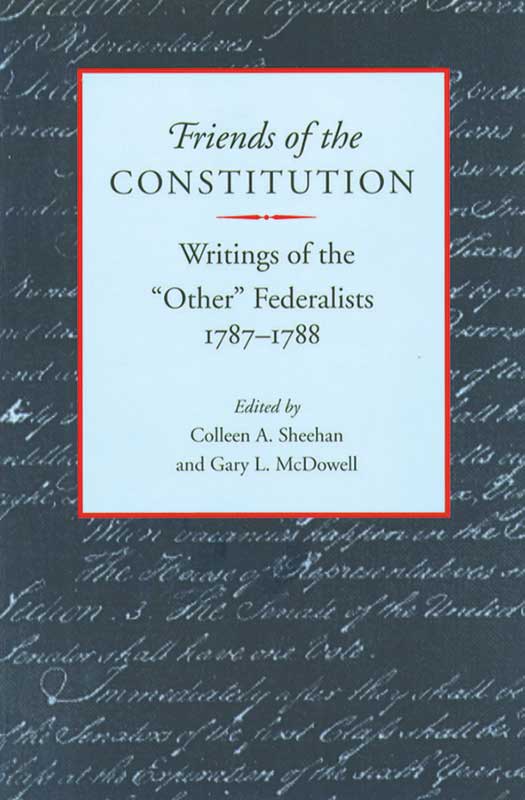
Friends of the Constitution: Writings of the “Other” Federalists, 1787-1788, edited by Colleen A. Sheehan and Gary L. McDowell (Indianapolis: Liberty Fund, 1998).

About Liberty Fund:

Liberty Fund, Inc. is a private, educational foundation established to encourage the study of the ideal of a society of free and responsible individuals.


Benjamin Franklin

Speech

Like Washington’s, the views of Benjamin Franklin on the proposed Constitution carried great weight in the minds of his countrymen. In the final session of the Constitutional Convention on 17 September, Franklin gave James Wilson a speech to read which contained the elder statesman’s reasons for assenting to the proposed document. Two days later the Pennsylvania Gazette reported that the speech was “extremely sensible” and that Franklin’s support of the Constitution would recommend it to his fellow Pennsylvanians. At the request of Nathaniel Gorham, a delegate to the Convention from Massachusetts, Franklin provided him a version of the speech; Gorham’s hope was that its publication in Massachusetts would influence those in his state who were still opposed to the document’s ratification. Gorham deleted some portions of the speech and it appeared in the Boston Gazette on 3 December; this is also the version which appears here. By 21 December, the speech was reprinted twenty-six times.

I confess that I do not entirely approve of this Constitution at present, but Sir, I am not sure I shall never approve it: For having lived long, I have experienced many Instances of being oblig’d, by better Information or fuller Consideration, to change Opinions even on important Subjects, which I once thought right, but found to be otherwise. It is therefore that the older I grow the more apt I am to doubt my own Judgment and to pay more Respect to the Judgment of others. Most Men indeed as well as most Sects in Religion, think themselves in Possession of all Truth, and that wherever others differ from them it is so far Error. [Sir Richard] Steele, a Protestant, in a Dedication tells the Pope, that the only Difference between our two Churches in their Opinions of the Certainty of their Doctrine, is, the Romish Church is infallible, and the Church of England is never in the Wrong. But tho’ many private Persons think almost as highly of their own Infallibility, as that of their Sect, few express it so naturally as a certain French lady, who in a little Dispute with her Sister, said, I don’t know how it happens, Sister, but I meet with no body but myself that’s always in the right.

In these Sentiments, Sir, I agree to this Constitution, with all its Faults, if they are such: because I think a General Government necessary for us, and there is no Form of Government but what may be a Blessing to the People if well administred; and I believe farther that this is likely to be well administred for a Course of Years, and can only end in Despotism as other Forms have done before it, when the People shall become so corrupted as to need Despotic Government, being incapable of any other. I doubt too whether any other Convention we can obtain, may be able to make a better Constitution: For when you assemble a Number of Men to have the Advantage of their joint Wisdom, you inevitably assemble with those Men all their Prejudices, their Passions, their Errors of Opinion, their local Interests, and their selfish Views. From such an Assembly can a perfect Production be expected? It therefore astonishes me, Sir, to find this System approaching so near to Perfection as it does; and I think it will astonish our Enemies, who are waiting with Confidence to hear that our Councils are confounded, like those of the Builders of Babel, and that our States are on the Point of Separation, only to meet hereafter for the Purpose of cutting one another’s Throats. Thus I consent, Sir, to this Constitution because I expect no better, and because I am not sure that it is not the best. Much of the Strength and Efficiency of any Government, in procuring & securing Happiness to the People depends on Opinion, on the general Opinion of the Goodness of that Government as well as of the Wisdom & Integrity of its Governors. I hope therefore that for our own Sakes, as a Part of the People, and for the Sake of our Posterity, we shall act heartily & unanimously in recommending this Constitution, wherever our Influence may extend, and turn our future Thoughts and Endeavours to the Means of having it well administred.—

On the whole, Sir, I cannot help expressing a Wish, that every Member of the Convention, who may still have Objections to it, would with me on this Occasion doubt a little of his own Infallibility, and to make manifest our Unanimity, put his Name to this Instrument.—

Energetic but Limited Government

The debate between the Federalists and Anti-Federalists over the nature of the Union led naturally to the issue of governmental power and responsibility. The question was not only about the power of the central government vis à vis the states but also and more fundamentally about the power of the national representatives vis à vis the people. Federalists and Anti-Federalists generally agreed that in a free government a due dependence of the representatives on the people was required, otherwise there was no security for the people’s rights and liberties. Anti-Federalists claimed that the proposed scheme of government, with a small number of representatives governing in a large territory, did not provide for the necessary degree of responsibility and that the liberty of the people was in danger. Federalists countered this charge, arguing that in the new order interest, reputation, and duty would bind the representatives to the Constitution and public opinion.

While the Federalists presented the case that the elective principle, separation of powers, bicameralism, and numerous governmental checks would work to prevent the representatives from overstepping their constitutional bounds, they did not develop a clear, united understanding about the nature of public opinion or how governmental dependence on it was to be fostered and maintained. Some Federalists echoed Anti-Federalists, arguing for a close, direct dependence of the representatives on the will of their constituents, such that the representatives would act as mirrors reflecting the people’s interests and views. Unlike the Anti-Federalists, however, such Federalist writers as “Socius,” “America,” and Roger Sherman claimed that the proposed constitutional system was sufficient to maintain a close connection between the government and the people. The interests of the representatives and the interests of the people will be the same, they asserted.

Other proponents of the Constitution, such as Fisher Ames, James Wilson, and John Dickinson, set forth a subtler theory of representation in which the governing officials were responsible to the general opinion or sense of the public but not dependent on fleeting impulses or narrow, supposed interests. While most of the leading Federalists shared in this view, their position was not without some ambiguity. United in the general claim that the authoritative force in the American republic is the reason or sense of the people, they left unresolved the issue of what precisely constituted the public sense and how it was to be achieved by the people and depended on by the representatives. Fisher Ames, for example, understood the proposed system, with its large territory and insulation from the rule of faction, to encourage a certain degree of independence in the representatives during the ordinary business of public policy-making. The power of the representatives is the power of the people, Ames said; the watchfulness of the people’s representatives is the guard of the people themselves. In the delegation of power to trustees, Ames argued, the true sovereignty of the people and the real protection of liberty become manifest. John Dickinson also believed that the will of the people must be a reasonable and not a distracted will, and that it was “the sense of the people” that the representatives were to express. However Dickinson further declared that the people’s will is the “superior will” and that to preserve liberty the people must “trust to their own spirit” and practice the “living principle of watchfulness and controul” over their representatives.

Only a few years later, in the early 1790s, there would occur a split within the Federalist camp partly because this matter of what constituted the public sense, and a due dependence of the representatives on it, was never settled. In 1792, some of the Federalists formed the first American political party—the Republican Party—to oppose the Federalist administration of government. These former Federalists, led by James Madison and Thomas Jefferson, were joined by many who had been Anti-Federalists in the 1780s. One of their major criticisms of the Federalist administration was that the government was not sufficiently responsible to public opinion, and that it was in fact charting an antirepublican course largely independent of the people themselves.

The disagreement in respect to the theory of representation between the Federalists and Anti-Federalists, as well as among the Federalists themselves, points to the fundamental democratic challenge of the Founding generation: how to retain the spirit and principles of popular government without falling prey to its defects. The leading Federalist argument demonstrated that if representation was merely a vehicle for the expression of the narrow, unmodified interests and views of the populace, then the defects of democracy are not cured. What was necessary, powerful Federalist voices contended, was the establishment of a constitutional system that effectively placed limitations on the power of governmental officials so that they could not tyrannize over the people and that also controlled the collective power of the people so that they could not tyrannize over themselves. The solution they offered is summed up in the term “constitutionalism.” American constitutionalism meant that the people are sovereign and the supreme law of the land is of their own making. Further it involved the republican idea that the people never act directly but only through the refining filter of representation. The representatives are dependent on the people’s authority, but they are responsible first and foremost to the Constitution because it embodies the most fundamental, sovereign power of the people and is the source of all legitimate governmental activity. Accordingly, the Constitution is a higher law than legislative law, and government is limited in its powers to those delegated to it by the people and enumerated in the Constitution.

In the debate between Federalists and Anti-Federalists over the need for a bill of rights, Anti-Federalists generally believed that the absence of a written declaration was a major defect of the proposed Constitution. Without a bill of rights, they claimed, the government may become one of unlimited powers and trample on the rights and liberties of the people. Most Federalists argued that a written declaration of rights was unnecessary in theory and ineffectual in practice. In practical terms, Federalists claimed that the people’s rights and liberties are protected by the numerous constitutional safeguards that provide for mutual checks among the departments of government. Further, they insisted, the real security for the people’s rights is achieved by connecting the interests of the rulers with the interests of the people so that the rulers will have no motive to invade the rights of the people; or they argued that the true security for rights and the preservation of liberty can only be achieved by the ongoing perseverance of a freedom-loving people of sound sense and honest hearts. In theoretical terms, many Federalists claimed that the very idea of a constitution of enumerated and limited powers removes the need for a bill of rights. Elaborating on the notion of constitutionalism, they maintained that because the people delegate power to the government, and not vice versa, all powers that are not delegated are necessarily reserved to them as men or as citizens. The enumeration of the rights of the people carries with it the potential for abuse, for in the future it may be presumed that only those rights listed belong to the people. And it would be sheer folly, they said, to attempt to enumerate all the rights of mankind.

Some Federalists, James Wilson for example, demonstrated more fully the theoretical underpinnings of this argument. Wilson argued that all government derives its authority from the people, and government is obliged to act for the people; it must, however, act for the people only on the basis of the authority granted it by the people. Those who would have government do more than this misunderstand “the principle on which this system was constructed”—that is, the supreme and absolute authority of the people. The “inherent and unalienable right of the people” to establish government and organize its just powers, Wilson showed, is derived from the truths of the Declaration of Independence. In regard to the Declaration’s teaching, he proclaimed: “This is the broad basis on which our independence was placed; on the same certain and solid foundation this system is erected.” Precisely because the Constitution is erected on the foundation that all men are created equal and their rights are inalienable, there is no need for a bill of rights; because this is the only legitimate basis for government, there is no wisdom in risking a contrary understanding.

Despite the forceful reasoning of Wilson and others, the issue of where sovereignty ultimately resides in the American republic was neither unanimously agreed to nor practically solved by the Founding generation. “Alfredus,” for example, asserted that the state constitution of New Hampshire is a compact between individuals; the federal Constitution, however, “is not a compact between individuals, but between several sovereign and independent political societies already formed and organized.” Although he quotes Wilson at length and claims only to add to his reasoning, one must question whether this is a mere addition or rather a radical alteration of Wilson’s view. According to Wilson, not only do the American people possess supreme power, they have not and ought not “to part with it to any government whatsoever.” They may delegate certain powers in such proportions to the various governments as they think appropriate, but it is they, and only they, who are and always remain supremely and absolutely sovereign.

To complicate matters further, Tench Coxe blithely stated that “the contracting parties in the federal compact are the people of the several states and the federal state governments.” Thus we see that during the Founding era there is not only a divergence of opinion on the issue of sovereignty but a lack of clarity in the meaning of the term itself. Indeed the word “sovereignty” was often used in two different senses—one referring only to the federal nature of the polity and the constitutional division of power between the national and state governments, and the other referring to who or what possesses the fundamental and absolutely final authority in the regime.

In respect to the degree of power in the federal head, Federalists contended that in order to regulate trade, restore public and private credit, give respectability to the states both at home and abroad, safeguard property, and enlarge commerce, a federal government of limited powers but sufficient energy was absolutely necessary. Furthermore many of them forcefully attacked Anti-Federalist reasoning at its core, arguing that only a government of substantial energy can protect liberty. If the people are to retain their liberty, they must be protected against the influence of licentious passion within themselves. Thus drawing the distinction between liberty and license, Dickinson identified the issue of the character of the “predominant authority” in the polity as critical. His discussion of this issue sets forth the substantive republican grounds for the new Constitution and the corollary purpose for the principle of representation. He taught that nothing short of the formation of a people of sound, republican character will answer the cause of liberty in America. The predominance of “the true spirit of republicanism” requires that “life and vigor [be] communicated through the whole, by the popular representation of each part, and the close combination of all.”