Econlib

The Library

Other Sites

Front Page arrow Titles (by Subject) arrow Fabius [John Dickinson] The Letters: I-III - Friends of the Constitution: Writings of the Other Federalists, 1787-1788

Return to Title Page for Friends of the Constitution: Writings of the “Other” Federalists, 1787-1788

Search this Title:

“Fabius” [John Dickinson] The Letters: I-III - Colleen A. Sheehan, Friends of the Constitution: Writings of the “Other” Federalists, 1787-1788 [1998]

Edition used:

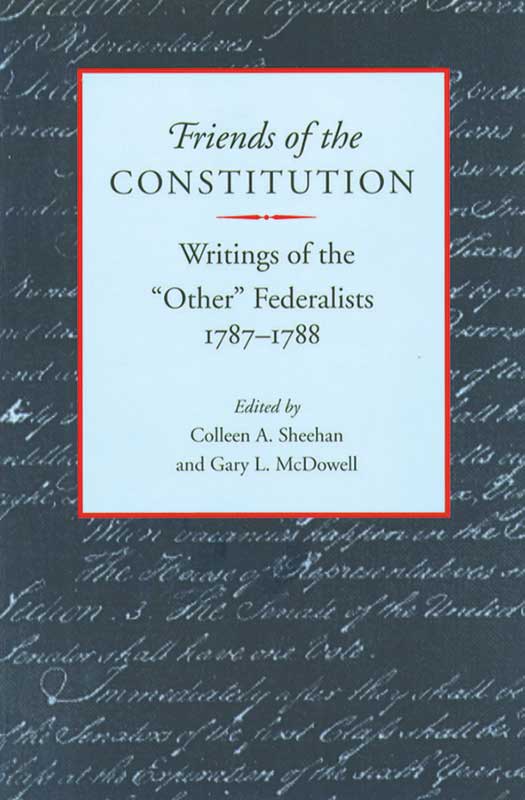
Friends of the Constitution: Writings of the “Other” Federalists, 1787-1788, edited by Colleen A. Sheehan and Gary L. McDowell (Indianapolis: Liberty Fund, 1998).

About Liberty Fund:

Liberty Fund, Inc. is a private, educational foundation established to encourage the study of the ideal of a society of free and responsible individuals.


“Fabius” [John Dickinson]

The Letters: I-III

John Dickinson was a delegate from Delaware to the Federal Convention. The “Penman of the Revolution,” Dickinson had written the important Letters from a Farmer in Pennsylvania to the Inhabitants of the British Colonies (1768) and a good portion of the “Declaration of the Causes of Taking up Arms” (1775); yet, believing the document premature, he refused to sign the Declaration of Independence. Nevertheless he served loyally in the American Revolution. These Letters of Fabius originally appeared separately in newspapers in Delaware in 1788; they were collected and published in pamphlet form in 1797.

I

The Constitution proposed by the Federal Convention now engages the fixed attention of America.

Every person appears to be affected. Those who wish the adoption of the plan, consider its rejection as the source of endless contests, confusions, and misfortunes; and they also consider a resolution to alter, without previously adopting it, as a rejection.

Those who oppose the plan, are influenced by different views. Some of them are friends, others of them are enemies, to The United States. The latter are of two classes; either men without principles or fortunes, who think they may have a chance to mend their circumstances, with impunity, under a weak government, or in public convulsions, but cannot make them worse even by the last—or men who have been always averse to the revolution; and though at first confounded by that event, yet, their hopes reviving with the declension of our affairs, have since persuaded themselves, that at length the people, tired out with their continued distresses, will return to their former connection with Great Britain. To argue with these opposers, would be vain—The other opposers of the plan deserve the highest respect.

What concerns all, should be considered by all; and individuals may injure a whole society, by not declaring their sentiments. It is therefore not only their right, but their duty, to declare them. Weak advocates of a good cause or artful advocates of a bad one, may endeavour to stop such communications, or to discredit them by clamour and calumny. This, however, is not the age for such tricks of controversy. Men have suffered so severely by being deceived upon subjects of the highest import, those of religion and freedom, that truth becomes infinitely valuable to them, not as a matter of curious speculation, but of beneficial practice—A spirit of inquiry is excited, information diffused, judgment strengthened.

Before this tribunal of the people, let every one freely speak, what he really thinks, but with so sincere a reverence for the cause he ventures to discuss, as to use the utmost caution, lest he should lead any into errors, upon a point of such sacred concern as the public happiness.

It is not the design of this address, to describe the present derangement of our affairs, the mischiefs that must ensue from its continuance, the horrors, of a total dissolution of the union, or of the division of it into partial confederacies. Nor is it intended to describe the evils that will result from pursuing the plan of another Federal Convention; as if a better temper of conciliation, or a more satisfactory harmony of decisions, could be expected from men, after their minds are agitated with disgusts and disappointments, than before they were thus disturbed; though from an uncontradicted assertion it appears, that without such provocations, the difficulty of reconciling the interests of the several states was so near to insuperable, in the late convention, that after many weeks spent in the most faithful labours to promote concord, the members were upon the very point of dispersing in the utmost disorder, jealousy and resentment, and leaving the states exposed to all the tempests of passions, that have been so fatal to confederacies of republics.

All these things, with observations on particular articles of the constitution, have been laid before the public, and the writer of this address means not to repeat what has been already said. What he wishes, is to simplify the subject, so as to facilitate the inquiries of his fellow citizens.

Many are the objections made to the system proposed. They should be distinguished. Some may be called local, because they spring from the supposed interests of individual states. Thus, for instance, some inhabitants of large states may desire the system to be so altered, that they may possess more authority in the decisions of the government; or some inhabitants of commercial states may desire it to be so altered, that the advantages of trade may center almost wholly among themselves; and this predilection they may think compatible with the common welfare. Their judgment being thus warp’d, at the beginning of their deliberations, objections are accumulated as very important, that, without this prepossession, would never have obtained their approbation. Certain it is, that strong understandings may be so influenced by this insulated patriotism, as to doubt—whether general benefits can be communicated by a general government.

Probably nothing would operate so much for the correction of these errors, as the perusal of the accounts transmitted to us by the ancients, of the calamities occasioned in Greece by a conduct founded on similar mistakes. They are expressly ascribed to this cause—that each city meditated a part on its own profit and ends—insomuch that those who seemed to contend for union, could never relinquish their own interests and advancement, while they deliberated for the public.

Heaven grant! that our countrymen may pause in time—duly estimate the present moment—and solemnly reflect—whether their measures may not tend to draw down the same distractions upon us, that desolated Greece.

They may now tolerably judge from the proceedings of the Federal Convention and of other conventions, what are the sentiments of America upon her present and future prospects. Let the voice of her distress be venerated—and adhering to the generous Virginian declaration, let them resolve to “cling to Union as the political Rock of our Salvation.

II

But besides the objections originating from the before mentioned cause, that have been called local, there are other objections that are supposed to arise from maxims of liberty and policy.—

Hence it is inferred, that the proposed system has such inherent vices, as must necessarily produce a bad administration, and at length the oppression of a monarchy and aristocracy in the federal officers.

The writer of this address being convinced by as exact an investigation as he could make, that such mistakes may lead to the perdition of his country, esteems it his indispensable duty, strenuously to contend, that—the power of the people pervading the proposed system, together with the strong confederation of the states, forms an adequate security against every danger that has been apprehended.

If this single assertion can be supported by facts and arguments, there will be reason to hope, that anxieties will be removed from the minds of some citizens, who are truly devoted to the interests of America, and who have been thrown into perplexities, by the mazes of multiplied and intricate disquisitions.

The objectors agree, that the confederation of the states will be strong, according to the system proposed, and so strong, that many of them loudly complain of that strength. On this part of the assertion, there is no dispute: But some of the objections that have been published, strike at another part of the principle assumed, and deny, that the system is sufficiently founded on the power of the people.

The course of regular inquiry demands, that these objections should be considered in the first place. If they are removed, then all the rest of the objections, concerning unnecessary taxations, standing armies, the abolishment of trial by jury, the liberty of the press, the freedom of commerce, the judicial, executive, and legislative authorities of the several states, and the rights of citizens, and the other abuses of federal government, must, of consequence, be rejected, if the principle contains the salutary, purifying, and preserving qualities attributed to it. The question then will be—not what may be done, when the government shall be turned into a tyranny; but how the government can be so turned?

Thus unembarrassed by subordinate discussions, we may come fairly to the contemplation of that superior point, and be better enabled to discover, whether our attention to it will afford any lights, whereby we may be conducted to peace, liberty, and safety.

The objections, denying that the system proposed is sufficiently founded on the power of the people, state, that the number of the federal trustees or officers, is too small, and that they are to hold their offices too long.

One would really have supposed, that smallness of number could not be termed a cause of danger, as influence must increase with enlargement. If this is a fault, it will soon be corrected, as an addition will be often made to the number of the senators, and a much greater and more frequently, to that of the representatives; and in all probability much sooner, than we shall be able and willing to bear the expence of the addition.

As to the senate, it never can be, and it never ought to be large, if it is to possess the powers which almost all the objectors seem inclined to allot to it, as will be evident to every intelligent person, who considers those powers.

Though small, let it be remembered, that it is to be created by the sovereignties of the several states; that is, by the persons, whom the people of each state shall judge to be most worthy, and who, surely, will be religiously attentive to making a selection, in which the interest and honour of their state will be so deeply concerned. It should be remembered too, that this is the same manner, in which the members of Congress are now appointed; and that herein, the sovereignties of the states are so intimately involved, that however a renunciation of part of these powers may be desired by some of the states, it never will be obtained from the rest of them. Peaceable, fraternal, and benevolent as these are, they think, the concessions they have made, ought to satisfy all.

That the senate may always be kept full, without the interference of Congress, it is provided in the system, that if vacancies happen by resignation or otherwise, during the recess of the legislature of the state, the executive thereof may make temporary appointments, until the next meeting of the legislature, which shall then fill up such vacancies.

As to the house of representatives, it is to consist of a number of persons, not exceeding one for every thirty thousand: But each state shall have at least one representative. The electors will reside, widely dispersed, over an extensive country. Cabal and corruption will be as impracticable, as, on such occasions, human institutions, can render them. The will of freemen, thus circumstanced, will give the fiat. The purity of election thus obtained, will amply compensate for the supposed defect of representation; and the members, thus chosen, will be most apt to harmonize in their proceedings, with the general interests, feelings, and sentiments of the people.

Allowing such an increase of population as, from experience and a variety of causes, may be expected, the representatives, in a short period, will amount to several hundreds, and most probably long before any change of manners for the worse, that might tempt or encourage our ruler to maladministration, will take place on this continent.

That this house may always be kept full, without the interference of Congress, it is provided in the system, that when vacancies happen in any state, the executive authority thereof shall issue writs of election to fill such vacancies.

But, it seems, the number of the federal officers is not only too small: They are to hold their offices too long.

This objection surely applies not to the house of representatives, who are to be chosen every two years, especially if the extent of empire, and the vast variety and importance of their deliberations, be considered. In that view, they and the senate will actually be not only legislative but also diplomatic bodies, perpetually engaged in the arduous talk of reconciling, in their determinations, the interests of several sovereign states, not to insist on the necessity of a competent knowledge of foreign affairs, relative to the states.

They who desire the representatives to be chosen every year, should exceed Newton in calculations, if they attempt to evince, that the public business would, in that case, be better transacted, than when they are chosen every two years. The idea, however, should be excused for the zeal that prompted it.

Is monarchy or aristocracy to be produced, without the consent of the people, by a house of representatives, thus constituted?

It has been unanimously agreed by the friends of liberty, that frequent elections of the representatives of the people, are the sovereign remedy of all grievances in a free government.—Let us pass on to the senate.

At the end of two years after the first election, one third is to be elected for six years; and at the end of four years, another third. Thus one third will constantly have but four years, and another but two years to continue in office. The whole number at first will amount to twenty-six, will be regularly renovated by the biennial election of one third, and will be overlooked, and overawed by the house of representatives, nearly three times more numerous at the beginning, rapidly and vastly augmenting, and more enabled to overlook and overawe them, by holding their offices for two years, as thereby they will acquire better information, respecting national affairs. These representatives will also command the public purse, as all bills for raising revenue, must originate in their house.

As in the Roman armies, when the Principes and Hastati had failed, there were still the Triarii, who generally put things to rights, so we shall be supplied with another resource.

We are to have a president, to superintend, and if he thinks the public weal requires it, to controul any act of the representatives and senate.

This president is to be chosen, not by the people at large, because it may not be possible, that all the freemen of the empire should always have the necessary information, for directing their choice of such an officer; nor by Congress, lest it should disturb the national councils; nor by any one standing body whatever, for fear of undue influence.

He is to be chosen in the following manner. Each state shall appoint, as the legislature thereof may direct, a number of electors, equal to the whole number of senators and representatives, to which the state shall be entitled in Congress: but no senator or representative, or person holding an office of trust or profit under the United States, shall be appointed an elector. As these electors are to be appointed, as the legislature of each state may direct, the fairest, freest opening is given, for each state to chuse such electors for this purpose, as shall be most signally qualified to fulfil the trust.

To guard against undue influence these electors, thus chosen, are to meet in their respective states, and vote by ballot; and still further to guard against it, Congress may determine the time of chusing the electors, and the days on which they shall give their votes—which day shall be the same throughoutthe United States. All the votes from the several states are to be transmitted to Congress, and therein counted. The president is to hold his office for four years.

When these electors meet in their respective states, utterly vain will be the unreasonable suggestions derived for partiality. The electors may throw away their votes, mark, with public disappointment, some person improperly favored by them, or justly revering the duties of their office, dedicate their votes to the best interests of their country.

This president will be no dictator. Two thirds of the representatives and the senate may pass any law, notwithstanding his dissent; and he is removable and punishable for misbehaviour.

Can this limited, fluctuating senate, placed amidst such powers, if it should become willing, ever become able, to make America pass under its yoke? The senators will generally be inhabitants of places very distant one from another. They can scarcely be acquainted till they meet. Few of them can ever act together for any length of time, unless their good conduct recommends them to a re-election; and then there will be frequent changes in a body dependant upon the acts of other bodies, the legislatures of the several states, that are altering every year. Machiavel and Cæsar Borgia together could not form a conspiracy in such a senate, destructive to any but themselves and their accomplices.

It is essential to every good government, that there should be some council, permanent enough to get a due knowledge of affairs internal and external; so constituted, that by some deaths or removals, the current of information should not be impeded or disturbed; and so regulated, as to be responsible to, and controulable by the people. Where can the authority for combining these advantages, be more safely, beneficially, or satisfactorily lodged, than in the senate, to be formed according to the plan proposed? Shall parts of the trust be committed to the president, with counsellors who shall subscribe their advices? If assaults upon liberty are to be guarded against, and surely they ought to be with sleepless vigilance, why should we depend more on the commander in chief of the army and navy of The United States, and of the militia of the several states, and on his counsellors, whom he may secretly influence, than of the senate to be appointed by the persons exercising the sovereign authority of the several states? In truth, the objections against the powers of the senate originated from a desire to have them, or at least some of them, vested in a body, in which the several states should be represented, in proportion to the number of inhabitants, as in the house of representatives. This method is unattainable, and the wish for it should be dismissed from every mind, that desires the existence of a confederation.

What assurance can be given, or what probability be assigned, that a board of counsellors would continue honest, longer than the senate? Or, that they would possess more useful information, respecting all the states, than the senators of all the states? It appears needless to pursue this argument any further.

How varied, balanced, concordant, and benign, is the system proposed to us? To secure the freedom, and promote the happiness of these and future states, by giving the will of the people a decisive influence over the whole, and over all the parts, with what a comprehensive arrangement does it embrace different modes of representation, from an election by a county to an election by an empire? What are the complicated ballot, and all the refined devices of Venice for maintaining her aristocracy, when compared with this plain-dealing work for diffusing the blessings of equal liberty and common prosperity over myriads of the human race?

All the foundations before mentioned, of the federal government, are by the proposed system to be established, in the most clear, strong, positive, unequivocal expressions, of which our language is capable. Magna charta, or any other law, never contained clauses more decisive and emphatic. While the people of these states have sense, they will understand them; and while they have spirit, they will make them to be observed.

III

The writer of this address hopes, that he will now be thought so disengaged from the objections against the principle assumed, that he may be excused for recurring to his assertion, that—the power of the people pervading the proposed system, together with the strong confederation of the states, will form an adequate security against every danger that has been apprehended.

It is a mournful, but may be a useful truth, that the liberty of single republics has generally been destroyed by some of the citizens, and of confederated republics, by some of the associated states.

It is more pleasing, and may be more profitable to reflect, that, their tranquility and prosperity have commonly been promoted, in proportion to the strength of their government for protecting the worthy against the licentious.1

As in forming a political society, each individual contributes some of his rights, in order that he may, from a common stock of rights, derive greater benefits, than he could from merely his own; so, in forming a confederation, each political society should contribute such a share of their rights, as will, from a common stock of these rights, produce the largest quantity of benefits for them.

But, what is that share? and, how to be managed? Momentous questions! Here, flattery is treason; and error, destruction.

Are they unanswerable? No. Our most gracious Creator does not condemn us to sigh for unattainable blessedness: But one thing he demands—that we should seek for happiness in his way, and not in our own.

Humility and benevolence must take place of pride and overweening selfishness. Reason, rising above these mists, will then discover to us, that we cannot be true to ourselves, without being true to others—that to love our neighbours as ourselves, is to love ourselves in the best manner—that to give, is to gain—and, that we never consult our own happiness more effectually, than when we most endeavour to correspond with the divine designs, by communicating happiness, as much as we can, to our fellow-creatures. Inestimable truth! sufficient, if they do not barely ask what it is, to melt tyrants into men, and to soothe the inflamed minds of a multitude into mildness—Inestimable truth! which our Maker in his providence, enables us, not only to talk and write about, but to adopt in practice of vast extent, and of instructive example.

Let us now enquire, if there be not some principle, simple as the laws of nature in other instances, from which, as from a source, the many benefits of society are deduced.

We may with reverence say, that our Creator designed men for society, because otherwise they cannot be happy. They cannot be happy without freedom; nor free without security; that is, without the absence of fear; nor thus secure, without society. The conclusion is strictly syllogistic—that men cannot be free without society. Of course, they cannot be equally free without society, which freedom produces the greatest happiness.

As these premises are invincible, we have advanced a considerable way in our enquiry upon this deeply interesting subject. If we can determine, what share of his rights, every individual must contribute to the common stock of rights in forming a society, for obtaining equal freedom, we determine at the same time, what share of their rights each political society must contribute to the common stock or rights in forming a confederation, which is only a larger society, for obtaining equal freedom: For, if the deposite be not proportioned to the magnitude of the association in the latter case, it will generate the same mischief among the component parts of it, from their inequality, that would result from a defective contribution to association in the former case, among the component parts of it, from their inequality.

Each individual then must contribute such a share of his rights, as is necessary for attaining that security that is essential to freedom; and he is bound to make this contribution by the law of his nature, which prompts him to a participated happiness; that is, by the command of his creator; therefore, he must submit his will, in what concerns all, to the will of all, that is of the whole society. What does he lose by this submission; The power of doing injuries to others—and the dread of suffering injuries from them. What does he gain by it? The aid of those associated with him, for his relief from the incommodities of mental or bodily weakness—the pleasure for which his heart is formed—of doing good—protection against injuries—a capacity of enjoying his undelegated rights to the best advantage—a repeal of his fears—and tranquility of mind—or, in other words, that perfect liberty better described in the Holy Scriptures, than any where else, in these expressions—“When every man shall sit under his vine, and under his fig-tree, and none shall make him afraid.

The like submission, with a correspondent expansion and accommodation, must be made between states, for obtaining the like benefits in a confederation. Men are the materials of both. As the largest number is but a junction of units—a confederation is but an assemblage of individuals. The auspicious influence of the law of his nature, upon which the happiness of man depends in society, must attend him in confederation, or he becomes unhappy; for confederation should promote the happiness of individuals, or it does not answer the intended purpose. Herein there is a progression, not a contradiction. As man, he becomes a citizen; as a citizen, he becomes a federalist. The generation of one, is not the destruction of the other. He carries into society his naked rights: These thereby improved, he carries still forward into confederation. If that sacred law before mentioned, is not here observed, the confederation would not be real, but pretended. He would confide, and be deceived.

The dilemma is inevitable. There must either be one will, or several wills. If but one will, all the people are concerned: if several wills, few comparatively are concerned. Surprizing! that this doctrine should be contended for by those, who declare, that the constitution is not founded on a bottom broad enough; and, though the whole people of the United States are to be trebly represented in it in three different modes of representation, and their servants will have the most advantageous situations and opportunities of acquiring all requisite information for the welfare of the whole union, yet insist for a privilege of opposing, obstructing, and confounding all their measures taken with common consent for the general weal, by the delays, negligences, rivalries, or other selfish views of parts of the union.

Thus, while one state should be relied upon by the union for giving aid, upon a recommendation of Congress, to another in distress, the latter might be ruined; and the state relied upon, might suppose, it would gain by such an event.

When any persons speak of a consideration, do they, or do they not acknowledge, that the whole is interested in the safety of every part—in the agreement of parts—in the relation of parts to one another—to the whole—or, to other societies? If they do—then, the authority of the whole, must be co-extensive with its interests—and if it is, the will of the whole must and ought in such cases to govern; or else the whole would have interests without an authority to manage them—a position which prejudice itself cannot digest.

If they do not acknowledge, that the whole is thus interested, the conversation should cease. Such persons mean not a confederation, but something else.

As to the idea, that this superintending sovereign will must of consequence destroy the subordinate sovereignties of the several states, it is begging a concession of the question, by inferring, that a manifest and great usefulness must necessarily end in abuse; and not only so, but it requires an extinction of the principle of all society: for the subordinate sovereignties, or, in other words, the undelegated rights of the several states, in a confederation, stand upon the very same foundation with the undelegated rights of individuals in a society, the federal sovereign will being composed of the subordinate sovereign wills of the several confederated states. As some persons seem to think, a bill of rights is the best security of rights, the sovereignties of the several states have this best security by the proposed constitution, and more than this best security, for they are not barely declared to be rights, but are taken into it as component parts for their perpetual preservation—by themselves. In short, the government of each state is, and is to be, sovereign and supreme in all matters that relate to each state only. It is to be subordinate barely in those matters that relate to the whole; and it will be their own faults if the several states suffer the federal sovereignty to interfere in things of their respective jurisdictions. An instance of such interference with regard to any single state, will be a dangerous precedent as to all, and therefore will be guarded against by all, as the trustees or servants of the several states will not dare, if they retain their senses, so to violate the independent sovereignty of their respective states, that justly darling object of American affections, to which they are responsible, besides being endeared by all the charities of life.

The common sense of mankind agrees to the devolutions of individual wills in society; and if it has not been as universally assented to in confederation, the reasons are evident, and worthy of being retained in remembrance by Americans. They were want of opportunities, or the loss of them, through defects of knowledge and virtue. The principle, however, has been sufficiently vindicated in imperfect combinations, as their prosperity has generally been commensurate to its operation.

How beautifully and forcibly does the inspired Apostle Paul, argue upon a sublimer subject, with a train of reasoning strictly applicable to the present? His words are—“If the foot shall say, because I am not the hand, I am not of the body; is it therefore not of the body? and if the ear shall say, because I am not the eye, I am not of the body; is it therefore not of the body?” As plainly inferring, as could be done in that allegorical manner, the strongest censure of such partial discontents and dissentions, especially, as his meaning is enforced by his description of the benefits of union in these expressions—“But, now they are many members, yet but one body: and the eye cannot say to the hand, I have no need of thee.”

When the commons of Rome upon a rupture with the Senate, seceded in arms at the Mons sacer, Menemius Agrippa used the like allusion to the human body, in his famous apologue of a quarrel among some of the members. The unpolished but honest-hearted Romans of that day, understood him, and were appeased.

Another comparison has been made by the learned, between a natural and a political body; and no wonder indeed, when the title of the latter was borrowed from the resemblance. It has therefore been justly observed, that if a mortification takes place in one or some of the limbs, and the rest of the body is sound, remedies may be applied, and not only the contagion prevented from spreading, but the diseased part or parts saved by the connection with the body, and restored to former usefulness. When general putrefaction prevails, death is to be expected. History sacred and profane tells us, that, corruption of manners sinks nations into slavery.

[1. ]For a discussion of this common theme of the American Founding period, see Gordon S. Wood, Creation of the American Republic: 1776-1787 (Chapel Hill: University of North Carolina Press, 1969), 471-518.