EconlibThe LibraryOther Sites |
Front Page Titles (by Subject) The Necessity of Union - Friends of the Constitution: Writings of the Other Federalists, 1787-1788
Return to Title Page for Friends of the Constitution: Writings of the “Other” Federalists, 1787-1788The Online Library of LibertyA project of Liberty Fund, Inc.Search this Title:Also in the Library:
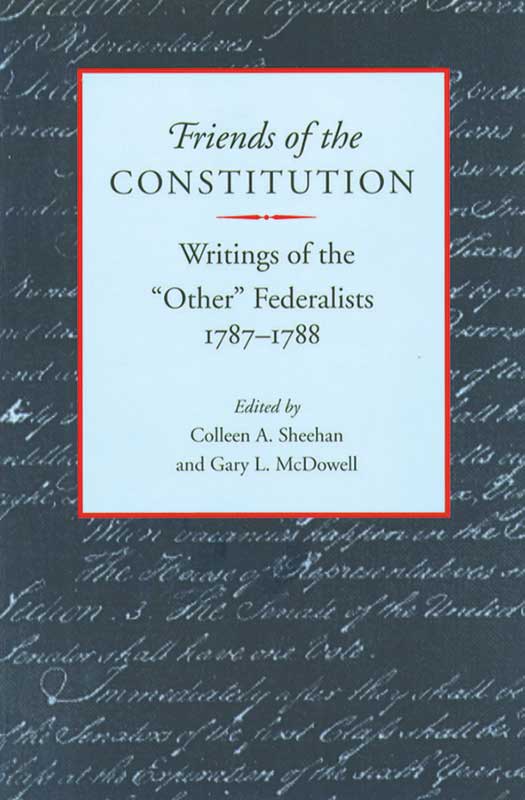
The Necessity of Union - Colleen A. Sheehan, Friends of the Constitution: Writings of the “Other” Federalists, 1787-1788 [1998]Edition used:Friends of the Constitution: Writings of the “Other” Federalists, 1787-1788, edited by Colleen A. Sheehan and Gary L. McDowell (Indianapolis: Liberty Fund, 1998).
About Liberty Fund:Liberty Fund, Inc. is a private, educational foundation established to encourage the study of the ideal of a society of free and responsible individuals. Copyright information:The copyright to this edition, in both print and electronic forms, is held by Liberty Fund, Inc. Fair use statement:This material is put online to further the educational goals of Liberty Fund, Inc. Unless otherwise stated in the Copyright Information section above, this material may be used freely for educational and academic purposes. It may not be used in any way for profit.
The Necessity of UnionIntroductionBy the late 1780s virtually all Americans agreed that their union needed to be strengthened. Some, most notably George Washington and Alexander Hamilton, saw much earlier the necessity of a firm, indissoluble union. In the years preceding the Constitutional Convention, those who favored stronger bonds of union and a larger role for the federal government were often referred to as “federal men” or “federalists.” It is no accident or case of mistaken identity that these men came to be known as “Federalists” when the battle for ratification of the Constitution was waged, the grumblings of some “Anti-Federalists” who thought they better deserved the title, not-withstanding. The Federalists of 1787-88 simply retained the appellation they had acquired in previous years. The selection following shows that the Federalists generally agreed that their country was sinking into disunion and anarchy. They concurred about the need to cement the union and fortify the federal head. Given what they perceived as a deteriorating economic situation, rise in domestic factions, and weakness in the face of foreign powers, their first object, of necessity, was the security of the United States. But many Federalists also believed that union was necessary to the liberty, prosperity, and happiness of the American people. Man’s nature fits him for society, John Dickinson claimed, for man needs society to be secure, security to be free, and freedom to be happy. James Wilson agreed, arguing that civil society and government are not only necessary for man’s security, but for his perfection and happiness as well. The achievement of these beneficial ends of political society, the Federalists generally believed, requires a union of “invincible firmness.” The Federalists did not claim that the Constitution was perfect. They understood that perfection in the human realm was not to be expected and that in fact prudential compromises had been made in the Philadelphia Convention. Though imperfect, Federalists nonetheless proudly declared that the proposed constitution was the best that could be obtained and perhaps the best that had ever been offered to the world. Despite the view widespread among Anti-Federalists that ratification should await the addition of a bill of rights, Federalists argued that the correction of any defects or omissions in the new plan of government should be made after ratification, through the constitutionally prescribed amendment process. It would be folly to expect more rather than less unity in a second convention, they asserted, and the immense risk that must accompany another convention would threaten the very existence of the United States. George Washington put it bluntly: the choice was between adoption of this Constitution or anarchy. Cognizant of living in the opening era of a new and free world, Federalist writers and orators often reminded their fellow citizens that the choice they were to make would decide the fate of freedom for generations yet unborn. This is the time of our political probation, Washington declared; “the citizens of America” are “Actors on a most conspicuous Theatre.” It was not uncommon to hear from the Federalists self-conscious acknowledgments of the part the United States had been assigned in mankind’s struggle for liberty and just government. With Providence the director, the American people the leading actors, and their war-worn soil the stage of the dramatic scenes to unfold, the eyes of the audience of the world were fixed upon them. The play is not over, the Revolution is not complete, the Federalist chorus rang out. The “temple of liberty” is yet to be secured from licentiousness and injustice, they said. The Federalists must bind themselves, said “Philodemos,” “with the restraints of just government.” They must conform their spirits to the spirit and cause of the Union—“the political Rock of our Salvation”—so that the fruits of the Revolution may ripen, and that so many sufferings and sacrifices will not have been in vain. The Federalists maintained that the fears spread by the Anti-Federalists concerning the Constitution’s lack of provision for freedom of the press and trial by jury, annihilation of the state governments, and general alarm for the people’s liberties were simply unfounded. The Constitution, they said, creates a federal government of expressly delegated, limited powers, reserving to the states and to the people all other powers; it is marked by a myriad of checks and balances to guard against tyranny and protect liberty. Besides, there are limits to what constitutional, parchment arrangements can do. The fundamental question is not what new provisions and arrangements are needed, but whether the American political system is sufficiently founded on the authority of the people. Is the will of the people given a decisive influence in the American polity? Dickinson asked. If the answer is yes then the preservation of liberty depends, finally, on the people themselves. The American people have been granted the singular opportunity of governing themselves wisely, said John Jay, and on this the “cause of freedom” depended. “In short,” wrote a “State Soldier,” “as there is nothing in this constitution itself that particularly bargains for a surrender of your liberties, it must be your own faults if you become enslaved.” Washington had issued the republican challenge of self-government even earlier during the founding period. As was his wont, his words and deeds were of the nature of a freeman mindful of the society of other equal and free men among whom he dwelled. His commands were of the kind that taught others that they must command themselves. Whether the American people will retain their liberty and secure prosperity and happiness depends on their choices and conduct, he said, and if they “should not be completely free and happy, the fault will be intirely their own.” Perhaps it was because of Washington’s solemn and commanding presence and Franklin’s gentle irony and wit that these two men were so beloved by the American people, but more likely it was because the citizens saw in them an uncommon devotion to the cause of a free people—a public spirit that reigned in them almost before there was any public to be spirited about. That Washington and Franklin were Friends of the Constitution carried enormous weight with the American people, as the Federalists who invoked their names well understood. George Washington
14 June 1783 This circular letter was written originally in June 1783. The copy sent to state executives in that year was dated 21 June. Because Washington here addresses issues regarding the strengthening of the central government, it was published again on 15 March 1787 in the Providence United States Chronicle. This letter was the first of many attempts by Federalists to align the great leader with the Federalist cause. Sir: The great object for which I had the honor to hold an appointment in the Service of my Country, being accomplished, I am now preparing to resign it into the hands of Congress, and to return to that domestic retirement, which, it is well known, I left with the greatest reluctance, a Retirement, for which I have never ceased to sigh through a long and painful absence, and in which (remote from the noise and trouble of the World) I meditate to pass the remainder of life in a state of undisturbed repose; But before I carry this resolution into effect, I think it a duty incumbent on me, to make this my last official communication, to congratulate you on the glorious events which Heaven has been pleased to produce in our favor, to offer my sentiments respecting some important subjects, which appear to me, to be intimately connected with the tranquility of the United States, to take my leave of your Excellency as a public Character, and to give my final blessing to that Country, in whose service I have spent the prime of my life, for whose sake I have consumed so many anxious days and watchfull nights, and whose happiness being extremely dear to me, will always constitute no inconsiderable part of my own. Impressed with the liveliest sensibility on this pleasing occasion, I will claim the indulgence of dilating the more copiously on the subjects of our mutual felicitation. When we consider the magnitude of the prize we contended for, the doubtful nature of the contest, and the favorable manner in which it has terminated, we shall find the greatest possible reason for gratitude and rejoicing; this is a theme that will afford infinite delight to every benevolent and liberal mind, whether the event in contemplation, be considered as the source of present enjoyment or the parent of future happiness; and we shall have equal occasion to felicitate ourselves on the lot which Providence has assigned us, whether we view it in a natural, a political or moral point of light. The Citizens of America, placed in the most enviable condition, as the sole Lords and Proprietors of a vast Tract of Continent, comprehending all the various soils and climates of the World, and abounding with all the necessaries and conveniencies of life, are now by the late satisfactory pacification, acknowledged to be possessed of absolute freedom and Independency; They are, from this period, to be considered as the Actors on a most conspicuous Theatre, which seems to be peculiarly designated by Providence for the display of human greatness and felicity; Here, they are not only surrounded with every thing which can contribute to the completion of private and domestic enjoyment, but Heaven has crowned all its other blessings, by giving a fairer oppertunity for political happiness, than any other Nation has ever been favored with. Nothing can illustrate these observations more forcibly, than a recollection of the happy conjuncture of times and circumstances, under which our Republic assumed its rank among the Nations; The foundation of our empire was not laid in the gloomy age of Ignorance and Superstition, but at an Epocha when the rights of mankind were better understood and more clearly defined, than at any former period; the researches of the human mind, after social happiness, have been carried to a great extent; the Treasures of knowledge, acquired through a long succession of years, by the labours of Philosophers, Sages and Legislatures, are laid open for our use, and their collected wisdom may be happily applied in the Establishment of our forms of Government; the free cultivation of Letters, the unbounded extension of Commerce, the progressive refinement of Manners, the growing liberality of sentiment, and above all, the pure and benign light of Revelation, have had a meliorating influence on mankind and increased the blessings of Society. At this auspicious period, the United States came into existence as a Nation, and if their Citizens should not be completely free and happy, the fault will be intirely their own. Such is our situation, and such are our prospects: but notwithstanding the cup of blessing is thus reached out to us, notwithstanding happiness is ours, if we have a disposition to seize the occasion and make it our own; yet, it appears to me there is an option still left to the United States of America, that it is in their choice, and depends upon their conduct, whether they will be respectable and prosperous, or contemptable and miserable as a Nation; This is the time of their political probation; this is the moment when the eyes of the whole World are turned upon them; this is the moment to establish or ruin their national Character forever; this is the favorable moment to give such a tone to our Federal Government, as will enable it to answer the ends of its institution; or this may be the ill-fated moment for relaxing the powers of the Union, annihilating the cement of the Confederation, and exposing us to become the sport of European politics, which may play one State against another to prevent their growing importance, and to serve their own interested purposes. For, according to the system of Policy the States shall adopt at this moment, they will stand or fall; and by their confirmation or lapse, it is yet to be decided, whether the Revolution must ultimately be considered as a blessing or a curse: a blessing or a curse, not to the present age alone, for with our fate will the destiny of unborn Millions be involved. With this conviction of the importance of the present Crisis, silence in me would be a crime; I will therefore speak to your Excellency, the language of freedom and of sincerity, without disguise; I am aware, however, that those who differ from me in political sentiment, may perhaps remark, I am stepping out of the proper line of my duty, and they may possibly ascribe to arrogance or ostentation, what I know is alone the result of the purest intention, but the rectitude of my own heart, which disdains such unworthy motives, the part I have hitherto acted in life, the determination I have formed, of not taking any share in public business hereafter, the ardent desire I feel, and shall continue to manifest, of quietly enjoying in private life, after all the toils of War, the benefits of a wise and liberal Government, will, I flatter myself, sooner or later convince my Countrymen, that I could have no sinister views in delivering with so little reserve, the opinions contained in this Address. There are four things, which I humbly conceive, are essential to the well being, I may even venture to say, to the existence of the United States as an Independent Power: 1st. An indissoluble Union of the States under one Federal Head. 2dly. A Sacred regard to Public Justice. 3dly. The adoption of a proper Peace Establishment, and 4thly. The prevalence of that pacific and friendly Disposition, among the People of the United States, which will induce them to forget their local prejudices and policies, to make those mutual concessions which are requisite to the general prosperity, and in some instances, to sacrifice their individual advantages to the interest of the Community. These are the Pillars on which the glorious Fabrick of our Independency and National Character must be supported; Liberty is the Basis, and whoever would dare to sap the foundation, or overturn the Structure, under whatever specious pretexts he may attempt it, will merit the bitterest execration, and the severest punishment which can be inflicted by his injured Country. On the three first Articles I will make a few observations, leaving the last to the good sense and serious consideration of those immediately concerned. Under the first head, altho’ it may not be necessary or proper for me in this place to enter into a particular disquisition of the principles of the Union, and to take up the great question which has been frequently agitated, whether it be expedient and requisite for the States to delegate a larger proportion of Power to Congress, or not, Yet it will be a part of my duty, and that of every true Patriot, to assert without reserve, and to insist upon the following positions, That unless the States will suffer Congress to exercise those prerogatives, they are undoubtedly invested with by the Constitution, every thing must very rapidly tend to Anarchy and confusion, That it is indispensable to the happiness of the individual States, that there should be lodged somewhere, a Supreme Power to regulate and govern the general concerns of the Confederated Republic, without which the Union cannot be of long duration. That there must be a faithfull and pointed compliance on the part of every State, with the late proposals and demands of Congress, or the most fatal consequences will ensue, That whatever measures have a tendency to dissolve the Union, or contribute to violate or lessen the Sovereign Authority, ought to be considered as hostile to the Liberty and Independency of America, and the Authors of them treated accordingly, and lastly, that unless we can be enabled by the concurrence of the States, to participate of the fruits of the Revolution, and enjoy the essential benefits of Civil Society, under a form of Government so free and uncorrupted, so happily guarded against the danger of oppression, as has been devised and adopted by the Articles of Confederation, it will be a subject of regret, that so much blood and treasure have been lavished for no purpose, that so many sufferings have been encountered without a compensation, and that so many sacrifices have been made in vain. Many other considerations might here be adduced to prove, that without an entire conformity to the Spirit of the Union, we cannot exist as an Independent Power; it will be sufficient for my purpose to mention but one or two which seem to me of the greatest importance. It is only in our united Character as an Empire, that our Independence is acknowledged, that our power can be regarded, or our Credit supported among Foreign Nations. The Treaties of the European Powers with the United States of America, will have no validity on a dissolution of the Union. We shall be left nearly in a state of Nature, or we may find by our own unhappy experience, that there is a natural and necessary progression, from the extreme of anarchy to the extreme of Tyranny; and that arbitrary power is most easily established on the ruins of Liberty abused to licentiousness. As to the second Article, which respects the performance of Public Justice, Congress have, in their late Address to the United States, almost exhausted the subject, they have explained their Ideas so fully, and have enforced the obligations the States are under, to render compleat justice to all the Public Creditors, with so much dignity and energy, that in my opinion, no real friend to the honor and Independency of America, can hesitate a single moment respecting the propriety of complying with the just and honorable measures proposed; if their Arguments do not produce conviction, I know of nothing that will have greater influence; especially when we recollect that the System referred to, being the result of the collected Wisdom of the Continent, must be esteemed, if not perfect, certainly the least objectionable of any that could be devised; and that if it shall not be carried into immediate execution, a National Bankruptcy, with all its deplorable consequences will take place, before any different Plan can possibly be proposed and adopted, So pressing are the present circumstances! and such is the alternative now offered to the States! The ability of the Country to discharge the debts which have been incurred in its defence, is not to be doubted; an inclination, I flatter myself, will not be wanting; the path of our duty is plain before us; honesty will be found on every experiment, to be the best and only true policy; let us then as a Nation be just; let us fulfil the public Contracts, which Congress had undoubtedly a right to make for the purpose of carrying on the War, with the same good faith we suppose ourselves bound to perform our private engagements; in the mean time, let an attention to the chearfull performance of their proper business, as Individuals, and as members of Society, be earnestly inculcated on the Citizens of America, then will they strengthen the hands of Government, and be happy under its protection: every one will reap the fruit of his labours; every one will enjoy his own acquisitions without molestation and without danger. In this state of absolute freedom and perfect security, who will grudge to yield a very little of his property to support the common interest of Society, and insure the protection of Government? Who does not remember, the frequent declarations, at the commencement of the War, that we should be compleatly satisfied, if at the expence of one half, we could defend the remainder of our possessions? Where is the Man to be found, who wishes to remain indebted, for the defence of his own person and property, to the exertions, the bravery, and the blood of others, without making one generous effort to repay the debt of honor and of gratitude? In what part of the Continent shall we find any Man, or body of Men, who would not blush to stand up and propose measures, purposely calculated to rob the Soldier of his Stipend, and the Public Creditor of his due? and were it possible that such a flagrant instance of Injustice could ever happen, would it not excite the general indignation, and tend to bring down, upon the Authors of such measures, the aggravated vengeance of Heaven? If after all, a spirit of disunion or a temper of obstinacy and perverseness, should manifest itself in any of the States, if such an ungracious disposition should attempt to frustrate all the happy effects that might be expected to flow from the Union, if there should be a refusal to comply with the requisitions for Funds to discharge the annual interest of the public debts, and if that refusal should revive again all those jealousies and produce all those evils, which are now happily removed, Congress, who have in all their Transaction shewn a great degree of magnanimity and justice, will stand justified in the sight of God and Man, and the State alone which puts itself in opposition to the aggregate Wisdom of the Continent, and follows such mistaken and pernicious Councils, will be responsible for all the consequences. For my own part, conscious of having acted while a Servant of the Public, in a manner I conceived best suited to promote the real interests of my Country; having in consequence of my fixed belief in some measure pledged myself to the Army, that their Country would finally do them compleat and ample Justice; and not wishing to conceal any instance of my official conduct from the eyes of the World, I have thought proper to transmit to your Excellency the inclosed collection of Papers, relative to the half pay and commutation granted by Congress to the Officers of the Army; From these communications, my decided sentiment will be clearly comprehended, together with the conclusive reasons which induced me, at an early period, to recommend the adoption of the measure, in the most earnest and serious manner. As the proceedings of Congress, the Army, and myself are open to all, and contain in my opinion, sufficient information to remove the prejudices and errors which may have been entertained by any; I think it unnecessary to say any thing more, than just to observe, that the Resolutions of Congress, now alluded to, are undoubtedly as absolutely binding upon the United States, as the most solemn Acts of Confederation or Legislation. As to the Idea, which I am informed has in some instances prevailed, that the half pay and commutation are to be regarded merely in the odious light of a Pension, it ought to be exploded forever; that Provision, should be viewed as it really was, a reasonable compensation offered by Congress, at a time when they had nothing else to give, to the Officers of the Army, for services then to be performed. It was the only means to prevent a total dereliction of the Service, It was a part of their hire, I may be allowed to say, it was the price of their blood and of your Independency, it is therefore more than a common debt, it is a debt of honour, it can never be considered as a Pension or gratuity, nor be cancelled until it is fairly discharged. With regard to a distinction between Officers and Soldiers, it is sufficient that the uniform experience of every Nation of the World, combined with our own, proves the utility and propriety of the discrimination. Rewards in proportion to the aids the public derives from them, are unquestionably due to all its Servants; In some Lines, the Soldiers have perhaps generally had as ample a compensation for their Services, by the large Bounties which have been paid to them, as their Officers will receive in the proposed Commutation, in others, if besides the donation of Lands, the payment of Arrearages of Cloathing and Wages (in which Articles all the component parts of the Army must be put upon the same footing) we take into the estimate, the Bounties many of the Soldiers have received and the gratuity of one Year’s full pay, which is promised to all, possibly their situation (every circumstance being duly considered) will not be deemed less eligible than that of the Officers. Should a farther reward, however, be judged equitable, I will venture to assert, no one will enjoy greater satisfaction than myself, on seeing an exemption from Taxes for a limited time, (which has been petitioned for in some instances) or any other adequate immunity or compensation, granted to the brave defenders of their Country’s Cause; but neither the adoption or rejection of this proposition will in any manner affect, much less militate against, the Act of Congress, by which they have offered five years full pay, in lieu of the half pay for life, which had been before promised to the Officers of the Army. Before I conclude the subject of public justice, I cannot omit to mention the obligations this Country is under, to that meritorious Class of veteran Non-commissioned Officers and Privates, who have been discharged for inability, in consequence of the Resolution of Congress of the 23d of April 1782, on an annual pension for life, their peculiar sufferings, their singular merits and claims to that provision need only be known, to interest all the feelings of humanity in their behalf: nothing but a punctual payment of their annual allowance can rescue them from the most complicated misery, and nothing could be a more melancholy and distressing sight, than to behold those who have shed their blood or lost their limbs in the service of their Country, without a shelter, without a friend, and without the means of obtaining any of the necessaries or comforts of Life; compelled to beg their daily bread from door to door! Suffer me to recommend those of this discription, belonging to your State, to the warmest patronage of your Excellency and your Legislature. It is necessary to say but a few words on the third topic which was proposed, and which regards particularly the defence of the Republic, As there can be little doubt but Congress will recommend a proper Peace Establishment for the United States, in which a due attention will be paid to the importance of placing the Militia of the Union upon a regular and respectable footing; If this should be the case, I would beg leave to urge the great advantage of it in the strongest terms. The Militia of this Country must be considered as the Palladium of our security, and the first effectual resort in case of hostility; It is essential therefore, that the same system should pervade the whole; that the formation and discipline of the Militia of the Continent should be absolutely uniform, and that the same species of Arms, Accoutrements and Military Apparatus, should be introduced in every part of the United States; No one, who has not learned it from experience, can conceive the difficulty, expence, and confusion which result from a contrary system, or the vague Arrangements which have hitherto prevailed. If in treating of political points, a greater latitude than usual has been taken in the course of this Address, the importance of the Crisis, and the magnitude of the objects in discussion, must be my apology: It is, however, neither my wish or expectation, that the preceding observations should claim any regard, except so far as they shall appear to be dictated by a good intention, consonant to the immutable rules of Justice; calculated to produce a liberal system of policy, and founded on whatever experience may have been acquired by a long and close attention to public business. Here I might speak with the more confidence from my actual observations, and, if it would not swell this Letter (already too prolix) beyond the bounds I had prescribed myself: I could demonstrate to every mind open to conviction, that in less time and with much less expence than has been incurred, the War might have been brought to the same happy conclusion, if the resources of the Continent could have been properly drawn forth, that the distresses and disappointments which have very often occurred, have in too many instances, resulted more from a want of energy, in the Continental Government, than a deficiency of means in the particular States. That the inefficiency of measures, arising from the want of an adequate authority in the Supreme Power, from a partial compliance with the Requisitions of Congress in some of the States, and from a failure of punctuality in others, while it tended to damp the zeal of those which were more willing to exert themselves; served also to accumulate the expences of the War, and to frustrate the best concerted Plans, and that the discouragement occasioned by the complicated difficulties and embarrassments, in which our affairs were, by this means involved, would have long ago produced the dissolution of any Army, less patient, less virtuous and less persevering, than that which I have had the honor to command. But while I mention these things, which are notorious facts, as the defects of our Federal Government, particularly in the prosecution of a War, I beg it may be understood, that as I have ever taken a pleasure in gratefully acknowledging the assistance and support I have derived from every Class of Citizens, so shall I always be happy to do justice to the unparalleled exertion of the individual States, on many interesting occasions. I have thus freely disclosed what I wished to make known, before I surrendered up my Public trust to those who committed it to me, the task is now accomplished, I now bid adieu to your Excellency as the Chief Magistrate of your State, at the same time I bid a last farewell to the cares of Office, and all the imployments of public life. It remains then to be my final and only request, that your Excellency will communicate these sentiments to your Legislature at their next meeting, and that they may be considered as the Legacy of One, who has ardently wished, on all occasions, to be useful to his Country, and who, even in the shade of Retirement, will not fail to implore the divine benediction upon it. I now make it my earnest prayer, that God would have you, and the State over which you preside, in his holy protection, that he would incline the hearts of the Citizens to cultivate a spirit of subordination and obedience to Government, to entertain a brotherly affection and love for one another, for their fellow Citizens of the United States at large, and particularly for their brethren who have served in the Field, and finally, that he would most graciously be pleased to dispose us all, to do Justice, to love mercy, and to demean ourselves with that Charity, humility and pacific temper of mind, which were the Characteristicks of the Divine Author of our blessed Religion, and without an humble imitation of whose example in these things, we can never hope to be a happy Nation. “A Pennsylvania Farmer”
Independent Gazetteer, Philadelphia, 27 September 1787 For the Independent Gazetteer.Mr. Oswald: In searching among some old papers a few days ago, I accidentally found a London newspaper, dated in March, 1774, wherein a certain Dean Tucker, after stating several advantages attendent on a separation from the then colonies, now United States of America, proceeds thus: “After a separation from the colonies our influence over them will be much greater than ever it was, since they began to feel their own weight and importance.” “The moment a separation takes effect, intestine quarrels will begin;” and “in proportion as their factious republican spirit shall intrigue and cabal, shall split into parties, divide and sub-divide, in the same proportion shall we be called in to become their general umpires and referees.” I stood aghast on perusing this British prophecy, and could not help reflecting how my infatuated countrymen are on the very verge of suffering it to be fulfilled. Already have they in several of the States spurned at the federal government, despised their admonitions, and absolutely refused to comply with their requisitions; nay, they have gone further, and have enacted laws in direct violation of those very requisitions; nor does the present federal constitution give Congress power to enforce a compliance with the most trifling measure they may recommend. Hence, liberty becomes licentiousness (for while causes continue to produce their effects, want of energy in government will be followed by disobedience in the governed). Hence, also, credit, whether foreign or domestic, public or private, hath been abused, and, of course, is reduced to the lowest ebb; Rhode Island faith in particular is become superlatively infamous, even to a proverb. Would to God that censure in this respect were only due to that petty State! Sorry I am to say, several others merit a considerable share of it. Ship-building and commerce no more enrich our country; agriculture is neglected, or what is just the same, our produce, instead of being exported, is suffered to rot in the fields. Britain has dared to retain our frontier posts, whereby she not only deprives us of our fur trade, but is enabled to keep up a number of troops, to take every advantage of any civil broils which may arise in these States; and to close the dismal scene, rebellion, with all its dire concomitants, has actually reared its head in a sister State—such have been the deplorable effects of a weak and impotent government. Perhaps the present situation of America cannot be better described than by comparing her to a ship at sea in a storm, when the mariners tie up the helm and abandon her to the fury of the winds and waves. O, America! arouse! awake from your lethargy! bravely assert the cause of federal unanimity! and save your sinking country! Let it not be said that those men who heroically extirpated tyranny from America, should suffer civil discord to undo all that they have achieved, or to effect more than all the powers of Britain, aided by her blood-thirsty mercenaries, were able to accomplish. Let not posterity say: “Alas, our fathers expended much blood and treasure in erecting the temple of liberty; and when nothing more was wanting but thirteen pillars to support the stately edifice, they supinely neglected this essential part; so has the whole become one mighty heap of ruins, and slavery is entailed on their unhappy offspring.” God forbid that this should ever be the case! Do any of my fellow citizens ask, how may we avert the impending danger? The answer is obvious; let us adopt that federal constitution, which has been earnestly recommended by a convention of patriotic sages, and which, while it gives energy to our government, wisely secures our liberties. This constitution, my friends, is the result of four months’ deliberation, in an assembly composed of men whose known integrity, patriotism and abilities justly deserve our confidence; let us also remember that the illustrious Washington was their President. And shall we, my fellow citizens, render all their measures ineffectual by withholding our concurrence? The preservation of ourselves and our country forbid it. Methinks I hear every hill from St. Croix to the Mississippi reecho the praises of this simple but excellent constitution. Having once adopted this truly federal form of government, Dean Tucker and all the divines in England may prophecy our downfall if they will, we shall not regard them. Then shall commerce revisit our shores; then shall we take a distinguished rank among the nations of the earth; then shall our husbandmen and mechanics of every denomination enjoy the fruits of their industry; and then, and not till then, shall we be completely happy. “Monitor”
Hampshire Gazette, Northampton, 24 October 1787 To the PUBLICK.My Countrymen, That important period has now arrived in which political life and death, for the last time, is set before you. It is now in your power to chuse whether you will be free and happy, or enslaved and miserable. Various innovations and changes have happened in your political system within the last few years—various amendments have been assayed to no purpose—all attempts hitherto made to establish your independence and happiness, have been blasted, have proved inadequate to the great purposes for which government is instituted, and have issued in disgrace, disappointment and contempt. Government, that bulwark of common defence, has at sundry times, within a few years past, been seen tottering on its basis, being shaken to its very center, by those frequent commotions which have been produced by the hostile invasions of lawless and ambitious men, intending, no doubt, to lay it level with the dust, and introduce anarchy, confusion and every disorder.1 Harrassed and worn out with tumults and distractions, and weary of so many fruitless endeavours to secure the rights and protect the citizens of the United States, from the wicked assaults and lawless ravages and depredations of unprincipled men, and finding the confederation of the thirteen states unequal to the great ends for which it was adopted, that the power delegated to that august body, the Congress, was insufficient any longer to hold you together, and that a speedy dissolution under the old administration was inevitable, therefore, that the union may be cemented with an invincible firmness; that a federal government may be formed upon a permanent foundation, endowed with energy sufficient to carry into execution every act and resolve necessary to maintain justice and equity, and to support the majesty and dignity as well as the privileges of a free people; and that an effectual barrier may be set to guard your rights against every invasion, foreign and domestic, and to fix you in a lasting peace upon just and righteous principles, accompanied with its concomitants, national glory and felicity. For these invaluable purposes (after every other effort, as I before observed proved abortive) as the dernier resort, you had recourse to a Convention of delegates from the several states, in which the wisdom thereof, as you may reasonably suppose, was collected—the honourable Members were gentlemen of unexceptionable characters, well acquainted with political concerns, and fully possessed with the danger of the present deranged situation of your public affairs—endowed not only with wisdom and knowledge, but firmness and integrity, equal to the arduous task to which they were called, and their well known affection for and to the interest of your country, must heighten your esteem of their qualifications. From an assembly of such worthy characters, with the illustrious Washington at their head, what may you not expect? yea, and what raised expectations could you have entertained that are not more than gratified in their result, which now lies before you—the result, not of an ordinary sagacity, but of uncommon wisdom—the result, not of a rash, hasty, and premature judgment, but of calm reasoning, cool deliberation, and a fair, candid and impartial discussion, on every article proposed, together with their supposed consequence, good and ill; every objection having been thoroughly examined and weighed; those obstacles arising from the separate interests of the different states duly considered, the plan was adopted not by one or two states only, or a bare majority, but the unanimous consent of twelve. I will not suggest it to be clear of every possible defect, for that is incompatible with the mutable uncertain state of human nature; and so long as men govern, errors and mistakes will happen: But this I aver, that it exceeds your most sanguine rational expectations. Permit me then to enjoin it as an indisp[ut]able duty on you to accept it. It will be your wisdom to comply with it, your safety and interest call for it. I presume your feelings debate it, and what is more, Heaven itself demands it, for your salvation and national existence depend on it. God forbid, that you should be so lost to your duty and interest, at this late hour, as to spurn the last opportunity which an indulgent Providence, ’tis likely, will ever grant you, to save your sinking country from tumbling into ruin. Suffer me to urge it upon you—not to be dictated by sinister motives—renounce all selfish, mean-spirited and contracted views, and fix your eyes upon the general good, and let those generous and liberal sentiments possess your minds, as shall animate you chearfully to lay aside some advantages that respect you individually, when they stand in the way to the common interest, for yourselves are shares in public benefits: and should you discover some inconveniences that will accrue to you from your local situation (as undoubtedly you will, the local interests of the different parts of this extended country being necessarily different) you will by no means suffer that consideration to gain the ascendency over your reason, so far as to influence you to reject the proposed plan of government; or, mark it, the moment you reject it, you involve yourselves and posterity in ruin. Should you now refuse to embrace this golden opportunity to establish your independency upon such a permanent and unshaken foundation (as it is now in your power to do) as shall preserve inviolable your dear bought privileges, bought at the expence of many invaluable lives and much precious treasure. You may with propriety apply to yourselves an observation of one of the wisest of men, viz. He that being often reproved hardeneth his neck, shall suddenly be destroyed, and that without remedy;2 which respects nations as well as individuals, that have been repeatedly reproved by such disasterous events and threatening commotions, and dangerous violences as have again and again distracted your country, greatly tending to the dissolution of your government; yea, you in vain, when too late, will see your folly, when a melancholy gloom hath overwhelmed you, and your remediless distresses have overtaken you. But should you be so happy as to adopt the proposed plan of government, as I presume you will, (for I am persuaded there is virtue yet remaining among you, and some vestiges of that zeal for liberty which glowed in every American in times past, which on a fresh occasion like this, will revive and manifest itself) you may with pleasure anticipate those agreeable prospects that are opening upon you—the congratulations of your benevolent allies, which will soon reach your ears—the satisfaction it will yield to the friends of your independence throughout the world, and the joy that will leap in the breast of every well-wisher to your national interest in the union. Your fame shall outlive you—your memory will be sweet to your progeny, and generations yet unborn will feel their souls inspired with gratitude to you for that firmness, integrity and resolution, which has marked your way in obtaining, preserving, and handing down unsullied to them, those inestimable blessings which they shall hold in quiet possession.3 Let such motives stimulate you to embrace that which alone will disappoint and chagrin your malevolent enemies, rear the hopes of your timorous and chear the drooping spirits of your despairing, friends, and then will you amply compensate the pains taken by the monitor. “Common Sense”
Massachusetts Gazette, Boston, 11 January 1788 For the MASSACHUSETTS GAZETTE.MR. ALLEN; Several honest countrymen have wondered that the advantages of the new constitution could not be pointed out to them in plain language. For the satisfaction of this class of men, permit me to inform them, through the mechanics of your paper, that one of the greatest excellencies of the proposed constitution is power, adequate power, to manage the great affairs of the nation, conferred upon the Congress. For the want of this, the United States have, within these six years past almost become bankrupt. The union have been to a very great annual expense to support a Congress without power to manage the important business of the nation. My countrymen, the plain truth is, that Congress have, in fact, made much such a figure as the General Court in this state would do, provided they had power only to recommend, not to make, laws. Reflect a moment upon the confusion this would introduce into the state of Massachusetts. Delegates annually chosen from every town in the state, to set at Boston, for the bigger part of the year, consulting the best interest of the state, and recommending to each town to make such laws as the General Assembly judged for the benefit of the whole; but no one of these laws to take effect till enacted by every town in the State. In such a case, the town of Boston, for instance, might judge it convenient to enact a law to punish these, while some of the neighbouring towns, for certain reasons, might judge it utterly inconvenient for them; and so, if all the towns in the state, except one should see fit to comply with the recommendation of the General Assembly, to make laws to punish theft, it would avail nothing, except this single, and perhaps small, vicious town should see fit to comply with the general recommendation. Does not common sense tell us, that it would be extreme folly to expect thousands annually to maintain such a body of men?—What a goodly figure would our delegates make, returning home from the seat of [the] CONSTITUTION, loaded with good and wholesome recommendations to their constituents! Would not every idle buffoon, in such a nation, find ample materials for sport and ridicule? and would not every man of sense prefer absolute monarchy to such a government as this? Would it not be ordinarily impossible, in the midst of such a variety of sentiment, local prejudices, and private interests, ever to have one law made in the state, unless it were to enact a law, that if any man did not do that which was right in his own eyes he should be hanged? My countrymen we have tried this mode, and found it every way insufficient to the great exigencies of the nation. Men of penetration have grown weary of such a weak and inefficient system, and wish to lay it aside; and have substituted in its room, a government that shall be as efficacious throughout the union, as this state government is throughout the Massachusetts. What one would think should greatly recommend the new constitution to an inhabitant of this state is, that it is as much like the constitution of this state, as a national government can be like that of a state. It is an elective government, consisting of three branches—legislative, judicial, and executive—having power to do nothing but of a national kind—leaving the several states full power to govern themselves as individual states. This power, which is so dreaded by some, is, therefore, one of the greatest excellencies of the new federal government, and what must center in some head, or the grand American fabrick of liberty, which has cost us so much blood and treasure, tumble to pieces, to the eternal disgrace of this new and free world. “Philodemos”
American Herald, Boston, 12 May 1788 To the PEOPLE of the UNITED STATES.The progress of events is steadily carrying forward the great business of your general government. May the God of our fathers direct this all-important matter to that issue which is really right!—The great opportunity for consideration and discussion afforded to the states, who have elected late, appears to have operated in favour of the constitution. In Maryland, all its faults have been pointed out with little ceremony, and the most delicate proceedings of the General Convention have been laid open without reserve. Yet we find there Johnson, Lee, Goldsboroughs, Plater, Hemsley, Carrol, Lloyd, Hanson, McHenry, and other characters, who were early active in the revolution, now decided in favour of the adoption. These gentlemen are not ignorant of liberty and government, nor of the interests of Maryland and the Union, not enemies of the people of America, nor uninterested in her fate. Maryland contains no patriotism, no genius, no virtue, if they be denied to that list of names and many of their respectable colleagues. Does it appear from this choice, that the people of Maryland have been influenced by the active and numerous exertions of their Attorney-General. Do they appear to consider him as having just conceptions of what they deem necessary to welfare and honor, either in their capacity as a separate state, or as a member of the confederacy. Compare the real conduct of the worthy citizens of Maryland with what was asserted to be their sentiments, and it was predicted would be their conduct, by the opponents to the constitution. Mark the dilemma in which the gentlemen in opposition are involved. If their assertion, that Maryland was unfavorable, was true at the time, then has the constitution stood the test of examination, and gained friends on the freest investigation. If, on the other hand, the assertion was not true, then they have passed on [to] you important information not founded on fact, the impressions of which it is now your duty to erase from your minds. Further discussions of the constitution are daily becoming less necessary for the people; for in almost all the states they have chose[n] their conventions. Yet a constant remembrance of the present condition of our country should be had in mind. The relaxation of government, consequent on a change from monarchy to liberty, and inevitable in the war,—suspension and installment laws, paper mediums, and legal tenders, corrupting those who handled property—ardent spirits, flowing through the land like the brooks and rivers, corrupting the morals and destroying the constitutions of the mass of the people—the interruption given to the education of our youth—the avocations of many from the sober habits of private citizens, to the irregularity and dissipations of the military life—the influx of foreign luxury, unknown in former times—the derangement of all business—these, and many other unfavorable circumstances, were found to exist at the conclusion of the war, or have taken place since that period. How painful to the man of virtue and spirit is this situation! how noble—how extraordinary—is the spectacle we are now exhibiting to the world! A people, exposed from adventitious circumstances to a condition so dangerous and corrupting as that above described, magnanimously binding themselves with the restraints of just government. Let us then not be discouraged by the unworthy measures of some of our fellow citizens, nor let us be prevented from prosecuting the good work by the mistaken, though honest, jealousy and apprehensions of others. It has been urged to you, that the terms on which we stand with foreign nations are rendered less advantageous than they might be, were we respectable in our general government. Those who have been honored with the charge of your public affairs have long known and felt this unfortunate truth; but a leading member in the British Parliament has lately stated it as a consideration which ought to suspend all arrangements on their part, concerning the intercourse between America and Great Britain. Tho’ the late arret of his Most Christian Majesty is exceedingly favorable to the commerce of the United States, particularly in putting us on a footing with his own subjects in all the ports of India belonging to his crown, yet the same difficulty stands in the way of more important advantages. In short, commerce, whereby we are to vend the surplus of our produce to foreign nations, is circumscribed and suspended, by our standing in the light of separate Commonwealths, instead of on a CONFEDERATED REPUBLIC. The question before you at this time does not involve the permanent acceptance and adoption of the Federal Constitution for ever, or without amendments. You are called seriously to consider the condition of your affairs at home, and the state of your connexions abroad—to reflect what must be the consequences of your continuing longer in the predicament described—and then to determine whether it is not better to cure a great number of these certain and ruinous evils by the adoption of the government proposed, accompanied as it is with opportunities and provisions for amendment. In resolving this momentous question, I do not wish you to be too far influenced by the distracted state of our affairs. If the liberty and safety obtained by the late revolution will be lost or endangered, take care how you proceed. But let us view the government with candor, and let us consider it as it is, bottomed on the state constitutions. It may not be perfect—it certainly is not perfect. I ask its candid and sincere opposers, where is the constitution, or when has existed the country more fortunate in its frame of government, th[a]n America would be under the combined operations of the State and Federal Constitutions? I admit again, that the constitution is not perfect; but shall we hesitate to accept a constitution better than any heretofore enjoyed by any nation, when the alternative is lawful tenders, insurrection and anarchy at home, and contempt abroad? Surely no. Let us then make the trial of the proposed government, understanding on both sides, that every wholesome alteration and amendment may hereafter be adopted, which shall be necessary to preserve the peace, liberty and safety of the people, and establish the dignity and importance of the United States. Were the honest opponents of the Federal Constitution to place themselves on the shores of France, Great-Britain or Holland, and thence to view with impartiality the situation and character of this country—were they, in addition to the melancholy evils already enumerated, to see the miserable state of our public and private credit in Europe, and the blessings of worse governments there better administered—they would fly to the Federal Constitution, as the first step to the restoration of order and prosperity at home, and honour and dignity abroad. It cannot be feared, that amendments will be refused or prevented after adoption. The people and the states will have all power, and if they will not then have wisdom and virtue enough to make wholesome amendments, they cannot be expected to form entirely a new and more perfect system. The United States, under the proposed system, will be defended from religious tyranny, paper tenders, perpetual or even long grants of military revenues to the executive, and from orders of nobility, or even any other anti-republican distinctions. They will have the independency of judges secured, and will always be certain of a concert of the state legislatures and executives against incroachments of the federal legislature or executive; and they will enjoy constitutions founded in every instance upon the great principle, of representation and political obligation being inseparable. They have rejected feudal principles, the foundation of the European tyrannies, from their habits, and do not now retain them in their laws; for the state legislatures have in some instances already reduced their descents to the principles of republicanism, or perfect equality, and all the rest may do the same without controul. With such securities for liberty, who will hazard the dangers with which it is threatened from a continuance of the present system. “A Federalist”
Independent Gazetteer, Philadelphia, 25 October 1787 To the Freemen of Pennsylvania.Friends and Fellow Citizens: Conscious of no other motives than those with which the love of my country inspires me, permit me to request your candid, impartial and unprejudiced attendance, while I address you on business of the utmost importance to every honest American—a business of no less magnitude than the salvation of the United States. I need hardly tell you, what is universally allowed, that our situation is now more precarious than it ever has been, even at that time when our country was laid waste by the sanguinary armies of Britain and her mercenary allies, and when our coasts were infested with her hostile fleets: then a sense of the common danger united every heroic, every patriotic soul in the great cause of liberty. Even selfishness itself, forgetting every narrow, contracted idea, gave way to that diffusive liberality of sentiment, which was so instrumental in procuring peace and independence to America. But ever since that memorable epoch, unanimity, the great source of national happiness and glory, has been banished from among us, and discord, with all its cursed attendants, has succeeded in its stead. Such a train of calamities issued from this fatal change as at length aroused the virtuous citizens of the different States from their lethargy, and excited in them a desire of exploring, and of removing the cause. Nor was the former a different task. Our distresses were immediately discovered to be inevitable effects of a weak, a disunited, and a despicable federal government. To effect the latter, delegates were sent by twelve of the States to the late Federal Convention, who, after four months’ deliberation, at length agreed upon a plan of government for the United States, which is now submitted to your consideration. Upon this proposed federal constitution I mean not to bestow my useless panegyrics at this time. My slender praise might cast an odium upon what is in itself truly excellent, and needs but a candid reading to be admired. Suspended, as the fate of the United States now is, how immensely base must the wretch be, who strains every nerve to disunite his fellow-citizens, and by a long train of sophistical arguments, strives to establish antifederal sentiments in this State! Yet, however strange it may seem, such there are among us. One antifederal piece signed “Centinel,”1 which is replete with glaring absurdities and complete nonsense, has been industriously circulated among you, in the newspapers and in hand-bills. The author (I should have said authors)2 of this illiberal and scandalous performance, remarks that a “frenzy of enthusiasm,” not “a rational investigation into its principles, actuated the citizens of Philadelphia in their approbation of the proposed plan” of government. As some drunken men think every person they see is intoxicated, and as an illiterate observer on this earth is apt to believe in the sun’s motion, not discerning that its apparent revolution is the effect of his own real motion, so has “Centinel” charged others with neglecting that rational investigation, to which he has paid very little attention. For if he carefully examines the proposed constitution, he will find that he has either ignorantly, or designedly, perverted its plain and simple construction. He seems to think that the citizens of Philadelphia ought to have suspended their judgment till they had known the result of his rational investigation. For, says the profound politician, “Those who are competent to the task of developing the principles of government ought to be encouraged to come forward, and thereby the better enable the people to make a proper judgment. For the science of government is so abstruse, that few are able to judge for themselves.” He certainly must have forgot that he was addressing American freemen, who enjoy the darling prerogative of thinking for themselves. Such political priestcraft might have answered some purpose in the early ages of ignorance and superstition, when a set of artful and designing monks assumed an absolute control over both the purses and consciences of the people. But thanks to heaven! we live in an enlightened age, and in a free country, where such pernicious doctrine has long since been treated with deserved contempt. He begins with enumerating “certain privileges secured to you by the constitution of this Commonwealth,” which, notwithstanding his groundless assertions, are not infringed in the smallest degree by the proposed federal constitution, which obliges Congress to guarantee to each State its respective republican form of government. Whatever he may think of the matter, a firm union of all the States is certainly necessary to procure happiness and prosperity to America. In vain do we look up to the constitution or legislature of this State; they cannot alleviate our distresses. Is it in the power of Pennsylvania to protest her own trade, by entering into commercial treaties with the nations of Europe, and thereby to secure a West India or an European market for her produce? No. Is it in her power to treat with and obtain from Spain a free navigation of the river Mississippi, to which God and nature have given us an undoubted right? The impoverished state of our Western country, where the luxuriant crops of a fertile soil are suffered to rot in the fields, for want of exportation, answers No. Is it in her power to encourage our infant manufactures, to give sustenance to our starving mechanics, to prevent a general bankruptcy, or to raise a revenue, by laying an impost on foreign goods imported into this State? No. All her attempts are liable to be counteracted by any neighboring State; for it is well known that the imposts have been frequently evaded in this State, and always will while Jersey and Delaware open free ports for the reception of foreign wares. So that the exigencies of government must necessarily be provided for by a heavy land tax, which you, my fellow citizens, have groaned under for some years past with surprising patience and resignation. Should some desperate ruffians, as a Shays or a Wyoming Franklin,3 with an armed banditti at his back, proceed to murder our defenceless inhabitants, has Pennsylvania the means of speedily repelling their ravages? No. Before the necessary steps could be taken for a defence, her towns might be laid in ruins and her fields deluged with the blood of her helpless citizens. And oh! distracting thought! the citizens of the neighboring States would abandon us to our unhappy fate; nor would they deign to shed a tear of pity on our funeral urn. It would be an endless talk to give a detail of all the cases in which the exertions of individual States cannot afford the smallest relief. An idea of thirteen neighboring States being able to exist independent of each other, without a general government, to control, connect and unite the whole, is no less absurd than was the conduct of the limbs, in the fable, which refused to contribute to the support of the belly, and by working its downfall, accelerated their own ruin. Of this every State in the Union is fully convinced, by awful experience, unless we except Rhode Island; for the meridian of which “Centinel” has calculated his Antifederal remarks, which he has had the presumption to address to the freemen of Pennsylvania. Afraid of investigating the constitution itself, he previously attempts to prejudice you against it by charging the patriotic members of the convention with a design “of lording it over their fellow-creatures” and with “long meditated schemes of power and aggrandizement.” Is it possible that the freemen of America would appoint such men as these to so important a trust? No. The public characters of the gentlemen who were chosen by my respectable fellow-citizens in the different States are such as at once justify their conduct in the choice, and contradict the unjust and ungenerous assertion. This defamer has even dared to let fly his shafts at a Washington and a Franklin, who, he tells you, have been so mean, ignorant and base as to be dupes to the designs of the other members. Is not every man among you fired with resentment against the wretch who could undertake a job thus low, infamous and vile, and who was so prone to slander as wantonly to traduce names dear to every American—names, if not respected and esteemed, at least admired even by their enemies? After having striven to inflame your passions against these worthy men, he then makes a general objection to different branches in government; here again he advances doctrine which has long since been exploded as dangerous and despotic. That a single legislative body is more liable to encroach upon the liberties of the people than two who hold an useful check upon the proceedings of each other he does not attempt to deny, but asserts that one body will be more responsible to the people than two or more can be; therefore, after this body shall have erred, the people can immediately take vengeance of its members, that is, if I may be indulged with a trite saying, after the steed is stolen lock the stable door. Had he proceeded in the same mode of reasoning, he might have proved that an elective monarchy is the best government, for it is certainly the most responsible, since one man is accountable for every grievance. In truth, my friends, you will easily perceive that this responsibility, which he lays so much stress on, is by no means sufficient to secure your liberties. If you enquire into the effects of sanguinary punishments upon criminals, you will find that instead of reforming they have increased the wickedness of the people. But the convention, not content with providing punishments for the misdemeanors of government, have done wiser, in endeavoring to prevent these misdemeanors, which was evidently their intention in new modeling the federal government. He next complains of the too extensive powers of Congress. “It will not be controverted,” says he, “that the legislative is the highest delegated power in government, and that all others are subordinate to it.” In this I perfectly agree with him, and am apt to believe, that had he paused here one moment, he would not have been so ready to fear an aristocracy in any branch of the new federal government; since the most essential parts of legislation are to be vested in the House of Representatives, the immediate servants of the people, with whom all money bills must originate. He is ready to allow Congress to pay the debts of the Union; but then, they are to have power to lay and collect duties, imposts, &c., which the new constitution declares shall be uniform throughout the United States; here the word collect seems to stick in his stomach. What! says he, will they have power to enforce the payment of taxes? Oh! it is dangerous to invest them with such authority; they ought to call upon us as heretofore, and leave it at our option to comply with their requisitions or not. Such is the reasoning of this advocate for delinquency, the absurdity of whose political creed is self-apparent, and needs no comment. Happy would it be for Pennsylvania, if the different States were obliged to pay their proportions of the foreign and domestic debt; she would not then be struggling under an enormous land tax, to pay much more than her just quota of the public burthens. But, says he, there is a possibility of having standing armies too. This is quite wrong; let Congress have power to make war, crush insurrections, &c., but let them have no troops for these purposes, unless each State shall think proper to furnish its quota of men; or if we vest the power of raising armies in Congress, let them be tied down, and not permitted to raise a single regiment, until an invasion shall have actually taken place, and the enemy shall have ravaged and spread desolation over five or six of the States; it will then be time enough. Indeed I think we ought immediately to disband the troops stationed on the Ohio, and not raise a man for that service before the savages shall have laid our country waste, as far as Susquehanna at least. Why need we trouble ourselves about the inhabitants on the frontiers? Such truly is the substance of his arguments. He has further discovered that the trial by jury in civil cases is abolished—that the liberty of the press is not provided for—and that the judicial and legislative powers of the respective States will be absorbed by those of the general government. As to the first of these, it is well known that the cases which come before a jury, are not the same in all the States; that therefore the Convention found themselves unequal to the task of forming a general rule, among so many jarring interests, and left it with Congress to regulate the conduct of the judiciary in all civil cases. It may not be improper here to remark, that Congress can at any time propose amendments to this Constitution, which shall become a part of it when ratified by the legislatures or Conventions of three-fourths of the States. True, no declaration in favor of the liberty of the press is contained in the new Constitution, neither does it declare that children of freemen are also born free. Both are alike the unalienable birthright of freemen, and equally absurd would it have been, in the Convention, to have meddled with either. The ne plus ultra of the powers of Congress, and of the judiciary of the United States, is expressly fixed—therefore, no danger can arise to the legislative or judicial authority of any State in the union. Centinel, in discussing this point, has ransacked his brains, tortured, twisted, and perverted the new plan of government, to support his blundering assertions; especially where he has quoted sect. 4 of the 1st Art. “The times, places, and manner, of holding elections, for senators, and representatives, shall be prescribed, in each State, by the legislature thereof; but the Congress may at any time, by law, make or alter such regulations, except as to the place of choosing senators.” “The plain construction of which,” says Centinel, “is, that when the State legislatures drop out of sight, from the necessary operation of this government, then Congress are to provide for the election and appointment of representatives, and senators.” O amazing result of a rational investigation! I confess he understands the meaning of words much better than I do, if his construction of that section be just. What may Congress “make or alter?” The times, places and manner of holding elections, in the different States. But why is the place of choosing senators excepted? Who are to appoint them? Certainly, the legislatures of the respective States, who are to elect the senators in any place they may think proper, which probably will be, where they meet in their legislative capacity. The existence of every branch of the Federal government depends upon the State legislatures, and both must stand or fall together. He next attacks the construction of the federal government, says the number of representatives is too few. Others have thought it too many. How was it possible that the Convention, in this, or indeed in any other instance, could please everybody? For my part I am of opinion that the number fixed by the Convention (one for every 30,000) is fully adequate to the task of effectually representing the people; and that a greater number would only clog the wheels, and add to the expenses of government, in which the strictest economy is at all times necessary. That two years is too long a time to continue in office is a mistaken notion; much more inconvenience and expense would be attendant on annual elections throughout this extensive continent. The most strenuous advocates for a parliamentary reform, in Great Britain, never stickled for more than triennial elections, which they deemed fully sufficient to secure the liberties of the people. This body may justly be called the guardians of our liberties, since they are not chosen by the State legislatures, as Congress has hitherto been, but by the freemen at large, in every State. No undue influence can be exercised over them, nor the Senate, for no placemen, or officers of government, can have a seat among them. He says the senate is constituted on the most unequal principles, since the smallest State in the Union sends as many senators as the largest. Here is a small concession to the smaller States, which proclaims the liberality of sentiment that prevailed in the convention. Let us, my friends, in the larger States, be satisfied with our superior influence in the House of Representatives. As to the senate being composed of the better sort, the well-born, etc., it is a most illiberal reflection thrown out by this anti-federal demagogue against the freemen of America, who, I trust, will always elect to this important trust men of integrity and abilities. But how is there any danger of this body becoming an aristocracy? In their executive capacity they are checked by the President, and in their legislative capacity are checked by the House of Representatives, and of themselves cannot do a single act. He seems apprehensive that the President may form a coalition with the senate, “whose influence might secure his re-election to office.” I cannot conceive how they can exercise any influence in his favor, for both senators and representatives are expressly excluded from being electors. The only objection he makes to the power of the President is that he can grant pardons and reprieves. This prerogative must be and always is vested somewhere in all free governments; to whom then can it be given with more safety than to this officer, who never can have any interest in exercising it to evil purposes? If he should, he will be liable to impeachment, etc. Previous to his conclusion he attempts to lull us into security; but his sophistry can never operate so far upon our senses as to make us believe that our situation is not “critically dreadful.” The most ignorant among us severely feel the miseries which surround us on all sides. That he may be very well pleased with his present situation, I have not the smallest doubt; for it is notorious that the Antifederal junto in Philadelphia is composed of a few self-interested men, who, in the midst of our distresses, are receiving most enormous sums out of the public treasury, and like ravens are preying upon our very vitals. “A Foreign Spectator” [Nicholas Collin]
Independent Gazetteer, Philadelphia, 18, 21, and 28 September 1787 Although these essays began appearing before the Federal Convention concluded, they continued to appear into October 1787. Unlike many of the writings by the Federalists, which tend to focus on particular Anti-Federalist attacks, these essays take up the whole range of human affairs. As the author puts it, since the stability of republics depends upon “fixed principles and settled habits,” it was necessary for him to consider “education, morals, religion, manners, laws, and learning.” The complete set of essays is on the microfiche supplement to volume 3 of The Documentary History of the Ratification of the Constitution. Nicholas Collin (1746-1831) was the pastor of the Old Swede’s Church on the Delaware River in Philadelphia. A native of Sweden, Collin wrote twenty-nine essays under the general heading “An Essay on the Means of Promoting Federal Sentiments in the United States.” A selection of the twenty-nine essays is reprinted in this volume. XXIVIn this federal composition it is not proper to draw comparisons. It is generally known which of the states have been most deficient. Pennsylvania has paid nearly the whole, and New-York more than her quota.* The former has however taken the resolution to discount by federal contribution to her own citizens who are creditors of the United States; and this would not grant the impost but on condition of reserving to herself the power of collecting it, and the liberty of paying in paper money. Both these states assume thus powers very antifederal; yet what else can be expected from the federal states, when others are so neglectful. How alarming are these facts! do they not plainly say—the ship will be lost, let every one take care of himself. If a foreign power should by arms demand payment from the United States, it would not inquire how they have paid their respective quotas; if most convenient, it may take New-York or Philadelphia, and let these cities take satisfaction from New-Hampshire or Carolina as they can. Is it not then shocking, that in this federal anarchy those states that have been the most generous may be ruined by the most selfish! Would not this alone be an ample cause of civil war? When the peace establishment is calculated, and the proportion of the national debt to be annually paid is determined; the federal revenue may with tolerable precision be fixed for several years. Accounts of the federal expenditure to be laid at regular intervals of time before the several Legislatures, will fully satisfy the states. When the national finances will allow, there should be at all times a saving of ready money in the federal treasury, or some certain fund, that could immediately be commanded, as a resource against a war, or some unexpected exigency. In time of actual war, and especially of an invasion, the federal government should have very ample powers for levying money; it will not be possible to limit them but in very general terms. I have thus ventured to draw a general sketch of the necessary federal powers. To set this grand affair in one clear point of view, let us consider: first, the great interest of the United States—this is nothing less than independency, with external safety, and internal peace; and on this depends the liberty, property, families, lives, and whatever dearest concerns of the people in general, as I have fully proved: secondly, the extent of the union—this requires a center of information and of action, which may collect a speedy and perfect knowledge of all federal affairs, and by quick effectual operations take care of the whole. Can any thing be so absurd as to make the fate of Georgia depend on the exertions of New-Hampshire, when two or three months may elapse before an authentic information could be obtained; as many more be spent in deliberations; and the same time again taken up in the preparation for executing the resolves: The southern states may be conquered by a powerful enemy; before the northern troops had begun their march. The badness of the public roads, and the broken situation of the country divided by great rivers, bays, and many large creeks, are also great impediments of communication—an enemy may by establishing some posts, and by means of a fleet, extremely distress the country if not defended by a federal force. This very local situation necessarily lessens the reciprocal simpathy of different states. They cannot see those flames, that lay a town in ashes, and ruin in a few hours so many hundred families—they do not behold the fields deluged with blood, strewed with human limbs, with the dead and dying—they cannot hear the frantic shrieks of mothers, wives and daughters. Thus neither humanity nor self-interest are alarmed: the enemies’ roaring artillery is heard only as the faint rumbling of a distant thunder storm, though it approaches fast, and will soon pour its deadly fury on the unfeeling and thoughtless. We read perhaps with indifferency, or with a transient emotion the sufferings of the back settlements from Indian barbarity; how different would the effect be, if the scenes were nearer! When there is a fire in the Northern Liberties, the people not only of Southwark, but in the city, are quite easy. Thirdly, though these reasons are quite sufficient, the present habits of the people require a strong federal government. Every person knows the exorbitant ideas of liberty so generally entertained, which render great numbers jealous of their rights, and fond of personal independency, to a degree absolutely incompatible with good government, the general welfare, and their own safety. The great attachment to property so common is visible, and in many respects pernicious to individuals and society. Carelessness about public affairs is another material characteristic, and palpable on numberless occasions. To cure a distemper, we must not contest it; every nation has its virtues and vices; a discreet apprehension of what is wrong, so far from affecting virtuous individuals, reflects the greater honor upon them. These three qualities in the present national character have originated from the peculiar circumstances of this country, as I have at large demonstrated and will be amended in the regular course of civilization and of an efficient government—at present this absolutely requires a strong federal power. The indolent and licentious man will say; I shall pay my federal tax some time or other, when it suits me. The licentious miser says, my property ismy right hand, I will not part with it. The haughty independent spirit says—I will grant the requisition of Congress; but they must come to me cup in hand, and wait my pleasure, they are but servants of the people. The moderate and not ungenerous will naturally say—I will do my part, if others will contribute; but why should the burden fall on a few, property is valuable, liberty is dear. When marching orders come, one says, let who will be a butt for balls and bayonetts, for my part, I will stay at home, and mind my business. Another, I prefer a warm bed and hot supper, to sleeping on the ground with an empty stomach—A third is kept within the arms of a wife, who is more concerned for the safety than the honor of her dear—The generous and brave who cheerfully hazards his own life and property, and though with a tender pang leaves his family, is justly incensed by the selfishness of his fellow citizens; can he be very criminal if he forces the griping hand to contribute for the public safety, and drags the coward into the field, where he may at least do some good with the pickaxe. Under these circumstances the union cannot possibly be safe without a strong federal government—It must so far as the grand interest of the confederacy requires, have legislative, executive, and judiciary powers. For the benefit of those readers who are less accustomed to political reasoning, I shall illustrate this matter by a plain simile. Suppose thirteen families are settled upon an island in this river, that is liable to be overflowed by the many accidental freshes dangerous to life and property. They must erect a strong bank, and keep it at all times in good repair. If the muskrats bore it through with many small holes, or if it is sunk in one or two places, a sudden storm may destroy the hay, grain, provisions, household goods; drown the cattle and the people themselves. Will they not then naturally appoint overseers, to inspect this bank, and with the most scrupulous attention keep it in order! They will fix a certain fund, to be collected by these men without any delay and opposition; and moreover impower them in case of any sudden danger to imploy all necessary hands; to press men and horses, take provisions and tools that are next at hand. The accounts may be settled when the danger is over. In proportion as all or some of these families are careless, stubborn, contentious, and selfish, those overseers must have greater powers. Suppose the case so bad, that one family keep loitering in their beds, while the water rises rapidly, another is groggy or foolish, and cannot see the danger; a third says, if I lose, my neighbour the rogue will lose more; a fourth will not expose its sons and fine horses to hardship and danger; a fifth is quarrelling and fighting when the furious waves threaten to swallow them up. But let the thirteen families be ever so good; future events are unknown—the overseers must have power adequate to any eventual situation. When those men are near relations of the families, and have themselves a great interest in the island, they may the more be trusted, and still more, if they are only for a time, and must be under other overseers in their turn. If we enlarge this idea, by supposing the island containing thirteen townships, and situated in the ocean, depending on the bank for its safety; the necessity of giving the overseers adequate powers, appears yet more striking. The inland people who seldom or never saw the sea, make hay and reap without any thought of the bank. While assistance is begged from house to house for twenty or thirty miles; or even while the generous hasten from shore to shore, the whole island may be buried in the briny waves; every wary mariner will shun the fatal strand with the reflexion—this land perished by the folly of its people. XXVMy general sketch of additional federal powers has come very near to the plan of the Honorable Convention now published, and I am glad to have in one or two particulars rather gone beyond than below the mark. Unasked, unadvised, and unbiassed I have only sought truth on this important subject; and beg leave to observe that she is the same in American and European minds, invariable from the North to the South Pole; that this blessing, like the Great Giver of it, is found by all that earnestly seek it. It is evident, that all the necessary powers of this federal government are fully consistent with every species of right and liberty of the people. First, This constitution has very few alluring objects of avarice and ambition: no standing armies, ecclesiastical establishments, pensions, and titles of nobility; and but a few offices in the revenue, foreign, and civil departments, that will be objects for men of easy fortunes either in profit or dignity. While land is so plenty, and consequently every kind of industry profitable, the lower offices will not be much affected by the middle classes as means of subsistence, nor as distinctions while a republican spirit is kept alive. This influence then is trifling to that in the best limited monarchies, where so great a part of the gentry and nobility depend more or less on the crown for support, honor, power; and the difficulty of subsistence with prejudices of ambition render the petty offices valuable to great numbers. As a further security, the 6th section of the 1st article, enacts, that no senator or representative shall, during the time for which he was elected, be appointed to any civil office under the authority of the United States, which shall have been created, or the emolument whereof shall have been encreased during such time; and no person holding any office under the United States, shall be a member of either house during his continuance in office.” Secondly. The conduct of members in both houses will be publicly known, because by 5th section of 1st article, “each house shall keep a journal of its proceedings, and from time to time publish the same—and the yeas and nays of the members of either house on any question shall, at the desire of one-fifth of those present, be entered on the journal.” Any unpatriotic member may therefore be excluded at the new election. The representatives are chosen every second year, and the senators for six years; but with the proviso, that one third of them goes out at the end of two years, and another after four, so that only two thirds of them coexist for four and one third for six years. Art. 1 Sect. 3. This excellent regulation sufficiently prevents all combination; men that come together with different habits, principles and interests, could not in a short time form a dangerous collusion. What scheme of iniquity could ripen in two years? or by what supernatural means could the whole body of representatives, and the new third part of the senate, be corrupted? A quicker rotation would be prejudicial, because men of the best theoretic knowledge want practice; and among the great numbers who in their turn become members of Congress, many, however sensible in the common affairs of life, must be indifferent politicians, even when the public education is brought to great perfection. No solid system can be concerted in a continual change of legislators; neither plans or modes of execution can be fixed. Besides a member who but comes and goes, is less responsible for bad public measures, and consequently less animated by a sense of duty and honor. It is therefore necessary, that no part of the legislature should be changed too often, and that one part should remain for a longer time, in order to form and preserve the stamina of administration. A person who wants only a common dwelling house, does not change the master workmen every week. The high office of president is held only during the term of four years. His electors must not be representatives, senators, or persons holding an office of trust or profit under the United States. The person having the greatest number of votes, becomes president, if such number is a majority of the whole number of electors; if more than one have such majority, and an equal number of votes; the house of representatives immediately chooses by ballot one of them; if no person has a majority, then from the five highest on the list, the said house chooses in like manner the president. Art. 2. Sect. 1. This prudently guards against any aristocratic collusion between the executive power and the senate, as some members of this body may otherways take an undue advantage from their superiority of talents and fortunes, and from a longer continuance in power. Thirdly, though it is nearly impossible, that under these circumstances a majority of the congress with the president should conspire to subvert the constitution; yet supposing the worst—their design must be watched and opposed by the minority, who would give the nation an early alarm—they have not money to carry it on, because by the 9th sect. 1st art. “no money shall be drawn from the treasury, but in consequence of appropriations made by law; and a regular statement and account of the receipts and expenditures of all public money shall be published from time to time.” They could not raise an army without a pretence of war, nor impose on the nation by a false alarm; and though they have a right “to call forth the militia to execute the laws of the union, and to suppress insurrections, sect. 8. art. 1; it is evident, that a people of tolerable virtue would never become tools for enslaving themselves: would any man be ordered to kill himself by his own sword? who but an idiot or a most dastardly wretch would not plunge it in the heart of the tyrant. For the raising and supporting armies no appropriation of money is allowed for more than two years by the 8th sect. 1st art. This term must be prolonged when necessary; but while an enemy is in the country, the army cannot be employed against its liberties; and after the war it is disbanded, or must be for the want of pay. The happy situation of America will generally guard her against long and severe wars—but should any such happen; even the power of a veteran army could not subdue a patriotic militia ten times its number, and rendered perfectly military in the course of such war. Besides, regular troops, who are natives of a country, allied by friendship and blood to the other citizens, bred in the principles of republican liberty, and who have for years defended this country with their blood against a powerful invader, cannot be so generally corrupted, as to turn their arms against those with whom they have so long shared danger and glory; to enslave and murder their friends, and relations, brothers, sons and fathers—in all probability a great part of this army would take part with the nation. The constitution incorporates all the states as members of one body with a federal and generous spirit. Representatives and direct taxes are apportioned among them, according to their respective numbers, with proper allowance for the inferior value of persons not free. Art. 1. sect. 2. By this the people are wisely regarded more than property; because a multitude of virtuous, brave, industrious people is the real strength, glory, wealth, and prosperity of a country; especially in America, where no necessity renders great numbers indigent, consequently dependent, poor in spirit, and in many respects less valuable as men and citizens. By the 3d sect. 1st art. a generous indulgence is shown to the smaller states, who delegate two senators equally with the greater. In cases when the house of representatives chooses the president, the votes are also taken by states. Art. 2. sect. 1. All duties, imposts, and excises are uniform through the United States; likewise the rule of naturalization, and the laws on bankruptcies. No preference is given by any regulation of commerce or revenue to the ports of one state over those of another. Art. 1. sect. 9. The citizens of each state shall be entitled to all privileges and immunities of citizens in the several states. Art. 4. sect. 2. &c. It would be very unjust and impolitic to grant all the states an equal right in the house of representatives. Voting by states, though according to the established proportion, would only keep up a local antifederal spirit; it is therefore laid aside, even in the senate, notwithstanding the indulgence mentioned—The United States in Congress assembled, should consider themselves as provinces of one empire: every member of either house is a federal citizen, sent there to think and act for the prosperity and glory of the UNION, and should never desire any thing for his own state, but an equitable share in the general happiness, which must be the result of united wisdom and federal virtue. XXVIIIIt is the singular happiness of America, to establish her federal empire at this enlightened era, when the principles of political union are in general pretty well understood; and when superstition, a passion for war, or other dangerous prejudices have no baneful influence. A sad experience of the evils that arise from an immoderate pursuit of wealth, and an overdriven love of liberty, is also very beneficial to a young nation, as it will impress the great maxims of moderation and integrity, without which neither individuals or civil societies can be happy. By the grace of Providence peace and tranquility favors a mature deliberation on the grand affairs of a national system. A solid confederation will secure the states against any external force, and prevent any dangerous internal tumults; but they may fear every calamity from the evil genius of party, that is the peculiar fiend of republics, and has ruined so many flourishing states—Let us then see, through what avenues this daemon may approach, and may they be shut up forever. No great or permanent national object can so differently affect individuals, as to create a general party through the states; but men may differ in sentiment on some capital matters to such a degree as to form opposite parties, which will afterwards, as usual, be variously blended with personal interest, pride, influence of leaders, mutual sympathy, antipathies, religious prejudices, &c. Extensive foreign connexions would among other great evils occasion this; because such complex systems are beyond the comprehension of great numbers, and cannot be regulated by fixed rules, but often require that reasoning of probability, in which men seldom agree. When foreign powers meddle in national affairs, foment animosities, and introduce a fatal corruption, great disasters are certain consequences—some of the greatest citizens will be their avowed partizans; and foreign gold will purchase yeas and nays in the most important debates. America, if wise, will enjoy her happy situation, and neither covet a greater share of the western continent, was it ten times more fertile, nor cast a wishful eye on the mines of Mexico; nor force over the friendly barrier of the Atlantic into the political labyrinths of Europe, in which she would lose her money, and many of her best sons. As to commerce, she will form a proper estimate of its advantages; not seek with danger and toil in remote climes what can be had at home; and value human blood more than liquors and toys. The constitution itself often becomes an object of contention, even when it has no material faults, merely from a too refined political taste, irritated by pride, personal pique, and the other usual sauce of party. No human production was ever perfect; individuals should not presume to pick out little blemishes in systems composed by some of the best and wisest citizens. In a grand building a small omission in minute parts, is nothing—yet little minds can often espy this, but are not capable of admiring the great design, the beauty and strength of proportion, the skill in attaining advantages almost incompatible. The memorable expression of Solon, that his laws were the best his country would admit, should be well considered by all political critics. It is better to put up with some real imperfections, than to be always reforming—Hudibras justly ridicules those who seemed to think, that religion was only made to be mended—A political satirist relates how a nurse, in order to reduce the overgrown foot o |

Titles (by Subject)