EconlibThe LibraryOther Sites |
Front Page Titles (by Subject) CONFUCIUS - The Ethics of Confucius
Return to Title Page for The Ethics of ConfuciusThe Online Library of LibertyA project of Liberty Fund, Inc.Search this Title:Also in the Library:
CONFUCIUS - Confucius, The Ethics of Confucius [1915]Edition used:The Ethics of Confucius. The Sayings of the Master and his Disciples upon the Conduct of “The Superior Man”, arranged according to the plan of Confucius with running commentary by Miles Menander Dawson, with a foreword by Wu Ting Fang (New York: G.P. Putnam’s Sons, 1915).
About Liberty Fund:Liberty Fund, Inc. is a private, educational foundation established to encourage the study of the ideal of a society of free and responsible individuals. Copyright information:The text is in the public domain. Fair use statement:This material is put online to further the educational goals of Liberty Fund, Inc. Unless otherwise stated in the Copyright Information section above, this material may be used freely for educational and academic purposes. It may not be used in any way for profit.
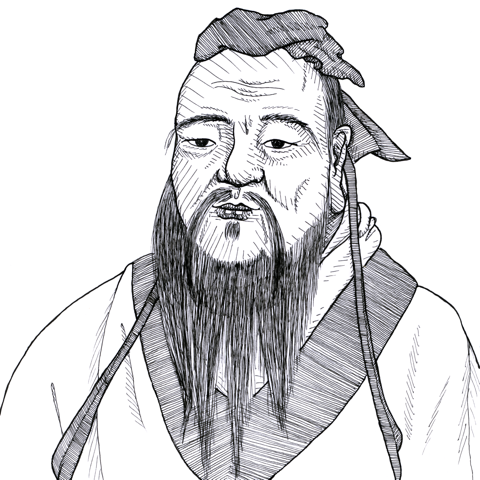
CONFUCIUSK‘ung Fu-tsze, “the philosopher K‘ung,” whose name has been Latinized into Confucius, was born in the year 550 (or 551) bc His father, Shuh-liang Heih was an officer in charge of the district of Tsow in the State of Lu and had been famous for his strength and daring; he was of the K‘ung family and lineally descended from Hwang-Ti, an almost legendary character of ancient China. At the age of seventy, Shuh-liang Heih, the father of ten children of whom but one was a son and he a cripple, sought a wife in the Yen family where there were three daughters. The two elder of them demurred when apprised by their father of the old man’s suit; but the youngest, Ching-tsai, only seventeen years of age, offered to abide by her father’s judgment. The following year Confucius was born and three years later she was a widow. Confucius was married, in accordance with Chinese custom, at nineteen and accepted public employment as a keeper of stores and later as superintendent of parks and herds. At twenty-two, however, he commenced his life-work as a teacher, and gradually a group of students, eager to be instructed in the classics and in conduct and government, gathered about him. He was a contemporary of Lao-tsze, the founder of Taoism, who, however, was of the next previous generation. Confucius is said to have had several interviews with him about 517 bc Up to the age of fifty-two, he was not much in public life. He was then made chief magistrate of the city of Chung-tu, which so thrived and improved under his care, that the Duke of Lu appointed him minister of crime which resulted in a great reduction of wrongdoing. The Duke accepting a present of female musicians and giving himself over to dissipation, Confucius withdrew and wandered among the various states, giving instruction as opportunity offered. His disciples during his lifetime rose to three thousand and of these some seventy or eighty were highly esteemed by him. Confucius when he set forth on his wanderings was fifty-six; it was thirteen years before he returned to Lu. In 482 bc, he lost his only son; in 481 bc, his favourite student, Yen Hwuy, and in 478 bc Tsze-lu, another of his favourites, passed away, and the same year Confucius himself died at the age of seventy-two. He was buried in the K‘ung cemetery outside the gates of K‘iuh-fow, where most of his descendants, said to number more than forty thousand, still live. His tomb is yet preserved and is annually visited by vast numbers of his followers. |

Titles (by Subject)