Econlib

The Library

Other Sites

Front Page arrow Titles (by Subject) arrow CHAPTER III - Observations on The Two Sons of Oil

Return to Title Page for Observations on “The Two Sons of Oil”

Search this Title:

CHAPTER III - William Findley, Observations on “The Two Sons of Oil” [1812]

Edition used:

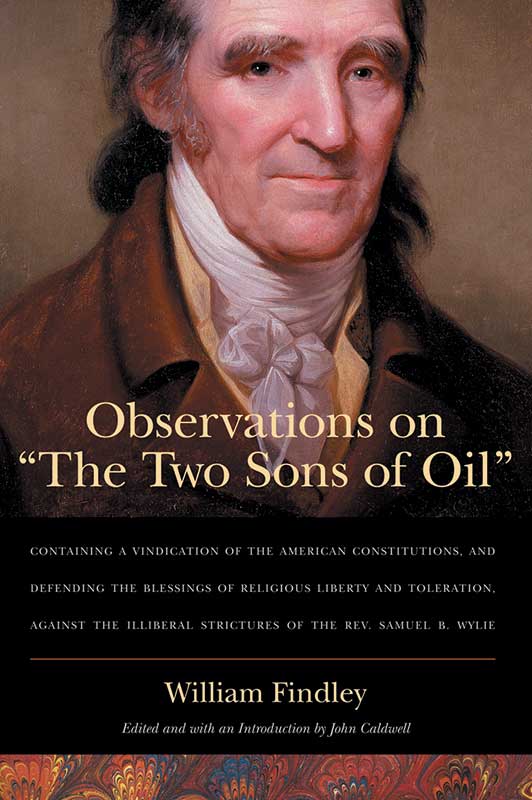
Observations on “The Two Sons of Oil”, Containing a Vindication of the American Constitutions, and Defending the Blessings of Religious Liberty and Toleration, against the Illiberal Strictures of the Rev. Samuel B. Wylie, edited and with an introduction by John Caldwell (Indianapolis: Liberty Fund, 2007).

About Liberty Fund:

Liberty Fund, Inc. is a private, educational foundation established to encourage the study of the ideal of a society of free and responsible individuals.


CHAPTER III

Arguments from the law of Moses examined—Sufficiency of the scriptures vindicated—The reformed churches considered—Toleration and establishments—Some difficulties examined.

The author of the manuscript, after with propriety having strongly asserted the unchangeable perfection and perpetuity of the moral law, admits that the typical institutions, which were shadows of good things to come, as soon as the substance appeared, all fled away; but that the moral law, including the penalties of the Sinai covenant, existeth still, and adds: “Indeed a law without a penalty, seems to me to be no law at all, but a mere directive thing. Now the reason why the divine lawgiver ordered every open and manifest breach of the divine law to be punished, was because it was an open rebellion and sin against God.”

Throughout the whole of the manuscript, he enforces the principle, that the execution of penalties by man, are punishment for sin against God. This is no new principle; it is the principle upon which all the persecutions by Constantine and his successors, of the Waldenses, Wickliffites, and other witnesses for the truths of the gospel under popery, was founded; and for this meritorious work, the executioners of those penalties were, in the later period, rewarded with the pardon of all the sins they had committed, and sometimes of what they would hereafter commit. On this principle Philip II. of Spain,1 who knew of no better way of expressing his gratitude to God, for obtaining a great victory, than by applying to the holy court of inquisition, who were under his holiness the pope, God’s vicegerents for punishing sin, to grant him an auto de fe, viz. a certain number of sinners to be burnt in the flames, for their sins against God. When this reputedly holy, and, at least, zealous prince, feasted his eyes with their torments, and one of them upbraided him with his cruelty, he answered, that if his own son was guilty of such sin against God, he would put him to death in the same manner. The sin was what they called heresy. This was acting up to the principles laid down by both the authors, viz. of the Sons of Oil and the manuscript.

Perhaps, however, they may object that this zealous prince and faithful son of the church, was mistaken in the application of the rule. This is granted. But have they any assurances, more than their own self-confidence, that they would not also be mistaken, in executing the same principle? Are they more infallible than the Pope? They plead scripture, and so did he, and acted on his opinion of the scripture, as laid down by the general councils of the church—so do they. This principle would also apply well to the Sadducees and mortal deists, who deny a future state of rewards and punishments—therefore sin ought to be punished in this world, lest it should escape altogether.

In maintaining the penalties of the Sinai covenant, to be a portion of the moral law, they both of them overthrow what they have advanced in favour of the perfection and immutability of that law. For the penalties of the Sinai covenant were not from the beginning, nor for twenty-five hundred years after mankind and the church had existed, and after crimes that deserved punishment were in the world. Therefore, on their own principles, it was imperfect all this time. A number of these penalties of death were for disobedience to such parts of the Sinai covenant as they acknowledge is abolished; such as making a compound of the holy oil, eating leavened bread at the passover, not keeping some of the solemn feasts, &c. consequently, their moral law has made another change, and is not immutable. The moral law not only reaches to overt acts, but to the thoughts and intents of the heart; the Sinai covenant only reached the outward man; therefore the moral law of the authors is imperfect. It was never intended to be the moral law. To use the Saviour’s words, “It was not so from the beginning.

Christian nations have carried penalties much further than the peculiar law of Moses did; they punish for having more wives than one, or keeping a concubine besides their wives, and declare the children born by the additional wives or concubines, illegitimate; and they punish a married man, as for adultery, for cohabiting with a single woman. They punish with very high penalties, any man, whether citizen or stranger, for introducing a slave into the country, however honestly procured abroad. This was not only tolerated, but authorised, by the judicial laws. They protect such slaves as are in the country equal to the citizens; and, except in one state, punish the wilful killing of a slave with death. I apprehend, that even the author will agree with me, that these laws are agreeable to the moral law, and useful to enforce obedience to it; and perhaps that some of the penalties should be higher than they are. Now these, and other cases that might be named, are all different from, or contrary to, the law of Moses. Are these laws improper, or are they additions to the law of Moses? If they are additions, they are forbidden in that law, and on their own principles they ought to be abandoned. The peculiar law of Moses, including its penalties, therefore, is not the moral, perfect, and unchangeable law, equally obligatory on all men, in all times and circumstances.

The peculiar law of Israel, as I have said, was local and temporary, calculated for a special purpose, and particular situation and state of the world. If it had pleased God to select any portion of Sweden, Denmark, or Norway, instead of the very mild and temperate climate and very fertile soil of Palestine, for the theatre on which a peculiar law was to have been administered, it is not to be supposed that they would have been forbidden to kindle a fire, or seek provisions on the sabbath; otherwise they would have been in weekly danger of being chilled with cold and perishing with hunger, in those frozen regions, where, for a great part of the year, the sun only faintly glimmers on them but for a few hours in the day. Many other peculiarities and penalties might be mentioned, which could not have been supported in that country, without much more of a constant miracle than in Palestine, where its natural situation, warmth, and fertility, was exceedingly suitable for the purpose. The moral law was equally suited to mankind, in every situation and climate in the world; therefore the penalties and peculiarities of the Sinai covenant were not the moral law. This is evident, from their not existing in the time of the patriarchs, before or after the flood; and from their not being extended beyond the symbolically holy land, nor by the apostles of Christ to the christian church.

He admits “that the ceremonial and typical institutions, which were all shadows of good things to come, as soon as the things themselves appeared, the shadows did all flee away; but the reasons of the moral law, both of its precepts and penalties, do still exist.”

That the reasons of the moral law, both of its precepts and its penalties, do still exist, is admitted. The precepts and penalties of the moral law must always be the same, because God is always the same. He will not hold the breaker of the precepts of this law guiltless at the final judgment; he will even in this world visit the iniquities of the fathers on the children; he no doubt has often done so; he no doubt did so in the destruction of the old world, and of Sodom, and also of the Canaanitish nations, with which he had borne long; he does so in the fall of empires; he has done so with the Asiatic and other churches; he has done so for a long time with the Jews; he has often, in his providence, done so with monstrously wicked men. But this is the prerogative of God, and not of man.

The moral law of nature makes it the duty of men to form civil societies, to provide for their own security; and when they have done so, he calls it his ordinance. The moral law of nature, written in the heart of man, and revealed to him, makes it both the duty and interest of civil government to enact laws agreeable to the moral law, and enforce obedience to it. This is necessary, for the peace of society, that the people may lead quiet and peaceable lives, in all godliness and honesty. But it is not their duty to interfere with God’s authority over the reason and judgment of man, in those things, for which he holds them solely accountable to himself. No human penalties can punish pride, hypocrisy, or want of love to God and our neighbour.

In p. 5. he quotes 1 Tim. i. 9, 16, to prove the binding obligation of the law of Moses, shewing that the law is made to punish transgressors; and the apostle enumerates certain offences that ought to be restrained by penal laws; but because the catalogue is not full, he adds, if there be anything else contrary to sound doctrine, viz. the doctrine of the moral law, not the doctrine of the peculiar law of Israel; for God did not see meet, in that state of society, to authorise sinful judges to punish their fellow sinners, to the extent which the moral law requires. Whoremongers, the first in the catalogue, are much more restrained under our laws than under the judicial law; but they had the same moral law for the rule of their conduct towards God and their fellow men, that we have. But it prescribed no penalties for man to execute on man. The Sinai covenant restrained Israel for wise purposes, from changing or extending the penalties of it. Christians have power, from the law of their nature, to extend or change the penalties, agreeable to the moral law, according to circumstances. The moral reasons of punishment were restricted to the laws; they are not so to christians.

The learned Scott, on this text, says, “The moral law was holy, just, and good, resulting from the nature of God and man, and man’s relation to him and each other. Even the ceremonial law had a relative goodness for the time, as typical of Christ’s gospel, and the entire Mosaic dispensation was good, as separating Israel from other nations, affording them the means of grace, and introducing the christian economy; but to enforce the Mosaic law on christians, or to teach them to depend on their own obedience, for any part of their justification, was contrary to the real meaning of the law itself, and intention of the lawgiver.”

The author admits that the typical part of the law of Moses vanished at the appearance of the substances. The apostle tells us of the whole law being a shadow of good things to come, and of a whole change of the old for the new covenant; that this happy change was not by their covenant, viz. the Sinai covenant.

What is the law of commandments which Christ abolished in his flesh? certainly not the moral law of the ten commandments; that can never be abolished. It certainly must be that law of commandments, which, like a middle wall of partition, kept Jew and Gentile separate, not only in their worship, but in their municipal laws, their eating, their clothing, and other common concerns of life; and this could be no other than the peculiar law of Israel, or old covenant, which the same apostle saith, elsewhere, was ready to vanish away. Having perfect confidence in the prophets and apostles, I do not suspect them of deceit—of saying a thing is vanished away, while it is only separated into two parts:—that instead of the Sinai covenant being abolished, it is divided into two Sinai covenants, the one of which is abolished, and the other remains in full force. If this had been the case, the prophets and apostles, being honest and inspired men, would have told us what was taken away, and what remained. I agree with the apostle Paul, that the whole of the Sinai covenant is abolished, and with Dr. Witsius, that the whole of it was a shadow of good things to come, viz. typical, and, as such, ceremonial. If it is not so, it is proper that these authors should distinctly tell us what remains. It is certain, that none of its penalties of death remain, because there are no courts to execute them. The priests and Levites, the sons of Aaron and Levi, were essential constituent judges of the court for life and death, and it was indispensable that those courts should sit where Jehovah gave his oracles in the sanctuary. There are now no priests and Levites, nor any local divine sanctuary; therefore, no such case can be decided and executed under that law. It will not do to say, that other judges may supply their place; for doing so, would be expressly contrary to that law, of which the priests and Levites only possessed the legal authority and records; and whoever usurped their station was liable to the penalty of death. Maintaining this is to give up the law. Has the Saviour and his apostles provided for this dilemma? They have not, in any other way than by abrogating the whole system, and turning the attention of men to the moral law, as explained and enforced by the prophets and apostles, divinely inspired. It is upon these the christian church is built.

But to return to the author’s definition of the judicial law, viz. “That it was that body of laws given for the government of the Jews,” &c. Now there was no law so closely connected with the civil government of the Jews, as the institution of the sabbatical years and grand jubilee. This was at the foundation of that republican institution, and secured republican equality, as originally instituted by Jehovah. It restored every man to his liberty, to his possession, and to his family. With this it does not appear that the priests and Levites had so much concern, as in the courts of justice, &c. yet it was the grand regulator of the liberty and property of the nation. It did not, however, belong to the external worship of God; it was a civil regulation, and, as such, belonged to the civil code. As far as appears, it might have been continued and put in execution without priests, Levites, or sacrifices. It was a law so important in the estimation of Jehovah, its author, that for the breach of it, he says, (Jer. xxxiv. 17.) “Behold I proclaim a liberty for you, saith the Lord, to the sword, to the pestilence, and to the famine; and I will make you to be removed into all the kingdoms of the earth.”

That nation had been devoted to desolation and captivity long before, for the sins of Manasseh, by long continued breaches of the whole law, moral as well as peculiar. He made the streets of Jerusalem run with innocent blood; he did worse than the heathens or the Amorites, &c. Yet, on repentance, they got a respite; but for this one sin, in breaking through the fundamental regulations of the jubilee, they had no respite of the threatened execution of the sentence.

Why do not these authors charge our government with a total neglect of this institution, which lay at the foundation of the civil oeconomy of the Jews? There were some other statutes, perhaps not so important in their own nature, yet equally important from the authority of the divine legislator, such as the commands, not to sow their fields with divers seeds—not to plough with an ox and an ass together—not to reap clean out, the corners of their fields, nor to return for sheaves they had left—not to glean or take all the fruit from off their vineyard—not to wear a garment of linen and woollen, and to wear fringes on their garments—and several other commands of this nature, with which it appears that the priests had nothing to do, in their official character; therefore, they did not belong to the worship of God, which the priests superintended. The jubilee was a civil institution, of a high rank; the others were agricultural and domestic institutions; but all of them statutes of the Sinai covenant, and enjoined by Jehovah. Why are these forgotten or overlooked by both the authors? It could not be because they were ordained by inferior authority. They were certainly divine laws. Is it really the case that they have no regard for the Sinai covenant, further than they, in their own opinion, can apply it in favour of burning, stoning, hanging, fining and imprisoning. They give up the ceremonial part, and all the judicial, except the penalties. It is indeed not probable they will have this actually in their power, but it may console them, to believe, that they have a right to do it. It is their part to examine whether this disposition is agreeable to the spirit of the gospel, or the practice of the apostles and primitive christians. It is certain, that such as have had the power, and have gone into the exercise of it in the gospel day, have discovered a want of that spirit in numerous instances; but they have been more consistent than the authors. The Pope revived the grand jubilee, and it brought a prodigious concourse of people, and influx of money to Rome, and other holy places; and if it did not restore men to their estates, on going through the penance prescribed, it set them free, in their own opinion, from the guilt of all their sins. The authors do not offer this encouragement, nor claim infallibility.

As I have found in both the authors, something like a predisposition to mistake, I will explain two instances, wherein I may happen to be misunderstood. The one is, that by denying the law of Moses to be the moral law, I depreciate the character of the law of Moses. I do not depreciate it, as a national code for a peculiar people, which it certainly was. This is clearly stated in the books of Moses, from their first constitution, and in the whole history of their conduct, and God’s dispensations towards them, as a peculiar nation, until the ends of that peculiar national constitution were accomplished, and the peculiar constitution itself abolished; and those who objected to this abolition, long foretold by the prophets, were cast out from being a people, and dispersed through all nations of the earth, as monuments of the evil of rejecting God’s counsel against themselves. To them, in their national character, Moses, with great propriety, appeals, Deut. iv. 9. “What nation is there so great, that hath statutes and judgments, so righteous as all this law, which I set before you this day?”

To those acquainted with the state of society in the period of the world, the Mosaic law will appear incomparably superior to any other national code then known in the world. The restraints on agriculture and domestic usages, mentioned above, were probably calculated and intended to counteract, and to be a standing testimony against superstition, that had, by its baleful contagion, enlisted ploughing and sowing, food and raiment, in its train. All who have any knowledge of the miseries brought on the human family—from the humane and civilized Hindoo in Asia, to the unpolished Hottentots in the south of Africa; and from thence to the savage Esquimaux in North America—know that more than half the miseries felt by them, is the result of superstition. To prevent the reign, and to stop the progress of this baneful offspring of ignorance, mistaken piety, timidity, and foolish curiosity, then making progress in the world, the law of Moses was well calculated, and exceedingly necessary. In its municipal laws, particularly with respect to justice between man and man, it was not only excellently adapted to the nature of the government, but highly worthy of imitation by every government, as far as circumstances admit.

The great excellence, however, consisted in the frequent introduction of the precious maxims of the moral law, of which an apostle has said, that love is the fulfilling of the law. This impression of the nature of the moral law, though more powerfully enforced by the Saviour and his disciples, was zealously inculcated by Moses, either as incorporated in the national law, or accompanying the delivery of it. In the nineteenth chapter of Leviticus, called in the context a repetition of sundry laws, I find about eight laws that are peculiar, and at least double that number that are moral, equally binding on all men, in all situations. Of these I will insert but two, viz. Lev. xix. 18. “Thou shalt not avenge nor bear any grudge against the children of this people; but thou shalt love thy neighbour as thyself. I am the Lord;” and that the term neighbour is here used in the same sense in which the Saviour explained it, in the New Testament, is evident from the following texts: Exod. xxii. 21. Lev. xix. 34. and many other texts in the books of Moses. I shall only quote Deut. x. 18. “The Lord loveth the stranger,” &c. Every repetition of the fourth commandment is accompanied with expressions of love to the stranger, the servant, &c. This is the language of the moral law. The law of love, proceeding from that God, of whom an inspired apostle informs us, that “he so loved the world, that he gave his only begotten Son, that whosoever believeth in him should not perish, but have eternal life;” and of whom the same apostle tells us, in one of his epistles, that “God is love.”

There was undoubtedly more of the law of love, viz. the moral law incorporated with, or accompanying the Israelitish theocracy, than the political constitution of any nation then in the world. The nations had not then the written word. But the Saviour himself has testified, that in that national constitution, prescribed by Moses, certain deviations from the perfection of the moral law were tolerated, out of indulgence to the hardness of the people’s hearts, for whom it was made. From this, I conclude that though the moral law of love accompanied the delivery of it, and much of it was incorporated in it; yet considered as a peculiar national constitution, it was not the moral law, nor as a national law, obligatory on any but that nation, and on them only, while they continued to be a nation, and acted in that character within the territory to which the administration of this national constitution was limited. In short, I have the same opinion of it that the apostle Paul had. Heb. viii. 7. “If the first covenant had not been found fault with, no place would have been found for the second.” Compare this with what the same apostle has said, corresponding with the prophet Jeremiah, with respect to the old covenant being abolished, to make way for the new covenant, viz. the gospel dispensation, accompanied with the perfect exposition and application of the moral law of love, not only of love to our neighbour, including the stranger, but of love to our enemies, whom we are bound to forgive, under the express stipulation, “that unless we forgive, we shall not be forgiven.” This explanation, I presume, will afford a competent justification of all I have said respecting the Sinai covenant, or constitution of Israel, as a nation. I leave it to the author of the manuscript to justify himself, in his charges of defective morality against the New Testament, which out of sympathy to him, I have not thought proper to quote.

I have said that civil governments do not, and cannot punish sin, because none but the heart searching God is a competent judge of the demerit of sin. I believe that the prerogative of searching the heart, and of forgiving sin, he has not transferred to any vicegerent. I must admit, however, that Pope Leo, the tenth of that name, thought otherwise, and sold the pardon of sins, past, present, and to come, at a pretty cheap rate. A pragmatical fellow, however, named Martin Luther, interrupted the sale. I ask now if Leo X. who had the power to pardon all sins, had not also the power to inflict an adequate punishment for all sins? This, I presume, must be admitted, on the principle of analogy; and on this ground, after endeavours used to reclaim him, Luther was given to the devil, by the Pope.

If this is so, I ask, if hanging, burning, imprisoning, fining, and tortures, if they please, will, in the opinion of the authors, be an adequate punishment for the sins which the culprits have committed? If the punishment, to which they consign them, is an adequate punishment for their sin, it is well. If not, what does it amount to? Nothing, because a punishment of sin against God, if not necessary to protect society, only gratifies the bad passions of those that put themselves in God’s stead.

Lest I should not be understood; by sin, I mean an act against the laws of God—a violation of the laws of religion, or, as it is otherwise defined, any want of conformity to, or transgression of, the law of God. By crime, I mean a transgression of the criminal laws of the state, proper to be brought before a court of criminal jurisdiction. In this sense it is used, not only in common law, but in scripture. Job. xxxi. 11. “This is a heinous crime, yea it is an iniquity to be punished by the judges.” Ezek. vii. 23. “For the land is full of bloody crimes.” Acts xxv. 16. “Have his accusers face to face, and he have license to answer for himself, concerning the crime laid against him,” &c.

The term crime is probably sometimes applied improperly in common usage. It does not apply to what is called civil injuries, or wrongs between man and man; it does not apply to any thing that only subjects a person to the censures of the church. The church has no power to decide on crimes; their censures only extend to what in the New Testament is called offences. Rom. xvi. 17. “I beseech you to mark them which cause offences,” &c. The terms stumbling and offend, used in the New Testament, (1 John ii. 10. and Mat. xiii. 41) are translated in the margin, and by commentators, scandal. By the Presbyterian church of Scotland, this term has been usually applied to such offences as were, by their discipline, subjected to church censure. On this subject the learned Durham,2 one of the greatest ornaments of that church, wrote his celebrated treatise on scandal. Church judicatures have nothing to do with offences, considered as crimes, against the state; but as sins against God, or scandals to religion; they have no authority to punish crimes, but to bring offenders to repentance. A crime is not only a fault, but a great fault; it is not a private injury, which affects an individual only, but such as affects the public in general; therefore, belongs to what, in England, are called the pleas of the crown. A crime is a violation of public rights, such as treason, murder, and robbery. Conviction of crime renders the person infamous, and disqualifies him from public confidence. Every crime committed by a professor of religion, is also a scandal to religion, but every offence or scandal, which may offend our brethren, and subject the person to reproof or admonition, can only be figuratively called so; it does not render the person infamous, and ought not to be classed with such as do so; for it has a tendency to discourage offenders from submitting to church censures, when they cannot, in truth, confess themselves to be criminal, or infamous. This may be considered as a digression, but I trust not unuseful.

Under the peculiar constitution of Israel, as a nation, Jehovah was not only their God, in the same relation in which he stood to all the families of the earth, but he was also the immediate and peculiar king of Israel, as a nation. In that character, every offence committed against the peculiar laws of the national covenant, or constitution, was not only an offence, or crime against these laws, but a sin against Jehovah, their king. This national law did not forbid all offences against the moral law, nor authorise the courts to punish all the infractions of those laws, which were forbidden in the Jewish law; very many of them have no penalty annexed, to be executed by man. All transgressions of, or want of conformity to the moral law, even though not prohibited in the national law, were sins, for which sinners must account to God at the final judgment. In that solemn and general decision, there will be no respect of persons or nations—no difference between Jew and Gentile. Sins and the aggravations of them, will be weighed in an even balance, and all will be condemned who have not fled for refuge to the Mediator, according to the gospel.

If “a law without a penalty, to be executed by man, is no law at all, but a mere directive thing,” as the author of the manuscript maintains, he may easily correct this mistake by looking into the Sinai covenant, which he maintains to be still binding on christians. In Exod. chap. xxi. xxii, and xxiii. which contain the principal precepts or rules for the courts of justice, and in that sense their judicial, or rather juridical laws; these were in the twenty-fourth chapter wrote in a book, and deposited with the priests and Levites, who were afterwards constituted the permanent and official judges of these courts. He will there find more than twenty cases forbidden or commanded, without any penalty annexed to be executed by man. He may, indeed, call these mere directive things. If so, let him look a little further. (Lev. chap. vii.) He will find many other statutes in that book which have no penalties annexed, that the judges are authorised to execute. In some cases of disobedience, it is said they will be cut off from their people; but where no authority was given to the judges, God reserved the execution in his own hand, of which he soon gave an example in the case of Nadab and Abihu, and afterwards in the case of Korah, &c. The issue lies between the author of the manuscript and Moses, who says they are laws. The author says they are mere directive things. I had always thought a law was a rule of action prescribed by competent authority, and that its obligation arose from the authority of the legislator; and that penalties were merely incidental, to enforce the execution of the law, but added nothing to its moral obligation; it appears Moses was of the same opinion. The law of the ten commandments prescribes no penalties to be executed by man; are those commandments, therefore, no laws, but mere directive things?

The author of the Sons of Oil not only introduces divine laws, as repealed and mitigated, on which I have already made remarks, but he adds, “Where the laws are silent or indefinite, with respect to particular crimes, and the punishment thereto annexed, great discretion and prudence will be necessary,” &c.

I am no where in the Bible informed of the repeal of any law of God. The Saviour, who only had power to do so, repealed none. In the question of divorce, &c. he declared what the moral law of nature was from the beginning, and informed the people that Moses, in giving the peculiar law to Israel, had given this indulgence for the hardness of their hearts. He, in every instance, explained the moral law in its greatest purity, and applied it to the conscience. The delivery of a compend of this most perfect law preceded the national law to Israel; the one was a rule of conduct, as they should answer to God; the other a rule of conduct, as they should answer to the civil magistrate. The Saviour did not abridge, nor enlarge, the power of the magistrate; but he explained and applied the moral law to the conscience.

He not only sent the leper to the priest, to offer for his cleansing, according to the law of Moses, but a few days before he was crucified, he told his hearers, “The Scribes and Pharisees sit in Moses’ seat; all, therefore, whatsoever they bid you observe, that observe and do; but do not after their works, for they say and do not.”

Nothing can be more plain than this direction, to attend to the law, without regarding the character of the officer who administers it, if they are legally possessed of the office; and that the national law of Moses continued without repeal or mitigation till the great antitype had fulfilled all righteousness, including obedience to the symbolical law, and having, on the cross, fulfilled all its requirements, said “It is finished.” This was the end and fulfilment of that law, not its repeal, like the repeal of the laws of short-sighted mortals.

Who, before the author, ever thought of a silent, or indefinite law of the most high God? I am at a loss to decide whether this sentence exhibits most of absurdity, prophaneness, blasphemy, or nonsense. To say that a law is silent, is nonsense. Silence is a negative; it is the reverse of law. The definition of law is, a rule of action, established by competent authority, and publicly known; against such only can a crime be committed. This definition is agreeable both to scripture and common sense; as sin in scripture is the transgression of a known law, so is crime with respect to municipal laws. How then can a crime possibly be committed against a silent, or unknown law?

The term indefinite is commonly used in two senses. The first is, not determined; not limited; not settled. The second is, large beyond the comprehension of man, though not absolutely infinite, or without limits. Such is the number of the stars, or of the sands on the sea shore. Does the author really ascribe this character to the laws of a just and a holy God? Does he assert that his laws, for the breach of which he authorises punishment, are in their own nature not settled or determined, or that they are incomprehensible and undefinable? He certainly does; and by so doing, depreciates the laws of God below the standard of the heathen oracles. They were dubious, indeed, but not indefinite; they required good guessing. The king of Lydia was informed by the oracle, which he consulted, that if he went to war with Persia, he would destroy a great nation; he wished, and therefore hoped and believed, that the oracle meaned that he would destroy Persia; but the oracle, as explained by the event, meant that Persia would destroy Lydia. The responses of those oracles were, no doubt, the result of deep cunning, but the construction given to them was on the same principle on which the reverend author of the Sons of Oil and the author of the manuscript, construe the oracle of God. They form a system, founded on certain first principles, framed by their own imagination, contrary to which, they persuade themselves, it would be inconsistent for the divine character to act; and they practically say unto Jehovah, hitherto shalt thou come and no further; just as he set bounds to the overflowing of the ocean, and just as the Jews did in order to justify them in rejecting the counsel of God against themselves.

In the seventh chapter of John, we find no less than five self-created barriers that they had erected against their own happiness. In the first ten verses they object to Christ’s doing miracles in secret, viz. in Galilee and such remote places, because if he was the Messiah, he ought to be known openly, not giving credit to the prophecy of his character, viz. that the Saviour would not cry nor lift up his voice, &c. Others concluded he could not be the Messiah, because he never had human learning. Others, more than half convinced that he was the Christ, yet it being a first principle or maxim with them, that when Christ came, no man would know from whence he was, but they both knew him, and from whence he was—therefore rejected him, notwithstanding the most incontestable proofs of his divine mission. A little further on, in the same chapter, he came out of Galilee, and not out of Bethlehem, therefore they shut their eyes against the clearest evidence. And a little further still, he was rejected by the rulers, because that those who approved of the Saviour had not studied the law of Moses, according to the rules then prescribed; they had not studied at the feet of Gamaliel, nor been dignified with a diploma. Nathaniel, the Israelite without guile, was entangled in the same manner, but did not, like the others, persist against reasonable demonstration; but he at first adhered to his maxim, that no good thing could come out of Nazareth. His candid mind yielded to evidence, and he rejected his own prepossessions.

Probably I would not have introduced these observations, had it not been, that when I was entangled with first principles, maxims and prepossessions, impressed by respectable authority, and received so much at heart, that for some time I turned with a kind of alarm from examining their solidity. I was, in part, relieved from this bondage by the divine blessing directing and assisting me in deliberately examining the seventh chapter of John, and the case of Nathaniel. I was there convinced that we are very apt to make the snares, wherein we ourselves are entangled, and have, of course, relinquished my former confidence in maxims and first principles. Not that I have given up all first principles; it is still a first principle with me, to receive, believe, and rest on scripture testimony in the most plain, simple, and obvious sense in which it is revealed, unless it is so clearly figurative, that taking it literally would be evidently absurd; and I am, from many years experience, the longer the more convinced, that in this way only there is safety; that departing from this rule has been the source of all the mysticism, enthusiasm, superstition, idolatry, tyranny and persecution, by which the christian religion has been dishonoured, and its genuine principles perverted. By departing from this rule, even orthodox commentators have, in some instances, gone wrong.

It is no uncommon thing, in church history, to find professors proclaiming the law of God as their exclusive rule, with regard to religion; and this being a very simple proposition, enlisting and arming fire, sword, tortures and lesser punishments, according to their discretion, against others who not only make the same professions, but practice more conformably to them. This might be demonstrated by facts, both in earlier and later times. The church of Rome professes to rest solely on the scriptures, but proves from scripture, as she believes, the right of giving the true sense or interpretation of it, and the authority of tradition, to which all must conform under the penalty of death. The reformation took its rise from a free enquiry, by every man for himself; the preachers (sometimes and not amiss, called the apostles of the reformation) addressed every man’s reason and judgment, in the same manner as the gospel was offered by Christ and his apostles. In this way the gospel church was planted and spread abroad through the nations, and continued in purity until the ministers of religion, in their councils, assumed a legislative authority in the church of Christ, towards the close of the second century. From this time, the right of private judgment was restrained, but so gradually, as to give little alarm; for it was while manslept that the enemy sowed: but in proportion as this claim was extended, superstition, error, and corruption of every kind overspread the church, until the grand apostacy, foretold by the apostles, was consummated. When the clergy first assumed a legislative authority in the church of Christ, they exercised it with prudence, and professed to derive that authority from the scriptures, as the church of Rome still has done, and as Dr. Mosheim, treating of the second century, says, “The christian doctors had the good fortune to persuade the people, that the ministers of the christian church succeeded to the character, rights and privileges of the Jewish priesthood; and this persuasion was a new source, both of honour and profit to the sacred order. This notion was prosecuted with industry, some time after the reign of Adrian, when the second destruction of Jerusalem extinguished all hopes among the Jews of seeing their government restored to its former lustre, and their country arising out of its ruins. And accordingly, the bishops considered themselves as invested with a rank and character, similar to those of the high priests among the Jews, while the presbyters represented the dignity of the priests, and the deacons that of the Levites.”

This is the first instance I find on record, of dividing the law of Moses into two codes, viz. ceremonial and judicial—The precepts for external worship of God prescribed in the Sinai covenant—and those for the peculiar civil government of the Jews. This last they gave up, but retained the former. But though they began with applying this rule only to the orders of the clergy, they soon extended it to the public worship, which they so loaded and disfigured with Jewish rites, that even Augustine, a bishop of eminent talents and rank, but not clear of the superstition of his time, says, “that the yoke under which the Jews formerly groaned, was more tolerable than that imposed upon christians in his time,” viz. the fourth century; to what enormity it afterwards grew under this usurped legislative authority of the clergy, church history records.

It was not, however, till the clergy united with the civil magistrate, in the administration of Christ’s legislative authority over his own house, that the judicial or civil part of the Sinai covenant was enlisted in the cause. The penalty of death and lesser punishments, were necessary to support this usurped authority, and consequently applied, not only to such heretics as perverted the truth of the gospel, but against such persons as testified in any manner against the legislative authority usurped from the church’s head. Historians testify, that many did make efforts to stem the torrent of apostacy, without success.

After the doctrine of the reformation had been successfully addressed to the reason and judgment of individuals, so as to make a progress similar, in some good measure, to what the preaching of the gospel at first had done;—princes, under the profession of being protectors of the reformed churches, became its legislators, and the clergy generally supported them, and those who did not, were subjected to actual persecution; and thus, instead of union, divisions were promoted. Instances of those who held the truth of the christian religion, being persecuted by those who held the same fundamental truths, for not submitting to human and fallible authority in matters of worship, in a lesser or greater degree, are to be found in the histories of all the protestant national churches. The churches of Britain produced strong examples of this sort.

This application of the law of Moses to christians, both in the time of Constantine, and since the reformation, is wholly founded in mistake. I have before stated, that the Sinai covenant provided no legislative power to be exercised by man. Under that economy, the priests were the official repositories of the laws, and it was their duty to read them on stated occasions to the people; and when a king was permitted, it was his duty to take a copy of that law before the priests and Levites, and to read in it all the days of his life, but not to make additions to it. Consequently, though we find the prophets complain, that the people were not obedient to his law—That they that handle the law knew him not—That they had not obeyed nor walked in his law—That they have forgotten the law of their God—That they have done violence to the law, &c. they no where complain, that they did not make laws for reformation, or for punishing offences. Their sin, for which they were punished, was for the non-execution or transgression of the law of Moses. The prophet Malachi finishes the Old Testament system of prophecy, by saying, “Remember the law of Moses, my servant, which I commanded him in Horeb for all Israel, with the statutes and judgments”—and also by bringing into view the coming of the Messiah as near at hand. But neither he, nor any other of the prophets, calls their attention to the laws of their reforming kings, judges, or governors, because they could make no such laws, being merely entrusted with the execution of the law of Moses. But the prophets, from Moses inclusive, frequently introduce the Messiah as a lawgiver, to whom the typical law of Moses pointed, and who was to introduce a new covenant, or dispensation of it, on other principles.

It may be objected, that my arguments against political churches go against the abuse of the power, but not against the power itself. That all civil governments among men have been abused; yet, notwithstanding this, all governments are not to be rejected.

I answer, that all civil governments among men are founded on the moral law of nature, resulting from the will of God; that his reasonable and accountable creatures ought to pursue their own happiness; but the kingdom of Christ not being derived from this source, is founded solely on divine revelation—all its rules and authority are drawn from that divine source.

The moral law of nature obliges all men, in all stations of life, to pay respect in those stations to divine revelation, but does not authorise them to usurp any official authority that he has not transferred to them. Civil magistrates are not enumerated among the officers of Christ’s kingdom, (which is not of this world,) prescribed in the New Testament; therefore they have no authority in or over it. Every attempt to exercise such authority, is usurpation on what is withheld from them. I may, however, with propriety be asked, if these political churches are not the church of Christ, where shall the church of Christ be found since the reformation?

I will answer, as near as I can recollect it, in the language of a much greater man on this subject than myself; I mean the very learned bishop Benjamin Hoadly, of the established church of England: “The church of Christ,” says that great divine, “is to be found in the established church of England, and in other christian denominations, which she excludes from her communion, or who refuse to join in it; that all who believe in Christ and worship him according to his word, by whatever name they are called, are his church.” I will apply this principle to all other political churches; I will apply it to the Javians and Vigilentians, who, in the fourth century, were excluded from the first political christian church. I believe they belonged to the church of Christ. I believe their persecutors, St. Ambrose, St. Jerome, &c. whose memories christians generally revere, were also members of the church of Christ, though they persecuted his faithful witnesses. I believe that while the Waldenses, &c. were persecuted, there were many of the church of Christ in the church of Rome. I believe that the great Wickliffe of England, whose corpse was raised and insulted after he was dead, and his disciples, John Huss, and Jerome of Prague, who loved not their lives unto the death for the gospel of Christ, and many others, who never had separated from the church of Rome, were members of the church of Christ. I believe that Luther was such before he disowned the Pope’s authority, even when he obeyed that church in attending the council; but after he was informed of the Pope’s bull of excommunication being issued against him, to be executed at a given day, he was as much a member of the church of Christ, as he was the day after he with solemnity burned the Pope’s bull. I believe that the ministry of Luther, and his coadjutors and disciples, was valid; and I believe the same of Calvin and his disciples, notwithstanding that they received their ordination, or, in the language of that church, consecration, from the church of Rome. Luther, however, deserves to be respectfully remembered for being the first who declared a separation from, and disowned the authority of, that apostate church, of which he had been a minister, and instituted a separate communion, in defiance of anathemas of more than a thousand years standing, against schism, as if it had been an unpardonable sin. We know the Waldenses, &c. were under many mistakes, yet they were the church of Christ in the wilderness. They, as well as other witnesses, testified against the corruptions of that church, but not against the church itself; they plead with their mother. John Huss and Jerome of Prague were attending the council of Constance, convened by the Pope and emperor, when they became martyrs. Luther narrowly escaped from his attendance at the diet of Worms, whose summons he had obeyed, contrary to the advice of his friends.

The most important manifestation of the covenant of grace, after the first discovery thereof to our first parents, in their fallen and ruined state, seems to be the promise to Abraham. More special promises were then made than had been theretofore, and more peculiar duties enjoined—he was to be a sojourner in a strange land, &c. External promises were given him respecting the multitude and power to which his seed should arrive, &c. but these were only typical of the spiritual promises which contained the substance of the covenant of grace, by which he was constituted “the Father of all them that believe.” Rom. iv. 16.—and from which all believers, of all nations, are accounted the children of faithful Abraham, to whom it was promised, that in him and in his seed, all the nations of the earth should be blessed—Gal. iii. 6–8. This is frequently called the covenant of circumcision, because this rite or sacrament was the sign and seal of it. It was not, however, applied or binding on Melchizedec, or any other believers of that day; but the household and seed of Abraham, not the promised seed only, viz. Isaac, but on all his seed. Though it is not founded on the law of Moses, yet it was incorporated in it. Levit. xii. 3. Therefore the Saviour says, John vii. 22. Moses therefore gave you circumcision (not because it is of Moses but of the fathers). Though this seal was continued in the law of Moses, yet the covenant, of which it was the seal, was totally distinct from the Sinai covenant. The apostle, reasoning on the stability and efficacy of the covenant with Abraham, concludes, Gal. iii. 17. “And this I say, that the covenant that was confirmed before of Christ, the law that was four hundred and thirty years after, cannot disannul it that it should make the promise of none effect.” Thus the apostle puts the covenant with Abraham in direct contrast with the Sinai covenant. The first he says cannot be disannulled. This is admitting that the other is to be disannulled, of which he elsewhere says, it is disannulled, vanished and abolished. While this covenant was wholly abrogated, the Abrahamic covenant only underwent a change of the initiating rites. Baptism was substituted for circumcision, &c. The believing Jews were exceedingly opposed to this change, as well as the abolition of the law of Moses respecting meat and drink, &c. They did not claim the continuance of the passover, the sacrificial worship, the Aaronic priesthood, nor the penalties of the Sinai covenant. Their attachment to the law of Moses was strong; it was a divine law, given with the greatest solemnity, by the most high God.

It pleased God, out of condescension to their weakness, to tolerate the believing Jews to use such observances of the law of Moses, as were not wholly inconsistent with the gospel of Christ; not only so, but to give them an authoritative toleration for these observances. Acts xv. 19–29. But though they were thus officially tolerated in these things, the apostles never ceased to preach against them, as may be seen in all Paul’s epistles. He combated error with instruction, the only means instituted by God for that purpose. He reproved and admonished, but did not exclude them from the communion of the church. This was not an error of little importance, for the Judaizing christian taught, that except they be circumcised they cannot be saved. Acts xv. 1. The apostle, on the other hand, taught, that if they were circumcised (viz. trusted in it) Christ shall profit you nothing. “For I testify again to every man that is circumcised, that he is a debtor to do the whole law.” Gal. v. 23.

There is no doubt but the legal application of circumcision, for justification, was the most pernicious part of the error; but this was not peculiar to them. Christians to this day make a legal application of the moral law for justification before God; not only so, but even some christian sects turn the gospel into a new law, through obedience to which, they expect to be justified; but neither the moral law nor the gospel can be, therefore, abolished, because they are misunderstood or misused. The apostle did not require those that were called in circumcision to renounce it, but he constantly protested against continuing the practice. Titus, who was with him, being a Greek, was compelled to be circumcised, and he took and circumcised Timothy, (who was also a Greek by his father) because of the Jews, who were in these quarters. Acts xvi. iii. These instances discover indeed a high degree of toleration and sympathy towards weak and erring brethren. For these, and probably many others, who were thus compelled to be circumcised, out of accommodation to the prepossessions of the Jews, were Gentiles, therefore, out of the rule of permission granted by the apostles and elders, convened at Jerusalem. It is evident that this toleration was admitted after that decree was published. The apostle in so doing, was guided by the spirit of Christ. This is no doubt put on sacred record to shew the condescending patience of God. Our Saviour, who waits to be gracious to erring men, and bears long with their errors, and continued long with them the means of instruction, the appointed corrective of error before he casts them off.—He bore with the unbelieving Jews, and continued the means of instruction, not without its influence. His prayer for forgiveness was no doubt heard in behalf of many of his betrayers and murderers. Paul himself was a violent persecutor till some years after the Saviour’s ascension; but when they became obdurate in rejecting the counsel of God against themselves, they were given up to that exemplary destruction which the Saviour, in the most affecting manner had foretold, and of which Moses, many centuries before, had prophesied; yet he continued to bear with the obstinate prepossessions of the believing Jews, who continued their attachment in favour of some parts of the law of Moses, because it was a divine law, and, as such, delivered to the fathers in whom they gloried. Without considering that all its objects were accomplished, and its requirements fulfilled, they gradually, but slowly indeed, relinquished this attachment, after their temple, their place and nation, as to them, were no more. It was not till the second great dispersion of the Jews, in the reign of the emperor Adrian, that the great body of the believing Jews coalesced fully with the christians from among the Gentiles, in the abolition of the middle wall of partition, which had, by divine authority, been abolished more than one hundred years before. A small remnant, who took to themselves the name of Nazarines, separated. Unfortunately, those who united with the Gentile churches, contributed to introduce the abolished hierarchy, and rites of the Jewish, into the christian church, as I have before stated.

I conclude this part of the subject with only remarking, that the apostle, in asserting, by divine authority, that by being circumcised, they became debtors to fulfil the whole law of Moses, strongly confirms what I have before stated from scripture, that the law of Moses, viz. the national law, or code of laws, consisting of many subordinate laws, which is always necessary to form a national system of laws, called by moderns a constitution of civil government, viz. that the nation must either submit to the whole, or to no part of it. This is evidently the declaration of the prophets and apostles, with respect to the old and new covenants, viz. the gospel dispensation of the covenant of grace, and the symbolical covenant with Israel, as a political and symbolical nation. That in this my opinion is correct, is evident, if the apostle is correct; and I wish no better authority.

The United States, notwithstanding the denunciations against their constitutions, by both the authors, precisely followed this divine example, when in pursuance of their own happiness, not consistent with the equal happiness, of their fellow men, they declared themselves an independent nation. They, by that very act declared all laws derived from the former government void. So many of them were revived, by special acts of the state legislatures, as they thought proper; but none of them by authority of the old government. This is denied by the author of the manuscript. I am sorry for the confusion of his ideas on this question. He has been an officer of the state government. He knows the laws; let him examine them, particularly such as were enacted at the commencement of independence. They will answer for me. Let him read the revising act; till then there was no law in the states, but order was preserved by committees throughout the states, acting on their moral discretion, agreeable to the law of nature. In this manner they prepared the way for a convention, with full power to give a constitutional establishment to a state legislature. In this manner all the thirteen provinces became sovereign and independent states. These state legislatures agreed to articles of confederation, by which they transferred certain general powers to a congress, composed of delegates from the respective states. A congress had been appointed before that time, by provincial committees, or legislatures, acting in that character, for which the king dissolved the legislatures. That congress, however, having no legal authority, could do nothing but advise; but their advices were treated with great respect. Thus being reduced to a state of nature, by the king declaring them out of his protection and dissolving their legislatures, in pursuit of their own happiness, they, agreeably to the moral law of nature, viz. the will of God expressed in that law, formed civil society for the preservation of order and protection; and being thus formed agreeable to the law of nature, the only law which they then acknowledged, they proceeded to institute civil, viz. political society; that is to say, to organize civil government. This proceeding being agreeable to the will of God, expressed in the law of nature, is the ordinance of God, agreeable to the apostle Paul, and being organized by man, is the ordinance of man, agreeable to the apostle Peter, (See Rom. xiii. 1. and 1 Peter ii. 13.) therefore entitled to obedience for conscience sake. A paragraph of the Rev. Mr. Wylie, however, declares them to be immoral and illegitimate—that is to say, bastard governments, whose authority ought not to be obeyed; and compares paying taxes to them, to compounding with a robber. As this will be examined in another place, I will conclude here with observing, that in all my acquaintance with the organization of civil governments, I know of none that in every respect originated in a way so agreeable to the law of our nature and reason. I know of none wherein the voice of the citizens, of all ranks, had so much weight, as in the forming of their constitutions, by which the people have transferred so few of their natural rights, or in which those they have retained, are so equally and so effectually secured.

As far as I have observed, the author of the manuscript does not go all lengths with the author of the Sons of Oil, in disowning the legal authority of the civil government; but they agree in censuring it very severely, on account of the protection it affords to the citizens in the exercise of their truly unalienable right of worshipping God agreeable to the discovery of his will to their own reason and judgment, as they are to be accountable to him in the day of judgment. This they, by a strange mistake of language, call toleration. Certainly they might have known, and it is strange that they did not know, that the term toleration, in religious matters, among christians, originated from political religious establishments, introduced with other conceptions of christianity, and too soon adopted, and too eagerly pursued after the reformation by protestant states, while they worshipped an idol of their own making, viz. uniformity, in obedience to rules of worship prescribed by human authority. They had formerly groaned under that power exercised by the Pope and councils of the priesthood, convened first by the authority of the emperors, and afterwards by the Pope, approved by the emperors. These, however, claimed to possess infallibility, and the immediate inspiration of the Holy Ghost, though they sometimes disputed whether this precious arcanum was vested in the Pope or in the council, or jointly in both. The emperor Phocas, however, having transferred it to Pope Boniface, and the councils having acknowledged the authority of the Pope to forgive sins, and to transfer the gift of the Holy Ghost to the subordinate clergy, and having acknowledged him to be the vicegerent of Christ on earth, the dispute, to all practical purposes, was settled. With those who believed the Pope to be the vicegerent of Christ on earth, as he had long before been as the successor of Peter, and the infallible judge of truth, it was perfectly consistent to worship and believe according to his dictates. But after the reformation had progressed through the influence of truth, addressed by the reformer to the reason and judgment of man, as the gospel had been by the apostles, princes, as I have before stated, assumed the power of the Pope, as the judge of truth, not to the whole church, but to their own subjects, and enforced their decisions with respect to doctrine and worship with civil penalties, in the same manner as they did the municipal laws. Consequently, Europe produced at one period above twenty Popes, including the free and sovereign cantons and cities, as well as the sovereign kings, princes and dukes, who acted equal to the Pope of Rome in deciding definitively on religious truth. But neglecting to assume infallibility, and claim divine inspiration, such of their subjects as thought it their duty to judge for themselves, in matters for which they were accountable to God only, could not implicitly rely on such decisions, not supported, as the Popes were believed to be by his votaries, by the immediate inspiration of the Holy Ghost; these dissented from the political standard of truth, or attempted to explain it, so as, in their judgment, to render it more agreeable to the scriptures, which they believed were really given by the inspiration of the Holy Ghost. For this, as I have stated before, they were persecuted with greater or less severity in the dominions of these diminutive Popes, until they gradually became convinced, that the establishment of the worship of their idol of uniformity, could not be supported; that it either made hypocrites, or excited their subjects to oppose it; and, in short, that they were not God’s vicegerents to judge of, or punish sin against himself. Reluctant, however, to give up the hold they had on the consciences of men, by their self-interest, they retained the rewards of hypocrisy in their own hands. They made laws to tolerate dissenters from the politically established religion, subject, however, to certain disabilities and privations, while those who adhered to the established religion, not only enjoyed the clerical livings, but an extensive preference of civil privileges. Can the Rev. Mr. Wylie, a native of Britain, where he received a liberal education, be ignorant of the toleration act of William and Mary,3 which gave no positive privilege to dissenters from the national religion, but only provided for exempting their majesties’ protestant subjects, dissenting from the church of England, from the penalties of certain laws, commonly called the toleration act.

On the whole, religious establishments, by civil authority and toleration, are relative terms, as much as parent and child. Political establishments are the parents of political toleration. There is, however, this difference: An establishment may exist without toleration, and did so for many ages, till, by its baneful influence, darkness covered the earth, and gross darkness the people. It was the beast or dragon of the Revelations, which banished the woman into the wilderness, and made war with the remnant of her seed, and still continues the war, though with less power. I am the more astonished at the Rev. Mr. Wylie charging the United States with toleration, that I know it is not the opinion of all his brethren. The late Rev. Mr. King,4 a member of the same Presbytery, being asked in my hearing, by some of his people, (who, from ignorance, objected to the constitution of Pennsylvania, as granting a toleration,) if that was the ground for objecting to the constitution, answered candidly, that it was not, because it gave no toleration; that having no religious establishment, there could be no toleration to depart from what did not exist; that his objection was, that it equally protected all religious denominations. This is admitted. It provides for the protection of all who lead a quiet and peaceable life in godliness and honesty. 1 Tim. ii. 2—“And who study, as much as in them lieth, to live peaceably with all men.” Rom. xii. 18. Which the apostle, in these and other texts, has considered to be the great end of civil government to promote, and undoubtedly the principal object of its institution. That it may answer this purpose, the legislature of Pennsylvania has enacted laws for the suppression of vice and immorality, as already mentioned, and for punishing not only the grosser crimes, but all breaches of the peace, slander, &c. therefore it has provided laws for all the great purposes of civil government; and by the constitution, it has power to add, or more efficiently to enforce them. It has, by the constitution, and by the law of nature, power to provide for its own security, by punishing those who slander the government itself, or excite opposition to its legal authority. No government on earth can be more justifiable in doing so, than that of Pennsylvania. It has no power to interfere with, or punish for, any thing that solely lies between a man’s reason and judgment, and his God, and of which God is the only infallible judge. Though this doctrine may indeed be disagreeable to the great and little Popes of Europe, because it tends to disrobe them of their fancied godhead, and also disagreeable to both the authors, whose arguments and manner of expression testify their opinion of their own infallibility, in as high a tone as the Popes of Rome have formerly done, but not so terrific, their denunciations against their neighbours, and the government from which they receive protection, are not supported by the flames of the inquisition, the gallows, the torturing boots and thumb screws of Scotland, nor the fines and imprisonments of England. They themselves are hitherto protected in promoting sedition and persecution, and charging their neighbours, and even the government, with that blasphemy and atheism with which themselves alone are liable to be charged; but I do not charge them with it, because I believe they did not mean so. Of this God is the only competent and rightful judge.

The author of the manuscript, viz. Observations on Toleration, after occupying sixteen folio pages in advocating the perpetual obligation of the national law of Israel, for fifteen pages further combats those whom he calls tolerants—a new name, indeed, for a religious sect. I understand it, however, to include not one particular sect, but all sects who are not intolerants; who believe and teach that they have no authority to burn, hang, fine or imprison other men for not believing as they do, in questions that they think belong to religion. People think differently about the question, Wherein does religion consist? The Russians thought much of it consisted in wearing very long coats and their beards unshaved, and considered Peter the great as a persecutor,5 because he made them cut their coats short and shave their beards. This some may think ridiculous; but it is not more so than flying to caves and deserts, idolizing the dead bones of supposed saints, considering holiness to consist in a single life, and bodily macerations, &c. which was in high repute among christians, not only in the fourth, but even so early as the third century, and patronized by the greatest divines of that period. It was in the fourth century, that a still more pernicious principle became a part of religion, viz. “That error in religion, when maintained and adhered to, after proper admonition, were punishable with death.” This is the principle for which both the authors are zealous advocates, and they make their own judgment of the scripture the rule. It was very necessary at that period, for there were then a Javian, a Vigilentius, and many others, who testified against the rapid progress of superstition, and having scripture and reason clearly on their side, the then church not having recourse to these arms, the only arms used by the apostles and primitive christians (2 Cor. x. 4. Eph. vi. 13–16.) by the use of which the christian church was planted and defended at the first, temporal punishments became a necessary substitute for its defence. I believe, with the apostles, the reformers, and the most celebrated modern divines, among whom I name the great Dr. Owen, that scripture is always sufficient to overturn error. That divine demonstrates, that those arms were always successful, until the church, and afterwards church and state, usurped a legislative authority in the church of Christ. That the spiritual armour would still have been so, if other armour had not been resorted to.

It is an established principle in criminal laws, that they cannot be applied by implication, or by example, or by necessary consequence, agreeable to the author’s rules of construction. This gives too great latitude to judges. It made sad work in England, where the most virtuous men went to the block for treason, in the tyrannical reigns of Henry VIII. and of the Stuarts. They had judges to their mind, who judged from necessary consequences in their opinion, and from examples. This, in fact, makes the judges legislators. Criminal laws must be applied and executed agreeable to the express letter and plain meaning of the law in Israel; and where the case was doubtful, recourse was had to God, as their peculiar king. This was done in several instances by Moses in the wilderness, by Joshua, in the case of Achan, &c. In other cases, with respect to which God, as king of Israel, did not think proper to entrust man to execute his judgments for disobeying his laws, he reserved the execution in his own hand, and applied it as he thought proper.

The reverend author of the Sons of Oil, however, considers these peculiar national laws as equally binding on all mankind at all times, or at least on all christians; and not only so, but that they authorize a discretionary power, and something which he calls mitigated and silent laws, of which I have spoken already, and of which, as they are not known to others, he is, no doubt, the repository. The author of the manuscript has expressly declared, as I have quoted before, that “the laws and examples of the Jewish church and nation, in the Old Testament, that are not repealed in the New, either by express precept, approven examples, or by necessary consequence, are still binding,” as he afterwards states, on all christian nations. Thus the two authors are substantially agreed, though they differ in expression. The one claims the authority of discretionary, mitigated and silent laws, and the other a latitude of construction that would make them whatever his imagination would suggest. There would be just as many opinions of the application of examples, and of the various real or supposed necessary consequences, as there would be of imaginations and prepossessions. Neither the laws of God, nor any wise laws of man, ever subjected the lives, liberty, and property of men to such caprice, much less their consciences.

If the scripture foundation of the legislative authority, and infallibility of the church of Rome is unsound, where will the authors and other advocates of human legislatures, in and over protestant churches, find a scripture foundation to rest upon? Not on the law of Moses, because the operation and administration was intended for, and applied only to a peculiar people and precisely described territory, and the immediate superintendance of God, as before stated; and with relation to that peculiar people and territory, it waxed old and vanished away, agreeably to divine appointment. This is abundantly testified, both by the prophets and apostles. If this covenant and its laws were of general application, as plead by the authors, I demand proof of it, from the authority of the prophets and apostles. This they have not given, and cannot give. They make a general application of it on their own authority only, contrary to the testimony of the prophets and apostles themselves, on whose testimony, under Christ himself, the christian church is built.

The author of the manuscript says (p. 23) “I do not know that any allege, that civil or national establishments, of even the true religion, was necessary to the growth and increase of the church, but only to her preservation and security against her enemies. It is necessary to prevent the wild boar of the forest from making her a prey,” &c. This principle the reverend author admits. All the abettors and supporters of human legislation, in and over the church of Christ, also admit it. In this they are completely in union with the church of Rome, who fully admit it. It is a common cause, in which they are equally interested; for though they seem on the greatest extremes, and oppose each other with the most ardent zeal, yet in this, and other fundamental principles, they harmonize. They cannot do otherwise. They agree substantially, though they differ in words, that the Mediator was deficient in wisdom to plan, or in power to procure such offices and officers as were necessary to the planting, the growth, or increase of his church, or that he had not power to employ kings or other human legislators to make laws for his church, or to send forth booted and spurred apostles to make proselytes of the Gentiles, with fire and sword, as was afterwards done, instead of humble fishermen, equipped with only spiritual armour, and authorised only to make converts, by means of the sincere milk of the word. I agree with both the authors, and even with the Pope, however much I am opposed to popery, that human legislative authority was not necessary to the planting, growth, or increase of the christian church in its infancy, nor for several centuries after, while the christians had to endure heathen persecution, and were accounted as the offscourings of all things, by the reputed wise, and by the mighty. I believe further, that it is not necessary for the preservation of the truth of the gospel.

A serious question, however, arises from the above. It is this: If civil establishments of religion, viz. a human legislative authority, in and over the church of Christ, was not necessary for its growth and increase, in its infant state, when all the powers of hell and earth were combined against it, how or when did it become necessary? Was it when the majority of the Roman empire, then called the world, had received it, and professed to be in its favour, and when the most despotic and powerful emperors found it to be their interest to embrace it? Again, if Christ and his apostles, authorised and directed by his spirit, really foresaw the necessity of such offices, such officers, and such laws in his church, how did it happen that they were so short-sighted or inattentive, as not to give warning of it, and provide rules suited to the occasion? It is necessary that these questions should be answered by those who advocate the change of Christ’s kingdom, respecting which he gave his dying testimony, that it was not of this world; but who, contrary to this testimony, boldly declare that it is of this world, and subject to human authority, in matters of faith and worship. It becomes the advocates of civil or ecclesiastic government, or any human authority, assuming Christ’s headship over his own house, whether they be advocates of the Roman or the protestant popes—I say it becomes them to inform us when, or by what authority, Christ’s kingdom became a kingdom of this world. By what authority the church of Christ, which he has declared is one, (as his own body, which it is, was one,) became a church of England, a church of Scotland, a church of Switzerland, a church of Saxony, of Sweden, Denmark, and many others, without including the church of Rome, all regulated by laws less or more at variance with each other. Such a change could not be lawfully made by less than divine authority. It could not be lawfully made but by an authority superior to that of Christ or his apostles, to maintain which, is not only deism, but blasphemy; the very thought of which throws a doubt on the truth of divine revelation, on the truth of which all my hope of salvation depends. Whether it maintained that the body of Christ is not one, but many, viz. as many as there are political churches, prescribed by human authority, founded, as they say, on scripture, I appeal to the apostles of Christ, whom he authorised to plant and to prescribe the laws to his church, for which purpose he promised that the Holy Ghost would teach them all things; and to the fulfilling of which promise he gave testimony to the word of his grace, by enabling them to do signs, wonders, &c. Passing other testimonies to the unity of the body of Christ, I shall only instance 1 Cor. xii. 27. “Now ye are the body of Christ,” &c. This is certainly not to be the body of twenty or thirty political churches; Christ’s visible body is not so divided. Believers are members of his body, of which the apostle says, (Col. i. 18) “He is the head of his body the church.” The church they advocate has many heads, who are very changeable in their laws.

But is the respectable author of the manuscript really serious, in admitting that civil or national establishments of religion were not necessary to the growth and increase of the church of Christ, but only to her preservation against her enemies, when she had come to her growth. I seriously ask the author, if the church had acquired her full growth and increase in the beginning of the fourth century, when she first became a kingdom of this world? Notwithstanding the vanity of the Romans in dignifying their empire with the name of the world, yet by far the greatest portion of the human race were not only without its limits, but, as since discovered, far beyond its knowledge. The regions of the north, whose numerous hordes overturned the Roman empire, and laid its glory in the dust, were then unexplored. The vast empire of China, called a world by itself, was then unknown. The very numerous savage nations of America, and the more lately discovered islands of the Southern and Pacific Oceans, containing a vast amount of the human race, had not heard the sound of the gospel. The dispersed tribes of Israel had not been converted, nor the fulness of the Gentiles brought in, agreeably to the divine promise. The church, therefore, was very far short of having completed her increase and growth at the period in question; consequently, the author, on his own principles, must admit that the church became a kingdom of this world too soon for his purpose. I believe it never will become so with the divine approbation; but that there is a set time in the councils of heaven when Christ’s kingdom shall prevail throughout the world. This blessed time is yet to come. We know not the time how long. May the Lord hasten it in its time. There are signs of its approach, but I do not expect to see its accomplishment in my day, but I hope to die in the faith of its final and joyful accomplishment. He is faithful who has promised. Blessed be his name.

The reverend author has frequently appealed, in his book, to the reformers, martyrs, and approved commentators, without introducing the name of one of them, and without any quotations from their works. He has indeed made a quotation from the Larger Catechism, compiled by the Westminster Assembly on the question, “What are the sins forbidden in the second commandment?” In the answer they say, among other things, that “Tolerating a false religion is forbidden.” To this I perfectly agree, because I believe, with the respectable author of the book called the “Hind let loose,” which the Reformed Presbytery fifty years ago considered as a standard authority, that the term toleration is improper. It is the illegitimate production of political establishments, of what they are pleased to call the christian religion. The texts offered by the assembly, in answer to the demand of parliament for such proofs, called by one branch of the then civil government to answer such questions as would be propounded to them by the parliament who convened them, are all taken from the peculiar law of Israel as a nation, on which I have already given my opinion.

The author himself quotes the authority of the prophet Isaiah, xlix. 23. “Kings shall be thy nursing fathers,” &c. This chapter, and others of that prophecy, look forward to the gospel day. It has its accomplishment in part in the United States. It had its first and most literal accomplishment, as all commentators agree, in the protection which the symbolical church and nation of the Jews received from the Persian kings and queen Esther. We know of no kings, since that period, but what were chargeable with smiting some of the most faithful witnesses for Christ. The government of the United States has provided against smiting any of the servants of Christ, and against pulling up the good wheat in order to root up the tares; but to leave all to the harvest, when the heart-searching Judge will make the discrimination, which no fallible man can do. The worship of God is completely protected by the government of the United States. The magistrates, indeed, have not turned preachers, to feed believers with the sincere milk of the word. It is believed this was not intended by the prophet, nor meant by the author. The prophecy is, therefore, in part fulfilled by the government of the United States, as a prelude to its more full accomplishment in the millennium, which I believe is certainly approaching; but not such as many expect, not a worldly kingdom.

The author, p. 24. quotes from the Larger Catechism the duties required in the second commandment, which are there described to be “the detesting, disapproving, opposing all false worship, and, according to every one’s place and calling, removing all monuments of idolatry.” Though I do not substitute the Westminster, nor any other human fallible authority, or creed of any church, for scripture, yet with the above I most heartily agree. I hereby declare that I detest, disapprove, and oppose all false worship, and, according to my place and calling, endeavour to remove all monuments of idolatry. As a proof of the truth of this, I offer my present endeavours to remove the idolatry of the ratifying and sanctioning power of the laws of the most high God, by the civil magistrate,as he does civil laws, and, consequently, of setting human authority above the divine, and other errors which this idolatry brings in its baleful train.

The author (p. 30) quotes Gillespie’s Miscellaneous Questions.6 “Is not,” says he, “the mischief of a blind guide greater than if he acted treason, &c. and the loss of one soul by seduction, greater mischief than if he blew up a parliament—cut the throat of kings, or emperors; so precious is that invaluable jewel of a soul: and (says he) when the church of Christ sinketh in a state, let not that state think to swim. Religion and righteousness flourish or fade, stand or fall together. They who are false to God, will never prove faithful to men.”

Mr. Gillespie, though neither a reformer nor a martyr, was a very respectable minister of the church of Scotland, during the distracting struggles between prelacy and presbytery, in the seventeenth century. If, as I believe, he wrote the above after 1660, when prelacy was restored on a change of the political head of the church, his warmth can be well accounted for. On that change, two thirds of the ministers of that church conformed to prelacy, thereby renouncing presbytery and the national and solemn league and covenant to which they had solemnly sworn. They turned out a disgrace, even to that church to which they had conformed, and violent persecutors of their former brethren, and patrons of dissoluteness; but they had been hypocrites before. For the proof of this, see The causes of God’s wrath, which I have not now before me, and the Solemn acknowledgment of sins and engagement to duties, bound up with the Westminster Confession, both official records. You will scarcely any where find a more irreligious set of clergy described, than these had been while they were members of that church, during what many have thought to be the purest times of reformation. This is one to be added to many other proofs that the wrath or power of man in matters of religion, worketh not the righteousness of God. He in that instance in Scotland, as well as in every similar instance on record, made foolish the wisdom of this world, that he might thereby teach men that their faith should not stand in thewisdom of man. The apostle Paul’s preaching, whereby he converted the Gentiles, “was not in the words that man’s wisdom toucheth.” The metaphysical wisdom of councils and emperors, never brought souls to Christ, nor did worldly wisdom, terrors or rewards, ever make a pure church of Christ. Mr. Gillespie, in the above quotation, is not speaking of political establishments or powers, but of blind guides, such as the Saviour described the Pharisees to have been. They are no doubt to be found in all christian sects, but they abound most in political churches, for obvious reasons. His observations of the importance of real religion to the happiness of a nation, are very just, agreeing with Proverbs xiii. 34. “Righteousness exalteth a nation, but sin is the reproach of any people.” For this reason I am opposed to laws calculated to promote hypocricy, viz. prevarication with God and man. Against such the Saviour pronounces the most tremendous woes. Even Mahomet has sentenced such to the seven ovens in hell, the deepest and most wretched.7 Civil government, using its power and influence to increase that guilt, is contributing to increase national guilt, and call down desolating judgments.

The reverend author has, p. 71, supposed us to object to his system, by saying, “The restraint and punishment of blasphemers and gross heresies, which you contend for, belonged to the Jewish theocracy, which was typical, and so ought not to be imitated.”

The objection is not admitted, because it is not true. The law of Moses no where names or provides for punishing gross or other heresies. It provides against overt acts, which it expressly defines, committed by persons, and in situations which it explicitly describes; and where it prescribes punishment, it does not leave it to the opinion of the judges to decide whether the offence is gross or small; this is matter of opinion. The author ought not to have foisted this into the law of Moses. Did he forget that God, by Moses, had given a solemn charge not to add to it? The law of Pennsylvania defines and provides for the punishment of both blasphemy and prophaneness, not because it is forbidden in the peculiar law of Moses, but because it is contrary to the moral law, and a corruption of manners. The law may yet provide for punishing idolatry on the same principles, but surely the law of Moses did not authorise it but in the symbolically holy land, where priests and Levites set as judges; nor to execute it on any but the devoted nations and apostate Israelites, and in defined cases.

To support this system in his case, he introduces a long quotation from a publication of the Rev. John Brown, seceding minister of Haddington.8 This pious and laborious divine, however, was neither one of the reformers nor martyrs, to which the author appealed. He lived down to our own day, many of his works are, and will be useful, but I do not see a sentence in the author’s quotation from him, that supports his system. The quotation, in substance, is as follows:

“The typical magistrates of the Jewish nation exercised (intended executed) laws relative to murder, theft, unchastity, and other matters relative to the second table of the moral law. Ought, therefore, no magistrate now to do so? The laws respecting the second table pertained as much to the Jewish theocracy as the first. Must, therefore, the christian magistrate for fear of carrying the Jewish theocracy into effect, meddle with no morality at all? Must every thing that was once typical, be now under the gospel, excluded from regulating authority? Must all the laws, directing to elect men fearing God and hating covetousness, to be magistrates or directing men, to judge justly and impartially and prudently, and to punish murderers, thieves, robbers, &c. be discarded as typical? Must the ten commandments, and all the explications of them in the Old and New Testament, be discarded as published in a typical manner?” &c. &c. &c. I agree with the Rev. Mr. Brown, that they ought not; they all belong to the moral law, and their authority was not impaired by having been applied to typical purposes in the less perfect national law of Israel, nor do I know of any christian, or sect of christians, that thinks otherwise; nor do I know how the author came to introduce the quotation to support his cause. Surely he knows that Mr. Brown might, with propriety, be quoted, in opposition to the leading principles of his system. Why did he introduce the weight of that man’s name, to prove what is nothing to his purpose? He knows that whatever particular opinions that divine might have had, he did not support the author’s system, either in theory or practice. He never preached or practised disobedience to the moral authority of the powers that be, though he no doubt preached to reform them, as Paul did, who preached on righteousness, temperance, and judgment, before Felix, the Roman governor and representative of Nero, till he trembled; but he did not preach against the immorality of the government itself, but of those who administered it.

[1. ]Philip II (1527–1598), husband of Mary I of England, was refused coronation as King of England. He ruled Spain from 1556 to 1598. The Spanish Inquisition reached new heights during his reign.

[2. ]James Durham (1622–1658), Scottish Presbyterian divine, The Dying Mans Testament to the Church of Scotland, or A Treatise Concerning Scandal (1659).

[3. ]Protestant dissenters were granted freedom of worship by the Toleration Act of 1689. William, Prince of Orange (1650–1702), married Mary (1662–1694), the daughter of James II. They became King William III and Queen Mary II of England, in 1689, as a result of the Glorious Revolution of 1688.

[4. ]William King (d. 1798), itinerate Scottish Covenanter minister, visited societies in America from about 1792.

[5. ]Peter I (1672–1725): Czar of Russia from 1682 to 1725.

[6. ]George Gillespie (1613–1648), Scottish Presbyterian theologian and member of the Westminster Assembly, A Treatise of Miscellany Questions (1648). Because Gillespie died in 1648, he cannot have written the quoted material after 1660.

[7. ]Muhammad (c. 570–632): Arabian prophet and founder of Islam.

[8. ]John Brown (1722–1787), minister of the Secession Church and noted biblical scholar, Dictionary of the Holy Bible (1769) and Self-Interpreting Bible, 2 vols. (1778).