EconlibThe LibraryOther Sites |
Front Page Titles (by Subject) CHAPTER II - Observations on The Two Sons of Oil
Return to Title Page for Observations on “The Two Sons of Oil”The Online Library of LibertyA project of Liberty Fund, Inc.Search this Title:Also in the Library:
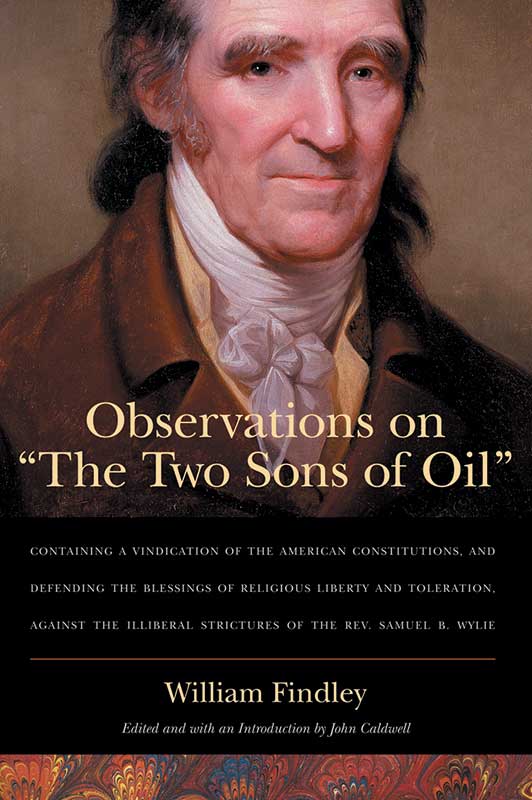
CHAPTER II - William Findley, Observations on “The Two Sons of Oil” [1812]Edition used:Observations on “The Two Sons of Oil”, Containing a Vindication of the American Constitutions, and Defending the Blessings of Religious Liberty and Toleration, against the Illiberal Strictures of the Rev. Samuel B. Wylie, edited and with an introduction by John Caldwell (Indianapolis: Liberty Fund, 2007).
About Liberty Fund:Liberty Fund, Inc. is a private, educational foundation established to encourage the study of the ideal of a society of free and responsible individuals. Copyright information:The copyright to this edition, in both print and electronic forms, is held by Liberty Fund, Inc. Fair use statement:This material is put online to further the educational goals of Liberty Fund, Inc. Unless otherwise stated in the Copyright Information section above, this material may be used freely for educational and academic purposes. It may not be used in any way for profit.
CHAPTER IIA historical review of the author’s standard period of the church, and of his emperors and councils—A vindication of the constitution of Pennsylvania, with respect to the rights and liberty of conscience, and of the federal government, from the author’s charge of atheism—A vindication of the treaty with Tripoli. In page 23, the author introduces the examples of Asa, Hezekiah, Josiah, &c. pious kings of Judah, who called the people back from their apostacy from the national covenant propounded by God, whom they had agreed to obey as the peculiar king of their nation, and from whom, on condition of their obedience, numerous temporal blessings were promised; and as a punishment for disobedience, temporal curses, equally numerous, were threatened. It is presumed that no christian believes that eternal salvation was promised in the Sinai covenant; or, in other words, that it was the covenant of grace. The Abrahamic covenant was, indeed, a most gracious manifestation of the covenant of grace, such as the apostle testifies that the Sinai covenant could not disannul. The blessings of this covenant descend to all true believers, in right of which they are called the children of Abraham. The Sinai covenant, as has been shown before, was symbolical or typical of the kingdom of Christ, through which, as through a glass darkly, true believers saw Christ’s day and rejoiced. The author, however, takes no notice of the divine antitype, who fulfilled every law that man had broken, and made atonement for transgressions, nor of the spiritual kingdom which he had instituted, and of which he had expressly declared that it was not of this world; but with a gigantic stride overleaps the examples of the church of God for a thousand years, viz. from good Josiah, king of Judah, till the reign of Constantine. After, from the example of those pious kings who had no authority to make laws civil or ecclesiastic, nor even ever attempted to do it, he attempts to prove the authority of kings to convoke synods and councils, consisting of ecclesiastic persons, to consult how the church may be purged from corruption, and the truths of God most effectually propagated, he says, “Moreover, the four ecumenical councils were called by christian magistrates. Constantine called the first Nicene council: Theodosius the elder, the first council at Constantinople: Theodosius the younger, the first Ephesian council: Marcian the Chalcedon council.” All christians who are acquainted with the history of the age which the author has fixed upon as the purest period of the christian church, and of the emperors, who, in his opinion, copied the virtues of pious Asa, Hezekiah, &c. can decide on the correctness of his estimate. To such as are not, I recommend the perusal of the histories of both church and state during the fourth and fifth centuries, the period in which the author’s standard councils were held, and his pious emperors reigned. The church of Christ had, before this period, fallen from her first love, and, like Israel of old, played the harlot; the shepherds of his flock had usurped a lordship over it; but in his standard period, the fourth century, they had transferred that lordship to the kingdoms of this world, or rather parted it between them, and to this day have never fully agreed what share of it each should possess. In proof of this, such extracts from national and church history might be given, as would fill a volume; for the professed kingdom of Christ having become a kingdom of this world, the civil history of every nation, where christianity prevailed, is also a history of the church. Gibbon’s History of the decline and fall of the Roman Empire,1 which is in many hands, is full on that subject; he was a deist, and records the corruption and tyranny of those councils and emperors, with an insidious triumph, and applies it to destroy the credibility of the christian religion, not considering that the facts which he truly records of the corruption of the church, were at the same time testimonies to the truth of prophecy. The Abbe Millot’s Elements of Universal History, give ample testimony to the truth of the facts, accompanied with judicious observations. He was a Catholic, and historiographer to a Catholic prince, and rather disposed to apologise for, than to expose their corruption, but does not conceal the facts. The History of the Christian Church, by that reverend and learned Lutheran divine, Mosheim,2 is full on this subject, and his facts are carefully selected from the best authority; and though he was an Erastian,3 viz. believed that the external government of the church ought to be regulated by the civil magistrate, yet on this subject, he is justly esteemed an impartial historian. This valuable work is in many hands. Milnor’s church history,4 though the author, being a rector of the English church, and of what is known there by the name of the high church party, and an avowed advocate of the union of church and state, and of the persecution resulting from that union, yet admits the facts, and particularly, the very rapid increase of corruption, after the council of Nice; but attempts accounting for it from other causes. From these historians I intended to have inserted large extracts; but when I had them prepared, I found they would swell the work too much. I will chiefly substitute extracts from the History of the Rise, Declension, and Revival of the Church of Christ, by the Rev. T. Haweis,5 Rector of All Saints, (who was of the low church party) for those I had prepared from Mosheim, &c. not because they are more full to the purpose, but because they are less minute, and therefore more concise. For the truth of my general statements, I appeal to all the before-mentioned historians. I had proposed extracts from Parker’s6 edition of Eusebeus, Theodorate, &c. to shew the ignorance and credulity of that age, and the ridiculous miracles wrought by unlearned monks and hermits, which are still believed by the great mass of the catholic church, though treated with contempt by those better informed: but I found they also would swell the work too much. My object was, to bring Christians to be better acquainted with the state and character of the church in that period, held up by the church of Rome, her council of Trent, and the Rev. Mr. Wylie, as the standard of perfection; and taken as a model for imitation, in a less or greater degree, by all the advocates of national political churches, and of persecution. I presume, pious well-meaning christians, when they know the character of the church during the period of the author’s standard councils, and his reputed pious emperors, they will not choose to be considered as in communion with it, especially now, when the terror and punishment of schism are no more. If, however, they do, and at the same time keep separate from the communion of either the Presbyterian or Episcopal protestant churches, now in being, they will be justly chargeable with straining at a gnat, and swallowing a camel, at a bar where the reverend author will not be admitted as their advocate. Christians, who take the instructions of Christ and his apostles, as the rule for the edification and the conduct of the new testament church, and the promises of Christ to be with it to the end of the world, for their assurance of its support, may do pretty well, with little knowledge of church history: but such as consider, with the author, (pages 24, 27.) that the laws of the Most High God, and the decrees of ecclesiastic courts, stand in need of the ratification and sanction of the civil magistrate, ought to be well acquainted with church history, that they may avoid former mistakes. They having taken the government which God laid on Christ’s shoulders, (Isa. ix. 6.) and laid it on their own, have subjected themselves to a very high responsibility. To understand the state of the church in the fourth and fifth centuries, which include the author’s standard period, it is necessary to have some knowledge of the third century. Without this, we lay the saddle on the wrong horse, and set the errors of bishops to the account of kings. Even in the second century, the presbyters, or bishops of large cities, assumed a pre-eminence, and seem to have distinguished the character of a bishop from that of a presbyter, and instituted councils with lawmaking power. In the third century, however, episcopacy was more exalted, and councils of the clergy assumed a higher legislative authority. “One bishop also had great pre-eminence over his fellows; summoned councils; presided at their deliberations, and usually swayed their opinions; such was Cyprian in Africa. Rome, Antioch, Alexandria, claimed a sort of pre-eminence for their antiquity, and on difficult matters were consulted: though the bounds of metropolitan, or episcopal authority fluctuated, according to the ability, reputation or ambition of the person who filled the see. The bishop of the great metropolis began to claim, and was generally now admitted to hold a certain priority of dignity above his fellows; for equality respecting order and office was yet jealously maintained by the episcopal band: And therefore, when Stephen, bishop of Rome, issued his mandate, respecting the baptism of heretics, Cyprian rebuked his insolence, with equal indignation and contempt; but whilst the bishops watched with jealousy the ambitious encroachments of their companions in office, each endeavoured to extend his claims successfully in his own church; and was supported by the spirit of the corps in his pretensions. They assumed every day more of absolute rule in their own sees, trenching upon the rights of the presbyters, and excluding the interference of the faithful. These were now taught implicit obedience, and heard the constant warnings of the deadly crime of resisting episcopal authority, seated upon the throne of God, and claiming divine right and submission. The evils necessarily resulting from such a spirit, and such abuses, must be incalculable; and appeared in the pride, pomp, luxury and carnality of many of these prelatical dignitaries. The other orders endeavoured to imitate them in lording it over their inferiors; and claiming their superior honors of sacerdotal reverence. Even the deacons usurped many of the presbyters’ offices, and, in the useless and multiplied rites and ceremonies instituted in the church, appointed beneath them a herd of inferior orders, sub-deacons, acolothists, door-keepers, readers, exorcists, and buriers of the dead, all which strengthened the clerical army with their subordinate functions; and were supposed to share a minor portion of their sanctity.” Haweis, vol. I. p. 223, 224. Am. Edit. The historian further informs us, that marriage, though not prohibited to the clergy, was discouraged; that celibacy continued to acquire a great degree of reputation; and that monkery extended its roots and peopled the deserts, far from the haunts of men. That the sacraments, instead of being considered as memorials, or outward signs of inward grace, had acquired a superstitious reverence for the signs themselves, and were thought indispensably necessary to salvation; and that the supper was administered even to infants. A warfare was carried on to a scandalous height, by bishops and councils, about trifles. The question, whether or not infants should be baptized on the eighth day, as circumcision had been directed, occupied the wisdom of the great saint, and afterwards martyr, Cyprian, and a council of sixty six bishops; and for his supposed unscriptural decision, he was solemnly excommunicated by the bishop of Rome, whom he did not acknowledge as his superior. The above, and other like instances, demonstrated the propriety of one visible head or judge of truth on earth, to settle the disputes of the four metropolitan bishops, who were each of them heads of the church of Christ in different provinces of the empire, in right of being the vicegerents or representatives of Christ—a doctrine early advanced, and which was a lasting curse to the church. While the preachers had given up the simplicity of the gospel, and substituted the Grecian eloquence, full of tropes, figures and allegory, taken from the philosophical school of Plato, in their sermons; burning incense on the altar was introduced from the law of Moses, as the different grades of the priesthood had been before. “The sacrament of the Lord’s Supper was celebrated with greater pomp and solemnity. Gold and silver vessels were used in the service, with garments for beauty and glory; supposing these would command greater reverence and respect for the sacred mysteries. They began also to speak of the elements after consecration, in a language which laid the foundation for the gross and impious doctrine of transubstantiation, and by degrees proceeded, though after a course of ages, from veneration to adoration, and from high mystical flights, to suggest a real body of Christ in the eucharist. Before admission to baptism, the exorcist with frightful menaces and formidable shouts, pretended to expel the prince of darkness from the candidate. The remission of sins was thought to be the immediate effect of baptism, rightly administered by the bishop or his delegate. By his subsequent prayer and imposition of hands (for his presence on those occasions was always necessary) the Holy Ghost was supposed to be given. These baptismal solemnities were reserved for the great festival of Easter, and the forty days succeeding. A solemn parade and procession of the exorcised and baptised, in white garments and crowns, in token of their victory over the devil, closed the august ceremonial. Every step we advance, betrays the growing declension, and the loss of true Christianity, in forms and ceremonies, and the tricks of jugglers to give importance to a new-invented priesthood.” Haweis, vol. I. p. 226. Am. Edit. In short, fastings, the doctrine of demons, exorcism, bodily macerations, hungry bellies to starve out the devil, &c. were introduced. In this century, the sign of the cross was supposed to administer victorious power over all sorts of trials. No christian undertook any thing of importance, without arming himself with the influence of this triumphant sign. The doctrine of the purging fire was also introduced, which, as afterwards dressed up in the form of purgatory, became a great source of profit to the clergy. Though for a clergyman to marry was not yet forbidden, it was esteemed unholy; yet many of the clergy kept concubines. The keeping of lent was introduced, and other fasts and festivals were multiplied. A superstitious reverence for the memories and tombs of the martyrs, approaching to idolatry, and also of the relics, viz. the bones of saints, and dust of places reputedly holy, was in high repute. I have preferred giving a sketch of the history of the church during the third century; because, in the second century, superstition was but gradually commencing; and in the fourth and fifth, which includes the author’s standard period of pure christianity, and from thence to the council of Trent, the change was only progressive and circumstantial, and depended on the same principles adopted in the third and fourth, viz. human invention and human tradition. The long peace and prosperity, enjoyed in the third century, was misimproved, so as to promote pride, ambition, and superstition. The ten years most cruel persecution, under Dioclesian, and two of his three associates in the empire, increased the number of real martyrs and confessors, and made very numerous apostates; but does not appear to have put a stop to the increasing superstition, or the ambition of the bishops. On the decease of Constantius Chlorus, who governed the empire in the west, viz. Britain, Spain and Gaul, (France) and who, in protecting all men in the enjoyment of their natural rights, protected the Christians, while they were cruelly persecuted through all other parts of that widely extended empire;—the christians, then very numerous, naturally attached themselves to Constantine his son, who, with their assistance, in the hand of Providence, became sole emperor. He put the sign of the cross, which the christians had already been in the habit of using as a charm, in his military colours (laborum); and after defeating the imperial tyrant Maxentius, and taking possession of Rome, he put a stop to the persecution of christians, and accepted, of the office of high-priest or head of the church, as other emperors had done of that of Jupiter; and protected all who lived peaceably. The christians having faithfully and successfully supported him in his wars, he paid great attention to their bishops, whom he enriched by his bounty, and bestowed on them, for a church, one of the heathen temples in Rome; and they recompensed him with the seductive incense of flattery, and promises of support, which it was evidently their interest to perform. They having, before the Dioclesian persecution, (to use the words of Mosheim) “assumed, in many places, a princely authority; and having appropriated to their evangelical function, the splendid ensigns of temporal majesty;—a throne surrounded with ministers, exalted above their equals, the servants of the meek and humble Jesus; and sumptuous garments; dazzled the eyes and the minds of the multitude, into an ignorant veneration for their arrogated authority.” Men of such influence, and held in such veneration, were well worth being courted and purchased too, by a man of the discernment and unbounded ambition of Constantine. That the subject may be the better understood, it is proper to mention, that when Constantine subdued the tyrant Maxentius, (who was loved by none but his praetorian guards, who enjoyed his bounty) and got possession of the capital of the Roman world, and of the empire of the west; two emperors still remained on the plan of Dioclesian, for governing that extensive empire. Maximian, who reigned in Asia, was the only survivor of those who had been appointed to the government of the empire by Dioclesian, with equal authority as himself. That unwieldy empire, being attacked and pressed on all sides, Dioclesian added two Caesars, clothed with imperial authority in the districts assigned to them, and having the right of succession to the empire and title of Augustus. The title of Caesar was bestowed on Constantius Chlorus and Galerius. Chlorus, the father of Constantine, and the best of these appointments, had Britain, Spain, and Gaul allotted to his government; the second had Macedonia, Greece, &c. Maximian, as emperor, governed the west, and Dioclesian the east, a division, that afterwards proved fatal to the empire. Dioclesian was one of the best and most moderate of the Roman emperors; but after he had reigned eighteen years successfully, he, through the influence and intrigues of Galerius, the Caesar in most immediate connection with him, and of the pagan priests, whose altars had been forsaken through the prevalence of christianity, reluctantly issued a very severe edict for persecuting the christians. In two years after this wicked edict, he became so disgusted with the empty grandeur and excessive cares of empire, that he abdicated the sovereignty, and retired to a private life, from which he afterwards, when earnestly solicited, refused to return to empire. “If you did but see (replied he to those who solicited him) the pulse which I raise with my own hands, you would never speak to me of the empire.” Galerius and his colleagues, except Chlorus, carried on the persecution with unrelenting severity for about eight years afterwards, when Galerius died (christian writers say) miserably. He, however, repealed his persecuting edict at the approach of death. Dioclesian and the elder Maximian, both having resigned, (the last with reluctance;) he was afterwards (perhaps deservedly) killed by his son-in-law, Constantine, for the security of his own life. The two Caesars assumed the title of Augustus,—governed the empire,—and, to assist them, appointed two Caesars, viz. subordinate emperors. One of these was Licinius, who married Constantine’s sister. He was made Caesar by Galerius. Maxantius, the son of Maximian, and brother-in-law of Constantine, was then emperor of the west. He hated and persecuted the christians, but was overthrown and slain by Constantine, as has been mentioned. The remaining Maximian governed the Asiatic portion of the empire;—Licinius governed Greece, &c. viz. the eastern part of Europe. Maximian, being the only survivor of Dioclesian’s appointments, prepared to subdue both Licinius and Constantine. The former had, equally with Constantine, given peace and protection to the christians; he, with a very inferior force, met with, fought and subdued Maximian, who poisoned himself. Christian writers, of that age, inform us that Licinius was warned of God, in a dream, to risk the battle, and assured of success. Thus the Roman world came to be governed by two brothers in law. Their ambition could not brook having either superior or equal. They soon quarreled. Constantine, with his hardy northern troops, defeated Licinius, at the head of his effeminate associates. Licinius, with the sacrifice of the best portion of that part of the empire which he governed, obtained peace. Constantine, whose ambition was unbounded, made his three sons, two of them infants, Caesars. The two brothers, both in blood and empire, did not long agree. Constantine had the greatest power and resources, and, from circumstances and by address, he had won the hearts of the christians, then a very powerful body. Probably on this account Licinius commenced a persecution against them. They met in battle; Constantine, with superior force, both by land and sea, defeated Licinius, committed him prisoner, with a promise of life; but he was soon after strangled in the prison. In a short time after he put to death his own son Crispen, whom he had created Caesar, and who was generally beloved; and the son of Licinius, but twelve years old; and afterwards his own wife, and many of the nobles, without a public trial; which we, in this country, would call murder, and for which, even his flatterers have never yet, from authentic documents, assigned a sufficient cause; but for which, he was in Rome spoken of as a second Nero. He left that metropolis in disgust, and erected a new one, which he called Constantinople, in a well chosen situation, to build and aggrandize which, he miserably oppressed the empire. He had, as has been mentioned, from the first, favoured and enriched the christian bishops, who, even before he came to the empire, sat on princely thrones, to which some of them waded through blood. This was afterwards the case with Damasius, bishop of Rome, to whose infallible tradition Theodosius commanded implicit obedience to be paid, on the pain of death. Some commentators have considered the silence in heaven (viz. the church) for the space of half an hour, Rev. viii. 1. to be applicable to the reign of Constantine. It may have been so; but could only have been so in the first twelve years of his reign, during which he put a stop to persecution, made several good and humane laws, and protected all in their natural rights. It is admitted by the best interpreters, that it could not apply to any other period of his reign. It was not afterwards silence, but war in the church. It is generally admitted, that great courtiers, such as Eusebius then, and Laud afterwards were, are never pious ministers of the gospel.7 With such self-seekers and flatterers, Constantine was surrounded. He not only enriched them by his bounty, but unfortunately engaged in their controversies. The same, or similar principles, to what Arius taught,8 had been taught long before, and refuted by the force of truth, addressed to the reason and judgment of men. Constantine, who had never studied divinity, nor had received baptism, by his letters and advice endeavoured to settle the Arian controversy: this not succeeding, he by his imperial authority, convened the well known council of Nice, in which, if not formally, he actually presided. That council, after much debate, rejected the doctrine of Arius, for doing which they had sufficient authority from scripture, if they consulted it. They also decided the question on what day the festival of Easter should be held, and the Melitian controversy about the right of ordination, then lately claimed by the metropolitan bishops, and the rank of these bishops, and the limits of their respective jurisdictions: but so far was their decision from settling any of these controversies, that it seemed to give them new life and activity. The time of keeping Easter is yet unsettled. The Arian heresy, then condemned, in a few years after, was restored through the influence of the terrors and rewards of the emperor, who, by the council of Nice, was made the head of Christ’s church, which then became a kingdom of this world, and for which event it had been prepared by such carnal bishops, as the apostle Paul foretold would arise in the church, in his farewell address to the elders of the church at Ephesus. Here, at least in my opinion, the man of sin was openly revealed, who, even in the time of the apostle Paul, did already work, but who was to be openly revealed in his appointed time. They that letted or prevented it, in the apostles’ day, viz. the heathen emperors, were then taken out of the way, which gave a fair opportunity for the usurper of Christ’s kingdom, viz. the man of sin, to be revealed. Constantine commenced, and Theodosius completed his inauguration. Protestant commentators have perplexed themselves in endeavouring to ascertain the beginning and ending of the days mentioned by the prophet Daniel, and the corresponding times in the apocalypse. With those I have nothing to do on this question. Probably they will never be perfectly known till the prophecy is accomplished; but the early degeneracy of the christian church is well known. It already wrought in the days of the apostles, and was rapidly progressive after the apostles were dead, and redoubled its progress after the conducting of it was, by bishops, transferred to a fortunate and unprincipled adventurer, like the Napoleon of the present age. Unfortunately, he had not ballast to bear, nor prudence to guide, such a degree of elevation, as never any man before him enjoyed; not only the civil government of the Roman world, but also the government of Christ’s spiritual kingdom. He did not claim divine inspiration to himself, Theodosius afterwards did; but in his circular letters, enforcing the decrees of the council of Nice, he considered them as divinely inspired. He banished Arius, and decreed the penalty of death against those who would even read his books. In a few years after, he became convinced in his own opinion, that the decision of the council of Nice was wrong; he recalled Arius, replaced the Arian bishops whom he had banished, and commanded Athanasius to receive them into communion: but that veteran confessor refused, and Constantine convened a council at Tyre, who, as most other councils did, obeyed their master’s will, and banished Athanasius. Constantine, after this, threw the weight of his influence against the Nicenes, and at the approach of death was baptized by an Arian bishop, and left his will in the hands of an Arian priest. Long before his time, the name priest had been substituted for minister. He distributed the empire to his three sons: the eldest and favourite son, Constantius, was left in possession of the imperial city, Constantinople, and of the east; his two brothers, Constans and Constantine, had the empire of the west divided between them; and two of Constantine’s brothers had ample estates allotted to them in the east. These were soon dispatched to the other world, except two children; one of which was put to death for his crimes by Constantius, through whose means their father had been murdered. The other, Julien, called the apostate, came to the empire on the death of Constantius. He, after a short reign, was killed in the Persian war, and the house of Chlorus became extinct. I never read the history of that good man, Chlorus, and his numerous and promising family, extinguished by the hands or commands of those who ought to have been their protectors, without a tear of sympathy and regret. Constantius, left by his father in an Arian court, by numerous councils established Arianism, and not only protected, but promoted it, by all the powers of the secular arm. The distress and destruction which took place on this occasion, I would rather weep over than relate. It was the first instance of professed Christians so profusely shedding the blood of their fellow christians for difference of opinion; but, alas! it was far from being the last. Constantine had commenced the practice—Mr. Wylie, himself, advocates the bloody anti-christian cause, which, happily for mankind, he has not the power of carrying into effect. The two brothers of Constantius, between whom the empire of the west was divided, were discontented with their shares, and quarrelled about the division. They protected and encouraged the Nicene faith, which their brother Constantius persecuted. They soon fell by the hands of assassins, and Constantius became possessed of the empire of the Roman world, as his father Constantine had been, but governed it with still less wisdom. He died of a fever, on his way going to fight with his cousin Julien, who was, as I have said before, killed soon after in the Persian war. I will pass over the short reign of Javian, and the longer reigns of the two brothers, Valentine and Valens, who divided the Roman empire between them. Valentine not only protected the Nicenes, but all who lived peaceably. Valens supported the Arians, and persecuted all who differed from them. I will pass over the other emperors, who governed the Roman world and the christian church, then become a kingdom of this world, till the reign of the emperor Theodosius the Great, who was called to the throne, and to take part in the government. He was the first baptised emperor who ever sat on the imperial throne. A fit of sickness, which threatened to be fatal, induced him to go to the baptismal font; in coming from which, he, unacquainted with the principles of the christian religion, believed he was divinely inspired, and issued the following decree, over which the christian has often weeped, and the infidel, not without reason, triumphed. “It is our pleasure, that the nations which are governed by our clemency and moderation, should stedfastly adhere to the religion which was taught by St. Peter and St. Paul to the Romans; which faithful tradition has been preserved, and which is now possessed by the pontiff Damasius, (of Rome) and by Peter, bishop of Alexandria, men of apostolical holiness. According to the discipline of the apostles, and doctrine of the gospel, let us believe the sole deity of the Father, the Son and the Holy Ghost, under an equal magistracy, and a pious trinity. We authorise the followers of this doctrine to assume the title of Catholic christians; and as we judge that all others are extravagant madmen, we brand them with the infamous name of Heretics, and declare that their conventicles shall no longer usurp the respectable appellation of churches. Besides the condemnation of divine justice, they must expect to suffer the severest penalties, which our authority, guided by heavenly wisdom, shall think proper to inflict.” Agreeably to the above imperial decree, he drove out the Arian bishops of Constantinople, who refused to embrace his creed; occupied the church with a military guard; and conducted Gregory Nazianzan, who had before kept an orthodox conventicle, to the church, with solemn military triumph, and placed him, with his own hand, on the arch-episcopal throne. The good bishop, however, was deeply affected by the consideration, that he entered the fold rather like a wolf than a shepherd; and that, while the glittering arms were around him, necessary for his protection, he was receiving the curses of the people, and not their blessing. He did not, however, enjoy it long. A council of the clergy thought that the throne of the capital episcopate should be occupied by one of noble birth, and not by the son of a poor bishop. He withdrew from it to retirement, and they elected a nobleman, who consented to be baptised and consecrated. Nazianzan was one of the few of that age, whose writings are still in esteem. In six weeks after the military instalment of Gregory, which he himself records, the city had the appearance of one taken by the arms of a barbarian conqueror. Theodosius expelled from all the churches of his dominions, such as refused to profess their belief in his own faith. This violent and tyrannical prince did not embrue his hands in kindred blood as Constantine had done; but he far exceeded him in persecution. He made it criminal to differ, even in the slightest degree, from his own religious opinions, and enacted the most cruel pains and penalties against such as did. The christian lesson, taught him by Libenius, the heathen philosopher, “That religion ought to be planted in men’s minds by reason and instruction, and not by force,” had no effect. Constantine introduced this system of tyranny; but it was Theodosius who completed the establishment of the bloody idol of uniformity in religion by human authority, at whose shrine more human sacrifices have been made, than ever were offered on the polluted altars of Moloch. It was this prince who dignified the christian church, as founded on the council of Nice, and the infallible traditions, preserved and possessed by the metropolitan bishops of Rome and Alexandria, with the honourable title of Catholic, which it still retains; and degraded those who did not agree with him in receiving those traditions, and resting their faith on the authority of the council of Nice, or, to use his own words, branded them with the opprobrious name of extravagant madmen and heretics—a character severely known since that day. Vigilentius, and many of that age, who had the sense and courage to lift up their voice against the prevailing superstition, and to call the people back to the scriptures, were branded and punished under that character. Very numerous sacrifices, to this idol, were made of the Waldenses, the disciples of Wickliffe, &c. John Huss and Jerome of Prague,9 by the sentence of the ecumenical council of Constantine, (which had certainly equal authority with the council of Nice, both having the authority and presence of the emperors,) expiated the crime of heresy in the flames. The arch heretics and extravagant madmen, Luther,10 Calvin, Knox, &c. narrowly escaped that fate; but many of their followers were not so fortunate. The laws of Theodosius were executed to effect by the massacre of Paris, and the flames kindled in Smithfield by Mary, queen of England, in which the bishops, Cranmer, Latimer, Ridley, Hooper, and many others, were consumed, for disobeying his imperial decree.11 Theodosius, agreeable to this law, if it could have been executed, subjected myself, and all denominations of protestants with which I am acquainted, except the Rev. Mr. Wylie, and such as adhere to his opinions, to have been burned or hanged as heretics, long before this time. Many a joyful festivity has been held in Spain, at the burning of heretics in groupes (auto de fe.) It was, by some of their kings, considered and practised, as the most acceptable thanksgiving to God, for victory in war. Unfortunately, when the blessed reformation took place, and the reformers protested against the religion and uniformity established by Theodosius, the great, they did not wholly divest themselves of the principle. If they did not kindle the flames, they made a pretty free use of the gallows and lesser punishments, against such as would not worship the idol Uniformity, which Constantine had set up, and the worship of which, Theodosius completely established; and which has continued, hitherto, unchanged in the catholic church. To find the true church of Christ, after the catholic church became degenerated—the hierarchy exalted—and superstition greatly increased—I recommend the reader to the perusal of Haweis, first chapter in each century, on The true spiritual church of Christ. Even in the third century, it will rarely be found among the high dignitaries; but among those of low degree, and such as were declared schismatics, for not acquiescing in some decisions of the metropolitan bishops and councils, and some questions about ordination and discipline. The number of these increased after the council of Nice, when by persecution they were banished from the empire, or suffered great oppression in it. It was some of those that spread the gospel, with the bible in their hands, but without the support of wealth, or the sword of the civil magistrate, into Persia, Tartary, China and India. They were not clear of superstition or mistakes; but they did not enjoy wealth as the means of corruption, and led lives agreeable to the gospel; and there were still some in the catholic church, who plead with their mother, but their voice was not heard. In every instance, in which human uniformity has been enforced by the sword of the civil magistrate, many of the servants of Christ have suffered persecution. It is not in the wisdom of man to make a clean riddance of the tares from the wheat; and the Saviour has forbidden the attempt. It is not necessary to make remarks on the character of Theodosius the Younger, or of Marcian, who called the two last of the author’s standard councils, viz. the Ephesian and Chalcedon councils. They pursued the same system. Marcian was not a bad man; he married the empress Pulchrea, after a solemn engagement that he should never cohabit with her; she having devoted herself to perpetual virginity. Thus a marriage took place, under a solemn engagement not to accomplish the purpose for which marriage was instituted. I only mention this to shew the substitutes invented for real religion in those times. I will drop the emperors, whose authority was, in their own opinion, to use the words of Theodosius, guided by heavenly wisdom, (Infallibility!) and insert a few extracts of the character of the church and priesthood of that age. On this period, Haweis says, “The church, in all the pomp of rites and ceremonies, groaned under the load of her own trappings. Vestments, holidays, fasts, festivals, shrines, martyrs’ tombs, holy water, with all the trumpery so happily since improved, had begun to deck out the meretricious Church of Rome. The growing virtue of relics, and the supposed efficacy of the intercession of departed saints, opened a door for the grossest superstitions. Even Augustin himself laments, that the yoke, under which the Jews were held, was liberty compared with the bondage imposed on Christians.” Patronage was then introduced, which has ever since been the curse of even many protestant churches. Building churches was an atonement for sin, and entitled the builder to the appointing of his own pastor. This right is continued even in Britain. The deserts were then peopled with monks and hermits, to whom an uncommon degree of sanctity, and the power of working miracles, were ascribed. “The presbyters wholly depended on bishops and patrons: The bishops were the creatures of patriarchs and metropolitans; or, if the see was important, appointed by the emperor. So church and state formed the first inauspicious alliance, and the corruption which had been plentifully sown before, now ripened by court intrigues for political bishops of imperial appointment, or at the suggestion of the prime minister.” “The establishment of christianity under Theodosius, and the uniformity enforced by his decrees, seemed to have placed the Catholic Church on the summit of eminence. This, added to all the wealth poured into it, and the patronage now enjoyed, cast a glare of splendour around it, which might lead an inattentive spectator to reverence this establishment as a glorious Church; but corruption already preyed on its vitals. The name prevailed, but the glory was departed. The profession of Christianity had become general, but the power of it was nearly lost. Ambition, pride, luxury, and all the legions of evils engendered by wealth and power, lodged in her bosom. Heresies, contentions, schisms, rent her garments and discovered her nakedness; whilst every hand grasping at pre-eminence, sought their own exaltation, instead of in honour preferring one another, and in meekness instructing those who opposed themselves: the victors as well as the vanquished, afforded an humiliating spectacle of the absence of all divine principle and influence. “The divided empire began to fall in pieces, and to be crushed by its own weight; whilst the feeble hands which grasped the trembling sceptre, scarcely defended the tottering throne on which they were seated. We are now sinking into Gothic barbarism, ecclesiastical usurpation, monkery triumphant, and the profession of christianity buried under fraud, follies, ceremonies, and all kinds of the most ridiculous and debasing superstitions.” Haweis, vol. I. p. 301. Am. Edit. For much more to the same purpose, see Mosheim, Millot and Gibbons. This was the state of the political catholic church, in that period, which Mr. Wylie selects for our imitation, in preference to the apostolic age, and the present state of the church in this or any protestant country. The period of history which I have stated, is from the council of Nice to that of Chalcedon, a period of 126 years, which he has held up as a period of the greatest perfection of the christian church, and this church dignified with the superb title of Catholic by Theodosius, who, in his own opinion, was guided by infallible heavenly wisdom. It has undergone no material change of principle since that period. It indeed progressed in ignorance and superstition, but not in the violence of persecution. If its own infallible authority was not called in question, it always admitted of more freedom of opinion than Theodosius and Justinian did. It always admitted of both the disciples of Augustine and Pelagius, to be in its communion, (viz. doctrinal Calvinists and Armenians.) The transfer of the infallibility from the emperor Phocas, to Boniface bishop of Rome, about the same time that Mahomet arose in the east, made no change of principle, nor did it prevent the struggle for power between kings and bishops. Theodosius, guided by heavenly wisdom, declared in a solemn decree, that the bishops of Rome were possessed of the infallible traditions which all must receive under the penalty of temporal and eternal vengeance. It was reasonable then, that those inspired bishops should enjoy and exercise the infallibility, and be the sole and final judges of truth on earth; they being the successors of St. Peter, and the vicars of Christ. If it was even now to be put to vote, I would prefer a learned clergyman to decide on religious truth, to such fortunate military adventurers as Constantine and Theodosius were, or as Napoleon now is. I am, however, so much of an infidel, as not to believe one word about the infallibility or heavenly wisdom claimed and exercised by these emperors and bishops. I have not faith enough to believe that Peter was ever at Rome. The scriptures say nothing of it; and he was an old man when he wrote his last epistle in Asia. Christ and his apostles gave testimony of their infallibility, by their holiness of life, and mighty and beneficent works, beyond the ordinary powers of nature. The author’s standard emperors and bishops, by their general conduct, gave evidence that they were guided by another spirit. I was astonished, indeed, on reading the Sons of Oil, to observe that he was so severe against the members of the catholic church of Theodosius in this state, as to assign the protection of them and their property from injury, as one of the reasons why he and those that think with him, could not obey (homologate) the civil government of the state. The author, and those who think and act as he does, ought, like honest men, to avow their creed, viz. that received and practised on, in what he represents as the purest time of the christian church; and declare to the world on what grounds they can, or do keep separate from the catholic church, or exclude papists from their communion; and what is still more extraordinary, endeavour to exclude them from breathing in the same air, or drinking in the same running stream with themselves. It cannot be for believing the infallibility of their church, nor in a purging fire, (purgatory) nor in the actual removal of the guilt of sin by baptism, nor the laying on of the hands of the bishops, nor for adoring the elements of the supper, nor worshipping and praying to the spirits of departed saints, or reverencing their supposed bones, nor indeed for almost any superstition that I know of, practised at this day in the Catholic church; surely not for the surplice, and endless ceremonies practised in their worship. All these were practised in his period of purity which he pompously holds forth as a perfect model for our imitation. Surely, to be consistent, the author ought to keep communion still with the church, dignified by the emperor Theodosius, with the honourable title of catholic. That emperor certainly set the most perfect example of ratifying and sanctioning the laws of the most high God, and the decrees of the church, and of that discretion so much recommended by the author. He decided on the ordination and doctrine of the clergy, and purged the church fully, agreeably to the author’s prescription, p. 24, &c. He, in the free exercise of this authority, appointed such bishops to princely thrones, as, in his discretion, he thought proper; and degraded from that pre-eminence more, perhaps, than a thousand, by one stroke of his pen. They might have deserved it, but they were not admitted to answer for themselves, agreeable to the Roman law, as the apostle Paul was, even in the reign of the monster Nero. It is a received opinion, that the best things, when corrupted, become the worst. The persecuting laws of Theodosius, Justinian, &c. were more absurd and inconsistent than even the laws of the inhuman monsters Nero and Domitian. The laws of Moses did not permit any man to be condemned, but at the mouth of two witnesses. Theodosius, guided by heavenly wisdom, did not consider himself to be bound by such limits. He authorised the Catholics to kill the impious heretics at discretion. Charles II. and the parliament of England, followed this pious example; they cast two thousand gospel ministers out of the church in one day by the Bartholomew act, without hearing or trial, only because they would not prefer human authority to divine.12 The same king and Scottish parliament acted in the same manner in Scotland, and with still greater severity. Before presbytery or a political reformation was introduced in Scotland, the pious and justly revered martyrs, Mill, Hamilton, Wishart, and others, suffered martyrdom for the precious gospel of Christ; not for a political church establishment.13 That church afterwards, under the instruction of the justly celebrated John Knox, who had been a preacher in the Episcopal church of England, during the reign of Edward VI.14 to which he had retreated during the persecution in Scotland, taking the advice of the Saviour, when they were persecuted in one city, to flee to another, he, with the English divines, during the bloody persecution of Mary, fled to Frankford in Germany, and from thence to Geneva, where he became a worthy disciple of the celebrated John Calvin; from whence, returning to his native country, (Scotland) as soon as he could do it with safety, he, with admirable courage and perseverance, promoted the overturning of the religion of Constantine and Theodosius, and the substitution of the protestant, viz. the scriptural doctrine of the reformation in its stead, accompanied with the presbyterian form of church government, as nearly similar to what Calvin had introduced in Geneva, as was convenient; but not exclusive of moderate Episcopacy, such as appears to have taken place in the second century. Bishops who embraced the scriptural protestant doctrine, were continued in communion; and bishops, under the name of superintendants, to visit the parish clergy, were appointed to prescribed districts—they were responsible to the general assembly for their conduct, and removeable by it. This, however, did not succeed; the bishops, supported by the influence of the crown, though not constitutionally invested with the sovereignty over Christ’s body, gradually prevailed, and overturned presbytery; but when the impositions of prelacy were increased by Charles I.15 and archbishop Laud, the people revolted against it, and restored presbytery without the consent of the king. This dispute was silenced during the government of Cromwell,16 who, though to this day called a usurper, always refused to usurp the authority of Christ over his own house. Charles II. had no such scruples. He restored prelacy on the ruins of presbytery, in a violent manner, and made many human sacrifices to the idol uniformity, which Constantine and Theodosius had set up. Under his reign, profligacy and every species of vice had full scope. After this, the inclination and the interest of the nation, in order to obtain internal peace, produced the re-establishment of presbytery in Scotland, and Episcopacy in England; and Ireland, where, to this day, eight tenths of the people are members of the Catholic church, as established agreeably to the heavenly wisdom of Theodosius and his successors, in the government of the church. Time will not permit giving the history of all the political churches of Europe, but it would be easy to shew that those establishments checked the progress of the blessed reformation, and was at least the occasion of reconciling thousands, including many sovereigns, princes, and nobles, who, as their ancestors had supported the blessed reformation, back to the communion of the Catholic church. Finding they were only changing tyrants, they returned to their former masters. It must be known to every intelligent Protestant, that the blessed gospel was received and protected by the poor among the rocks of Piedmont, and the sterile islands of Scotland, after it was banished from the palaces and courts of emperors and princely bishops. The Lollards and Culdees in Britain kept up some knowledge of the word of life.17 Wickliffe in England was the blessed instrument of reviving the church of Christ in that country, and throughout Europe. He not only preached the gospel as revealed in the scripture, but translated it and put it into the people’s hands to judge for themselves. Lord Cabam,18 and many other of his disciples in England, Germany, &c. expiated the guilt of heresy in the flames, agreeably to the laws of Theodosius. The church of Christ, banished to the wilderness by emperors and princely bishops, was still, agreeably to his promise, preserved by the Waldenses, the Culdees, and the Wickliffites, and yielded a plentiful crop of martyrs to the flames. Their souls are represented (Rev. vi. 9.) as crying for vengeance on their persecutors. Henry VIII. of England,19 (of whom Sir W. Raleigh,20 a competent judge, says, that if the record of all the other tyrants with which ever mankind had been cursed, were extinguished, his character would be a sufficient model for others,) quarrelled with the bishop of Rome, then the acknowledged head of the church of Christ on earth, about a question of divorce; he renounced the authority of the pope (bishop) of Rome, and declared himself pope, viz. head or supreme judge in all cases, civil or ecclesiastic, in England. And in the exercise of this authority, hanged or burned such as either acknowledged the pope’s authority on the one hand, or denied his doctrine, as transubstantiation, &c. on the other. Governed by the heavenly wisdom by which Theodosius and his successors were guided, (which, however, I call wicked caprice) the religion of England, or at least the national creed, on this event, changed four times in twenty years. The clergy became perfect disciples in the change of oaths. Whoever would be king (head of the church) they would be vicar of Bray.21 Oaths had become a form, and faith an article of traffic. The choicest servants of God, in every age, have exhibited marks of imperfection; even the apostles, when not guided by divine inspiration, knew but in part, and were not already perfect. The primitive martyrs in the first and second centuries, laboured under great mistakes; so did those who suffered under bloody Mary in England, and in every other period. This appears to have been wisely ordered by divine providence, in a state of society in which all are depraved, and liable to frequent errors; in which he has made it our duty to depend on himself for religious instruction, as well as for the forgiveness of our offences, and not to depend on man, whose breath is in his nostrils, who goes astray from his birth, and drinketh up iniquity like water. To teach us this lesson, that the errors and mistakes of the eminent patriarchs, prophets, pious kings, apostles, martyrs and confessors, who enjoyed the smiles of heaven in an extraordinary degree, are not for examples but cautions. They are put on record for our learning. Yet, strange as it seems, it is nevertheless true, that erring men have not improved this practical lesson of instruction as they ought. The Catholic church, in the third and fourth centuries, and to the present day, idolized the memories, the tombs, and even the bones of the martyrs of the first and second centuries, and substituted them in the place of the Saviour, by praying to them as intercessors with God. They copied their errors, and made additions to them, but not their virtues. In like manner, the rites, ceremonies, and forms, not introduced but from a principle of accommodation, practised by the godly bishops and other pious martyrs in bloody Mary’s reign, was in the succeeding reign of Elizabeth,22 copied after, as the testimony of the martyrs; and as error is always progressive, such additions were made to them by Laud and others, as would have excluded these martyrs from church communion, had they been living. The creeds and concordates, now in use in most of the political protestant churches, would exclude the reformers if they were now living. The solemn league and covenant would exclude all who did not with their hearts believe that Scotland, England, and Ireland were morally bound to be in a perpetual league, as separate and independent nations, and bound to support the royal prerogative, and the privileges of three distinct parliaments, as they stood in the year 1643. Those who suffered privations, tortures, and death, in the tyrannical reigns of the two last Stuarts, doubtless also laboured under mistakes. They were, however, deprived of their natural and unalienable right of worshipping almighty God agreeably to their own knowledge of his perfections and his will, by the sanctioning and ratifying power of the civil magistrate, agreeable to Mr. Wylie’s system, and the public conscience of Hobbes, then prevalent. If the Saviour was correct, in declaring to the Jews in his own day, (Mat. xxiii. 35) that all the guilt of the righteous blood shed, from that of righteous Abel to the blood of Zacharias, should be visited on that generation, the Rev. Mr. Wylie, and those who think with him, should carefully examine how far they make themselves heirs to the guilt of the blood of the martyrs, shed from the time of Constantine and the council of Nice, to the present day. How far, or in how many things those who believe in the divinity of, and atonement made by him who was, by divine direction, called Jesus (viz. the Saviour from sin) may differ in other things, or even what degree of indistinctness their impressions may be of those very important principles, has employed the wisdom of ages, without success, to define; nor will it ever be defined with precision in this world. God, who knows all our motives of action, and the circumstances by which our actions are influenced, has reserved the power of this discrimination in his own hand, and has restrained men from usurping his authority. The obligation on all men to make the moral law of their nature, the rule of their conduct, can never be dispensed with, unless a change of the divine nature takes place, which, even to contemplate with approbation, is blasphemy. That law, as a condition of life, and the positive institution of the covenant of works having given place to the gospel, the plan and discovery of which, results solely from the free and sovereign will of God; by the same sovereign will all the conditions of enjoying gospel privileges are prescribed. The conditions, as prescribed by the forerunners of the blessed Saviour who came to prepare his way are, John iii. 36. “He that believeth on the Son hath everlasting life, and he that believeth not the Son, shall not see life.” And by Paul and Silas, to the keeper of the prison, “believe on the Lord Jesus Christ, and thou shalt be saved.” But that believing, viz. faith if it is genuine, worketh by love, Gal. v. 6.—“love is the fulfilling of the law.” They are only Christ’s “friends, that do what he commands them.” John xv. 14.—And faith without works is dead, James ii. 17. The Saviour’s rule of moral conduct towards our neighbour, is, “whatsoever ye would that men should do unto you, do ye the same unto them.” Mat. vii. 12. These are all the terms of christian communion, which I find prescribed by the Saviour and his apostles, to the New Testament church. Whosoever does not profess this faith, and endeavour to live agreeable to these rules, are not Christ’s disciples, nor entitled to communion in his church; and to such as add to, or take away from them, he, in the conclusion of the New Testament, says, he will add to him the plagues written in that book, and take away his part out of the book of life. With such as reject this faith, or disobey these rules, they are to have no religious fellowship. Further than this, the church is not authorised to go by its glorious head. Civil governments, appointed by the people in pursuit of their own happiness, are under a moral obligation to protect all men who lead quiet and peaceable lives, and punish such as do not; they are, in so doing, nursing fathers to the church, which few of them have ever been. Many of the heathen emperors persecuted it, but the imperial union of church and state, has far exceeded them in violence and cruelty, and in keeping the human mind in darkness. The author, and others who think with him, complain much of our governments for granting liberty of conscience, toleration &c. There is no such thing in our laws. They made no religious establishment, of which toleration, as understood in national political churches, is the spurious brood. Jehovah, as the peculiar king of the Israelitish theocracy, tolerated so far as not to authorize the civil magistrates to punish much greater departures from the purity of the moral law, than any of the United States have. He tolerated polygamy, concubinage and divorces at discretion, the perpetual slavery of aliens and their posterity, and several other deviations from the moral law, which our laws prohibit and punish. Sadducees who denied the resurrection of the dead and the existence of angels and spirits, were not only tolerated to be in the communion of the church, but to be the priests of it. Such was the wisdom of God; but he gave them the moral law for their rule, as they should account to himself. If these zealous enemies of that christian forbearance, agreeable to the spirit of the gospel, which they call toleration, would only with the spirit of meekness, without passion, peruse Rom. 14. throughout, they would perhaps think with me, that most of the regular protestant churches, might and ought still to be in one communion. None of them are perfect, but most of them, with the holy patriarch Job, “have the root of the matter in them.” I have heard much of the importance and necessity of public testimony bearing. The histories and doctrines of the new testament, contain the testimony of Christ’s church. To add to it is presumption. I will conclude this paragraph with a few sentences from the apostle Paul, Rom. xiv. “Who art thou that judgest another man’s servant? To his own master he standeth or falleth.—But why dost thou judge thy brother? or why dost thou set at nought thy brother? for we shall all stand before the judgment seat of Christ. Let us not therefore judge one another any more.” If the same spirit which guided the apostle, had continued to guide the church, there never would have been political churches, nor persecution for difference of opinion. This would have passed to the judgment seat of Christ. In page 40, the author says, “Most, if not all, of the state constitutions, contain positive immorality. Witness their recognition of such rights of conscience, as sanction every blasphemy, which a depraved heart may believe to be true. The recognition of such rights of conscience, is insulting to the Majesty of heaven.” In the next page, he particularly denounces the constitution of Pennsylvania, for permitting the people to reserve from the powers of government, “The indefeasible right of worshipping Almighty God, whatever way a man’s conscience may dictate; and declares, that this shall, for ever, remain inviolate.” The words whatever way, are not in that instrument; but I admit them. The constitution, in this instance only, reserved what they had no moral power to take away. The master has not the power of taking the right from his slave of worshipping God agreeable to his own knowledge of his perfections and his will. Worship offered in obedience to the master’s knowledge and judgment of the will of God, that is, the master’s conscience, would indeed be a mockery; it would be insulting to the all-seeing God, who knows our thoughts before we utter them. If the slave has this right, it must be unalienable. The representatives of Pennsylvania in convention, could have no greater claims on the obedience of their constituents, than masters have over their slaves. They could not oblige them to worship agreeable to their own reason and judgment, on an implicit faith. All acceptable worship is a reasonable service rendered in faith, agreeable to the discoveries of the will of God, as revealed to the worshippers. If he is ignorant, or ill-informed of it, his sin, if information is attainable, is but worship rendered agreeable to the judgment of another man, contrary to his own, is a presumptuous sin, nearly approaching to that which has no forgiveness. The author, indeed, personifies conscience, as if it was an independent agent. He charges it with legitimating what God’s law condemns; and acting paramount to the divine law, rendering virtuous and laudable the most damnable errors—the most horrid blasphemies, &c. Page 41. It is necessary to enquire what this monster is. It is no person: it is an exercise of mind of every man possessed of reason. It is not even a faculty of mind. It is the exercise of memory, recollecting what the person has done; and of reason, comparing our conduct with the law; and of the judgment, drawing a conclusion. We may suppose Judas reasoned thus: He that betrayeth an innocent person to death, breaketh the law. I have betrayed an innocent person to death; therefore I have broken the law. Reason and judgment are exercised also before the action contemplated is committed, in comparing the proposed action with the law, and drawing the conclusion. This is called an antecedent exercise of conscience, and the other a subsequent exercise of it. The apostle Paul treats of both, Rom. ii. 14, 15. “For when the Gentiles which know not the law, do by nature the things contained in the law, these, having not the law, are a law unto themselves: which shew the work of the law written in their hearts, their conscience also bearing witness, and their thoughts in the mean while accusing or else excusing one another.” It is evident, from the context, that by law here is meant the written law revealed by the prophets; and that by nature, is meant the remains of the law of nature in man, by which their moral conduct is governed; which shews that the office of conscience is the same in all men, whether they have the written word or not. It bears witness; this is the exercise of memory, and a very important one. In this exercise, conscience may for a time be silenced or seared, but it cannot be extinguished. It haunts the slumbers, and even the pleasures, of the wicked, and will torment the finally impenitent through eternity. Their thoughts (viz. their reason and judgment) in the mean while accusing or else excusing one another, viz. comparing their conduct with the law, and deciding favourably or unfavourably, agreeable to that rule. Conscience is not here represented as that rampant tyrant that legitimates, viz. makes laws to sanction every blasphemy, paramount to the divine law. It is the recorder of the actions, and the accuser or excuser of them, and is guided solely by the divine law, as far as that law is known. It is so far from being a law-making power, that it is a term solely relative to law. If there was no divine law, there could be no place or use for that exercise of the faculties of mind called conscience. It would have no rule nor object. Many divines have called conscience God’s vicegerent in the soul of man, and not improperly, for it is a faithful and diligent accuser of every known breach of the divine law; it will not give the sinner rest under the knowledge of guilt; and it is also a very comfortable approver of conduct, done agreeable to the divine law. The apostle (2 Cor. i. 12.) says, “Our rejoicing is this, the testimony of our conscience,” &c. Heb. xiii. 18. “We trust we have a good conscience.” The term conscience is more than thirty-six times used in the New Testament, but in no instance in the sense in which the author has used it, viz. as a law-making power, and not subject to the law of God, but itself a paramount law. Indeed I cannot reduce the use he makes of it to common sense. That many have exalted human reason above the revealed manifestations of God and his law, I well know; but that conscience, which is a relative term to law, and regulated by it, should be exalted above law, even to be law itself, seems a contradiction in terms. Deists substitute human reason and their knowledge of the law of nature, in the place of supernatural revelation; and thus, like the Jews of old, reject the counsel of God against themselves; but still they permit conscience to act in its proper place—to act agreeably to the law, the obligation of which they acknowledge. They cannot do otherwise; they may have their understanding blinded; they may, by the obstinate depravity of their will, refuse to receive instruction, and be destroyed for want of knowledge; but they cannot divest themselves of that exercise of the faculties of the mind, which is called conscience; and it will decide agreeable to the divine law impartially—agreeably to the knowledge thereof possessed by the understanding. Here it is proper to premise, that the mind is a simple, undivided power of acting, or determining how it ought to act; that speaking of the faculties of the mind as distinct from each other, is only done for illustration, in the same manner as we are permitted to do of the divine perfections. God is one, undivided and indivisible; yet he permits us to speak of his divine perfections, in a manner suited to our capacities. The mind of man is so also, but in a very subordinate degree. Mind or spirit is indivisible, therefore immortal; and even in this respect it, though very faintly, resembles its Creator. He is infinite and independent of all creatures; angels, arch-angels, and the spirits or minds of men, are wholly dependent on him, not only for their existence, but for the continuance thereof, and their happy enjoyment of it: for it is in him they all live, and move, and have their being. It is in his hand the breath of man is, for he received it from his Creator, and none of his fellow men have a right to deprive him of the breath of life, which God freely gave, except in defence of his own life, or in obedience to a positive command of God, or to the laws of society, enacted agreeably to the moral law. I was a member of the convention of Pennsylvania; and of the committee that prepared the constitution for public discussion. Knowing the mistakes that had been promoted, either through ignorance or artifice, or both, among pious well-meaning people; to prevent giving them offence, I endeavoured to have the term conscience suppressed, and the definition of it, viz. That no man should be obliged to worship God contrary to his own knowledge and judgment of his will, substituted for it; but failed. It was not easy to convince those with whom I acted, that people did not generally know the meaning of a term in such general use as conscience. It would have been much easier for Constantine or Theodosius to have made their own conscience the rule, than for a numerous convention to do it. They possessed above sixty different consciences, or judgments of their own, differing less or more from each other. They laid the constitution before the people before it was enacted; after this the convention was dissolved. The author’s standard emperors had each but one conscience or judgment, and this was changeable; and they were possessed of absolute power, which enabled them to oblige the consciences of all their subjects to submit implicitly to their own conscience, in all its changes, or suffer for disobedience to it. Mr. Wylie says, plausibly enough, that the divine law is the rule; so says the church of Rome. But what is that divine law? not the moral law, nor the precepts of the gospel, but such parts of the peculiar law of Moses, as he thinks proper to revive, after it has been eighteen hundred years abrogated, and even that only agreeably to the construction to be given to it by the civil magistrate, in the exercise of his ratifying and sanctioning power of the laws of the most high God, equal to what he does with civil laws. Hence, according to him, we must give up our own judgment and reason, (viz. conscience) implicitly to the conscience of his civil magistrate, and without any assurance of the infallibility of that magistrate. I will appeal to the author himself, if we are to give up our own judgment and our responsibility to God, if it is not better at once to join the Roman Catholic church, which is certified by Theodosius, to possess infallibility, and, as asserted from antiquity, the power of remitting our sins if we err; than to depend upon his own, or the deistical philosopher Hobbes’ public conscience, who cannot forgive our offences. That this is not a forced construction of his sentiments, is evident from his own words. He charges the constitution with sanctioning whatever a “depraved heart may believe to be true.” I believe the hearts of all men are depraved, viz. have a corrupted nature, but that many increase their own depravity by habits of wickedness; but I ask the author whether he thinks that compelling them by civil penalties to profess or practice what they believe not to be true, or to be sinful, will remove that depravity, or increase it? He thinks it will remove it, or else he would not recommend the practice. I think directly the contrary, and have scripture and the experience of all ages on my side. Dealing deceitfully or in guile with the heart-searching God, and obeying man in preference to him, is, in scripture, branded as a sin of the deepest dye. The effects of this on the moral character of nations, might be shewn in numerous instances. It is sufficient to mention the well known rapid progress of profligacy, promoted by the laws of Constantine, to controul the consciences of men; and the extreme profligacy produced in England and Scotland, on the restoration of the house of Stuart. The conformity, enforced by the same means, in the preceding period in Scotland, had prepared an abundant nursery of hypocrites, who, on the change of the civil magistracy, became the most violent persecutors of what they, by compulsion, solemnly professed. The author ought to have known, however, that our laws provide for the punishment of vice and immorality; among which, blasphemy, viz. a profane use of the names of any of the persons of the trinity are expressly enumerated. The very section which he quotes, protects the worship of the Almighty God only, and not of Baal or Molech, nor the idol of uniformity in religion, (prescribed and enforced by depraved man) which has been no less bloody; it has destroyed not only the bodies, but the souls of men. In page 41, the author says, “But, supposing for a moment, that men had such a right, let us enquire how they came by it? Either they must have it by derivation from God, or hold it independently of him.” This supposition is contrived to be a foundation for a number of dilemmas, calculated to alarm the passions, but not to inform the judgment, accompanied with so many notes of astonishment, as seem to have affrighted himself; nor is it very singular, for men to be affrighted with monsters created by their own imagination. I will not, however, examine these sophisms in detail; but, to his supposition, I answer by denying the assertion on which it is founded, viz. that our constitution “gives a legal security and establishment to gross heresy and idolatry, under the notion of liberty of conscience.”—p. 40. and that we maintain that “conscience can legitimate what God’s law condemns.”—p. 41. I answer again, that the charges are wholly unfounded. The constitution gives no liberty of conscience. This was not in the power of the convention to give or to withhold. The members of the convention were of the same opinion with the Westminster divines, viz. “That God alone is Lord of the conscience, and hath left it free from the doctrines and commandments of men,” and that “God, the supreme lord and king of all the world, hath ordained civil magistracy to be under him, and over the people, for his own glory and the public good.” But they did not find it in any place in scripture, that ever God, the supreme lord of all the world, had transferred to the civil magistrate, his sovereignty over the conscience, viz. the reason and judgment of men in things for which they were only accountable to himself. If he had, there would have been lords of the conscience, as many as there were supreme civil magistrates. Christ instituted a gospel ministry for the edification of souls. Civil magistracy was introduced by the law of nature, for the happiness of society, as marriage and the subjection of children to their parents were; hence, the Westminster divines, and all approved commentators, derive the relation of magistrates and subjects, and their relative duties, from the fifth precept of the moral law, which is a compend of the law of nature. God positively instituted but one government among men, and that was temporary, suited to a peculiar dispensation; and in that government he left the conscience perfectly free from human restraints. Nothing was to be punished as a crime but by his express command; nor restrained even from deviations from the moral law, further than he explicitly prescribed. Christ and his apostles transferred no such power to magistrates; they taught obedience, agreeable to the law of nature, to such magistrates as God, in his providence, had set over them; and set the example by their own practice. The convention durst not usurp this authority, in imitation of Constantine, Theodosius, &c. In doing so, they would have rebelled against the sovereign Lord of all the world. That they established gross heresy, blasphemy, &c. in the constitution, is therefore, false in fact. They did not dare to make any exclusive establishment of religion by their own authority; therefore, there was no place for qualified toleration, such as has arisen from the exclusive establishments in Europe. Mr. Wylie’s denomination is as much established as any other, if they do not disturb the public peace, or defraud their neighbours or the government of their just dues. Why then should his eye be evil, because the government is good. His dilemma, of a right to obey the divine law, and a right not to obey it; a right to obey God, and a right not to obey him, as given by the constitution, is a mere sophism. The constitution gives no rights respecting religion or obeying God; the convention had none to give, nor the power of withholding any; they were not constituted nor authorised by any law divine or human, to sit as judges on religious doctrines or rights; these were decided in the New Testament by the inspiration of the Holy Ghost, three hundred years before Constantine and the council of Nice sat in judgment on them, and perverted the apostolic decisions, and made additions to them. The Saviour and his apostles did not prescribe death or lesser punishments against such as disobeyed their infallible decisions, as the emperors and councils did against those who disobeyed their fallible, and, in many instances, corrupt decisions. Of consequence, Mr. Wylie is practically in unison with the emperors and councils, and not with Christ and his apostles. To treat of liberty and right in a more abstract manner, is not necessary on this question, as it relates not to the government of Pennsylvania, but to the rights and liberties which the people retained in their own hands, and reserved from the power of the government, some of which are in their own nature unalienable; such as the right to which the author so violently objects; a right, which, as I have shewn, even a slave retains; and a right, for the retaining of which, all the martyrs of Jesus lost their lives, rather than part with it. Several of the reserved rights are of a political nature, for the security of civil liberty. Because the people reserve this unalienable right, the author pronounces the government immoral, illegitimate, &c. and denounces and excludes from church communion such as acknowledge, or as he expresses it, homologates its authority, or gives any tessera of obedience, even to its lawful commands, &c. This condition of christian or social communion is not derived from the New Testament. If the government had usurped that authority, for the want of which he denounces it, it would have been justly blamed by all who prefer the authority of Christ, to the authority of depraved man. But the author is so infatuated with the love of that characteristic mark of the man of sin, persecution, that he denounces all civil governments that have not that mark, and that do not exercise it agreeable to his opinion. Our governments are necessarily imperfect, being the work of imperfect men; but I sincerely bless God for it, that they have not usurped God’s sovereignty over the conscience, and are not stained with having or exercising the dreadful power of persecuting for obeying God, rather than man. In this, the United States have set a laudable example to other nations, and the ministers of Christ are not entangled in the affairs of state. If, in the constitution, instead of reserving to every man the right of worshipping almighty God agreeably to the dictates of his own conscience, it had been expressed, that no man should be compelled to worship God agreeably to the dictates of the consciences of any other man or body of men, it would have answered precisely the same purpose, and probably have been less liable to the cavils of those that are skilful to find fault. It has been impressed on the author’s people, and he boldly, but very absurdly, asserts it, that the clause, as it stands, makes conscience a law-making power, paramount to the law of God. I have shewn already that conscience is not a law-making power, and that it exists only by its relation to the law of God; that this is its sole rule of acting, as far as it is known. The people of Pennsylvania have reserved, in this instance, no further right or liberty than that no other man’s reason or judgment, (viz. conscience) shall have authority to interfere between their own conscience and the authority of God, to whom they are to be accountable at the last day. In fact, that they shall not be obliged to receive the divine law agreeable to the construction of such emperors and councils as the author, in unison with the church of Rome, sets forth as standard authorities. The constitution, thus understood, would be objected to by few who are well disposed to receive the gospel as it was revealed. This, however, would not satisfy the author, who considers the constructive and sanctioning power of the magistracy to be essential. To simplify the subject still further, the question between the author and myself is not whether or not conscience should judge of and apply the law of God with respect to religion. It is presumed that all are agreed, that the worship of God should be a conscientious and reasonable service. Rom. xii. 1; 2 Tim. i. 3. “And that all true worshippers serve God with their conscience,” as the apostle Paul did. But the question at issue is, whether we shall worship God with our own, or with another man’s conscience. The apostle served God with his own conscience, so do all acceptable worshippers; this I advocate. The author says no, this is making conscience paramount to the law of God, &c. We must serve God with the consciences of emperors and councils, or of the civil magistrate, in the exercise of his ratifying and sanctioning power, at his discretion—[See Sons of Oil, p. 30.] I ask the author if ever the pope of Rome, Mahomet, or Hobbes asked more? In p. 39, the author commences his attacks on the federal constitution, in a manner that discovers his ignorance of the nature and object of a federal government. He says this constitution “does not even recognise the existence of a God, the king of nations,” &c. Did he seriously expect that a federal government must also have a federal religion, and a federal creed? None of the councils of Nice, Chalcedon, Constance, or Trent, have yet formed such a creed, nor prescribed such a religion as would apply to such a government. Federal government is the result of the union of different sovereign states, not for internal purposes, but as a bond of union for general defence, and foreign relations. They are distinct from an alliance, which has only a particular object in view. The earliest account we have of confederation, was between Abraham and Aner, Eshcal and Mamre, neighbouring chiefs of the Amorites, viz. of the devoted nations. When Abraham removed from thence to the land of the Philistines, he entered into a similar covenant with the king of Geser, which Isaac renewed, to continue for three generations; they were also of the devoted nations. Religion surely was no article in their instrument of union. These chiefs possibly worshipped the true God, but they certainly had no part in the Abrahamic covenant. Of the Lycian confederation in Asia, or the Etruscan in Italy, we know but little. Of the Amphicton and Achian confederations in Greece, we are better informed; but there was no difference in religion, they were all worshippers of Jupiter, but each in his own way. The want of such confederation in Gaul, Spain, &c. gave facility to Caesar’s conquests, and brought these nations under the Roman yoke. The Swiss confederation, being nearer our own times and circumstances, is more to our purpose. The cantons are eighteen in number, though they did not all confederate at one time, they were all of the Catholic religion, as it was handed down by Constantine and Theodosius, from the council of Nice. The blessed reformation was introduced by Zuinglius,23 in the canton of Zurich, which, supported by other eminent reformers, was received in Berne and several other cantons. In short, several cantons are still Catholics, and others nearly equally divided. When Geneva, the seat of Calvin and Beza,24 declared independence of their sovereign bishop, they put themselves under the protection of this confederation, which enjoyed the smiles of heaven in the continuance of peace and independence for the greatest length of time of any nation of Europe, and with the least expense. They have no federal religion or federal creed. This famous confederation the colonies took for their model, as far as circumstances would admit. Their representatives, under the first confederation, were, from a jealousy of liberty, too limited in their powers; they had the power of peace and war—of raising armies and navies, but not of regulating commerce, nor raising money, except by requisitions on the state legislatures, to which they could not compel obedience. The national character could not, in this way, be supported. The members were merely diplomatic characters, appointed, instructed, and liable to be recalled, by the state legislatures. A revision of the confederation became necessary; by this the powers were so much enlarged as enabled them to carry their former powers into effect; the form was changed from one to two branches, and an executive magistrate chosen by the people for a short period; the representatives in both houses are also appointed by the states for a limited period; but congress still are representatives of sovereign states, who have the sole government of their internal concerns, both civil and religious. Congress has no more internal power than is necessary to carry the external powers, for the public defence and general welfare, into effect. No member can be voted for but by such voters as are qualified, agreeable to the laws of the respective states which he represents. How would the author himself contrive a religion or creed, to be sworn to by such a diplomatic corps, so as to correspond with the laws of the respective states? I am ashamed of this detail; every citizen does, or ought to know it—but the author says (p. 76) the members of their church are mostly aliens; for their information I have made this detail. One qualification, however, is prescribed, in which all the states, notwithstanding the diversity of their laws and opinions, agree—that is, that all the members of the federal government shall swear, as they shall answer to God, to the faithful performance of their duty. This certainly excludes atheists. Several of them do so in the English form, using the bible in the oath; but many, probably most, with the hand lifted up to heaven. And each house of congress elect a minister of the gospel (of some protestant denomination) to open the business by prayer every morning, and to preach the gospel to them every Lord’s day. This is certainly as great a testimony in favour of the “existence of God the king of nations,” and their belief of the christian religion, as it is competent for such a diplomatic body, possessed of no internal power but for external purposes, to give. I leave it to the author himself to explain, how he came to assert that the federal government did not acknowledge the being of a God, the king of nations. I am sorry that this is not the only misrepresentation he has made of the government from which he receives protection. [1. ]Edward Gibbon (1737–1794), English historian, The History of the Decline and Fall of the Roman Empire, 6 vols. (1776–1788). [2. ]Johann Lorenz Mosheim (1694–1755), Historical Commentaries on the State of Christianity During the First Three Hundred and Twenty-five Years from the Christian Era, trans. of The Commentaries on the Affairs of the Christians before the Time of Constantine the Great (1741). [3. ]Erastianism is a doctrine named for Thomas Erastus (1524–1583), a Swiss theologian, although he never personally embraced it. The doctrine holds that the state is superior to the church in ecclesiastical matters. [4. ]Joseph Milner (1744–1797), The History of the Church of Christ, 5 vols. (1795–1809). [5. ]Thomas Haweis (1734–1820), An Impartial and Succinct History of the Rise, Declension and Revival of the Church of Christ: From the Birth of Our Saviour to the Present Time with Faithful Characters of the Principal Personages, Ancient and Modern, 3 vols. (1800). [6. ]Samuel Parker (1681–1730) published, in 1703, an abridged translation of Eusebius, dedicated to Robert Nelson, and later An Abridged Translation of the Church Histories of Socrates, Sozomen, and Theodoret (1707–1712). [7. ]Eusebius of Caesarea (fl. 4th century): bishop, exegete, and historian of the first four centuries of Christianity; William Laud (1573–1645), Archbishop of Canterbury, was anti-Scot and anti-Puritan. At the beginning of the English Civil War, he was convicted of treason and beheaded. [8. ]Arius (c. ad 250–336), Greek theologian, taught that God created the Son before all other things. The Son was the first creation but neither equal to the Father nor eternal like him. [9. ]John Wycliffe (c. 1324–1383), English reformer and theologian, instigated the translation of the Bible into English, and he was condemned as a heretic but not molested; Jan Hus (c. 1372–1415) was a Czech nationalist, educator, and reformer, and was burned as a heretic; and Jerome of Prague (c. 1365–1416) was a Czech philosopher, theologian, and reformer, as well as a colleague of Hus. He too was burned as a heretic. [10. ]Martin Luther (1483–1546), German reformer, theologian, and Bible translator, was father of the Reformation. [11. ]Smithfield is a district in London where executions were carried out; Mary I, or Mary Tudor (1516–1558), daughter of Henry VIII and Catherine of Aragon, was known as “Bloody Mary,” reigning as Queen of England from 1553 to 1558; Thomas Cranmer (1489–1556), Archbishop of Canterbury from 1533, attempted, during the reign of Edward VI, to make the Church of England Protestant, and under Queen Mary I he was declared a heretic and burned; Hugh Latimer (c. 1485–1555), Bishop of Worcester and an English reformer, was burned as a heretic during the reign of Queen Mary I; Nicholas Ridley (c. 1503–1555), Bishop of Lincoln, publicly denounced Queen Mary I, and was declared a heretic and burned at the stake; and John Hooper (d. 1555), Bishop of Gloucester and Worcester and an English Protestant reformer, was burned as a heretic during the reign of Queen Mary I. [12. ]Charles II (1630–1685) ruled as King of England from the Restoration of the monarchy in 1660; The Uniformity Act was passed in England on August 24, 1662 (St. Bartholomew’s Day). It required that the Book of Common Prayer be used in all church services and that all ministers be ordained by bishops. Nearly two thousand ministers left the established church. [13. ]Walter Mylne (d. 1558), also Miln and Mill, was a Scottish priest influenced by the German reformers, and he was burned at St. Andrews as a heretic; Patrick Hamilton (c. 1504–1528), Scottish priest, became a disciple of Lutheranism, and was burned at St. Andrews as a heretic; and George Wishart (1513–1546), Scottish Protestant preacher, was a colleague of John Knox. He was convicted of heresy and burned at the stake at St. Andrews. [14. ]Edward VI (1537–1553), son of Henry VIII and Jane Seymour, ruled as King of England from 1547 to 1553. [15. ]Charles I (1600–1649) reigned as King of England from 1625 until his execution during the English Civil War. [16. ]Oliver Cromwell (1599–1658): the leading Puritan figure during the English Civil War (1642–1651) between Royalists and Parliament. He served as Lord Protector of England from 1653 to 1658. [17. ]The Lollards were followers of Wycliffe and his teachings, in fourteenth- and fifteenth-century Britain. Culdees is Irish for “servants of God.” They were loosely organized ancient communities of celibate men, chiefly inhabiting Ireland and Scotland. The last of the Irish communities disbanded in 1541 at Armagh. All Scottish communities converged on St. Andrews, where they disappeared in 1616. [18. ]Sir John Oldcastle (c. 1378–1417), known as Lord Cobham because he was married to the heiress of the Cobham family, espoused the teachings of John Wycliffe. He was condemned and hanged as a heretic on December 14, 1417. The gallows was set on fire while he was still hanging. He might therefore have been burned alive. [19. ]Henry VIII (1491–1547), King of England from 1509 to 1547, removed the English Church from the pope’s control. [20. ]Sir Walter Raleigh (c. 1552–1618), English statesman and adventurer, was a favorite of Queen Elizabeth I. He organized colonization expeditions to America and was ultimately convicted of treason and executed, under James I. [21. ]“The Vicar of Bray” is a folk ballad about the singing Vicar of Bray who changed his politics and religious convictions to suit what the times required. [22. ]Elizabeth I (1533–1603), daughter of Henry VIII and Anne Boleyn, reigned as Queen of England from 1558 to 1603. [23. ]Ulrich Zwingli (1484–1531): Swiss Protestant reformer. [24. ]Theodore Beza (1519–1605): theologian and colleague of Calvin. |

Titles (by Subject)