Econlib

The Library

Other Sites

Front Page arrow Titles (by Subject) arrow CHAPTER I.: That Sovereignty is Inalienable. - Ideal Empires and Republics. Rousseau's Social Contract, More's Utopia, Bacon's New Atlantis, Campanella's City of the Sun

Return to Title Page for Ideal Empires and Republics. Rousseau’s Social Contract, More’s Utopia, Bacon’s New Atlantis, Campanella’s City of the Sun

Search this Title:

Also in the Library:

Subject Area: Political Theory
Debate: Utopias, or the Ideal Society of the Future
Collection: Banned Books

CHAPTER I.: That Sovereignty is Inalienable. - Jean-Jacques Rousseau, Ideal Empires and Republics. Rousseau’s Social Contract, More’s Utopia, Bacon’s New Atlantis, Campanella’s City of the Sun [1901]

Edition used:

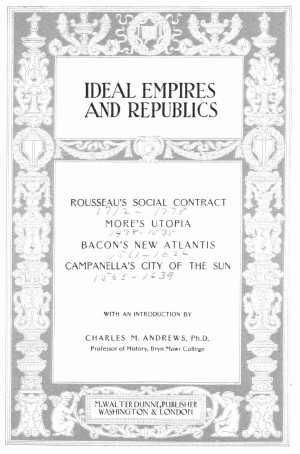
Ideal Empires and Republics. Rousseau’s Social Contract, More’s Utopia, Bacon’s New Atlantis, Campanella’s City of the Sun, with an Introduction by Charles M. Andrews (Washington: M. Walter Dunne, 1901).

About Liberty Fund:

Liberty Fund, Inc. is a private, educational foundation established to encourage the study of the ideal of a society of free and responsible individuals.


CHAPTER I.

That Sovereignty is Inalienable.

The first and most important consequence of the principles above established is that the general will alone can direct the forces of the State according to the object of its institution, which is the common good; for if the opposition of private interests has rendered necessary the establishment of societies, the agreement of these same interests has rendered it possible. That which is common to these different interests forms the social bond; and unless there were some point in which all interests agree, no society could exist. Now, it is solely with regard to this common interest that the society should be governed.

I say, then, that sovereignty, being nothing but the exercise of the general will, can never be alienated, and that the sovereign power, which is only a collective being, can be represented by itself alone; power indeed can be transmitted, but not will.

In fact, if it is not impossible that a particular will should agree on some point with the general will, it is at least impossible that this agreement should be lasting and constant; for the particular will naturally tends to preferences, and the general will to equality. It is still more impossible to have a security for this agreement; even though it should always exist, it would not be a result of art, but of chance. The sovereign may indeed say: “I will now what a certain man wills, or at least what he says that he wills”; but he cannot say: “What that man wills to-morrow, I shall also will,” since it is absurd that the will should bind itself as regards the future, and since it is not incumbent on any will to consent to anything contrary to the welfare of the being that wills. If then, the nation simply promises to obey, it dissolves itself by that act and loses its character as a people; the moment there is a master, there is no longer a sovereign, and forthwith the body politic is destroyed.

This does not imply that the orders of the chiefs cannot pass for decisions of the general will, so long as the sovereign, free to oppose them, refrains from doing so. In such a case the consent of the people should be inferred from the universal silence. This will be explained at greater length.