EconlibThe LibraryOther Sites |
Front Page Titles (by Subject) THE WRITINGS OF JAMES MADISON. - The Writings, vol. 9 (1819-1836)
Return to Title Page for The Writings, vol. 9 (1819-1836)The Online Library of LibertyA project of Liberty Fund, Inc.Search this Title:Also in the Library:
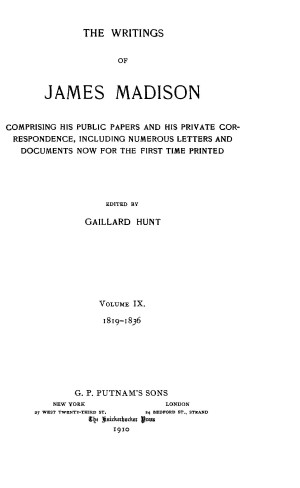
THE WRITINGS OF JAMES MADISON. - James Madison, The Writings, vol. 9 (1819-1836) [1910]Edition used:The Writings of James Madison, comprising his Public Papers and his Private Correspondence, including his numerous letters and documents now for the first time printed, ed. Gaillard Hunt (New York: G.P. Putnam’s Sons, 1900). Vol. 9.
Part of: The Writings of James Madison, 9 vols.About Liberty Fund:Liberty Fund, Inc. is a private, educational foundation established to encourage the study of the ideal of a society of free and responsible individuals. Copyright information:The text is in the public domain. Fair use statement:This material is put online to further the educational goals of Liberty Fund, Inc. Unless otherwise stated in the Copyright Information section above, this material may be used freely for educational and academic purposes. It may not be used in any way for profit.
THE WRITINGS OF JAMES MADISON.TO ROBERT WALSH.mad. mss. Montpellier, Novr 27 1819. Dear Sir,—Your letter of the 11th was duly recd and I should have given it a less tardy answer, but for a succession of particular demands on my attention, and a wish to assist my recollections, by consulting both Manuscript & printed sources of information on the subjects of your enquiry. Of these, however, I have not been able to avail myself but very partially. As to the intention of the framers of the Constitution in the clause relating to “the migration and importation of persons, &c” the best key may perhaps be found in the case which produced it. The African trade in slaves had long been odious to most of the States, and the importation of slaves into them had been prohibited. Particular States however continued the importation, and were extremely averse to any restriction on their power to do so. In the convention the former States were anxious, in framing a new constitution, to insert a provision for an immediate and absolute stop to the trade. The latter were not only averse to any interference on the subject; but solemnly declared that their constituents would never accede to a Constitution containing such an article. Out of this conflict grew the middle measure providing that Congress should not interfere until the year 1808; with an implication, that after that date, they might prohibit the importation of slaves into the States then existing, & previous thereto, into the States not then existing. Such was the tone of opposition in the States of S. Carolina & Georgia, & such the desire to gain their acquiescence in a prohibitory power, that on a question between the epochs of 1800 & 1808, the States of N. Hampshire, Masstts & Connecticut, (all the eastern States in the Convention,) joined in the vote for the latter, influenced however by the collateral motive of reconciling those particular States to the power over commerce & navigation; against which they felt, as did some other States, a very strong repugnance. The earnestness of S. Carolina & Georgia was farther manifested by their insisting on the security in the V article, against any amendment to the Constitution affecting the right reserved to them, & their uniting with the small states, who insisted on a like security for their equality in the Senate. But some of the States were not only anxious for a Constitutional provision against the introduction of slaves. They had scruples against admitting the term “slaves” into the Instrument. Hence the descriptive phrase, “migration or importation of persons;” the term migration allowing those who were scrupulous of acknowledging expressly a property in human beings, to view imported persons as a species of emigrants, while others might apply the term to foreign malefactors sent or coming into the country. It is possible tho’ not recollected, that some might have had an eye to the case of freed blacks, as well as malefactors.1 But whatever may have been intended by the term “migration” or the term “persons,” it is most certain, that they referred exclusively to a migration or importation from other countries into the U. States; and not to a removal, voluntary or involuntary, of slaves or freemen, from one to another part of the U. States. Nothing appears or is recollected that warrants this latter intention. Nothing in the proceedings of the State conventions indicates such a construction there.2 Had such been the construction it is easy to imagine the figure it would have made in many of the states, among the objections to the constitution, and among the numerous amendments to it proposed by the State conventions1 not one of which amendments refers to the clause in question. Neither is there any indication that Congress have heretofore considered themselves as deriving from this Clause a power over the migration or removal of individuals, whether freemen or slaves, from one State to another, whether new or old: For it must be kept in view that if the power was given at all, it has been in force eleven years over all the States existing in 1808, and at all times over the States not then existing. Every indication is against such a construction by Congress of their constitutional powers. Their alacrity in exercising their powers relating to slaves, is a proof that they did not claim what they did not exercise. They punctually and unanimously put in force the power accruing in 1808 against the further importation of slaves from abroad. They had previously directed their power over American vessels on the high seas, against the African trade. They lost no time in applying the prohibitory power to Louisiana, which having maritime ports, might be an inlet for slaves from abroad. But they forebore to extend the prohibition to the introduction of slaves from other parts of the Union. They had even prohibited the importation of slaves into the Mississippi Territory from without the limits of the U. S. in the year 1798, without extending the prohibition to the introduction of slaves from within those limits; altho’ at the time the ports of Georgia and S. Carolina were open for the importation of slaves from abroad, and increasing the mass of slavery within the U. States. If these views of the subject be just, a power in Congress to controul the interior migration or removals of persons, must be derived from some other source than Sect 9, Art. 1; either from the clause giving power “to make all needful rules and regulations respecting the Territory or other property belonging to the U. S. or from that providing for the admission of New States into the Union.” The terms in which the 1st of these powers is expressed, tho’ of a ductile character, cannot well be extended beyond a power over the Territory as property, & a power to make the provisions really needful or necessary for the Govt of settlers until ripe for admission as States into the Union. It may be inferred that Congress did not regard the interdict of slavery among the needful regulations contemplated by the constitution; since in none of the Territorial Governments created by them, is such an interdict found. The power, however be its import what it may, is obviously limited to a Territory whilst remaining in that character as distinct from that of a State. As to the power of admitting new States into the federal compact, the questions offering themselves are; whether congress can attach conditions, or the new States concur in conditions, which after admission, would abridge or enlarge the constitutional rights of legislation common to the other States; whether Congress can by a compact with a new member take power either to or from itself, or place the new member above or below the equal rank & rights possessed by the others; whether all such stipulations, expressed or implied would not be nullities, and so pronounced when brought to a practical test. It falls within the Scope of your enquiry, to state the fact, that there was a proposition in the convention to discriminate between the old and new States, by an Article in the Constitution declaring that the aggregate number of representatives from the States thereafter to be admitted should never exceed that of the States originally adopting the Constitution. The proposition happily was rejected. The effect of such a discrimination, is sufficiently evident. In the case of Louisiana, there is a circumstance which may deserve notice. In the Treaty ceding it, a privilege was retained by the ceding party, which distinguishes between its ports & others of the U. S. for a special purpose & a short period.1 This privilege however was the result not of an ordinary legislative power in Congress; nor was it the result of an arrangement between Congress & the people of Louisiana. It rests on the ground that the same entire power, even in the nation, over that territory, as over the original territory of the U. S. never existed; the privilege alluded to being in the deed of cession carved by the foreign owner, out of the title conveyed to the purchaser. A sort of necessity therefore was thought to belong to so peculiar & extraordinary a case. Notwithstanding this plea it is presumable that if the privilege had materially affected the rights of other ports, or had been of a permanent or durable character, the occurrence would not have been so little regarded. Congress would not be allowed to effect through the medium of a Treaty, obnoxious discriminations between new and old States, more than among the latter. With respect to what has taken place in the N. W. Territory, it may be observed, that the ordinance giving its distinctive character on the Subject of Slaveholding proceeded from the old Congress, acting, with the best intentions, but under a charter which contains no shadow of the authority exercised. And it remains to be decided how far the States formed within that Territory & admitted into the Union, are on a different footing from its other members, as to their legislative sovereignty. For the grounds on which ⅗ of the slaves were admitted into the ratio of representation, I will with your permission, save trouble by referring to No. 54 of the Federalist. In addition, it may be stated that this feature in the Constitution was combined with that relating to the power over Commerce & navigation. In truth these two powers, with those relating to the importation of slaves, & the Articles establishing the equality of representation in the Senate & the rule of taxation, had a complicated influence on each other which alone would have justified the remark, that the Constitution was “the result of mutual deference & Concession.” It was evident that the large States holding slaves, and those not large which felt themselves so by anticipation, would not have concurred in a constitution, allowing them no more Representation in one legislative branch than the smallest States, and in the other less than their proportional contributions to the Common Treasury. The considerations which led to this mixed ratio which had been very deliberately agreed on in Apl., 1783, by the old Congress, make it probable that the Convention could not have looked to a departure from it, in any instance where slaves made a part of the local population. Whether the Convention could have looked to the existence of slavery at all in the new States is a point on which I can add little to what has been already stated. The great object of the Convention seemed to be to prohibit the increase by the importation of slaves. A power to emancipate slaves was disclaimed; Nor is anything recollected that denoted a view to controul the distribution of those within the Country. The case of the N. Western Territory was probably superseded by the provision agst. the importation of slaves by S. Carolina & Georgia, which had not then passed laws prohibiting it. When the existence of slavery in that territory was precluded, the importation of slaves was rapidly going on, and the only mode of checking it was by narrowing the space open to them. It is not an unfair inference that the expedient would not have been undertaken, if the power afterward given to terminate the importation everywhere, had existed or been even anticipated. It has appeared that the present Congress never followed the example during the twenty years preceding the prohibitory epoch. The expediency of exercising a supposed power in Congress, to prevent a diffusion of the slaves actually in the Country, as far as the local authorities may admit them, resolves itself into the probable effects of such a diffusion on the interests of the slaves and of the Nation. Will it or will it not better the condition of the slaves, by lessening the number belonging to individual masters, and intermixing both with greater masses of free people? Will partial manumissions be more or less likely to take place, and a general emancipation be accelerated or retarded? Will the moral & physical condition of slaves, in the mean time, be improved or deteriorated? What do experiences and appearances decide as to the comparative rates of generative increase, in their present, and, in a dispersed situation? Will the aggregate strength security tranquillity and harmony of the whole nation be advanced or impaired by lessening the proportion of slaves to the free people in particular sections of it? How far an occlusion of the space now vacant, agst. the introduction of slaves may be essential to prevent compleatly a smuggled importation of them from abroad, ought to influence the question of expediency, must be decided by a reasonable estimate of the degree in which the importation would take place in spight of the spirit of the times, the increasing co-operation of foreign powers agst the slave trade, the increasing rigor of the Acts of Congress and the vigilant enforcement of them by the Executive; and by a fair comparison of this estimate with the considerations opposed to such an occlusion. Will a multiplication of States holding slaves, multiply advocates of the importation of foreign slaves, so as to endanger the continuance of the prohibitory Acts of Congress? To such an apprehension seem to be opposed the facts, that the States holding fewest slaves are those which most readily abolished slavery altogether; that of the 13 primitive States, Eleven had prohibited the importation before the power was given to Congs, that all of them, with the newly added States, unanimously concurred in exerting that power; that most of the present slaveholding States cannot be tempted by motives of interest to favor the reopening of the ports to foreign slaves; and that these, with the States which have even abolished slavery within themselves, could never be outnumbered in the National Councils by new States wishing for slaves, and not satisfied with the supply attainable within the U. S. On the whole, the Missouri question, as a constitutional one, amounts to the question whether the condition proposed to be annexed to the admission of Missouri would or would not be void in itself, or become void the moment the territory should enter as a State within the pale of the Constitution. And as a question of expediency & humanity, it depends essentially on the probable influence of such restrictions on the quantity & duration of slavery, and on the general condition of slaves in the U. S. The question raised with regard to the tenor of the stipulation in the Louisiana Treaty, on the subject of its admission, is one which I have not examined, and on which I could probably throw no light if I had. Under one aspect of the general subject, I cannot avoid saying, that apart from its merits under others, the tendency of what has passed and is passing, fills me with no slight anxiety. Parties under some denominations or other must always be expected in a Govt as free as ours. When the individuals belonging to them are intermingled in every part of the whole Country, they strengthen the Union of the Whole, while they divide every part. Should a State of parties arise, founded on geographical boundaries and other Physical & permanent distinctions which happen to coincide with them, what is to controul those great repulsive Masses from awful shocks agst each other? The delay in answering your letter made me fear you might doubt my readiness to comply with its requests. I now fear you will think I have done more than these justified. I have been the less reserved because you are so ready to conform to my inclination formerly expressed, not to be drawn from my sequestered position into public view. Since I thanked you for the copy of your late volume1 I have had the pleasure of going thro’ it; and I should have been much disappointed, if it had been recd. by the public with less favor than is everywhere manifested. According to all accounts from the Continent of Europe, the American character has suffered much there by libels conveyed by British Prints, or circulated by itinerant Calumniators. It is to be hoped the truths in your book may find their way thither. Good translations of the Preface alone could not but open many eyes which have been blinded by prejudices against this Country. TO THOMAS HERTELL.mad. mss. Decr 20, 1819. Dear Sir,—I have been some time a debtor for your favor of Novr 11th accompanied by a Copy of your Exposè.2 It reached me at a time when my attention had some particular calls on it; and I was so unlucky as to lose by an accident, the answer which I had prepared for a late mail. I now repeat the thanks it contained for your communication. I have read with pleasure the interesting lights in which you have placed a subject, which had passed thro’ so many able hands. The task of abolishing altogether the use of intoxicating, & even exhilarating drinks, is an arduous one. If it should not succeed in the extent at which you aim, your mode of presenting the causes and effects of the prevailing intemperance, with the obligation & operation of an improved police & of corrective examples, cannot fail to recompense your efforts tho’ it should not satisfy your philanthropy & patriotism. A compleat suppression of every species of stimulating indulgence, if attainable at all, must be a work of peculiar difficulty, since it has to encounter not only the force of habit, but propensities in human nature. In every age & nation, some exhilarating or exciting substance seems to have been sought for, as a relief from the languor of idleness, or the fatigues of labor. In the rudest state of Society, whether in hot or cold climates, a passion for ardent spirits is in a manner universal. In the progress of refinement, beverages less intoxicating, but still of an exhilarating quality, have been more or less common. And where all these sources of excitement have been unknown or been totally prohibited by a religious faith, substitutes have been found in opium, in the nut of the betel, the root of the Ginseng, or the leaf of the Tobo. plant. It wd doubtless be a great point gained for our Country, and a great advantage towards the object of your publication, if ardent spirits could be made only to give way to malt liquors, to those afforded by the apple & pear, and the lighter & cheaper varieties of wine. It is remarkable that in the Countries where the grape supplies the common beverage, habits of intoxication are rare; and in some places almost without example. These observations, as you may well suppose are not made for notice in a new edition of your work, of which they are certainly not worthy, even if they should not too much vary from your own view of the subject. They are meant merely as an expression to yourself of that respect for the laudable object of the Exposè, and for its author, of which sincere assurances are tendered. TO CLARKSON CROLIUS.mad. mss. Montpellier, Decr, 1819. I have received Sir the copy of the Address of the Society of Tammany, with which I have been politely favored.1 The want of economy in the use of imported articles enters very justly into the explanation given of the causes of the present general embarrassments. Were every one to live within his income, or even the savings of the prudent to exceed the deficits of the extravagant, the balance in the foreign commerce of the nation, could not be against it. The want of a due economy has produced the unfavorable turn which has been experienced. Hence the need of specie to meet it, the call on the vaults of the Banks, and the discontinuance of their discounts, followed by their curtailments: Hence too the failure of so many Banks, with a diminished confidence in others: And hence finally a superabundance of debts, without the means of paying them. The Address seems very justly also to charge much of the general evil by which many of the Banks themselves have been overwhelmed, on the multiplicity of these Institutions, and a diffusion of the indiscriminate loans, of which they have been the sources. It has been made a question whether Banks, when restricted to spheres in which temporary loans only are made to persons in active business promising quick returns, do not as much harm to imprudent as good to prudent borrowers. But it can no longer be a doubt with any, that loan offices, carrying to every man’s door, and even courting his acceptance of, the monied means of gratifying his present wishes under a prospect or hope of procrastinated repayments, must, of all devices, be the one most fatal to a general frugality, and the benefits resulting from it. The effect of domestic manufactures in diminishing imports, and as far as they are carried on by hands attracted from abroad, or by hands otherwise idle or less productively employed at home, without a proportional diminution of the exports, merits certainly a distinguished attention in marking out an internal system of political Economy, and in counteracting a tendency in our foreign Commerce to leave a balance against us. The relief from this source would be more effectual, but for the circumstance that the articles which contribute much to an excess of our imports over our exports, are articles, some not likely soon, others perhaps not at all to be produced within ourselves. There is moreover a feature in the trade between this Country and most others, which promotes not a little an unfavorable result. Our Exports being chiefly articles for food, for manufactures, or for a consumption easily surcharged, the amount of them called for, never exceeds what may be deemed real and definite wants. This is not the case with our imports. Many of them, some the most costly, are objects neither of necessity, nor utility; but merely of fancy & fashion, wants of a nature altogether indefinite. This relative condition of the trading parties, altho’ it may give to the one furnishing the necessary & profitable articles, a powerful advantage over the one making its returns in superfluities, on extraordinary occasions of an interrupted intercourse; yet, in the ordinary and free course of commerce, the advantage lies on the other side; and it will be the greater in proportion to the lengthened credits on which the articles gratifying extravagant propensities are supplied. Such an inequality must in a certain degree controul itself. It wd be compleatly redressed by a change in the public preferences & habits, such as is inculcated in the address. In not regarding domestic manufactures as of themselves, an adequate cure for all our embarrassments, it is by no means intended to detract from their just importance, or from the policy of legislative protection for them. However true it may be in general that the industrious pursuits of individuals, ought to be regulated by their own sagacity & interest, there are practical exceptions to the Theory, which sufficiently speak for themselves. The Theory itself indeed requires a similarity of circumstances, and an equal freedom of interchange among commercial nations, which have never existed. All are agreed also that there are certain articles so indispensable that no provident nation would depend for a supply of them on any other nation. But besides these, there may be many valuable branches of manufactures which if once established, would support themselves, and even add to the list of exported commodities; but which without public patronage would either not be undertaken or come to a premature downfall. The difficulty of introducing manufactures, especially of a complicated character & costly outfit, and above all, in a market preoccupied by powerful rivals, must readily be conceived. They appear accordingly to have required, for their introduction into the Countries where they are now seen in their greatest extent & prosperity, either the liberal support of the Government, or the aid of exiled or emigrant manufacturers, or both of these advantages. In determining the degree of encouragement which can be afforded to domestic manufactures, it is evident that, among other considerations, a fair comparison ought to be made of what might be saved by supplies at home during foreign wars, to say nothing of our own, with the expence of supporting manufactures in times of peace against foreign competitions in our market. The price of domestic fabrics, tho’ dearer than foreign, in times of peace, might be so much cheaper in times of war, as to be cheaper also than the medium price of the foreign taking the two periods together. Yet the Amn. manufacturer if unprotected during the periods of peace wd necessarily be undermined by the foreign; and he could not be expected to resume his undertaking at the return of war, knowing the uncertainty of its continuance; and foreseeing his certain ruin at the end of it. Estimates on these points cannot be made with much precision, but they ought not on that acct. to be overlooked; and in making them a strong leaning ought to be indulged towards the policy of securing to the nation independent resources within itself. If I have extended these remarks beyond the proper limits I must find my apology in the nature of the subject; & in the tenor of your letter, for Which I pray you to accept my acknowledgts., with my respects & good wishes. TO NOAH WEBSTER.mad. mss. Montpellier (near Orange Court House Virga) Jany —, 1820. Dear Sir,—In looking over my papers in order to purge and finally arrange my files, my attention fell on your letter of Aug. 20, 1804, in which I was requested to give such information as I could as to the origin of the change in the Federal Government which took place in 1788. My answer does not appear, the copy of it having been lost, if one was retained as is probable. Will you be so obliging as to enable me to replace it, and to pardon the trouble I am imposing on you; accepting at the same time assurances of my esteem, and of my friendly respects. Where can your pamphlet entitled “Sketches of Amn policy” be now obtained; also that of Mr. Peletiah Webster referred to in your letter.1 TO JAMES MONROE.mad. mss. Montplr., Feby 10, 1820. Dear Sir,—I have duly recd. your favr. of the 5th, followed by a copy of the public documents, for which I give you many thanks. I shd. like to get a copy of the Journals of the Convention.1 Are they to be purchased & where? It appears to me as it does to you, that a coupling of Missouri with Maine, in order to force the entrance of the former thro’ the door voluntarily opened to the latter is, to say the least, a very doubtful policy. Those who regard the claims of both as similar & equal, and distrust the views of such as wish to disjoin them may be strongly tempted to resort to the expedient; and it wd perhaps, be too much to say that in no possible case such a resort cd be justified. But it may at least be said that a very peculiar case only could supersede the general policy of a direct & magnanimous course, appealing to the justice & liberality of others, and trusting to the influence of conciliatory example. I find the idea is fast spreading that the zeal wth. which the extension, so called, of slavery is opposed, has, with the coalesced leaders, an object very different from the welfare of the slaves, or the check to their increase; and that their real object is, as you intimate, to form a new state of parties founded on local instead of political distinctions; thereby dividing the Republicans of the North from those of the South, and making the former instrumental in giving to the opponents of both an ascendancy over the whole. If this be the view of the subject at Washington it furnishes an additional reason for a conciliatory proceeding in relation to Maine. I have been truly astonished at some of the doctrines and deliberations to which the Missouri question has led; and particularly so at the interpretations put on the terms “migration or importation &c.” Judging from my own impressions I shd. deem it impossible that the memory of any one who was a member of the Genl. Convention, could favor an opinion that the terms did not exclusively refer to Migration & importation into the U. S. Had they been understood in that Body in the sense now put on them, it is easy to conceive the alienation they would have there created in certain States; And no one can decide better than yourself the effect they would have had in the State Conventions, if such a meaning had been avowed by the Advocates of the Constitution. If a suspicion had existed of such a construction, it wd at least have made a conspicuous figure among the amendments proposed to the Instrument. I have observed as yet, in none of the views taken of the Ordinance of 1787, interdicting slavery N. W. of the Ohio, an allusion to the circumstance, that when it passed, the Congs. had no authority to prohibit the importaton of slaves from abroad; that all the States had, & some were in the full exercise of the right to import them; and, consequently, that there was no mode in which Congs. could check the evil, but the indirect one of narrowing the space open for the reception of slaves. Had a federal authority then existed to prohibit directly & totally the importation from abroad, can it be doubted that it wd have been exerted? and that a regulation having merely the effect of preventing an interior dispersion of the slaves actually in the U. S. & creating a distinction among the States in the degrees of their sovereignty, would not have been adopted, or perhaps, thought of? No folly in the Spanish Govt can now create surprise. I wish you happily thro’ the thorny circumstances it throws in your way. Adieu &c. TO JAMES MONROE.mad. mss. Montpr, Feby. 23, 1820 Dr Sir,—I recd. yours of the 19th on Monday. Genl. Brown who returned from Monticello that evening has been since with me till 10 O’C today. Your letter found me indisposed from exposure to a cold wind, without due precaution, And I have continued so. I write now with a fever on me. This circumstance will account for both the delay & the brevity in complying with your request. The pinch of the difficulty in the case stated seems to be in the words “forever,” coupled with the interdict relating to the Territory N. of L 36° 30′.1 If the necessary import of these words be that they are to operate as a condition on future States admitted into the Union, and as a restriction on them after admission, they seem to encounter indirectly the argts. which prevailed in the Senate for an unconditional admission of Missouri. I must conclude therefore from the assent of the Senate to the words, after the strong vote on constitutional grounds agst. the restriction on Missouri, that there is some other mode of explaining them in their actual application. As to the right of Congs. to apply such a restriction during the Territorial Periods, it depends on the clause in the Constitution specially providing for the management of these subordinate establishments. On one side it naturally occurs that the right being given from the necessity of the case, and in suspension of the great principle of self Govt. ought not to be extended farther nor continued longer than the occasion might fairly require. On the other side it cannot be denied that the Constl. phrase, “to make all rules” &c as expounded by uniform practice, is somewhat of a ductile nature, and leaves much to Legislative discretion. The questions to be decided seem to be whether a territorial restriction be an assumption of illegitimate power, or 2 a measure of legitimate power. And if the latter only whether the injury threatened to the nation from an acquiescence in the measure, or from a frustration of it, under all the circumstances of the case, be the greater. On the first point there is certainly room for difference of Opinion, tho’ for myself I must own that I have always leaned to the belief that the restriction was not within the true scope of the Constitution. On the alternative presented by the second point there can be no room, with the cool and candid, for blame on those acquiescing in a conciliatory course, the demand for which was deemed urgent, and the course itself deemed not irreconcilable with the Constitution. This is the hasty view of the subject I have taken. I am aware that it may be suspected of being influenced by the habit of a guarded construction of Constl powers; and I have certainly felt all the influence that cd. justly flow from a conviction, that an uncontrouled dispersion of the slaves now in the U. S. was not only best for the nation, but most favorable for the slaves, also both as to their prospects of emancipation, and as to their condition in the mean time. The inflammatory conduct of Mr. King surprises every one. His general warfare agst. the slave-holding States, and his efforts to disparage the securities derived from the Constn were least of all to be looked for. I have noticed less of recurrence to the contemporary expositions of the Charter than was to be expected from the zeal & industry of the Champions in Debate. The proceedings of the Va. Convention have been well sifted; but those of other States ought not to have been Overlooked. The speeches of Mr. King in Massts and Mr. Hamilton in N. York shew the ground on which they vindicated particularly the Compound rule of representation in Congs. And doubtless there are many other evidences of the way of thinking then prevalent on that & other articles equally the result of a sense of equity & a spirit of mutual concession. TO C. D. WILLIAMS.mad. mss. Feby —, 1820 I have received your favor of [January 29] accompanied by the pamphlet on the subject of a circulating medium.1 I have not found it convenient to bestow on the plan proposed the attention necessary to trace the bearings and operations of new arrangements ingeniously combined on a subject which in its most simple forms has produced so much discussion among political Economists. It cannot be doubted that a paper currency rigidly limited in its quantity to purposes absolutely necessary, may be made equal & even superior in value to specie. But experience does not favor a reliance on such experiments. Whenever the paper has not been convertible into specie, and its quantity has depended on the policy of the Govt. a depreciation has been produced by an undue increase, or an apprehension of it. The expedient suggested in the pamphlet has the advantage of tying up the hands of the Govt but besides the possibility of legislative interferences, bursting the fetters, a discretion vested in a few hands over the Currency of the nation, & of course over the legal value of its property, is liable to powerful objections; and tho’ confined to a range of 5 per Ct, wd have still room for a degree of error or abuse not a little formidable. The idea also of making foreign currency depending on a foreign will, and the balance of trade always varying, and at no time reducible to certainty & precision, standards for a natl Currency wd not easily be admitted. I am sensible Sir that these observations must have been included in your examination of the subject, and that they are to be regarded in no other light than as an expression of the respect & acknowledgment, which I pray you to accept for your polite Communication. TO JAMES MONROE.1Montplr, Mar., 1820 Dr. Sir,—My nephew R. L. Madison has turned his thoughts to the new acquisition expected from Spain on our S. Frontier and wishes an official situation there which may be convenient for the time and improve his future prospects for a growing family. The reluctance I feel in speaking on all such occasions is heightened in this by the personal relation which may be supposed to bias me. Leaving the other sources there for the more general information requisite, I will not permit myself to say more than that I consider him as not deficient in talents and that to these have been added a tolerably good education. However agreeable it must of course be to me to see his interests promoted, I can neither expect nor wish it farther than his pretensions may bear the test applied to those of others and those that public considerations will authorize. TO J. Q. ADAMS.mad. mss. Montplr., June 13, 1820 Dr. Sir,—I have recd & return my thanks for your polite favor accompanying the Copy of the printed Journal of the Federal Convention transmitted in pursuance of a late Resolution of Congress. In turning over a few pages of the Journal, which is all I have done a casual glance caught a passage which erroneously prefixed my name to ye proposition made on the 7, day of Sepr. for making a Council of six members a part of the Executive branch of the Govt. The proposition was made by Col. George Mason one of the Virga delegates, & seconded by Dr. Franklin.1 I cannot be mistaken in the fact; For besides my recollection which is sufficiently distinct on the subject, my notes contain the observations of each in support of the proposition. As the original Journal according to my extract from it, does not name the mover of ye propn the error, I presume must have had its source in some of the extrinsic communications to you, unless indeed it was found in some of the separate papers of the Secretary of the Convention, or is to be ascribed to a copying pen. The degree of symphony in the two names Madison & Mason may possibly have contributed to the substitution of the one for the other. This explanation having a reference to others as well as myself, I have thought it wd. be neither improper nor unacceptable. Along with it I renew the assurance of my high esteem and cordial respts.. TO JACOB DE LA MOTTA.mad. mss. Montpellier, Aug., 1820 Sir,—I have received your letter of the 7th inst. with the Discourse delivered at the Consecration of the Hebrew Synagogue at Savannah, for which you will please to accept my thanks. The history of the Jews must forever be interesting. The modern part of it is, at the same time so little generally known, that every ray of light on the subject has its value. Among the features peculiar to the Political system of the U. States, is the perfect equality of rights which it secures to every religious Sect. And it is particularly pleasing to observe in the good citizenship of such as have been most distrusted and oppressed elsewhere, a happy illustration of the safety & success of this experiment of a just & benignant policy. Equal laws protecting equal rights, are found as they ought to be presumed, the best guarantee of loyalty & love of country; as well as best calculated to cherish that mutual respect & good will among Citizens of every religious denomination which are necessary to social harmony and most favorable to the advancement of truth. The account you give of the Jews of your Congregation brings them fully within the scope of these observations. I tender you, Sir, my respects & good wishes TO JAMES MONROE.mad. mss. Montpellier, Nov. 19, 1820 Dr. Sir,—Yesterday’s mail brought me your favor of the 16th, with a copy of your message; the only one which reached me; no newspaper containing it having come to hand. The view you have taken of our public affairs cannot but be well received at home, and increase our importance abroad. The State of our finances is the more gratifying as it so far exceeds the public hopes. I infer from the language of your letter that the contest for the Chair terminated in favor of Mr. Taylor, and that it manifested a continuance of the spirit which connected itself with the Missouri question at the last session.1 This is much to be regretted, as is the clause in the constitution of the new State, which furnishes a text for the angry & unfortunate discussion. There can be no doubt that the clause, if against the Constitution of the U. S., would be a nullity; it being impossible for congress, with, more than without, a concurrence of New or old members of the Union, to vary the political equality of the States, or their constitutional relations to each other or to the whole. But it must, to say the least, be an awkward precedent, to sanction the Constitution of the New State containing a clause at variance with that of the U. S. even with a declaration that the clause was a nullity, and the awkwardness might become a very serious perplexity if the admission of the New State into the Union, and of its Senators & Representatives into Congress, & their participation in the acts of the latter, should be followed by a determination of Missouri to remain as it is rather than accede to an annulment of the obnoxious clause. Would it not be a better course to suspend the Admission until the people of Missouri could amend their constitution; provided their so doing would put an end to the controversy and produce a quiet admission at the ensuing session. Or if the objections to this course be insuperable; may it not deserve consideration, whether the terms of the clause, would not be satisfied by referring the authority it gives, to the case of free people of colour not Citizens of other States. Not having the Constitution of Missouri at hand, I can form no opinion on this point. But a right in the States to inhibit the entrance of that description of coloured people, it may be presumed, would be as little disrelished by the States having no slaves, as by the States retaining them. There is room also for a more critical examination of the Constitutional meaning of the term “Citizens” than has yet taken place; and of the effect of the various civil disqualifications applied by the laws of the States to free people of colour. I do not recollect that Mr. Correa had any direct or explicit conversation with me on the subject between him & the Govt.. It is possible that my view of it might have been inferred from incidental observations; but I have no recollections leading me to the supposition; unless an inference was made from a question touched on concerning the precise criterion between a Civilized and uncivilized people, which had no connection, in my mind with his diplomatic transactions. What may have passed with Mr. Jefferson I know not. I find that Mr. Tench Coxe is desirous of some profitable mark of the confidence of the Govt. for which he supposes some opportunities are approaching; and with that view, that you should be reminded of his public career.1 I know not what precise object he has in his thoughts, nor how far he may be right in anticipating an opening for its attainment; and I am aware both of your own knowledge of his public services, and of your good dispositions towards him. I feel an obligation, nevertheless, to testify in his behalf, that from a very long acquaintance with him, and continued opportunities of remarking his political course, I have ever considered him among the most strenuous & faithful laborers for the good of his Country. At a very early period he was an able defender of its commercial rights & interest. He was one of the members of the convention at Annapolis. His pen was indefatigable in demonstrating the necessity of a new form of Govt. for the nation; & he has steadfastly adhered, in spite of many warping considerations, to the true principles and policy on which it ought to be administered. He has also much merit in the active & efficient part he had in giving impulse to the Cotton cultivation, & other internal interests; and I have reason to believe that his mind & his pen continue to be occupied with subjects closely connected with the public welfare. With these impressions of the services he has rendered, I cannot but own, that any provision that could be proper in itself, & contribute to make his advanced age more comfortable than it otherwise might be, would afford me real pleasure. Of its practicability I do not presume to judge. In looking over the bundle of my letters to Mr. Jones I find one dated in Decr., 1780, containing a statement of what passed in the old Congress relative to the proposed cession of the Missĩppi to Spain, corresponding precisely with my recollection of it as explained to you1 I was disappointed in finding it limited to that year. My correspondence ran through a much longer period of which I have proofs on hand, and from the tenor of the above letters, & my intimacy with him, I have no doubt that my communications were often of an interesting character. Perhaps the remaining letters or a part of them may have escaped your search. Will you be so good as to renew it whenever & wherever the convenient opportunity may admit? What is become of the Secret journals of the old Congress, & when will the press give them to the public? A fever of the Typhus denomination, which has for some months been rambling in this district of Country, has lately found its way to this spot. Out of 14 patients within my precincts 5 have died, 2 only have perfectly recovered, & among the rest the major number are very ill. New Cases also are almost daily occurring. I have sustained a heavy loss in a young fellow who was educated in Washington a cook, & was becoming moreover a competent Gardener. I am suffering also much from the protracted illness of the man charged with my farming business, which exposes the several crops not yet secured to great neglect & waste. We have heard nothing particularly of Mrs. Monroe’s health, which we hope has been fully restored. We have the same hope as to Mr. Gouverneur, who Mr. Hay informed me was dangerously ill. With our best wishes for you all, be assured of my affectionate respects. TO MARQUIS DE LA FAYETTE.mad. mss. Montpellier, Novr 25, 1820 I have received, my dear friend, your kind letter of July 22, inclosing your printed opinion on the Election project. It was very slow in reaching me. I am very glad to find, by your letter, that you retain, undiminished the warm feelings of friendship so long reciprocal between us; and, by your “opinion,” that you are equally constant to the cause of liberty so dear to us both. I hope your struggles in it will finally prevail in the full extent required by the wishes, and adapted to the exigencies of your Country. We feel here all the pleasure you express at the progress of reformation on your Continent. Despotism can only exist in darkness, and there are too many lights now in the political firmament, to permit it to reign any where, as it has heretofore done, almost every where. To the events in Spain & Naples has succeeded already, an auspicious epoch in Portugal. Free States seem indeed to be propagated in Europe, as rapidly as new States are on this side of the Atlantic: Nor will it be easy for their births or their growths if safe from dangers within to be strangled by external foes, who are not now sufficiently united among themselves, are controuled by the aspiring sentiments of their people, are without money of their own, and are no longer able to draw on the foreign fund which has hitherto supplied their belligerent necessities. Here, we are, on the whole, doing well, and giving an example of a free system, which I trust will be more of a Pilot to a good Port, than a Beacon warning from a bad one. We have, it is true, occasional fevers, but they are of the transient kind flying off thro’ the surface, without preying on the vitals. A Govt. like ours has so many safety-valves giving vent to overheated passions, that it carries within itself a relief agst. the infirmities from which the best of human Institutions cannot be exempt. The subject which ruffles the surface of public affairs most at present, is furnished by the transmission of the “Territory” of Missouri from a state of nonage to a maturity for self-Govt. and for a membership in the Union. Among the questions involved in it, the one most immediately interesting to humanity is the question whether a toleration or prohibition of slavery Westward of the Mississippi, would most extend its evils. The humane part of the argument against the prohibition, turns on the position, that whilst the importation of slaves from abroad is precluded, a diffusion of those in the Country, tends at once to meliorate their actual condition, and to facilitate their eventual emancipation. Unfortunately, the subject which was settled at the last session of Congress, by a mutual concession of the parties, is reproduced on the Arena, by a clause in the Constitution of Missouri, distinguishing between free persons of Colour, and white persons; and providing that the Legislature of the new State shall exclude from it the former. What will be the issue of the revived discussion is yet to be seen. The case opens the wider field as the Constitutions & laws of the different States are much at variance in the civic character given to free people of colour; those of most of the States, not excepting such as have abolished slavery, imposing various disqualifications which degrade them from the rank & rights of white persons. All these perplexities develope more & more the dreadful fruitfulness of the original sin of the African trade. I will not trouble you with a full Picture of our economics. The cessation of neutral gains, the fiscal derangements incident to our late war, the inundation of foreign merchandizes since, and the spurious remedies attempted by the local authorities, give to it some disagreeable features. And they are made the more so, by a remarkable downfal in the prices of two of our great Staples Breadstuffs & Tobacco, carrying privations to every man’s door, and a severe pressure to such as labour under debts for the discharge of which, they relied on crops & prices which have failed. Time however will prove a sure Physician for these maladies. Adopting the remark of a British Senator applied with less justice to his Country, at the commencement of the revolutionary Contest, we may say, that “altho’ ours may have a sickly countenance, we trust she has a strong Constitution.” I see that the bickerings between our Govts. on the point of tonnage has not yet been terminated. The difficulty, I should flatter myself, cannot but yield to the spirit of amity, & the principles of reciprocity entertained by the parties. You would not, believe me, be more happy to see me at lagrange, than I should be to see you at Montpr. where you wd. find as zealous a farmer, tho’ not so well cultivated a farm as Lagrange presents. As an interview can hardly be expected to take place at both, I may infer from a comparison of our ages a better chance of your crossing the Atlantic than of mine. You have also a greater inducement in the greater number of friends whose gratifications would at least equal your own. But if we are not likely to see one another, we can do what is the next best, communicate by letter what we wd most wish to express in person, and particularly can repeat those sentiments of affection & esteem, which, whether expressed or not, will ever be most sincerely felt by your old & steadfast friend. TO FRANCIS CORBIN.1November 26, 1820 Dr Sir,—I had the pleasure of receiving, a few days ago, your favor post-marked the 18th, in lieu of the greater pleasure with which I should have received you in propria persona. I am sorry you so readily yielded to the consideration which deprived us of it in September. The addition of your company would have been felt no otherwise than as an ingredient highly acceptable to that you would have met here, as well as to Mrs. M. and myself. For a day or two, indeed, you might have been involved in the common distress occasioned by the hopeless and expiring condition of the little son of Mrs. Scott; but even that drawback might not have taken place within the period of your visit. You complain of the times, which are certainly very hard; but you have a great abatement of your comparative suffering in your paper funds, notwithstanding the suspension of their current productiveness. This is but a lucrum cessans. How many are feeling the damnum emergens also! Besides, in the event of a necessary sale of property, (certainly not your case,) the paper property is the only sort that can find a tolerable and certain market. Whilst I condole with you, therefore, on the hardships in which you participate, I must congratulate you on your escape from a portion which afflicts others. The general condition of these is truly lamentable. If debtors to the Banks, nothing can relieve them but a renewal of discounts, not to be looked for: if owing debts, for discharging which they have relied on crops or prices, which have failed, they have no resource but in the sale of property, which none are able to purchase. With respect to all these, the times are hard indeed; the more so, as an early change is so little within the reach of any fair calculation. I do not mean to discuss the question how far slavery and farming are incompatible. Our opinions agree as to the evil, moral, political, and economical, of the former. I still think, notwithstanding, that under all the disadvantages of slave cultivation, much improvement in it is practicable. Proofs are annually taking place within my own sphere of observation; particularly where slaves are held in small numbers, by good masters and managers. As to the very wealthy proprietors, much less is to be said. But after all, (protesting against any inference of a disposition to underrate the evil of slavery,) is it certain that in giving to your wealth a new investment, you would be altogether freed from the cares and vexations incident to the shape it now has? If converted into paper, you already feel some of the contingencies belonging to it; if into commercial stock, look at the wrecks every where giving warning of the danger. If into large landed property, where there are no slaves, will you cultivate it yourself? Then beware of the difficulty of procuring faithful or complying labourers. Will you dispose of it in leases? Ask those who have made the experiment what sort of tenants are to be found where an ownership of the soil is so attainable. It has been said that America is a country for the poor, not for the rich. There would be more correctness in saying it is the country for both, where the latter have a relish for free government; but, proportionally, more for the former than for the latter. Having no experience on the subject myself, I cannot judge of the numerical point at which congratulations on additional births cease to be appropriate. I hope that your 7th son will in due time prove that in his case, at least, they were amply called for; and that Mrs. C. and yourself may long enjoy the event as an addition to your happiness. Mrs. M. unites with me in this, and in every assurance of respect and good wishes to you both. TO JAMES MONROE.mad. mss. Montpellier, Decr. 28, 1820. Dear Sir,—I have received your two favors of the 10th & 23d inst. The prospect of a favorable issue to the difficulties with Spain, is very agreeable. I hope the ratification will arrive without Clogs on it; and that the acquisition of Florida will give no new stimulus to the Spirit excited by the case of Missouri. I am glad to learn that a termination of this case, also is not despaired of. If the new State is to be admitted with a proviso, none better occurs than a declaration that its admission is not to imply an opinion in Congress that its Constitution will be less subject to be tested & controuled by the Constitution of the U. S. than if formed after its admission, or than the Constitutions of other States now members of the Union. It is a happy circumstance that the discussions renewed by the offensive clause introduced by Missouri, are marked by such mitigated feelings in Congress. It argues well as to the ultimate effect which you anticipate. The spirit and manner of conducting the opposition to the new State, with the palpable efforts to kindle lasting animosity between Geographical divisions of the nation will have a natural tendency, when the feverish crisis shall have passed, to reunite those who never differed as to the essential principles and the true policy of the Govt.. This salutary reaction will be accelerated by candor & conciliation on one side appealing to like dispositions on the other; & it would be still farther promoted by a liberality with regard to all depending measures, on which local interests may seem to be somewhat at variance, and may perhaps be so for a time. Your dispositions towards Mr. T. Coxe are such as I had counted on. I shall regret, if it so happen, that nothing can properly be done for him. I feel a sincere interest in behalf of Doct Eustis.1 The expedient at which you glance would I suppose be in itself an appropriate provision; but I am sensible of the delicacy of the considerations which I perceive weigh with you. I wish he could have been made the Govr. of his State. It would have closed his public career with the most apt felicity. Is not the law vacating periodically the described offices an encroachment on the Constitutional attributes of the Executive?1 The creation of the office is a legislative act, the appointment of the officer, the joint act of the President & Senate; the tenure of the Office, (the judiciary excepted,) is the pleasure of the P. alone; so decided at the commencement of the Govt. so acted on since, and so expressed in the commission. After the appointment has been made neither the Senate nor H. of Reps have any power relating to it; unless in the event of an impeachment by the latter, and a judicial decision by the former; or unless in the exercise of a legislative power by both, abolishing the office itself, by which the officer indirectly looses his place; and even in this case, if the office were abolished merely to get rid of the tenant, and with a view, by its reestablishment, to let in a new one, on whom the Senate would have a negative, it would be a virtual infringement of the constitutional distribution of the powers of Government. If a law can displace an officer at every period of 4 years, it can do so at the end of every year, or at every session of the Senate, and the tenure will then be the pleasure of the Senate, as much as of the President, & not of the P. alone. Other very interesting views might be taken of the subject. I never read if I ever saw the debates on the passage of the law. Nor have I looked for precedents which may have countenanced it. I suspect that these are confined to the Territories, that they had their origin in the ordinance of the old Congress in whom all powers of Govt. were confounded; and that they were followed by the New Congs. who have exercised a very undefined and irregular authority within the Territorial limits; the Judges themselves being commissioned from time to time, and not during good behaviour, or the continuance of their offices. TO RICHARD RUSH.mad. mss. Apl. 21, 1821. Dear Sir,—Your favor of Novr. 15, came duly to hand, with Mr. Ridgeley’s farming Pamphlet; for which I return my thanks. The inflexibility of G. B. on the points in question with the U. S. is a bad omen for the future relations of the parties. The present commercial dispute, tho’ productive of ill humor will shed no blood. The same cannot be said of Impressments & blockades. I have lately recd also Mr. Godwin’s attack on Malthus, which you were so good as to forward. The work derives some interest from the name of the Author and the singular views he has taken of the subject. But it excites a more serious attention by its tendency to disparage abroad the prospective importance of the U. S. who must owe their rapid growth to the principle combated.1 In this Country the fallacies of the Author will be smiled at only unless other emotions should be excited by the frequent disregard of the probable meaning of his opponent, and by the harshness of comments on the moral scope of his doctrine. Mr. G. charges him also with being dogmatical. Is he less so himself? and is not Mr. G. one of the last men who ought to throw stones at Theorists? At the moment of doing it too he introduces one of the boldest speculations in anticipating from the progress of chemistry an artificial conversion of the air the water & earth into food for man of the natural flavour and colour. My memory does not retain all the features of Mr. Malthus’s System. He may have been unguarded in his expressions, & have pushed some of his notions too far. He is certainly vulnerable in assigning for the increase of human food, an arithmetical ratio. In a Country thoroughly cultivated, as China is said to be, there can be no increase. And in one as partially cultivated, and as fertile as the U. S. the increase may exceed the geometrical ratio. A surplus beyond it, for which a foreign demand has failed, is a primary cause of the present embarrassments of this Country. The two cardinal points on which the two Authors are at issue, are 1. the prolific principle in the human race. 2. its actual operation, particularly in the U. S. Mr. G. combats the extent of both. If the principle could not be proved by direct facts, its capacity is so analogous to what is seen throughout other parts of the animal as well as vegetable domain, that it would be a fair inference. It is true indeed that in the case of vegetables on which animals feed, and of animals the food of other animals, a more extensive capacity of increase might be requisite than in the Human race. But in this case also it is required, over and above the degree sufficient to repair the ordinary wastes of life, by two considerations peculiar to man: one that his reason can add to the natural means of subsistence for an increased number, which the instinct of other animals cannot; the other, that he is the only animal that destroys his own species. Waiving however the sanction of analogy, let the principle be tested by facts, either stated by Mr. G. or which he cannot controvert. He admits that Sweden has doubled her numbers, in the last hundred years, without the aid of emigrants. Here then there must have been a prolific capacity equal to an increase in ten centuries from 2 millions to 1000 mills.. If Sweden were as populous ten Centuries ago as now, or should not in ten Centuries to come arrive at a thousand millions, must not 998 mills. of births have been prevented; or that number of infants have perished? And from what causes? The two late enumerations, in England which shew a rate of increase there much greater than in Sweden are rejected by Mr. G. as erroneous. They probably are so; tho’ not in the degree necessary for his purpose. He denies that the population increases at all. He even appeals with confidence to a comparison of what it has been with what it is at present as proving a decrease. There being no positive evidence of the former numbers and none admitted by him of the Present, resort must be had to circumstantial lights; and these will decide the question with sufficient certainty. As a general rule it is obvious that the quantity of food produced in a country determines the actual extent of its population. The number of people cannot exceed the quantity of food, and this will not be produced beyond the consumption. There are exceptions to the rule; as in the case of the U. S. which export food, and of the W. Indies which import it. Both these exceptions however favor the supposition that there has been an increase of the English population: England adding latterly imported food to its domestic stock, which at one period it diminished by exportation. The question to be decided is whether the quantity of food produced the true measure of the population consuming it, be greater or less now than heretofore. In the savage state where wild animals are the chief food, the population must be the thinnest. Where reared ones are the chief food, as among the Tartars, in a pastoral State, the number may be much increased. In proportion as grain is substituted for animal food a far greater increase may take place. And as cultivated vegetables, & particularly roots, enter into consumption, the mass of subsistence being augmented, a greater number of consumers, is necessarily implied. Now, it will not be pretended, that there is at present in England more of forest, and less of Cultivated ground than in the feudal or even much later periods. On the contrary it seems to be well understood that the opened lands have been both enlarged & fertilized; that bread has been substituted for flesh; and that vegetables, particularly roots have been more & more substituted for both. It follows that the aggregate food raised & consumed now, being greater than formerly, the number who consume it, is greater also. The Report to the Board of Agriculture quoted by Mr. G. coincides with this inference. The Animal food of an individual which is the smaller part of it, requires, according to this authority, 2 acres of ground; all the other articles 1¾ of an acre only. The report states that a horse requires four acres. It is probable that an ox requires more, being fed less on grain & more on Grass. It may be said that Horses which are not eaten are now used instead of oxen which were. But the horse as noted is supported by fewer acres than the ox; and the oxen superseded by the horses, form but a small part of the eatable Stock to which they belong. The inference therefore can at most be but slightly qualified by this innovation. The single case of Ireland ought to have warned Mr. G. of the error he was maintaining. It Seems to be agreed that the population there has greatly increased of late years; altho’ it receives very few if any emigrants; and has sent out numbers, very great numbers, as Mr. G. must suppose, to the U. S. In denying the increase of the Amn. population, from its own stock, he is driven to the most incredible suppositions, to a rejection of the best established facts, and to the most preposterous estimates & calculations. He ascribes the rapid increase attested by our periodical lists, wholly to emigrations from Europe; which obliged him to suppose that from 1790, to 1810 150 thousand persons were annually transported; an extravagance which is made worse by his mode of reducing the no. necessary to one half; and he catches at little notices of remarkable numbers landed at particular ports, in particular seasons; as if these could be regarded as proofs of the average arrivals for a long series of years, many of them unfavorable for such transmigrations. In the year 1817, in which the emigrants were most numerous, according to Seybert, they did not in the ten Principal ports where with few if any exceptions they are introduced, exceed 22,240; little more than of the average annually assumed. Were it even admitted that our population is the result altogether of emigrations from Europe, what wd. Mr. G. gain by it? The Census for 1820 is not yet compleated. There is no reason however, to doubt that it will swell our numbers to about ten millions. In 1790 the population was not quite four millions. Here then has been an increase of six millions. Of these six five millions will have been drawn from the population of G. B. & Ireland. Have the numbers there been reduced accordingly? Then they must have been 30 years ago, greater by 5 millions than at this time. Has the loss been replaced? Then, as it has not been by emigrants, it must have been by an effect of the great principle in question. Mr. G. may take his choice of the alternatives. It is worth remarking that N. England which has sent out such continued swarms to other parts of the Union for a number of years, has continued at the same time, as the Census shews to increase in population, altho’ it is well known that it has recd. comparatively very few emigrants from any quarter; these preferring places less inhabited for the same reason that determines the course of migrations from N. England. The appeal to the case of the black population in the U. S. was particularly unfortunate for the reasoning of Mr. G. to which it gives the most striking falsification. Between the years 1790 & 1810 the number of slaves increased from 694,280 to 1,165,441. This increase at a rate nearly equal to that of the Whites, surely was not produced by emigrants from Africa. Nor could any part of it have been imported, (except 30 or 40,0001 into S. Carolina & Georgia,) the prohibition being every where strictly enforced throughout that period. Louisiana indeed brought an addition amounting in 1810 to 37,671. This no. however (to be reduced by the slaves carried thither from other States prior to 1810) may be regarded as overbalanced by emancipated blacks & their subsequent offspring. The whole number of this description in the Census of 1810, amounts to 186,446. The evidence of a natural and rapid increase of the Blacks in the State of Virginia is alone conclusive on the subject. Since the Epoch of Independence the importation of slaves has been uniformly prohibited, and the spirit of the people concurring with the policy of the law, it has been carried fully into execution. Yet the number of slaves increased from 292,627 in 1790 to 392,518 in 1810; altho’ it is notorious that very many have been carried from the State by external purchases and migrating masters. In the State of Maryland to the North of Virginia whence alone it could be surmised that any part of them could be replaced, there has been also an increase. Mr. G. exults not a little (p. 420—2) in the detection of error in a paper read by Mr. W. Barton in 1791 to the Philosophical Society at Philda. I have not looked for the paper; but from the account of it given by Mr. G. a strange error was committed by Mr. B. not however in the false arithmetic blazoned by Mr. G., but by adding the number of deaths to that of births in deducing the Productiveness of marriages in a certain Parish in Massachusetts. But what is not less strange than the lapsus of Mr. B. is that his critic should overlook the fact on the face of the paper as inserted in his own Page, that the population of the Parish had doubled in 54 years, in spite of the probable removals from an old parish to newer settlements; And what is strangest of all, that he should not have attended to the precise statement in the record, that the number of births within the period exceeded the number of deaths, by the difference between 2,247 and 1,113. Here is the most demonstrable of all proofs of an increasing population unless a Theoretical zeal should suppose that the Pregnant women in the neighbourhood made lying in visits to Hingham, or that its sick inhabitants chose to have their dying eyes closed elsewhere. Mr. G. has not respected other evidence in his hands, which ought to have opened his eyes to the reality of an increasing population in the U. S. In the population list of Sweden, in the authenticity of which he fully acquiesces as well as in the Census of the U. S. the authenticity of which he does not controvert, there is a particular column for those under ten years of Age. In that of Sweden, the number is to the whole population, as 2,484 to 10,000 which is less than ¼. In that of the U. S. the number is as 2,016,704 to 5,862,096, which is more than ⅓. Now Mr. G. refers (p. 442) to the proportion of the ungrown to the whole population, as testing the question of its increase. He admits & specifies the rate at which the population of Sweden increases. And yet with this evidence of a greater increase of the population of the U. S. he contends that it does not increase at all. An attempt to extricate himself by a disproportion of children or of more productive parents emigrating from Europe, would only plunge him the deeper into contradictions & absurdities. Mr. G. dwells on the Indian Establishment at Paraguay by the Jesuits, which is said not to have increased as a triumphant disproof of the prolific principle. He places more faith in the picture of the establishment given by Raynal than is due to the vivid imagination of that Author, or than the Author appears to have had in it himself. For he rejects the inference of Mr. G. and reconciles the failure to increase with the power to increase by assigning two causes for the failure; the small-pox, and the exclusion of individual Property. And he might have found other causes, in the natural love of indolence till overcome by avarice & vanity motives repressed by their religious discipline; in the pride of the men, retaining a disdain of agricultural labour; and in the female habit of prolonging for several years the period of keeping children to the breast. In no point of view can a case marked by so many peculiar circumstances & these so imperfectly known, be allowed the weight of a precedent. Mr. G. could not have given a stronger proof of the estrangement of his ideas from the Indian character & modes of life than by his referring to the Missouri Tribes, which do not multiply, “altho’ they cultivate corn.” His fancy may have painted to him fields of Wheat, cultivated by the Plough & gathered into Barns, as a provision for the year. How wd. he be startled at the sight of little patches of Maize & squashes, stirred by a piece of Wood, and that by the Squaws only; the hunters & warriors spurning such an occupation, & relying on the fruits of the Chase for the support of their Wigwams? “Corn Eaters” is a name of reproach given by some tribes to others beginning under the influence of the Whites to enlarge their cultivated spots. In going over Mr. Gs volume, these are some of the remarks which occurred; and in thanking you for it, I have made them supply the want of more interesting materials for a letter. If the heretical Work should attract conversations in which you may be involved, some of the facts, which you are saved the trouble of hunting up, may rebut misstatements from misinformed friends or illiberal opponents of our Country. You have not mentioned the cost of Godwin’s book or the pamphlet of Mr. Rigby. I suspect that they overgo the remnant of the little fund in your hands. If so let me provide for it. You will oblige me also by forwarding with its cost, the Book Entitled “The apocryphal New Testament translated from the Original Tongues,” “printed for Wm. Hone Ludgate Hill.” TO SPENCER ROANE.mad. mss. Montpr, May 6, 1821. Dear Sir,—I recd. more than two weeks ago, your letter of Apl. 17. A visit to a sick friend at a distance, with a series of unavoidable attentions have prevented an earlier acknowledgment of it. Under any circumstances I should be disposed rather to put such a subject as that to which it relates into your hands than to take it out of them. Apart from this consideration, a variety of demands on my time would restrain me from the task of unravelling the arguments applied by the Supreme Court of the U. S. to their late decision.1 I am particularly aware moreover that they are made to rest not a little on technical points of law, which are as foreign to my studies as they are familiar to yours. It is to be regretted that the Court is so much in the practice of mingling with their judgments pronounced, comments & reasonings of a scope beyond them; and that there is often an apparent disposition to amplify the authorities of the Union at the expence of those of the States. It is of great importance as well as of indispensable obligation, that the constitutional boundary between them should be impartially maintained. Every deviation from it in practice detracts from the superiority of a Chartered over a traditional Govt. and mars the experiment which is to determine the interesting Problem whether the organization of the Political syste |

Titles (by Subject)