Econlib

The Library

Other Sites

Front Page arrow Titles (by Subject) arrow Americanus Number I * - The Pacificus-Helvidius Debates of 1793-1794: Toward the Completion of the American Founding

Return to Title Page for The Pacificus-Helvidius Debates of 1793-1794: Toward the Completion of the American Founding

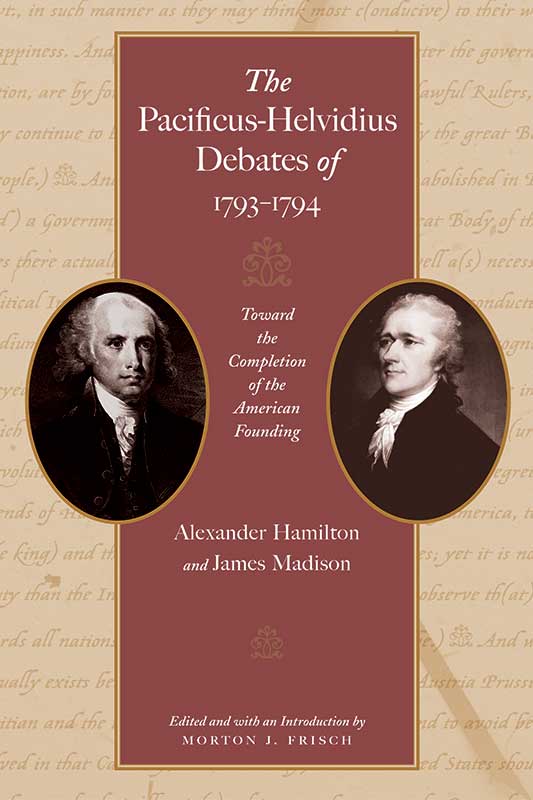
Americanus Number I * - Alexander Hamilton, The Pacificus-Helvidius Debates of 1793-1794: Toward the Completion of the American Founding [1793]

Edition used:

The Pacificus-Helvidius Debates of 1793-1794: Toward the Completion of the American Founding, edited with and Introduction by Morton J. Frisch (Indianapolis: Liberty Fund, 2007).

About Liberty Fund:

Liberty Fund, Inc. is a private, educational foundation established to encourage the study of the ideal of a society of free and responsible individuals.


Americanus Number I*

The first issue here is whether the cause of France is truly the cause of liberty or one stained by excesses and extravagances of an unparalleled nature; Hamilton argues that the latter view has a tolerable foundation. The second issue concerns the character of the French regime and whether it would be in the best interests of the United States to ally herself with that regime.

An examination into the question how far regard to the cause of liberty ought to induce the UStates to take part with France in the present war has been promised. This promise shall now be performed; premising only that it is foreign to the immediate object of these papers—a vindication of the Declaration of Neutrality. That Executive Act must derive its defence, from a just construction of existing Treaties and Laws. If shewn to be consistent with these the defence is complete.

Whether a mere regard to the cause of Liberty, independent of Treaty, ought to induce us to become volunteers in the war is a question, under our constitution, not of Executive, but of Legislative cognizance. It belongs to Congress to say—whether the Nation shall of choice dismiss the olive branch and unfurl the banners of War.

In judging of the eligibility of the measure with a view to the question just stated, it would present itself under two aspects—

I. Whether the cause of France be truly the cause of liberty, pursued with justice and humanity, and in a manner likely to crown it with honorable success.

II. Whether the degree of service, we could render, by participating in the conflict, was likely to compensate, by its utility to the cause, the evils which would probably flow from it to ourselves.

If either of these questions can be answered in the negative, it will result that the consideration, which has been stated, ought not to embark us in the War.

A discussion of the first point will not be entered upon. It would involve an examination too complicated for the compass of these papers; and after all, the subject gives so great scope to opinion, to imagination to feeling that little could be expected from argument. The great leading facts are before the Public; and by this time most men have drawn their conclusions so firmly, that the issue alone can adjust their differences of opinion. There was a time when all men in this Country entertained the same favourable view of the French Revolution. At the present time they all still unite in the wish, that the troubles of France may terminate in the establishment of a free and good government; and all dispassionate well-informed men equally unite in the doubt, whether this is likely to take place under the auspices of those who now govern the affairs of that Country. But agreeing in these two points, there is a great and serious diversity of opinion as to the real merits and probable issue of the French Revolution.

None can deny, that the cause of France has been stained by excesses and extravagances, for which it is not easy, if possible, to find a parallel and at which reason and humanity recoil. Yet many find apologies & extenuations with which they satisfy themselves; they still see in the cause of France the cause of Liberty; they are still sanguine in the hope that it will be crowned with success; that the French Nation will establish for themselves not only a free, but a Republican Government, capable of promoting solidly their happiness. Others on the contrary discern no adequate apology for the horrid and disgusting scenes which have been and continue to be acted. They conceive that the excesses which have been committed transcend greatly the measure of those which were reasonably to have been expected with every due allowance for circumstances. They perceive in them proofs of atrocious depravity in the most influential leaders of the Revolution. They observe, that among these, a Marat and a Robespierre, assassins still reeking with the blood of murdered fellow Citizens, monsters who outdo the fabled enormities of a Busiris and a Procrustes, are predominent in influence as in iniquity. They find every where marks of an unexampled dissolution of all the social and moral ties. They see no where any thing but principles and opinions so wild so extreme passions so turbulent so tempestuous, as almost to forbid the hope of agreement in any rational or well organised system of Government: They conclude, that a state of things like this is calculated to extend disgust and disaffection throughout the Nation, to nourish more and more a spirit of insurrection and mutiny, facilitating the progress of the invading armies, and exciting in the bowels of France commotions, of which it is impossible to compute the mischiefs the duration or the end: that if by the energy of the national character and the intrinsic difficulty of the enterprise the enemies of France shall be compelled to leave her to herself, this era may only prove the commencement of greater misfortunes: that after wading through seas of blood, in a furious and sanguinary civil war, France may find herself at length the slave of some victorious Scylla or Marius or Caesar: And they draw this afflicting inference from the whole view of the subject, that there is more reason to fear, that the cause of true Liberty has received a deep wound in the mismanagements of it, by those who, unfortunately for the French Nation, have for a considerable time past, maintained an ascendant in its affairs—than to regard the Revolution of France, in the form it has latterly worn, as intitled to the honors due to that sacred and all important cause—or as a safe bark on which to freight the Fortunes the Liberties and the Reputation of this now respectable and happy land.

Without undertaking to determine, which of these opposite opinions rests most firmly on the evidence of facts, I shall content myself with observing that if the latter is conceived to have but a tolerable foundation, it is conclusive against the propriety of our engaging in the war, merely through regard for the cause of Liberty: For when we resolve to put so vast a stake upon the chance of the die, we ought at least to be certain that the object for which we hazard is genuine is substantial is real.

Let us proceed to the discussion of the second question.

To judge of the degree of aid which we could afford to France in her present struggle, it may be of use to take a true view of the means, with which we carried on the War that accomplished our own Revolution.

Our supplies were derived from five sources—1. paper money—2. domestic loans 3. foreign loans 4. pecuniary taxes 5. taxes in specific articles 6. military impress.

The first of these resources with a view to a future war may be put out of the question. Past experience would forbid its being again successfully employed, and no friend to the morals property or industry of the people, to public or private credit, would desire to see it revived.

The second would exist, but probably in a more limited extent. The circumstances of a depreciating paper, which the holders were glad, as they supposed, to realize, was a considerable motive to the loans obtained during the late war. The magnitude of them, however, even then, bore a small proportion to the aggregate expence.

The third resource would be equally out of the question with the first. The principal lending powers would be our enemies as they are now those of France.

The three remaining items—Pecuniary taxes, taxes on specific articles; military impress, could be employed again in a future war and are the resources upon which we should have chiefly to rely: for the resources of domestic loans is by no means a very extensive one, in a community where capitals are so moderate as in ours.

Though it is not to be doubted, that the People of the UStates would hereafter as heretofore throw their whole property into common stock for their common defence against internal invasion or an unprovoked attack—who is there sanguine enough to believe that large contributions either in money or produce could be extracted from them to carry on an external war voluntarily undertaken for a foreign and speculative purpose?

The expectation were an illusion. Those who may entertain it ought to pause and reflect. Whatever enthusiasm might have been infused into a part of the community would quickly yield to more just and sober ideas inculcated by experience of the burthens & calamities of war. The circuitous logic, by which it is attempted to be maintained, that a participation in the war is necessary to the security of our own liberty would then appear, as it truly is, a mere delusion, propagated by bribed incendiaries or hair- brained enthusiasts. And the authors of the delusion would not fail to be execrated as the enemies of the public weal.

Viewing the matter dispassionately, we cannot but conclude, that in a war of choice, not of necessity, like that in which we are invited to engage—it would be a bad calculation to look for great exertions of the community.

The business would move as heavily, as it was in its origin impolitic. The faculty of the government to obtain pecuniary supplies would in such a situation be circumscribed within a narrow compass. Levies of men would not be likely to be more successful than those of money. No one would think of detaching the Militia for distant expeditions abroad: And the experience we have had in our Indian enterprizes do not authorise strong expectations of going far, by voluntary enlistments, where the question is not as it was during the last war the defence of the essential rights & interests of the Country. The severe expedient of drafting from the Militia, a principal reliance in that war, would put the authority of Government in the case supposed to a very critical test.

This summary view of what would be our situation & prospects is alone sufficient to demonstrate the general position that our ability to promote the cause of France by external exertions could not be such as to be very material to the event.

Let us however for more complete elucidation inquire to what particular objects they could be directed.

Fleets we have not and could not have in time or to an extent to be of use in the contest.

Shall we raise an army and send it to France? She does not want soldiers. Her own population can amply furnish her armies. The number we could send, if we could get them there at all, would be of no weight in the scale.

The true wants of France are of system, order, money, provisions, arms, military stores.

System and Order we could not give her by engaging in the war. The supply of money in that event would be out of our power. At present we can pay our debt to her in proportion as it becomes due. Then we could not even do this. Provisions and other supplies, as far as we are in condition to furnish them, could not then be furnished at all. The conveyance of them would become more difficult—& the forces we should be obliged ourselves to raise would consume our surplus.

Abondonning then, as of necessity we must, the idea of aiding France in Europe, shall we turn our attention to the succour of her Islands? Alas we should probably have here only to combat their own internal disorders to aid Frenchmen against French men—whites against blacks, or blacks against whites. If we may judge from the past conduct of the powers at war with France their effort is immediately against herself—her Islands are not in the first instance, a serious object. But grant that they become so, is it evident, that we can cooperate efficaciously to their preservation? Or if we can what will this have to do with the preservation of French Liberty. The dangers to this arise, from the invasion of foreign armies carried into the bosom of France—from the still more formidable assaults of civil dissention and the spirit of anarchy.

Shall we attack the Islands of the Powers opposed to France?

How shall we without a competent fleet carry on the necessary expeditions for the purpose? Where is such a fleet? How shall we maintain our conquests after they are made? What influence could the capture of an Island or two have upon the general issue of the Contest? These questions answer themselves.

Or Shall we endeavour to make a diversion in favour of France by attacking canada on the one side & Florida on the other?

This certainly would be the most, indeed the only, eligible mode of aiding France in war. These enterprises may be considered as within the compass of our means.

But while this is admitted, it ought not to be regarded as a very easy task. The reduction of Canada ought not to be undertaken with less than NA men; that of the Floridas with much fewer than NA1 for reinforcement could be brought to both those countries from the West India possessions of their respective sovereigns. Relying on their naval superiority, they could spare from the Islands all the troops which were not necessary to the preservation of their internal tranquillity.

These armies are then to be raised and equipped and to be provided with all the requisite apparatus for operation. Proportionate magazines are to be formed for their accommodation and supply.

Some men, whose fate it is to think loosely may imagine that a more summary substitute could be found in the Mi[li]tia. But the Militia, an excellent auxiliary for internal defence, could not be advantageously employed in distant expeditions requiring time and perseverance. For these, men regularly engaged for a competent period are indispensable. The conquest of Canada at least may with decision be regarded as out of the reach of a Militia operation.

If war was resolved upon, the very preparation of the means for the enterprizes which have been mentioned would demand not less than a year. Before this period was elapsed, the fate of France, as far as foreign invasion is concerned, would probably be decided. It would be manifest either that she could or could not be subjugated by force of external coertion. Our interposition would therefore be too late to benefit her. It appears morally certain, that the War against France cannot be of much duration. The Exertions are too mighty to be long protracted.

The only way in which the enterprizes in question could serve the cause of France would be by making a diversion of a part of those forces which would otherwise be directed against her. But this consequence could not be counted upon. It would be known that we could not be very early ready to attack with effect; and it would be an obvious policy to risk secondary objects rather than be diverted from the efficacious pursuit of the main one. It would be natural in such case to rely for indemnification on the successful result of the War in Europe. The Governments concerned imagine that they have too much at stake upon that result not to hazard considerably elsewhere in order to secure the fairest chance of its being favourable to their wishes.

It would not probably render the matter better, to precipitate our measures for the sake of a more speedy impulse. The parties ought in such case to count upon the abortion of our attempts from their immaturity, and to rely the more confidently upon the means of resistance already on the spot.

We could not therefore flatter ourselves that the expedient last proposed—that of attacking the possessions of Great Britain and Spain in our neighbourhood—would be materially serviceable to the cause of France.

But to give the argument its fairest course, I shall take notice of two particulars, in respect to which our interference would be more sensibly felt. These are the depredations, which our privateers might make upon the commerce of the maritime enemies of France, and the direct injury which would accrue to that of G Britain from the interruption of intercourse between the two Countries. Considering the shock lately sustained by mercantile credit in that Country—the real importance to it of our imports from thence and of our exports thither, the large sums which are due and in a continual course of remittance from our merchants to her Merchants—a war between the UStates and Great Britain could not fail to be seriously distressing to her.

Yet it would be weak to count upon very decisive influence of these circumstances. The Public credit of G Britain has still energy sufficient to enable her to struggle with much partial derangement. Her private credit manifestly disordered by temporary causes, and propped as it has been by the public purse seems to have recovered its impaired tone. Her commerce too suddenly interrupted by the breaking out of war must have resumed its wonted channels in proportion as the progress of her naval preparations has tended to give it protection. And though the being at war with us would be very far from a matter of indifference either to her commerce or to her credit; yet it is not likely that it would arrest her carreer or over- rule those paramount considerations which brought her into her present situation.

When we recollect how she maintained herself under a privation of our commerce, through a seven years war with us, united for certain periods of it with France Spain & Holland, though we perceive a material difference between her present and her then situation arising from that very effort, yet we cannot reasonably doubt that she would be able notwithstanding a similar privation to continue a war which in fact does not call for an equal exertion on her part, as long as the other powers with which she is associated shall be in condition to prosecute it with a hope of success. Nor is it probable, whatever may be the form or manner of the engagement, that Great Britain could, if disposed to peace, honorably make a separate retreat. It is the interest of all parties in such cases to assure to each other a cooperation: and it is presumeable that this has taken place in some shape or other between the Powers at present combined against France.

The conclusion from the several considerations which have been presented carefully & dispassionately weighed is this, that there is no probable prospect of this country rendering material service to the cause of France, by engaging with her in the War.

It has been very truly observed in the course of the publications, upon the subject—that if France is not in some way or other wanting to herself she will not stand in need of our assistance and if she is our assistance cannot save her.

Pacificus

[* ]Reprinted with permission from The Papers of Alexander Hamilton, ed. Harold Syrett et al., vol. 15 (New York: Columbia University Press, 1969), 669–78.

[1. ][The blank spaces contain numbers that were crossed out by Hamilton.]