Econlib

The Library

Other Sites

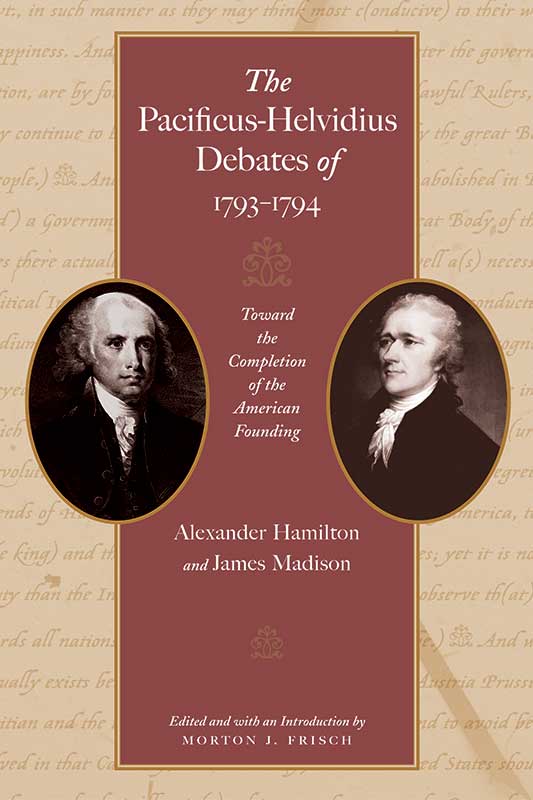
Front Page arrow Titles (by Subject) arrow THE PACIFICUS-HELVIDIUS DEBATES OF 1793-1794 - The Pacificus-Helvidius Debates of 1793-1794: Toward the Completion of the American Founding

Return to Title Page for The Pacificus-Helvidius Debates of 1793-1794: Toward the Completion of the American Founding

THE PACIFICUS-HELVIDIUS DEBATES OF 1793-1794 - Alexander Hamilton, The Pacificus-Helvidius Debates of 1793-1794: Toward the Completion of the American Founding [1793]

Edition used:

The Pacificus-Helvidius Debates of 1793-1794: Toward the Completion of the American Founding, edited with and Introduction by Morton J. Frisch (Indianapolis: Liberty Fund, 2007).

About Liberty Fund:

Liberty Fund, Inc. is a private, educational foundation established to encourage the study of the ideal of a society of free and responsible individuals.


THE PACIFICUS-HELVIDIUS DEBATES OF 1793-1794

Washington’s Neutrality Proclamation, April 22, 1793*

Whereas it appears that a state of war exists between Austria, Prussia, Sardinia, Great Britain, and the United Netherlands, of the one part, and France on the other; and the duty and interest of the United States require, that they should with sincerity and good faith adopt and pursue a conduct friendly and impartial towards the belligerent Powers:

I have therefore thought fit by these presents to declare the disposition of the United States to observe the conduct aforesaid towards those Powers respectively; and to exhort and warn the citizens of the United States carefully to avoid all acts and proceedings whatsoever, which may in any manner tend to contravene such disposition.

And I hereby also make known, that whosoever of the citizens of the United States shall render himself liable to punishment or forfeiture under the law of nations, by committing, aiding, or abetting hostilities against any of the said Powers, or by carrying to any of them those articles which are deemed contraband by the modern usage of nations, will not receive the protection of the United States, against such punishment or forfeiture; and further, that I have given instructions to those officers, to whom it belongs, to cause prosecutions to be instituted against all persons, who shall, within the cognizance of the courts of the United States, violate the law of nations, with respect to the Powers at war, or any of them.

Defense of the President’s Neutrality Proclamation*

In the following essay, Hamilton attacks the motives of those who opposed President Washington’s Neutrality Proclamation of 1793 relative to the war between England and France. It should be read in conjunction with Hamilton’s Pacificus essays, which attempt to counter the criticisms of the president’s issuance of that proclamation.

1. It is a melancholy truth, which every new political occurrence more and more unfolds, that there is a discription of men in this country, irreconcileably adverse to the government of the United States; whose exertions, whatever be the springs of them, whether infatuation or depravity or both, tend to disturb the tranquillity order and prosperity of this now peaceable flourishing and truly happy land. A real and enlightened friend to public felicity cannot observe new confirmations of this fact, without feeling a deep and poignant regret, that human nature should be so refractory and perverse; that amidst a profusion of the bounties and blessings of Providence, political as well as natural, inviting to contentment and gratitude, there should still be found men disposed to cherish and propagate disquietude and alarm; to render suspected and detested the instruments of the felicity, in which they partake; to sacrifice the most substantial advantages, that ever fell to the lot of a people at the shrine of personal envy rivalship and animosity, to the instigations of a turbulent and criminal ambition, or to the treacherous phantoms of an ever craving and never to be satisfied spirit of innovation; a spirit, which seems to suggest to its votaries that the most natural and happy state of Society is a state of continual revolution and change—that the welfare of a nation is in exact ratio to the rapidity of the political vicissitudes, which it undergoes—to the frequency and violence of the tempests with which it is agitated.

2. Yet so the fact unfortunately is—such men there certainly are—and it is essential to our dearest interests to the preservation of peace and good order to the dignity and independence of our public councils—to the real and permanent security of liberty and property—that the Citizens of the UStates should open their eyes to the true characters and designs of the men alluded to—should be upon their guard against their insidious and ruinous machinations.

3. At this moment a most dangerous combination exists. Those who for some time past have been busy in undermining the constitution and government of the UStates, by indirect attacks, by labouring to render its measures odious, by striving to destroy the confidence of the people in its administration—are now meditating a more direct and destructive war against it—a<nd> embodying and arranging their forces and systematising their efforts. Secret clubs are formed and private consultations held. Emissaries are dispatched to distant parts of the United States to effect a concert of views and measures, among the members and partisans of the disorganising corps, in the several states. The language in the confidential circles is that the constitution of the United States is too complex a system—that it savours too much of the pernicious doctrine of “ballances and checks” that it requires to be simplified in its structure, to be purged of some monarchical and aristocratic ingredients which are said to have found their way into it and to be stripped of some dangerous prerogatives, with which it is pretended to be invested.

4. The noblest passion of the human soul, which no where burns with so pure and bright a flame, as in the breasts of the people of the UStates, is if possible to be made subservient to this fatal project. That zeal for the liberty of mankind, which produced so universal a sympathy in the cause of France in the first stages of its revolution, and which, it is supposed, has not yet yielded to the just reprobation, which a sober temperate and humane people, friends of religion, social order, and justice, enemies to tumult and massacre, to the wanton and lawless shedding of human blood cannot but bestow upon those extravagancies excesses and outrages, which have sullied and which endanger that cause—that laudable, it is not too much to say that holy zeal is intended by every art of misrepresentation and deception to be made the instrument first of controuling finally of overturning the Government of the Union.

5. The ground which has been so wisely taken by the Executive of the UStates, in regard to the present war of Europe against France, is to be the pretext of this mischievous attempt. The people are if possible to be made to believe, that the Proclamation of neutrality issued by the President of the US was unauthorised illegal and officious—inconsistent with the treaties and plighted faith of the Nation—inconsistent with a due sense of gratitude to France for the services rendered us in our late contest for independence and liberty—inconsistent with a due regard for the progress and success of republican principles. Already the presses begin to groan with invective against the Chief Magistrate of the Union, for that prudent and necessary measure; a measure calculated to manifest to the World the pacific position of the Government and to caution the citizens of the UStates against practices, which would tend to involve us in a War the most unequal and calamitous, in which it is possible for a Country to be engaged—a war which would not be unlikely to prove pregnant with still greater dangers and disasters, than that by which we established our existence as an Independent Nation.

6. What is the true solution of this extraordinary appearance? Are the professed the real motives of its authors? They are not. The true object is to disparage in the opinion and affections of his fellow citizens that man who at the head of our armies fought so successfully for the Liberty and Independence, which are now our pride and our boast—who during the war supported the hopes, united the hearts and nerved the arm of his countrymen—who at the close of it, unseduced by ambition & the love of power, soothed and appeased the discontents of his suffering companions in arms, and with them left the proud scenes of a victorious field for the modest retreats of private life—who could only have been drawn out of these favourite retreats, to aid in the glorious work of ingrafting that liberty, which his sword had contributed to win, upon a stock of which it stood in need and without which it could not flourish—endure—a firm adequate national Government—who at this moment sacrifices his tranquillity and every favourite pursuit to the peremptory call of his country to aid in giving solidity to a fabric, which he has assisted in rearing—whose whole conduct has been one continued proof of his rectitude moderation disinterestedness and patriotism, who whether the evidence of a uniform course of virtuous public actions be considered, or the motives likely to actuate a man placed precisely in his situation be estimated, it may safely be pronounced, can have no other ambition than that of doing good to his Country & transmitting his fame unimpaired to posterity. For what or for whom is he to hazard that rich harvest of glory, which he has acquired that unexampled veneration and love of his fellow Citizens, which he so eminently possesses?

7. Yet the men alluded to, while they contend with affected zeal for gratitude towards a foreign Nation, which in assisting us was and ought to have been influenced by considerations relative to its own interest—forgetting what is due to a fellow Citizen, who at every hazard rendered essential services to his Country from the most patriotic motives—insidiously endeavour to despoil him of that precious reward of his services, the confidence and approbation of his fellow Citizens.

8. The present attempt is but the renewal in another form of an attack some time since commenced, and which was only dropped because it was perceived to have excited a general indignation. Domestic arrangements of mere convenience, calculated to reconcile the oeconomy of time with the attentions of decorum and civility were then the topics of malevolent declamation. A more serious article of charge is now opened and seems intended to be urged with greater earnestness and vigour. The merits of it shall be examined in one or two succeeding papers, I trust in a manner, that will evince to every candid mind to futility.

9. To be an able and firm supporter of the Government of the Union is in the eyes of the men referred to a crime sufficient to justify the most malignant persecution. Hence the attacks which have been made and repeated with such persevering industry upon more than one public Character in that Government. Hence the effort which is now going on to depreciate in the eyes and estimation of the People the man whom their unanimous suffrages have placed at the head of it.

10. Hence the pains which are taking to inculcate a discrimination between principles and men and to represent an attachment to the one as a species of war against the other; an endeavour, which has a tendency to stifle or weaken one of the best and most useful feelings of the human heart—a reverence for merit—and to take away one of the strongest incentives to public virtue—the expectation of public esteem.

11. A solicitude for the character who is attacked forms no part of the motives to this comment. He has deserved too much, and his countrymen are too sensible of it to render any advocation of him necessary. If his virtues and services do not secure his fame and ensure to him the unchangeable attachment of his fellow Citizens, twere in vain to attempt to prop them by anonymous panygeric.

12. The design of the observations which have been made is merely to awaken the public attention to the views of a party engaged in a dangerous conspiracy against the tranquillity and happiness of their country. Aware that their hostile aims against the Government can never succeed til they have subverted the confidence of the people in its present Chief Magistrate, they have at length permitted the suggestions of their enmity to betray them into this hopeless and culpable attempt. If we can destroy his popularity (say they) our work is more than half completed.

13. In proportion as the Citizens of the UStates value the constitution on which their union and happiness depend, in proportion as they tender the blessings of peace and deprecate the calamities of War—ought to be their watchfulness against this success of the artifices which will be employed to endanger that constitution and those blessings. A mortal blow is aimed at both.

14. It imports them infinitely not to be deceived by the protestations which are made—that no harm is meditated against the Constitution—that no design is entertained to involve the peace of the Country. These appearances are necessary to the accomplishment of the plan which has been formed. It is known that the great body of the People are attached to the constitution. It would therefore defeat the intention of destroying it to avow that it exists. It is also known that the People of the UStates are firmly attached to peace. It would consequently frustrate the design of engaging them in the War to tell them that such an object is in contemplation.

15. A more artful course has therefore been adopted. Professions of good will to the Constitution are made without reserve: But every possible art is employed to render the administration and the most zealous and useful friends of the Government odious. The reasoning is obvious. If the people can be persuaded to dislike all the measures of the Government and to dislike all or the greater part of those who have [been] most conspicuous in establishing or conducting it—the passage from this to the dislike and change of the constitution will not be long nor difficult. The abstract idea of regard for a constitution on paper will not long resist a thorough detestation of its practice.

16. In like manner, professions of a disposition to preserve the peace of the Country are liberally made. But the means of effecting the end are condemned; and exertions are used to prejudice the community against them. A proclamation of neutrality in the most cautious form is represented as illegal—contrary to our engagements with and our duty towards one of the belligerent powers. The plain inference is that in the opinion of these characters the UStates are under obligations which do not permit them to be neutral. Of course they are in a situation to become a party in the War from duty.

17. Pains are likewise taken to inflame the zeal of the people for the cause of France and to excite their resentments against the powers at War with her. To what end all this—but to beget if possible a temper in the community which may overrule the moderate or pacific views of the Government.

Pacificus Number I*

One of the most controversial opinions of Hamilton’s political career was his justification of executive independence in foreign policy questions in the debate over Washington’s Neutrality Proclamation. Hamilton argues in the following essay that the president’s power to make such a proclamation issues from the general grant of executive power, which includes conducting foreign relations; from the president’s primary responsibility in the formation of treaties; and from the power of the execution of the laws, of which treaties form a part.

As attempts are making very dangerous to the peace, and it is to be feared not very friendly to the constitution of the UStates—it becomes the duty of those who wish well to both to endeavour to prevent their success.

The objections which have been raised against the Proclamation of Neutrality lately issued by the President have been urged in a spirit of acrimony and invective, which demonstrates, that more was in view than merely a free discussion of an important public measure; that the discussion covers a design of weakening the confidence of the People in the author of the measure; in order to remove or lessen a powerful obstacle to the success of an opposition to the Government, which however it may change its form, according to circumstances, seems still to be adhered to and pursued with persevering Industry.

This Reflection adds to the motives connected with the measure itself to recommend endeavours by proper explanations to place it in a just light. Such explanations at least cannot but be satisfactory to those who may not have leisure or opportunity for pursuing themselves an investigation of the subject, and who may wish to perceive that the policy of the Government is not inconsistent with its obligations or its honor.

The objections in question fall under three heads—

1. That the Proclamation was without authority

2. That it was contrary to our treaties with France

3. That it was contrary to the gratitude, which is due from this to that country; for the succours rendered us in our own Revolution.

4. That it was out of time & unnecessary.

In order to judge of the solidity of the first of these objection[s], it is necessary to examine what is the nature and design of a proclamation of neutrality.

The true nature & design of such an act is—to make known to the powers at War and to the Citizens of the Country, whose Government does the Act that such country is in the condition of a Nation at Peace with the belligerent parties, and under no obligations of Treaty, to become an associate in the war with either of them; that this being its situation its intention is to observe a conduct conformable with it and to perform towards each the duties of neutrality; and as a consequence of this state of things, to give warning to all within its jurisdiction to abstain from acts that shall contravene those duties, under the penalties which the laws of the land (of which the law of Nations is a part) annexes to acts of contravention.

This, and no more, is conceived to be the true import of a Proclamation of Neutrality.

It does not imply, that the Nation which makes the declaration will forbear to perform to any of the warring Powers any stipulations in Treaties which can be performed without rendering it an associate or party in the War. It therefore does not imply in our case, that the UStates will not make those distinctions, between the present belligerent powers, which are stipulated in the 17th and 22d articles of our Treaty with France; because these distinctions are not incompatible with a state of neutrality; they will in no shape render the UStates an associate or party in the War. This must be evident, when it is considered, that even to furnish determinate succours, of a certain number of Ships or troops, to a Power at War, in consequence of antecedent treaties having no particular reference to the existing war, is not inconsistent with neutrality; a position well established by the doctrines of Writers and the practice of Nations.*

But no special aids, succours or favors having relation to war, not positively and precisely stipulated by some Treaty of the above description, can be afforded to either party, without a breach of neutrality.

In stating that the Proclamation of Neutrality does not imply the non performance of any stipulations of Treaties which are not of a nature to make the Nation an associate or party in the war, it is conceded that an execution of the clause of Guarantee contained in the 11th article of our Treaty of Alliance with France would be contrary to the sense and spirit of the Proclamation; because it would engage us with our whole force as an associate or auxiliary in the War; it would be much more than the case of a definite limited succour, previously ascertained.

It follows that the Proclamation is virtually a manifestation of the sense of the Government that the UStates are, under the circumstances of the case, not bound to execute the clause of Guarantee.

If this be a just view of the true force and import of the Proclamation, it will remain to see whether the President in issuing it acted within his proper sphere, or stepped beyond the bounds of his constitutional authority and duty.

It will not be disputed that the management of the affairs of this country with foreign nations is confided to the Government of the UStates.

It can as little be disputed, that a Proclamation of Neutrality, where a Nation is at liberty to keep out of a War in which other Nations are engaged and means so to do, is a usual and a proper measure. Its main object and effect are to prevent the Nation being immediately responsible for acts done by its citizens, without the privity or connivance of the Government, in contravention of the principles of neutrality.

An object this of the greatest importance to a Country whose true interest lies in the preservation of peace.

The inquiry then is—what department of the Government of the UStates is the prop<er> one to make a declaration of Neutrality in the cases in which the engagements <of> the Nation permit and its interests require such a declaration.

A correct and well informed mind will discern at once that it can belong neit<her> to the Legislative nor Judicial Department and of course must belong to the Executive.

The Legislative Department is not the organ of intercourse between the UStates and foreign Nations. It is charged neither with making nor interpreting Treaties. It is therefore not naturally that Organ of the Government which is to pronounce the existing condition of the Nation, with regard to foreign Powers, or to admonish the Citizens of their obligations and duties as founded upon that condition of things. Still less is it charged with enforcing the execution and observance of these obligations and those duties.

It is equally obvious that the act in question is foreign to the Judiciary Department of the Government. The province of that Department is to decide litigations in particular cases. It is indeed charged with the interpretation of treaties; but it exercises this function only in the litigated cases; that is where contending parties bring before it a specific controversy. It has no concern with pronouncing upon the external political relations of Treaties between Government and Government. This position is too plain to need being insisted upon.

It must then of necessity belong to the Executive Department to exercise the function in Question—when a proper case for the exercise of it occurs.

It appears to be connected with that department in various capacities, as the organ of intercourse between the Nation and foreign Nations—as the interpreter of the National Treaties in those cases in which the Judiciary is not competent, that is in the cases between Government and Government—as that Power, which is charged with the Execution of the Laws, of which Treaties form a part—as that Power which is charged with the command and application of the Public Force.

This view of the subject is so natural and obvious—so analogous to general theory and practice—that no doubt can be entertained of its justness, unless such doubt can be deduced from particular provisions of the Constitution of the UStates.

Let us see then if cause for such doubt is to be found in that constitution.

The second Article of the Constitution of the UStates, section 1st, establishes this general Proposition, That “The Executive Power shall be vested in a President of the United States of America.”

The same article in a succeeding Section proceeds to designate particular cases of Executive Power. It declares among other things that the President shall be Commander in Cheif of the army and navy of the UStates and of the Militia of the several states when called into the actual service of the UStates, that he shall have power by and with the advice of the senate to make treaties; that it shall be his duty to receive ambassadors and other public Ministers and to take care that the laws be faithfully executed.

It would not consist with the rules of sound construction to consider this enumeration of particular authorities as derogating from the more comprehensive grant contained in the general clause, further than as it may be coupled with express restrictions or qualifications; as in regard to the cooperation of the Senate in the appointment of Officers and the making of treaties; which are qualifica<tions> of the general executive powers of appointing officers and making treaties: Because the difficulty of a complete and perfect specification of all the cases of Executive authority would naturally dictate the use of general terms—and would render it improbable that a specification of certain particulars was designd as a substitute for those terms, when antecedently used. The different mode of expression employed in the constitution in regard to the two powers the Legislative and the Executive serves to confirm this inference. In the article which grants the legislative powers of the Governt. the expressions are—“All Legislative powers herein granted shall be vested in a Congress of the UStates”; in that which grants the Executive Power the expressions are, as already quoted “The Executive Po<wer> shall be vested in a President of the UStates of America.”

The enumeration ought rather therefore to be considered as intended by way of greater caution, to specify and regulate the principal articles implied in the definition of Executive Power; leaving the rest to flow from the general grant of that power, interpreted in conformity to other parts <of> the constitution and to the principles of free government.

The general doctrine then of our constitution is, that the Executive Power of the Nation is vested in the President; subject only to the exceptions and qu[a]lifications which are expressed in the instrument.

Two of these have been already noticed—the participation of the Senate in the appointment of Officers and the making of Treaties. A third remains to be mentioned the right of the Legislature “to declare war and grant letters of marque and reprisal.”

With these exceptions the Executive Power of the Union is completely lodged in the President. This mode of construing the Constitution has indeed been recognized by Congress in formal acts, upon full consideration and debate. The power of removal from office is an important instance.

And since upon general principles for reasons already given, the issuing of a proclamation of neutrality is merely an Executive Act; since also the general Executive Power of the Union is vested in the President, the conclusion is, that the step, which has been taken by him, is liable to no just exception on the score of authority.

It may be observed that this Inference w<ould> be just if the power of declaring war had <not> been vested in the Legislature, but that <this> power naturally includes the right of judg<ing> whether the Nation is under obligations to m<ake> war or not.

The answer to this is, that however true it may be, that th<e> right of the Legislature to declare wa<r> includes the right of judging whether the N<ation> be under obligations to make War or not—it will not follow that the Executive is in any case excluded from a similar right of Judgment, in the execution of its own functions.

If the Legislature have a right to make war on the one hand—it is on the other the duty of the Executive to preserve Peace till war is declared; and in fulfilling that duty, it must necessarily possess a right of judging what is the nature of the obligations which the treaties of the Country impose on the Government; and when in pursuance of this right it has concluded that there is nothing in them inconsistent with a state of neutrality, it becomes both its province and its duty to enforce the laws incident to that state of the Nation. The Executive is charged with the execution of all laws, the laws of Nations as well as the Municipal law, which recognises and adopts those laws. It is consequently bound, by faithfully executing the laws of neutrality, when that is the state of the Nation, to avoid giving a cause of war to foreign Powers.

This is the direct and proper end of the proclamation of neutrality. It declares to the UStates their situation with regard to the Powers at war and makes known to the Community that the laws incident to that situation will be enforced. In doing this, it conforms to an established usage of Nations, the operation of which as before remarked is to obviate a responsibility on the part of the whole Society, for secret and unknown violations of the rights of any of the warring parties by its citizens.

Those who object to the proclamation will readily admit that it is the right and duty of the Executive to judge of, or to interpret, those articles of our treaties which give to France particular privileges, in order to the enforcement of those privileges: But the necessary consequence of this is, that the Executive must judge what are the proper bounds of those privileges—what rights are given to other nations by our treaties with them—what rights the law of Nature and Nations gives and our treaties permit, in respect to those Nations with whom we have no treaties; in fine what are the reciprocal rights and obligations of the United States & of all & each of the powers at War.

The right of the Executive to receive ambassadors and other public Ministers may serve to illustrate the relative duties of the Executive and Legislative Departments. This right includes that of judging, in the case of a Revolution of Government in a foreign Country, whether the new rulers are competent organs of the National Will and ought to <be> recognised or not: And where a treaty antecedently exists between the UStates and such nation that right involves the power of giving operation or not to such treaty. For until the new Government is acknowleged, the treaties between the nations, as far at least as regards public rights, are of course suspended.

This power of determ[in]ing virtually in the case supposed upon the operation of national Treaties as a consequence, of the power to receive ambassadors and other public Ministers, is an important instance of the right of the Executive to decide the obligations of the Nation with regard to foreign Nations. To apply it to the case of France, if the<re> had been a Treaty of alliance offensive <and> defensive between the UStates and that Coun<try,> the unqualified acknowlegement of the new Government would have put the UStates in a condition to become an associate in the War in which France was engaged—and would have laid the Legislature under an obligation, if required, and there was otherwise no valid excuse, of exercising its power of declaring war.

This serves as an example of the right of the Executive, in certain cases, to determine the condition of the Nation, though it may consequentially affect the proper or improper exercise of the Power of the Legislature to declare war. The Executive indeed cannot control the exercise of that power—further than by the exer[c]ise of its general right of objecting to all acts of the Legislature; liable to being overruled by two thirds of both houses of Congress. The Legislature is free to perform its own duties according to its own sense of them—though the Executive in the exercise of its constitutional powers, may establish an antecedent state of things which ought to weigh in the legislative decisions. From the division of the Executive Power there results, in referrence to it, a concurrent authority, in the distributed cases.

Hence in the case stated, though treaties can only be made by the President and Senate, their activity may be continued or suspended by the President alone.

No objection has been made to the Presidents having acknowleged the Republic of France, by the Reception of its Minister, without having consulted the Senate; though that body is connected with him in the making of Treaties, and though the consequence of his act of reception is to give operation to the Treaties heretofore made with that Country: But he is censured for having declared the UStates to be in a state of peace & neutrality, with regard to the Powers at War; because the right of changing that state & declaring war belongs to the Legislature.

It deserves to be remarked, that as the participation of the senate in the making of Treaties and the power of the Legislature to declare war are exceptions out of the general “Executive Power” vested in the President, they are to be construed strictly—and ought to be extended no further than is essential to their execution.

While therefore the Legislature can alone declare war, can alone actually transfer the nation from a state of Peace to a state of War—it belongs to the “Executive Power,” to do whatever else the laws of Nations cooperating with the Treaties of the Country enjoin, in the intercourse of the UStates with foreign Powers.

In this distribution of powers the wisdom of our constitution is manifested. It is the province and duty of the Executive to preserve to the Nation the blessings of peace. The Legislature alone can interrupt those blessings, by placing the Nation in a state of War.

But though it has been thought adviseable to vindicate the authority of the Executive on this broad and comprehensive ground—it was not absolutely necessary to do so. That clause of the constitution which makes it his duty to “take care that the laws be faithfully executed” might alone have been relied upon, and this simple process of argument pursued.

The President is the constitutional Executor of the laws. Our Treaties and the laws of Nations form a part of the law of the land. He who is to execute the laws must first judge for himself of their meaning. In order to the observance of that conduct, which the laws of nations combined with our treaties prescribed to this country, in reference to the present War in Europe, it was necessary for the President to judge for himself whether there was any thing in our treaties incompatible with an adherence to neutrality. Having judged that there was not, he had a right, and if in his opinion the interests of the Nation required it, it was his duty, as Executor of the laws, to proclaim the neutrality of the Nation, to exhort all persons to observe it, and to warn them of the penalties which would attend its non observance.

The Proclamation has been represented as enacting some new law. This is a view of it entirely erroneous. It only proclaims a fact with regard to the existing state of the Nation, informs the citizens of what the laws previously established require of them in that state, & warns them that these laws will be put in execution against the Infractors of them.

Pacificus Number II*

Hamilton argues that the 1778 treaty with France was a defensive alliance and that the war France has now undertaken was not forced on her by an attack of some third power. France is now fighting an offensive war and therefore America’s involvement is not required under the terms of the treaty.

The second & principal objection to the Proclamation namely that it is inconsistent with the Treaties between the United States and France will now be examined.

It has been already shewn, that it is not inconsistent with the per formance of any of the stipulations in those Treaties, which would not make us an associate or party in the war and particularly, that it is compatible with the privileges secured to France by the 17 & 22d articles of the Treaty of Commerce; which, except the clause of Guarantee, constitute the most material discriminations to be found in our treaties in favour of that Country.

Official documents have likewise appeared, in the public papers, which are understood to be authentic, that serve as a comment upon the sense of the proclamation in this particular; proving that it was not deemed by the Executive incompatible with the performance of the stipulations in those articles, and that in practice they are intended to be observed.

It has however been admitted, that the declaration of neutrality excludes the idea of an execution of the clause of Guarantee.

It becomes necessary therefore to examine whether the United States would have a valid justification for not complying with it, in case of their being called upon for that purpose by France.

Without knowing how far the reasons, which have occurred to me, may have influenced the President, there appear to me to exist very good and substantial grounds for a refusal.

The Alliance between the United States and France is a Defensive Alliance. In the Caption of it it is denominated a “Treaty of Alliance eventual and defensive.” In the body of it, (Article the 2) it is again called a defensive Alliance. The words of that Article are as follow “The essential and direct end of the present Defensive Alliance is to maintain effectually the liberty, sovereignty, and independence absolute and unlimited, of the United States, as well in matters of government as of commerce.”

The predominant quality or character then of our alliance with France is that it is defensive in its principle. Of course, the meaning obligation and force of every stipulation in the Treaty must be tested and determined by that principle. It is not necessary (and would be absurd) that it should be repeated in every article. It is sufficient that it be once declared, to be understood in every part of the Treaty, unless coupled with express negative words excludi<ng> the implication.

The great question consequently is—What are the nature and effect of a defensive alliance? When does the casus foederis, or condition of the contract take place, in such an alliance?

Reason the concurring opinions of Writers and the practice of Nations will answer—“When either of the allies is attacked, when war is made upon him not when he makes war upon another.” In other words, The stipulated assistance is to be given to the ally, when engaged in a defensive not when engaged in an offensive war. This obligation to assist only in a defensive war constitutes the essential difference between a defensive alliance and one which is both offensive and defensive. In the latter case there is an obligation to cooperate as well when the war on the part of our ally is offensive as when it is defensive. To affirm therefore that the UStates are bound to assist France in the War in which she is at present engaged would be to convert our Treaty with her into an Alliance Offensive and Defensive contrary to the express & reiterated declarations of the Instrument itself.

This assertion implies that the War in question is an offensive war on the part of France.

And so it undoubtedly is with regard to all the powers with whom she was at War at the time of issuing the Proclamation.

No position is better established than that the Power which first declares or actually begins a War, whatever may have been the causes leading to it, is that which makes an offensive war. Nor is there any doubt that France first declared and began the War against Austria, Prussia, Savoy Holland England and Spain.

Upon this point there is apt to be some incorrectness of ideas. Those, who have not examined subjects of such a Nature are led to imagine that the party which commits the first injury or gives the first provocation is on the offensive side in the war, though begun by the other party.

But the cause or occasion of the War and the War itself are things entirely distinct. Tis the commencement of the War itself that decides the question of being on the offensive or defensive. All writers on the laws of Nations agree in this principle but it is more accurately laid down in the following extract from Burlamaqui.*

“Neither are we to believe (says he) that he who first injures another begins by that an offensive War and that the other who demands the satisfaction for the Injury received is always on the Defensive. There are a great many unjust acts which may kindle a War and which however are not the war itself, as the ill treatment of a Princes Ambassador the plundering of his subjects &c.”

“If therefore we take up arms to revenge such an unjust act we commence an offensive but a just war; and the Prince who has done the injury and will not give satisfaction makes a defensive but an unjust war.”

“We must therefore affirm, in general, that the first who takes up arms whether justly or unjustly commences an offensive War & he who opposes him whether with or without reason, begins a defensive War.”

France then being on the offensive in the war, in which she is engaged, and our alliance with her being defensive only, it follows that the casus foederis or condition of our guarantee cannot take place; and that the UStates are free to refuse a performance of that guarantee, if demanded.

Those who are disposed to justify indiscriminately every thing, in the conduct of France, may reply that though the war in point of form may be offensive on her part, yet in point of principle it is defensive—was in each instance a mere anticipation of attacks meditated against her, and was justified by previous aggressions of the opposite parties.

It is believed that it would be a sufficient answer to this observation to say that in determ[in]ing the legal and positive obligations of the UStates the only point of inquiry is—whether the War was in fact begun by France or by her enemies; that All beyond this would be too vague, too liable to dispute, too much matter of opinion to be a proper criterion of National Conduct; that when a war breaks out between two Nations, all other nations, in regard to the positive rights of the parties and their positive duties towards them are bound to consider it as equally just on both sides—that consequently in a defensive alliance, when war is made upon one of the allies, the other is bound to fulfil the conditions stipulated on its part, without inquiry whether the war is rightfully begun or not—as on the other hand when war is begun by one of the allies the other is exempted from the obligation of assisting; however just the commencement of it may have been.

The foundation of this doctrine, is the utility of clear and certain rules for determining the reciprocal duties of nations—that as little as possible may be left to opinion and the subterfuges of a refining or unfaithful casuistry.

Some writers indeed of great authority affirm that it is a tacit condition of every Treaty of alliance, that one ally is not bound to assist the other in a war manifestly unjust. But this is questioned on the ground which has been stated by other respectable authorities. And though the manifest injustice of the war has been affirmed by some, to be a good cause for not executing the formal obligations of a treaty, I have no where found it maintained, that the justice of a war is a consideration, which can oblige a nation to do what its formal obligations do not require; as in the case of a defensive alliance, to furnish the succours stipulated, though the formal obligation did not exist, by reason of the ally having begun the war, instead of being the party attacked.

But if this were not the true doctrine, an impartial examination would prove, that with respect to some of the powers, France is not blameless in the circumstances, which preceded and led to the war with those powers; that if she received, she also gave cause of offense, and that the justice of the War on her side is, in those cases, not a little problematical.

There are prudential reasons which dissuade from going largely into this examination; unless it shall be rendered necessary by the future turn of the discussion.

It will be sufficient here, to notice cursorily the following facts.

France committed an aggression upon Holland in declaring free the navigation of the Scheldt and acting upon that declaration; contrary to Treaties in which she had explicitly acknowleged and even guaranteed the exclusive right of Holland to the navigation of that River and contrary to the doctrines of the best Writers and established usages of Nations, in such cases.

She gave a general and just cause of alarm to Nations, by that Decree of the 19th. of November 1792 whereby the Convention, in the name of the French Nation, declare that they will grant fraternity and assistance to every People who wish to recover their liberty and charge the Executive Power to send the necessary orders to the Generals to give assistance to such people, and to defend those citizens who may have been or who may be vexed for the cause of liberty; which decree was ordered to be printed in all languages.

When a Nation has actually come to a resolution to throw off a yoke, under which it may have groaned, and to assert its liberties—it is justifiable and meritorious in another nation to afford assistance to the one which has been oppressed & is in the act of liberating itself; but it is not warrantable for any Nation beforehand to hold out a general invitation to insurrection and revolution, by promising to assist every people who may wish to recover their liberty and to defend those citizens, of every country, who may have been or who may be vexed for the cause of liberty; still less to commit to the Generals of its armies the discretionary power of judging when the Citizens of a foreign Country have been vexed for the cause of Liberty by their own government.

The latter part of the decree amounted exactly to what France herself has most complained of—an interference by one nation in the internal Government of another.

Vatel justly observes, as a consequence of the Liberty & Independence of Nations—“That it does not belong to any foreign Power to take cognizance of the administration of the sovereign of another country, to set himself up as a judge of his Conduct or to oblige him to alter it.”1

Such a conduct as that indicated by this Decree has a natural tendency to disturb the tranquillity of nations, to excite fermentation and revolt every where; and therefore justified neutral powers, who were in a situation to be affected by it in taking measures to repress the spirit by which it had been dictated.

But the principle of this Decree received a more particular application to Great Britain by some subsequent circumstances.

Among the proofs of this are two answers, which were given by the President of the National Convention at a public sitting on the 28th. of November to two different addresses; one presented by a Deputation from “The Society for constitutional information in London” the other by a deputation of English & Irish Citizens at Paris.

The following are extracts from these answers.

“The shades of Penn, of Hambden and of Sydney hover over your heads; and the moment without doubt approaches, in which the French will bring congratulations to the National Convention of Great Britain.

“Nature and principles draw towards us England Scotland and Ireland. Let the cries of friendship resound through the two Republics.” “Principles are waging war against Tyranny, which will fall under the blows of philosophy. Royalty in Europe is either destroyed or on the point of perishing, on the ruins of feudality; and the Declaration of Rights placed by the side of thrones is a devouring fire which will consume them.Worthy Republicans &c.”

Declarations of this sort cannot but be considered as a direct application of the principle of the Decree to Great Britain; as an open patronage of a Revolution in that Country; a conduct which proceeding from the head of the body that governed France in the presence and on behalf of that body was unquestionably an offense and injury to the Nation to which it related.

The decree of the 15 of November is another cause of offence to all the Governments of Europe. By That Decree “The French Nation declares, that it will treat as enemies the people, who refusing or renouncing liberty and equality are desirous of preserving their Prince and privileged casts—or of entering into an accomodation with them &c.” This decree was little short of a declaration of War against all Nations, having princes and privileged classes.

The incorporation of the territories, over which the arms of France had temporarily prevailed, with and as a part of herself is another violation of the rights of Nations into which the Convention was betrayed by an intemperate zeal, if not by a culpable ambition.

The laws of Nations give to a Power at War nothing more than a usufructuary or possessory right to the territories, which it conquers; suspending the absolute dominion & property till a treaty of Peace or something equivalent shall cede or relinquish the conquered territory to the Conqueror. This principle is one of the greatest importance to the tranquillity and security of Nations; facilitating an adjustment of the quarrels and the preservation of ancient limits.

But France, by incorporating with herself, in several instances, the territories she had acquired, violated this important principle and multiplied indefinitely the obstacles to peace and accommodation. The Doctrine, that a Nation cannot consent to its own dismemberment, but in a case of extreme necessity, immediately attached itself to all the incorporated territories. While the progressive augmentation of the dominions of the most powerful nation in Europe, on a principle not of temporary acquisition, but of permanent union, threatened the independence of all other countries and give to neighbouring neutral powers the justest cause of umbrage and alarm.

It is a principle well agreed & founded on the best reasons, that whenever a particular nation adopts maxims of conduct contrary to <th>ose generally established among nations calculated to disturb their tranquillity & to expose their safety, they may justifiably make a common cause to oppose & controul such Nation.

Whatever partial[it]y may be entertained for the general object of the French Revolution, it is impossible for any well informed or soberminded man not to condemn the proceedings which have been stated; as repugnant to the general rights of Nations, to the true principles of liberty, to the freedom of opinion of mankind; & not to acknowlege as a consequence of this, that the justice of the war on the part of France, with regard to some of the powers with which she is engaged, is from those causes questionable enough to free the UStates from all embarrassment on that score; if it be at all incumbent upon them to go into the inquiry.

The policy of a defensive alliance is so essentially distinct from that of an offensive one, that it is every way important not to confound their effects. The first kind has in view the prudent object of mutual defence, when either of the allies is involuntarily forced into a war by the attack by some third power. The latter kind subjects the peace of each ally to the will of the other, and obliges each to partake in the wars of policy & interest, as well as in those of safety and defence, of the other. To preserve their boundaries distinct it is necessary that each kind should be governed by plain and obvious rules. This would not be the case, if instead of taking the simple fact of who begun the war as a guide, it was necessary to travel into metaphysical niceties about the justice or injustice of the cause which led to it. Since also the not furnishing a stipulated succour, when it is due, is itself a cause of War, it is very requisite, that there should be some palpable criterion for ascertaining when it is due. This criterion as before observed, in a defensive alliance is the commencement or not of the war by our ally, as a mere matter of fact.

Other topics calculated to illustrate the position, that the UStates are not bound to execute the clause of guarantee; are reserved for another paper.

Pacificus Number III*

Hamilton is attempting to show why it would not be in the national interest to engage in a war with France against England and the European powers on the grounds that self-preservation is the first duty of a nation. American involvement in a war that placed the maritime forces of all Europe against her could lead to the entire destruction of her trade.

France at the time of issuing the proclamation was engaged & likely to be engaged in war, with all or almost all Europe; without a single ally in that quarter of the Globe.

In such a state of things, it is evident, that however she may be able to defend herself at home (a thing probably still practicable if her factions can be appeased, and system and order introduced) she cannot make any external efforts, in any degree proportioned to those which can be made against her.

By this situation of things alone, the UStates would be dispensed from an obligation to embark in her quarrel.

It is known that we are wholly destitute of naval force. France, with all the great maritime Powers united against her, is unable to supply this deficiency. She can not afford us that species of cooperation, which is necessary to render our efforts useful to her and to prevent our experiencing the intire destruction of our Trade and the most calamitous inconveniences in other respects.

Our guarantee does not respect France herself. It does not relate to her own immediate defence or preservation. It relates merely to the defence & preservation of her American colonies; objects of which (though of considerable importance) she might be deprived and yet remain a great and powerful and a happy Nation.

In the actual situation of this Country, and in relation to an object so secondary to France, it may fairly be maintained, that an ability in her to supply in a competent degree our deficiency of naval force is a condition of our obligation to perform the Guarantee on our part.

Had the United States a powerful marine or could they command one in time, this reasoning would not be solid; but circumstanced as they are, it is presumed to be well founded.

There would be no proportion between the mischiefs and perils, to which the UStates would expose themselves by embarking in the War, and the benefit which the nature of their stipulation aims at securing to France, or that, which it would be in their power actually to render her, by becoming a party.

This disproportion would be a valid reason for not executing the Guarantee. All contracts are to receive a reasonable construction. Self preservation is the first duty of a Nation; and though in the performance of stipulations relating to war, good faith requires that the ordinary hazards of war should be fairly encountered, because they are directly contemplated by such stipulations, yet it does not require that extraordinary and extreme hazards should be run; especially where the object, for which they are to be run, is only a partial and particular interest of the ally, for whom they are to be run.

As in the present instance good faith does not require, that the UStates should put in jeopardy their essent<ial> interests, perhaps their very existence, in one of the most unequal contests, in which a nation could be engaged—to secure to France what?—her West India Islands and other less important possessions in America. For it is to be remembered, that the stipulations of the UStates do in no event reach beyond this point. If they were upon the strength of their Guarantee, to engage in the War, and could make any arrangement with the Belligerent Powers, for securing to France those Islands and those possessions, they would be at perfect liberty instantly to withdraw. They would not be bound to prosecute the War one moment longer.

They are under no obligation, in any event, as far as the faith of treaties is concerned; to assist France in the defence of her liberty; a topic on which so much has been said, so very little to the purpose as it regards the present question.

The Contest in which the UStates would plunge themselves, were they to take part with France, would possibly be still more unequal, than that in which France herself is engaged. With the possessions of Great Britain and Spain on both Flanks, the numerous Indian tribes, under the influence and direction of those Powers, along our whole Interior frontier, with a long extended sea coast—with no maritime force of our own, and with the maritime force of all Europe against us, with no fortifications whatever and with a population not exceeding four Millions—it is impossible to imagine a more unequal contest, than that in which we should be involved in the case supposed; a contest from which, we are dissuaded by the most cogent motives of self preservation, as well as of Interest.

We may learn from Vatel one of the best Writers on the laws of Nations that “If a State which has promised succours finds itself unable to furnish them, its very inability is its exemption; and if the furnishing the succours would expose it to an evident danger this also is a lawful dispensation. The case would render the Treaty pernicious to the state and therefore not obligatory. But this applies to an imminent danger threatening the safety of the State; the case of such a danger is tacitly and necessarily reserved in every Treaty.*

If too (as no sensible and candid man will deny) the extent of the present combination against France is in a degree to be ascribed to imprudences on her part—the exemption to the UStates is still more manifest and complete. No country is bound to partake in hazards of the most critical kind, which may have been produced or promoted, by the Indiscretion and intemperance of another. This is an obvious dictate of reason, with which the common sense and common Practice of Mankind coincide.

To the foregoing considerations it may perhaps be added, with no small degree of force, that military stipulations in national Treaties contemplate only the ordinary case of foreign war, and are irrelative to the contests which grow out of Revolutions of Government ; unless where they have express reference to a Revolution begun, or where there is a guarantee of the existing constitution of a nation, or where there is a personal alliance for the defence of a prince and his family.*

The Revolution in France is the primitive source of the War, in which she is engaged. The restoration of the monarchy is the avowed object of some of her enemies—and the implied one of all of them. That question then is essentially involved in the principle of the war; a question certainly never in the contemplation of that Government, with which our Treaty was made, and it may thence be fairly inferred never intended to be embraced by it.

The inference would be that the UStates have fulfilled the utmost that could be claimed by the Nation of France, when they so far respected its decision as to recognise the newly constituted Powers; giving operation to the Treaty of Alliance for future occasions, but considering the present war as a tacit exception. Perhaps too this exception is in other respects due to the circumstances under which the engagements between the two Countries were contracted. It is impossible, prejudice apart, not to perceive a delicate embarrassment <bet>ween the theory and fact of <our political relations> to France.

On these grounds, also, as <well> as on that of the present War being of <fensive> on the side of France—The USta<tes have> valid and honorable pleas to offer <against> the Execution of the Guarantee, <if> it should be claimed of them by France. And the President was in every view fully justified in pronouncing, that the duty and interest of the UStates dictated a Neutrality in the War.

Pacificus Number IV*

Washington’s Neutrality Proclamation had the effect of annulling the eleventh article of America’s 1778 Treaty of Alliance with France. One of the arguments made in opposition to the proclamation was that it was inconsistent with the gratitude due to France for assistance to America during its war with England. Hamilton maintains in the following essay that mutual interest and reciprocal advantage are much sounder bases for relations among nations than gratitude. This is an important statement because it appears to call for concentration less on moralism than on the realities of power. Hamilton confronts the doctrine that individual morality should be the standard for international conduct with the demand for the preservation of the state. He asserts that the rule of morality is not the same between nations as between individuals, but not that political life is less moral than private life. What he suggests is that political life, generally speaking, is more moral than private life in that it offers a greater opportunity for moral action. That moral action is directed toward collective rather than individual conduct.

A third objection to the Proclamation is, that it is inconsistent with the gratitude due to France, for the services rendered us in our own Revolution.

Those who make this objection disavow at the same time all intention to advocate the position that the United States ought to take part in the War. They profess to be friends to our remaining at Peace. What then do they mean by the objection?

If it be no breach of gratitude to refrain from joining France in the War—how can it be a breach of gratitude to declare that such is our disposition and intention?

The two positions are at variance with each other; and the true inference is either that those who make the objection really wish to engage this country in the war, or that they seek a pretext for censuring the conduct of the chief Magistrate, for some purpose, very different from the public good.

They endeavour in vain to elude this inference by saying, that the Proclamation places France upon an equal footing with her enemies; while our Treaties require distinctions in her favour, and our relative situation would dictate kind offices to her, which ought not to be granted to her adversaries.

They are not ignorant, that the Proclamation is reconcileable with both those objects, as far as they have any foundation in truth or propriety.

It has been shewn, that the promise of “a friendly and impartial conduct” towards all the belligerent powers is not inconsistent with the performance of any stipulations in our treaties, which would not include our becoming an associate in the Wars; and it has been observed, that the conduct of the Executive, in regard to the 17th and 22 articles of the Treaty of Commerce, is an unequivocal comment upon those terms. The expressions indeed were naturally to be understood with the exception of those matters of positive compact, which would not amount to taking part in the War; for a nation then observes a friendly and impartial conduct, towards two powers at war—when it only performs to one of them what it is obliged to do by the positive stipulations of antecedent treaties; those stipulations not amounting to a participation in the war.

Neither do those expressions imply, that the UStates will not exercise their discretion, in doing kind offices to some of the parties, without extending them to the others; so long as those offices have no relation to war: For kind offices of that description may, consistently with neutrality, be shewn to one party and refused to another.

If the objectors mean that the UStates ought to favour France, in thin<gs relating> to war and where they are not bound <to do it> by Treaty—they must in this case al<so abandon> their pretension of being friends to pea<ce. For> such a conduct would be a violation <of neutrality,> which could not fail to produce war.

<It> follows then that the <proclamation> is reconcilable with all that those <who> censure it contend for; taking them upon their own ground—that nothing is to be done incompatible with the preservation of Peace.

But though this would be a sufficient answer to the objection under consideration; yet it may not be without use to indulge some reflections on this very favourite topic of gratitude to France; since it is at this shrine we are continually invited to sacrifice the true interests of the Country; as if “All for love and the world well lost” were a fundamental maxim in politics.

Faith and Justice between nations are virtues of a nature sacred and unequivocal. They cannot be too strongly inculcated nor too highly respected. Their obligations are definite and positive their utility unquestionable: they relate to objects, which with probity and sincerity generally admit of being brought within clear and intelligible rules.

But the same cannot be said of gratitude. It is not very often between nations, that it can be pronounced with certainty, that there exists a solid foundation for the sentiment—and how far it can justifiably be permitted to operate is always a question of still greater difficulty.

The basis of gratitude, is a benefit received or intended, which there was no right to claim, originating in a regard to the interest or advantage of the party, on whom the benefit is or is meant to be conferred. If a service is rendered from views chiefly relative to the immediate interest of the party, who renders it, and is productive of reciprocal advantages, there seems scarcely in such a case to be an adequate basis for a sentiment like that of gratitude. The effect would be disproportioned to the cause; if it ought to beget more than a disposition to render in turn a correspondent good office, founded on mutual interest and reciprocal advantage. But gratitude would require more than this; it would require, to a certain extent, even a sacrifice of the interest of the party obliged to the service or benefit of the party by whom the obligation had been conferred.

Between individuals, occasion is not unfrequently given to the exercise of gratitude. Instances of conferring benefits, from kind and benevolent dispositions or feelings towards the person benefitted, without any other interest on the part of the person, who confers the benefit, than the pleasure of doing a good action, occur every day among individuals. But among nations they perhaps never occur. It may be affirmed as a general principle, that the predominant motive of go<od> offices from one nation to another is the interest or advantage of the Nation, which performs them.

Indeed the rule of morality is <in> this respect not exactly the same between Natio<ns> as between individuals. The duty of making <its> own welfare the guide of its action<s> is much stronger upon the former than upon the latter; in proportion to the greater magnitude and importance of national compared with individual happiness, to the greater permanency of the effects of national than of individual conduct. Existing Millions and for the most part future generations ar<e> concerned in the present measures of a government: While the consequences of the private actions of <an> individual, for the most part, terminate with himself or are circumscribed within a narrow compass.

Whence it follows, that an individual may on numerous occasions meritoriously indulge the emotions of generosity and benevolence; not only without an eye to, but even at the expence of his own interest. But a Nation can rarely be justified in pursuing <a similar> course; and when it does so ought to confine itself within much stricter bounds.* Good offices, which are indifferent to the Interest of a Nation performing them, or which are compensated by the existence or expectation of some reasonable equivalent or which produce an essential good to the nation, to which they are rendered, without real detriment to the affairs of the nation rendering them, prescribe the limits of national generosity or benevolence.

It is not meant here to advocate a policy absolutely selfish or interested in nations; but to shew that a policy regulated by their own interest, as far as justice and good faith permit, is, and ought to be their prevailing policy: and that either to ascribe to them a different principle of action, or to deduce from the supposition of it arguments for a self-denying and self-sacrificing gratitude on the part of a Nation, which may have received from another good offices, is to misconceive or mistake what usually are and ought to be the springs of National Conduct.

These general reflections will be auxiliary to a just estimate of our real situation with regard to France; of which a close view will be taken in a succeeding Paper.

Pacificus Number V*

Hamilton counters the argument that gratitude is due to France by analyzing the motives for assistance rendered in the American Revolution. Moreover, any gratitude is owed to Louis XVI rather than to the authors of the French Revolution.

France, the rival, time immemorial, of Great Britain, had in the course of the war, which ended in 1763, suffered from the successful arms of the latter the severest losses and the most mortifying defeats. Britain from that moment had acquired an ascendant over France in the affairs of Europe and in the commerce of the world, too decided to be endured without impatience, or without an eager desire of finding a favourable opportunity to destroy it and repair the breach which had been made in the National Glory. The animosity of wounded pride conspired with calculations of the interest of the State to give a keen edge to that impatience and to that desire.

The American Revolution offered the occasion. It attracted early the notice of France, though with extreme circumspection. As far as countenance and aid may be presumed to have been given prior to the epoch of the acknowlegement of our independence, it will be no unkind derogation to assert that they were marked neither with liberality nor with vigour; that they bore the appearance rather of a desire to keep alive disturbances, which would embarrass a rival Power, than of a serious design to assist a revolution or a serious expectation that it would be effected.

The victories of Saratoga, the capture of an army, which went a great way towards deciding the issue of the contest, decided also the hesitations of France. They established in the government of that Country a confidence in our ability to accomplish our purpose; and as a consequence of it produced the treaties of alliance and commerce.

It is impossible <to see> in all this any thing more than the co<nd>uct of a rival nation; e<mb>racing a most promising opportunity to repress the pride and diminish the dangerous power of its rival by seconding a successful resistance to its authority, and by lopping off a valuable portion of its dominions. The dismemberment of this country from Great Britain was an obvious and a very important interest of France. It cannot be doubted, that it was the determining motive, and an adequate compensation for the assistance afforded us.

Men of sense, in this country, deduced an encouragement to the part, which their zeal for liberty prompted them to take in our Revolution, from the probability of the cooperation of France and Spain. It will be remembered that this argument was used in the publications of the day; but upon what was it bottomed? Upon the known competition between those Powers and <Great> Britain, upon their evident interest to reduce her power and circumscribe her empire; not upon motives of regard to our interest or of attac<hment> to our cause. W<hoever> should have alleged the latter, as grounds of the expectation held out, would have been justly considered as a Visionary, or a Deceiver. And whoever shall now ascribe the aid we received to such motives would not deserve to be viewed in a better light.

The inference from these facts is not obscure. Aid and co[o]peration founded upon a great interest, pursued and obtained by the party affording them, is not a proper stock upon which to en<graft> that enthusiastic gratitude, which is claimed fr<om us> by those who love France more than the United States.

This view of the subject, extorted by the extravagancy of such a claim, is not meant to disparage the just pretensions of France upon our good will. Though neither in the motives to the succours which she furnished us, nor in their extent (considering how powerfully the point of honor in such a war reinforced the considerations of interest, when she was once engaged) can be found a sufficient basis for that gratitude which is the theme of so much declamation. Yet we shall find in the manner of affording those succours just cause for our esteem and friendship.

France did not attempt, in the first instance, to take advantage of our situation to extort from us any humiliating or injurious concessions, as the price of her assistance; nor afterwards in the progress of the war, to impose hard terms as the condition of particular aids.

Though this course was certainly dictated by policy; yet it was an honorable and a magnanimous policy; such a one as always constitutes a title to the approbation and esteem of mankind and a claim to the friendship and acknowlegement of the party, in whose favour it is practiced.

But these sentiments are satisfied on the part of a Nation; when they produce sincere wishes for the happiness of the party, from whom it has experienced such conduct and a cordial disposition to render all good and friendly offices which can be rendered without prejudice to its own solid and permanent interests.

To ask of a Nation so situated, to make a sacrifice of substantial interest; to expose itself to the jealousy illwill or resentment of the rest of the world; to hazard in an eminent degree its own safety, for the benefit of the party, who may have observed towards it the conduct which has been discribed, would be to ask more than the nature of the case demands, more than the fundamental maxims of Society authorise, more than the dictates of sound reason justify.

A question has arisen, with regard to the proper object of that gratitude, which is so much insisted upon; whether the unfortunate Prince, by whom the assistance received was given; or the Nation of whom he was the Chief and the Organ.

The arguments which support the latter idea are as follow—

“Louis the XVI was but the constitutional Agent of the French Nation. He acted for and on behalf of the Nation; ’twas with their money and their blood he supported our cause. Tis to them therefore not to him, that our obligations are due. Louis the XVI in taking our part was no doubt actuated by motives of state-policy. An absolute Prince could not love liberty. But the people of France patronised our cause with zeal, from sympathy in its object. The people therefore, not the monarch, were intitled to our sympathy.”

This reasoning may be ingenious but it is not founded in nature or fact.

Louis the XVI, though no more than the constitutional Agent of the Nation, had at the time the sole power of managing its affairs—the legal right of directing its will and its forces. It belonged to him to assist us or not, without consulting the nation; and he did assist us, without such consultation. His will alone was active; that of the Nation passive. If there was any kindness in the decision, demanding a return of kindness from us, it was the kindness of Louis the XVI—his heart was the depository of the sentiment. Let the genuine voice of nature then, unperverted by political subtleties, pronounce whether the acknowlegement, which may be due for that kindness, can be equitably transferred from him to others, who had no share in the decision—whether the principle of gratitude ought to determine us to behold with indifference his misfortunes and with satisfaction the triumphs of his enemies.

The doctrine that the Prince is only the Organ of his nation is conclusive to enforce the obligations of good faith between Nation and Nation; in other words, the observance of duties stipulated in treaties for National purposes—and it will even suffice to continue to a nation a claim to the friendship and good will of another resulting from friendly offices done by its prince; but it would be to carry it too far and to render it too artificial to attribute to it the effect of transferring that claim from the Prince to the Nation, by way of opposition and contrast. Friendship good will gratitude for favours received have so inseparable a reference to the motives with which and to the persons by whom they were rendered, as to be incapable of being transferred to another at his expence.

But Louis the XVI it is said, acted from reasons of State without regard to our cause; while the people of France patronised it with zeal and attachment.

As far as the assertion, with regard to the Monarch is founded and is an objection to our gratitude to him it destroys the whole fabric of gratitude to France; For our gratitude is and must be relative to the services rendered us. The Nation can only claim it on the score of their having been rendered by their Agent with their means. If the views with which he rendered them divested them of that merit which ought to inspire gratitude—none is due. The Nation no more than their Agent can claim it.

As to the individual good wishes of the citizens of France, as they did not produce the services rendered to us as a nation, they can be no foundation for national gratitude. They can only call for a reciprocation of individual good wishes. They cannot form the basis of public obligation.

But the assertion takes more for granted, than there is reason to believe true.

Louis the XVI no doubt took part in our contest from reasons of State; but Louis the 16 was a humane kind-hearted man. The acts of his youth had intitled him to this character. It is natural for a man of such a disposition to become interested in the cause of those whom he protects or aids; and if the concurrent testi<mony> of the period may be creditted, there was no man in France more personally friendly to the cause of this Country than Louis the 16th. I am much misinformed, if repeated declarations of the venerable Franklin did not attest this fact.

It is a just tribute to the People of France to admit, that they manifested a lively interest in the cause of America; but while motives are scanned, who can say how much of it is to be ascribed to the antipathy which they bore to their rival neighbours—how much to their sympathy in the object of our pursuit? It is certain, that the love of liberty was not a national sentiment in France when a zeal for our cause first appeared among that people.

There is reason to believe too that the attachment to our cause, which ultimately became very extensive, if not general, did not originate with the mass of the French people. It began with the higher circles, more immediately connected with the government, and was thence transmitted through the Nation.

This observation, besides its tendency to correct ideas, which are calculated to give a false direction to the public feeling, may serve to check the spirit of illiberal invective, which has been wantonly indulged against those distinguished friends of America, who, though the Authors of the French Revolution, have fallen victims to it, because their principles would not permit them to go the length of an intire subversion of the monarchy.

The preachers of gratitude are not ashamed to brand Louis the XVI as a Tyrant, and La Fayette as a Traitor. But how can we wonder at this, when they insinuate a distrust even of a NA !1

In urging the friendly disposition of our cause manifested by the people of France, as a motive to our gratitude towards that people, it ought not to be forgotten, that those dispositions were not confined to the inhabitants of that Country. They were eminently shared by the people of the United Provinces, produced to us valuable pecuniary aids from their citizens and finally involved them in the war on the same side with us. It may be added, too, that here the patronage of our cause emphatically began with the community, not originating as in France, with the Government, but finally implicating the government in the consequences.

Our cause had also numerous friends in other countries; even in that with which we were at war. Conducted with prudence, moderation, justice and humanity, it may truly be said to have been a popular cause among mankind; conciliating the countenance of Princes and the affection of Nations.

The dispositions of the individual Citizens of France can therefore in no sense be urged, as constituting a peculiar claim to our gratitude. As far as there is foundation for it, it must be referred to the services rendered; and, in the first instance, <to> the unfortunate monarch, that rendered them. This is the conclusion <of> Nature and Reason.

Pacificus Number VI*

Continuing the argument of the previous paper, the question discussed is the extent to which gratitude for aid in the American Revolution requires an American commitment in France’s war with England. Hamilton continues to argue that gratitude in and of itself is not a sound principle for guiding foreign attachments; rather, the United States must strive for what is in the best interests of the nation, which is essentially a practical consideration. French aid in the American Revolution does not justify the sacrifice of substantial interests or the safety of the United States.

The very men who not long since, with a holy zeal, would have been glad to make an autos de fé of any one who should have presumed to assign bounds to our obligations to Louis the XVI are now ready to consign to the flames those who venture even to think, that he died a proper object of our sympathy or regret. The greatest pains are taken to excite against him our detestation. His supposed perjuries and crimes are sounded in the public ear, with all the exaggerations of intemperate declaiming. All the unproved and contradicted allegations which have been brought against him are taken for granted, as the oracles of truth, on no better grounds, than the mere general presumptions—that he could not have been a friend to a revolution which stripped him of so much power—that it is not likely the Convention would have pronounced him guilty, and consigned him to so ignominious a fate, if he had been really innocent.

It is very possible that time may disclose facts and proofs, which will substantiate the guilt imputed to Louis; but these facts and proofs have not yet been authenticated to the world; and justice admonishes us to wait for their production and authentication.

Those who have most closely attended to the course of the transaction, find least cause to be convinced of the criminality of the deceased monarch. While his counsel, whose characters give weight to their assertions, with an air of conscious truth, boldly appeal to facts and proofs, in the knowledge and possession of the Convention, for the refutation of the charges brought against him—the members of that body, in all the debates upon the subject which have reached this country, either directly from France, or circuitously through England, appear to have contented themselves with assuming the existence of the facts charged, and inferring from them a criminality which, after the abolition of the royalty, they were interested to establish.

The presumptions of guilt drawn from the suggestions which have been stated, are more than counterbalanced by an opposite presumption, which is too obvious not to have occurred to many, though I do not recollect yet to have met with it in print. It is this:

If the Convention had possessed clear evidence of the guilt of Louis, they wou’d have promulgated it to the world in an authentic and unquestionable shape. Respect for the opinion of mankind, regard for their own character, the interest of their cause made this an indispensable duty; nor can the omission be satisfactorily ascribed to any other reason, than the want of such evidence.

The inference from this is, that the melancholy catastrophe of Louis XVI, was the result of a supposed political expediency, rather than of real criminality.

In a case so circumstanced, does it, can it consist with our justice or our humanity, to partake in the angry and vindictive passions which are endeavored to be excited against the unfortunate monarch? Was it a crime in him to have been born a Prince? Could this circumstance forfeit his title to the commiseration due to his misfortunes as a man?

Would gratitude dictate to a people, situated as are the people of this country, to lend their aid to extend to the son the misfortunes of the father? Should we not be more certain of violating no obligation of that kind—of not implicating the delicacy of our national character—by taking no part in the contest—than by throwing our weight into either scale?

Would not a just estimate of the origin and progress of our relations to France, viewed with reference to the mere question of gratitude, lead us to this result—that we ought not to take part against the son and successor of a father, on whose sole will depended the assistance which we received—that we ought not to take part with him against the nation, whose blood and whose treasure had been, in the hands of the father, the means of the assistance afforded us?

But we are sometimes told, by way of answer, that the cause of France is the cause of liberty: and that we are bound to assist the nation on the score of their being engaged in the defence of that cause. How far this idea ought to carry us, will be the object of future examination.

It is only necessary here to observe, that it presents a question essentially different from that which has been in discussion. If we are bound to assist the French nation, on the principle of their being embarked in the defence of liberty, this is a ground altogether foreign to that of gratitude. Gratitude has reference only to kind offices received. The obligation to assist the cause of liberty, has reference to the merits of that cause, and to the interest we have in its support. It is possible, that the benefactor may be on one side—the defenders and supporters of liberty on the other. Gratitude may point one way—the love of liberty another. It is therefore important to just conclusions, not to confound the two things.

A sentiment of justice more than the importance of the question itself has led to so particular a discussion, respecting the proper object of whatever acknowledgment may be due from the United States for the aid which they received from France during their own revolution.

The extent of the obligation which it may impose is by far the most interesting enquiry. And though it is presumed, that enough has been already said to evince, that it does in no degree require us to embark in the war; yet there is another and very simple view of the subject, which is too convincing to be omitted.

The assistance lent us by France was afforded by a great and powerful nation, possessing numerous armies, a respectable fleet, and the means of rendering it a match for the force to be contended with. The position of Europe was favorable to the enterprise; a general disposition prevailing to see the power of Great-Britain abridged. The co-operation of Spain was very much a matter of course, and the probability of other powers becoming engaged on the same side not remote. Great Britain was alone and likely to continue so—France had a great and persuasive interest in the separation of this country from Britain. In this situation with much to hope and not much to fear, she took part in our quarrel.

France is at this time singly engaged with the greatest part of Europe, including all the first rate powers, except one, and in danger of being engaged with all the rest. To use the emphatic language of a member of the National Convention—she has but one enemy and that is All Europe. Her internal affairs are without doubt in serious disorder. Her navy comparatively inconsiderable. The United States are a young nation; their population though rapidly increasing, still small—their resources, though growing, not great; without armies, without fleets—capable from the nature of the country and the spirit of its inhabitants of immense exertions for self-defence, but little capable of those external efforts which could materially serve the cause of France. So far from having any direct interest in going to war, they have the strongest motives of interest to avoid it. By embarking with France in the war, they would have incomparably more to apprehend, than to hope.

This contrast of situations and inducements is alone a conclusive demonstration, that the United States are not under an obligation, from gratitude, to join France in the war. The utter disparity between the circumstances of the service to be rendered, and of the service received, proves, that the one cannot be an adequate basis of obligation for the other. There would be a want of equality, and consequently of reciprocity.

But complete justice would not be done to this question of gratitude, were no notice to be taken of the address, which has appeared in the public papers (the authenticity of which has not been impeached) from the Convention of France to the United States; announcing the appointment of the present Minister Plenipotentiary. In that address the Convention informs us, that “the support which the ancient French Court had afforded the United States to recover their independence, was only the fruit of a base speculation; and that their glory offended its ambitious views, and the Ambassadors of France bore the criminal orders of stopping the career of their prosperity.”

[If this information is to be admitted in the full force of the terms, it is very fatal to the claim of gratitude towards France. An observation similar to one made in a former paper occurs here. If the organ of the Nation, on whose will the aid given us depended, acted not only from motives irrelative to our advantage but from unworthy motives or as it is stated, from a base speculation; if afterwards he displayed a temper hostile to the confirmation of our security and prosperity, in a point so momentous as the establishment of a more adequate government; he acquired no title to our gratitude in the first instance, or he forfeited it in the second. And the Nation of France, who can only claim it in virtue of the conduct of their agent must together with him renounce the pretension. It is an obvious principle, that if a Nation can claim merit from the good deeds of its sovereign, it must answer for the demerit of his misdeeds. The rule to be a good one, must apply both ways.

But some deductions are to be made from the suggestions contained in the address of the Convention in reference to the motives which evidently dictated the communication. Their zeal to alienate the good will of this country from the late monarch and to increase the odium of the French Nation against the monarchy which was so ardent as to make them over-look the tendency of their communication to disarm their votaries among us of the plea of gratitude, may justly be suspected of exaggeration.

The truth probably is, that the base speculation charged amounts to nothing more than the Government of France in affording us assistance was directed by the motives which have been attributed to it, namely, the desire of promoting the interest of France, by lessening the power of Great Britain and opening a new channel of commerce to herself—that the] orders said to have been given to the Ambassadors of France to stop the career of our prosperity are [resolvable into a speculative jealousy of the Ministers of the day, lest the UStates by becoming as powerful and great as they are capable of becoming under an efficient government might prove formidable to the European possessions in America. With these qualifications and allowances the address offers no new discovery to the intelligent and unbiased friends of their Country. They knew long ago, that the interest of France had been the governing motive of the aid afforded us; and they saw clearly enough, in the conversation & conduct of her Agents, while the present constitution of the United States was under consideration, that the Government, of which they were the instruments, would have preferred our remaining under the old form, for the reason which has been stated.] They perceived also, [that these views had their effect upon some of the devoted partisans of France among ourselves; as they now perceive that the same characters are embodying themselves with all the aid they can obtain, under the like influence, to resist the operation of that government of which they withstood the establishment.]

All this was and is seen, and the body of the people of America are too discerning to be long in the dark about it. Too wise to have been misled by foreign or domestic machinations, they adopted a constitution which was necessary to their safety and to their happiness. Too wise still to be ensnared by the same machinations, they will support the government they have established, and will take care of their own peace, in spite of the insidious efforts which are making to detach them from the one, and to disturb the other.

The information which the address of the Convention contains, ought to serve as an instructive lesson to the people of this country. It ought to teach us not to over-rate foreign friendships—to be upon our guard against foreign attachments. The former will generally be found hollow and delusive; the latter will have a natural tendency to lead us aside from our own true interest, and to make us the dupes of foreign influence. They introduce a principle of action, which in its effects, if the expression may be allowed, is anti-national. Foreign influence is truly the Grecian Horse to a republic. We cannot be too careful to exclude its entrance. Nor ought we to imagine, that it can only make its approaches in the gross form of direct bribery. It is then most dangerous, when it comes under the patronage of our passions, under the auspices of national prejudice and partiality.

I trust the morals of this country are yet too good to leave much to apprehend on the score of bribery. Caresses, condescentions, flattery, in unison with our prepossessions, are infinitely more to be feared; and as far as there is opportunity for corruption, it is to be remembered, that one foreign power can employ this resource as well as another, and that the effect must be much greater, when it is combined with the other means of influence, than where it stands alone.

Pacificus

Pacificus Number VII*

Hamilton answers Madison’s objections regarding the prudence of a neutrality proclamation. His answer constitutes a summary statement of the American position.

The remaining objection to the Proclamation of Neutrality, still to be discussed, is that it was [out of time and unnecessary.]

To give colour to this objection it is asked—why did not the Proclamation appear when the war commenced with Austria & Prussia? Why was it forborne till Great Britain Holland and Spain became engaged? Why did not the Government wait till the arrival at Philadelphia of the Minister of the French Republic? Why did it volunteer a declaration not required of it by any of the belligerent Parties?

To most of these questions solid answers have already appeared in the public Prints. Little more can be done than to repeat and enforce them.

Austria and Prussia are not Maritime Powers. Contraventions of neutrality as against them were not likely to take place to any extent or in a shape that would attract their notice. It would therefore have been useless, if not ridiculous, to have made formal Declaration on the subject, while they were the only parties opposed to France.

But the reverse of this is the case with regard to Spain Holland & England. These are all commercial maritime Nations. It was to be expected, that their attention would be immediately drawn towards the UStates with sensibility, and even with jealousy. It was to be feared that some of our citizens might be tempted by the prospect of gain to go into measures which would injure them, and commit the peace of the Country. Attacks by some of these Powers upon the possessions of France in America were to be looked for as a matter of course. While the views of the UStates as to that particular, were problematical, they would naturally consider us as a power that might become their enemy. This they would have been the more apt to do, on account of those public demonstrations of attachment to the cause of France; of which there has been so great a display. Jealousy, every body knows, especially if sharpened by resentment; is apt to lead to ill treatment, ill treatment to hostility.

In proportion to the probability of our being regarded with a suspicious and consequently an unfriendly eye, by the Powers at war with France; in proportion to the danger of imprudencies being committe