Econlib

The Library

Other Sites

Front Page arrow Titles (by Subject) arrow The seventh rule.: Chap. xvi. - The Manual of a Christian Knight

Return to Title Page for The Manual of a Christian Knight

Search this Title:

Also in the Library:

Subject Area: Religion
Collection: Banned Books

The seventh rule.: Chap. xvi. - Desiderius Erasmus, The Manual of a Christian Knight [1501]

Edition used:

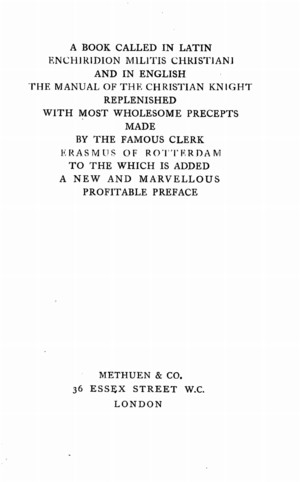
A Book Called in Latin Enchiridion Militis Christiani and in English The Manual of the Christian Knight, replenished with the most wholesome precepts made by the famous clerk Erasmus of Rotterdam, to which is added a new and marvellous profitable Preface (London: Methuen and Co., 1905).

About Liberty Fund:

Liberty Fund, Inc. is a private, educational foundation established to encourage the study of the ideal of a society of free and responsible individuals.


The seventh rule.

Chap. xvi.

Moreover if through infancy and feebleness of mind we cannot as yet attain to these spiritual things We must still be climbing yea though we despair to attain to the top., we ought nevertheless to study not the sluggisher one deal, that at the least we draw as nigh as is possible. How be it the very and compendious way to felicity is, if at once we shall turn our whole mind to the contemplation and beholding of celestial things so fervently, that as the body bringeth with him his shadow, even so the love of Christ, the love of eternal things and honest, bringeth with him naturally the loathsomeness of caduke and transitory things and the hate of filthy things. For either other necessarily followeth the other: and the one with the other either augmenteth or minisheth. As much as thou shalt profit in the love of Christ, so much shalt thou hate the world. The more thou shalt love and set by things invisible, the more vile shall wax things vain and momentary. We must therefore do even that same in the discipline of virtue which Fabius counselleth to be done in sciences or faculties of learning, that we at once press up to the best, which thing yet if through our own fault will not come to pass, the next of all is that we at the least may by certain natural prudence abstain from great vices, and keep ourselves (as much as may be) whole and sound to the beneficence of God. For as that body is near unto health, which (though it be wasted) is free yet and out of the danger of noisome humours, even so is that mind more capax of the benefit of God Capax apt to receive., which is not yet inquynate or defiled with grievous offences, though she lack yet true and perfect virtue. If we be too weak to follow the apostles, to follow the martyrs If thou cannot counterfeit holy saints, be not yet inferior to heathen men., to follow the virgins, at the least way let us not commit that the Ethnykes or heathen men should seem to over-run us in this plain or lists. Of the which very many when they neither knew God whom they should dread, neither believed any hell whom they should fear: yet determined they that a man ought by all crafts to avoid and eschew filthiness for the thing itself. In so much that many of them chose rather to suffer the loss of fame, loss of goods, in conclusion to suffer loss of life, than to depart from honesty. If sin itself be such a manner thing, that for no commodities or incommodities proffered to man it ought to be committed, certainly if neither the justice of God fear us, neither his beneficence discourage us and move us to the contrary, if no hope of immortality or fear of eternal pain call us aback, or else if the very natural filthiness of sin withdraw us not, which could withdraw the minds of the very gentiles, at the least way let a thousand incommodities which accompany the sinner in this life put a christian man in fear: Ponder in thy mind the incommodities of sin. as infamy, loss or waste of goods, poverty, the contempt and hate of good men, grief of mind, unquietness and torment of conscience most miserable of all, which though many feel not now presently, either because they be blinded with dulness of youth, or made drunk with the voluptuousness and pleasure of sin, yet shall they feel it hereafter: and plainly the later it happeneth, so much the more unhappily shall they feel it: wherefore young men most specially should be warned and exhorted that they would rather believe so many authors that the very nature and property of sin were thus indeed than with miserable and woful experience learn it in themselves, and that they would not contaminate nor defile their life before they knew surely what life meant. If Christ be to thee vile, to whom thou art so costly, at the leastway for thine own sake refrain thyself from filthy things. And though it be very perilous to tarry anywhile in this state, as between the ways (as it is in the proverb), nevertheless unto them which cannot as yet climb up to the pure, perfect and excellent virtue Hear that is in civil or moral virtues., it shall not be a little profitable to be in the civil or moral virtues rather than to run headlong in to all kind of vices and uncleanliness. Here is not the resting place and quiet haven of felicity, but from hence is a shorter journey and an easier stair up to felicity. In the mean season for all that, we must pray God that he will vouchsafe to pluck us up to better things.