EconlibThe LibraryOther Sites |
Front Page Titles (by Subject) CHAPTER XXIII.: On Exportation. - Letters to Mr. Malthus, and A Catechism of Political Economy
Return to Title Page for Letters to Mr. Malthus, and A Catechism of Political EconomyThe Online Library of LibertyA project of Liberty Fund, Inc.Search this Title:Also in the Library:
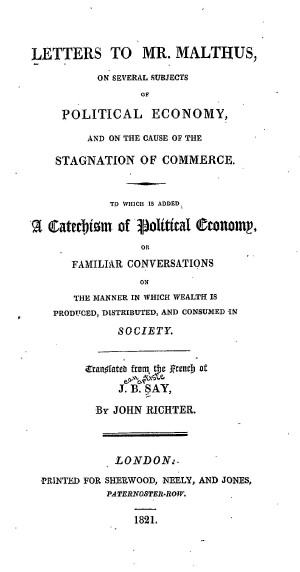
CHAPTER XXIII.: On Exportation. - Jean Baptiste Say, Letters to Mr. Malthus, and A Catechism of Political Economy [1821]Edition used:Letters to Mr. Malthus, on Several Subjects of Political Economy, and on the Cause of the Stagnation of Commerce. To Which is added, A Catechism of Political Economy, or Familiar Conversations on the Manner in which Wealth is Produced, Distributed, and Consumed in Society, trans. John Richter (London: Sherwood, Neely, and Jones, 1821).
About Liberty Fund:Liberty Fund, Inc. is a private, educational foundation established to encourage the study of the ideal of a society of free and responsible individuals. Copyright information:The text is in the public domain. Fair use statement:This material is put online to further the educational goals of Liberty Fund, Inc. Unless otherwise stated in the Copyright Information section above, this material may be used freely for educational and academic purposes. It may not be used in any way for profit.
CHAPTER XXIII.On Exportation.What does the word exportation signify? It signifies the selling and sending the indigenous productions of a country to foreign countries. Is it beneficial to a country to sell abroad its indigenous products? No doubt it is, for that multiplies its affairs, and its lucrative relations, which are always beneficial; and also it procures in return merchandise which we may seek for in vain in our own country, or which would cost much more. Does not a nation gain more by selling to strangers than to its own people? No; an internal market, when it produces the same profits as an external one, is quite as valuable to the nation, and is a better sign of increasing prosperity than exportation itself. In fact, if your fellow countrymen buy your goods, it is a proof that they produce something with which they can pay for them. When a stranger travels into another country and spends his money there, does not that country gain all the money he leaves behind? The country gains in that case, the value of the money which it has received from the traveller less than the value of the things which have been delivered to him in exchange for his money: for the value of what is given to him is as real as the value of the money received. The expenditure of a stranger produces an effect similar to an exportation of merchandise which is paid for in money. The profits made on this production are gained, and these profits are generally advantageous, because a traveller cannot dispute the prices of what is sold to him as rigorously as the foreign merchant who purchases the merchandise of a country. Is it beneficial to expend money in order to attract foreigners? What is spent with this view diminishes by so much the profit of the sales which are made to them; exactly as the premiums and rewards which are given to encourage exportation, are so much taken from the profits which result from it, and sometimes even exceed them. Why do most nations and most governments (who act in this case agreeably to the desires of those nations) endeavour by every means to increase the quantity of merchandise which they export to strangers, and to limit the quantity of those which they purchase from them? It is because they are unacquainted with the true source of riches. What is, according to them, the source of riches? The mines of gold and silver; and, as these are not in our country, they think that they cannot become rich without selling to foreigners merchandise of their own production, and compelling them to pay for them in the precious metals. On what do they found this opinion? On a merchant not gaining any thing on his merchandise until it is sent out of his warehouse, at which time he exchanges it for gold or silver money. Why does a nation, in regard to other nations, differ from a merchant in regard to his customers? A merchant, like a nation, sells his products only to repurchase others, which are either necessary for his consumption or fit for the continuation of his commerce. But a merchant does not find in his customer, precisely the man who can furnish him with the goods or materials which he wants, and at the most advantageous price. It is only with the money of the buyer that he can himself buy what he wants, and in the quantities that are convenient to him. It is not the same between one nation and another. The merchants, who are the agents of this communication, by the variety and the facility of their operations, are enabled to bring back in return for what they send out, merchandise which, if not useful to the dealer, whose products they have exported, will at least be so to some other. The last, in paying for it, will provide the means of paying the first. The interest of merchants in all these operations, is to obtain in return such merchandise as is most in demand, because it will sell the best. Would it not still be better that a neighbouring nation should pay us in money rather than in goods? You do not desire this money, but in order to use it in the purchase of goods of which you are in want. That is true; but when I have the money I am at liberty to employ it in the purchase of whatever I think proper. A foreign nation who pays you in merchandise, gives you only such merchandise as you are willing to receive, for you are at liberty to purchase in return whatever you please. But when she pays us in merchandise, this merchandise is consumed, and we lose the value of it; a loss which we should not have made if she had paid us in money. The loss you make does not come from the importation, but from the consumption, of the merchandise. If at the close of an external commercial operation there is a value consumed under the form of champaign, the loss is not greater than when at the close of an internal commercial operation, the same value had been consumed in cyder. The cyder would at least have been a product of the national industry. The foreign goods are equally products of the national industry, since they are products of its commerce. How does foreign commerce procure new values, new riches, since we must always give to foreigners a merchandise of equal value to that which they give to us? An example will make you understand this. A merchant sends stuffs to Brazil; he obtains in that country, in exchange for his stuffs, a greater value than he gave for them in Europe, because they have gained by the carriage. This value which he has gained, he there exchanges for cotton which he brings back to Europe, the value of which is also augmented by the carriage. When these operations are finished, although the merchant has exchanged, in each place, his merchandise at the current price; that is, value for value; still as the value of the different products have increased while they were in his hands, he has, without robbing the stranger of any value, brought back to his own country a value superior to that which he had exported; which is equivalent to a value created in the country. Every augmentation of riches, even in external commerce, is then the fruit of an internal production? Yes, with the exception of plunder, in exchange for which nothing is given. But besides spoliation being criminal, because it is contrary to justice, it is odious, and consequently dangerous, and the advantages which it procures are uncertain, temporary, and scarcely ever profitable. Why do you say, scarcely ever profitable? Because when we seize upon goods created by others, we rob them at the same time of the means of continuing to create new ones, and we can only enjoy them for once, as when we cut down a tree to get at its fruit. The goods thus obtained are besides of very little profit, because they are seldom obtained when wanted, or when they could be made a good use of, but must be taken when they can be got. They may be carried off; but the carriage itself constitutes a great part, and sometimes the whole of their value. They are consumed; and generally the greater part of them, on the spot; they are wasted rather than used, and their consumption often creates more evil than good. |

Titles (by Subject)