EconlibThe LibraryOther Sites |
Front Page Titles (by Subject) CHAPTER XX.: On Markets. - Letters to Mr. Malthus, and A Catechism of Political Economy
Return to Title Page for Letters to Mr. Malthus, and A Catechism of Political EconomyThe Online Library of LibertyA project of Liberty Fund, Inc.Search this Title:Also in the Library:
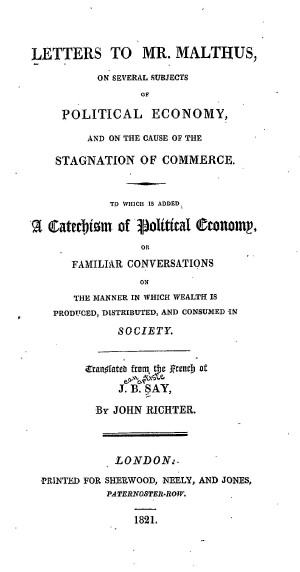
CHAPTER XX.: On Markets. - Jean Baptiste Say, Letters to Mr. Malthus, and A Catechism of Political Economy [1821]Edition used:Letters to Mr. Malthus, on Several Subjects of Political Economy, and on the Cause of the Stagnation of Commerce. To Which is added, A Catechism of Political Economy, or Familiar Conversations on the Manner in which Wealth is Produced, Distributed, and Consumed in Society, trans. John Richter (London: Sherwood, Neely, and Jones, 1821).
About Liberty Fund:Liberty Fund, Inc. is a private, educational foundation established to encourage the study of the ideal of a society of free and responsible individuals. Copyright information:The text is in the public domain. Fair use statement:This material is put online to further the educational goals of Liberty Fund, Inc. Unless otherwise stated in the Copyright Information section above, this material may be used freely for educational and academic purposes. It may not be used in any way for profit.
CHAPTER XX.On Markets.What do you mean by markets? Before answering this question, I beg you to remark, that those who engage in production are seldom occupied with more than one product, or at most a small number of products. A tanner produces nothing but leather; a clothier, cloth; one merchant deals in wine, another imports foreign goods; one cultivator raises the vine, another corn, a third cattle. What consequences do you draw from that? That none of them can enjoy the greatest part of the various articles for which he has occasion, except by means of exchanging the greater part of his own productions for those which he desires to consume: so that the greater part of the consumptions of society take place only in consequence of an exchange. But when we are able easily to exchange our own productions for those which we want, we are said to have found ready markets for our products. On what does the ready sale of any particular article depend? On the vivacity of the demand for it. On what does the vivacity of the demand depend? On two motives, which are—1st. The utility of the product, that is, the necessity the consumer has for it:—2d. The quantity of other products he is able to give in exchange. I conceive the first motive. As to the second, it appears to me that it is the quantity of money that the buyer possesses, which induces him to buy or not. That is also true: but the quantity of money which he has, depends on the quantity of product with which he has been able to buy this money. Could he not obtain the money otherwise, than by having acquired it by products? No. If he had received the money from his tenants . . . . ? His tenant had received it from the sale of part of the products to which the earth had contributed. If he had received the interest of a capital lent—? The undertaker who employed that capital had received the money which he paid, on the sale of a part of the products to which his capital had concurred. If the purchaser had obtained this money by gift or inheritance—? The giver, or he from whom the giver had obtained it, had it in exchange for some product. In every case the money, with which any product is purchased, must have been produced by the sale of another product; and the purchase may be considered as an exchange in which the purchaser gives that which he has produced, (or that which another has produced for him), and in which he receives the thing bought. What do you conclude from this? That the more the purchasers produce, the more they have to purchase with, and that the productions of the one procure purchasers to the other. It appears to me, that if the buyers only purchased by means of their products, they have generally more products than money to offer in payment. Every producer asks for money in exchange for his products, only for the purpose of employing that money again immediately in the purchase of another product; for we do not consume money, and it is not sought after in ordinary cases to conceal it: thus, when a producer desires to exchange his product for money, he may be considered as already asking for the merchandise which he proposes to buy with this money. It is thus that the producers, though they have all of them the air of demanding money for their goods, do in reality demand merchandise for their merchandise. Then the more merchandise there is produced, the more animated is the demand for merchandise? Without doubt. It is for this reason that countries, which are but little civilized, present few markets, and those for products but little varied; while in populous, industrious, and productive districts, the sales are repeated and considerable. It is not necessary then, in order that markets should be extended and multiplied, to look for them in foreign countries? No; it is sufficient that other products should be multiplied in our own country. What is it that multiplies foreign markets? The riches of neighbouring nations, and the activity of their production. What consequence do you draw from that? That each of them is interested in the prosperity of his neighbour, and every nation in the prosperity of all others: for it is only those who produce much that can readily give you any thing in exchange for your products: or which comes to the same thing, that can give you the value of them in money. What other consequence follows from this? That riches are not exclusive: that, so far from that which another man, or another people gains, being a loss to you, their gains are favourable to you; that it is only necessary for you to produce, not that which they produce easier than you, but that which they cannot fail to demand from you by means of their products; and that wars, entered into for commerce, will appear so much the more senseless as we become better informed. |

Titles (by Subject)