Econlib

The Library

Other Sites

Front Page arrow Titles (by Subject) arrow CHAPTER XVI.: On Property, and the Nature of Riches. - Letters to Mr. Malthus, and A Catechism of Political Economy

Return to Title Page for Letters to Mr. Malthus, and A Catechism of Political Economy

Search this Title:

Also in the Library:

Subject Area: Economics
Debate: Malthus: For and Against

CHAPTER XVI.: On Property, and the Nature of Riches. - Jean Baptiste Say, Letters to Mr. Malthus, and A Catechism of Political Economy [1821]

Edition used:

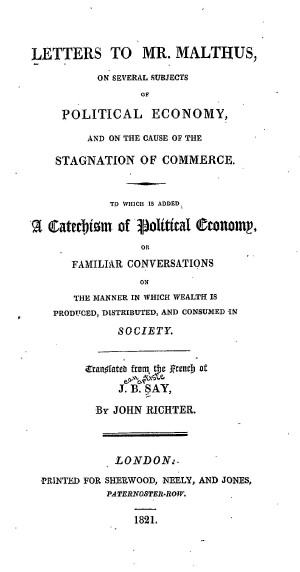
Letters to Mr. Malthus, on Several Subjects of Political Economy, and on the Cause of the Stagnation of Commerce. To Which is added, A Catechism of Political Economy, or Familiar Conversations on the Manner in which Wealth is Produced, Distributed, and Consumed in Society, trans. John Richter (London: Sherwood, Neely, and Jones, 1821).

About Liberty Fund:

Liberty Fund, Inc. is a private, educational foundation established to encourage the study of the ideal of a society of free and responsible individuals.


CHAPTER XVI.

On Property, and the Nature of Riches.

Can riches exist where there is no property?

No: for riches being composed of the value of the things which we possess, there can be no riches where no things are possessed; that is, no property.

Into how many classes can things possessed be arranged?

Into two grand classes: that which constitutes stock, and that which constitutes income.

What do you observe relative to the riches which constitute income?

That having been created without affecting our stock, they may be consumed without encroaching upon it; and that if we do not consume them improductively, they will increase our stock.

Do you not sub-divide that which constitutes our stock?

Yes: our stock may consist,

1st. Of land and other natural agents of which we are acknowledged proprietors;

2d. Of capital, or values produced, which we devote to reproduction:

3d. Of faculties, or talents, natural and acquired, which we employ for the same purpose.

What do you observe relatively to the riches which constitute our stock?

That we can alienate the property of the first two kinds of stock (our lands and our capitals) but not that of the third kind (our industrious talents). That we can let out to use all the three kinds. That the last is a life property, which perishes with us.

What have you further to observe respecting them?

That not being applicable to the satisfying of our wants, or of procuring enjoyments, because they are appropiated to reproduction, they are of no value, except for the faculty which they have of contributing to the production of some other consumable values. The demand which there exists for consumable values, that is, for products, establishes a demand for the stock which is capable of producing, that is, for land, capital, and industrious talents; this demand establishes their value, and this value makes a part of the riches of those to whom they belong.

Why have not a great number of natural agents necessary to production, as the heat of the sun, the air of the atmosphere; why have not these a value?

Because there is no demand for their productive faculties; and there is no demand for them, because when these faculties are present they exceed all wants, and are accessible to all mankind: and when they are not present, no person can provide them, because no one can appropriate them.

What results from this fact in relation to the value of products?

That when nature lends, gratuitously, her powers to the creation of products, the charges are less than when we must pay for assistance, and that we obtain consequently, products at a cheaper rate. It is for that reason that the grapes of the south do not cost so much as those of the north, which are raised in hot-houses.

You have said that riches are proportioned to the value of the things we possess, that is, that they are so much the greater as the values we possess are greater; have you any thing to add to this subject?

Riches are proportioned to the values we possess, or rather are only those values themselves: but these values are great or small in comparison with the price of the things which may be obtained for them. In other words, if with a certain sum in land, in capital, and in income, I can obtain the things I am in want of at half the price I have hitherto obtained them, by that alone, my riches are doubled.

Thus a nation which does not possess in nominal value more than one half what another nation possesses, will nevertheless be as rich, if she can procure all the products of which she is in want at half the price the other nation is obliged to pay.

The very height of riches, however few values one might possess, would be to be able to procure for nothing all the objects we wished to consume.

We should be at the lowest ebb of poverty, however immense might be the values we possessed, if the value of the things we wanted to consume exceeded the price which we were able to pay for them.

In what does the dearness and cheapness of things consist?

We will examine that in the next chapter.