EconlibThe LibraryOther Sites |
Front Page Titles (by Subject) CHAPTER III.: On Production. - Letters to Mr. Malthus, and A Catechism of Political Economy
Return to Title Page for Letters to Mr. Malthus, and A Catechism of Political EconomyThe Online Library of LibertyA project of Liberty Fund, Inc.Search this Title:Also in the Library:
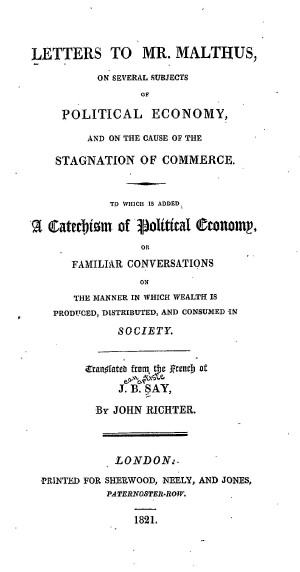
CHAPTER III.: On Production. - Jean Baptiste Say, Letters to Mr. Malthus, and A Catechism of Political Economy [1821]Edition used:Letters to Mr. Malthus, on Several Subjects of Political Economy, and on the Cause of the Stagnation of Commerce. To Which is added, A Catechism of Political Economy, or Familiar Conversations on the Manner in which Wealth is Produced, Distributed, and Consumed in Society, trans. John Richter (London: Sherwood, Neely, and Jones, 1821).
About Liberty Fund:Liberty Fund, Inc. is a private, educational foundation established to encourage the study of the ideal of a society of free and responsible individuals. Copyright information:The text is in the public domain. Fair use statement:This material is put online to further the educational goals of Liberty Fund, Inc. Unless otherwise stated in the Copyright Information section above, this material may be used freely for educational and academic purposes. It may not be used in any way for profit.
CHAPTER III.On Production.You have told me that to produce is to give utility to things: how is utility given? How are we to produce? In an infinity of ways; but for our convenience we may arrange, in three classes, every manner of producing. What is the first manner of producing? It consists in collecting or gathering together those things which nature creates, either without the intervention of man, such as fish and minerals; or, such as men have, by the cultivation of the earth, and by means of seeds, induced and assisted nature to produce. All these works are alike in their object. They are called Agricultural Industry. What utility is given to a thing by him who finds it ready made to his hands; as the fisherman who takes a fish, or the miner who collects minerals? He renders it fit for use. The fish, while it is in the sea, is useless. As soon as it is brought to the market we can make use of it. In like manner, it is in vain that coal exists in the bosom of the earth; while there, it is of no utility; it neither warms us, nor heats the iron in the forge: it is the industry of the miner that makes it fit for these purposes. He creates, by extracting it from the earth, all the value that it has when extracted. How does the cultivator create value? The materials, of which a sack of corn is composed, are not drawn from nothing; they existed before the corn was corn: they were diffused through the earth, the water, and the air, and had no value whatever. The industry of the cultivator, in taking measures to bring these different matters together, first under the form of grain, and afterwards of a sack of corn, created a value which they had not before. It is the same with all the other products of agriculture. What is the second manner of producing? It consists in giving to the product of another industry a greater value, by the new forms which we give to it, by the changes which it is made to undergo. The miner procures the metal of which a buckle is made; but a buckle, when made, is worth more than the metal of which it is formed. The value of the buckle above that of the metal is a value produced, and the buckle is the product of two kinds of industry: of that of the miner, and that of the manufacturer. This last is called manufacturing industry. What works are included in manufacturing industry? It includes the most ordinary as well as the most exquisite workmanship, the form given by a rough village artisan to a pair of wooden shoes, as well as that given to a piece of jewellery. It includes alike the work executed by a single cobler in his stall, and by hundreds of workmen in a vast manufactory. What is the third manner of producing? We produce also by buying a product in one place, where it is of a less value, and conveying it to another, where it is of greater value. This is the work of Commercial Industry. How does commercial industry produce utility, as it neither changes the form nor the substance of a product, which is sold just as it is bought? It acts like the fisherman, of whom we have just spoken; it takes a product from a place where it cannot be used; from a place, at least, where its uses are less extensive, less precious, to a place where they are more so, or where its production is less easy, less abundant, and dearer. Wood is little used, and consequently of very limited utility in the mountains, where it so far exceeds the wants of the inhabitants, that it is sometimes left to rot; this utility,* however, becomes very considerable when the same wood is transported into a city. Hides are of little value in South America, where they have a great number of wild animals: the same skins have a great value in Europe, where their production is expensive, and their uses much more multiplied. Commercial Industry, in bringing them, augments their value by all the difference between their price in Brazil and their price in Europe. What is comprehended under the term Commercial Industry? Every species of industry which takes a product from one place and transports it to another, where it is more precious, and which thus brings it within the reach of those who want it. It includes also, by analogy, the industry which, by retailing a product, brings it within the reach of small consumers. Thus the grocer, who buys merchandise in gross to resell it in detail in the same town; and the butcher, who buys whole beasts to resell them piece by piece, exercises Commercial Industry. Is there not great similarity between these different modes of producing? The greatest. They all consist in taking a product in one state, and delivering it in another, in which it has a greater utility and a higher value. They may be all reduced to one species. If we distinguish them here, it is to facilitate the study of their results, but notwithstanding all our distinctions it is often very difficult to separate one kind of industry from another. A villager, who makes baskets, is a manufacturer; when he carries them to market, he becomes commercial. But no matter by which means, the moment that we create or that we augment the utility of things, we augment their value, we exercise an industry, we produce wealth. For shortness, Agricultural Industry may be called Agriculture; Manufacturing Industry may be called Manufactures; and Commercial Industry, Commerce. [* ]We must never forget that, by the words utility of things, we mean the faculty they have of serving those purposes, to which man thinks proper to apply them. |

Titles (by Subject)