Econlib

The Library

Other Sites

Front Page arrow Titles (by Subject) arrow CHAPTER II.: On the Utility and Value of Products. - Letters to Mr. Malthus, and A Catechism of Political Economy

Return to Title Page for Letters to Mr. Malthus, and A Catechism of Political Economy

Search this Title:

Also in the Library:

Subject Area: Economics
Debate: Malthus: For and Against

CHAPTER II.: On the Utility and Value of Products. - Jean Baptiste Say, Letters to Mr. Malthus, and A Catechism of Political Economy [1821]

Edition used:

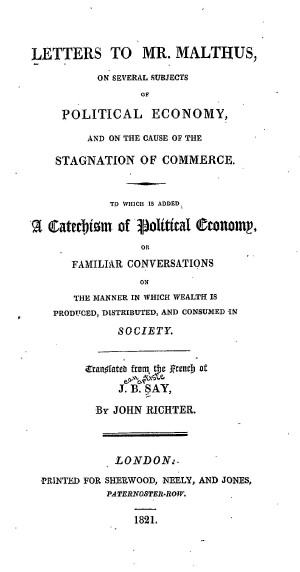
Letters to Mr. Malthus, on Several Subjects of Political Economy, and on the Cause of the Stagnation of Commerce. To Which is added, A Catechism of Political Economy, or Familiar Conversations on the Manner in which Wealth is Produced, Distributed, and Consumed in Society, trans. John Richter (London: Sherwood, Neely, and Jones, 1821).

About Liberty Fund:

Liberty Fund, Inc. is a private, educational foundation established to encourage the study of the ideal of a society of free and responsible individuals.


CHAPTER II.

On the Utility and Value of Products.

What do you understand by the word Products?

I understand all those things to which men have consented to give a value.

How is value given to a thing?

By giving it utility.

How is the utility of a thing the cause of its having a value?

Because persons are then to be found who are in want of this thing; they desire to have it from those who produce it. These, on their side, will not part from it until they are paid the expenses they have been at in producing it, including their profits. The value of the thing is established by the result of this opposition between the producer and the consumer.

But there are many things of great utility, and no value, as water. Why have they no value?

Because nature gives them gratuitously, and without stint, and we are not obliged to produce them. If a person was able to create water, and wished to sell it, no one would buy it, because it could be got at the river for nothing. Thus all the world enjoy these things, but they are not riches to any body. If all things that men could desire were in the same case, no one would be rich, but no one would be in want of riches, since each could enjoy all things at his pleasure.

But this is not the case: the greater part of things which are necessary and even indispensible to us, are not given to us gratuitously and unlimitedly. Human industry must, with pains and labour, collect, fashion and transport them.

They then become products. The utility, the faculty they have acquired of being serviceable, gives them a value and this value is riches.

When once riches are thus created they may be exchanged for other riches, other values, and we may procure the products which we want in exchange for those we can spare. We have seen in the preceding chapter how money facilitates this exchange.

I now conceive how products alone are riches; but their utility does not appear to be the only cause which gives them value; for there are products, such as rings and artificial flowers, which have value but no utility.

You do not discover the utility of these products because you call only useful that which is so to the eye of reason, but you ought to understand by that word whatever is capable of satisfying the wants and desires of man such as he is. His vanity and his passions are to him wants, sometimes as imperious as hunger. He is the sole judge of the importance that things are of to him, and of the want he has of them. We cannot judge of it but by the price he puts on them. The value of things is the sole measure of their utility to man. It is enough for us to give them utility in his eyes in order to give them a value. Now that is what we call to produce, to create products.

Recapitulate what you have said.

Give to any thing, to a material which has no value, utility, and you give it a value; that is, you make a product of it, you create wealth.

One can then create wealth?

Incontestibly.

I thought that man could not create any thing.

He cannot create matter: he cannot make the laws which regulate nature; but with existing matter and the laws of nature such as they are, he can give a value to certain things, and consequently can create wealth.

What country may be called a rich country?

One in which many things of value, or more briefly, many values are to be found; in the same manner as a family which possesses many of these values is a rich family.