Econlib

The Library

Other Sites

Front Page arrow Titles (by Subject) arrow LETTER II. - Letters to Mr. Malthus, and A Catechism of Political Economy

Return to Title Page for Letters to Mr. Malthus, and A Catechism of Political Economy

Search this Title:

Also in the Library:

Subject Area: Economics
Debate: Malthus: For and Against

LETTER II. - Jean Baptiste Say, Letters to Mr. Malthus, and A Catechism of Political Economy [1821]

Edition used:

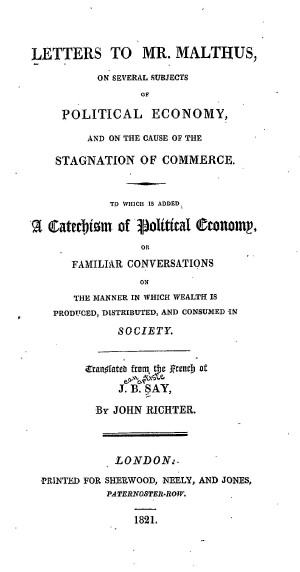
Letters to Mr. Malthus, on Several Subjects of Political Economy, and on the Cause of the Stagnation of Commerce. To Which is added, A Catechism of Political Economy, or Familiar Conversations on the Manner in which Wealth is Produced, Distributed, and Consumed in Society, trans. John Richter (London: Sherwood, Neely, and Jones, 1821).

About Liberty Fund:

Liberty Fund, Inc. is a private, educational foundation established to encourage the study of the ideal of a society of free and responsible individuals.


LETTER II.

Sir,

I think I have proved in my first letter that productions can only be purchased with productions: I do not therefore yet see any reason to abandon the doctrine, that it is production which opens a market to production. I have indeed considered as productions all the services arising from our personal capacities, from our capitals, and our lands; which has obliged me to sketch anew, and in other terms, the doctrine of production, which Smith evidently did not comprehend, and has not completely described.

But on reading again the third section of your 7th chapter (p. 351) I feel that there is still a point on which you will not agree with me. You will probably grant that productions can only be bought with productions; but you will persist in maintaining that people may create a quantity of produce in the whole exceeding their wants, and that consequently part of this produce can not be used; that there may be a superabundance and glut of all commodities at once. In order to present your objection in its full force, I shall transform it into a sensible image, by saying: Mr. Malthus will readily allow that 100 sacks of corn will buy 100 pieces of stuff, in a society which has occasion for those quantities of stuff and corn for its raiment and food; but if the same society should happen to produce 200 sacks of corn and 200 pieces of stuff, although these two commodities may still be exchangeable for each other, he will maintain that a part of each of them will no longer find purchasers. It is therefore necessary for me to prove, first, that whatever may be the quantity produced, and the consequent depression of price, a quantity produced of one species always suffices to enable those who have produced it to acquire the quantity produced of another species; and after proving that the possibility of acquiring exists, I shall endeavour to shew how the superabundance of productions creates a demand for it, for the purpose of consumption.

The farmer who produces corn, after having purchased the productive services of the land and capital which he employs, as well as those of his labourers, and added to these services that of his own personal labour, has consumed all those values to convert them into sacks of corn; let us suppose that each sack stands him in thirty shillings, including the value of his own labour, that is to say, his profit. On the other hand the manufacturer who produces stuffs of linen, woollen, or cotton, after having consumed in like manner the services of his capital, those of his workmen and himself, has produced stuffs which stand him also in thirty shillings the piece. If I may be permitted to jump at once to the main point of the inquiry, I will premise that this manufacturer of stuffs represents in my mind the producers of all manufactured produce, and this grower of corn the producers of all provisions and raw materials. The question is, whether their two articles of produce, to whatever quantities they may be multiplied, and whatever depression of price may result from that multiplication, can be wholly purchased by the producers, who are also at the same time the consumers; and how wants arise always in proportion to the quantity of productions.

We must first inquire into the course of things upon the hypothesis of a perfect liberty, permitting the indefinite multiplication of all productions; and we will afterwards examine the obstacles which the nature of things, or the imperfection of society opposes to this unrestricted freedom of production; but you will remark that the hypothesis of unrestricted production is more favourable to your cause, because it is much more difficult to dispose of unlimited produce than of that which is restricted; and that the hypothesis of production restricted sometimes by one cause and sometimes by another, is more favourable to mine, which supports the doctrine that these restrictions are the very causes which, by restraining certain productions, impede the purchases which might be made of the only productions which can be indefinitely multiplied.

Upon the hypothesis, then, of perfect liberty, suppose the grower brings to market a sack of corn, which including his profit, comes to thirty shillings, and the manufacturer brings a piece of stuff which comes to the same price, and consequently these productions will be exchangeable at par.* Of these two dealers, if one have gained more than his costs of production, he will draw into his line of business a part of the persons occupied in the production of the other article, until in both parts productive services shall be equally well paid: this is an effect generally allowed.

Here we ought to observe, that upon this supposition, the producers of the piece of stuff have altogether gained wherewith to repurchase that entire piece, or to buy any other product of equal value. If, for instance, it amounts to thirty shillings, including all expenses, as well as the profit of the manufacturer at the current rate, this sum is distributed amongst all the persons concerned in the production of the piece of stuff; but in unequal shares, according to the nature and amount of the services which they have rendered in the operation of its production. If the piece contain ten yards, he who has received six shillings can buy two yards of it; he who has received eighteen pence can only buy half a yard: but all of them together can certainly buy the whole piece. But if instead of the stuff, they wish to buy the corn, they are able, together, to purchase the whole quantity, since its value is the same with that of the stuff; so each of them can purchase, according to their respective occasions, either a part of the piece of stuff, or an equivalent portion of the sack of corn. He who has received for his services in either of these productions six shillings, may use three shillings in the purchase of a tenth part of the piece of stuff, and three shillings in buying a tenth of the corn; in all cases it is clear that all the producers possess collectively the means of acquiring the whole of the productions.

Now, Sir, come your objections. If commodities increase, or wants diminish, you say, commodities will fall to a price too low to pay the labour requisite for their production.*

In proceeding to answer this objection, I wish to premise, that if I consent to employ your word labour, which, according to the explanation given in my former letter, is incomplete, I shall comprehend under that denomination, not only the productive services of the workman and his master, but the productive services rendered by capital and land; services which have their price, as well as personal labour, and a price so strictly real, that the capitalist and the landholder live upon it.

This point being understood, I answer you in the first place, that the depression of the price of productions, does not prevent the producers from purchasing the labour which has created them, or any other equivalent labour. In our hypothesis, the grower of corn will, by an improved process, produce a double quantity of corn, and the manufacturer a double quantity of stuffs; and the corn and stuffs will fall to half their prices. What then? The producers of corn will receive for the same services as before, two sacks worth only what one sack was before worth, and the producers of stuffs will have two pieces together of the same value, as one piece had formerly been: In the exchange called production, the same services will have respectively obtained a double quantity of produce; but these double quantities may be acquired by each other as before, and as easily as ever; so that without a greater expense in productive services, a nation in which this productive faculty should be thus developed, would have double the quantity of commodities for consumption, in corn or stuffs, or even in other articles; as we have agreed to represent by corn and stuffs, all things of which men stand in need for their support and accommodation. Productions in such an exchange are valued against productive services; now as in every exchange, the value of one of the terms is greater in proportion to the greater quantity of the other which it obtains, it follows that productive services are increased in value in proportion as productions are increased in quantity, and diminished in price.* This is the reason why the reduction of the price of productions, by increasing the value of the productive funds of a nation and of the income derived therefrom, augments the national wealth. I think this demonstration, which may be seen at length in my Traité d’Economic Politique, 4th edition, book ii. ch. 3, has done some service to science, by elucidating what previously had been felt, but not explained; that is to say, that although wealth is an exchangeable value, the general wealth is increased by the low price of commodities and productions of all sorts.

Probably it never happened that the productive power of labour was suddenly doubled; and for all productions at once; but a gradual augmentation with respect to many articles, and in various proportions, has undoubtedly occurred. Among the antients, a scarlet mantle of equal fineness and size, solidity of texture and beauty of colour, to one of ours, cost unquestionably more than double the price it would cost amongst us; and I have no doubt that the corn, paid in labour, fell in value at least half at the unknown period of the invention of the plough. These articles, costing less labour, were, in consequence of the competition, given for what they cost, without any one being a loser; while all gained in their revenues by the event.

But to return to the first part of your objection: Thegrowers of corn and makers of stuffs will then produce more corn and stuffs than they can consume. Ah! my good Sir, after having proved that notwithstanding a fall of one half in the value of productions, the same labour may purchase the whole of them, and thereby procure an increase of as much again in the necessaries and luxuries of life, can it be necessary for me to prove to the justly celebrated author of the Essay on Population, that whatever is produced will find consumers, and that among the enjoyments procured by the quantity of productions which men can command, they do not place in the inferior ranks the comforts of a home, and the increase and preservation of their children? After having written three justly admired volumes, to prove that population always rises to the level of the means of subsistence, can you possibly have admitted the supposition of a great augmentation of produce, with a stationary number of consumers, and wants diminished by parsimony? (p. 355.)

Either the author of the “Essay on Population,” or the author of “Principles of Political Economy,” must be in the wrong. But every thing convinces us that it is not the former who is mistaken. Experience, as well as reasoning, demonstrates that a production, an article necessary or agreeable to man, is only rejected when people have not the means of paying for it. These means of purchasing are precisely those which establish the demand for a production, and give it a price. Not to want an useful thing is not to be able to pay for it. And what occasions this inability to pay for it? The being deprived of that which constitutes wealth: the being deprived of industry, land, or capital.

As soon as men are provided with the means of producing, they appropriate their productions to their wants; for production itself is an exchange, in which we offer (or supply) productive means, and demand in return the thing of which we feel the greatest want. To create a thing which no one wanted, would be to create a thing without value: it would not be to produce. But the moment it has a value, its producer may exchange it for other commodities which he may wish to procure.

This faculty of exchange, peculiar to man alone, among all the animals, adapts all productions to all wants; and permits him to depend, for his subsistence, not upon the kind of his production (for he can exchange it when he pleases, if it has value,) but upon its value.

The difficulty, you will say, is to create productions which shall be worth the costs of production. This I well know; and, in my next letter, you will find what I think on the subject. But upon the hypothesis which we have already supposed, of the freedom of industry, permit me to point out that the only difficulty we find in creating productions worth the costs of production, arises from the high demands of the vendors of productive services. Now the high price of productive services denotes that what is required exists; namely, that there are employments, the productions of which suffice to repay the costs of production.

You charge those who entertain the same opinions with me, with “not taking into consideration the influence of so general and important a principle in human nature, as indolence, or the love of case.” (p. 358.) You suppose the case that men, after having produced the means of satisfying their primary and most urgent wants, would prefer doing nothing more; the love of repose overbalancing in their minds the desire of enjoyment. This supposition is all in my favour. What do I say? That things are only sold to those who produce. Why are objects of luxury not sold to a farmer who chooses to lead a homely life? Because he prefers ease to the trouble of producing the means of purchasing objects of luxury. Whatever be the cause which limits production, whether the want of capital or of population, of diligence or liberty, the effect is, in my opinion, the same; the productions which are offered on one side are not sold, because sufficient commodities are not produced on the other.

You consider the indolence which refuses to produce as directly impeding the sale of productions, and I entirely agree with you on that point. But then, how can you look on the indolence of those whom you call unproductive consumers, as favourable to such sales. (c. vii. sect. 9.) “It is absolutely necessary,” you say, (page 463,) “that a country with great powers of production should possess a body of unproductive consumers.” How comes it that the indolence that refuses to produce is prejudicial to the markets in the former case, and favourable to them in the latter?

The fact is, this indolence is injurious to them in both cases. Whom do you designate by this numerous body of unproductive consumers, so necessary, according to you, to the producers? Is it the proprietors of lands and capitals? Undoubtedly they do not directly produce, but their instrument (their property) does it for them. They consume the value to the creation of which their lands and capitals have contributed. They therefore assist in production, and can only make purchases in consequence of this assistance. If they also contribute their personal services, and join to their profits as capitalists and landholders other profits as labourers, they can, by thus producing more, consume more; but it is not in their non-productive capacity that they increase the markets for the sale of productions.

Do you allude to public functionaries, the military, and fundholders? Still it is not on account of their non-productive quality that they increase the demand for produce. I am far from disputing the legitimacy of the emoluments which they receive; but I cannot believe that those who are taxed would be very much embarrassed by their money, even if these receivers of contributions did not come to their assistance: either their wants would be more amply satisfied, or they would employ this same money in a reproductive manner. In either case the money would be expended, and would promote the sale of some productions of equal value to what is now bought by those whom you call unproductive consumers. Confess then, Sir, that it is not through the unproductive consumers that sales are promoted, but by the productions of those who provide the means for their expenditure; and that even should all the unproductive consumers vanish, which heaven forbid, there would not be a pennyworth the less sold.

Nor do I know on what better foundation you decide (page 356,) that production cannot continue if the value of the commodities pays for but little labour beyond what they cost. It is by no means necessary to the continuance of production that a commodity should be worth more than the costs of its production. When an undertaking is begun with a capital of a hundred thousand pounds, it is sufficient to enable the proprietors to re-commence their operations, that the production which results from it should be worth a hundred thousand pounds. Where then, say you, are the profits of the producers? The whole capital has served to pay them;* and it is the price which it has paid to them which has formed the incomes of all the producers. If the produce which has been obtained be worth only one hundred thousand pounds, there is the capital reestablished, and all the producers are paid.*

I do not hesitate to strengthen your objection, by expressing it thus:—“Though each commodity may have cost the same quantity of labour and capital in its production, and they may be exactly equivalent to each other, yet they may both be so abundant, that they will not purchase more labour than they have cost. In this case, can production go on? Unquestionably not.

And why not, I pray? Why could not farmers and manufacturers, who had produced together to the amount of sixty shillings in corn and stuffs, and would, as I have demonstrated, be able to purchase the whole of those commodities, sufficient for their wants—why could they not recommence their operations after making such purchases, and consuming the articles bought? They would have the same lands, the same capitals, the same industry as before; they would be precisely where they began; and they would have lived and been supported by their incomes, by the sale of their productive services. What more is requisite for the preservation of society? The great phenomenon of production analyzed and viewed in its proper light, explains all.

After the fear which you have testified, Sir, lest the produce of society should exceed in quantity what it can and will consume, it is natural that you should behold with terror its capitals increasing by parsimony; for the endeavour to employ capital causes an augmentation of productions,—new sources of accumulation—whence new productions arise: in short, you seem to fear that we should be suffocated beneath the overwhelming mass of our riches. This fear, I confess, does not torment me at all.

Was it for you, Sir, to renew the popular prejudices against those who do not expend their incomes in objects of luxury? You allow (page 351,) that no permanent increase of wealth can take place without a previous increase of capital; you allow (page 352), that those who labour are consumers, as well as the unproductive consumers; and yet you fear that if accumulation goes on, it will be impossible to consume the still increasing quantity of commodities produced by these new labourers (p. 353).

We must remove your vain terrors; but first permit me one reflection on the subject of modern political economy. It is of a nature to guide us on our way.

What is it that distinguishes us from the economists of the school of Quesnay? It is the scrupulous care with which we observe the concatenation of the facts which relate to wealth: it is the rigorous exactness which we impose on ourselves in describing them. Now, in order to see and to describe clearly, one must to the utmost of one’s power remain a passive spectator. Not that we may not, ought not, indeed, sometimes to sigh at those operations, pregnant with ruinous effects, of which we are often the sad and impotent witnesses. The philanthropic historian is not prohibited from indulging in the mournful reflections which political iniquity frequently draws from him. But opinions and advice are not history; and, I insist, are not political economy. Our duty to the public is to inform it how and why one fact is the consequence of another. If it approves or fears the consequence, that is sufficient; it knows what it has to do: but let us avoid exhortations.

It appears, therefore, to me, that I ought not, after Adam Smith, to preach up parsimony; and that you should not, after Lord Lauderdale, extol dissipation. Let us confine ourselves to observing the manner in which things succeed, and are connected with each other in the accumulation of capitals.

In the first place, it is to be observed that the greater number of accumulations are necessarily slow. Every one, whatever be his income, has to live before he can save; and what I here call living, is, in general, so much the more expensive as the party is richer. In most cases and in professions, the support of a family and its establishment in life demands the whole income, and often the capital besides; and when there are some yearly savings, they are generally in a very small proportion to the capital actually employed. A man of business, with ten thousand pounds and a calling, gains, in ordinary cases, from twelve to fifteen hundred pounds per annum. Now with that capital, and a business of equal value, that is to say, with a fortune of twenty thousand pounds, he is economical if he only spends one thousand; he then saves annually only five hundred pounds or the twentieth part of his capital.

If this fortune be divided, as it often is, between two persons, one of whom supplies the capital, the other the industry, the saving will be still much less; because in this case two families are to live upon the united profits of the capital and industry, instead of one.* None but very great fortunes, of whatever nature, can allow great savings; and very great fortunes are rare in all countries. Therefore capital can never augment with a rapidity capable of producing sudden revolutions in industrious pursuits.

I am not sensible of the fears which caused you to say (p. 357), “That a country is always liable to an increase of the funds for the maintenance of labour faster than the increase of population.” Neither am I afraid of the enormous surplus of productions to result from an augmentation of capital so slow in its nature. On the contrary, I see these new capitals, and the revenues which issue out of them, distribute themselves in the most advantageous way, amongst the producers. First, the capitalist, by augmenting his capital, increases his income, which invites him to multiply his enjoyments. A capital increased in the course of the year, purchases the following year a few more industrious services than before. These services being thus more in demand, are a little better paid; a greater number of the industrious find employment and reward for their faculties. They labour, and consume unproductively the produce of their labour; so that, if there is more produce created in consequence of this augmentation of capital, there are also more productions consumed. Now what is this but an increase of prosperity?

You say (p. 352, 360), “That if savings are made only with a view to increase capital—if capitalists do not add to their enjoyments by augmenting their incomes, they have no sufficient motive to save; for men do not save merely through philanthropy, and to make industry prosper.” This is true, but what conclusion do you desire to draw from hence? If they save, I say, that they promote industry and production, and that this increase of production is distributed in the most advantageous manner to the public. If they do not save, I know not how to help it: but you cannot conclude from this that producers will be better off, for what the capitalists would have saved would nevertheless have been equally expended. In expending it unproductively, the expenditure has not been increased in amount. As to riches accumulated, without being reproductively consumed, such as the sums amassed in the miser’s coffers, neither Smith nor I, nor any one, undertakes their defence; but they cause very little alarm; first, because they are always very inconsiderable, compared with the productive capital of a nation; and secondly, because their consumption is only suspended. All treasures get spent at last, productively or otherwise.

I cannot perceive on what account you look upon reproductive expenditure, such as that which is occasioned by digging canals, building shipping, erecting manufactories or barns, constructing machines, paying artists and artisans, as less favourable to producers than unproductive expenditure, or that which has for its object only the personal gratification of the prodigal. You say (p. 363), “While the farmers were disposed to consume the luxuries produced by the manufacturers, and the manufacturers those produced by the farmers, all would go on smoothly; but if either one or both the parties were disposed to save, with a view of bettering their condition and providing for their families in future, the state of things would be very different.” That is to say, I presume, that all would go wrong! “The farmer, instead of indulging himself in ribbons, lace, and velvets, would be disposed to be satisfied with more simple clothing; but by this economy he would disable the manufacturer from purchasing the same amount of his produce: and for the returns of so much labour employed upon the land, and all greatly increased in productive power, there would evidently be no market. The manufacturer, in like manner, instead of indulging himself in sugar, grapes, and tobacco, might be disposed to save, with a view to the future, but would be totally unable to do so, owing to the parsimony of the farmers and the want of a demand for manufactures.”

And a little farther on (p. 365), “The population required to provide simple clothing to such a society, with the assistance of good machinery, would be inconsiderable, and would absorb but a small portion of the proper surplus of rich and well-cultivated land. There would evidently therefore be a general want of demand both for produce and population: and while it is quite certain that an adequate passion for consumption (unproductive) may fully keep up the proper proportion between supply and demand, whatever may be the powers of production, it appears to be quite certain that a passion for accumulation must inevitably lead to a supply of commodities beyond what the structure and habits of such a society will permit to be consumed.”

You go so far as to ask “what would become of the demand for commodities, if all consumption, except bread and water, were suspended for the next half year?”* and it is to me, by name, that you address this question.

In this passage and the foregoing, you assume implicitly as fact, that a production saved is abstracted from every species of consumption; although in all these discussions, in all the writings you attack, in those of Adam Smith, of Mr. Ricardo, in mine, and even in your own, it is laid down that a production saved is so much substracted from unproductive consumption to be added to capital, that is to say, to the value that is consumed reproductively. “What would become of commodities, if every species of consumption, except that of bread and water, were suspended for six months?” Why, Sir, they would be sold for a value every bit as great; for, after all, what would be thereby added to the sum of capital, would buy meat, beer, coats, shirts, shoes, furniture, for that class of producers whose savings had so enabled them to make purchases. But if they were to live on bread and water in order not to use their savings? - - - That is to say, you suppose that they would generally bind themselves to an extravagant fast from mere wantonness, and without any object whatever!

What would you reply, Sir, to him who should place among the derangements that might happen in society, the case of the moon’s falling on the earth? - - - - The thing is not physically impossible; it would only be requisite that the course of that planet in its orbit should be suspended, or even merely slackened by the approach of a comet. Nevertheless, I suspect you would be apt to discover something like impertinence in such a proposition; and I must own I think you would be very excusable.

Philosophy, indeed, does not reject the method of carrying principles to their extreme consequences, in order to exaggerate and discover their errors; but this exaggeration itself is an error when the nature of things itself presents continually increasing obstacles to the supposed excess, and thus renders the supposition inadmissible. To the disciples of Adam Smith, who think that saving is beneficial, you oppose the inconveniences of an excessive saving; but here the excess carries its remedy along with it. Wherever capital becomes too abundant, the interest which capitalists derive from it becomes too small to balance the privations which they impose upon themselves by their economy. It becomes more and more difficult to find good securities for investing money, which is then placed in foreign securities. The simple course of nature stops many accumulations. A great part of those which occur in families in good circumstances are stopped the moment it becomes necessary to provide for the establishment of children. The incomes of the fathers being reduced by this circumstance, they lose the means of accumulating at the same time that they lose part of the motives which induced them to save. Many accumulations are also stopped at the decease of the proprietor. An estate is divided amongst the heirs and legatees, whose situation is different from that of the deceased, and who often dissipate part of the inheritance instead of increasing it. That portion which the fiscal department seizes, is very sure to be dissipated, for the state does not employ it reproductively.

The prodigality and inexperience of many individuals, who lose part of their capitals in ill-concerted schemes, require to be balanced by the economy of many others. Every thing tends to convince us, that in what respects accumulation, as well as other matters, there is much less danger in leaving things to take their natural course, than in endeavouring to give them a forced direction.

You say (p. 495), “That in some cases it is contrary to sound principles of political economy to advise saving.” I repeat, Sir, that sound political economy is not apt to advise; it shews what a capital judiciously employed adds to the power of industry, in the same manner as sound agricultural knowledge teaches what a well-managed irrigation adds to the power of the soil; and after this it leaves to the world the truths which it demonstrates; of which every one is to avail himself according to his intelligence and capacity.

All that is required, Sir, of a man so enlightened as yourself, is, not to propagate the popular error, that prodigality is more favourable to producers than economy.* Mankind is already but too much disposed to sacrifice the future to the present. The principle of all amelioration is, on the contrary, the sacrifice of momentary temptations to future welfare. This is the first foundation of all virtue as well as of all wealth. The man who loses his character by violating a trust; he who ruins his health by giving way to his desires; and he who spends to-day his means of gain for to-morrow, are all equally deficient in economy: hence it has been said, with much reason, that vice is nothing, at the end of the account, but a bad calculation.

[* ]Does not the farmer, who sells a sack of corn for thirty shillings, and buys a piece of calico at thirty shillings, exchange his corn for the stuff? and does not the manufacturer, who buys a sack of corn at thirty shillings, being the price of his piece of stuff, exchange that piece for a sack of corn?

[* ]That I may not incur the charge of misrepresentation, while I am merely endeavouring to compress and render more perspicuous the meaning of the worthy professor, I copy the exact passages. “If commodities were only to be compared and exchanged with each other, then, indeed, it would be true that, if they were all increased in their proper proportions to any extent, they would continue to bear among themselves the same relative value; but if we compare them, as we certainly ought to do, with the numbers and wants of the consumers, then a great increase of produce with comparatively stationary numbers, and with wants diminished by parsimony, must necessarily occasion a great fall of value estimated in labour, so that the same produce, though it might have cost the same quantity of labour, would no longer command the same quantity”. . . .p. 355. “It is asserted that effectual demand is nothing more than the offering one commodity in exchange for another. But is this all that is necessary to effectual demand? Though each commodity may have cost the same quantity of labour and capital in its production, and they may be exactly equivalent to each other in exchange, yet why may not both be so plentiful as not to command more labour, or but very little more than they have cost; and in this case, would the demand for them be effectual? Would it be such as to encourage their continued production? Unquestionably not.” p. 355, 356.

[* ]That is, according to the English expression: when they (productions) do not command the same quantity of labour as before.

[]This demonstration, by the bye, completely overthrows an assertion of Mr. Malthus, that cheapness is always (must be) at the expense of profits (p. 370), and consequently all the reasoning which he has built on this foundation. It is also fatal to all that part of Mr. Ricardo’s doctrine, in which he flatters himself that he has proved, that the costs of production, and not the proportion of supply and demand, regulates the prices of goods. He identifies the costs of production with the production itself, whereas they are completely opposed to each other, and the former are diminished in proportion to the increase of the latter.

[* ]Some people imagine that when capital is employed in an undertaking the portion of this capital which is employed in purchasing raw materials, is not employed in purchasing productive services. This is an error. Raw material itself is a product, which has no other value than that which has been imparted to it by productive services, which have made it a product; have given it a value. When raw material is of no value, it employs no part of capital: when it must be paid for, this payment is only to reimburse the productive services which have created its value.

[* ]The profits which are made by a person who carries on any undertaking, are the reward of the labour and talents which he exerts in his business. He only continues this business while it produces such an income that he cannot expect a better in any other employment. He is one of the necessary producers, and his profits form part of the necessary charges of production.

[* ]This happens in France much more frequently than in England, where the rate of the profits of industry and interest of capital is too low in ordinary employments for the former to suffice for the support of a family who have no capital.

[* ]“What an accumulation of commodities! what a prodigious market, according to M. Say (says Mr. Malthus), would this event occasion!” The learned professor here totally mistakes the meaning of the word accumulation: accumulation is not non-consumption; it is the substitution of reproductive consumption for that which is unproductive. Besides, I never said that a product saved was a market opened; I said that a product made was a market opened for another product; and that is true, whether the value of it be unproductively consumed, or whether it be added to the savings of its proprietor, that is to say, to the reproductive expenditure which he intends to make.

[]“It must be allowed that the produce annually saved is as regularly consumed as that which is annually spent, but that it is consumed by a different set of people.”—Malthus’s Principles of Political Economy, p. 31.

[* ]“When there is more capital than is necessary in a country, to recommend saving is contrary to all principles of political economy. It is like recommending marriage to a people perishing with famine.”—Principles of Political Economy, p. 495. How came Mr. Malthus not to perceive that marriage gives birth to children, and consequently to new wants; whilst capitals have no wants, but, on the contrary, possess the means of satisfying them?