Econlib

The Library

Other Sites

Front Page arrow Titles (by Subject) arrow LETTER I. - Letters to Mr. Malthus, and A Catechism of Political Economy

Return to Title Page for Letters to Mr. Malthus, and A Catechism of Political Economy

Search this Title:

Also in the Library:

Subject Area: Economics
Debate: Malthus: For and Against

LETTER I. - Jean Baptiste Say, Letters to Mr. Malthus, and A Catechism of Political Economy [1821]

Edition used:

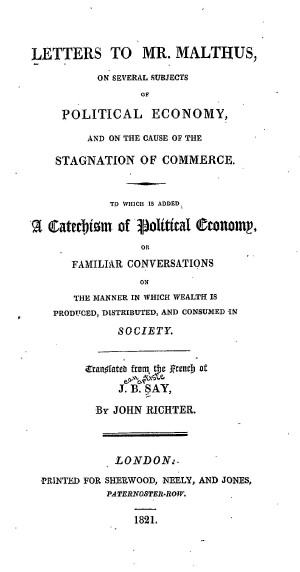
Letters to Mr. Malthus, on Several Subjects of Political Economy, and on the Cause of the Stagnation of Commerce. To Which is added, A Catechism of Political Economy, or Familiar Conversations on the Manner in which Wealth is Produced, Distributed, and Consumed in Society, trans. John Richter (London: Sherwood, Neely, and Jones, 1821).

About Liberty Fund:

Liberty Fund, Inc. is a private, educational foundation established to encourage the study of the ideal of a society of free and responsible individuals.


LETTER I.

Sir,

Every person who takes an interest in the new and interesting science of political economy, will certainly read the work with which you have lately enriched it. You are not one of those authors who claim the attention of the public, without having any information to communicate; and when the celebrity of the writer is added to the importance of the subject, when the question in debate is that momentous one to civilized society, namely, what are its means of existence and enjoyment? the curiosity of readers will undoubtedly be excited in an extraordinary degree.

I shall not attempt, Sir, to add my suffrage to that of the public, in pointing out the just and ingenious observations in your book; the undertaking would be too laborious. Nor shall I here discuss with you some points, to which, I think, you attach an importance which does not belong to them: I should be sorry to annoy either you or the public with dull and unprofitable disputes. But, I regret to say, that I find in your doctrines some fundamental principles which, if admitted under the imposing sanction of your authority, would occasion a retrograde movement in a science of which your extensive information and great talents are so well calculated to assist the progress.

In the first place my attention is fixed by the inquiry, so important to the present interests of society: What is the cause of the general glut of all the markets in the world, to which merchandize is incessantly carried to be sold at a loss? What is the reason that in the interior of every state, notwithstanding a desire of action adapted to all the developements of industry, there exists universally a difficulty of finding lucrative employments? And when the cause of this chronic disease is found, by what means is it to be remedied? On these questions depend the tranquillity and happiness of nations. A discussion therefore which tends to their illustration, I have not thought unworthy of your attention, or that of the enlightened public.

Since the time of Adam Smith, political economists have agreed that we do not in reality buy the objects we consume, with the money or circulating coin which we pay for them. We must in the first place have bought this money itself by the sale of productions of our own. To the proprietor of the mines whence this money is obtained, it is a production with which he purchases such commodities as he may have occasion for: to all those into whose hands this money afterwards passes, it is only the price of the productions which they have themselves created by means of their lands, capital, or industry. In selling these, they exchange first their productions for money; and they afterwards exchange this money for objects of consumption. It is then in strict reality with their productions that they make their purchases; it is impossible for them to buy any articles whatever to a greater amount than that which they have produced either by themselves, or by means of their capitals and lands.

From these premises I had drawn a conclusion which appeared to me evident, but which seems to have startled you. I had said, “As each of us can only purchase the productions of others with his own productions—as the value we can buy is equal to the value we can produce, the more men can produce, the more they will purchase.” Thence follows the other conclusion, which you refuse to admit: “that if certain goods remain unsold, it is because other goods are not produced; and that it is production alone which opens markets to produce.”

I am aware that this proposition has a paradoxical appearance, which creates prejudices against it; I know that common prejudices are more likely to support the opinions of those who maintain that there is too much produce, because every body is engaged in creating it: that instead of constantly producing, we ought to increase unproductive consumption, and devour our old capitals instead of accumulating new ones. This doctrine has indeed appearances on its side: it may be supported by arguments; and may interpret facts in its favour. But, Sir, when Copernicus and Galileo first taught that the sun (although it was daily seen to rise in the east, ascend majestically to the meridian, and decline at evening in the west) never moved from its station, they also had to contend with universal prejudice, the opinion of antiquity, the evidence of the senses: ought they to have renounced the demonstrations resulting from sound philosophy? I should wrong you, were I to doubt of your answer.

To proceed. When I advance that produce opens a vent for produce; that the means of industry, whatever they may be, when unshackled, always apply themselves to the objects most necessary to nations, and that these necessary objects create at once new populations and new enjoyments for those populations, all appearances are not against me. Let us only look back two hundred years, and suppose that a trader had carried a rich cargo to the places where New York and Philadelphia now stand; could he have sold it? Let us suppose even, that he had succeeded in founding there an agricultural or manufacturing establishment; could he have there sold a single article of his produce? No, undoubtedly. He must have consumed them himself. Why do we now see the contrary? Why is the merchandize carried to, or made at Philadelphia or New York, sure to be sold at the current price? It seems to me evident that it is because the cultivators, the traders, and now even the manufacturers of New York, Philadelphia, and the adjacent provinces, create, or send there, some productions, by means of which they purchase what is brought to them from other quarters.

Perhaps it will be said that “what is true with respect to a new state, may not be applicable to an old one: that there was in America room for new producers and new consumers; but in a country which already contains more producers than sufficient, additional consumers only are wanting.” Permit me to answer, that the only true consumers are those who on their side produce, because they alone can buy the produce of others; and that unproductive consumers can buy nothing, unless by means of the value created by those who produce.

It is probable that so early as the time of Queen Elizabeth, when England was not half so populous as at present, it was already found that the number of hands exceeded the quantity of employment: I desire no other proof of it than the poor law of that period, the consequences of which constitute one of the plagues of England. The principal object of it is to furnish work to the unfortunate who cannot obtain employment. They had no employment, in a country which has since been able to employ twice or thrice the number of workmen! How happens it, Sir, how happens it that, however unfortunate the situation of Great Britain may now be, much greater quantities of various kinds of goods are now sold there than in the time of Elizabeth? Whence can this arise, unless from the fact that the produce of that country is now greater? One man produces an article which he exchanges for another article produced by his neighbour. The means of subsistence having become greater, the population has increased, yet every one has been better provided for. It is the power of producing which makes the difference between a country and a desert; and a country is so much the more advanced, so much the more populous, and so much the better provisioned, as it increases in productions.

You will probably not object to this observation, which appears so obvious; but you deny the consequences which I draw from it. I have advanced that whenever there is a glut, a superabundance, of several sorts of merchandize, it is because other articles are not produced in sufficient quantities to be exchanged for the former; and if those who produce the latter could provide more of them, or of other goods, the former would then find the vent which they required: in short, that the superabundance of goods of one description arises from the deficiency of goods of another description. You, on the contrary, assert that there may be a superabundance of goods of all sorts at once; and you adduce several facts in favour of your opinion. M. Sismondi had already opposed my doctrine; and I am happy to quote here his strongest expressions, that I may not deprive you of any of your advantages, and that I may answer you and M. Sismondi at once.

“Europe,” says that ingenious author, “has in every part arrived at the point of possessing industry and manufacturing power superior to its wants.” He adds that the glut which results from it begins to affect the rest of the world: That, “In reading the commercial reports, the journals and accounts of travellers, we see on every side proofs of the superabundant production which exceeds consumption; of the manufacturing industry which is proportioned, not to the demand, but to the capital employed; of that mercantile activity which impels the merchants in crowds to every new market, and exposes them by turns to ruinous losses, in every branch of commerce from which they looked for profit. We have seen merchandize of every description, but above all that of England, the great manufacturing power, abounding in all the markets of Italy in a proportion so far exceeding the demand, that the merchants, in order to realize even a part of their capital, have been obliged to dispose of them at a loss of a fourth or a third, instead of obtaining any profit. The torrent of commerce repelled from Italy, flowed upon Germany, Russia, and Brazil, and soon found in those countries similar obstacles.

“The latest journals announce similar losses in new countries. In August 1818, they complained at the Cape of Good Hope that all the warehouses were filled with European merchandize, which, although offered at lower prices than in Europe, could not be sold. Similar complaints were made in June at Calcutta. Presently a strange phenomenon was seen, that of England sending her cotton goods, &c. to India, and consequently succeeding in working cheaper than the half-naked people of Hindostan, by reducing her workmen to a still more miserable existence! But the extraordinary direction thus given to commerce has not lasted long: even now, English manufactures are cheaper in the Indies than in England itself. In May, it it was found necessary to re-export from New Holland European merchandize which had been carried thither in excessive quantities. Buenos Ayres, New Granada, and Chili, are already sending back goods in a similar way.

“Mr. Fearon’s journey in the United States, concluded only in the spring of 1818, presents the same spectacle in a manner still more striking. From one extremity of that vast and prosperous continent to the other, there is not even a village where the quantity of merchandize offered for sale is not infinitely superior to the means of the buyers, although the merchants labour to allure them by very long credits, and facilities of every kind for the payments, which they receive by instalments and in goods of every description.

“There are no facts which present themselves to us in so many places, and so many forms, as the disproportion between the means of consumption and the means of production—the inability of those who produce to abandon an employment when it becomes unprofitable,—and the certainty that their numbers are never reduced but by failures. How does it happen that philosophers refuse to perceive what meets the eyes of the vulgar in every direction?

“The error into which they have fallen arises entirely from the false principle that production is the same thing as revenue. Mr. Ricardo, following M. Say, thus repeats and confirms it. ‘M. Say has proved in the most satisfactory manner,’ he says, ‘that there is no capital, however considerable, which cannot be employed, because the demand for production is limited only by production. No one produces any thing but with the intention of consuming or selling the thing produced; and nothing is ever sold but for the purpose of buying some other product, either of immediate utility, or calculated to contribute to future production. The producer therefore becomes the consumer of his own produce, or the purchaser and consumer of the produce of some other person.’ Upon this principle,” says M. Sismondi, “it becomes absolutely impossible to comprehend or explain the most established fact in the history of commerce—the glut of markets.”*

I must remark to those to whom the facts which M. Sismondi justly regrets appear conclusive, that they are indeed conclusive, but that they are conclusive against himself. The quantity of English merchandize offered for sale in Italy and elsewhere is too great, because there is not sufficient Italian or other produce suitable to the English market. A country purchases only that for which it can pay; for, if it did not pay, people would soon tire of selling to it. But with what articles can the Italians pay the English? with oils, silks, and raisins; and besides those and a few other articles, if they would still acquire English produce, how are they to pay for them? With money! But they must first acquire the money itself with which they are to pay for the English produce. You perceive, Sir, that to acquire foreign productions, a nation must, like an individual, have recourse to its own productions.

It is said that the English sell at a loss in those places which they inundate with their merchandize. This I believe to be true: they multiply the goods offered, which depreciates them; and they demand in return, as far as it is practicable, money only, which therefore becomes more rare and valuable. Being thus enhanced in value, money is given in smaller quantities in every exchange; and this is the reason why they are people obliged to sell at a loss. But suppose for an instant that the Italians possessed more capital; that they employed their lands and their industrious faculties to greater advantage; in short that they produced more; and suppose, at the same time, that the English laws, instead of having been modelled upon the absurd principles of the balance of trade, had admitted on moderate terms all that the Italians had been capable of furnishing in payment for the English productions; can you doubt that the English merchandize which incumbers the ports of Italy, and great quantities of other merchandize besides, would have been disposed of with facility?

Brazil, that vast country, so favoured by nature, might absorb a hundred times as much English merchandize as is now vainly sent there without finding a market; but it would first be requisite that Brazil should produce all that it is capable of producing; and how is that wretched country to attain that desirable object? All the efforts of the citizens are paralyzed by the government. If any branch of industry offers there the prospect of gain, it is instantly seized and stifled by the hand of power. Does any one find a precious stone, it is taken from him. Fine encouragement this to exert productive industry for the purpose of buying with its produce European merchandize!

The English government, on its part, by custom and import duties, refuses admission to the productions which the English might obtain by exchanges with foreigners; and even to the articles of food of which their manufacturers stand so much in need; and this because it is necessary that the English farmers should sell their corn at more than 80s. the quarter, to enable them to pay their excessive taxes. All these nations complain of a state of suffering into which they have been brought by their own fault; like diseased persons who bewail their maladies, and at the same time obstinately refuse to abandon the excesses which have caused them.

I know that it is not so easy to root up an oak as to pull up a weed; I know that old fences, however rotten, cannot be overthrown when they are supported by the heaps of filth which have accumulated beneath their shelter; I know that certain governments, corrupted and corrupting, stand in need of monopolies, and of custom duties, to pay for the votes of the honourable majorities which pretend to represent nations: I am not so unreasonable as to expect them to govern so entirely according to the general interest, as to be able to obtain the votes without paying for them; but, at the same time, why should I be astonished that such vicious systems have deplorable consequences?

You will, I presume, readily agree with me, as to the injuries which nations mutually sustain by their mutual jealousies, by the sordid interest or the inexperience of those who take upon themselves to be their organs; but you maintain, that even supposing they possessed more liberal institutions, the goods produced might exceed the wants of the consumers. Well, Sir, on this ground I am willing to rest my defence. Let us leave out of the question the war carried on between nations by means of their revenue officers; let us consider each nation in its relations with itself; and let us inquire, once for all, whether we have not the means of consuming what we have the means of producing.

“M. Say, Mr. Mill, and Mr. Ricardo,” you say, “the principal authors of the new doctrines on profits, appear to me to have fallen into some fundamental errors on this subject. In the first place they have considered commodities as if they were so many mathematical figures, or arithmetical characters, the relations of which were to be compared, instead of articles of consumption, which must of course be referred to the numbers and wants of the consumers.”*

I know not, Sir, at least so far as I am concerned, upon what foundation you have built this assertion. I have repeated, in a great variety of forms, this idea, that the value of things (the only quality by which they become wealth) is founded on their utility; on the aptitude which they possess to satisfy our wants. “The want which we have for any thing,” I have said,* “depends on the physical and moral nature of man, on the climate which he inhabits, and the manners and laws of his country. He is subject to bodily wants, to mental and spiritual wants; some things he wants on his own account, others for his family; and others he requires as a member of society. A bear-skin and a rein-deer are to a Laplander objects of the first necessity; whilst the very names of them are wholly unknown to a lazzarone of Naples. The latter, for his part, can dispense with every other thing, if he is plentifully supplied with macaroni. In like manner, courts of justice, in Europe, are considered the strongest bonds of civil society; while the natives of America, the Arabs, and the Tartars, do very well without them - - -

“Of these wants, some are satisfied by the use which we make of certain things with which nature furnishes us gratuitously; as air, water, and the light of the sun. We may call these things natural riches, because the charges of their production is defrayed by nature herself. As she gives them without distinction to all, nobody is obliged to purchase them at the price of any sacrifice whatever. They have therefore no exchangeable value.

“Other wants can only be satisfied by the use which we make of certain things to which their utility could not have been given, without having subjected them to a modification, without having produced a change in their condition; without having, for this purpose, surmounted a difficulty of some kind. Such are the various goods which we can only obtain by the processes of agriculture, commerce, or the arts. These only have an exchangeable value. The reason of this is evident: they are, by the mere fact of their production, the result of an exchange, in which the producer has given his productive services, in order to receive this product. They cannot therefore be obtained from him, except by virtue of another exchange, in which some other product is given to him, which he may consider of equal value with his own.

“These things may therefore be called social riches, because no exchange can take place without a social relation, and because it is only in a state of society that the right of possessing exclusively what has been obtained by production or exchange, can be guaranteed.”

I add, “Let us observe at the same time, that social riches are, as riches, the only ones which can become the object of scientific study; first, because they are the only ones which can be appreciated, or at least the only ones of which the appreciation is not arbitrary; and, secondly, because they alone are formed, distributed, and destroyed, according to laws which we are able to assign.”

Is this to consider productions as algebraic signs, by abstracting them from the number of consumers and the nature of their wants? On the contrary, does not this doctrine establish that our wants alone induce us to make the sacrifices by means of which we obtain productions? These sacrifices are the price which we pay to procure them; you, like Smith, call these sacrifices by the name of labour, an inadequate expression, for they are partly composed of the use derived from land and capital. I call them productive services. They have everywhere a current price. When that price exceeds the value of the thing produced, the result is a disadvantageous exchange, in which the value consumed is greater than the value created. When a production has been created equal to the value of the services employed, those services are paid by the production, the value of which, distributed among the producers, forms their revenues. You see that the existence of these revenues depends upon the production having an exchangeable value, which it can only have in consequence of the want which there is for such production in the actual state of society. Therefore I do not abstract this want, or give it an arbitrary appreciation; I take it for what it is, for what the consumers make it to be. I could have cited, had it been necessary, the whole of my third book, which details the different modes, motives, and results of consumption, but I will not trifle with your time and attention:—let us proceed.

You say,* “It is by no means true, as a matter of fact, that commodities are always exchanged for commodities. The great mass of commodities is exchanged directly for labour, either productive or unproductive; and it is quite obvious that this mass of commodities, compared with the labour with which it is to be exchanged, may fall in value from a glut just as any one commodity falls in value, from an excess of supply, compared either with labour or money.” Permit me to remark, in the first place, that I never said, commodities are always exchanged for commodities; but that productions can only be purchased by productions.

Secondly, that even those who admit this expression of commodities might answer you, that when commodities are given in exchange for labour, these commodities are in reality given in exchange for other commodities, that is to say, for those which result from the labour which has been purchased. But this answer is insufficient for those who embrace in a more extended and complete view, the phenomenon of the production of our riches. Allow me to place it before your eyes in a striking form. The public, which is to judge between us, will, I think, be thus materially assisted in appreciating your objections and my answers.

To obtain a better view of the operations of industry, capital, and land, in the work of production, I personify them: and I discover that all these personages sell their services, which I call productive services, to a speculator, who may be either a trader, a manufacturer, or a farmer. This speculator having purchased the services of a landed estate, by paying a rent to the proprietor; the services of a capital, by paying interest to the capitalist; and the industrious services of workmen, factors, agents of whatever description, by the payment of salaries;—consumes all these productive services, annihilates them; and out of this consumption comes a production which has a value.

The value of this production, provided it be equal to the costs of production, that is to say, to the sum necessarily advanced for all the productive services, suffices to pay the profits of all those who have concurred directly or indirectly in this production. The profit of the speculator on whose account this operation has been effected, deducting the interest of the capital which he may have employed, represents the remuneration for his time and talents; that is to say, his own productive services employed in his own behalf. If his abilities be great, and his calculations well made, his profit will be considerable. If instead of talent he evinces inexperience in his affairs, he may gain nothing; he may very probably be a loser. All the risks attach to the speculator; but on the other hand he takes the advantage of all the favourable chances.

Every production which we see, or which our imagination conceives, is formed by operations which resolve themselves, without exception, into those which I have described, but combined in an infinity of different manners. What some speculators are doing for one sort of production, others perform for another sort. Now, it is the exchanging of these articles one for another which constitutes a market for each. The greater or less want that exists for one of these productions, compared with the others, determines the greater or less price which is given to obtain it; that is to say, the greater or less quantity of any other production. Money is in these transactions only a transient agent, which, when once the exchange is completed, is no farther concerned in it, and flies to effect other exchanges.

It is with the rent, interest, and wages, which form the profits resulting from this production, that the producers buy the objects of their consumption. These producers are at the same time consumers; and the nature of their wants, influencing in different degrees the demand for different kinds of produce, is always favourable, where liberty exists, to the most necessary kind of production; because that, being the most in demand, affords to those who produce it the greatest profits.

I said that in order to see how industry, capital, and land respectively act in productive operations, I personified them, and observed them in the services they rendered. But this is not a gratuitous fiction; it is a fact. Industry is represented by the industrious of all classes; capital, by capitalists; land by its proprietors. These are the three orders of persons who sell the productive services of the instrument they possess, and stipulate the remuneration for its employment. My expressions may perhaps be objected to; but it will then be incumbent on those who find fault with them, to propose better, for it is impossible to deny that this is the course of the transactions. I have stated the fact. The manner of the painter may be criticized, but the facts represented defy contradiction; there they are, and they will defend themselves.

To return to your assertion. You say, Sir, that many commodities are purchased with labour; and I go farther than you: I say, they are all purchased with labour, extending that expression to the services rendered by capital and land.* I say that they cannot be purchased by any other means; that the value and utility of things in all cases are produced by such services; and that the alternative is thus presented to us: either to consume ourselves the utility, and consequently the value which we have produced, or to employ it in the purchase of the utility and value produced by others; that in both cases we purchase commodities with productive services, and that the more productive services we carry to market, the more we can buy in return.

You assert that there are no immaterial productions.* Why, Sir, originally there were no other. A field, for instance, furnishes towards production only its service, which is an immaterial product. It serves as a crucible into which you put a mineral, and extract metal and dross. Is there any part of the crucible in these products? No; the crucible serves for a new productive operation. Is there any portion of the field in the harvest which is obtained from it? I answer likewise, No; for if land were thus gradually consumed, it would cease to exist in a few years: the land only returns what is put into it; but returns it after an elaboration, which I call the productive service of the field. Possibly some people may quibble on the word. I do not apprehend any quibbles that may be attempted as to the thing, because that is undeniable, and wherever political economy shall be studied, will be acknowledged as the fact, whatever name people may think proper to give it.

The service rendered by capital in any undertaking whatever, commercial, agricultural, or manufactoral, is likewise an immaterial product. He who consumes a capital unproductively destroys the capital itself; he who consumes it reproductively, consumes the material capital, and also the service of that capital, which is an immaterialproduct. When a dyer puts indigo, to the value of a thousand francs, into his copper, he consumes material produce worth a thousand francs; and, besides, he consumes the hire of this capital, its interest. The dye which he obtains, returns to him the value of the material capital employed, and also the value of the immaterial service of the same capital. The service of the workman is likewise an immaterial product. The workman comes out of the manufactory at night with the ten fingers which he carried into it in the morning. He has left nothing material in the workshop. It is then an immaterial service which he has furnished towards the productive operation. This service is the daily or annual produce of a fund or estate which I call his industrious faculties, and which compose his riches: miserable riches! particularly in England; - - and I know the reason.

All these are immaterial productions, which, call them as you please, will still be immaterial productions, exchangeable mutually one with another, exchangeable for material productions; and which, in all exchanges, will still seek their market-price, founded, like every market-price in the world, upon the proportion between the supply and demand.

These services, of industry, capital, and land, which are products independent of all matter, form all our revenues, much as we are - - - - What! all our revenues immaterial!!! Yes, Sir, All: otherwise the mass of matter which composes the globe would increase every year; it must happen so, for we should every year have new material revenues. We neither create nor destroy a single atom. All that we do is to change the combinations of things; and all that we add is immaterial. It is value; and it is this value which is immaterial also, that we daily, annually consume, and upon which we live; for consumption is a change of form given to matter, or, if you prefer the expression, a derangement, as production is an arrangement of form. If you find a paradoxical appearance in these propositions, examine the things which they express, and I have no doubt they will appear very simple and reasonable.

Without this analysis, I defy you to explain the whole of the facts; for instance, how the same capital is twice consumed: productively, by a speculator, and unproductively, by his workman. By means of the foregoing analysis, it may be seen how the workman brings to market his labour, the fruits of his ability; he sells it to the master, carries home with him his wages, which forms his revenue, and consumes it unproductively. But the master, who has bought the labour of the workman with a part of his capital consumes it reproductively, as the dyer consumes reproductively the indigo thrown into his copper. These values having been consumed reproductively, reappear in the production which comes out of the hands of the master. It is not the capital of the master which forms [Editor: illegible word] revenue of the workman, as M. Sismondi pretends. The capital of the master is consumed in the workshops. and not in the maintenance of the workman. The value consumed by the latter has another source; it is the produce of his industrious faculties. The master devotes to the purchase of the workman’s labour a part of his capital. Having purchased it, he consumes it; and the workman consumes, on his part, the value which he has obtained in exchange for his labour. Wherever there is exchange, there are two values created and bartered one for the other; and wherever two values are created, there must be, and there are, in effect, two consumptions.*

It is the same with the productive service rendered by capital. The capitalist who lends, sells the service, the labour of his instrument; the daily or annual hire, which a speculator pays him for it, is called interest. The terms of the exchange are, on one side, the service of the capital, on the other, the interest. The speculator, while he consumes reproductively the capital, also consumes reproductively the service of the capital. The lender, on the other hand, who has sold the service of the capital, consumes the interest unproductively, which is a material value given in exchange for the immaterial service of the capital. Ought we to wonder that there should be a double consumption, that of the speculator to make his production, and that of the capitalist to satisfy his wants, since there are the two terms of an exchange, two values drawn from two different funds, bartered for each other, and both capable of consumption?

You say, Sir, that the distinction between productive and unproductive labour is the corner-stone of Adam Smith’s work; that to recognise as productive, labours which are not fixed in any material object (as I do) is to overturn that work from top to bottom.* No, Sir; that is not the corner-stone of Smith’s work; for when that stone is removed, the edifice, although imperfect, remains as solid as before. What will eternally sustain that excellent book is, that it proclaims in every page that the exchangeable value of things is the foundation of all riches. From the publication of that important truth, political economy became a positive science; for the market-price of every thing is a determinate quantity of which the elements may be analysed, the causes assigned, the relations studied, and the consequences foreseen. Permit me, Sir, to say that to separate this essential character from the definition of wealth, is to plunge the science again into the depths of obscurity—to drive it back.

Instead of weakening the authority of the celebrated Inquiry into the Wealth of Nations, I support it in the most essential part; but at the same time I think Adam Smith has forgotten some real exchangeable values, in omitting those which are attached to such productive services as leave no trace because they are totally consumed; I think that he has likewise misunderstood services unquestionably real, which even leave their traces in material produce; such are the services of capital, consumed independently of the consumption of the capital itself; I think that he fell into infinite obscurities through omitting to distinguish, in the course of production, the consumption of the industrious services of a speculator from the services of his capital; a distinction which nevertheless is so real, that there is scarcely any commercial association whose regulations do not contain clauses relative to it.

I revere Adam Smith—he is my master. When I took the first steps in political economy, and when still tottering I was pushed by the advocates of the balance of commerce on the one side, and the advocates of net produce on the other, I stumbled at every move—he shewed me the true path. Supported by his Wealth of Nations, which shews at the same time his own intellectual wealth, I learned to go alone. Now I have ceased to belong to any school, and I shall escape the sort of ridicule which attached to the reverend father Jesuits who translated the Elements of Newton with annotations. They were sensible that physical laws would not square very well with those of Loyola; they therefore took care to inform the public by an advertisement, that, although they had apparently demonstrated the motion of the earth to complete the theory of celestial physics, they nevertheless bowed with submissive acquiescence to the decrees of the Pope, who did not acknowledge this motion. I submit only to the decrees of eternal reason, and am not afraid to declare it: Adam Smith has not embraced all the phenomena of the production and consumption of wealth; but he has done so much that we ought to feel the deepest gratitude for his exertions. The most vague and obscure of all the sciences, will, thanks to his researches, soon become the most precise, and leave fewer facts unexplained than any of the others.

Let us then figure to ourselves the producers (by which name I mean as well the possessors of capital and of land, as the possessors of industrious faculties); let us imagine them pressing forwards with emulation to offer their productive services, or the utility derived from them, (an immaterial quality). This utility is their production. Sometimes it is fixed in a material object, which passes with the immaterial produce, but which in itself is of no importance, is nothing in political economy; for matter deprived of value is not wealth. Sometimes it passes, sold by one and bought by another, without being fixed in any substance—as the advice of the physician, that of the lawyer, the service of the soldier, and of the public functionary. All these exchange the utility which they produce for that which is produced by others; and in as many of these exchanges as are abandoned to free competition, according as the utility offered by Paul is more or less in demand than the utility offered by James, it is sold more or less dear, that is to say, it obtains in exchange, more or less of the utility produced by the latter. It is in this sense that we should understand the influence of demand and supply.

This, Sir, is not a doctrine retrospectively made for the occasion; it is delivered in several parts of my Traité d’Economic Politique;* and by means of my Epitome, its concordance with all the other principles of the science, and with all the facts which form its basis is firmly established. It is already professed in several parts of Europe; but I ardently wish to see you convinced of its truth, and that you may think it worthy of the support of that chair which you fill with so much credit.

After these necessary explanations, you will not accuse me of vain subleties, if I rely on the laws which I have shewn to be founded on the nature of things, and the facts which flow from that source.

Commodities, you say, are not exchanged for commodities only; they are also exchanged for labour. If this labour be a product which some sell and others buy and consume, I shall find little difficulty in calling it a commodity, and you will find little in assimilating other commodities to this, for they are also productions. If you will apply to each of them indiscriminately the generic name of production, you will probably agree with me that productions can only be purchased with productions.

[* ]Nouveaux Principes d’Economie Politique, de Sismondi, tom. i. p. 337.

[* ]Malthus’s “Principles of Political Economy,” p. 354.

[* ]Traité d’Economie Politique, &c. 4e édition, tom. ii. p. 5. See also, Catechism of Political Economy.

[* ]Malthus’s Principles of Political Economy, p. 153.

[* ]The English authors are often obscure through their confounding, like Smith, under the denomination of labour, the services rendered by men, by capital, and by land.

[* ]Page 49.

[* ]A domestic produces personal services which are wholly consumed unproductively by his master, as soon as produced. The service of the public functionary is in like manner wholly consumed by the public, as fast as it is produced. That is the reason why these different services contribute nothing to the augmentation of riches. The consumer enjoys these services, but cannot accumulate them. This is explained in detail in my “Traité d’Economie Politique,” 4e edition, tom. i. p. 124; and also in my Catechism of Political Economy. After that it is difficult to conceive how M. Malthus could print (p. 35.), “I am hardly aware how the causes of the increasing riches and prosperity of Europe since the feudal times could be traced, if we were to consider personal services as equally productive of wealth with the labour of merchants and manufacturers.” It is with these services as with the labour of the gardener, who has cultivated salads or strawberries. The wealth of Europe certainly does not arise from the strawberries which have been produced, because they must, like personal services, have been consumed unproductively as fast as they ripened, although less quickly than personal services.

I have instanced strawberries as a very perishable product; but it is not the durability of a production which particularly facilitates accumulation. It is because it is consumed in a manner adapted to reproduce its value in another object. For whether durable or not, every product is devoted to consumption, and answers no purpose whatever except by its consumption; this purpose is either to satisfy a want, or to reproduce a new value. When people undertake to write on political economy, they should dismiss from their minds the notion that durable produce accumulates better than what is perishable.

[* ]Malthus on Political Economy, p. 37.

[* ]4e edit. L. i. ch. 15; L. ii. ch. 1, 2, 3, & 5; and also the Epitome at the end, at the words, Productive Services, Charges of Production, Income, Utility, Value.