Econlib

The Library

Other Sites

Front Page arrow Titles (by Subject) arrow PREFACE. - Letters to Mr. Malthus, and A Catechism of Political Economy

Return to Title Page for Letters to Mr. Malthus, and A Catechism of Political Economy

Search this Title:

Also in the Library:

Subject Area: Economics
Debate: Malthus: For and Against

PREFACE. - Jean Baptiste Say, Letters to Mr. Malthus, and A Catechism of Political Economy [1821]

Edition used:

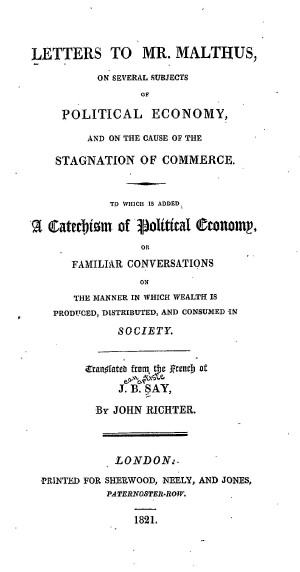
Letters to Mr. Malthus, on Several Subjects of Political Economy, and on the Cause of the Stagnation of Commerce. To Which is added, A Catechism of Political Economy, or Familiar Conversations on the Manner in which Wealth is Produced, Distributed, and Consumed in Society, trans. John Richter (London: Sherwood, Neely, and Jones, 1821).

About Liberty Fund:

Liberty Fund, Inc. is a private, educational foundation established to encourage the study of the ideal of a society of free and responsible individuals.


PREFACE.

The science of Political Economy is at once one of the most important and interesting to mankind. It has in the course of a few years made great progress, and has attracted the attention and become the study of a considerable portion of the enlightened part of the public. Every attempt therefore to elucidate the subject of it will be kindly received, more particularly as a general knowledge of its principles cannot fail to produce incalculable advantages to the world.

Mr. Say was the first writer who attempted to raise Political Economy to the rank of the exact sciences:—how he has succeeded the public have the means of appreciating; posterity will decide. Until the appearance of the Traité d’Economie Politique, it had been limited to theories drawn from partial views of isolated facts and statistical histories, and from circumstances which it was always uncertain whether they had been fully observed or contemplated. No attempt was made to define the true nature of production, and to consider the thing in itself—to form just ideas on this subject; and, following them to their remotest consequences, to establish such a basis as should prove a true guide under every circumstance. Mr. Say had most clearly shewn that markets for commodities are created by and depend upon the production of commodities which can only be purchased by producers, or their representatives—not by unproductive consumers.

Mr. Malthus, in his Principles of Political Economy, and particularly in treating of the causes of the general stagnation of trade, has controverted this doctrine, together with some of the best established principles of the science. In these letters Mr. Say has entered the field of controversy—whether he will have added to his high reputation as a political economist, or Mr. Malthus will have disappointed the admirers of his Essay on Population, the public cannot fail to be benefitted by the discussion.

When the great truths of Political Economy shall become generally known—when men shall be convinced that each person will sell with greater facility the more others gain; that they can only gain by means of labour, capital, or land; that the greater the number of producers the greater the number of consumers; that unproductive consumers are mere representatives of others, and can only consume by means of what others produce; that all nations are interested in the prosperity of each other, and in facilitating the means of communication; that capital or land, and even labour, can only be productive while it is respected as property, and that the poor but industrious man is interested in the defence of the property of the rich, and in maintaining good order, because their subversion may deprive him of the means of subsistence:—when these truths shall be generally known, it will be almost impossible to stir up nations or bodies of men against each other. This science therefore is eminently social, and by teaching that no men can injure others without injuring themselves, and that the advantages gained by others are productive of advantages to themselves, will probably effect what a less interested doctrine has not yet accomplished.

J. R.

  • Cornwall Place,