EconlibThe LibraryOther Sites |
Front Page Titles (by Subject) Of an unequal Distribution of Property. - Observations on the Importance of the American Revolution, and the Means of Making it a Benefit to the World
Return to Title Page for Observations on the Importance of the American Revolution, and the Means of Making it a Benefit to the WorldThe Online Library of LibertyA project of Liberty Fund, Inc.Search this Title:Also in the Library:
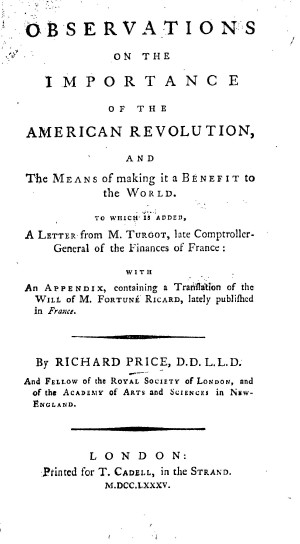
Of an unequal Distribution of Property. - Richard Price, Observations on the Importance of the American Revolution, and the Means of Making it a Benefit to the World [1784]Edition used:Observations on the Importance of the American Revolution, and the Means of Making it a Benefit to the World. To which is added, a Letter from M. Turgot, late Comptroller-General of the Finances of France: with an Appendix, containing a Translation of the Will of M. Fortuné Ricard, lately published in France (London: T. Cadell, 1785).
About Liberty Fund:Liberty Fund, Inc. is a private, educational foundation established to encourage the study of the ideal of a society of free and responsible individuals. Copyright information:The text is in the public domain. Fair use statement:This material is put online to further the educational goals of Liberty Fund, Inc. Unless otherwise stated in the Copyright Information section above, this material may be used freely for educational and academic purposes. It may not be used in any way for profit.
Of anunequal Distribution of Property.IT is a trite observation, that “dominion is founded on property.” Most free States have manifested their sense of the truth of this observation, by studying to find out means of preventing too great an inequality in the distribution of property. What tumults were occasioned at Rome, in its best times, by attempts to carry into execution the Agrarian law? Among the people of Israel, by the direction of heaven, all estates which had been alienated during the course of fifty years, returned to their original owners at the end of that term. One of the circumstances that has been most favourable to the American States in forming their new constitutions of government has been the equality which subsists among them. The happiest state of man is the middle state between the savage and the refined, or between the wild and the luxurious state. Such is the state of society in Connecticut, and some others of the American provinces; where the inhabitants consist, if I am rightly informed, of an independent and hardy Yeomanry, all nearly on a level—trained to arms,—instructed in their rights—cloathed in home-spun—of simple manners—strangers to luxury—drawing plenty from the ground—and that plenty, gathered easily by the hand of industry; and giving rise to early marriages, a numerous progeny, length of days, and a rapid increase—the rich and the poor, the haughty grandee and the creeping sycophant, equally unknown—protected by laws, which (being their own will) cannot oppress; and by an equal government, which wanting lucrative places, cannot create corrupt canvassings* and ambitious intrigue.—O distinguished people! May you continue long thus happy; and may the happiness you enjoy spread over the face of the whole earth!—But I am forgetting myself. There is danger that a state of society so happy will not be of long duration; that simplicity and virtue will give way to depravity; that equality will in time be lost, the cursed lust of domineering shew itself, liberty languish, and civil government gradually degenerate into an instrument in the hands of the few to oppress and plunder the many.—Such has hitherto been the progress of evil in human affairs. In order to give them a better turn, some great men (Plato, Sir Thomas More, Mr. Wallace, &c.) have proposed plans, which, by establishing a community of goods and annihilating property, would make it impossible for any one member of a State to think of enslaving the rest, or to consider himself as having any interest distinct from that of his fellow-citizens. Such theories are in speculation pleasing; nor perhaps are they wholly impracticable. Some approaches to them may hereafter be made; and schemes of government may take place, which shall leave so little, besides personal merit, to be a means of distinction, as to exclude from society most of the causes of evil. But be this as it will; it is out of doubt that there is an equality in society which is essential to liberty, and which every State that would continue virtuous and happy ought as far as possible to maintain.—It is not in my power to describe the best method of doing this.—I will only observe, that there are three enemies to equality against which America ought to guard. First; Granting hereditary honours and titles of nobility. Persons thus distinguished, though perhaps meaner than the meanest of their dependents, are apt to consider themselves as belonging to a higher order of beings, and made for power and government. Their birth and rank necessarily dispose them to be hostile to general liberty; and when they are not so, and discover a just zeal for the rights of mankind, it is always a triumph of good sense and virtue over the temptations of their situation. It is, therefore, with peculiar satisfaction that I have found in the articles of confederation an order that no titles of nobility shall be ever granted by the united States. Let there be honours to encourage merit; but let them die with the men who have earned them. Let them not descend to posterity to foster a spirit of domination, and to produce a proud and tyrannical aristocracy.—In a word, let the united States continue for ever what it is now their glory to be—a confederation of States prosperous and happy, without Lords—without Bishops* —and without Kings. Secondly; The right of primogeniture. The tendency of this to produce an improper inequality is very obvious. The disposition to raise a name, by accumulating property in one branch of a family, is a vanity no less unjust and cruel, than dangerous to the interest of liberty; and no wise State will encourage or tolerate it. Thirdly; Foreign Trade is another of the enemies against which I wish to caution the united States. But this operates unfavourably to a State in so many more ways than by destroying that equality which is the basis of liberty, that it will be proper to take more particular notice of it. [* ]In this State, and also the State of Massachusetts, New Jersey, &c. any attempt to canvas, or even the expression of a wish to be chosen, will exclude a candidate from a seat in the House of Representatives. The same is true of any stain on his moral character. [* ]I do not mean by Bishops any officers among Christians merely spiritual; but Lords spiritual, as distinguished from Lords temporal, or Clergymen raised to preeminence, and invested with civil honours and authority, by a State establishment. |

Titles (by Subject)