Econlib

The Library

Other Sites

Front Page arrow Titles (by Subject) arrow part iii: Logic - Natural Rights on the Threshold of the Scottish Enlightenment: The Writings of Gershom Carmichael

Return to Title Page for Natural Rights on the Threshold of the Scottish Enlightenment: The Writings of Gershom Carmichael

Search this Title:

part iii: Logic - Gershom Carmichael, Natural Rights on the Threshold of the Scottish Enlightenment: The Writings of Gershom Carmichael [1724]

Edition used:

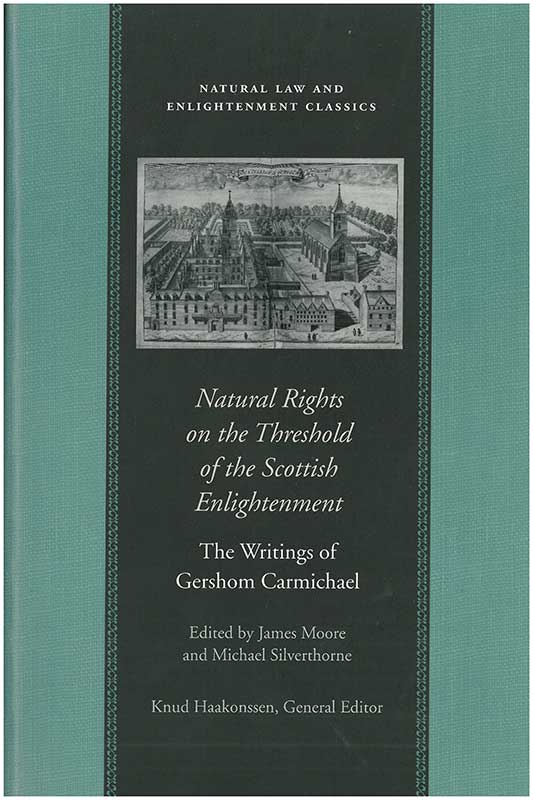
Natural Rights on the Threshold of the Scottish Enlightenment: The Writings of Gershom Carmichael, ed. James Moore and Michael Silverthorne (Indianapolis: Liberty Fund, 2002).

About Liberty Fund:

Liberty Fund, Inc. is a private, educational foundation established to encourage the study of the ideal of a society of free and responsible individuals.


part iii

Logic

A Short Introduction to Logic:

an elementary textbook for

students of philosophy

(particularly at the University of Glasgow)

Second edition

revised and corrected by the author.

Edinburgh

At the press of John Mosman and Co., for John Paton,

Bookseller, and for sale at his shop in Parliament Square

1722

Editorial Note

Carmichael’s logic was an abridgment and an adaptation of the Port Royal logic, or Ars Cogitandi, or The Art of Thinking.1 In his account of his teaching method,2 he described The Art of Thinking as “the best Logick that I know under the name of Logick, and that is tolerably adapted for the Use of teaching in a University.”3 The principal attraction of the Port Royal logic for Carmichael was the importance it accorded to simple apprehension (or conception) and judgment: “there are basically just two modes of thinking which require the special direction of Logic, Apprehension and Judgment.”4 Other logics, notably those in the Aristotelian tradition, continued to emphasize the third part of logic, discursive reasoning.5 Carmichael’s concern, like that of the logicians of Port Royal, was to ensure that the terms used by logicians in their reasoning should represent, with some accuracy, the ideas they are supposed to signify or express.

Carmichael’s endorsement of the logic of Port Royal was not unqualified. He did not consider it necessary “to follow the Author through all his Digressions.”6 He also amended the text in classroom presentation by referring students to Locke’s Essay for a closer examination of the distinctions among clear and obscure, distinct and confused ideas.7 He agreed with Antoine Arnauld and Pierre Nicole, the logicians of Port Royal, that not all ideas have their origins in sensation; but he considered that the origin of such ideas had been better explained by Locke. Ideas of physical or corporeal things have their origin in sensation; ideas of thinking, judging, reasoning, willing, have their origin in the operations of the understanding.8 This was a consideration of the first importance for Carmichael; for he discovered in reflections on the operations of the understanding the origin of ideas of God, of lasting happiness, and the other central ideas of his natural theology and moral philosophy.

Carmichael’s Logic was, by his own account, an elementary text, “directed primarily to first-year students.” It should be read as an introduction to the Philosophical Theses which follow and represent “the higher studies which follow this in my course of instruction.”

Preface

To the reader

There is no need to speak at length about the scope of this little work. Anyone may readily see that it is a short and simple course of instruction designed merely to prepare the minds of beginners for a deeper understanding of logic and for the more fruitful approach to other branches of knowledge which it may facilitate. With this end in view some years ago I prepared for publication a short Introduction to Logic.1 This was at the time when the use of handwritten systems, which had prevailed for too long, to the great inconvenience of teachers and students, was beginning to disappear from our university. My hope in preparing that text was to ensure that the students of the university would not be deterred from the study of philosophy as soon as they began by long, tedious, and unrewarding labor. Now that the first edition has sold out, I am allowing the book to reappear in a second edition, with corrections in many places and additions in others. It is directed primarily to first-year students, who are to go on, if God so wills, to the higher studies which follow this in my course of instruction.2

I have had two aims: not only to lay out for beginners the usual precepts (at least, all that is useful among the precepts usually taught at this stage), but also to explain the reasons for them in a manner suited, so far as possible, to the capacity of beginners. I hope that in this way students will realize from the beginning that the study of philosophy does not consist in mere reading, nor in the understanding and memorizing of what they read, but above all in the exercise of judgment and reason, by which they may come to see the truth as it were with their own eyes, by perceiving the self-evidence of principles and seeing the necessary consequences which lead to the conclusions that follow from them. This is the reason why I have gone beyond the practice adopted in most compends of this kind by focusing not so much on the differences between words and the various forms of speech as on the various modes of thought that underlie them, which I would wish learners to pay particular attention to. That is also why I did not think it right to omit brief demonstrations of the rules about the relative modes of propositions, about the legitimate forms of syllogisms, and so on, which are normally taught (though most authors reserve these for a larger treatise). For these rules (as the distinguished John Harris rightly observed in the case of trigonometrical rules)3 can be more easily learned with the aid of demonstrations; certainly nothing better assists the memory than calling in judgment to help her.

My purpose in writing this introduction however does not require me to say anything in detail about the causes and remedies of obscurity and confusion in ideas, or of error in judgments; about the method to be observed in the investigation and demonstration of truth; of the different kinds of arguments that are appropriate to the various natures of the things to be known, and so on. These topics are much the most useful part of logic as well as the most beautiful, and in the fuller course on logic one should devote much time to them. They are the additional subjects which should be taught in their own place, and tackled by students only after they have been properly prepared by prior instruction in this elementary instruction in the forms of propositions and syllogisms. The facts themselves prove that those who despise this elementary teaching or urge the omission of it are doing the worst possible service to the progress of students in any branch of knowledge they may subsequently study. …

In the final chapter I have added a section on logical practice, not because I think that it should be taught along with the rest right at the beginning of the study of philosophy, but because it is useful for certain exercises which instructors should prescribe in their proper place, and which are not to be found in the other books which are most in use today. I have taken less trouble at the present with this part than with the rest, and have readily adopted what particularly pleased me in the teachings of others, changing or adding only a few things.

As for the alterations made in this new edition, most of them are intended to render more obvious and evident for beginners, at the glance of an eye, each particular part of the doctrine, so that they may more easily mark them and commit them to memory, when they go back over the book.

Farewell, reader, and wish well to this little work dedicated solely to the use of the students. Such a work (to use the words of a distinguished man)4should find such a favorable reception that no one will think the trouble taken over it to be unworthy of him, even though it brings him no intellectual repute or prestige.

G. C.

A Short Introduction to Logic

Logic is the science which exhibits the method of discovering truth and of expounding it to others. Since we can be said to attain truth or deviate from it, strictly speaking, only by the act of judging, it is clear that the purpose of teaching it is the formation of true and, so far as possible, certain judgments about things which everyone should learn. Now forming judgments about things requires a prior apprehension of them; and both the truth and the certainty of the judgment depend in no small degree on the correctness of the apprehension. There are therefore just two modes of thinking which require the particular direction of logic, i.e., apprehension and judgment.

chapter 1

On Apprehension

1.

On the nature of apprehension. On the idea, and its comprehension and extension.

Apprehension is the act of the mind by which it merely perceives a thing or simply thinks about it, neither affirming nor denying it, neither desiring nor avoiding it. The representation of a thing in the mind which enables us to perceive it, is called an idea. A fuller inquiry into the relation of an idea to the actual act of apprehension belongs to the domain not of logic but of pneumatics.1 Meanwhile what is usually taught about ideas in logic may be appropriately understood of both.2

The thing which is represented to the mind through an idea is said to be its object.

Finally the word or complex of words, by which the idea, or the object as represented by it, is signified (as triangle, good man, etc.) is normally called a term (the reason for which we will give).3 It should be distinguished as a verbal term, since the idea itself is sometimes called a mental term; as the thing represented is also sometimes called an objective term.

Ideas are classified above all (not to touch here on other differences between them) either by their comprehension, i.e., by whether they include in themselves one or several representations, or by their extension, i.e., by whether they represent one or several objects.

In the former respect, an idea is either simple or complex. A simple idea is one which cannot be resolved into several different ideas; such are ideas of being, power, thought, etc. A complex idea on the other hand is one which comprehends several different ideas, into which it can be resolved; such is the idea of spirit, i.e., of a thing which has the capacity to think.

In the latter respect, an idea is either singular or universal. A singular idea is one which represents directly one object alone, so that it cannot be truly attributed to more than one individual: such are the ideas of Alexander, Bucephalus, this tree, etc. I say, directly, because a singular idea can represent one thing as conflated from several or related in another way to more than one; however, it cannot be predicated of these individual things in a direct, but only in an oblique, case. See what is said below about the proposition [pp. 299–300].4 By contrast, a universal idea is one which represents several direct objects indiscriminately, so that it can be truly applied to each one of them: such are the ideas of man, horse, tree, etc.

Here one must note that from singular or less universal ideas, more universal ideas are formed by means of abstraction, by which some part of the former comprehension is lost, and they become as a result more simple. By contrast, from universal, ideas become singular or less universal, by means of composition, by which they are made more complex by the addition of some idea to their comprehension.

2.

On division as the resolution of the extension of a universal idea.

The extension of a universal idea is resolved by division, by which we mean here the particular enumeration of ideas differing in their whole extension, by which the extension of a given universal idea is exactly exhausted. Thus animal is divided into man and brute; brute in turn into quadrupeds, flying beasts, fish, and reptiles. The more universal idea which is divided, is here called the whole; and the less universal ideas, into which it is divided, are called parts.

The division of a thing very much differs from this division of a universal idea of which we have spoken. It is the particular enumeration of things totally different, by which the constitution of any given composite thing is briefly described. By this means man is divided into soul and body, and body in turn into its various members.

3.

On definition as the resolution of the comprehension of a complex idea.

Just as the extension of a universal idea is resolved by division, so the comprehension of any complex idea is resolved by definition. By this we mean a phrase which explains a complex idea corresponding to the given name, by means of several connected words, by which are signified both the simpler ideas which make it up and the order in which they unite to do so.

The use of definition does not arise because when one has a complex idea before the mind, one may at the same time be unaware of its comprehension (just as one may be unaware of its extension). Rather it arises because, owing to the shorthand nature of speech, fairly complex ideas are normally denoted by simple words, and so it quite often happens that others do not understand what we mean to signify by some phrase, or we ourselves are not careful enough always to attach the same determinate idea in our minds to the same word.

Both these difficulties are remedied by definition, by which the meaning of a given word is both declared to others and determined with greater certainty in ourselves. We both instruct others and at the same time fix it in our own memories that the simple word covers the same complex idea which is explicated more clearly by several words in the definition. So, for example, spirit is defined as thinking substance, virtue as a habit inclining to morally good acts. If anyone should say that definition, as we have explained it here, is merely ideal, or rather nominal, I would not feel obliged for that reason to introduce a real definition which would be distinct from it, until I know how to explain real essences of things, distinct from ideal or nominal essences. And I have no doubt that it would be highly beneficial to all disciplines, if writers of every genre would imitate the precision of mathematicians in this respect, and never use a definition which they would not accept as a substitute for the word itself.5

From this it is obvious that if a definition is to have the use it is intended for, i.e., if it is to determine the idea which corresponds to a given word, one must first clearly understand which idea is expressed by the actual words of the definition. To understand this, it is important both to know the simpler ideas attached to the various words which enter into the definition and to perceive the relationship between the ideas which is expressed by the arrangement of the words. Therefore the definition must be designed to make both of these more evident than the notion one would have of the meaning of the word to which the definition is applied, if one did not have the help of the definition.

This is precisely the point of the cardinal rule of definition, which is almost the only rule we need: the definition must be clearer than what is defined. But provided clarity is preserved, a definition is thought to be all the better for being shorter and therefore easier to remember. For this reason, first, avoid all unnecessary words (such as words whose meaning is adequately included in other parts of the definition, except so far as the demands of grammar require them). Second, so that the definition may consist of as few words as possible, choose words that signify ideas which are immediately simpler than the idea to be defined, and in particular one word (if it can be found) which signifies the idea which is immediately superior in the categorical series. This idea, together with the word by which it is signified, is usually called a genus, as substance is in the definition of spirit given above. Anything added to the definition to fix its limits, is called the differentia, as thinking is in that same definition. And with respect to these parts, the whole complex idea together with the word by which it is signified, is called a species, and in fact, with respect to them, a subjicible species; but if it has no other universal class subject to it, of which it is the genus, it is said, with respect to particulars, to be a predicable species.

chapter 2

On Judgment in General, and on Immediate Judgment in Particular

1.

On the nature of judgment; and on the difference between immediate and mediate judgment.

Judgment is the act of the mind by which it gives a verdict on two ideas in comparison with each other: i.e., a verdict as to the identity or difference of the objects represented by them.

The relationship of the ideas so compared is learned either from their immediate juxtaposition (without the intervention of any third idea) or with the assistance of one or more intermediate ideas, with which both of the given ideas are compared. Therefore, one kind of judgment is immediate, by which a verdict is given about ideas which are directly compared; the other is mediate judgment, by which a verdict is given on ideas which are compared with each other through the intervention of some third idea, or even of more, properly ordered in relation to each other.

Mediate judgment has an alternative name, discourse; for it is one and the same thing to deduce one verdict of the mind from other verdicts and to give a verdict because of other verdicts or with regard to them. Therefore just as one must treat discourse under the name of judgment as one species of it, so what is said in this chapter about judgment in general should also be understood to be appropriate to discourse, insofar as discourse is concerned with the relation of two extreme ideas.

2.

On affirmative and negative propositions, and their subjects and predicates.

The particular aim of any judgment is what it defines or what relation it determines to exist between two given ideas; hence we often utter it in words, while not indicating whether that relation between ideas is known to us immediately or mediately, much less what the intermediary is.

Now a judgment precisely considered, since it defines the relation of two given ideas, may be considered a statement. The statement which expresses a mediate judgment as such is not a mere proposition but an argument. However, it is not altogether appropriate to restrict the term “proposition” to statements which express immediate judgments, since the obvious and universally accepted use of the word is against it.1 Such a statement is commonly called a proposition, and, to differentiate it, a verbal proposition; for the act of judging itself (considered, as I have said, precisely, and so as far as it is signified by a verbal proposition) has also usually been called a proposition, but that is a mental proposition. This latter use of the word, though perhaps less proper and not so common in the usual books of logic, is to be especially kept in view in what follows. For most of what is commonly taught about the proposition, which we shall explain below, properly and primarily applies to the judgment itself, or to the mental proposition, and fits the verbal proposition only secondarily, so far as it is a sign of the mental proposition. The few things that relate particularly to the verbal proposition will become clear as we go.

By virtue of their form, or (as some call it) their internal quality, propositions are divided into affirmative and negative. For in making a judgment, the mind gives a verdict on two ideas in one of two ways. It either unites them because they belong to each other, that is, because they are representations of the same object, and this proposition is said to be affirmative (e.g., the human mind is immortal); or it distinguishes them from each other because they are discrepant from each other, that is, because they are not representations of the same object; and this proposition is said to be negative (e.g., the human mind is not material).

Here one must note that of the two ideas, on whose association the mind gives a verdict in making a judgment, one is, as it were, fundamental (since the other idea is summoned to it to be compared with it); it is commonly called the subject. The other may be called accessory (in the sense that it is brought in to be compared with the other); it is usually called the predicate. Thus in both of the propositions given above, the human mind is the subject; in the affirmative proposition the predicate is immortal; in the negative, material. If the distinct notions of subject and predicate do not seem to be adequately discriminated by the explanations offered, the difference will become clear enough (at least in the propositions where it matters) from the properties of each which we are about to explain.

Here then we note that the words subject and predicate (used in nearly all treatises of logic) are usually applied not only to the actual ideas which are being compared, but also, analogically, to the words by which those ideas are signified; in such a way however, that the epithets mental and verbal may be added, in order to remove ambiguity (as we noted above for the words term and proposition).

Note further that both subject and predicate are commonly called by a single name, the terms of the proposition, which are either mental or verbal, depending whether they refer to the ideas themselves or to the words by which they are signified. The reason for that appellation is that in the simplest and most regular form of the verbal proposition, the subject occupies the first place, and the predicate the last place. Placed between them is a substantive verb, either alone or qualified by a negative, which is commonly called the copula; and which more directly signifies the act of affirming or negating. As these parts frequently change their relative positions, so it very often happens, that the copula is included in the same words as the predicate: e.g., Peter reads, that is, Peter is reading.

[Sections 3 and 4, which contain technical rules of argument, are omitted.]

5.

On propositions which are composite, complex, etc.

Besides the simple and regular form of propositions which we have assumed so far, logicians differentiate several other forms and specify a corresponding number of different classes of propositions which they call composite or complex. However all of them are either (1) of such a kind that each of them is not one proposition or one judgment in the mind, but several taken jointly together in one statement; or (2) really simple propositions in the mind (although consisting of complex terms) by which one predicate is affirmed or denied of one subject, but are expressed in a sort of cryptic manner (in which the true subject and the true predicate do not reveal themselves clearly) because of the shorthand nature of ordinary speech.

To the former class we refer all copulative propositions, such as Peter and Paul read (i.e., Peter reads and Paul reads), and all those which have the force of copulative propositions: that is, propositions which join two or more propositions together in such a way that they assert the truth of each one, whether they distinctly contain the words of each proposition or the second is contained in some part of it: such are the propositions called causal, adversative, and exclusive. We leave to class discussion anything more that needs to be said about them in this first course.

To the latter class (that is, the class of those propositions which are simple in the mind, though they are not expressed simply and in regular form) belong particularly conditional propositions, such as, if God exists, the world is ruled by providence. Such propositions contain as it were the material of two propositions (the proposition which is supposed is called the antecedent, and the one which is said to follow from the supposed proposition is called the consequent). But they do not absolutely posit the truth of either the one or the other, but only go so far as to assert the consequence of the latter from the former. They are easily reduced to a simple, or (as it is usually called) categorical, form. For we note that a particular conditional, if, has precisely the value of, in the case that; and thus the proposition just quoted comes out as, in the case that (or in every case in which) God exists, the world is ruled by providence. But if in turn we transpose the terms which are here put forward obliquely, to the direct case, we shall have the following categorical proposition, by which one predicate is affirmed of one subject: every case which posits that God exists (i.e., in which God exists) is a case which posits that the world is ruled by providence. In the same way, any other conditional can be reduced to categorical form, some more easily than others.

[Several paragraphs of section 5 are omitted.]

6.

On certain and uncertain judgment.

A judgment may be certain, in which case it has in itself a certain inexpressible gleam of truth, which is found only in true judgments (though not in all of them), and thus excludes all suspicion of falsity; or it may be uncertain or doubtful, in which case, since it is without the infallible character of truth, it does not escape all suspicion of falsity. We may understand from what was said at p. 299, why we use the term judgment here rather than proposition when we are considering subjective certainty (i.e., the certitude which is actually present to the mind) and the uncertainty opposed to it. Hence too it is quite evident that objective certainty is more correctly attributed to the proposition in the case where we can know with certainty the relationship which it defines between ideas; and similarly the uncertainty opposed to it, where it cannot.

7.

Of immediate judgment in particular, and of its double kind.

Of immediate judgment as such, little remains to be said, except to stress that all our knowledge of every kind must be resolved ultimately into immediate propositions, or propositions known by their own light. Hence whether the relation of terms of any given proposition is known from one term or through several mediate terms, it is always necessary that the relation of any intermediate idea to the ideas which are directly compared with it on either side be immediately knowable.

The principles on which our knowledge rests may be reduced to two kinds. Some principles are abstract. What abstraction is, we have said above at p. 294. We may understand from this that one idea can be said to be abstracted from another whenever it is recognized by the mind as separate from the other with which it had previously constituted the same complex. But an idea simply is called abstract when it is abstracted from the particular consideration of any singular thing which is offered to our senses or reflection, such as the ideas of a whole, of a part, etc.2 Their truth is known from the mere comparison with each other of abstract ideas, without the mind’s taking notice of the thing itself as it exists in nature; an example is: every whole is greater than its part. Others are intuitive, or experiential, and these consist in an intimate sense, or awareness which the mind has, of a thing’s being intimately present to itself; an example is the proposition, I thinking exist.

Propositions which are deduced solely from principles of the former kind are purely hypothetical, and do not absolutely posit the existence of anything. Such are the predications by which a property is attributed to something on the condition of its existence, a property which, though it does not enter into the actual concept of the thing, still has a necessary connection with that concept. The logicians call this a property, as in the following: Every rational creature is subject to the moral rule.

All absolute propositions presuppose principles of the latter kind, that is, propositions which absolutely attribute actual existence to some thing or which attribute a predicate that actually belongs to it. In this sense one normally attributes any predicate which belongs to a subject only contingently, such as logicians call a common accident, as in the proposition, Peter is learned. Property and common accident, together with species, genus, and differentia (see pp. 296–97) are the five usual predicables of the logicians.

chapter 3

On Mediate Judgment or Discourse

1.

On mediate judgment or discourse.

Whenever the mutual relationship of any two ideas is not adequately understood by the direct comparison of them, some other intermediate idea has to be brought in (as we have pointed out above), so that one may infer the relation of these ideas to each other from the perceived relation of both of the ideas in question with this mediate idea (or with several ideas properly related to each other). The act by which we give a verdict on the relation of ideas with each other in turn, resting on judgments previously given about the relation of both with the third, is called a mediate judgment or discourse, as we said above.

It makes no difference to the consequence, whether both of the extreme ideas are directly compared with the same intermediate idea, or whether only one of the extreme ideas is directly compared with the first mediate idea, and this with the second, and so on, until we end at the other extreme idea, in accordance with rules to be established below. However, because the order of nature and of teaching requires us to begin with the simpler ideas, we assume for the time being merely that the two extreme ideas are compared with one and the same intermediate idea in the same number of propositions; for the moment we ignore the question whether the relation of both of the extreme ideas with that mediate idea is known directly or by the assistance of one or several further mediate ideas.

2.

Of the affirmative and negative syllogism and of their principles and parts.

A statement by which a mediated judgment as such is expressed, together with the two other judgments on which it immediately rests, is called a syllogism; in other words, it is a statement by which one proposition is explicitly inferred from two others, by which its two terms are compared with the same middle term. This is a verbal syllogism; for the actual progress of the mind through two judgments, by which the same number of ideas are separately compared with the same middle idea, to a third judgment by which the relation of the same two ideas with each other is determined, is called a mental syllogism. For reasons analogous to those I noted above under the name of proposition, most of what will be said below about the syllogism, should be particularly and primarily understood of the mental syllogism, and secondarily of the verbal syllogism.

A syllogism may be affirmative or negative. The affirmative syllogism is defined as that by which one concludes that the objects of two ideas are the same as each other, because it had previously affirmed the identity of both of them with the same object of a third idea. It rests on the axiom that things that are the same as some third thing are the same as each other; for example:

  • Every thinking thing is immortal;
  • The human mind is a thinking thing:
  • Therefore, the human mind is immortal.

A negative syllogism is that by which one concludes that the objects of two ideas are not the same as each other; because it had affirmed the identity of one of them, and denied the identity of the other, with the same object of some third idea. It rests on the axiom that things of which one is the same as some third thing to which the other is not the same, are not the same as each other; for example:

  • No thinking thing is material;
  • The human mind is a thinking thing:
  • Therefore, the human mind is not material.

In both cases we are considering only a syllogism which proceeds correctly (i.e., only a valid syllogism).

The conclusion from what has been said is that in every syllogism three ideas are compared. They are two ideas whose congruence or incongruence is inferred and which are usually called the extremes (in the example given above of the affirmative syllogism, these are the human mind and immortal), and a third idea, with which both of the extreme ideas are individually compared, so that either both are seen to be congruent with it, or one is and the other is not. This third idea is commonly called the middle; an instance, in the same example, is thinking thing. These three ideas, together with the words in which they are expressed, are commonly called the three terms of the syllogism.

Likewise it is also agreed that three propositions are contained in every syllogism. By one proposition the congruence or incongruence of the two extremes is inferred, and it is called the conclusion; as in the example given above, the human mind is immortal (of which the predicate, immortal, is called the greater extreme, and the subject, the human mind, is called the lesser extreme). In addition there are two other propositions, by which the two extremes are individually compared with the middle, and these are called premises. Of these, that which compares the major extreme with the middle is called the major proposition, as in the aforesaid example, every thinking thing is immortal; that which compares the minor extreme with the middle, is called the minor proposition, or assumption, as the human mind is a thinking thing.

3.

On the general rules of syllogisms.

From the definitions given of both syllogisms (affirmative and negative), and from the axioms on which they are constructed, it is quite clear that in order for two extremes to be united with each other in a conclusion, it is necessarily required that both of them, in the premises, be united with the middle; and, in order for the extremes to be separated from each other in the conclusion, it is no less necessarily required that one of them be united with the middle in the premises, the other separated from the same middle. It follows that, if both extremes are separated, in the premises, from the middle, neither the congruence of the extremes with each other, nor their incongruence, will be able to be inferred. Hence naturally flow the rules which are commonly but rather confusingly (since they are mixed with others) taught as the rules on the quality of syllogistic propositions:

  • First, if one of the premises is negative, the conclusion will be negative.
  • Second, if both of the premises are affirmative, the conclusion will be affirmative.
  • Third, from two negative premises, nothing follows.

[Further specifications of these rules of the syllogism follow (sections 3–9), which follow the rules given in The Art of Thinking about the extension of terms, which as Carmichael notes, are not found in “the scholastic logics.”1 However the rules on “the quantity and quality of syllogisms,” which are found in the scholastic logics, and which include the “moods” and “figures” of the syllogism, may be deduced from the rules of the extension of terms. This Carmichael proceeds to do. In accordance with the plan of an elementary textbook, there is no discussion of sophisms and paralogisms. The chapter ends with the following general account of the nature of argument.]

10.

On the syllogism considered with reference to its content.

Every perfect argument (such as all, in intention, seem to be) which is constructed according to the rules laid down above, if it rests on true premises, yields a true conclusion, and if it rests on certain premises, yields a certain conclusion; this is called demonstration. The certain intuition of the connection between the extreme ideas which is inferred in the conclusion is normally called knowledge. This intuition may be achieved in the very act of drawing the conclusion (an act which gets its own self-evidence and certitude directly from a distincter perception of the truth of the premises), or in a subsequent act which relies on a more general recall of an earlier demonstration.

But if even one of the premises on which the argument rests is uncertain, then the conclusion deduced is also doubtful and uncertain (so far as it flows from these premises). Such a mental verdict is called an opinion. It may be reached either in the very act of drawing the conclusion, by a particular inspection of the premises, or accepted from our confidence in a previous chain of reasoning.

Finally if any of the premises is false, it carries no weight, supposing it is false, toward establishing the truth of the conclusion. However it sometimes happens that a conclusion deduced from false premises is true, just as a conclusion drawn from uncertain premises is sometimes certain on other grounds.

But a syllogism which does not conform to the rules given above is said to be a paralogism, although this name is normally applied particularly to syllogisms in which the fault in form is obvious. Other paralogisms, in which the fault of form is concealed by some convoluted fallacy of ambiguous words or phrases, are usually called by the more particular name of sophisms.

chapter 4

On Method, and Logical Practice

1.

On the general rules of method.

To investigate the truth or expound it to others with success, we need to do more than look at individual acts taken separately, we must also arrange them in due order among themselves. We would not wish this compend to omit any of the essential parts of logic, and so we have included here the three following general laws of method. We postpone to another place a more detailed explanation of the individual methods and the rules belonging to them.

  • i.In the individual steps of our reasoning in pursuit of knowledge, we must preserve self-evidence; that is, nothing must be admitted as true which is not evidently seen to be so.
  • ii.One must not carry one’s reasoning about things beyond the point where determinate ideas of them are present to the mind.
  • iii.One must always begin from the simpler and the easier; and one must stay with them for quite a while until they may become familiar, before one passes on to the more difficult and the more complex.

2.

On logical practice, and first on the treatment of the simple theme.

The special practice of logic is the careful and precise investigation of truth, and virtually the entire discipline seeks to direct this investigation and remove obstacles to it. But what is called logical practice usually gives precepts about certain exercises which pertain to the disclosure of truth, and it has been found to be extremely useful to bring these precepts to the attention of the students of the university. We therefore include here some of the most important and useful of them.

Logicians reduce these precepts to two classes: one concerns genesis, the other analysis. They define genesis as the mode of using the tools of logic by which one forms and produces for oneself a discourse on a theme. They define themes as anything that may be put before the intellect as a subject of knowledge, and divide them into simple and complex.

A simple theme is said to be a term, whether complex or noncomplex; or rather, the thing itself so far as it is merely represented by an idea, and is signified by one or more words which denote that idea.

A complex theme is any proposition; or rather the very truth of the thing, so far as it can terminate the act of affirming or denying, and is expressed in the form of a statement or perhaps a question.

In treating a simple theme the following rules must be observed.

  • i. The origin of the word itself under which the theme is proposed must be indicated, if the derivation is not too obscure. If the word admits of different meanings, they must be distinguished; and one must also mention any other preliminary points required for accurately determining its significance. This is to be done for each and every word, if the theme is put forward in a phrase of several words.
  • ii. One must also explain by a lucid definition the present signification of the proposed term and so the essence of the thing itself, or at least its nominal essence.
  • iii. One must deduce the secondary attributes, if there are any, from the essential concept by clear and evident inference.
  • iv. One must take into consideration any accidental attributes that may pertain to a given theme, and one must show to what variations it is liable because of them.
  • v. One must investigate the origin of the theme, and if dealing with a manufactured object, one must indicate how it is produced.
  • vi. One must also think of its end; that is, one must consider whether it will utterly perish, and if it is determined to be corruptible, by what and by means of what.
  • vii. One must also observe its relations and connections with other things.
  • viii. If the theme is composed of parts, these must be examined, and inquiry made as to how they are united in the composite theme.
  • ix. Finally if a proposed term is universal, one must also survey its inferiors, especially the immediate ones.

3.

On the solo treatment of a complex theme, or on exegesis.

If a complex theme is put forward for treatment, it is handled either in a speech by one person, which is called exegesis, or by argument between two or more persons, which is called disputation.

There are three important and essential parts of exegesis. The first is called paraskeuê,1 or preparation for treating the question. The rules are as follows:

  • i. The terms of the question must be distinctly explained, if they are liable to any ambiguity of meaning.
  • ii. Then the state of the question must be clearly and lucidly settled.
  • iii. The various opinions of different authors must be briefly and faithfully expounded.

The second part is called kataskeuê, or confirmation of truth, of which the rules are these:

  • i. The true position is to be taken and established by means of arguments.
  • ii. Weight, rather than number, of arguments is the principal weapon; and one must use no argument which does not have solid force and importance.
  • iii. One must meet any objections which opponents urge to elude the force of the reasons we have given.
  • iv. Finally, if there are any famous testimonies of great authors, they should be adduced to lend further confirmation to our position.

The third part is anaskeuê, or the solution of objections; these are the rules:

  • i. Opponents’ arguments must be faithfully rehearsed, in such a way that they lose nothing of their force.
  • ii. They must be refuted firmly and clearly, and the difficulties contained in them lucidly resolved, not only by denying what is falsely alleged, but also by adding a firm ground for the denial.
  • iii. Contrary testimonies from great men are to be given due weight, and reconciled with the previously established truth, if this can be done; if not, they must be modestly rejected.

One may preface all these matters with a proparaskeuê as a proem on the importance and timeliness of the question; one may also annex to all the aforesaid parts an episkeuê as a peroration, which gives the gist of the whole dissertation in a few words, together with the corollaries that flow from it.

However, for the right treatment of any theme, whether simple or complex, no rules direct us so well as a well-formed judgment and an accurate knowledge of the subject under discussion. For the method must be suited to the different conditions of things, and the things must not have their necks twisted, so to speak, to fit the more rigid laws of method. No one therefore will expound any proposed theme more elegantly than one who has looked thoroughly into it and has set himself carefully to observe this one rule above all others, to give a simple account of what he has learned by paying serious attention to the matter for himself, with an attitude of benevolence toward others and a desire to make clear the truth, for the glory of God.

4.

On the social treatment of complex themes or on disputation.

The next subject is disputation; its laws regard either the matter or the form of disputation. Of the former there are three:

  • i. The subject of the disputation must be useful and serious, something it would be worth learning the truth about.
  • ii. It must also be suited to the capacity, condition, and studies of the disputants.
  • iii. It must be such as may be a subject of disputation without absurdity or impiety.

As for the form, since three persons are necessary to the proper organization of a formal disputation, i.e., opponent, respondent, and president, some rules are common to them all; some are peculiar to each.

The rules all three must observe are these:

  • i. No one should seek to attract vain glory by disputations, but each should seek the truth with honest sincerity.
  • ii. The state of the controversy should be clearly put forward, and kept firmly in mind through the whole disputation.
  • iii. It is useful for the disputants to agree among themselves on certain principles on which the arguments are founded. In formal disputations, however, principles are not normally adduced before the opponent comes to use them.2
  • iv. Wait patiently for the other person to finish his speech.
  • v. Strive above all for brevity and clarity; and therefore avoid pointless periphrases and digressions.
  • vi. Both sides are to abstain from all abuse and insult.
  • vii. No one should use, or allow another to use, without interpretation, any word or phrase on whose current significance the disputants are perhaps not altogether agreed. No one therefore should be ashamed to request explanations of the terms used by his adversary, and no one should neglect to interpret the terms he uses himself, until words are found whose meaning no one in frankness and candor can claim to doubt. It is not good enough to make the allegation (which is the common refuge of ignorance and idleness) that the words employed are accepted in common usage and well known to philosophers, since no words can be more ambiguous than most of the technical terms of the scholastics, or less suited to raise clear and distinct ideas in the mind.3

The rules peculiar to the opponent are these:

  • i. He must carefully examine the meaning of the thesis.
  • ii. The first argument he puts forward should explicitly contradict the thesis. We should completely banish from the schools the silly, long-winded practice that some have of taking a third or even a fourth argument to arrive at a contradiction of the thesis; which is what they should have started from.4
  • iii. The proposition denied by the respondent should be the conclusion of the next argument.
  • iv. The argument should be put forward, as far as possible, with clarity and in syllogistic form (especially among beginners in formal disputations).
  • v. As soon as a sound response has been given which destroys the force of the argument, there should be no further dispute.

The rules to be observed by the respondent are these:

  • i. After an introductory salutation of congratulations or goodwill, he must faithfully rehearse the whole argument of the opponent; and he must once again repeat how far the proposition to which the response is to be attached has been taken.
  • ii. In rehearsing the argument, he must consider, if it was the first, whether it contradicts the thesis; or if it was not the first, whether it proves the proposition which is denied. If it turns out that the opponent has not succeeded in this, he is said to be committing ignoratio elenchi.
  • iii. If the argument does contradict the thesis, or if it proves the proposition just denied, he must examine its form; and if it is not good, he must show what is wrong with it.
  • iv. If it proves what it had to, and the form is good, the proposition, if false, must be denied, or if ambiguous, analyzed.
  • v. If none of this appears, but on the contrary it becomes clear that the argument is demonstrative, the truth must be frankly acknowledged.

As for the president, he intervenes either merely to keep order (eutaxia)5 or also to give assistance to the respondent. A president of the first kind merely has the duty to admonish the disputants to follow the aforesaid rules, and to bring them back to the proper form of disputation, if they wander from the straight path. But a president of the latter sort, in addition to the duty just mentioned, which he shares with the first kind of president, must also solve a difficulty which has been advanced when the respondent fails to do so, and defend the truth of the thesis; but in such a way that he also finds out how much the respondent can do for himself, and should lead him gradually to the true solution of the argument rather than do all the work himself, which makes the respondent uninterested in the outcome of the disputation.

5.

On analysis.

The other part of logical practice is analysis. This is defined as, the mode of using the tools of logic by which we resolve a discourse which has already been made and composed into the principles from which it was made and composed. It is particularly useful in understanding other men’s writings, and since we owe to them by far the largest part of our knowledge, it is rightly considered all the more useful and necessary to have an acquaintance with analysis.

Our first concern should be to reach the real meaning of the author; to this end we must use means to guide us in understanding an ambiguous or obscure sense. These are either external or internal means.

The external means for discovering the sense of a statement are these:

  • i. One must take into account who is speaking; for individuals usually fit their discourse to their own condition, intelligence, and interests.
  • ii. One must take note of what the subject of the discourse is; for words must be understood in accordance with the subject matter.
  • iii. One must take note of the end and intention of the discourse; for we usually try to address others in order to bring them to our point of view.
  • iv. One must note the audience of the discourse; for we are bound to address others in such a way that we will be understood.
  • v. One must weigh the occasion of the discourse, whether it was premeditated or really an accidental and casual remark.
  • vi. Finally, one must take account of what went before and what comes after it and of parallel passages; for an author must be presumed to speak so as to be consistent with himself; and darker passages may be illuminated by relevant passages which are clearer.

Internal means are those which regard the discourse itself considered in itself. In this, lexicons give the meanings of individual words; grammar indicates the construction and its force; rhetoric, the figures of speech. In making out the real sense of a complete discourse, there are sometimes difficulties which cannot be removed by any of these aids. They are overcome most especially by careful attention to the subject under discussion and by previous knowledge, if not of the actual doctrine being given, then at least of the principles on which it rests (and which are assumed rather than laid out in the actual treatise).

After reaching a good understanding of the sense of the piece of writing whose resolution we are attempting, the following preliminaries are usually prefaced to the actual analysis:

  • i. An indication of the argument, or of the theme, under discussion.
  • ii. An indication of the author and of the occasion of writing.
  • iii. Something on the utility, dignity, and agreeableness of the writing itself, but in such a way that we always stay within the bounds of truth.

Analysis may be of a single proposition which has to be resolved into its subject and predicate, or of a whole discourse; whether it treats of a simple or a complex theme, we should observe the same order in taking it apart as the author followed in writing it. If the discourse consists of all or some of the parts which we assigned to the treatment of a theme above, whether simple or complex, we should note them and point them out one by one. If the author has departed from the usual rules of method, such departures should also be pointed out, and emphasized for imitation or avoidance, as they seem to deserve. In a word, the meaning of the treatise should be frankly laid bare, without trickery or deceit, and by distinguishing what is particularly pertinent from the digressions, the sequence of the thoughts and their connection with the proposed aim are to be revealed as clearly as possible.

Corollaries or conclusions deduced from the doctrine as expounded are sometimes annexed to an analysis, but one must be careful that their consequences are quite evident. It would certainly be very unfair to ascribe a conclusion to any author as his own, of which the author himself might question whether it follows from the doctrine he has taught.

[1.]La Logique ou l’Art de Penser [Logic or the Art of Thinking].

[2.] Carmichael’s account of his teaching method, Glasgow University Library 43170, appended below, pp. 379–87.

[3.] See below, p. 380.

[4.] See below, p. 292.

[5.] E.g., Wallis, Institutio Logicae; and Aldrich, Ars Logicae.

[6.] See below, p. 380.

[7.] In his Annotationes ad Artem Cogitandi [Annotations on the Art of Thinking], pp. 14–15, Carmichael refers his students to Locke’s Essay Concerning Human Understanding, II.29ff., for discussion of clear and obscure, distinct and confused ideas.

[8.] See below, pp. 293 n. 2 and 338.

[1.] In the account of his teaching method prepared at the request of the faculty in August 1712, Carmichael reported that a “Compend of Logick” composed by him was printing in November 1711. See below, p. 379. An earlier version of the text translated here was published in 1720.

[2.] Logic was the first of the philosophical subjects which, as regent, Carmichael would have taught to his students over four years. See pp. 379–81.

[3.] Harris, A new short Treatise of Algebra.

[4.] Carmichael is quoting Pufendorf, On the Duty of Man and Citizen, p. 6.

[1.] In the longer treatment of logic provided in his dictates, Logica, sive ars intelligendi [Logic or the Art of Understanding] (1697), Carmichael included discussion that he here consigns to pneumatology, or the science of the mind, of how ideas are formed. See also below, pp. 326 ff. In the Logica he also prefaced his logic with a historical account of the origin of philosophy. In that account, he underlined the importance of direct study of the nature of things, following the lead of great philosophers of the current age, in contrast with the scholastics.

[2.] The two sentences preceding were a footnote in Carmichael’s text. In his Annotations on the Art of Thinking, p. 2, he asked his students to write: “See this question more correctly addressed by Locke, in his Essay Concerning Human Understanding, Book II, where he teaches that ideas of things and of corporeal modes derive their origin from sensation; of spiritual things (among them the idea of thought) from reflection on our thoughts; and more general ideas (among them the idea of being) derive their origin from both sources.”

[3.] See below, p. 300.

[4.] The two sentences beginning, “I say, directly, …” were a footnote in Carmichael’s text.

[5.] The previous two sentences were a footnote in Carmichael’s text. Carmichael’s insistence on merely nominal essences, as distinct from real essences, derives from Locke, Essay, III.III.17 ff. See also below, pp. 328 ff.

[1.] The previous two sentences were a footnote in Carmichael’s text.

[2.] The previous three sentences beginning, “What abstraction is …” were a footnote in Carmichael’s text. In his Annotations on the Art of Thinking, p. 90, Carmichael asked his students to write the following note: “It is not only the existence of our thoughts that we know by reflection, properly so called, but also innumerable abstract truths, which by collation of abstract ideas become more certainly known than any of those external things which we perceive by the evidence of the senses.”

[1.] E.g., Franco Burgersdyck, Institutiones Logicae. Carmichael’s colleague John Law reported to the faculty in August 1712 that “in the logicall years I began always the logicks by teaching those of Burgersdick.” (Glasgow University Archives 43227).

[1.] Carmichael’s use of these Greek terms indicates that he was following a version of the “preliminary exercises,” or Progymnasmata, of Aphthonius (especially chs. 5 and 6). This text was widely used in Latin translation in grammar schools in England in this period. See M. L. Clarke, Classical Education in Britain 1500–1900 (Cambridge: Cambridge University Press, 1959), pp. 2, 184.

[2.] This sentence was a footnote in Carmichael’s text.

[3.] The previous two sentences were a footnote in Carmichael’s text.

[4.] This sentence was a footnote in Carmichael’s text.

[5.] Cicero discusses eutaxia at On Duties, I.142.