Econlib

The Library

Other Sites

Front Page arrow Titles (by Subject) arrow Preface: Natural Theology and the Foundations of Morals - Natural Rights on the Threshold of the Scottish Enlightenment: The Writings of Gershom Carmichael

Return to Title Page for Natural Rights on the Threshold of the Scottish Enlightenment: The Writings of Gershom Carmichael

Search this Title:

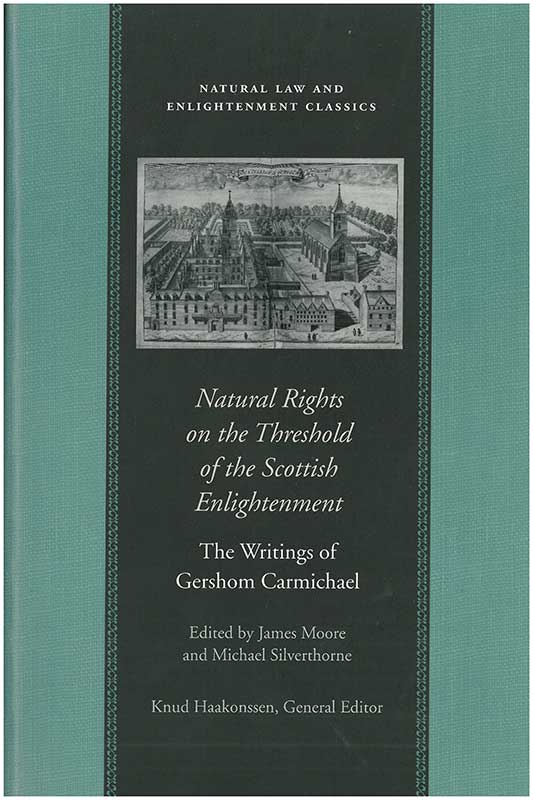
Preface: Natural Theology and the Foundations of Morals - Gershom Carmichael, Natural Rights on the Threshold of the Scottish Enlightenment: The Writings of Gershom Carmichael [1724]

Edition used:

Natural Rights on the Threshold of the Scottish Enlightenment: The Writings of Gershom Carmichael, ed. James Moore and Michael Silverthorne (Indianapolis: Liberty Fund, 2002).

About Liberty Fund:

Liberty Fund, Inc. is a private, educational foundation established to encourage the study of the ideal of a society of free and responsible individuals.


Preface: Natural Theology and the Foundations of Morals

Greetings to the reader

I would not expect even my kindest readers to forgive me for putting before the public today this small and unpolished textbook on the most difficult and sublime of subjects, and I would certainly never forgive myself for publishing it, if I did not think that it was necessary to do so. I feel obliged to give a brief explanation.

Anyone who has any knowledge of the matter knows how valuable, indeed indispensable, it is, in teaching at the university level, to make use of a short system which sets out in an appropriate and natural order the main points of the subject which the instructor will explain to the students at greater length. The examples of the most learned professors in every faculty are surely good testimony to this, and it is amply borne out by the outrageous errors which teachers make on topics which they profess to know well and to dictate to others, when they reject this regular method of instruction and rely on their own native wit and miscellaneous reading.

For this purpose there were really only two such compends1 available for teaching pneumatology, of which the discipline briefly outlined here is a part. Both came over from Holland in our own time and have been in use in our universities for some years now.2 Neither is completely satisfactory; to explain why would be superfluous for the learned and useless to others.

I have long therefore wished that someone would prepare for the use of students a more suitable treatise of this kind, which would follow the lead of truth and not be out of line with the present state of philosophy. I had myself prepared a text which seemed to be quite suitable for explaining the second part of the subject; this was the treatise of the celebrated Pufendorf, On the Duty of Man and Citizen, on which I had published my own notes and commentary. But when a little while ago I obtained the Chair which limits my teaching of philosophy to an annual course in natural theology and moral philosophy, I was concerned that there was no text which I might prelect in covering the first part of the annual curriculum with equal ease and profit for my audience.

It seemed that nothing of this kind could be soon expected from anyone with more leisure and better qualifications in the subject. And since the state of my health would not allow me to take upon myself any heavier or longer labor, my only option was to take up again the very brief compendium of the subject which I had composed more than thirty years before for the pupils who attended my teaching at that time, when we still had the custom of using dictated systems. I had made no serious effort to revise it since then, except in some earlier sections of the first chapter, which I retouched a few years ago to bring them more closely into line with the current state of philosophy.

Both the style and the chain of argument in this compend bore various traces (which even now I am not quite convinced I have eliminated) of my youthfulness and inexperience at the time that I wrote them. However because it was quite short, it seemed it could be revised somehow with relatively little effort. But at the same time its very brevity was a problem, not only because I had to fill in various gaps here and there and explain some things at greater length, but also because as it was short, the reader would be unlikely to be willing to let me nod off occasionally, which, as Horace says, may properly happen to a writer of a long work.3

As I said then, I have carefully read this piece over, and so far as my inadequate background and poor health permitted, I have revised it in some places and expanded it in others. I allow it to be published as you now see it, in the hope that it will be useful to young people, albeit with some danger to my reputation.

I have not however dared to forget what a grave and fearful theme it is which is treated here, and how scrupulously one should beware of publishing anything false about him whom (as the wise warned long ago) even to tell the truth is dangerous. It was far from my aim therefore to attempt to say anything new. If the evidence of truth, more powerful than any human authority, has seemed to require anything of me, even in the manner of explanation, which appears to be new, I am not so tenacious of my own opinions that I am not prepared willingly to follow anyone who shows a better way if I have committed any error. I am very aware of my own inadequacy, and of how readily I could slip into error, even when I most wished to avoid it.

I have never enslaved myself to any school of philosophers (nor of political writers either). I have always avoided the forms of speaking of the Aristotelian school, which are obscure, ambiguous, and, as it were, deliberately fashioned for deception; nor did I think they were made any more sacred because they had been blended into sacred matters, and for want of a better philosophy, applied to the explanation of the gravest topics of religion. Yet I cannot avoid confessing that if we look at the matter itself, in what is by far the gravest part of philosophy, and particularly in the articles concerning the unity of God, his simplicity, and the other incommunicable attributes which flow from them, as well as in those concerning the knowledge and decrees of God, and his providence in preservation and in government, the doctrines of the Scholastics,4 or rather of the more ancient among them, seem to me much more correct and more consonant with sound reason, as well as with sacred scripture, than the doctrines which are opposed to them today, the opinions of certain quite recent learned men whose writings are very much in the hands of the students. Hence I have not been ashamed to develop on these issues certain views which have been hissed off the stage by recent writers as scholastic fictions. I have also felt no need to refrain from certain words and phrases proper to the scholastics, though they may perhaps grate on more delicate ears, when a more Latin manner of signifying the sense with equal precision did not occur to me.

The title adequately indicates that I will be expounding here only what is drawn from nature itself about God; and therefore what is known only by special divine revelation falls outside the limits of the subject I propose. And I have adequately shown in the Preface to Pufendorf, pp. x and xi,5 that the use of this natural knowledge is not excluded, as some believe, but is on the contrary enlarged, by what is more clearly taught on the same matters in the Sacred Book.

There is just one thing left which I think in the interest of truth I should bring to the reader’s notice.

I have asserted more than once in this little treatise that a genuine philosophy of morals must be built upon what I call a foundation of natural theology: every rightly founded distinction of moral good and evil in our actions and the sense of obligation that one must pursue the former and avoid the latter in all circumstances, ought to be deduced from the perceived relationship of those actions to God and from a knowledge of the existence, perfections, and providence of the Supreme Deity. I used the same method in laying the foundations of moral doctrine in the first and second Supplements to Pufendorf.6

But some have thought otherwise, so much so that in recent years schemes which utterly divorce morality from religion have been put before the public and commended to the world by a highly attractive combination of ingenuity and eloquence.7 I wondered for some time whether it would be worthwhile to vindicate the doctrine I have given here and elsewhere by briefly examining the soundness of these hypotheses.

But at the same time I remarked that the foundation of moral obligation would be exposed only when the immediate motive of the will, which is always and everywhere common to all men, was established as the principle. For we ought in the last analysis always to do what we ought to judge is conducive to the end toward which we are directed by the fundamental law of nature. Now a universal motive of this kind is rejected by these authors, and the only motive which can with any likelihood of truth be called universal is not only criticized as sordid self-love by those ingenious writers I mentioned, but is also condemned for impiety by very grave men (who however go in quite different directions from the previous writers on the origin of moral obligation).8 Therefore even if I had more leisure and strength, I could scarcely bear to involve myself in such squabbles (in which I see the cause of religion attacked from opposite sides).

I ask only that the learned in both camps who disagree would take a moment to reflect what it is they are doing when they hesitate between two proposed objects which pull the will in different directions; whether or not they then call in reason and judgment to advise them; and why they do this if it is not to disclose which direction is better, that is, which possesses a greater degree of that quality which, by the fundamental law of our nature, determines the will in the direction in which that quality is judged to preponderate; what likewise it is that they are doing when they attempt to lead others who are choosing and acting wrongly into a better way; whether they are not trying to correct their judgment by showing that the direction which they reject is better, or possesses a higher degree of the said quality.

And yet what opportunity could there be for all this, if there were not some common quality which always and everywhere determines our choice, in accordance with which all the other factors which enter into deliberation are compared among themselves? I freely grant to a recent ingenious writer, that no reason can suffice to determine our actions without the assumption of some instinct, i.e., some fundamental law, in accordance with which a certain definite quality perceived in things immediately determines our choice.9 But I contend that if more than one instinct of this kind is admitted, and thus more than one quality in things capable of moving the will with equal immediacy, no opportunity at all is left for reason to weigh them up and compare them with each other. But if they accept this, there is no apparent reason why in following this instinct or that anyone should be said to have acted better or worse.

Reflecting on all this, one may perhaps be permitted to ask one further question of those who have religious scruples about this. I ask whether they can conceive of anything more honorable to God or more worthy of a rational creature, than that God should direct each individual rational creature toward himself by the fundamental law implanted in its nature (by law I understand not a moral law but a physical law); so that the creature cannot fail to seek his happiness in God and pursue it by a series of actions which seek to illustrate the glory of God and testify to his esteem, love, and veneration for his supreme creator, without straying, by a shameful abuse of reason, from that end to which, by the said fundamental law, he cannot but aspire. But this is not the place to pursue this further.

[1.] The treatises referred to are de Vries, De Natura Dei, and Le Clerc, Ontologia.

[2.] See below, pp. 381–82, in Carmichael’s account of his teaching method (1712), how he substituted his own pneumatics for the third part of the pneumatology of de Vries. Francis Hutcheson employed a similar strategy when he composed his Synopsis Metaphysicae (1742): “I am sure it will match de Vries, and therefore I teach the 3rd. part of it de Deo.” Letter to Thomas Drenman, 29 October 1743 (Glasgow University Library MS. Gen. 1018, fol. 14).

[3.] Horace, The Art of Poetry, ll. 359–60.

[4.] The scholastics to whom Carmichael refers are the Reformed scholastics of the late sixteenth and early seventeenth centuries: Lambert Daneau (the successor to Calvin and Beza at Geneva), the authors of the Leiden Synopsis, Gisbertus Voetius, Franciscus Turretinus, and others. For a systematic statement of their theology, see Heppe, Reformed Dogmatics; for historical background, Fatio, Méthode et Théologie.

[5.] See above, pp. 30–31.

[6.] See above, pp. 21–29 (Supplement I) and pp. 46–52 (Supplement II).

[7.] Shaftesbury, Characteristicks of Men, Manners, Opinions, Times; and Hutcheson, Inquiry.

[8.] The “very grave men” whom Carmichael had in mind may have been those Scottish hyper-Calvinist theologians (the so-called Marrow men), who denounced natural theology as legalism; they were in turn denounced as antinomians. See Lachman, Marrow Controversy.

[9.] Hutcheson, Inquiry, and Essay, where a number of senses (or instincts as Carmichael puts it) are acknowledged.