EconlibThe LibraryOther Sites |
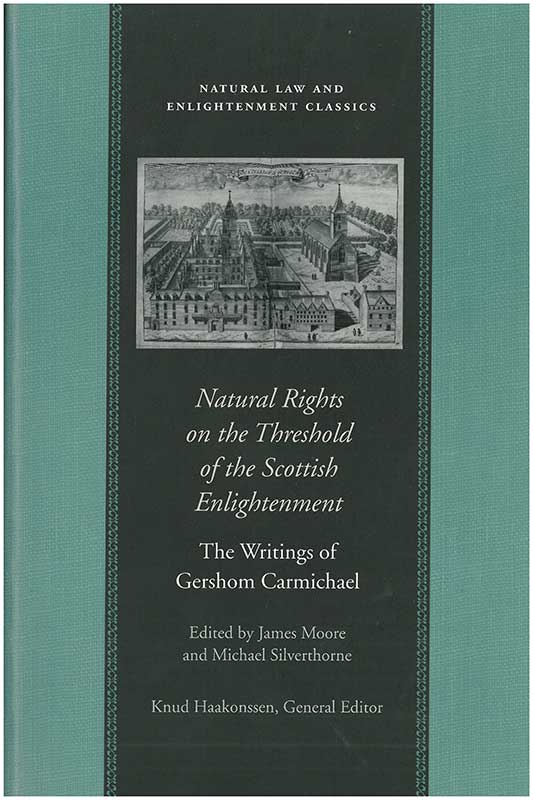
Front Page Titles (by Subject) part ii: Natural Theology - Natural Rights on the Threshold of the Scottish Enlightenment: The Writings of Gershom Carmichael
Return to Title Page for Natural Rights on the Threshold of the Scottish Enlightenment: The Writings of Gershom CarmichaelThe Online Library of LibertyA project of Liberty Fund, Inc.Search this Title:Also in the Library:
part ii: Natural Theology - Gershom Carmichael, Natural Rights on the Threshold of the Scottish Enlightenment: The Writings of Gershom Carmichael [1724]Edition used:Natural Rights on the Threshold of the Scottish Enlightenment: The Writings of Gershom Carmichael, ed. James Moore and Michael Silverthorne (Indianapolis: Liberty Fund, 2002).
About Liberty Fund:Liberty Fund, Inc. is a private, educational foundation established to encourage the study of the ideal of a society of free and responsible individuals. Copyright information:The copyright to this edition, in both print and electronic forms, is held by Liberty Fund, Inc. Fair use statement:This material is put online to further the educational goals of Liberty Fund, Inc. Unless otherwise stated in the Copyright Information section above, this material may be used freely for educational and academic purposes. It may not be used in any way for profit.
part iiNatural TheologyThe complete text of A Synopsis of Natural Theology or, the Knowledge of the existence, attributes and operations of the Supreme Deity, drawn from Nature itself Suitable for the use of students by Gershom Carmichael, Professor of Philosophy in the University of Glasgow (Edinburgh 1729) At the cost of John Paton, at whose premises in Parliament Square copies may be purchased Preface: Natural Theology and the Foundations of MoralsGreetings to the readerI would not expect even my kindest readers to forgive me for putting before the public today this small and unpolished textbook on the most difficult and sublime of subjects, and I would certainly never forgive myself for publishing it, if I did not think that it was necessary to do so. I feel obliged to give a brief explanation. Anyone who has any knowledge of the matter knows how valuable, indeed indispensable, it is, in teaching at the university level, to make use of a short system which sets out in an appropriate and natural order the main points of the subject which the instructor will explain to the students at greater length. The examples of the most learned professors in every faculty are surely good testimony to this, and it is amply borne out by the outrageous errors which teachers make on topics which they profess to know well and to dictate to others, when they reject this regular method of instruction and rely on their own native wit and miscellaneous reading. For this purpose there were really only two such compends1 available for teaching pneumatology, of which the discipline briefly outlined here is a part. Both came over from Holland in our own time and have been in use in our universities for some years now.2 Neither is completely satisfactory; to explain why would be superfluous for the learned and useless to others. I have long therefore wished that someone would prepare for the use of students a more suitable treatise of this kind, which would follow the lead of truth and not be out of line with the present state of philosophy. I had myself prepared a text which seemed to be quite suitable for explaining the second part of the subject; this was the treatise of the celebrated Pufendorf, On the Duty of Man and Citizen, on which I had published my own notes and commentary. But when a little while ago I obtained the Chair which limits my teaching of philosophy to an annual course in natural theology and moral philosophy, I was concerned that there was no text which I might prelect in covering the first part of the annual curriculum with equal ease and profit for my audience. It seemed that nothing of this kind could be soon expected from anyone with more leisure and better qualifications in the subject. And since the state of my health would not allow me to take upon myself any heavier or longer labor, my only option was to take up again the very brief compendium of the subject which I had composed more than thirty years before for the pupils who attended my teaching at that time, when we still had the custom of using dictated systems. I had made no serious effort to revise it since then, except in some earlier sections of the first chapter, which I retouched a few years ago to bring them more closely into line with the current state of philosophy. Both the style and the chain of argument in this compend bore various traces (which even now I am not quite convinced I have eliminated) of my youthfulness and inexperience at the time that I wrote them. However because it was quite short, it seemed it could be revised somehow with relatively little effort. But at the same time its very brevity was a problem, not only because I had to fill in various gaps here and there and explain some things at greater length, but also because as it was short, the reader would be unlikely to be willing to let me nod off occasionally, which, as Horace says, may properly happen to a writer of a long work.3 As I said then, I have carefully read this piece over, and so far as my inadequate background and poor health permitted, I have revised it in some places and expanded it in others. I allow it to be published as you now see it, in the hope that it will be useful to young people, albeit with some danger to my reputation. I have not however dared to forget what a grave and fearful theme it is which is treated here, and how scrupulously one should beware of publishing anything false about him whom (as the wise warned long ago) even to tell the truth is dangerous. It was far from my aim therefore to attempt to say anything new. If the evidence of truth, more powerful than any human authority, has seemed to require anything of me, even in the manner of explanation, which appears to be new, I am not so tenacious of my own opinions that I am not prepared willingly to follow anyone who shows a better way if I have committed any error. I am very aware of my own inadequacy, and of how readily I could slip into error, even when I most wished to avoid it. I have never enslaved myself to any school of philosophers (nor of political writers either). I have always avoided the forms of speaking of the Aristotelian school, which are obscure, ambiguous, and, as it were, deliberately fashioned for deception; nor did I think they were made any more sacred because they had been blended into sacred matters, and for want of a better philosophy, applied to the explanation of the gravest topics of religion. Yet I cannot avoid confessing that if we look at the matter itself, in what is by far the gravest part of philosophy, and particularly in the articles concerning the unity of God, his simplicity, and the other incommunicable attributes which flow from them, as well as in those concerning the knowledge and decrees of God, and his providence in preservation and in government, the doctrines of the Scholastics,4 or rather of the more ancient among them, seem to me much more correct and more consonant with sound reason, as well as with sacred scripture, than the doctrines which are opposed to them today, the opinions of certain quite recent learned men whose writings are very much in the hands of the students. Hence I have not been ashamed to develop on these issues certain views which have been hissed off the stage by recent writers as scholastic fictions. I have also felt no need to refrain from certain words and phrases proper to the scholastics, though they may perhaps grate on more delicate ears, when a more Latin manner of signifying the sense with equal precision did not occur to me. The title adequately indicates that I will be expounding here only what is drawn from nature itself about God; and therefore what is known only by special divine revelation falls outside the limits of the subject I propose. And I have adequately shown in the Preface to Pufendorf, pp. x and xi,5 that the use of this natural knowledge is not excluded, as some believe, but is on the contrary enlarged, by what is more clearly taught on the same matters in the Sacred Book. There is just one thing left which I think in the interest of truth I should bring to the reader’s notice. I have asserted more than once in this little treatise that a genuine philosophy of morals must be built upon what I call a foundation of natural theology: every rightly founded distinction of moral good and evil in our actions and the sense of obligation that one must pursue the former and avoid the latter in all circumstances, ought to be deduced from the perceived relationship of those actions to God and from a knowledge of the existence, perfections, and providence of the Supreme Deity. I used the same method in laying the foundations of moral doctrine in the first and second Supplements to Pufendorf.6 But some have thought otherwise, so much so that in recent years schemes which utterly divorce morality from religion have been put before the public and commended to the world by a highly attractive combination of ingenuity and eloquence.7 I wondered for some time whether it would be worthwhile to vindicate the doctrine I have given here and elsewhere by briefly examining the soundness of these hypotheses. But at the same time I remarked that the foundation of moral obligation would be exposed only when the immediate motive of the will, which is always and everywhere common to all men, was established as the principle. For we ought in the last analysis always to do what we ought to judge is conducive to the end toward which we are directed by the fundamental law of nature. Now a universal motive of this kind is rejected by these authors, and the only motive which can with any likelihood of truth be called universal is not only criticized as sordid self-love by those ingenious writers I mentioned, but is also condemned for impiety by very grave men (who however go in quite different directions from the previous writers on the origin of moral obligation).8 Therefore even if I had more leisure and strength, I could scarcely bear to involve myself in such squabbles (in which I see the cause of religion attacked from opposite sides). I ask only that the learned in both camps who disagree would take a moment to reflect what it is they are doing when they hesitate between two proposed objects which pull the will in different directions; whether or not they then call in reason and judgment to advise them; and why they do this if it is not to disclose which direction is better, that is, which possesses a greater degree of that quality which, by the fundamental law of our nature, determines the will in the direction in which that quality is judged to preponderate; what likewise it is that they are doing when they attempt to lead others who are choosing and acting wrongly into a better way; whether they are not trying to correct their judgment by showing that the direction which they reject is better, or possesses a higher degree of the said quality. And yet what opportunity could there be for all this, if there were not some common quality which always and everywhere determines our choice, in accordance with which all the other factors which enter into deliberation are compared among themselves? I freely grant to a recent ingenious writer, that no reason can suffice to determine our actions without the assumption of some instinct, i.e., some fundamental law, in accordance with which a certain definite quality perceived in things immediately determines our choice.9 But I contend that if more than one instinct of this kind is admitted, and thus more than one quality in things capable of moving the will with equal immediacy, no opportunity at all is left for reason to weigh them up and compare them with each other. But if they accept this, there is no apparent reason why in following this instinct or that anyone should be said to have acted better or worse. Reflecting on all this, one may perhaps be permitted to ask one further question of those who have religious scruples about this. I ask whether they can conceive of anything more honorable to God or more worthy of a rational creature, than that God should direct each individual rational creature toward himself by the fundamental law implanted in its nature (by law I understand not a moral law but a physical law); so that the creature cannot fail to seek his happiness in God and pursue it by a series of actions which seek to illustrate the glory of God and testify to his esteem, love, and veneration for his supreme creator, without straying, by a shameful abuse of reason, from that end to which, by the said fundamental law, he cannot but aspire. But this is not the place to pursue this further. May 12, 1729. On the Scope of Natural TheologyThe knowledge of God which is drawn from nature itself is usually called natural theology. As it contemplates the most noble of all objects, so it greatly exceeds in the gravity and sublimity of the truths which it sets forth all other parts of human knowledge (excepting only the teaching which is divinely inspired and sealed by the sacred oracles). It also commends itself by its utility, since the whole of the philosophy of morals is built upon the principles of this knowledge; for no distinction of moral good and evil has a properly secure basis, unless it rests upon the great and good God, creator, Lord, and disposer of all things. If we extend the term natural theology as far as the word theology is usually extended by theologians in the case of revealed theology (theology defined as the doctrine of acknowledging God and worshipping him, where the term “worship” implies obedience to all his commands),1 moral doctrine, as we have said, will have to be considered as its second part. But the prevailing practice is to include under the name of natural theology, only the theoretical part, and to distinguish it from the practical part, which is to be taught separately. This is the subject of which we shall attempt to give a brief account, so far as our modest ability allows, under the guidance of the God we discuss. Our account will have four chapters: in the first we shall speak of the existence of God; in the second, of his incommunicable attributes; in the third, of his communicable attributes; and in the fourth, of his operations, or actions.2 chapter 1On the Existence of Godsection iIn which it is demonstrated that an independent being exists That something exists, we here assume as certain, and rightly so; for each man is intimately conscious to himself of at least his own existence as a thinking being; and hardly anyone doubts the existence of physical objects, perceived by sense. But that which is assumed to exist is either independent or dependent; that is, it is either sufficient to itself for existence, or it borrows its existence from elsewhere. If it is independent, we have what we aimed to demonstrate in the first place, so long as the properties of independent being, which we shall establish in the next Section, do not compel us to abandon this hypothesis and have recourse to another. But if that whose existence is assumed is dependent, that on which it depends is either independent itself, or leads us, as we trace it back, to some first and independent cause; for in the subordination of causes, there can be no possibility of a circle or of a series running back to infinity. That the former is impossible, is clear by itself, but it is also clear that we should not admit the latter either. For the efficacy by whose power every particular effect exists, must necessarily be transmitted through all previous causes in a straight line; but no efficacy can be transmitted through an infinite series of causes, for the reason that infinity cannot be traversed; therefore no effect can depend on an infinite series of causes. The force of this argument will show more clearly, if we notice that every particular effect necessarily, so long as it exists, depends on some cause which is actually operative at the time; and it would be difficult to accept that there could be an infinite series of causes of this kind. But it is most evidently clear that neither a circle nor an infinite series of dependent causes can exist without an independent cause; for either the whole range of dependent causes is itself dependent on something external, or it is not. If it is, we already have the independent cause which we are seeking, since it is distinct from the whole range of dependent causes. If it is not, then the whole mass of dependent causes will be independent; and nothing is more absurd than that. For since a whole includes every individual part, and its existence presupposes their existence, it is manifest that if none of the parts is sufficient to itself for existence, the whole cannot exist of itself either, but will still require an external cause. For an infinite number of effects will never be able to take the place of a cause, any more than an infinite series of weights, depending on each other, will be able to take the place of a fixed support. Necessarily therefore it must be conceded that there is an independent being which is prior and superior to particular dependent things. section iiIn which it is shown that the independent being is a spirit, supremely perfect, from whom all things have their being, that is, is God That which is independent must necessarily be supremely and infinitely perfect. For just as the perfection of any effect is measured either by the power or the will of the producing cause, so the measure of an independent being (if we may speak of measure) cannot be other than what is best for itself, i.e., a supreme and infinite measure. And as that which is sufficient to itself for existence, exists necessarily, so, by the same necessity, it enjoys every possible perfection. Hence the most perfect essence must be that which is possessed in the most perfect mode, and that is the independent mode. Hence it follows (note this carefully) that anything which comes within the range of our sensation or reflection is dependent, by the very fact that it is not infinitely perfect but suffers from multiple defects. But when we speak of something as supremely and infinitely perfect, we mean by that appellation to attribute to it every kind of pure and simple perfection and no imperfection. To put this in rather more technical language, it formally possesses absolutely every perfection, really pure as they exist in the object itself. The distinction that is taught in Ontology between pure perfections, or perfections simply so called, and qualified perfections, should be applied both to perfections absolutely regarded, as they exist in their own subject (in which sense only the divine perfections are pure and simply so called, all the rest being essentially limited and imperfect) and to perfections so far as they are represented by a given abstract idea. If the idea involves nothing in its comprehension which suggests defect or imperfection, it is said to represent a pure perfection, otherwise merely a qualified perfection. In this sense thought, as I go on to say, is a pure perfection, but extension is not.1 It contains all the attributes of any possible things whatsoever in the manner in which they can be contained in the most perfect being. That is, it contains them virtually, as in the first and sufficient cause; and at the same time it contains them eminently, as in that to which should be attributed everything whose idea suggests pure perfection shorn of imperfections, and which is also negatively detached from all imperfections. Hence we understand that though the perfection of the supreme being does not exclude the existence of finite beings dependent on itself (since finite perfections cannot be formally contained in an infinite being, and if they depend on it, are contained in it so far as they are able), yet it does exclude the existence of another independent, and therefore infinitely perfect, being. It also requires that every other being, and every state in which any being can be, depend so completely upon the supremely perfect being, that nothing exists or can exist without its existence, its quality, its quantity, and its duration being determined by the independent being. For if anything existed which was independent of this Being, it would not contain, either formally or virtually, the perfections of the other, and so would not be infinitely perfect. Hence finally it necessarily follows that the Supreme Being, independent and infinitely perfect, is spirit or thinking thing (res cogitativa), since to have the use of thought is much better and more perfect than to be without it. It also follows that, as the creator of bodies no less than of spirits, it is not body; for the very idea of physical nature involves imperfection. By all these arguments we have afforded a demonstration of the existence of an independent spirit, supremely perfect, from whom all things have their being, that is, of God himself. section iiiIn which it is shown that the physical world cannot subsist without an immaterial principle The general demonstration which we have given leads us from any finite, and therefore dependent, thing to an independent, and therefore infinite, cause; and from this in turn, as if a priori, it leads us to the spiritual nature of that cause, and its power of causing all other things there may be; and so on to whatever may be demonstrated of God. But there are also innumerable more particular reasons afforded by individual parts of the universe, which all conspire to prove that there is an immaterial principle of things, that it is essentially a thinking principle, and that it is wise, powerful, and benevolent beyond anything that we can conceive. Once these points are proven, the cause of atheism is overturned. To make it clear that we must necessarily acknowledge an immaterial principle, we need not repeat once again that matter, since it is the lowest of all things that exist and contains perfection of the lowest order, is far from the supreme eminence of perfection which we have shown above to be necessarily involved in independent and necessary existence; and that matter therefore exists neither of itself nor necessarily, but presupposes a superior cause by which its existence is determined. Assuming that matter exists, it is indifferent with regard to motion or rest, and no individual piece of matter is destined by the necessity of its nature to the one rather than to the other. Moreover, since the varieties of possible direction are infinite, if matter is not set on one course rather than another by some external cause, it must necessarily be at rest forever. In order therefore that existing matter may be set in motion, having no principle of motion in itself, it stands in need of the influence of some external and superior principle. If you prefer to suppose that matter is in motion rather than at rest from the beginning—apart from the fact that this supposition has been soundly refuted by what I have already said—it makes no difference. For just as matter at rest continues in a state of rest, so no less necessarily, matter in motion perseveres in a state of motion and uniformly in direction, except insofar as it is compelled to change that state by the application of forces; and since these forces are assumed to exist merely as bodies, they can be applied only by means of an impulse. Yet it is no less certain, that continual changes occur in the motions of matter, that they are plainly required for sustaining the fabric of the physical universe, and that they cannot be derived from any physical impulse. This is so true that, if we assumed the existence of every particle of matter as well as of the compound bodies which are compacted from them, and if we assumed that they were arranged in the same order in which they are now arranged to compose this universe of physical things, and if too they were stirred by the same movements which actually do occur in them; if we assumed also that individual portions of matter could continue not only their existence, but also the motions which they have (however it may be that this happens) according to laws of nature known and proved by experience, or could even communicate these motions by contact with other parts; if all these things, I say, were assumed, still the fabric of the universe could not subsist even for one moment, if the motions of bodies did not undergo continual changes from an external source. And since these changes do not proceed from the impact of other bodies, they can only come about by the unceasing application of forces from some immaterial principle in accordance with fixed laws. We see the evident effects of forces of this kind in the gravitation of terrestrial bodies toward earth, in the curving orbs of planets and comets, in the hardness and elasticity of bodies, in those wonderful phenomena of light recently detected by the celebrated Newton, and in other such things. None of them, as has been shown time and again, can be derived from the laws of a mechanism, much less are they produced by the essential forces of inert matter. section ivIn which it is proved that the physical world could not have been preserved forever, nor ever originally brought forth, without some force which operates above the laws of nature The face of nature, as we now see it, could not have been preserved through infinite centuries, nor originally brought forth, by dint of those laws and applied forces by which today the fabric of the world is sustained. The planets could not have turned for infinite centuries about the sun, without at last losing their projectile motion by one of those rare collisions of celestial matter, and rushing headlong by their own gravity into the sun once they had lost their motion; nor could the sun itself and the fixed stars have avoided the similar danger, by gravitation toward one another, of compacting, in the passage of infinite centuries, into a great immobile mass. Those flaming globes could not have emitted rays of light in every direction through infinite centuries without being at last exhausted of all light and heat. Finally, this globe itself, composed as it is of earth and water, could not have been irrigated by waters flowing down for infinite centuries, without its face being at last worn smooth, as the higher parts of the dry land were gradually carried down toward the sea. But if physical nature, left to its own laws, could not have sustained itself forever in its own state, much less could it have arranged itself in the regular order which it has from any other state. We may conclude therefore that the dry parts of the terraqueous globe were elevated above the surface of the waters, that the celestial bodies were placed at due distances from one another, that the sun and the other fixed stars were saturated with the most subtle fire, that the planets were propelled with great impetus, and so on, by some force and power which exceeds the laws of nature and is therefore without a doubt immaterial; even if we were to claim, contrary to all evidence of truth, that the said laws were essential to mater. The propagation of animals and plants equally proclaims the same power. For it has been well known for a long time to all who are versed in these matters, that no new animal or plant could be formed by any laws of nature;2 things which are commonly said to be generated have in fact been previously formed, and simply expand and unfold as the new fluids rise. Hence it follows that the generation of plants and animals cannot have continued through infinite centuries, unless we assume an infinite number of individuals of every single species and therefore an infinite number of wholes (which is supremely absurd). For however small the mass of each individual one was, it would necessarily have had to contain all the threads of life, that is, all the originally solid parts, and thus a specific quantity of matter. Therefore the bodies of all plants and animals were fabricated by some immaterial agent, and one who operates above the laws of nature. section vIn which is shown from the structure of the physical world that it is the work of an intelligent and purposefully operating cause It is fully established by the arguments of the previous section that the physical world, from whatever direction we view it, betokens a creator, whose power is superior to the laws of nature; and he reveals himself as intelligent and free, as well as powerful, by the fact that, though he necessarily employed his power in the original creation of the world, he does not exercise it in the same way in its daily governance, but operates for the most part by means of fixed laws adequate to this end. But an intelligent and purposefully operating creator of the universe is more clearly attested by the overwhelming evidence of providential and benevolent design, which reveals itself in the apt disposition of all things, originally formed by that supernatural force and then preserved in accordance with fixed laws. So powerful is this evidence that it is much less conceivable that out of the infinite number of possible motions and combinations of motions, matter once set in motion formed of its own accord and without the direction of an intelligent principle, precisely that arrangement of things which we admire in this visible world, than that the whole Aeneid of Virgil could have been written in intelligible letters by the casual dripping of ink onto a page. And here a vast store of things would suggest themselves to our thoughts (if our intention to be brief would allow it). Whether we contemplate the excellent order in which the various parts of the universe are laid out; or the striking beauty which shines out in individual things; or the marvellous utility found in all members of the creation and the exquisite adaptation of their structures to their specific ends, or the constant regularity of every individual thing in performing its operations; or the lavishly accumulated stock of all those things which make for the preservation of each kind of creature, and particularly of man; or finally the traces of thought, or even wisdom, which are perceptible in the operations of irrational agents: in all these things the evidence of infinite wisdom, power, and benevolence is more than manifest. But since I cannot spend time on this, anyone who wishes to see a large number of such phenomena surveyed and explained in detail, should consult The Wisdom of God in the Works of Creation, by the celebrated Ray, Pelling’s Discourse on the Existence of God, Cheyne’s Philosophical Principles of Natural Religion, Derham’s Physico-Theology and Astro-Theology, Nieuwentijt’s Religious Philosopher, and other books of the same tendency, which are widely available.3 He should look at the older books but pay particular attention to the recent ones. For the greater the progress made in the knowledge of nature, the more indications emerge, and the more clearly, of the divine Artificer. section viIn which the existence of an immaterial and essentially thinking principle is confirmed from the thinking to be found in man, both as viewed in itself and as combined with physical motions But if the structure of the physical world points by such manifest signs to an immaterial and intelligent cause, how much more obvious are the signs we are obliged to recognize in the intellectual world. If matter cannot be brought into existence itself; if existing matter cannot move itself; if matter, however set in motion, is not sufficient to preserve the structure of the world for even a short while without the continuous application of new forces to it from elsewhere; if matter, together with those moving forces, whatever their source, by which we now see it impelled, is not adequate to give rise to the visible world or preserve it forever: much less could matter, by whatsoever means moved and by whatever forces impelled, acquire for itself the power of thinking. Leaving aside arguments by which it has often been invincibly demonstrated that matter, however modified, cannot think, it is at least more than evident that thought does not belong essentially to matter, whatever motion or impulsion matter may undergo; as if matter could not be moved or impelled without immediately becoming conscious of itself. No matter under what conditions matter is moved or impelled, if (as atheists claim) it is the only vehicle of thought in man, it still needs the efficacy of a superior principle, and that an essentially thinking one, in order to be raised to a perfection that is not essentially appropriate to it. For thought cannot emerge by itself from things devoid of thought, especially if they are not mutually penetrable. But if even thought of the lowest order cannot arise from matter however modified, much less can the nobler and more sublime modes of thought which the human mind experiences in itself. For often from the smallest and simplest principles, it arrives by long chains of reasoning at knowledge of the most recondite and abstract truths; it represents to itself at a glance not only things past and to come, but also infinite vistas of possible things; through earth and heaven it roams, yea, and ascends in its meditation beyond the bounds of both; it contemplates the idea of the most perfect being; it aspires to the beatific enjoyment of him, it recoils from his anger; and it is so strongly moved to obtain the former and avoid the latter that, without hesitation, it respects the divine precepts revealed to it, however contrary they may be to its desires, as the most sacred rules of morality which it may not violate with impunity. Suppose we allowed the atheists to claim (yet no claim is more absurd) that there are certain distinct combinations of motions which, every time they happen to occur, necessarily give rise to thought. Since such a delicate combination of motions is required for such a singular effect (for out of an infinite number of equally possible combinations, scarcely one or two are suitable), it will certainly seem incredible that this combination occurs so frequently, is so constantly and regularly maintained and results in such remarkable effects. Certainly if no one ever dreamed that things which happen without purpose and by chance have their origin in men, much less should one think that the very power of taking thought from which such wonderful effects result, arose from a fortuitous concourse of atoms without the design of a superior cause. Whatever then we suppose its inmost constitution to be, the mind gives evidence of some cause which is far superior to matter and also intelligent, and which (for the reasons given in the last section) possesses this intelligence essentially and independently, as well as all the other perfections to be found in the mind, so far as they are such. This is also the strong implication of the wonderful phenomena of the union between the human mind and the body, that imperceptible reciprocity of thought and movement. When certain movements trouble the body, they are passed on by channels of which the mind itself is not aware, and are followed by certain perceptions in the mind which alert it to a timely concern for the body. In the other direction when the mind wishes to move a bodily limb, its decisions are taken up by specific motions of the animal spirits of which the mind is not conscious, which yet lead directly to the external motion whose execution it has itself commanded. Similar evidence is afforded by the stupendous construction of the organs that make this communication possible and by the imperceptible ties which connect the human mind, by mediation of the body, with all the visible parts of the world and especially with other men,4 and which in turn incline man to enter society and cultivate peace with others of his kind, which is the basis of the security of the human race on this earth and the firm foundation of all government and order among men. All these things, which cannot be thoroughly explained even by the most diligent and skilled investigators of nature, man could certainly never have provided for himself. Consequently if there was nothing existing in the world but the human race, one would be utterly unworthy of the name of man if one contended that man could be either created or preserved without the efficacy of the Deity. section viiIn which remarkable events are adduced in support of the same conclusion Furthermore the creator and preserver who is proclaimed by the fixed order of things that stay the same or move in regular courses, is also revealed as governor by extraordinary events which happen from time to time in the world. Concealed crimes are uncovered in marvellous ways; the designs of the impious are frustrated by unexpected events; oppressed innocence is vindicated and set free by an unlooked for coincidence of various accidents; contumacious sinners are afflicted with horrible punishments; governments are transferred from one man to another because of the sins of rulers and their subjects, with massive loss of life; while all the time, government and, through government, order of some kind are preserved in the world. If to all this we add miracles, which incontrovertible evidence tells us have occurred for the benefit of man beyond the ordinary laws of nature, and the no less wonderful predictions of future events, and revelation of the divine will by the testimony of both, no one in the face of all these things will be able to resist the conclusion that there is a God who judges justly, who has nature in his power and to whom all his works are known from the beginning of the world. section viiiIn which universal human consent is adduced to the same end, with some other considerations Finally a great deal of weight is added to the previous arguments by the consent of almost all men, of every race and every age. However diverse their opinions on the nature and properties of God, they have nevertheless unanimously agreed that there is a Supreme Deity. Such universal agreement to a doctrine to which all the prejudices of the senses, the imagination, and the feelings are opposed, must necessarily be recognized as a native offspring of the reasoning faculties, as a seal which the divine hand has impressed upon his work. Various other considerations could be given here, based upon a comparison between the belief which denies divine existence and that which affirms it. These include considerations of the great risk which the atheist runs if he is wrong; of the horrid consequences of atheism, which will destroy all virtue, all order in human society; of the ineluctable difficulties in which the atheist becomes involved in laboring to escape from certain difficulties in conceiving of the Deity; and of the weakness of the reasons which the atheist puts forward compared with the reasons which establish the opposite truth. But all this and much more that we must pass over, which has the strongest tendency to confirm and illustrate this most important truth, may be read in the celebrated Master Jacques Abbadie’s On the Truth of the Christian Religion, volume 1, section 1.5 section ixOn the arguments for proving the existence of God made by the celebrated Descartes As no mention has been made above of the arguments which have been used to demonstrate the existence of the Deity by the celebrated Descartes in the third and fifth Meditations, the fame of the author and of his speculations seems to oblige us to explain this omission.6 In the third Meditation the celebrated author argues that any idea presupposes a cause of itself which has in itself so much reality and perfection, formally or eminently, as is contained in the idea itself objectively or by representation. Since therefore we have an idea which represents supreme and infinite perfection, it must necessarily be obtained from some cause which contains in itself all that perfection. I would consider this argument to be well-founded, if we were conceiving of God here in his own kind or, as the scholastics say, in his quiddity, such as one must believe the blessed inhabitants of heaven to enjoy, impressed upon them by the object itself, or by the exemplary cause. But since the idea of God which we have in this life is merely abstract, such an idea as can be formed, like other ideas, from simple sensations or reflections by variously separating or combining them, it is not obvious what can be inferred from this idea, more than from any other to be found in the mind. You might perhaps argue that we can at least rightly infer from it that the first cause also of ourselves contains an idea of infinitely perfect being, and consequently that since it too has the power of actually possessing all the perfections of which it has the idea because it has the power of existing in itself, it is itself infinitely perfect. The celebrated author makes this argument toward the end of the same Meditation. I have myself shown above that being which exists by the internal necessity of its own nature, also possesses by the same necessity every perfection. But I do not see how it contributes to the elucidation of this question to say that the supreme Being has the idea of infinite perfection, unless he is supposed, by some voluntary act of his own, to impart existence to himself and the perfection which he possesses; but this is certainly not acceptable. Another argument which the same author uses in the fifth Meditation, which infers that God exists from the fact that necessary existence, as a perfection, is involved in the idea of an absolutely perfect Being, suffers from a more obvious fallacy. For from the fact that some attribute is involved in the idea of something, it only follows that this attribute belongs to that thing, if that thing exists, not that the thing having this attribute actually exists. Anyone who wants to read more about these questions should consult the Meditations of Descartes cited above, with the supplements, objections, and replies. He should also read the teaching of the celebrated Gerard de Vries on this subject in his Reasoned Discussions, in the dissertation “On infinite extension” and “On innate ideas of things,” and elsewhere.7 chapter 2On the Attributes of God and First, on the Incommunicable Attributessection iOn the attributes of God in general, and their division In the last chapter we demonstrated the existence of a Supreme Deity, that is, an independent spirit, supremely perfect, from whom all things have their being. The next step is to give an outline, however briefly, of certain particular perfections of the Deity which are contained by necessary connection in the idea we have just explained and to demonstrate that they belong to the Deity. The perfections formally involved in this idea need no further work, since we have demonstrated above that God exists, when the idea of him is considered in its full comprehension. This was the result of the first two sections of the last chapter, where we proved from the evident series of causes that an independent being exists; then, that what is independent is infinitely perfect; that what is infinitely perfect contains in itself all the perfections of other things, and consequently all things depend upon it; and finally that this most perfect being is also a thinking being and is therefore spirit. Since, as I say, we have adequately demonstrated the existence of this Being which is represented by the idea of God just defined, we must now investigate the attributes which we infer are necessarily connected with that idea.1 One part of this complex idea is generic, namely, that by which God is represented as spirit, or thinking substance; the second part is distinctive, by which God is represented as infinitely perfect, independent, from whom all things depend. Hence also arises a double order of secondary ideas, or attributes. Those which are a consequence of the generic concept, that is, spirituality, are called communicable, because they belong or may belong also to created spirit, at least in some degree. But those ideas which are a consequence of the distinctive concept, i.e., infinite perfection, independence, and absolute primacy, are normally called the incommunicable attributes of God. We must speak briefly about both kinds of attribute, but first about the incommunicable attributes, both because they are by and large formed in our conception from the attributes common to every being by the removal of the imperfections or limitations which are found in every being except God, and because it is by adding incommunicable attributes that we are to give a particular description of the communicable attributes and in some measure elevate them in our thought in order to make our conceptions of them worthy of God. By this means other incommunicable attributes are generated from the combination of communicable and incommunicable attributes with each other. They designate in a manner appropriate to us the special mode in which otherwise communicable attributes belong to God. Thus infinitude added to knowledge constitutes omniscience, added to power, omnipotence, and so with the rest. section iiOn the necessary existence of God First, it is inferred from the divine independence that God exists necessarily, that is, by internal and absolute necessity, not (like all other things) in relation to some external principle. However we do not therefore, as some do, consider the divine perfection as either the cause or reason of the divine existence. Perfection cannot be conceived as the reason for existence, unless existing perfection is meant; that is, unless we assume the very thing whose reason is supposed to be being explained, since existing perfection necessarily involves an existing subject to which it belongs. We are correct therefore in saying that no cause or reason for the existence of the first and intrinsically necessary being ought to be sought or can be given. In truth it exists, because it exists. And therefore its existence does not have to be demonstrated by us a priori, but only a posteriori. However we do not deny that granted the existence of a deity, his infinite Perfection can be understood, to our way of thinking, as the reason why he cannot but exist in any case. But from the fact that no reason can be given for first existence, it does not follow (as a certain learned man contends)2 that the first being exists purely fortuitously. Intrinsically necessary existence is not less contrary to fortuitous existence, it is in fact much more contrary to it than it is to anything that follows by the strictest necessity from any principles whatever; and for this reason it cannot by any chance cease to exist. section iiiOn the divine unity The infinity of God no less clearly entails his unity, or his uniqueness, which is utterly incompatible with the existence of several gods, several beings supremely and infinitely perfect. For what is infinitely perfect essentially involves all pure and simple perfections; and so leaves no perfections of that kind (perfections, that is, from which every imperfection is absent) to be possessed by any other being whatsoever. Likewise, all things depend on what is infinite, so that no room is left for any other independent being whatsoever. Divine perfection therefore utterly excludes any other being similar or equal to it. Conversely, no finite being includes in the idea of itself any essential attribute which may not belong to anything at all. section ivOn the divine simplicity Not only is God himself one, so that it is impossible that more than one God exists; but also whatever exists in God is one in such a way that it is plainly incompatible with the presence in him of several parts or perfections which are really distinct from each other or different from God himself. For either the several things which are supposed to exist in God are finite and dependent, or they are infinite. If the former, they cannot belong to God, whose perfection does not allow that anything found in him be dependent or finite; if the latter, they imply a plurality of gods, a view refuted in the previous section. The divine simplicity consists in this real identity of all things that exist in God, among themselves and within God himself. This not only precludes God from being composed of several things, that is, from drawing his existence from others; it also precludes him from being composed with several things, or entering as a part into the constitution of some whole. For this would prove that God does not contain all perfections in himself, but must borrow some by the addition of a component. This is the point of the phrase of the Scholastics that God is purest Act,3 by which they mean that in God there is nothing potential, that is, no passive power of receiving any perfection or quality whatsoever which is not contained in his essence itself. section vOn the divine immutability God’s immutability necessarily flows from his simplicity. Every change occurs either by a new arrangement of parts or by the addition of some new component, or by the removal of what had previously been a part. But none of these can occur to God, who, as we demonstrated in the previous section, admits neither parts nor components. Therefore the excellence of the divine nature utterly rejects any change whatsoever. It is equally evident that all created things, being composed of several things or at least with several things, are liable to change. section viOn the divine eternity Because of this mutability of all created things and because of their contingency, they may not only possess perfections at one time and lack them at another, but also may exist at one moment and not exist at all at another. Further because of their finite natures and the frequent incompatibility of the properties which they may admit, they possess the various modifications of which they are capable only in succession. This is why we normally measure the existence of created creatures by time, that is, by the parts of succession with which they coexist. By contrast, the uniform constancy (if one may put it this way) of the existence of God, who exists necessarily, and possesses immutably and therefore all together, all the perfections which can belong to a Supreme Being, and who contains all things by virtue of himself, is far above all those modes of measurement. Hence on the one hand it makes no difference to the essential perfection of the Deity whether succession itself exists and so whether God coexists with it, or not; and on the other hand the Supreme Deity could not lack any of the eternal constancy of existence which coexistence with a succession which was infinite on both sides would involve. The ideas of divine eternity and immensity which we explain here may seem to some to be rather unusual. But we could not follow the philosophy of some recent writers4 and accept succession and extension as properties of the Supreme Deity or regard them as anything but properties of contingent things, to which necessary existence is no more to be attributed for that reason than to the subjects in which they are. On the other hand we could not for that reason follow the unsubtle subtlety of the Scholastics,5 who on the one hand declare that the whole idea of succession is so distinct from the concept of eternity that they do not seem to recognize any relation of one to the other, and yet by their very manner of speaking betray the fact that they secretly cherish in their minds the popular idea of eternity as a permanent coexistence with a certain infinite flux of moments, or a temporal space, so to speak; just as they do not conceal the fact that they conceive of immensity by means of presence (but without any extension on its own part) with infinite local space. At the same time, since they do not concede necessary existence either to succession or to real extension, they call both spaces imaginary, and thus attribute the properties of real entities to mere nothing. He who seriously reflects on this, will easily recognize that no other way is left than the one which we have attempted. 6 God therefore is eternal, he is the one who, without succession in himself, transcends the whole order of successive things and embraces all succession in his own person, so that he can lengthen or shorten it, by the effective decree of his will, to whatever limits he wishes in either way, while he coexists with it all in the most perfect manner, neither adding anything to his existence, nor taking it away. section viiOn the divine immensity Again, we are accustomed to define created things not only by times, or parts of succession with which they coexist, but also by places, or parts of extension with which they correspond. Now the simplicity of the divine nature does not admit this kind of part any more than the other, nor does actual extension any more than succession belong to the essential perfection of the Deity (for the existence of both is contingent). It is a puerile sophism which some learned men have used in trying to demonstrate that real existence cannot be bounded by any furthest limits, much less not exist at all. That which is extended, they say, if it is finite, is either bounded (i.e., as they explain it, surrounded) by that which is extended or by that which is unextended or by nothing; if you say surrounded by nothing, you are, according to them, already attributing extension, which is a property of real being, to nothing. But what schoolboy does not see that the sense of the proposition by which it is said that an extended thing is surrounded by nothing, is negative, i.e., it is not surrounded by any thing, or not surrounded at all. For that every extended finite thing should be actually surrounded by something else (which necessarily posits a further extension) is an obvious petitio principii.7 Yet it is certain that God cannot lack any amplitude which copresence with extension infinite in all dimensions would include. We therefore conceive of God as immense, that is, as one who without extension in himself, transcends all extension and has it all within himself, so that by the effective decree of his will he may command it to be extended or circumscribed to whatever limits he pleases, being present himself to the whole of it in the most perfect manner, neither adding anything to himself nor taking it away. section viiiOn the divine omnisufficiency From what has been said it is easily understood that God is omnisufficient, i.e., that both for himself, and for all others from himself, he is all in all. That he is sufficient to himself, is quite obvious from his independence. But if God, the supremely perfect being, is sufficient to himself, much more must he be sufficient for other things which have no perfection at all in themselves, except so far as they carry some shadow of the divine perfections, whether for giving them existence and maintaining it, or affording them the highest perfection they can attain. This is particularly true of the dispensation of complete beatitude, perfect at every point, for rational creatures, not only for giving it to them from himself as the supreme provider, but also for exhibiting it in himself as omnisufficient object. section ixOn the divine incomprehensibility From each and every one of the perfections explained so far, it obviously follows that the Supreme Deity is incomprehensible, that is, that he cannot be so thoroughly understood by any intelligence except his own that he is not infinitely more concealed than known. This is not to be understood only in the sense in which it may be truly affirmed that no object of any kind can be comprehended by a finite intelligence, because any given thing has innumerable relations with other things, whether existing or possible, which no finite intellect could exhaustively enumerate. The divine incomprehensibility, I say, is not to be understood only in this sense. For not only does God have infinite relations with infinite external objects, but infinite in himself he also contains all their perfections within himself, and thus has infinitely more perfections than can be enumerated; which cannot be said of any other being. In fact, though in some measure we do grasp the divine attributes which we conceive, yet in the manner in which they belong to God, each of them leads the mind as it were into an abyss which no finite mind has power to penetrate. And yet this does not prevent the idea of God which with due attention we achieve, from being said to be clear and distinct in the sense intended by recent writers on logic.8 For however inadequate it may be, and however much of the unknown it may contain, yet in itself it does strike the mind with sufficient vividness, and is easily distinguished from any other idea. Note too that the finite capacity of our minds implies not only that all the knowledge which we can have of God is quite inadequate in any case, but we cannot grasp it all in one go; we are compelled to present to ourselves the perfections which are plainly identical in God (as is clear from section iv) under various different notions. But if God cannot be comprehended by the mind, much less can he be plainly expressed by the tongue; and thus he is ineffable. section xOn the divine admirability From the divine incomprehensibility it follows that God is supremely admirable, since however long the mind persists in its contemplation of him, something new is always arising for its contemplation, even for eternity. section xiOn the divine adorability Finally, from all the aforesaid prerogatives of Deity, his adorability necessarily flows; that is, the eminence of perfection on account of which every rational creature is bound to submit himself to God with the greatest mental devotion, and to order all his actions to celebrate his praises. This prerogative necessarily presupposes that God is a thinking agent, and is in truth the incommunicable acme of the divine majesty, of which we will speak in the next chapter. chapter 3On the Communicable Attributes of Godsection iOn the communicable attributes of God in general It naturally tends to enhance our devotion to God to consider him as a spirit, a spirit in whom all the individual prerogatives of supreme Deity which we surveyed above are attached to each of the common properties of spirits.This attachment of incommunicable attributes to communicable attributes is neatly expressed by the reverend theologians of the Synod of Westminster, when in describing God in the Westminster Catechism, Question 4, they liken the incommunicable attributes to adjectives, the communicable to substantives which the adjectives modify.1 In order to proceed properly in this train of thought, we should reflect on ourselves and on the modes of thinking which we experience in ourselves; we must then carefully distinguish in each mode what indicates a perfection and what indicates an imperfection. Our aim is to reject all imperfections, that is, all those conditions which derogate in any way from the divine prerogatives established in the last chapter, and to assign the remainder securely to the Deity, not only stripped of imperfections, but also negatively separated from them, or so elevated by the addition of incommunicable attributes, that the result is worthy of God and proper to him. We have explained above (ch. 2, sec. i, toward the end) the way in which incommunicable attributes are formed from communicable attributes.2 But (to avoid repeating the same thing again and again later) we must make a cautionary point at the outset. We find an imperfection in all our modes of thinking: they are adventitious to our minds and different in reality both from the mind itself in which they inhere and among themselves, and they are only formed in us successively. But in God there is a completely different mode: all his thoughts are one most simple and eternal act which is in reality identical with his essence, as is quite clear from the simplicity and immutability which we previously asserted of the Deity. Further, a consideration which we used above to form the notion of the simplicity of God in general is highlighted in a special way when we attribute the perfections of spirits to God. For, since the divine essence has necessarily to be recognized as most perfect in itself without addition of any distinct entity, it cannot be most perfect without actual knowledge, and that knowledge must be consistent with his most perfect nature, i.e., it must be infinite. Hence knowledge which is actually infinite belongs essentially to God, i.e., is identical with his nature. (The same thing is to be understood of an actual volition that conforms with the supreme reason, etc.) With this observation, we go on to particular points. section iiOn the divine ideas of things In the first place we experience in ourselves that we contemplate various ideas of various things or conceive of various objects; and since it denotes a perfection rather than an imperfection to conceive of objects or to apprehend them (because this is necessarily involved in every thought about them), there is no doubt that we should attribute the same to God. But our mind has particular concepts of only a few things, and these are thoroughly imperfect and inadequate; and just as it views external things only in ideas drawn from outside itself, so perhaps it does not know itself till it catches itself engaged with things other than itself. By contrast God himself is the closest object of knowledge to God; thus while he comprehends himself in his omnisufficiency, he must also contemplate in the most perfect manner all possible things which are virtually contained in it. That God cannot comprehend himself without contemplating all possible things, since they are virtually and eminently contained within himself, is so far from convicting him of poverty (as Poiret foolishly fears) that on the contrary it is to be attributed to the infinite sufficiency of the Deity.3 But we must not attribute to the Deity the sensations and imaginations that are found in us, since they are not in themselves true representations of objects, but give evidence of passions and dependence on external things, and seem to have been given to us only to assist our weakness, i.e., so that external things, which would otherwise be hidden, may become known to us through their effect on our minds. section iiiOn the divine knowledge We also observe in ourselves that we form opinions or judgments by comparing ideas with each other. As the knowledge of truth which consists in the sole act of judging is a great perfection of a thinking thing, without which simply having ideas by observation would be of little use to the mind, there is no doubt that judgment, understood in this sense, belongs also to God. We here use the term “judgment” as it is understood by logicians in describing acts of the mind. One must beware therefore of following the usage of our vernacular idiom and including anything in the idea of it which would derogate from the certainty of knowledge.4 But of the immense number of knowable truths our judgment extends only to a few, and is frequently uncertain even about these and quite often wrong. But the judgment of God bears on its face the highest evidence of truth in all things, and has the most absolute right to be called knowledge. It also embraces the whole range of truth in its scope; for only infinite knowledge is worthy of infinite Spirit. But to get a better grasp of these things so far as our means allow, we must distinguish between the different classes of truths to be known. In the first place there is no doubt that God, however incomprehensible to every finite intellect, is wholly perspicuous to himself; he is conscious in the most perfect manner of his own existence and of his infinite perfections. For no other object of knowledge is either more intimate to infinite mind, or more worthy of it. Further, since God in his omnisufficiency, as we said in the last section, contemplates all ideas of possible things whatsoever, he must be able to perceive all their possible relations, i.e., those hypothetical truths about the connections and oppositions between the attributes of things which, since they are the same at any point of time, are generally called eternal, and among which are all the things that we get to know by direct or indirect comparison of abstract ideas. These hypothetical truths have this in common with the truths concerning the actual existence of God himself and the supreme perfections, that they are conceived as being as they are necessarily and independently of the decree of the divine will; hence both these kinds of knowledge in God are called the knowledge of simple intelligence. With great effort and with no success the distinguished Poiret attempts to show that all truths, even purely hypothetical truths concerning the properties of finite things, have their origin in the free and indifferent decision of the divine will. In fact he seems to betray his case when he contends that in no way could those things be without those properties. But they could (he says) have been nothing. What is this? Not to exist? No one denies it. They could (he says) not have been possible. But no; for since they involve a contradiction, they could never have been possible for that reason. The learned man seems to have been misled by the fact that (following a scholastic prejudice on this issue) he considered the essences of nonexistent things as something real; nor has he fully recognized that whatever is affirmed of things which are not posited as actually existing, is only affirmed in view of the possible case that they exist. 5 Again, God, who is intimately aware within himself of his eternal design, ever knows with supreme certainty the existence of all created things and all their actions and all the changes which may occur to them at any time, since these are all determined directly or indirectly by the decree of the divine will. Divine knowledge of truths of this kind, which he contemplates in the deliberation of his will, is called the knowledge of vision. In knowing all these things, God does not depend on acquiring pieces of knowledge from external sources as we do, nor does he perceive them in their effects, but in the first cause of all things. Hence he does not make use of discursive thought, that is, he does not proceed from the known to things which were previously unknown. The supreme perfection of the divine intellect does not permit this successive mode of thought; its absolute simplicity and immutability does not suffer it; these individual perfections make it clear that the divine intellect surveys all truths in one eternal and simple act. But if our successive mode of knowing does not belong to God because it implies previous ignorance or doubt, still less does forgetfulness, which is subsequent ignorance, take place in him, not to mention the cruder imperfections of our intellect such as error and inconsistency in judgment. God’s knowledge is called wisdom, since it is concerned with what it is most worthy of divine perfection to effect and most fitting to illustrate his glory in a splendid manner. Since it is understood to embrace the whole system of things that might be created and thus assumes that nothing has yet been decreed, it belongs to the knowledge of simple intelligence. Besides this double knowledge which we have shown to be rightly attributed to God, some of the Scholastics (namely those who, as we shall explain below, have denied to God the determination of the free actions performed by rational creatures) have concocted a third knowledge, which they call mediate. They were attempting to explain how God has foreknowledge from eternity of the free actions of creatures, though they have not been at all determined by his decree. Mediate knowledge is the knowledge by which God is said to know what a rational creature would do, if he were placed in such and such circumstances; and thus God would know what the creature would actually do when he saw in his decree that the creature would be placed in such circumstances.6 But either the circumstances in which the creature is assumed to be placed have a necessary connection with the action which the creature is foreseen as likely to do in that case, or they do not. If the former, God knows the connection by the knowledge of simple intelligence, and by placing the creature in those circumstances, he determines it by that very fact to do the action necessarily connected with them. If the latter, the connection of the action with the circumstances supposed could neither occur nor be foreseen without an ordination of the divine will by which it would be determined, either in itself or in its cause (for nothing else can be credited with connecting things which are not linked by nature), and in this case God knows the said connection by the knowledge of vision. In both cases, the action of the creature cannot be known as absolutely going to occur except in those causes by which, when taken together as a whole, the exercise of the same action is determined. Nor could something which was to exist in time be foreknown from eternity, unless something also existed from eternity which determined its existence. And thus we are led to think about the divine will. section ivOn the divine will We experience in ourselves that we will what seems compatible with ourselves and that we reject what seems incompatible with ourselves. Since this in itself shows no imperfection but on the contrary obvious perfection, it is certain that will is to be attributed to God. For we cannot understand the notion of a happiness in which the happy person does not acquiesce by willing it, and no action which is not done freely, i.e., by command of the will, is worthy of a most perfect being. The difference is that men want what they will because it contributes in some manner to their felicity (which good men seek in God, and pursue in order to illustrate the divine glory). God, on the other hand, who is most happy in himself, as will be said below, first seeks, in whatever he wills outside himself, not the increase or preservation of his own felicity but the illustration of his infinite perfections (in which lies the felicity of rational creatures who seek their felicity in the manner which God commands). As we can conceive of no object outside God more worthy of conception by the divine will, so it is noteworthy that Holy Scripture everywhere favors this manner of conceiving him.7 What God’s will is in other respects and with what objects it is concerned, can be understood to some extent from what has been said before. Firstly, it is agreed that the divine will is utterly independent and cannot be moved or swayed properly speaking by external objects, since it is in reality the same as the divine essence and therefore is prior to all external things and eternal and immutable. As far as the objects are concerned, the divine will can be distinguished in much the same way as we distinguished divine knowledge in the previous section. First it is certain that God wills himself, wills his own existence and all his perfections; likewise he wills that the eternal and immutable relations of ideas, or what we have called hypothetical truths about the essential attributes of things, be always the same as they always are. But with respect to these, since the divine will, as far as our mode of conceiving goes, seems rather to presuppose than to precede the truth of the things themselves as it appears to the divine intellect, this will of God which is concerned with the objects of the knowledge of simple intelligence, is usually called approving will. Secondly, God also wills that certain beings different from himself should exist, each in their own times; that they should have a certain fixed order and arrangement among themselves; that some things be born, some die, etc. As there seems to be no necessary reason in any of these things why it should be thus or otherwise antecedently to the ordination of the divine will, for this reason God is conceived (in our order of conceiving) as willing those things to be so, before the things themselves are conceived as such or known by God to be so. This will of God, which is concerned with the objects of the knowledge of vision (which is itself founded in that will, so far as our manner of conceiving it goes) has normally been called deciding will or decree. And just as approving will extends to all necessary and immutable truths, so deciding will pertains to all truths which we normally call contingent, not only about things as absolutely going to be or not going to be, but also about connections made between things which are bound together with each other not in their natures but in the divine decree; knowledge of them, as we remarked above, belongs to the knowledge of vision. For we understand here by necessary truths to which we extend the knowledge of simple intelligence and the approving will of God, only those truths whose ground, in our order of conceiving, does not seem to need to be sought in the divine will. Such truths, as we indicated above, include purely conditional truths, as well as the existence of God himself and his supreme perfections. By contingent truths, on the other hand, which we assign to the knowledge of vision and the deciding will, we understand all truths whose reason for being as they are should be sought in God’s will. Such are all truths which are not purely conditional and abstract about created things as well as those which flow from the will of God and which we understand from the very idea of Deity as belonging to his most perfect nature. Thus the distinction between the approving will and the deciding will in no way coincides with the distinction which some make between the necessary and the indifferent will of God. We assume, for example, that retributive justice is essential to God. On this assumption, it is certain that God necessarily wills that if sins have been committed, they should be punished; this however is the deciding will, and the knowledge by which God knows that sins will be punished is the knowledge of vision. For the reason why this will happen is to be sought in the divine will, and antecedently to the divine will there is no necessity for it internal to the effect itself, however necessarily that will (even in our ideas) is connected with divine perfection. Hence this necessity is not at all opposed to liberty rightly understood, since it does not prevent the effect being produced by God through the decision of his will. The conclusion of the argument is that the will of God is the true cause of all real existence outside of God, since it completely depends on God and on his willing it. And since the divine decree is identical with God, it cannot depend on any cause which is really distinct from him, even though in our order of conceiving it (which is by analogy drawn from our mode of thinking) the decree presupposes the divine existence together with its essential perfections, as well as the knowledge of simple intelligence. Furthermore by the mode of thinking with which we are familiar, one decree is normally thought of as presupposing another. For among men, what is last in execution of a set of effects bound to each other by constant connection, is normally first in intention; so in comparing the works of God (where what is last in execution seems to be superior in excellence, and its production seems to illustrate the divine perfections more clearly) it is natural for us to think of God as willing one thing first, then as willing other things so far as they are means to it. And indeed, when some creation of God’s manifestly serves an excellent purpose worthy of the divine wisdom, it would be an absurd scruple, which would seriously insult the supreme craftsman, to doubt that the fitness of this creation to this use was appointed by the most wise counsel of God. And it is not only in the apt fitting of means to ends, but also of other things between which there is no physical connection (especially of moral actions with their moral effects) that the divine purpose so plainly appears that we cannot fail to recognize it without impiety. Thus we prove that the successive mode of willing does not belong to God by employing the same considerations by which we showed in the previous section that discursive thought is not appropriate to him. The successive mode of willing is that by which we are led from intending an end to deciding on the use of means, or in general are led from a thing previously decided to deciding another which must be connected with it. Similarly it seems that we cannot find a more suitable way to think about the divine purposes from our narrow perspective than by representing God to ourselves as taking in at one glance the whole system of things, or even innumerable possible systems, or (as a certain recent excellent writer, Leibniz,8 loved to say) infinite possible worlds, from which he chooses one, namely that system of things which are to exist at the time and place that has seemed to infinite wisdom to be most appropriate. Since we see such a small part of this system (not to mention the infinite possible systems with which it is compared in the divine mind), the reasons for the divine purposes even in things which come within our view, are for the most part hidden from us. Finally just as every vacillation and inconstancy is to be excluded from the divine will, so much more is every irregularity, though all too often found in our wills. section vOn the divine sanctity And from here we move to consideration of the divine sanctity. The difficulty of conceiving it is all the greater because though it is a perfection in us to conform our will to the supreme rule, yet this implies the imperfection of assuming a superior whose will we are bound to respect; and to recognize a superior denotes a dependence which is as alien to the Supreme Deity as it is possible to be. But one must reflect that the sanctity, or moral goodness, of a rational creature consists in his love and veneration of God, and in displaying these feelings by habitual will in all those actions which God determines to demand as evidences of them. And similarly the sanctity of God consists in the infinite love by which God embraces his infinite perfection, and in his immutable will to declare this love by all those dispensations toward creatures, and especially rational creatures, which eternal reason teaches most aptly serve this end. When we assert that the idea of moral good necessarily has regard to God, we do not therefore abandon the idea of a moral goodness which is to be attributed to God himself, nor are we forced to turn it into something trivial, as some wrongly object.9 Here it is relevant that God is truthful, so that he is not able to contradict himself either by deceiving a creature by his testimony or by imposing a false proposition on him to be accepted by faith. It is also relevant that he is benevolent, or ready to do good to his creatures, especially his rational creatures, so far as they bear his image and are not opposed to him, and finally that he is just, i.e., he approves in a rational creature what is consistent with himself and rejects the inconsistent, and he wills that both be manifested by connecting the felicity of a creature with duly observed subordination to him, its misery with violation of that subordination. God’s will to interpret certain actions of a rational creature as tokens of due or undue feeling toward him or the preservation or violation of subordination and thus to connect it with the happiness or misery of the creature, this will, I say, when proclaimed to the creature by suitable signs, is called the divine law. No secret will of God is ever in conflict with this will so signified. For in its precepts God does not express absolutely what he wills or decrees that the creature should do, but what sort of deed on the part of a rational creature he will accept as an indication of love and veneration and connect with the happiness of the same creature; and what sort of deed, by contrast, he will hold as a sign of neglect or contempt for himself, and will connect with the misery of the creature. And the event always corresponds to this revealed will. section viOn the divine power We also experience in ourselves some power over external objects or at least a shadow of such power. This is the power by which in response to specific acts of our will, certain new motions are produced in our bodies and sometimes also in external objects by means of bodily motions; and such motions could have been restrained or at least checked by contrary acts of will. Since power which is freely active (i.e., power that acts at the command of the will) argues no defect, but on the contrary denotes a perfection which is utterly worthy of the being who embraces all things by his own virtue, it is certain that freely acting power belongs to God, or that the will of God is efficacious in external objects. But our power is quite limited and dependent; that is, it extends only to producing certain changes in things, a few small changes which are put within our power by the efficacy of a superior cause. These imperfections must be excluded from divine power. Only infinite power is to be attributed to an infinite being and only a wholly independent power to an independent being. We are right to say therefore that God is omnipotent; by this title we imply that the efficacy of the divine will is such that God brings about outside of himself by the sheer command of his will whatever he wishes to exist, at the time and in the circumstances in which he wishes it to exist. He does so quite independently and irresistibly, so that in carrying out his will he does not depend on the influence of any superior or allied cause; nor is any other cause capable of putting an obstacle in his way. By this kind of explanation, by which we conceive the power of God as the efficacy of the divine will, we neither confound the idea of power with the idea of will nor restrict the power itself. (Both of these objections are made and both are wrong.) We only restrict the exercise of it to objects which God actually wishes to exist. section viiOn the dominion and majesty of God Since God, the creator of all things, ever seeks the illustration of his infinite perfections and of the infinite love with which he embraces them as eternal reason dictates, it cannot be doubted, that he both can and will, by most just right, dispose all things created by himself to that most excellent end. In the first place he can and will dispose those endowed with reason. To them God shows himself a most worthy object of love and veneration in which alone they can be supremely happy, and at the same time declares that he wills with equally just right that happiness be connected with duly observed subordination to him, misery with the violation of subordination; and he is omnipotent to carry out this his will. It is evident that nothing is lacking to bind each rational creature by the most sacred ties to seek his happiness (to which he ever aspires by the fundamental law of his nature) in God, and to pursue it by a series of actions which God wills to require as symbols of love and veneration toward himself; and he rightly renders the creature which acts otherwise liable to supreme misery. And the sovereign right of the Supreme Deity, insofar as it affects all creatures indifferently, is his dominion; insofar as it regards rational creatures in particular, it is his majesty or authority. section viiiOn the divine happiness Finally we have the experience from time to time of enjoying happiness or pleasure, but also sometimes are afflicted by misery or pain. And so we understand that our beatitude or misery does not depend wholly upon us, since we would wish to be always happy, never miserable. To be happy is indeed a great perfection of thinking substance, and therefore to be attributed to the Deity without reservation. But to depend on another for one’s happiness, and to be capable of misery, are imperfections, which must therefore be excluded from God. As he is most perfectly conscious of his infinite perfection, he cannot but acquiesce in it with supreme complacency; he has from eternity infinite beatitude in the enjoyment of himself, to which no external thing can add or subtract anything. chapter 4On the Divine Operations, or Actions Involving External Objects1section iIn which the transition to this subject is explained In the first chapter we demonstrated the existence of God from the visible operations of God. We should therefore look rather more closely at the modes and conditions of his operations. It is not necessary at this point to prove that all that exists outside of God owes its being to divine efficacy. We believe this has been adequately made out above where we demonstrated that God exists. For we included in the notion of God the idea that all things depend upon him; and in the same passage we also showed (to anticipate the objection that we are arbitrarily assuming such a universal principle) that this same thing is necessarily connected with the divine infinity and thus with the divine independence itself. Here we shall simply make a few small points about the mode of divine efficacy and its specific ways. section iiOn the properties of divine operations As to the manner of divine efficacy, it is certain in the first place that God is a free agent; that is, whatever he does, he does in accordance with a deliberation of reason and a resolve of will. It is true that if God is to be formally called an agent or an efficient, an effect must exist outside of God, apart from his will which is eternal. And in this sense some kind of distinction can be made between the will of God and external action. Nevertheless we are right to say (despite objections in some quarters) that the manner in which God produces anything at all apart from himself is by willing. For one cannot conceive of any action intermediate between the efficacious will of God and the existence of the effect produced in its own time. But God not only operates freely in all things, he also operates independently, so that he does not borrow from any other cause either sufficiency of willing or efficacy of will to produce an effect outside of himself. Hence it also follows that God is irresistible in his operations; what other cause can check the operation of him on whom all other causes absolutely depend, that is, from whom they draw both their existence and their active force? section iiiOn divine creation and preservation We proceed to take note of the different kinds of divine operations. Every operation or efficacy either terminates in the actual being or existence of a created thing in that the thing exists rather than does not exist (is simply nothing), or it terminates in the introduction of some change in a permanent subject, whose existence it takes for granted. Now since all the efficacy of which any trace is found in created agents is of the latter kind, we should not be surprised if we experience great difficulty in conceiving the other efficacy on which the very existence of continuing things depends, if it seems so incredible to men who are tied to their imaginations that any effect at all is produced from nothing; and if it seems still more incredible that an effect already produced cannot go on existing but will return to nothing, unless it is preserved in its existence by continuation of the same efficacy by which it was first produced. These things (I say) are difficult to conceive, for the reason that we may not find any such thing in created agents open to our observation. For they produce nothing except from preexisting matter, nor effect anything other than a change in the arrangement of that matter or that subject by which it passes to a different state. This new state, though normally attributed to the influence of a mutative cause, persists after the action of that cause ceases; and in fact does not exist completely until the mutative action is finished. This is the origin of the common prejudice which conceives of an action as something which precedes the existence of an effect, and need only continue until the effect begins to exist; once the effect has been produced, it is assumed to exist thereafter of itself. It is indeed not surprising that a cause whose only effect is the alteration of a given subject, is required to take no further action than the making of the change. Some argue that the need for continuous divine operation for the continued existence and activity of created things is removed by the fact that things continue to exist or operate after the created cause to which they attribute their continued existence and operation ceases.2 It is clear that these people have not noticed how little is really due to the efficacy of created causes. For things which are said to be formed by them draw neither their substance nor their active force from them; just as a watch does not borrow from the craftsman either its material or the force of gravity or elasticity by which its wheels move.3 But since the actual substances of things no less than the changes which occur in them, finite spirits no less than their thoughts, bodies no less than their movements, are at an infinite distance from supreme perfection, we conclude from what we said at ch. 1., sec. ii, that they are no less distant from independence. And thus they are creatures, or effects, that is, things which need an external efficacy to determine them into existence, an efficacy which, as soon as it is exercised, makes at least the first existence of the effect contemporary with itself. But if at any one instant these effects need the efficacy of an external cause to exist, there is no reason why they do not stand in equal need of the same efficacy at all moments at which they exist thereafter. For however many effects are produced, they would never become independent or self-sufficient, and there is no necessary connection between the existence of an effect for this moment and its existence at a following moment. And you cannot argue that, once created, things exist until they are annihilated in a new action by God. For as annihilation does not have a positive outcome, it is not a positive action, and can only be conceived as a suspension of preserving action; such action therefore is necessary to the continued existence of a created thing. The conclusion of all this is that every single thing accessible to our observation, whether spiritual or physical, derives its existence from the creative efficacy of God as long as it exists, and ceases to exist only when God no longer exercises that efficacy. We do not think it necessary to spend time on a fuller explanation of this, nor to pursue more carefully the distinction between creation and preservation. For the same action which terminates in the actual existence of a created thing, is called creation in the first moment of the effect’s existing, preservation in subsequent moments. I am aware that many writers on these subjects take pains |

Titles (by Subject)