EconlibThe LibraryOther Sites |
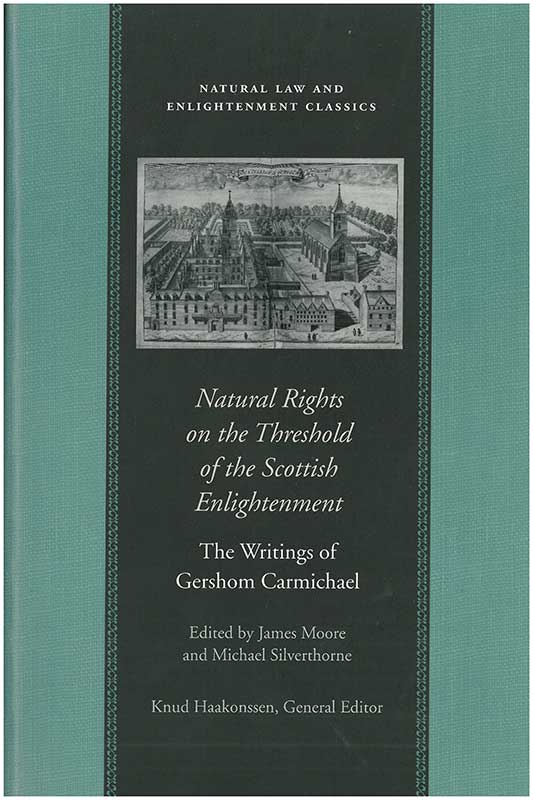
Front Page Titles (by Subject) chapter 23: Appendix: The Rights and Duties of Men and Citizens In which concise ethical theses are succinctly set out in the order which seems most natural for the study of moral science 1 - Natural Rights on the Threshold of the Scottish Enlightenment: The Writings of Gershom Carmichael
Return to Title Page for Natural Rights on the Threshold of the Scottish Enlightenment: The Writings of Gershom CarmichaelThe Online Library of LibertyA project of Liberty Fund, Inc.Search this Title:Also in the Library:
chapter 23: Appendix: The Rights and Duties of Men and Citizens In which concise ethical theses are succinctly set out in the order which seems most natural for the study of moral science 1 - Gershom Carmichael, Natural Rights on the Threshold of the Scottish Enlightenment: The Writings of Gershom Carmichael [1724]Edition used:Natural Rights on the Threshold of the Scottish Enlightenment: The Writings of Gershom Carmichael, ed. James Moore and Michael Silverthorne (Indianapolis: Liberty Fund, 2002).
About Liberty Fund:Liberty Fund, Inc. is a private, educational foundation established to encourage the study of the ideal of a society of free and responsible individuals. Copyright information:The copyright to this edition, in both print and electronic forms, is held by Liberty Fund, Inc. Fair use statement:This material is put online to further the educational goals of Liberty Fund, Inc. Unless otherwise stated in the Copyright Information section above, this material may be used freely for educational and academic purposes. It may not be used in any way for profit.
chapter 23Appendix: The Rights and Duties of Men and Citizens
In almost every discipline, the evidence of the propositions taught depends on their connections with one another, with the principles on which they are based, and therefore on the order in which they are presented. Accordingly I concluded the first edition of this work with an appendix, in which I made an attempt to set out the order which nature seems to have directed us to follow in moral science, so far as it differs from that given by Pufendorf. But I now believe that a clearer understanding of this science can be achieved from an even shorter summary of the discipline itself. And so I have attempted to offer a synopsis of moral science in the following theses. The exercise may also be useful in another respect inasmuch as students may find sufficient matter for their disputations in these theses which refer the reader to the relevant passages of Pufendorf amended and amplified by the annotations and supplements supplied by myself.2 I. A man can find the right road to that happiness to which he aspires by the fundamental law of his nature only if he conducts himself in every one of his actions in a manner that exhibits love and veneration for the supreme being. And anything in his conduct which betrays hatred or neglect of the deity, he must scrupulously avoid: chapter 2, pp. 21–24 that is, he must act in conformity with the divine law or with that which is morally right: chapter 2, pp. 24–25. II. All free actions and only free actions are within the scope of the divine law and are therefore capable of moral good and evil: chapter 2, pp. 25–26. These actions and their omissions are considered moral only when they fall within the compass of the divine law and may be imputed directly to an agent: chapter 2, p. 26. III. We have considered the headings under which actions may be imputed to an agent in the court of God and of conscience in chapter 2, pp. 26–28. And Pufendorf3 discusses the actions and outcomes imputed to us in the human court on the ground that they are connected with our actions. IV. Although it is the divine law alone which obligates us, so that the morality of all our actions is ultimately to be referred to it, yet it may be useful to consider what is taught about law in general and about the qualities of actions derived from the law and the propositions that are put forward there for discussion. See chapter 4, pp. 39 ff. V. The divine law is made known to us not only by positive signs [as in revealed theology], but it is in great part signified by nature herself. And when the divine law is so indicated it is called natural law. And the study of the precepts of natural law is the proper business of ethics, which for this reason is nothing but natural jurisprudence: chapter 2, pp. 28–29. VI. The duties prescribed for us by natural law are either immediate or mediate. In our immediate duties we express our affection or lack of it to God directly; in our mediate duties this expression of affection is indirect: chapter 5, p. 46. VII. All the immediate duties of the law of nature which are explained in Pufendorf’s fourth chapter,4 may be comprehended summarily under the precept of the law of nature which we have put first, that God must be worshipped: chapter 5, pp. 46–47. VIII. The mediate duties of the law of nature consist basically in this, that each man should promote, so far as he is able, the common good of the whole human race and, so far as it may be consistent with the common good, the particular good of individuals. This is shown in chapter 5, pp. 47–48. IX. Further, all those actions in which a man brings good to himself or to another in such a way that he harms no one else contribute manifestly to the common good of the human race; therefore it follows as the second precept of the law of nature that each man should pursue every man’s interests but especially his own, provided he does no harm to anyone. For each man can secure more harmless advantages for himself than for others, and the duties owed to others can always be deduced under the [third] precept [of the law of nature], the precept of sociability: chapter 5, p. 48, and also chapter 7. X. Because the interests of men often conflict with one another, one must consider, in securing different interests, what is best, in general, for the human race. And given the character and condition of men on this earth, as described by Pufendorf,5 it follows that for the human race to be safe, it must be sociable. Thus the third precept of natural law, which must be employed as the common criterion of all the duties that pertain to conflicts of interest or advantage is that every man so far as he can must cultivate and preserve sociability: chapter 5, pp. 48–51. XI. The cultivation of social life consists in this, that each man should defend his own right in a manner that duly acknowledges the right of other men according to the hypothesis of natural equality: this follows from the reasons given at chapter 5, pp. 51 ff. We may infer then that the best method of defining the duties which apply to men with respect to other men is to set out the various rights which belong to men, jointly and separately, from which the corresponding obligations will become clear of their own accord. XII. Rights are either perfect or imperfect: chapter 4, pp. 43–44, above and may belong either to individual men (or to groups, which do not need to be considered here separately since they result from a combining of the rights of individuals) or to the whole human race. XIII. Perfect rights of individual men are natural or adventitious. Perfect natural rights are reviewed by us in chapter 9, pp. 77 ff.; and Pufendorf instructs us that an unlimited obligation is attached to them.6 XIV. Adventitious rights may be real or personal. Among real rights ownership is preeminent, and when it is unimpaired, as it is when it results from the original modes of acquisition, it comprehends all rights of this kind; see chap. 10, pp. 92–96. Moreover, Pufendorf shows that the same unlimited obligation adheres to real rights as to natural rights.7 XV. Personal rights (whose nature and origin are expounded at length in chapter 9, pp. 78–90) are constituted in various ways but particularly by agreement or by mutual consent declared by appropriate signs on the part of the person who acquires the right and on the part of the person against whom the right is acquired. XVI. The obligation to tell the truth is directly related to the obligation of agreements; it derives from at least a tacit agreement: see chapter 9, pp. 87–88. XVII. In both agreements and assertions the greatest consideration is given to oaths: see chapter 9, pp. 85–86. XVIII. Agreements concerning things or services which enter into commerce and so come to acquire a definite value are called contracts by Pufendorf (see chapter 11, pp. 106–8).8 The common types of contract have their own particular names, also discussed in chapter 11, pp. 108 ff. XIX. Personal rights are also constituted in various ways other than by agreement (and often by the action of him alone against whom some claim may be imputed) as by the possession of someone else’s property (chapter 10, pp. 101–2) and from those diverse causes which fall under the rubric of quasi contracts: chapter 11, pp. 112–17. XX. These latter rights commonly arise from a delict. The delict may lie in the past and insofar as damage resulted from it, the injured party has a right to reparation: chapter 8, pp. 73–74. (If the damage was inflicted by fraud, the person who caused the damage may also be required to give an undertaking to desist from such conduct in the future.) The delict may also be in the present inasmuch as damage is clearly intended or a debt is not acknowledged; in order to prevent the one or secure the other, force may be necessary. See chapter 7, and particularly pp. 67–71, which may be considered as a Supplement. XXI. Personal rights, especially those constituted by agreement, may be abolished in the various ways reviewed in chapter 12, pp. 118–21. This does not apply to those personal rights reviewed in theses XIX and XX above; their duration is discussed in chapter 7, pp. 65–67. XXII. There are also certain rights, partly real, partly personal, but more often for the most part real, which are founded, extraordinarily, in some individual necessity: chapter 7, pp. 71–72. XXIII. There are also certain perfect rights which are common (as was said above, thesis XII) to the human race considered collectively and as a person which endures through successive generations. These rights of the human race are protected by God in the state of nature, and most of them are also enjoined upon men in civil society. Among these perfect rights are the right of preventing anyone from killing or mutilating himself or another (even though he may be willing) without just cause; the right of preventing anyone from enjoying an illicit or merely transient sexual union, chapter 14, pp. 128–31; the right to prevent anyone from needlessly spoiling things provided by nature for human use, particularly if others might enjoy long use of the thing in question; and the right to prevent anyone from inflicting obvious damage in any other way whatsoever on the living or on posterity or from violating the reverence which is due to the dead. Finally, there remains the perfect right to inflict physical punishment on violent criminals, a right which devolves in civil society from individuals to the ruler: see chapter 7, pp. 67–71, and chapter 21, pp. 191–94.9 XXIV. There are also imperfect rights; these may be unlimited or limited.10 XXV. Most of the duties of men are defined either by positive laws or by agreements, and so they depend on a correct interpretation of the language used in those laws and agreements. Therefore rules of interpretation have a well-deserved place in natural jurisprudence. And these are explained in chapter 12, pp. 121–23. XXVI. In addition to that general society in which nature has associated all men with one another there are also particular or narrower societies in which men are connected by necessity or utility almost always through certain actions on their part. And the ends of entering these societies demand that some must rule and others must obey. Moreover these societies are designed either for the satisfaction of needs or for the prevention of injuries: the former is achieved mainly in those lesser societies called domestic societies; the latter is for the most part secured in those larger societies commonly called civil societies. In both cases an adventitious state is superimposed upon a natural one: chapter 13, pp. 124–27. XXVII. The first place among the particular or lesser societies must be given to conjugal society, which is the seedbed of the human race. Its laws and the duties which follow from them are described in chapter 14, pp. 128–33. XXVIII. Conjugal society generates offspring; and the mutual obligations of parents and children are described in chapter 15, pp. 134–37. XXIX. The different conditions of men brought about the introduction of servants into households (or domestic societies) by mutual agreements which reflected a concern for the convenience of both parties; while others were thrust into a servile condition against their will: how rarely this happens by right has been noted by us in chapter 16, pp. 138–45. XXX. In spite of the fact that everything that is either useful or agreeable in human life could be obtained promptly and universally by the performance of general duties and of those particular duties which follow from the condition of domestic society, the common depravity of mortal men requires them to live in societies with laws of some severity which are designed to keep them in check; and this is the reason for establishing civil societies: chapter 17, pp. 146–53. XXXI. But such societies cannot be rightly established because of the natural equality of mankind unless prospective citizens give their consent. How this consent is obtained is explained in chapter 17, pp. 153–56. XXXII. The supreme power in civil governments is composed of various parts, which may be reduced conveniently to three: legislative, executive, and federative. And there is not one of these parts which could not be derived from the concurrent consent of subjects, that is, of those for whom or even against whom any action is performed: chapter 18, pp. 157–59. XXXIII. The forms of civil government vary according to whether supreme power is lodged in one man or in one assembly of a few or of all: chapter 18, pp. 159–61. XXXIV. The sense in which the ruler is in all of these forms sovereign, unaccountable and superior to the laws and the sense in which he may be considered absolute and sacred is explained: chapter 19, pp. 162–74. XXXV. On the various ways of instituting a ruler and of transmitting his right to rule to successors, particularly in monarchies: see chapter 20, pp. 175–87. XXXVI. The power of making civil laws (the forms and uses of this power are described in chapter 21, part i, pp. 188–91) and the power of executing them extend (as do the limits of these powers) to the lives and bodies of the citizens (chapter 21, part ii, pp. 191–94), to their reputations (chapter 21, part iii, pp. 194–96), and to their properties. XXXVII. Under the federative power is comprehended the capacity to declare war and make peace (chapter 22, pp. 199 ff.) and to enter into treaties for either purpose. XXXXVIII. The duties of sovereigns are described in chapter 18 and the general and particular duties of citizens in chapter 21. THE END To God Alone the GlorySoli Deo Gloriapart iiNatural TheologyThe complete text of A Synopsis of Natural Theology or, the Knowledge of the existence, attributes and operations of the Supreme Deity, drawn from Nature itself Suitable for the use of students by Gershom Carmichael, Professor of Philosophy in the University of Glasgow (Edinburgh 1729) At the cost of John Paton, at whose premises in Parliament Square copies may be purchased [1.] In this edition we have attempted to follow the order of topics outlined in this appendix. See also the “Editorial Note,” p. 7, above. [2.] The page numbers cited in the text refer to pages in this edition. [3.] Pufendorf, On the Duty of Man and Citizen, I.1.18–27, pp. 23–26. [4.] Ibid., I.4, pp. 39–45. [5.] Ibid., I.3.1–6, pp. 33–35, where Pufendorf describes the natural condition of mankind as a condition of weakness, poverty, and malice. See also Pufendorf, Of the Law of Nature and Nations, II.II.II, pp. 99–102. [6.] Pufendorf, On the Duty of Man and Citizen, I.6.2, p. 56. [7.] Ibid., I.6.3, pp. 56–57; and I.13.1, p. 90. [8.] Ibid., I.13, pp. 90–92. [9.] On perfect rights that are common to mankind, compare Hutcheson, A Short Introduction to Moral Philosophy, pp. 246–47, and at greater length on somewhat different grounds, A System of Moral Philosophy, vol. II, pp. 104–6. [10.] See above, pp. 75–76 and 80. |

Titles (by Subject)