Econlib

The Library

Other Sites

Front Page arrow Titles (by Subject) arrow chapter 12: Dissolution of Obligations 1 - Natural Rights on the Threshold of the Scottish Enlightenment: The Writings of Gershom Carmichael

Return to Title Page for Natural Rights on the Threshold of the Scottish Enlightenment: The Writings of Gershom Carmichael

Search this Title:

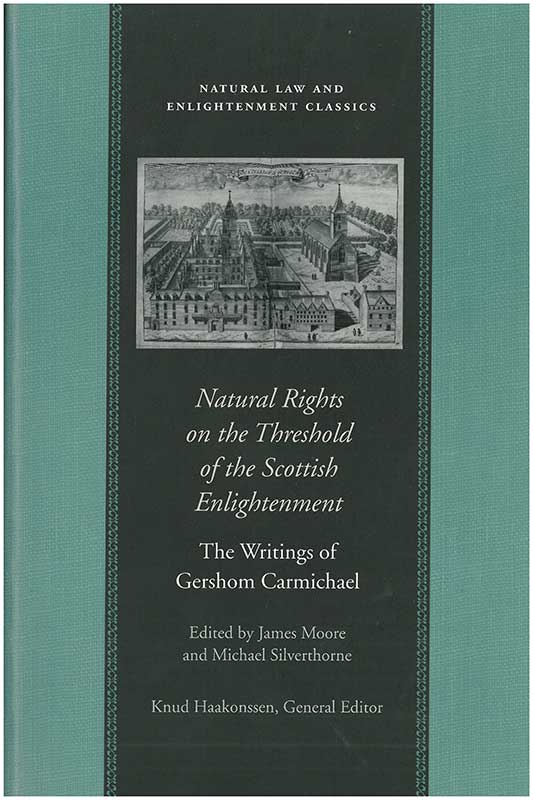
chapter 12: Dissolution of Obligations 1 - Gershom Carmichael, Natural Rights on the Threshold of the Scottish Enlightenment: The Writings of Gershom Carmichael [1724]

Edition used:

Natural Rights on the Threshold of the Scottish Enlightenment: The Writings of Gershom Carmichael, ed. James Moore and Michael Silverthorne (Indianapolis: Liberty Fund, 2002).

About Liberty Fund:

Liberty Fund, Inc. is a private, educational foundation established to encourage the study of the ideal of a society of free and responsible individuals.


chapter 12

Dissolution of Obligations1

The principle of dissolution

Several of the means [of dissolving obligations] which are reviewed here may also dissolve other obligations than those that arise from agreements. The dissolution of an obligation (as may be understood from our observation on p. 79 is simply the reversion of the corresponding personal right to its original subject, and its consolidation with his natural liberty. By this agreement the personal right itself is said to be abolished because he no longer has a reason for such a right. [I.16.1.i]

Modes of dissolution

Just as an obligation is constituted by the perfectly natural mode of mutual consent on the part of the person who obligates himself and of the person to whom he is obligated, so it is no less naturally dissolved by a contrary will on both sides. I say on both sides. For just as in a simple promise when a particle of natural liberty is transferred to another person by the consent of a future debtor, so in a simple renunciation, when that particle of liberty reverts, by the will of the creditor, to its natural subject, the consent of its acquirer needs to be given as well as that of the transferor. The obligation is dissolved by the concurrent consent of the creditor, in this case the transferor, and of the debtor (the acquirer), either gratis—in which case it is properly said to be renounced—or for onerous cause, i.e., in view of some other thing or service. The personal thing or service may be either performed at that very moment or promised for later; it may be either the assignment of a right against a third party (for example, by delegation, see I.16.9.i) or the reciprocal remission of some other obligation by which the creditor himself has been obligated to his debtor. For this reason reciprocal obligations are said to be dissolved on both sides by mutual dissent, as our author says in his next paragraph.2 [I.16.3.i]

The duration of an obligation may be said to depend upon a point of time in two senses. Either it is meant that the performance which could be required before a certain date cannot be demanded after it, or the sense is that performance may be required at certain intervals up to a certain end-date, but not after it. In the former case, it is obvious that the obligation is understood to be conditional, i.e., one is only obliged to perform, if required to do so within a certain time. If this condition is not met, the obligation disappears, not because of the mere lapse of time but because the condition is lacking. In the latter case, the end-date by which the performances are to be required is either definite or indefinite. If the end-date is definite, the obligation requiring performance after that date does not so much expire as never existed. If the end-date is indefinite, because it depends on some event the date of whose occurrence is unknown, in this case the obligation to seek performance by any given end-date is conditional, i.e., provided the event in question did not occur before. If this condition, which relates to future time after the existence of this event, is not fulfilled, then performance is no longer required. In either case the obligation to do any particular thing before the end-date has passed, is only removed by fulfilment or some equivalent mode. This is true also in the first case, if the performance is demanded before the passing of the end-date. [I.16.7.i]

The grounds on which these obligations [which are “essentially rooted in a man’s person” (Pufendorf)] are said to be dissolved by death, may be understood from what was said in the previous paragraph about obligations which expire with time, particularly an indefinite time. These obligations are to be regarded as rooted in a person. This is indicated either by the actual words of the agreement or testament on which they are based or by the nature of the transaction. On this question the correct position seems to be as follows: (1) Every obligation deriving from an onerous cause is transmitted to heirs and against heirs, unless it happens to concern some special service where it obviously matters to the creditor which person performs it, or it matters to the debtor to whom the payment is made. For the obligation of the former is understood to be rooted in the person of the debtor, of the latter in the person of the creditor. And here anything which was given in expectation of a service which had not yet been performed when the obligation expired, ought to be returned, unless there was a stay against its performance from the creditor himself. (2) All obligations arising from beneficial cause, concerned with merely personal services, are naturally understood to be rooted in the person both of the debtor and of the creditor, so that they disappear with the death of either of them. (3) Obligations flowing from discretionary cause for paying some object or quantity at fixed intervals of time, or for permitting continuous use of a thing, when no end-date is given, seem naturally to be rooted in the person of the creditor but not of the debtor; this is still more the case if something has been expressly given to someone for so long as he shall live. But obligations, though from beneficial cause, to give something once, or on repeated occasions at intervals, or for conceding the use of a thing to some definite end-date, which we suppose to be neither the death of the debtor nor of the creditor, are rooted in the person of neither, but naturally pass to the heirs and against the heirs. I say naturally because there is no doubt that obligations of this kind may be extended or restricted by positive laws or customs. In all these cases the death of the debtor or the creditor does not cause the expiration of the obligations to the burdens whose time of payment has already passed, provided that their payment is made from the property of the debtor, either directly or in subsidiary manner. (4) An obligation to corporal punishment does not go beyond the person of the delinquent. But a pecuniary penalty owes its origin to the civil laws and so passes to the heirs or not, as the laws may determine. [I.16.8.i]

What our author here describes as delegation, is actually the cession of an action against a third party which a debtor makes to his creditor, thus transferring his obligation to the third party. It counts therefore as the dissolution of an obligation for the debtor who has ceded the action and thus obtains immunity from the obligation by which he was previously bound, but not for the third party whose obligation is merely transferred and not dissolved (see above pp. 118–19). Delegation as the Romans described it is actually the substitution of another debtor (expromissio: see above p. 111). In natural law expromissio is only necessary when someone is delegated on behalf of a person to whom he had no previous obligation of a kind which the creditor has a right to transfer. Novation in its special sense our author rightly treats as one of the excessive subtleties of the civil law. In the civil law a novation is the abolition of a prior obligation when a new obligation is contracted among the same persons on the same matter. For the novation which conforms to the simplicity of natural law is the addition or removal of something by a new agreement while the old obligation remains intact in other respects. The mere formal change [in the Roman system] to a stipulation from another form of contract is merely a matter of civil law. However if a nonliquid obligation arising from the infliction of damage or a similar cause is changed by agreement to a liquid obligation, this relates to what we said above at pp. 118–19.

Thus all the modes of dissolving obligations so far surveyed may be reduced to three, viz., dissolution, cession by the creditor in favor of the debtor (whether done gratis or from onerous cause), and failure of the condition. Compensation naturally reduces itself to the first; all transactions, delegations, etc., are obviously contained in the second, according to our observations at pp. 118–19; under the last head we find perfidy of the other party, change of status, lapse of time, and death (to which must be added the perishing of the specific object owed) whenever the obligation expires for any of these reasons. A peculiar mode of abolishing an obligation is confusio, i.e., when a creditor succeeds to a debtor, or a debtor to a creditor. [I.16.9.i]

A note on the interpretation of laws

I see no good reason why the distinguished Titius and Barbeyrac thought that this rule [“interpret favorable expressions more broadly, invidious expressions more strictly” (Pufendorf)], needed criticism, since it is so natural, and almost everyone would approve it. Universal common sense dictates that there is a distinction among things: some things are more desirable in themselves than others; or rather, there are some aspects of things from which they should be considered desirable, others from which they should be seen to be avoided, so that it is useless to look for clear definitions of favorable and invidious or odious here. But it is still very clear that this distinction should have some weight in interpreting an ambiguous utterance, so that we recognize, so far as the usage of words and other circumstances permit, that this or that was the intention of the speaker.

They criticize the instances of favorable and odious things adduced by Grotius and our author as inconsistent with each other; since what is to the common interest is said to be favorable, and anything that contains a penalty is said to be invidious, despite the fact, they say, that the imposition of penalties is in the common interest. But this instance simply proves what the author himself admits, that certain things are mixed qualities which contain in themselves something favorable and something invidious. The infliction of penalties is odious in itself, insofar as it involves suffering and pain on the part of the man penalized. But it is favorable insofar as it is in the public interest; and the favorableness of this consideration, where it actually is relevant, absorbs the odiousness of the other consideration. Therefore as the pain inflicted on a man tends to the public advantage (though not simply and in itself but within limits and in certain situations), so insofar as the pain is odious in itself, it is to be regarded as desired for that purpose or enjoined by the legislator only because obvious reasons or clear indications of his will have shown the need for it. The aforesaid rule is not therefore a “wax nose,” however much those who have not thought about it or are swayed by the power of their feelings, may distort it, as they may distort all the best rules, by applying it badly. [I.17.9.ii]

[Barbeyrac responded to Carmichael’s observations on interpretation at length, in his notes on Grotius, Rights of War and Peace, II.XVI.10, n. 1, pp. 356– 57: “I shall at present only add some reflections, occasioned by what I have lately observed in a new Edition of the Abridgment of Pufendorf … printed at Glasgow in 1718, under the direction of Mr. Carmichael, Professor of philosophy in that University. That able Man, who has added a Volume of Notes and Supplements, larger than that of the Text, says, in his Remarks on Bk. I, Chap. XVII, that the Difference of Favourable and Odious, which I have rejected after others is founded in the very Nature of things; … To this, I answer, first, that not one of those who have rejected the Distinction under Consideration, ever thought of denying that some things are more desirable than others; but the Question is, whether that Quality can be of service here for settling sure Rules of Interpretation. Now I am not convinced that it can.” Barbeyrac goes on to specify his reasons for skepticism concerning the relevance of this distinction. The same thing may appear more favorable or odious depending on how it is perceived. The two qualities are often inextricably mixed together. One may interpret laws without applying this distinction. The differences between Carmichael and Barbeyrac on this subject were fundamental. For Carmichael’s understanding of natural law requires one always to consider the spirit or disposition of an action or a positive law: whether it is consistent with reverence for God and for God’s creation, with respect for the rights of self and others. Barbeyrac considered Carmichael’s concerns on this subject to be beyond the scope of natural jurisprudence. See also Devoirs, I.XVII, I, n. 1, where Barbeyrac reminds Carmichael that Pufendorf consistently opposed the human court or forum (the proper sphere of natural law) to the divine forum or tribunal of conscience. This was precisely the dualism that Carmichael sought to overcome.]

[1.] From the notes to bk. I, ch. 16, “How Obligations Arising from Agreements Are Dissolved.”

[2.] Barbeyrac differed from Carmichael on the mutuality required to dissolve an obligation. In the case of a loan, in his view, the obligation is dissolved when the creditor releases the debtor from his obligation. It is not necessary for the debtor to agree as well: “It is in vain that Mr. Carmichael makes what is necessary to contract an obligation equally necessary to cancel it” (Pufendorf, On the Law of Nature and Nations, V.XI.7, p. 531, n. 4).