Econlib

The Library

Other Sites

Front Page arrow Titles (by Subject) arrow ACT IV. - Titus Andronicus

Return to Title Page for Titus Andronicus

Search this Title:

Also in the Library:

Subject Area: Literature

ACT IV. - William Shakespeare, Titus Andronicus [1594]

Edition used:

The Complete Works of William Shakespeare (The Oxford Shakespeare), ed. with a glossary by W.J. Craig M.A. (Oxford University Press, 1916).

Part of: The Complete Works of William Shakespeare (The Oxford Shakespeare)

About Liberty Fund:

Liberty Fund, Inc. is a private, educational foundation established to encourage the study of the ideal of a society of free and responsible individuals.


ACT IV.

Scene I.—

Rome.TitusGarden.

EnterTitusandMarcus.Then enter youngLucius, Laviniaranning after him.

Boy.

Help, grandsire, help! my aunt Lavinia

Follows me everywhere, I know not why:

Good uncle Marcus, see how swift she comes:

Alas! sweet aunt, I know not what you mean.

Mar.

Stand by me, Lucius; do not fear thine aunt.

Tit.

She loves thee, boy, too well to do thee harm.

Boy.

Ay, when my father was in Rome, she did.

Mar.

What means my niece Lavinia by these signs?

Tit.

Fear her not, Lucius: somewhat doth she mean.

See, Lucius, see how much she makes of thee;

Somewhither would she have thee go with her.

Ah! boy; Cornelia never with more care

Read to her sons, than she hath read to thee

Sweet poetry and Tully’s Orator.

Mar.

Canst thou not guess wherefore she plies thee thus?

Boy.

My lord, I know not, I, nor can I guess,

Unless some fit or frenzy do possess her;

For I have heard my grandsire say full oft,

Extremity of griefs would make men mad;

And I have read that Hecuba of Troy

Ran mad through sorrow; that made me to fear,

Although, my lord, I know my noble aunt

Loves me as dear as e’er my mother did,

And would not, but in fury, fright my youth;

Which made me down to throw my books and fly,

Causeless, perhaps. But pardon me, sweet aunt;

And, madam, if my uncle Marcus go,

I will most willingly attend your ladyship.

Mar.

Lucius, I will.

[Laviniaturns over the books whichLuciushad let fall.

Tit.

How now, Lavinia! Marcus, what means this?

Some book there is that she desires to see.

Which is it, girl, of these? Open them, boy.

But thou art deeper read, and better skill’d;

Come, and take choice of all my library,

And so beguile thy sorrow, till the heavens

Reveal the damn’d contriver of this deed.

Why lifts she up her arms in sequence thus?

Mar.

I think she means that there was more than one

Confederate in the fact: ay, more there was;

Or else to heaven she heaves them for revenge.

Tit.

Lucius; what book is that she tosseth so?

Boy.

Grandsire, ’tis Ovid’s Metamorphoses;

My mother gave it me.

Mar.

For love of her that’s gone,

Perhaps, she cull’d it from among the rest.

Tit.

Soft! see how busily she turns the leaves!

[Helping her.

What would she find? Lavinia, shall I read?

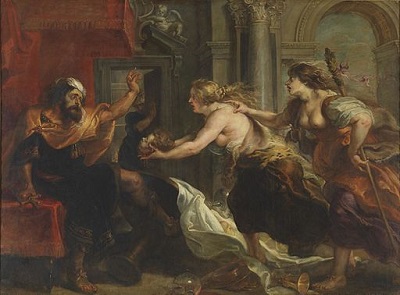
This is the tragic tale of Philomel,

And treats of Tereus’ treason and his rape;

And rape, I fear, was root of thine annoy.

Mar.

See, brother, see! note how she quotes the leaves.

Tit.

Lavinia, wert thou thus surpris’d, sweet girl,

Ravish’d and wrong’d, as Philomela was,

Forc’d in the ruthless, vast, and gloomy woods?

See, see!

Ay, such a place there is, where we did hunt,—

O! had we never, never hunted there,—

Pattern’d by that the poet here describes,

By nature made for murders and for rapes.

Mar.

O! why should nature build so foul a den,

Unless the gods delight in tragedies?

Tit.

Give signs, sweet girl, for here are none but friends,

What Roman lord it was durst do the deed:

Or slunk not Saturnine, as Tarquin erst,

That left the camp to sin in Lucrece’ bed?

Mar.

Sit down, sweet niece: brother, sit down by me.

Apollo, Pallas, Jove, or Mercury,

Inspire me, that I may this treason find!

My lord, look here; look here, Lavinia:

This sandy plot is plain; guide, if thou canst,

This after me.

[He writes his name with his staff, and guides it with his feet and mouth.

I have writ my name

Without the help of any hand at all.

Curs’d be that heart that forc’d us to this shift!

Write thou, good niece, and here display at last

What God will have discover’d for revenge.

Heaven guide thy pen to print thy sorrows plain,

That we may know the traitors and the truth!

[She takes the staff in her mouth, and guides it with her stumps, and writes.

Tit.

O! do you read, my lord, what she hath writ?

Stuprum, Chiron, Demetrius.

Mar.

What, what! the lustful sons of Tamora

Performers of this heinous, bloody deed?

Tit.

Magni dominator poli,

Tam lentus audis scelera? tam lentus vides?

Mar.

O! calm thee, gentle lord; although I know

There is enough written upon this earth

To stir a mutiny in the mildest thoughts

And arm the minds of infants to exclaims.

My lord, kneel down with me; Lavinia, kneel;

And kneel, sweet boy, the Roman Hector’s hope;

And swear with me, as, with the woeful fere

And father of that chaste dishonour’d dame,

Lord Junius Brutus sware for Lucrece’ rape,

That we will prosecute by good advice

Mortal revenge upon these traitorous Goths,

And see their blood, or die with this reproach.

Tit.

’Tis sure enough, an you knew how;

But if you hunt these bear-whelps, then beware:

The dam will wake, an if she wind you once:

She’s with the lion deeply still in league,

And lulls him whilst she playeth on her back,

And when he sleeps will she do what she list.

You’re a young huntsman, Marcus; let it alone;

And, come, I will go get a leaf of brass,

And with a gad of steel will write these words,

And lay it by: the angry northern wind

Will blow these sands like Sibyl’s leaves abroad,

And where’s your lesson then? Boy, what say you?

Boy.

I say, my lord, that if I were a man,

Their mother’s bed-chamber should not be safe

For these bad bondmen to the yoke of Rome.

Mar.

Ay, that’s my boy! thy father hath full oft

For his ungrateful country done the like.

Boy.

And, uncle, so will I, an if I live.

Tit.

Come, go with me into mine armoury:

Lucius, I’ll fit thee; and withal my boy

Shall carry from me to the empress’ sons

Presents that I intend to send them both:

Come, come; thou’lt do thy message, wilt thou not?

Boy.

Ay, with my dagger in their bosoms, grandsire.

Tit.

No, boy, not so; I’ll teach thee another course.

Lavinia, come. Marcus, look to my house;

Lucius and I’ll go brave it at the court:

Ay, marry, will we, sir; and we’ll be waited on.

[ExeuntTitus, Lavinia,and Boy.

Mar.

O heavens! can you hear a good man groan,

And not relent or not compassion him?

Marcus, attend him in his ecstasy,

That hath more scars of sorrow in his heart

Than foemen’s marks upon his batter’d shield;

But yet so just that he will not revenge.

Revenge, ye heavens, for old Andronicus!

[Exit.

Scene II.—

The Same. A Room in the Palace.

Enter, from one side,Aaron, Demetrius,andChiron;from the other youngLucius,and an Attendant, with a bundle of weapons, and verses writ upon them.

Chi.

Demetrius, here’s the son of Lucius;

He hath some message to deliver us.

Aar.

Ay, some mad message from his mad grandfather.

Boy.

My lords, with all the humbleness I may,

I greet your honours from Andronicus;

[Aside.] And pray the Roman gods, confound you both!

Dem.

Gramercy, lovely Lucius: what’s the news?

Boy.

[Aside.] That you are both decipher’d, that’s the news,

For villains mark’d with rape. [Aloud.] May it please you,

My grandsire, well advis’d, hath sent by me

The goodliest weapons of his armoury,

To gratify your honourable youth,

The hope of Rome, for so he bade me say;

And so I do, and with his gifts present

Your lordships, that whenever you have need,

You may be armed and appointed well.

And so I leave you both: [Aside.] like bloody villains.

[Exeunt Boy and Attendant.

Dem.

What’s here? A scroll; and written round about?

Let’s see:—

  • [Reads.]Integer vitæ, scelerisque purus,
  • Non eget Mauri jaculis, nec arcu.

Chi.

O! ’tis a verse in Horace; I know it well:

I read it in the grammar long ago.

Aar.

Ay just, a verse in Horace; right, you have it.

[Aside.] Now, what a thing it is to be an ass!

Here’s no sound jest! the old man hath found their guilt

And sends them weapons wrapp’d about with lines,

That wound, beyond their feeling, to the quick;

But were our witty empress well afoot,

She would applaud Andronicus’ conceit:

But let her rest in her unrest awhile.

[To them.] And now, young lords, was’t not a happy star

Led us to Rome, strangers, and more than so,

Captives, to be advanced to this height?

It did me good before the palace gate

To brave the tribune in his brother’s hearing.

Dem.

But me more good, to see so great a lord

Basely insinuate and send us gifts.

Aar.

Had he not reason, Lord Demetrius?

Did you not use his daughter very friendly?

Dem.

I would we had a thousand Roman dames

At such a bay, by turn to serve our lust.

Chi.

A charitable wish and full of love.

Aar.

Here lacks but your mother for to say amen.

Chi.

And that would she for twenty thousand more.

Dem.

Come, let us go and pray to all the gods

For our beloved mother in her pains.

Aar.

[Aside.] Pray to the devils; the gods have given us over.

[Trumpets sound.

Dem.

Why do the emperor’s trumpets flourish thus?

Chi.

Belike, for joy the emperor hath a son.

Dem.

Soft! who comes here?

Enter a Nurse, with a blackamoor Child.

Nur.

Good morrow, lords. O! tell me, did you see

Aaron the Moor?

Aar.

Well, more or less, or ne’er a whit at all,

Here Aaron is; and what with Aaron now?

Nur.

O gentle Aaron! we are all undone.

Now help, or woe betide thee evermore!

Aar.

Why, what a caterwauling dost thou keep!

What dost thou wrap and fumble in thine arms?

Nur.

O! that which I would hide from heaven’s eye,

Our empress’ shame, and stately Rome’s disgrace!

She is deliver’d, lords, she is deliver’d.

Aar.

To whom?

Nur.

I mean, she’s brought a-bed.

Aar.

Well, God give her good rest! What hath he sent her?

Nur.

A devil.

Aar.

Why, then she’s the devil’s dam: a joyful issue.

Nur.

A joyless, dismal, black, and sorrowful issue.

Here is the babe, as loathsome as a toad

Amongst the fairest breeders of our clime.

The empress sends it thee, thy stamp, thy seal,

And bids thee christen it with thy dagger’s point.

Aar.

’Zounds, ye whore! is black so base a hue?

Sweet blowse, you are a beauteous blossom, sure.

Dem.

Villain, what hast thou done?

Aar.

That which thou canst not undo.

Chi.

Thou hast undone our mother.

Aar

Villain, I have done thy mother.

Dem.

And therein, hellish dog, thou hast undone.

Woe to her chance, and damn’d her loathed choice!

Accurs’d the offspring of so foul a fiend!

Chi.

It shall not live.

Aar.

It shall not die.

Nur.

Aaron, it must; the mother wills it so.

Aar.

What! must it, nurse? then let no man but I

Do execution on my flesh and blood.

Dem.

I’ll broach the tadpole on my rapier’s point:

Nurse, give it me; my sword shall soon dispatch it.

Aar.

Sooner this sword shall plough thy bowels up.

[Takes the Child from the Nurse, and draws.

Stay, murderous villains! will you kill your brother?

Now, by the burning tapers of the sky,

That shone so brightly when this boy was got,

He dies upon my scimitar’s sharp point

That touches this my first-born son and heir.

I tell you, younglings, not Enceladus,

With all his threatening band of Typhon’s brood,

Nor great Alcides, nor the god of war,

Shall seize this prey out of his father’s hands.

What, what, ye sanguine, shallow-hearted boys!

Ye white-lim’d walls! ye alehouse painted signs!

Coal-black is better than another hue,

In that it scorns to bear another hue;

For all the water in the ocean

Can never turn the swan’s black legs to white,

Although she lave them hourly in the flood.

Tell the empress from me, I am of age

To keep mine own, excuse it how she can.

Dem.

Wilt thou betray thy noble mistress thus?

Aar.

My mistress is my mistress; this myself;

The vigour, and the picture of my youth:

This before all the world do I prefer;

This maugre all the world will I keep safe,

Or some of you shall smoke for it in Rome.

Dem.

By this our mother is for ever sham’d.

Chi.

Rome will despise her for this foul escape.

Nur.

The emperor in his rage will doom her death.

Chi.

I blush to think upon this ignomy.

Aar.

Why, there’s the privilege your beauty bears.

Fie, treacherous hue! that will betray with blushing

The close enacts and counsels of the heart:

Here’s a young lad fram’d of another leer:

Look how the black slavesmiles upon the father,

As who should say, ‘Old lad, I am thine own.’

He is your brother, lords, sensibly fed

Of that self blood that first gave life to you;

And from that womb where you imprison’d were

He is enfranchised and come to light:

Nay, he is your brother by the surer side,

Although my seal be stamped in his face.

Nur.

Aaron, what shall I say unto the empress?

Dem.

Advise thee, Aaron, what is to be done,

And we will all subscribe to thy advice:

Save thou the child, so we may all be safe.

Aar.

Then sit we down, and let us all consult,

My son and I will have the wind of you:

Keep there; now talk at pleasure of your safety.

[They sit.

Dem.

How many women saw this child of his?

Aar.

Why, so, brave lords! when we join in league,

I am a lamb; but if you brave the Moor,

The chafed boar, the mountain lioness,

The ocean swells not so as Aaron storms.

But say, again, how many saw the child?

Nur.

Cornelia the midwife, and myself,

And no one else but the deliver’d empress.

Aar.

The empress, the midwife, and yourself:

Two may keep counsel when the third’s away.

Go to the empress; tell her this I said:

[Stabbing her.

‘Weke, weke!’

So cries a pig prepared to the spit.

Dem.

What mean’st thou, Aaron? Wherefore didst thou this?

Aar.

O lord, sir, ’tis a deed of policy:

Shall she live to betray this guilt of ours,

A long-tongu’d babbling gossip? no, lords, no.

And now be it known to you my full intent.

Not far, one Muli lives, my countryman;

His wife but yesternight was brought to bed.

His child is like to her, fair as you are:

Go pack with him, and give the mother gold,

And tell them both the circumstance of all,

And how by this their child shall be advanc’d,

And be received for the emperor’s heir,

And substituted in the place of mine,

To calm this tempest whirling in the court;

And let the emperor dandle him for his own.

Hark ye, lords; you see, I have given her physic,

[Pointing to the Nurse.

And you must needs bestow her funeral;

The fields are near, and you are gallant grooms.

This done, see that you take no longer days,

But send the midwife presently to me.

The midwife and the nurse well made away,

Then let the ladies tattle what they please.

Chi.

Aaron, I see thou wilt not trust the air

With secrets.

Dem.

For this care of Tamora,

Herself and hers are highly hound to thee.

[ExeuntDemetriusandChiron,bearing off the Nurse’s body.

Aar.

Now to the Goths, as swift as swallow flies:

There to dispose this treasure in mine arms,

And secretly to greet the empress’ friends.

Come on, you thick-lipp’d slave, I’ll bear you hence;

For it is you that puts us to our shifts:

I’ll make you feed on berries and on roots,

And feed on curds and whey, and suck the goat,

And cabin in a cave, and bring you up

To be a warrior, and command a camp.

[Exit with the Child.

Scene III.—

The Same. A Public Place.

EnterTitus,bearing arrows, with letters on the ends of them; with himMarcus,youngLucius, Publius, Sempronius, Caius,and other Gentlemen, with bows.

Tit.

Come, Marcus, come; kinsmen, this is the way.

Sir boy, now let me see your archery:

Look ye draw home enough, and ’tis there straight.

Terras Astræa reliquit:

Be you remember’d, Marcus, she’s gone, she’s fled.

Sirs, take you to your tools. You, cousins, shall

Go sound the ocean, and cast your nets;

Happily you may find her in the sea;

Yet there’s as little justice as at land.

No; Publius and Sempronius, you must do it;

’Tis you must dig with mattock and with spade,

And pierce the inmost centre of the earth:

Then, when you come to Pluto’s region,

I pray you, deliver him this petition;

Tell him, it is for justice and for aid,

And that it comes from old Andronicus,

Shaken with sorrows in ungrateful Rome.

Ah! Rome. Well, well; I made thee miserable

What time I threw the people’s suffrages

On him that thus doth tyrannize o’er me.

Go, get you gone; and pray be careful all,

And leave you not a man-of-war unsearch’d:

This wicked emperor may have shipp’d her hence;

And, kinsmen, then we may go pipe for justice.

Mar.

O Publius! is not this a heavy case,

To see thy noble uncle thus distract?

Pub.

Therefore, my lord, it highly us concerns

By day and night to attend him carefully,

And feed his humour kindly as we may,

Till time beget some careful remedy.

Mar.

Kinsmen, his sorrows are past remedy.

Join with the Goths, and with revengeful war

Take wreak on Rome for this ingratitude,

And vengeance on the traitor Saturnine.

Tit.

Publius, how now! how now, my masters!

What! have you met with her?

Pub.

No, my good lord; but Pluto sends you word,

If you will have Revenge from hell, you shall:

Marry, for Justice, she is so employ’d,

He thinks, with Jove in heaven, or somewhere else,

So that perforce you must needs stay a time.

Tit.

He doth me wrong to feed me with delays.

I’ll dive into the burning lake below,

And pull her out of Acheron by the heels.

Marcus, we are but shrubs, no cedars we;

No big-bon’d men fram’d of the Cyclops’ size;

But metal, Marcus, steel to the very back,

Yet wrung with wrongs more than our backs can bear:

And sith there’s no justice in earth nor hell,

We will solicit heaven and move the gods

To send down Justice for to wreak our wrongs.

Come, to this gear. You are a good archer, Marcus.

[He gives them the arrows.

Ad Javem, that’s for you: here, ad Apollinem:

Ad Martem, that’s for myself:

Here, boy, to Pallas: here, to Mercury:

To Saturn, Caius, not to Saturnine;

You were as good to shoot against the wind.

To it, boy! Marcus, loose when I bid.

Of my word, I have written to effect;

There’s not a god left unsolicited.

Mar.

Kinsmen, shoot all your shafts into the court:

We will afflict the emperor in his pride.

Tit.

Now, masters, draw. [They shoot.] O! well said, Lucius!

Good boy, in Virgo’s lap: give it Pallas.

Mar.

My lord, I aim a mile beyond the moon;

Your letter is with Jupiter by this.

Tit.

Ha! Publius, Publius, what hast thou done?

See, see! thou hast shot off one of Taurus’ horns.

Mar.

This was the sport, my lord: when Publius shot,

The Bull, being gall’d, gave Aries such a knock

That down fell both the Ram’s horns in the court;

And who should find them but the empress’ villain?

She laugh’d, and told the Moor, he should not choose

But give them to his master for a present.

Tit.

Why, there it goes: God give his lordship joy!

Enter a Clown, with a basket, and two pigeons in it.

News! news from heaven! Marcus, the post is come.

Sirrah, what tidings? have you any letters?

Shall I have justice? what says Jupiter?

Clo.

O! tho gibbet-maker? He says that he hath taken them down again, for the man must not be hanged till the next week.

Tit.

But what says Jupiter, I ask thee?

Clo.

Alas! sir, I know not Jupiter; I never drank with him in all my life.

Tit.

Why, villain, art not thou the carrier?

Clo.

Ay, of my pigeons, sir; nothing else.

Tit.

Why, didst thou not come from heaven?

Clo.

From heaven! alas! sir, I never came there. God forbid I should be so bold to press to heaven in my young days. Why, I am going with my pigeons to the tribunal plebs, to take up a matter of brawl betwixt my uncle and one of the emperial’s men.

Mar.

Why, sir, that is as fit as can be to serve for your oration; and let him deliver the pigeons to the emperor from you.

Tit.

Tell me, can you deliver an oration to the emperor with a grace?

Clo.

Nay, truly, sir, I could never say grace in all my life.

Tit.

Sirrah, come hither: make no more ado,

But give your pigeons to the emperor:

By me thou shalt have justice at his hands.

Hold, hold; meanwhile, here’s money for thy charges.

Give me pen and ink.

Sirrah, can you with a grace deliver a supplication?

Clo.

Ay, sir.

Tit.

Then here is a supplication for you. And when you come to him, at the first approach you must kneel; then kiss his foot; then deliver up your pigeons; and then look for your reward. I’ll be at hand, sir; see you do it bravely.

Clo.

I warrant you, sir; let me alone.

Tit.

Sirrah, hast thou a knife? Come, let me see it.

Here, Marcus, fold it in the oration;

For thou hast made it like a humble suppliant:

And when thou hast given it to the emperor,

Knock at my door, and tell me what he says.

Clo.

God be with you, sir; I will.

Tit.

Come, Marcus, let us go. Publius, follow me.

[Exeunt.

Scene IV.—

The Same. Before the Palace.

EnterSaturninus, Tamora, Demetrius, Chiron, Lords, and Others:Saturninuswith the arrows in his hand thatTitusshot.

Sat.

Why, lords, what wrongs are these! Was ever seen

An emperor of Rome thus overborne,

Troubled, confronted thus; and, for the extent

Of egal justice, us’d in such contempt?

My lords, you know, as do the mightful gods,—

However these disturbers of our peace

Buzz in the people’s ears,—there nought hath pass’d,

But even with law, against the wilful sons

Of old Andronicus. And what an if

His sorrows have so overwhelm’d his wits,

Shall we be thus afflicted in his wreaks,

His fits, his frenzy, and his bitterness?

And now he writes to heaven for his redress:

See, here’s to Jove, and this to Mercury;

This to Apollo; this to the god of war;

Sweet scrolls to fly about the streets of Rome!

What’s this but libelling against the senate,

And blazoning our injustice every where?

A goodly humour, is it not, my lords?

As who would say, in Rome no justice were.

But if I live, his feigned ecstasies

Shall be no shelter to these outrages;

But he and his shall know that justice lives

In Saturninus’ health; whom, if she sleep,

He’ll so awake, as she in fury shall

Cut off the proud’st conspirator that lives.

Tam.

My gracious lord, my lovely Saturnine,

Lord of my life, commander of my thoughts,

Calm thee, and bear the faults of Titus’ age,

The effects of sorrow for his valiant sons,

Whose loss hath pierc’d him deep and scarr’d his heart;

And rather comfort his distressed plight

Than prosecute the meanest or the best

For these contempts.—[Aside.] Why, thus it shall become

High-witted Tamora to gloze with all:

But, Titus, I have touch’d thee to the quick,

Thy life-blood out: if Aaron now be wise,

Then is all safe, the anchor’s in the port.

Enter Clown.

How now, good fellow! wouldst thou speak with us?

Clo.

Yea, forsooth, an your mistership be emperial.

Tam.

Empress I am, but yonder sits the emperor.

Clo.

’Tis he. God and Saint Stephen give you good den.

I have brought you a letter and a couple of pigeons here.

[Saturninusreads the letter.

Sat.

Go, take him away, and hang him presently.

Clo.

How much money must I have?

Tam.

Come, sirrah, you must be hanged.

Clo.

Hanged! By ’r, lady, then I have brought up a neck to a fair end.

[Exit, guarded.

Sat.

Despiteful and intolerable wrongs!

Shall I endure this monstrous villany?

I know from whence this same device proceeds:

May this be borne? As if his traitorous sons,

That died by law for murder of our brother,

Have by my means been butcher’d wrongfully!

Go, drag the villain hither by the hair;

Nor age nor honour shall shape privilege.

For this proud mock I’ll be thy slaughterman;

Sly frantic wretch, that holp’st to make me great,

In hope thyself should govern Rome and me.

EnterÆmilius.

What news with thee, Æmilius?

Æmil.

Arm, arm, my lord! Rome never had more cause.

The Goths have gather’d head, and with a power

Of high-resolved men, bent to the spoil,

They hither march amain, under conduct

Of Lucius, son to old Andronicus;

Who threats, in course of this revenge, to do

As much as ever Coriolanus did.

Sat.

Is war-like Lucius general of the Goths?

These tidings nip me, and I hang the head

As flowers with frost or grass beat down with storms.

Ay, now begin our sorrows to approach:

’Tis he the common people love so much;

Myself hath often heard them say,

When I have walked like a private man,

That Lucius’ banishment was wrongfully,

And they have wish’d that Lucius were their emperor.

Tam.

Why should you fear? is not your city strong?

Sat.

Ay, but the citizens favour Lucius,

And will revolt from me to succour him.

Tam.

King, be thy thoughts imperious, like thy name.

Is the sun dimm’d, that gnats do fly in it?

The eagle suffers little birds to sing,

And is not careful what they mean thereby,

Knowing that with the shadow of his wings

He can at pleasure stint their melody;

Even so mayst thou the giddy men of Rome.

Then cheer thy spirit; for know, thou emperor,

I will enchant the old Andronicus

With words more sweet, and yet more dangerous,

Than baits to fish, or honey-stalks to sheep,

Whenas the one is wounded with the bait,

The other rotted with delicious feed.

Sat.

But he will not entreat his son for us.

Tam.

If Tamora entreat him, then he will:

For I can smooth and fill his aged ear

With golden promises, that, were his heart

Almost impregnable, his old ears deaf,

Yet should both ear and heart obey my tongue.

[ToÆmilius.] Go thou before, be our ambassador:

Say that the emperor requests a parley

Of war-like Lucius, and appoint the meeting,

Even at his father’s house, the old Andronicus.

Sat.

Æmilius, do this message honourably:

And if he stand on hostage for his safety,

Bid him demand what pledge will please him best.

Æmil.

Your bidding shall I do effectually.

[Exit.

Tam.

Now will I to that old Andronicus,

And temper him with all the art I have,

To pluck proud Lucius from the war-like Goths.

And now, sweet emperor, be blithe again,

And bury all thy fear in my devices.

Sat.

Then go successantly, and plead to him.

[Exeunt.