Econlib

The Library

Other Sites

Front Page arrow Titles (by Subject) arrow Speech of Mr. Hayne , of South Carolina [January 25, 1830] - The Webster-Hayne Debate on the Nature of the Constitution: Selected Documents

Return to Title Page for The Webster-Hayne Debate on the Nature of the Constitution: Selected Documents

Speech of Mr. Hayne , of South Carolina [January 25, 1830] - Daniel Webster, The Webster-Hayne Debate on the Nature of the Constitution: Selected Documents [1830]

Edition used:

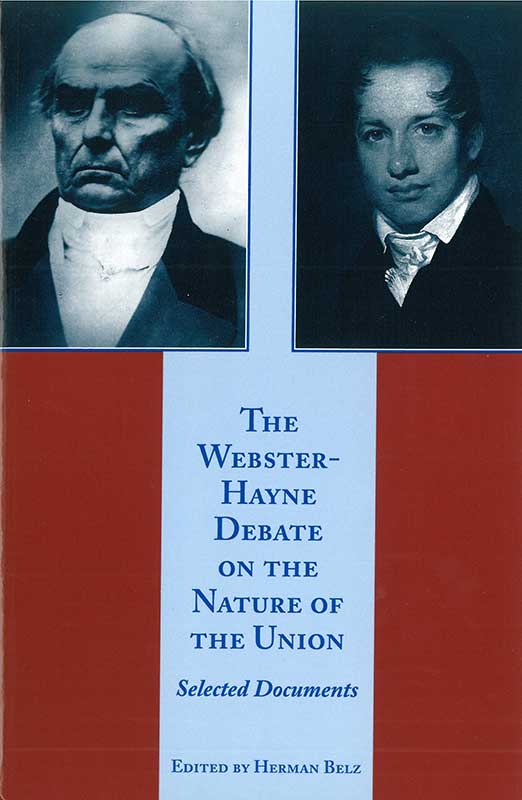
The Webster-Hayne Debate on the Nature of the Constitution: Selected Documents, ed. Herman Belz (Indianapolis: Liberty Fund, 2000).

About Liberty Fund:

Liberty Fund, Inc. is a private, educational foundation established to encourage the study of the ideal of a society of free and responsible individuals.


Speech of Mr. Hayne,
of South Carolina

[January 25, 1830]

The motion of Mr. Webster to postpone indefinitely, the resolution proposed by Mr. Foot, concerning the public lands, being under consideration, Mr. Hayne addressed the Chair as follows:

Mr. hayne began by saying that when he took occasion, two days ago, to throw out some ideas with respect to the policy of the Government in relation to the public lands, nothing certainly could have been further from his thoughts than that he should be compelled again to throw himself upon the indulgence of the Senate. Little did I expect [said Mr. H.] to be called upon to meet such as was yesterday urged by the gentleman from Massachusetts [Mr. Webster.] Sir, I questioned no man’s opinions; I impeached no man’s motives; I charged no party, or State, or section of country, with hostility to any other; but ventured, I thought in a becoming spirit, to put forth my own sentiments in relation to a great national question of public policy. Such was my course. The gentleman from Missouri, [Mr. Benton] it is true, had charged upon the Eastern States an early and continued hostility towards the West, and referred to a number of historical facts and documents in support of that charge. Now, sir, how have these different arguments been met? The honorable gentleman from Massachusetts, after deliberating a whole night upon his course, comes into this chamber to vindicate New England, and; instead of making up his issue with the gentleman from Missouri, on the charges which he had preferred, chooses to consider me as the author of those charges; and, losing sight entirely of that gentleman, selects me as his adversary, and pours out all the vials of his mighty wrath upon my devoted head. Nor is he willing to stop there. He goes on to assail the institutions and policy of the South, and calls in question the principles and conduct of the State which I have the honor to represent. When I find a gentleman of mature age and experience, of acknowledged talents and profound sagacity, pursuing a course like this, declining the contest offered from the West, and making war upon the unoffending South, I must believe, I am bound to believe, he has some object in view that he has not ventured to disclose. Why is this? [asked Mr. H.] Has the gentleman discovered in former controversies with the gentleman from Missouri, that he is overmatched by that Senator? And does he hope for an easy victory over a more feeble adversary? Has the gentleman’s distempered fancy been disturbed by gloomy forebodings of “new alliances to be formed,” at which he hinted? Has the ghost of the murdered Coalition come back, like the ghost of Banquo, to “sear the eye-balls” of the gentleman, and will it not “down at his bidding?” Are dark visions of broken hopes, and honors lost forever, still floating before his heated imagination? Sir, if it be his object to thrust me between the gentleman from Missouri and himself, in order to rescue the East from the contest it has provoked with the West, he shall not be gratified. Sir, I will not be dragged into the defence of my friend from Missouri. The South shall not be forced into a conflict not its own. The gentleman from Missouri is able to fight his own battles. The gallant West needs no aid from the South to repel any attack which may be made on them from any quarter. Let the gentleman from Massachusetts controvert the facts and arguments of the gentleman from Missouri—if he can; and if he win the victory, let him wear its honors: I shall not deprive him of his laurels.

The gentleman from Massachusetts, in reply to my remarks on the injurious operation of our land system on the prosperity of the West, pronounced an extravagant eulogium on the paternal care which the Government had extended towards the West, to which he attributed all that was great and excellent in the present condition of the new States. The language of the gentleman on this topic fell upon my ears like the almost forgotten tones of the tory leaders of the British Parliament, at the commencement of the American Revolution. They, too, discovered, that the colonies had grown great under the fostering care of the mother country; and I must confess, while listening to the gentleman, I thought the appropriate reply to his argument was to be found in the remark of a celebrated orator, made on that occasion: “They have grown great in spite of your protection.”

The gentleman, in commenting on the policy of the Government, in relation to the new States, has introduced to our notice a certain Nathan Dane, of Massachusetts, to whom he attributes the celebrated ordinance of ’ 87, by which he tells us, “slavery was forever excluded from the new States north of the Ohio.” After eulogizing the wisdom of this provision, in terms of the most extravagant praise, he breaks forth in admiration of the greatness of Nathan Dane—and great, indeed, he must be, if it be true, as stated by the Senator from Massachusetts, that “he was greater than Solon and Lycurgus, Minos, Numa Pompilius, and all the legislators and philosophers of the world,” ancient and modern. Sir, to such high authority it is certainly my duty, in a becoming spirit of humility, to submit. And yet, the gentleman will pardon me when I say, that it is a little unfortunate for the fame of this great legislator, that the gentleman from Missouri should have proved that he was not the author of the ordinance of ’ 87, on which the Senator from Massachusetts has reared so glorious a monument to his name. Sir, I doubt not the Senator will feel some compassion for our ignorance, when I tell him, that so little are we acquainted with the modern great men of New England, that, until he informed us yesterday, that we possessed a Solon and a Lycurgus in the person of Nathan Dane, he was only known to the South as a member of a celebrated assembly called and known by the name of “the Hartford Convention.” In the proceedings of that assembly, which I hold in my hand, (at page 19) will be found, in a few lines, the history of Nathan Dane; and a little further on, there is conclusive evidence of that ardent devotion to the interests of the new States, which it seems, has given him a just claim to the title of “Father of the West.” By the 2 d resolution of the “Hartford Convention,” it is declared, “that it is expedient to attempt to make provision for restraining Congress in the exercise of an unlimited power to make new States, and admitting them into the Union.” So much for Nathan Dane, of Beverly, Massachusetts.

In commenting upon my views in relation to the public lands, the gentleman insists that it being one of the conditions of the grants, that these lands should be applied to “the common benefit of all the States, they must always remain a fund for revenue,” and adds, “they must be treated as so much treasure.” Sir, the gentleman could hardly find language strong enough to convey his disapprobation of the policy which I had ventured to recommend to the favorable consideration of the country. And what, sir, was that policy, and what is the difference between that gentleman and myself, on this subject? I threw out the idea, that the public lands ought not to be reserved forever as “a great fund for revenue;” that they ought not to be “treated as a great treasure;” but that the course of our policy should rather be directed towards the creation of new States, and building up great and flourishing communities.

Now, Sir, will it be believed, by those who now hear me, and who listened to the gentleman’s denunciation of my doctrines yesterday, that a book then lay open before him, nay, that he held it in his hand, and read from it certain passages of his own speech, delivered to the House of Representatives, in 1825, in which speech he himself contended for the very doctrines I had advocated, and almost in the same terms. Here is the speech of the Hon. Daniel Webster, contained in the first volume of Gales and Seaton’s Register of Debates, (p. 251) delivered in the House of Representatives, on the 18th January, 1825, in a debate on the Cumberland Road—the very debate from which the Senator read yesterday. I shall read from this celebrated speech two passages, from which it will appear that, both as to the past and the future policy of the Government in relation to the public lands, the gentleman from Massachusetts maintained, in 1825, substantially the same opinions which I have advanced, but which he now so strongly reprobates. I said, sir, that the system of credit sales, by which the West had been kept constantly in debt to the United States, and by which their wealth was drained off to be expended elsewhere, had operated injuriously on their prosperity. On this point the gentleman from Massachusetts, in January, 1825, expressed himself thus: “There could be no doubt, if gentlemen looked at the money received into the treasury from the sale of the public lands to the West, and then looked to the whole amount expended by Government, (even including the whole of what was laid out for the army) the latter must be allowed to be very inconsiderable, and there must be a constant drain of money from the West to pay for the public lands. It might, indeed, be said that this was no more than the refluence of capital which had previously gone over the mountains. Be it so. Still its practical effect was to produce inconvenience, if not distress, by absorbing the money of the people.”

I contended that the public lands ought not to be treated merely as “a fund for revenue,” that they ought not to be hoarded “as a great treasure.” On this point the Senator expressed himself thus: “Government, he believed, had received eighteen or twenty millions of dollars from the public lands, and it was with the greatest satisfaction he adverted to the change which had been introduced in the mode of paying for them; yet he could never think the national domain was to be regarded as any great source of revenue. The great object of the Government in respect to those lands, was not so much the money derived from their sale, as it was the getting of them settled. What he meant to say was, that he did not think they ought to hug that domain as a great treasure, which was to enrich the exchequer.”

Now, Mr. President, it will be seen that the very doctrines which the gentleman so indignantly abandons, were urged by him in 1825; and if I had actually borrowed my sentiments from those which he then avowed, I could not have followed more closely in his footsteps. Sir, it is only since the gentleman quoted this book, yesterday, that my attention has been turned to the sentiments he expressed in 1825, and, if I had remembered them, I might possibly have been deterred from uttering sentiments here which, it might well be supposed, I had borrowed from that gentleman.

In 1825, the gentleman told the world, that the public lands “ought not to be treated as a treasure.” He now tells us, that “they must be treated as so much treasure.” What the deliberate opinion of the gentleman on this subject may be, belongs not to me to determine; but, I do not think he can, with the shadow of justice or propriety, impugn my sentiments, while his own recorded opinions are identical with my own. When the gentleman refers to the conditions of the grants under which the United States have acquired these lands, and insists that, as they are declared to be “for the common benefit of all the States,” they can only be treated as so much treasure, I think he has applied a rule of construction too narrow for the case. If, in the deeds of cession, it has been declared that the grants were intended for “the common benefit of all the States,” it is clear, from other provisions, that they were not intended merely as so much property: for, it is expressly declared that the object of the grants is the erection of new States; and the United States, in accepting the trust, bind themselves to facilitate the foundation of these States, to be admitted into the Union with all the rights and privileges of the original States. This, sir, was the great end to which all parties looked, and it is by the fulfilment of this high trust, that “the common benefit of all the States” is to be best promoted. Sir, let me tell the gentleman, that, in the part of the country in which I live, we do not measure political benefits by the money standard. We consider as more valuable than gold—liberty, principle, and justice. But, sir, if we are bound to act on the narrow principles contended for by the gentleman, I am wholly at a loss to conceive how he can reconcile his principles with his own practice. The lands are, it seems, to be treated “as so much treasure,” and must be applied to the “common benefit of all the States.” Now, if this be so, whence does he derive the right to appropriate them for partial and local objects? How can the gentleman consent to vote away immense bodies of these lands—for canals in Indiana and Illinois, to the Louisville and Portland Canal, to Kenyon College in Ohio, to Schools for the Deaf and Dumb, and other objects of a similar description? If grants of this character can fairly be considered as made “for the common benefit of all the States,” it can only be because all the States are interested in the welfare of each—a principle which, carried to the full extent, destroys all distinction between local and national objects and is certainly broad enough to embrace the principle for which I have ventured to contend. Sir, the true difference between us, I take to be this: the gentleman wishes to treat the public lands as a great treasure, just as so much money in the treasury, to be applied to all objects, constitutional and unconstitutional, to which the public money is now constantly applied. I consider it as a sacred trust, which we ought to fulfil, on the principles for which I have contended.

The Senator from Massachusetts has thought proper to present in strong contrast the friendly feelings of the East towards the West, with sentiments of an opposite character displayed by the South in relation to appropriations for internal improvement. Now, sir, let it be recollected that the South have made no professions; I have certainly made none in their behalf, of regard for the West. It has been reserved to the gentleman from Massachusetts, while he vaunts his own personal devotion to Western interests, to claim for the entire section of country to which he belongs, an ardent friendship for the West, as manifested by their support of the system of Internal Improvement, while he casts in our teeth the reproach that the South has manifested hostility to Western interests in opposing appropriations for such objects. That gentleman, at the same time, acknowledged that the South entertains constitutional scruples on this subject. Are we then, sir, to understand, that the gentleman considers it a just subject of reproach, that we respect our oaths, by which we are bound “to preserve, protect, and defend, the constitution of the United States?” Would the gentleman have us manifest our love to the West by trampling under foot our constitutional scruples? Does he not perceive, if the South is to be reproached with unkindness to the West, in voting against appropriations, which the gentleman admits, they could not vote for without doing violence to their constitutional opinions, that he exposes himself to the question, whether, if he was in our situation, he could vote for these appropriations, regardless of his scruples? No, sir, I will not do the gentleman so great injustice. He has fallen into this error from not having duly weighed the force and effect of the reproach which he was endeavoring to cast upon the South. In relation to the other point, the friendship manifested by New England towards the West in their support of the system of internal improvement, the gentleman will pardon me for saying that I think he is equally unfortunate in having introduced that topic. As that gentleman has forced it upon us, however, I cannot suffer it to pass unnoticed. When the gentleman tells us that the appropriations for Internal Improvement in the West would, in almost every instance, have failed, but for New England votes, he has forgotten to tell us the when, the how, and the wherefore, this new-born zeal for the West sprung up in the bosom of New England. If we look back only a few years, we will find, in both Houses of Congress, a uniform and steady opposition, on the part of the members from the Eastern States, generally, to all appropriations of this character. At the time I became a member of this House, and for some time afterwards, a decided majority of the New England Senators were opposed to the very measures which the Senator from Massachusetts tells us they now cordially support. Sir, the journals are before me, and an examination of them will satisfy every gentleman of that fact.

It must be well known to every one whose experience dates back as far as 1825, that, up to a certain period, New England was generally opposed to appropriations for internal improvements in the West. The gentleman from Massachusetts may be himself an exception, but if he went for the system before 1825, it is certain that his colleagues did not go with him. In the session of 1824 and 1825, however, (a memorable era in the history of this country) a wonderful change took place in New England, in relation to the Western interests. Sir, an extraordinary union of sympathies and of interests was then effected, which brought the East and the West into close alliance. The book from which I have before read contains the first public annunciation of that happy reconciliation of conflicting interests, personal and political, which brought the East and West together, and locked in a fraternal embrace the two great orators of the East and West. Sir, it was on the 18th January, 1825, while the result of the Presidential election, in the House of Representatives, was still doubtful, while the whole country was looking with intense anxiety to that Legislative hall where the mighty drama was so soon to be acted, that we saw the leaders of two great parties in the House and in the nation “taking sweet counsel together,” and in a celebrated debate on the Cumberland Road fighting side by side for Western interests. It was on that memorable occasion that the Senator from Massachusetts held out the white flag to the West, and uttered those liberal sentiments, which he, yesterday, so indignantly repudiated. Then it was that that happy union between the members of the celebrated coalition was consummated, whose immediate issue was a President from one quarter of the Union, with the succession (as it was supposed) secured to another. The “American System,” before, a rude, disjointed, and misshapen mass, now assumed form and consistency; then it was, that it became “the settled policy of the Government” that this system should be so administered as to create a reciprocity of interest, and a reciprocal distribution of Government favors—East and West, (the Tariff and Internal Improvements)—while the South—yes, sir, the impracticable South, was to be “out of your protection.” The gentleman may boast as much as he pleases of the friendship of New England for the West, as displayed in their support of Internal Improvement; but, when he next introduces that topic, I trust that he will tell us when that friendship commenced, how it was brought about, and why it was established. Before I leave this topic, I must be permitted to say that the true character of the policy now pursued by the gentleman from Massachusetts and his friends, in relation to appropriations of land and money, for the benefit of the West, is, in my estimation, very similar to that pursued by Jacob of old towards his brother Esau; “it robs them of their birthright for a mess of pottage.”

The gentleman from Massachusetts, in alluding to a remark of mine, that, before any disposition could be made of the public lands, the national debt (for which they stand pledged) must be first paid, took occasion to intimate “that the extraordinary fervor which seems to exist in a certain quarter [meaning the South, sir] for the payment of the debt, arises from a disposition to weaken the ties which bind the people to the Union.” While the gentleman deals us this blow, he professes an ardent desire to see the debt speedily extinguished. He must excuse me, however, for feeling some distrust on that subject until I find this disposition manifested by something stronger than professions. I shall look for acts, decided and unequivocal acts: for the performance of which an opportunity will very soon (if I am not greatly mistaken) be afforded. Sir, if I were at liberty to judge of the course which that gentleman would pursue, from the principles which he has laid down in relation to this matter, I should be bound to conclude that he will be found acting with those with whom it is a darling object to prevent the payment of the public debt. He tells us he is desirous of paying the debt, “because we are under an obligation to discharge it.” Now, sir, suppose it should happen that the public creditors, with whom we have contracted the obligation, should release us from it, so far as to declare their willingness to wait for payment for fifty years to come, provided only the interest shall be punctually discharged. The gentleman from Massachusetts will then be released from the obligation which now makes him desirous of paying the debt; and, let me tell the gentleman, the holders of the stock will not only release us from this obligation, but they will implore, nay, they will even pay us not to pay them. But, adds the gentleman, “so far as the debt may have an effect in binding the debtors to the country, and thereby serving as a link to hold the States together, he would be glad that it should exist forever.” Surely then, sir, on the gentleman’s own principles, he must be opposed to the payment of the debt.

Sir, let me tell that gentleman that the South repudiates the idea that a pecuniary dependence on the Federal Government is one of the legitimate means of holding the States together. A moneyed interest in the Government is essentially a base interest; and just so far as it operates to bind the feelings of those who are subjected to it to the Government; just so far as it operates in creating sympathies and interests that would not otherwise exist; is it opposed to all the principles of free government, and at war with virtue and patriotism. Sir, the link which binds the public creditors, as such, to their country, binds them equally to all governments, whether arbitrary or free. In a free government, this principle of abject dependence, if extended through all the ramifications of society, must be fatal to liberty. Already have we made alarming strides in that direction. The entire class of manufacturers, the holders of stocks, with their hundreds of millions of capital, are held to the Government by the strong link of pecuniary interests; millions of people, entire sections of country, interested, or believing themselves to be so, in the public lands, and the public treasure, are bound to the Government by the expectation of pecuniary favors. If this system is carried much further, no man can fail to see that every generous motive of attachment to the country will be destroyed, and in its place will spring up those low, grovelling, base, and selfish feelings which bind men to the footstool of a despot by bonds as strong and as enduring as those which attach them to free institutions. Sir, I would lay the foundation of this Government in the affections of the People; I would teach them to cling to it by dispensing equal justice, and, above all, by securing the “blessings of liberty to themselves and to their posterity.”

The honorable gentleman from Massachusetts has gone out of his way to pass a high eulogium on the State of Ohio. In the most impassioned tones of eloquence, he described her majestic march to greatness. He told us that, having already left all the other States far behind, she was now passing by Virginia, and Pennsylvania, and about to take her station by the side of New York. To all this, sir, I was disposed most cordially to respond. When, however, the gentleman proceeded to contrast the State of Ohio with Kentucky, to the disadvantage of the latter, I listened to him with regret; and when he proceeded further to attribute the great, and, as he supposed, acknowledged superiority of the former in population, wealth, and general prosperity, to the policy of Nathan Dane, of Massachusetts, which had secured to the people of Ohio (by the ordinance of ’ 87) a population of freemen, I will confess that my feelings suffered a revulsion, which I am now unable to describe in any language sufficiently respectful towards the gentleman from Massachusetts. In contrasting the State of Ohio with Kentucky, for the purpose of pointing out the superiority of the former, and of attributing that superiority to the existence of slavery, in the one State, and its absence in the other, I thought I could discern the very spirit of the Missouri question intruded into this debate, for objects best known to the gentleman himself. Did that gentleman, sir, when he formed the determination to cross the southern border, in order to invade the State of South Carolina, deem it prudent, or necessary, to enlist under his banners the prejudices of the world, which like Swiss troops, may be engaged in any cause, and are prepared to serve under any leader? Did he desire to avail himself of those remorseless allies, the passions of mankind, of which it may be more truly said, than of the savage tribes of the wilderness, “that their known rule of warfare is an indiscriminate slaughter of all ages, sexes, and conditions?” Or was it supposed, sir, that, in a premeditated and unprovoked attack upon the South, it was advisable to begin by a gentle admonition of our supposed weakness, in order to prevent us from making that firm and manly resistance, due to our own character, and our dearest interest? Was the significant hint of the weakness of slave-holding States, when contrasted with the superior strength of free States—like the glare of the weapon half drawn from its scabbard—intended to enforce the lessons of prudence and of patriotism, which the gentleman had resolved, out of his abundant generosity, gratuitously to bestow upon us [said Mr. H.] The impression which has gone abroad, of the weakness of the South, as connected with the slave question, exposes us to such constant attacks, has done us so much injury, and is calculated to produce such infinite mischiefs, that I embrace the occasion presented by the remarks of the gentleman from Massachusetts, to declare that we are ready to meet the question promptly and fearlessly. It is one from which we are not disposed to shrink, in whatever form or under whatever circumstances it may be pressed upon us. We are ready to make up the issue with the gentleman, as to the influence of slavery on individual and national character—on the prosperity and greatness, either of the United States, or of particular States. Sir, when arraigned before the bar of public opinion, on this charge of slavery, we can stand up with conscious rectitude, plead not guilty, and put ourselves upon God and our country. Sir, we will not stop to inquire whether the black man, as some philosophers have contended, is of an inferior race, nor whether his color and condition are the effects of a curse inflicted for the offences of his ancestors. We deal in no abstractions. We will not look back to inquire whether our fathers were guiltless in introducing slaves into this country. If an inquiry should ever be instituted in these matters, however, it will be found that the profits of the slave trade were not confined to the South. Southern ships and Southern sailors were not the instruments of bringing slaves to the shores of America, nor did our merchants reap the profits of that “accursed traffic.” But, sir, we will pass over all this. If slavery, as it now exists in this country, be an evil, we of the present day found it ready made to our hands. Finding our lot cast among a people, whom God had manifestly committed to our care, we did not sit down to speculate on abstract questions of theoretical liberty. We met it as a practical question of obligation and duty. We resolved to make the best of the situation in which Providence had placed us, and to fulfil the high trust which had developed upon us as the owners of slaves, in the only way in which such a trust could be fulfilled, without spreading misery and ruin throughout the land. We found that we had to deal with a people whose physical, moral, and intellectual habits and character, totally disqualified them from the enjoyment of the blessings of freedom. We could not send them back to the shores from whence their fathers had been taken; their numbers forbade the thought, even if we did not know that their condition here is infinitely preferable to what it possibly could be among the barren sands and savage tribes of Africa; and it was wholly irreconcileable with all our notions of humanity to tear asunder the tender ties which they had formed among us, to gratify the feelings of a false philanthropy. What a commentary on the wisdom, justice, and humanity, of the Southern slave owner is presented by the example of certain benevolent associations and charitable individuals elsewhere. Shedding weak tears over sufferings which had existence only in their own sickly imaginations, these “friends of humanity” set themselves systematically to work to seduce the slaves of the South from their masters. By means of missionaries and political tracts, the scheme was in a great measure successful. Thousands of these deluded victims of fanaticism were seduced into the enjoyment of freedom in our Northern cities. And what has been the consequence? Go to these cities now, and ask the question. Visit the dark and narrow lanes, and obscure recesses, which have been assigned by common consent as the abodes of those outcasts of the world—the free people of color. Sir, there does not exist, on the face of the whole earth, a population so poor, so wretched, so vile, so loathsome, so utterly destitute of all the comforts, conveniences, and decencies of life, as the unfortunate blacks of Philadelphia, and New York, and Boston. Liberty has been to them the greatest of calamities, the heaviest of curses. Sir, I have had some opportunities of making comparisons between the condition of the free negroes of the North and the slaves of the South, and the comparison has left not only an indelible impression of the superior advantages of the latter, but has gone far to reconcile me to slavery itself. Never have I felt so forcibly that touching description, “the foxes have holes, and the birds of the air have nests, but the son of man hath not where to lay his head,” as when I have seen this unhappy race, naked and houseless, almost starving in the streets, and abandoned by all the world. Sir, I have seen in the neighborhood of one of the most moral, religious, and refined cities of the North, a family of free blacks, driven to the caves of the rock, and there obtaining a precarious subsistence from charity and plunder.

When the gentleman from Massachusetts adopts and reiterates the old charge of weakness as resulting from slavery, I must be permitted to call for the proof of those blighting effects which he ascribes to its influence. I suspect that when the subject is closely examined, it will be found that there is not much force even in the plausible objection of the want of physical power in slave holding States. The power of a country is compounded of its population and its wealth; and, in modern times, where, from the very form and structure of society, by far the greater portion of the people must, even during the continuance of the most desolating wars, be employed in the cultivation of the soil, and other peaceful pursuits, it may be well doubted whether slave holding States, by reason of the superior value of their productions, are not able to maintain a number of troops in the field, fully equal to what could be supported by States with a larger white population, but not possessed of equal resources.

It is a popular error to suppose, that in any possible state of things, the people of a country could ever be called out en masse, or that a half, or a third, or even a fifth part of the physical force of any country could ever be brought into the field. The difficulty is not to procure men, but to provide the means of maintaining them; and in this view of the subject, it may be asked whether the Southern States are not a source of strength and power, and not to weakness, to the country? whether they have not contributed, and are not now contributing, largely, to the wealth and prosperity of every State in the Union? From a statement which I hold in my hand, it appears that, in ten years (from 1818 to 1827 inclusive) the whole amount of the domestic exports of the United States was five hundred and twenty-one millions eight hundred and eleven thousand and forty-five dollars. Of which, three articles, the product of slave labor, namely, cotton, rice, and tobacco, amounted to three hundred and thirty-nine millions two hundred and three thousand two hundred and thirty-two dollars; equal to about two-thirds of the whole. It is not true, as has been supposed, that the advantages of this labor is confined almost exclusively to the Southern States. Sir, I am thoroughly convinced that, at this time, the States North of the Potomac actually derive greater profits from the labor of our slaves, than we do ourselves. It appears, from our public documents, that, in seven years, (from 1821 to 1827 inclusive) the six Southern States exported to the amount of one hundred and ninety millions three hundred and thirty-seven thousand two hundred and eighty-one dollars; and imported to the value of fifty-five millions six hundred and forty-six thousand three hundred and one dollars. Now, the difference between these two sums, near one hundred and forty millions of dollars, passed through the hands of the Northern merchants, and enabled them to carry on their commercial operations with all the world. Such part of these goods as found its way back to our hands, came charged with the duties, as well as the profits of the merchant, the ship owner, and a host of others, who found employment in carrying on these immense exchanges; and, for such part as was consumed at the North, we received in exchange Northern manufactures, charged with an increased price, to cover all the taxes which the Northern consumer had been compelled to pay on the imported article. It will be seen, therefore, at a glance, how much slave labor has contributed to the wealth and prosperity of the United States; and how largely our Northern brethren have participated in the profits of that labor. Sir, on this subject I will quote an authority which will, I doubt not, be considered by the Senator from Massachusetts as entitled to high respect. It is from the great father of the American System—honest Mathew Carey; no great friend, it is true, at this time, to Southern rights and Southern interests, but not the worst authority, on that account, on the point in question.

Speaking of the relative importance to the Union of the Southern and the Eastern States, Mathew Carey, in the sixth edition of his “Olive Branch,” page 278, after exhibiting a number of statistical tables, to show the decided superiority, of the former, thus proceeds:

“But I am tired of this investigation. I sicken for the honor of the human species. What idea must the world form of the arrogance of the pretensions on the one side, [the East] and of the folly and weakness of the rest of the Union, to have so long suffered them to pass without exposure and detection? The naked fact is, that the demagogues in the Eastern States, not satisfied with deriving all the benefit from the Southern section of the Union that they would from so many wealthy colonies; with making princely fortunes by the carriage and exportation of its bulky and valuable productions, and supplying it with their own manufactures, and the productions of Europe, and the East and West Indies, to an enormous amount, and at an immense profit, have uniformly treated it with outrage, insult, and injury. And, regardless of their vital interests, the Eastern States were lately courting their own destruction, by allowing a few restless, turbulent men, to lead them blindfold to a separation, which was pregnant with their certain ruin. Whenever that event takes place they sink into insignificance. If a separation were desirable to any part of the Union, it would be to the Middle and Southern States, particularly the latter, who have been so long harassed with the complaints, the restlessness, the turbulence, and the ingratitude, of the Eastern States, that their patience has been tried almost beyond endurance. ‘Jeshurun waxed fat and kicked;’ and he will be severely punished for his kicking, in the event of a dissolution of the Union.”

Sir, I wish it to be distinctly understood that I do not adopt these sentiments as my own. I quote them to show that very different sentiments have prevailed in former times, as to the weakness of the slave holding States, from those which now seem to have become fashionable in certain quarters. I know it has been supposed, by certain ill informed persons, that the South exists only by the countenance and protection of the North. Sir, this is the idlest of all idle and ridiculous fancies that ever entered into the mind of man. In every State of this Union, except one, the free white population actually preponderates; while in the British West India Islands, where the average white population is less than ten per cent. of the whole, the slaves are kept in entire subjection. It is preposterous to suppose that the Southern States could even find the smallest difficulty in this respect. On this subject, as in all others, we ask nothing of our Northern brethren but to “let us alone;” leave us to the undisturbed management of our domestic concerns, and the direction of our own industry, and we will ask no more. Sir, all our difficulties on this subject have arisen from interference from abroad, which has disturbed, and may again disturb, our domestic tranquillity, just so far as to bring down punishment upon the heads of the unfortunate victims of a fanatical and mistaken humanity.

There is a spirit, which, like the father of evil, is constantly “walking to and fro about the earth, seeking whom it may devour.” It is the spirit of false philanthropy. The persons whom it possesses do not indeed throw themselves into the flames, but they are employed in lighting up the torches of discord throughout the community. Their first principle of action is to leave their own affairs, and neglect their own duties, to regulate the affairs and the duties of others. Theirs is the task to feed the hungry and clothe the naked, of other lands, whilst they thrust the naked, famished, and shivering beggar from their own doors; to instruct the heathen, while their own children want the bread of life. When this spirit infuses itself into the bosom of a statesman, (if one so possessed can be called a statesman) it converts him at once into a visionary enthusiast. Then it is that he indulges in golden dreams of national greatness and prosperity. He discovers that “liberty is power;” and not content with vast schemes of improvement at home, which it would bankrupt the treasury of the world to execute, he flies to foreign lands, to fulfil obligations to “the human race,” by inculcating the principles of “political and religious liberty,” and promoting the “general welfare” of the whole human race. It is a spirit which has long been busy with the slaves of the South, and is even now displaying itself in vain efforts to drive the Government from its wise policy in relation to the Indians. It is this spirit which has filled the land with thousands of wild and visionary projects, which can have no effect but to waste the energies and dissipate the resources of the country. It is the spirit, of which the aspiring politician dexterously avails himself, when, by inscribing on his banner the magical words “liberty and philanthropy,” he draws to his support that entire class of persons who are ready to bow down at the very names of their idols.

But, sir, whatever difference of opinion may exist as to the effect of slavery on national wealth and prosperity, if we may trust to experience, there can be no doubt that it has never yet produced any injurious effects on individual or national character. Look through the whole history of the country, from the commencement of the Revolution down to the present hour; where are there to be found brighter examples of intellectual and moral greatness, than have been exhibited by the sons of the South? From the Father of his Country, down to the distinguished chieftain who has been elevated, by a grateful people, to the highest office in their gift, the interval is filled up by a long line of orators, of statesmen, and of heroes, justly entitled to rank among the ornaments of their country, and the benefactors of mankind. Look at “the Old Dominion,” great and magnanimous Virginia, “whose jewels are her sons.” Is there any State in this Union which has contributed so much to the honor and welfare of the country? Sir, I will yield the whole question; I will acknowledge the fatal effects of slavery upon character; if any one can say that, for noble disinterestedness, ardent love of country, exalted virtue, and a pure and holy devotion to liberty, the people of the Southern States have ever been surpassed by any in the world. I know, sir, that this devotion to liberty has sometimes been supposed to be at war with our institutions; but it is in some degree the result of those very institutions. Burke, the most philosophical of statesmen, as he was the most accomplished of orators, well understood the operation of this principle, in elevating the sentiments and exalting the principles of the people in slaveholding States. I will conclude my remarks on this branch of the subject, by reading a few passages from his speech “on moving his resolutions for conciliation with the colonies, the 22 d of March, 1775.”

“There is a circumstance attending the Southern colonies, which makes the spirit of liberty still more high and haughty than those to the Northward. It is, that in Virginia and the Carolinas they have a vast multitude of slaves. Where this is the case, in any part of the world, those who are free are by far the most proud and jealous of their freedom. Freedom is to them not only an enjoyment, but a kind of rank and privilege. Not seeing there, as in countries where it is a common blessing, and as broad and general as the air, that it may be united with much abject toil, with great misery, with all the exterior of servitude, liberty looks among them like something more noble and liberal. I do not mean, sir, to commend the superior morality of this sentiment, which has, at least, as much of pride as virtue in it; but I cannot alter the nature of man. The fact is so, and these people of the Southern colonies are much more strongly, and with a higher and more stubborn spirit, attached to liberty, than those to the Northward. Such were all the ancient commonwealths; such were our Gothic ancestors; such, in our days, were the Poles; and such will be all masters of slaves who are not slaves themselves. In such a people, the haughtiness of domination, combined with the spirit of freedom, fortifies it, and renders it invincible.”

In the course of my former remarks, I took occasion to deprecate, as one of the greatest of evils, the consolidation of this Government. The gentleman takes alarm at the sound. “Consolidation,” like the “tariff,” grates upon his ear. He tells us, “we have heard much, of late, about consolidation; that it is the rallying word for all who are endeavoring to weaken the Union by adding to the power of the States.” But consolidation, says the gentleman, was the very object for which the Union was formed; and in support of that opinion, he read a passage from the address of the President of the Convention to Congress (which he assumes to be authority on his side of the question.) But, sir, the gentleman is mistaken. The object of the framers of the constitution, as disclosed in that address, was not the consolidation of the Government, but “the consolidation of the Union.” It was not to draw power from the States, in order to transfer it to a great National Government, but, in the language of the constitution itself, “to form a more perfect union;” and by what means? By “establishing justice,” “promoting domestic tranquillity,” and “securing the blessings of liberty to ourselves and our posterity.” This is the true reading of the constitution. But, according to the gentleman’s reading, the object of the constitution was to consolidate the Government, and the means would seem to be, the promotion of injustice, causing domestic discord, and depriving the States and the people “of the blessings of liberty” forever. The gentleman boasts of belonging to the party of national republicans. National republicans! a new name, sir, for a very old thing. The national republicans of the present day were the federalists of ’ 98, who became federal republicans during the war of 1812, and were manufactured into national republicans somewhere about the year 1825. As a party, (by whatever name distinguished) they have always been animated by the same principles, and have kept steadily in view a common object—the consolidation of the Government.

Sir, the party to which I am proud of having belonged from the very commencement of my political life to the present day, were the democrats of ’ 98. Anarchists, anti-federalists, revolutionists, I think they were sometimes called. They assumed the name of democratic republicans in 1812, and have retained their name and their principles up to the present hour. True to their political faith, they have always, as a party, been in favor of limitations of power; they have insisted that all powers not delegated to the Federal Government are reserved, and have been constantly struggling, as they are now struggling, to preserve the rights of the States, and prevent them from being drawn into the vortex, and swallowed up by one great consolidated Government. Sir, any one acquainted with the history of parties in this country will recognize in the points now in dispute between the Senator from Massachusetts and myself, the very grounds which have, from the beginning, divided the two great parties in this country, and which (call these parties by what names you will, and amalgamate them as you may) will divide them forever. The true distinction between those parties is laid down in a celebrated manifesto issued by the convention of the federalists of Massachusetts, assembled in Boston, in February, 1824, on the occasion of organizing a party opposition to the reelection of Governor Eustis. The gentleman will recognize this as “the canonical book of political scripture,” and it instructs us, that “when the American colonies redeemed themselves from British bondage, and became so many independent nations, they proposed to form a national union.” (Not a federal union, sir, but a national union.) “Those who were in favor of a union of the States in this form became known by the name of federalists; those who wanted no union of the States, or disliked the proposed form of union, became known by the name of anti-federalists. By means which need not be enumerated, the anti-federalists became, after the expiration of twelve years, our national rulers; and, for a period of sixteen years, until the close of Mr. Madison’s administration in 1817, continued to exercise the exclusive direction of our public affairs.” Here, sir, is the true history of the origin, rise, and progress, of the party of national republicans, who date back to the very origin of the Government, and who, then, as now, chose to consider the constitution as having created not a federal but a national union; who regarded “consolidation” as no evil, and who doubtless consider it “a consummation devoutly to be wished,” to build up a great “central Government,” “one and indivisible.” Sir, there have existed, in every age and every country, two distinct orders of men—the lovers of freedom, and the devoted advocates of power. The same great leading principles, modified only by peculiarities of manners, habits, and institutions, divided parties in the ancient republics, animated the whigs and tories of Great Britain, distinguished in our own times the liberals and ultras of France, and may be traced even in the bloody struggles of unhappy Spain. Sir, when the gallant Riego, who devoted himself, and all that he possessed, to the liberties of his country, was dragged to the scaffold, followed by the tears and lamentations of every lover of freedom throughout the world, he perished amidst the deafening cries of “Long live the absolute King!” The people whom I represent are the descendants of those who brought with them to this country, as the most precious of their possessions, “an ardent love of liberty;” and while that shall be preserved, they will always be found manfully struggling against the consolidation of the Government, as the worst of evils.

The Senator from Massachusetts, in alluding to the tariff, becomes quite facetious. He tells us that “he hears of nothing but tariff! tariff! tariff! and if a word could be found to rhyme with it, he presumes it would be celebrated in verse, and set to music.” Sir, perhaps the gentleman, in mockery of our complaints, may be himself disposed to sing the praises of the tariff in doggerel verse to the tune of “Old Hundred.” I am not at all surprised, however, at the aversion of the gentleman to the very name of tariff. I doubt not that it must always bring up some very unpleasant recollections to his mind. If I am not greatly mistaken, the Senator from Massachusetts was a leading actor at a great meeting got up in Boston in 1820, against the tariff. It has generally been supposed that he drew up the resolutions adopted by that meeting, denouncing the tariff system as unequal, oppressive, and unjust; and, if I am not much mistaken, denying its constitutionality. Certain it is that the gentleman made a speech on that occasion in support of those resolutions, denouncing the system in no very measured terms; and if my memory serves me, calling its constitutionality in question. I regret that I have not been able to lay my hands on those proceedings, but I have seen them, and I cannot be mistaken in their character. At that time, sir, the Senator from Massachusetts entertained the very sentiments in relation to the tariff which the South now entertains. We next find the Senator from Massachusetts expressing his opinion on the tariff as a member of the House of Representatives from the city of Boston in 1824. On that occasion, sir, the gentleman assumed a position which commanded the respect and admiration of his country. He stood forth the powerful and fearless champion of free trade. He met, in that conflict, the advocates of restriction and monopoly, and they “fled from before his face.” With a profound sagacity, a fulness of knowledge, and a richness of illustration that has never been surpassed, he maintained and established the principles of commercial freedom on a foundation never to be shaken. Great indeed was the victory achieved by the gentleman on that occasion; most striking the contrast between the clear, forcible, and convincing arguments by which he carried away the understandings of his hearers, and the narrow views and wretched sophistry of another distinguished orator, who may be truly said to have “held up his farthing candle to the sun.” Sir, the Senator from Massachusetts, on that, (the proudest day of his life) like a mighty giant bore away upon his shoulders the pillars of the temple of error and delusion, escaping himself unhurt, and leaving its adversaries overwhelmed in its ruins. Then it was that he erected to free trade a beautiful and enduring monument, and “inscribed the marble with his name.” It is with pain and regret that I now go forward to the next great era in the political life of that gentleman, when he was found upon this floor, supporting, advocating, and finally voting for the tariff of 1828—that “bill of abominations.” By that act, sir, the Senator from Massachusetts has destroyed the labors of his whole life, and given a wound to the cause of free trade, never to be healed. Sir, when I recollect the position which that gentleman once occupied, and that which he now holds in public estimation, in relation to this subject, it is not at all surprising that the tariff should be hateful to his ears. Sir, if I had erected to my own fame so proud a monument as that which the gentleman built up in 1824, and I could have been tempted to destroy it with my own hands, I should hate the voice that should ring “the accursed tariff” in my ears. I doubt not the gentleman feels very much in relation to the tariff as a certain knight did to “instinct,” and with him would be disposed to exclaim—

“Ah! no more of that Hal, an thou lov’st me.”

But, to be serious, what are we, of the South, to think of what we have heard this day? The Senator from Massachusetts tells us that the tariff is not an Eastern measure, and treats it as if the East had no interest in it. The Senator from Missouri insists it is not a Western measure, and that it has done no good to the West. The South comes in, and in the most earnest manner represents to you, that this measure, which we are told “is of no value to the East or the West,” is “utterly destructive of our interests.” We represent to you, that it has spread ruin and devastation through the land, and prostrated our hopes in the dust. We solemnly declare that we believe the system to be wholly unconstitutional, and a violation of the compact between the States and the Union, and our brethren turn a deaf ear to our complaints, and refuse to relieve us from a system “which not enriches them, but makes us poor indeed.” Good God! has it come to this? Do gentlemen hold the feelings and wishes of their brethren at so cheap a rate, that they refuse to gratify them at so small a price? Do gentlemen value so lightly the peace and harmony of the country, that they will not yield a measure of this description to the affectionate entreaties and earnest remonstrances of their friends? Do gentlemen estimate the value of the Union at so low a price, that they will not even make one effort to bind the States together with the cords of affection? And has it come to this? Is this the spirit in which this Government is to be administered? If so, let me tell gentlemen the seeds of dissolution are already sown, and our children will reap the bitter fruit.

The honorable gentleman from Massachusetts [Mr. Webster] while he exonerates me personally from the charge, intimates that there is a party in the country who are looking to disunion. Sir, if the gentleman had stopped there, the accusation would “have passed by me as the idle wind which I regard not.” But, when he goes on to give to his accusation a local habitation and a name, by quoting the expression of a distinguished citizen of South Carolina, [Dr. Cooper] “that it was time for the South to calculate the value of the Union,” and, in the language of the bitterest sarcasm, adds, “surely then the Union cannot last longer than July, 1831,’’ it is impossible to mistake either the allusion or the object of the gentleman. Now I call upon every one who hears me to bear witness that this controversy is not of my seeking. The Senate will do me the justice to remember, that, at the time this unprovoked and uncalled for attack was made upon the South, not one word had been uttered by me in disparagement of New England, nor had I made the most distant allusion, either to the Senator from Massachusetts, or the State he represents. But, sir, that gentleman has thought proper, for purposes best known to himself, to strike the South through me, the most unworthy of her servants. He has crossed the border, he has invaded the State of South Carolina, is making war upon her citizens, and endeavoring to overthrow her principles and her institutions. Sir, when the gentleman provokes me to such a conflict, I meet him at the threshold. I will struggle while I have life, for our altars and our fire sides, and if God gives me strength, I will drive back the invader discomfited. Nor shall I stop there. If the gentleman provokes the war, he shall have war. Sir, I will not stop at the border; I will carry the war into the enemy’s territory, and not consent to lay down my arms, until I shall have obtained “indemnity for the past, and security for the future.” It is with unfeigned reluctance that I enter upon the performance of this part of my duty. I shrink almost instinctively from a course, however necessary, which may have a tendency to excite sectional feelings, and sectional jealousies. But, sir, the task has been forced upon me, and I proceed right onward to the performance of my duty; be the consequences what they may, the responsibility is with those who have imposed upon me this necessity. The Senator from Massachusetts has thought proper to cast the first stone, and if he shall find, according to a homely adage, “that he lives in a glass house,” on his head be the consequences. The gentleman has made a great flourish about his fidelity to Massachusetts. I shall make no professions of zeal for the interests and honor of South Carolina—of that my constituents shall judge. If there be one State in this Union (and I say it not in a boastful spirit) that may challenge comparison with any other for an uniform, zealous, ardent, and uncalculating devotion to the Union, that State is South Carolina. Sir, from the very commencement of the Revolution, up to this hour, there is no sacrifice, however great, she has not cheerfully made; no service she has ever hesitated to perform. She has adhered to you in your prosperity, but in your adversity she has clung to you with more than filial affection. No matter what was the condition of her domestic affairs, though deprived of her resources, divided by parties, or surrounded by difficulties, the call of the country has been to her as the voice of God. Domestic discord ceased at the sound—every man became at once reconciled to his brethren, and the sons of Carolina were all seen crowding together to the temple, bringing their gifts to the altar of their common country. What, sir, was the conduct of the South during the Revolution? Sir, I honor New England for her conduct in that glorious struggle. But great as is the praise which belongs to her, I think at least equal honor is due to the South. They espoused the quarrel of their brethren with a generous zeal, which did not suffer them to stop to calculate their interest in the dispute. Favorites of the mother country, possessed of neither ships nor seamen to create commercial rivalship, they might have found in their situation a guarantee that their trade would be forever fostered and protected by Great Britain. But trampling on all considerations, either of interest or of safety, they rushed into the conflict, and, fighting for principle, periled all in the sacred cause of freedom. Never was there exhibited, in the history of the world, higher examples of noble daring, dreadful suffering, and heroic endurance, than by the whigs of Carolina, during that Revolution. The whole State, from the mountains to the sea, was overrun by an overwhelming force of the enemy. The fruits of industry perished on the spot where they were produced, or were consumed by the foe. The “plains of Carolina” drank up the most precious blood of her citizens! Black and smoking ruins marked the places which had been the habitations of her children! Driven from their homes, into the gloomy and almost impenetrable swamps, even there the spirit of liberty survived, and South Carolina (sustained by the example of her Sumpters and her Marions) proved by her conduct, that, though her soil might be overrun, the spirit of her people was invincible.

But, sir, our country was soon called upon to engage in another revolutionary struggle, and that too was a struggle for principle—I mean the political revolution which dates back to ’ 98, and which, if it had not been successfully achieved, would have left us none of the fruits of the Revolution of ’ 76. The revolution of ’ 98 restored the constitution, rescued the liberty of the citizen from the grasp of those who were aiming at its life, and in the emphatic language of Mr. Jefferson, “saved the constitution at its last gasp.” And by whom was it achieved? By the South, sir, aided only by the democracy of the North and West.

I come now to the war of 1812—a war which I well remember was called, in derision, (while its event was doubtful) the Southern war, and sometimes the Carolina war; but which is now universally acknowledged to have done more for the honor and prosperity of the country, than all other events in our history put together. What, sir, were the objects of that war? “Free trade and sailors’ rights!” It was for the protection of Northern shipping and New England seamen that the country flew to arms. What interest had the South in that contest? If they had sat down coldly to calculate the value of their interests involved in it, they would have found that they had everything to lose and nothing to gain. But, sir, with that generous devotion to country so characteristic of the South, they only asked if the rights of any portion of their fellow-citizens had been invaded; and when told that Northern ships and New England seamen had been arrested on the common highway of nations, they felt that the honor of their country was assailed; and, acting on that exalted sentiment, “which feels a stain like a wound,” they resolved to seek, in open war, for a redress of those injuries which it did not become freemen to endure. Sir, the whole South, animated as by a common impulse, cordially united in declaring and promoting that war. South Carolina sent to your councils, as the advocates and supporters of that war, the noblest of her sons. How they fulfilled that trust let a grateful country tell. Not a measure was adopted, not a battle fought, not a victory won, which contributed in any degree to the success of that war, to which Southern counsels and Southern valor did not largely contribute. Sir, since South Carolina is assailed, I must be suffered to speak it to her praise, that, at the very moment when, in one quarter, we heard it solemnly proclaimed, “that it did not become a religious and moral people to rejoice at the victories of our army or our navy,” her Legislature unanimously:

Resolved, That we will cordially support the Government in the vigorous prosecution of the war, until a peace can be obtained on honorable terms; and we will cheerfully submit to every privation that may be required of us, by our Government, for the accomplishment of this object.”

South Carolina redeemed that pledge. She threw open her treasury to the Government. She put at the absolute disposal of the officers of the United States all that she possessed—her men, her money, and her arms. She appropriated half a million of dollars, on her own account, in defence of her maritime frontier; ordered a brigade of State troops to be raised; and when left to protect herself by her own means, never suffered the enemy to touch her soil, without being instantly driven off or captured. Such, sir, was the conduct of the South—such the conduct of my own State in that dark hour “which tried men’s souls.”

When I look back and contemplate the spectacle exhibited, at that time, in another quarter of the Union, when I think of the conduct of certain portions of New England, and remember the part which was acted on that memorable occasion by the political associates of the gentleman from Massachusetts—nay, when I follow that gentleman into the councils of the nation, and listen to his voice during the darkest period of the war, I am indeed astonished that he should venture to touch upon the topics which he has introduced into this debate. South Carolina reproached by Massachusetts! And from whom does the accusation come? Not from the democracy of New England: for they have been, in times past, as they are now, the friends and allies of the South. No, sir, the accusation comes from that party whose acts, during the most trying and eventful period of our national history, were of such a character, that their own Legislature, but a few years ago, actually blotted them out from their records, as a stain upon the honor of the country. But how can they ever be blotted out from the recollections of any one who had a heart to feel, a mind to comprehend, and a memory to retain, the events of that day! Sir, I shall not attempt to write the history of the party in New England, to which I have alluded—the war party in peace, and the peace party in war. That task I shall leave to some future biographer of Nathan Dane, and I doubt not it will be found quite easy to prove that the peace party of Massachusetts were the only defenders of their country, during the war, and actually achieved all our victories by land and sea.

In the mean time, sir, and until that history shall be written, I propose, with the feeble and glimmering lights which I possess, to review the conduct of this party, in connexion with the war, and the events which immediately preceded it. It will be recollected, sir, that our great causes of quarrel with Great Britain were her depredations on Northern commerce, and the impressment of New England seamen. From every quarter we were called upon for protection. Importunate as the West is now represented to be, on another subject, the importunity of the East on that occasion was far greater. I hold in my hands the evidence of the fact. Here are petitions, memorials, and remonstrances, from all parts of New England, setting forth the injustice, the oppressions, the depredations, the insults, the outrages, committed by Great Britain against the unoffending commerce and seamen of New England, and calling upon Congress for redress. Sir, I cannot stop to read these memorials. In that from Boston, after stating the alarming and extensive condemnation of our vessels by Great Britain, which threatened “to sweep our commerce from the face of the ocean,” and “to involve our merchants in bankruptcy,” they called upon the Government “to assert our rights and to adopt such measures as will support the dignity and honor of the United States.”

From Salem, we heard a language still more decisive; they call explicitly for “an appeal to arms,” and pledge their lives and property in support of any measures which Congress might adopt. From Newburyport, an appeal was made “to the firmness and justice of the Government to obtain compensation and protection.” It was here, I think, that, when the war was declared, it was resolved “to resist our own Government, even until blood!”*

In other quarters, the common language of that day was, that our commerce and our seamen were entitled to protection, and that it was the duty of the Government to afford it at every hazard. The conduct of Great Britain, we were then told, was “an outrage upon our national independence.” These clamors, which commenced as early as January, 1806, were continued up to 1812. In a message from the Governor of one of the New England States, as late as the 10th October, 1811, this language is held: “A manly and decisive course has become indispensable—a course to satisfy foreign nations that, while we desire peace, we have the means and the spirit to repel aggression. We are false to ourselves, when our commerce or our territory is invaded with impunity.”

About this time, however, a remarkable change was observable in the tone and temper of those who had been endeavoring to force the country into a war. The language of complaint was changed into that of insult, and calls for protection, converted into reproaches. “Smoke, smoke;” (says one writer) “my life on it our Executive have no more idea of declaring war, than my grandmother.” “The Committee of Ways and Means” (says another) “have come out with their Pandora’s Box of taxes, and yet nobody dreams of war.” “Congress do not mean to declare war; they dare not.” But why multiply examples? An honorable member of the other House, from the city of Boston, [Mr. Quincy] in a speech delivered on the 3 d April, 1812, says, “neither promises, nor threats, nor asseverations, nor oaths, will make me believe that you will go to war. The navigation States are sacrificed, and the spirit and character of the country prostrated by fear and avarice;” “you cannot,” said the same gentleman on another occasion, “be kicked into a war.”

Well, sir, the war at length came, and what did we behold! The very men who had been for six years clamorous for war, and for whose protection it was waged, became at once equally clamorous against it. They had received a miraculous visitation; a new light suddenly beamed upon their minds; the scales fell from their eyes, and it was discovered that the war was declared from “subserviency to France;” and that Congress and the Executive “had sold themselves to Napoleon;” that Great Britain had, in fact, done us “no essential injury;” that she was “the bulwark of our religion;” that where “she took one of our ships, she protected twenty;” and that, if Great Britain had impressed a few of our seamen, it was because “she could not distinguish them from her own.” And so far did this spirit extend, that a committee of the Massachusetts Legislature actually fell to calculation, and discovered, to their infinite satisfaction, but to the astonishment of all the world beside, that only eleven Massachusetts sailors had ever been impressed. Never shall I forget the appeals that had been made to the sympathies of the South, in behalf of the “thousands of impressed Americans” who had been torn from their families and friends, and “immured in the floating dungeons of Britain.” The most touching pictures were drawn of the hard condition of the American sailor, “treated like a slave,” forced to fight the battles of his enemies, “lashed to the mast to be shot at like a dog.” But, sir, the very moment we had taken up arms in their defence, it was discovered that all these were mere “fictions of the brain,” and that the whole number of the State of Massachusetts was but eleven; and that even these had been “taken by mistake.” Wonderful discovery! The Secretary of State had collected authentic lists of no less than six thousand impressed Americans. Lord Castlereagh himself acknowledged sixteen hundred. Calculations on the basis of the number found on board of the Guerriere, the Macedonian, the Java, and other British ships, (captured by the skill and gallantry of those heroes whose achievements are the treasured monuments of their country’s glory) fixed the number at seven thousand; and yet, it seems, Massachusetts had lost but eleven! Eleven Massachusetts sailors taken by mistake! A cause of war, indeed! Their ships, too, the capture of which had threatened “universal bankruptcy,” it was discovered that Great Britain was their friend and protector; “where she had taken one, she had protected twenty.” Then was the discovery made, that subserviency to France, hostility to commerce, “a determination on the part of the South and the West to break down the Eastern States,” and especially, (as reported by a committee of the Massachusetts Legislature,) “to force the sons of commerce to populate the wilderness,” were the true causes of the war.* But let us look a little further into the conduct of the peace party of New England, at that important crisis. Whatever difference of opinion might have existed as to the causes of the war, the country had a right to expect that, when once involved in the contest, all America would have cordially united in its support. Sir, the war effected, in its progress, a union of all parties at the South. But not so in New England; there, great efforts were made to stir up the minds of the people to oppose it. Nothing was left undone to embarrass the financial operations of the Government, to prevent the enlistment of troops, to keep back the men and money of New England from the service of the Union, to force the President from his seat. Yes, sir, “the Island of Elba! or a halter!” were the alternatives they presented to the excellent and venerable James Madison. Sir, the war was further opposed by openly carrying on illicit trade with the enemy, by permitting that enemy to establish herself on the very soil of Massachusetts, and by opening a free trade between Great Britain and America, with a separate custom house. Yes, sir, those who cannot endure the thought that we should insist on a free trade in time of profound peace, could without scruple claim and exercise the right of carrying on a free trade with the enemy in a time of war; and, finally, by getting up the renowned “Hartford Convention,” and preparing the way for an open resistance to the Government, and a separation of the States. Sir, if I am asked for the proof of those things, I fearlessly appeal to cotemporary history, to the public documents of the country, to the recorded opinions and acts of public assemblies, to the declaration and acknowledgments, since made, of the Executive and Legislature of Massachusetts herself.*

Sir, the time has not been allowed me to trace this subject through, even if I had been disposed to do so. But I cannot refrain from referring to one or two documents which have fallen in my way since this debate began. I read, sir, from the Olive Branch of Mathew Carey, in which are collected “the actings and doings” of the peace party of New England, during the continuance of the embargo and the war. I know the Senator from Massachusetts will respect the high authority of his political friend and fellow laborer in the great cause of “domestic industry.”

In page 301, et seq. 9 of this work, is a detailed account of the measures adopted in Massachusetts during the war, for the express purpose of embarrassing the financial operations of the Government, by preventing loans, and thereby driving our rulers from their seats, and forcing the country into a dishonorable peace. It appears that the Boston banks commenced an operation by which a run was to be made upon all the banks to the South; at the same time stopping their own discounts, the effect of which was to produce a sudden and most alarming diminution of the circulating medium, and universal distress over the whole country—a distress which they failed not to attribute to the “unholy war.”

To such an extent was this system carried, that it appears from a statement of the condition of the Boston banks, made up in January, 1814, that with nearly five millions dollars of specie in their vaults, they had but two millions of dollars of bills in circulation. It is added by Carey, that at this very time an extensive trade was carried on in British Government bills, for which specie was sent to Canada, for the payment of the British troops then laying waste our Northern frontier, and this too at the very moment when New England ships, sailing under British licences, (a trade declared to be lawful by the courts both of Great Britain and Massachusetts* ) were supplying with provisions those very armies destined for the invasion of our own shores. Sir, the author of the Olive Branch, with a holy indignation, denounces these acts as “treasonable!” “giving aid and comfort to the enemy.” I shall not follow his example. But I will ask with what justice or propriety can the South be accused of disloyalty from that quarter. If we had any evidence that the Senator from Massachusetts had admonished his brethren then, he might with a better grace assume the office of admonishing us now.

When I look at the measures adopted in Boston at that day, to deprive the Government of the necessary means for carrying on the war, and think of the success and the consequences of these measures, I feel my pride as an American humbled in the dust. Hear, sir, the language of that day; I read from pages 301 and 302 of the Olive Branch: “Let no man who wishes to continue the war, by active means, by vote or lending money, dare to prostrate himself at the altar on the fast day.” “Will federalists subscribe to the loan? Will they lend money to our national rulers? It is impossible. First, because of the principle, and secondly, because of principal and interest.” “Do not prevent the abusers of their trust from becoming bankrupt. Do not prevent them from becoming odious to the public, and being replaced by better men.” “Any federalist who lends money to Government, must go and shake hands with James Madison, and claim fellowship with Felix Grundy. [I beg pardon of my honorable friend from Tennessee; but he is in good company. I had thought it was ‘James Madison, Felix Grundy, and the Devil.’] Let him no more call himself a federalist, and a friend to his country; he will be called by others, infamous,” &c.

Sir, the spirit of the people sunk under these appeals. Such was the effect produced by them on the public mind, that the very agents of the Government (as appears from their public advertisements, now before me) could not obtain loans, without a pledge that “the names of the subscribers should not be known.” Here are the advertisements: “The names of all subscribers (say Gilbert and Dean, the brokers employed by Government) shall be known only to the undersigned.” As if those who came forward to aid their country in the hour of her utmost need, were engaged in some dark and foul conspiracy, they were assured “that their names should not be known.” Can any thing show more conclusively the unhappy state of public feeling which prevailed at that day, than this single fact? Of the same character with these measures was the conduct of Massachusetts, in withholding her militia from the service of the United States, and devising measures for withdrawing her quota of the taxes, thereby attempting, not merely to cripple the resources of the country, but actually depriving the Government (as far as depended upon her) of all the means of carrying on the war: of the bone, and muscle, and sinews of war—“of man and steel—the soldier and his sword.” But it seems Massachusetts was to reserve her resources for herself; she was to defend and protect her own shores. And how was that duty performed? In some places on the coast neutrality was declared, and the enemy was suffered to invade the soil of Massachusetts, and allowed to occupy her territory, until the peace, without one effort to rescue it from his grasp. Nay, more, while our own Government and our rulers were considered as enemies, the troops of the enemy were treated like friends; the most intimate commercial relations were established with them, and maintained up to the peace. At this dark period of our national affairs, where was the Senator from Massachusetts? How were his political associates employed? “Calculating the value of the Union?” Yes, sir, that was the propitious moment, when our country stood alone, the last hope of the world, struggling for her existence against the colossal power of Great Britain, “concentrated in one mighty effort to crush us at a blow”—that was the chosen hour to revive the grand scheme of building up “a great Northern Confederacy”—a scheme, which, it is stated in the work before me, had its origin, as far back as the year 1796, and which appears never to have been entirely abandoned. In the language of the writers of that day, (1796) “rather than have a constitution such as the anti-Federalists were contending for, [such as we now are contending for] the Union ought to be dissolved;” and to prepare the way for that measure, the same methods were resorted to then, that have always been relied on for that purpose—exciting prejudice against the South. Yes, sir, our Northern brethren were then told “that, if the negroes were good for food, their Southern masters would claim the right to destroy them at pleasure.”* Sir, in 1814, all these topics were revived. Again we heard of “a Northern Confederacy.” “The slave States by themselves;” “the mountains are the natural boundary;” we want neither “the counsels nor the power of the West,” &c. &c. The papers teemed with accusations against the South and the West, and the calls for a dissolution of all connexion with them were loud and strong. I cannot consent to go through the disgusting details. But to show the height to which the spirit of disaffection was carried, I will take you to the temple of the living God, and show you that sacred place (which should be devoted to the extension of “peace on earth and good will towards men,” where “one day’s truce ought surely to be allowed to the dissensions and animosities of mankind”) converted into a fierce arena of political strife, where, from the lips of the priest standing between the horns of the altar, there went forth the most terrible denunciations against all who should be true to their country, in the hour of her utmost need.

“If you do not wish,” said a reverend clergyman, in a sermon preached in Boston, on the 23d July, 1812, “to become the slaves of those who own slaves, and who are themselves the slaves of French slaves, you must either, in the language of the day, cut the connexion, or so far alter the national compact as to ensure to yourselves a due share in the Government.” (Olive Branch, page 319.) “The Union,” says the same writer, (page 320) “has been long since virtually dissolved, and it is full time that this part of the disunited States should take care of itself.”

Another reverend gentleman, pastor of a church at Medford, (page 321) issues his anathema—“let him stand accursed”—against all, all, who by their “personal services,” or “loans of money,” “conversation,” or “writing,” or “influence,” give countenance or support to the unrighteous war, in the following terms: “that man is an accomplice in the wickedness; he loads his conscience with the blackest crimes; he brings the guilt of blood upon his soul, and in the sight of God and his law he is a murderer!”

One or two more quotations, sir, and I shall have done. A reverend doctor of divinity, the pastor of a church at Byefield, Massachusetts, on the 7th of April, 1814, thus addresses his flock [321.] “The Israelites became weary of yielding the fruit of their labor to pamper their splendid tyrants. They left their political woes. They separated; where is our Moses? Where the rod of his miracles? Where is our Aaron? Alas! no voice from the burning bush has directed them here.”

“We must trample on the mandates of despotism, or remain slaves forever.” [p. 322.] “You must drag the chains of Virginian despotism, unless you discover some other mode of escape.” “Those Western States, which have been violent for this abominable war, those States which have thirsted for blood—God has given them blood to drink.” [323.]——Sir, I can go no further. The records of the day are full of such sentiments, issued from the press, spoken in public assemblies, poured out from the sacred desk! God forbid, sir, that I should charge the people of Massachusetts with participating in these sentiments. The South and the West had there, their friends—men who stood by their country, though encompassed all around by their enemies. The Senator from Massachusetts [Mr. Silsbee] was one of them, the Senator from Connecticut [Mr. Foot] was another, and there are others now on this floor. The sentiments I have read were the sentiments of a party embracing the political associates of the gentleman from Massachusetts. If they could only be found in the columns of a newspaper, in a few occasional pamphlets, issued by men of intemperate feeling, I should not consider them as affording any evidence of the opinions even of the peace party of New England. But, sir, they were the common language of that day; they pervaded the whole land; they were issued from the legislative hall, from the pulpit, and the press. Our books are full of them; and there is no man who now hears me, but knows, that they were the sentiments of a party, by whose members they were promulgated. Indeed, no evidence of this would seem to be required, beyond the fact that such sentiments found their way even into the pulpits of New England. What must be the state of public opinion, where any respectable clergyman would venture to preach and to print sermons containing the sentiments I have quoted? I doubt not the piety or moral worth of these gentlemen. I am told they were respectable and pious men. But they were men, and they “kindled in a common blaze.” And now, sir, I must be suffered to remark, that, at this awful and melancholy period of our national history, the gentleman from Massachusetts, who now manifests so great a devotion to the Union, and so much anxiety lest it should be endangered from the South, was “with his brethren in Israel.” He saw all these things passing before his eyes—he heard these sentiments uttered all around him. I do not charge that gentleman with any participation in these acts, or with approving of these sentiments; but I will ask why, if he was animated by the same sentiments then, which he now professes, if he can “augur disunion at a distance, and snuff up rebellion in every tainted breeze,” why he did not, at that day, exert his great talents and acknowledged influence with the political associates by whom he was surrounded, (and who then, as now, looked up to him for guidance and direction) in allaying this general excitement, in pointing out to his deluded friends the value of the Union, in instructing them, that, instead of looking “to some prophet to lead them out from the land of Egypt,” they should become reconciled to their brethren, and unite with them in the support of a just and necessary war? Sir, the gentleman must excuse me for saying, that, if the records of our country afforded any evidence that he had pursued such a course, then; if we could find it recorded in the history of those times, that, like the immortal Dexter, he had breasted that mighty torrent which was sweeping before it all that was great and valuable in our political institutions; if like him he had stood by his country in opposition to his party; sir, we would, like little children, listen to his precepts and abide by his counsels.

As soon as the public mind was sufficiently prepared for the measure, the celebrated Hartford Convention was got up; not as the act of a few unauthorized individuals, but by authority of the Legislature of Massachusetts; and, as has been shown by the able historian of that convention, in accordance with the views and wishes of the party, of which it was the organ. Now, sir, I do not desire to call in question the motives of the gentlemen who composed that assembly: I know many of them to be in private life accomplished and honorable men, and I doubt not there were some among them who did not perceive the dangerous tendency of their proceedings. I will even go further, and say, that, if the authors of the Hartford Convention believed that “gross, deliberate, and palpable violations of the constitution” had taken place, utterly destructive of their rights and interests, I should be the last man to deny their right to resort to any constitutional measures for redress. But, sir, in any view of the case, the time when, and the circumstances under which, that convention assembled, as well as the measures recommended, render their conduct, in my opinion, wholly indefensible. Let us contemplate, for a moment, the spectacle then exhibited to the view of the world. I will not go over the disasters of the war, nor describe the difficulties in which the Government was involved. It will be recollected that its credit was nearly gone; Washington had fallen; the whole coast was blockaded; and an immense force, collected in the West Indies, was about to make a descent, which it was supposed we had no means of resisting. In this awful state of our public affairs, when the Government seemed almost to be tottering on its base, when Great Britain, relieved from all her other enemies, had proclaimed her purpose of “reducing us to unconditional submission,” we beheld the peace party of New England (in the language of the work before us) “pursuing a course calculated to do more injury to their country, and to render England more effective service, than all her armies.” Those who could not find it in their hearts to rejoice at our victories, sang te deum at the King’s Chapel in Boston, for the restoration of the Bourbons. Those who could not consent to illuminate their dwellings for the capture of the Guerriere, could give visible tokens of their joy at the fall of Detroit. The “beacon fires” of their hills were lighted up, not for the encouragement of their friends, but as signals to the enemy; and in the gloomy hours of midnight, the very lights burned blue. Such were the dark and portentous signs of the times, which ushered into being the renowned Hartford Convention. That convention met, and from their proceedings it appears that their chief object was to keep back the men and money of New England from the service of the Union, and to effect radical changes in the Government; changes that can never be effected without a dissolution of the Union.

Let us now, sir, look at their proceedings. I read from “A short account of the Hartford Convention,” (written by one of its members) a very rare book, of which I was fortunate enough a few years ago to obtain a copy. [Here Mr. H. read from the proceedings.* ]

It is unnecessary to trace the matter farther, or to ask what would have been the next chapter in this history, if the measures recommended had been carried into effect; and if, with the men and money of New England withheld from the Government of the United States, she had been withdrawn from the war; if New Orleans had fallen into the hands of the enemy, and if, without troops, and almost destitute of money, the Southern and the Western States had been thrown upon their own resources for the prosecution of the war, and the recovery of New Orleans? Sir, whatever may have been the issue of the contest, the Union must have been dissolved. But a wise and just Providence, which “shapes our ends, rough-hew them as we will,” gave us the victory, and crowned our efforts with a glorious peace. The ambassadors of Hartford were seen retracing their steps from Washington, “the bearers of the glad tidings of great joy.” Courage and patriotism triumphed; the country was saved; the Union was preserved. And are we, who stood by our country then; who threw open our coffers; who bared our bosoms; who freely periled all in that conflict, to be reproached with want of attachment to the Union? If, sir, we are to have lessons of patriotism read to us, they must come from a different quarter. The Senator from Massachusetts, who is now so sensitive on all subjects connected with the Union, seems to have a memory forgetful of the political events that have passed away. I must, therefore, refresh his recollection a little farther on these subjects. The history of disunion has been written by one, whose authority stands too high with the American people to be questioned—I mean Thomas Jefferson. I know not how the gentleman may receive this authority. When that great and good man occupied the presidential chair, I believe he commanded no portion of that gentleman’s respect.

I hold in my hand a celebrated pamphlet on the embargo, in which language is held in relation to Mr. Jefferson, which my respect for his memory will prevent me from reading, unless any gentleman should call for it. But the Senator from Massachusetts has since joined in singing hosannas to his name; he has assisted at his apotheosis, and has fixed him as “a brilliant star in the clear upper sky;” I hope, therefore, he is now prepared to receive with deference and respect the high authority of Mr. Jefferson. In the fourth volume of his memoirs, which has just issued from the press, we have the following history of disunion, from the pen of that illustrious statesman: “Mr. Adams called on me pending the embargo, and while endeavors were making to obtain its repeal; he spoke of the dissatisfaction of the Eastern portion of our confederacy with the restraints of the embargo then existing, and their restlessness under it. That there was nothing which might not be attempted to rid themselves of it. That he had information of the most unquestionable certainty, that certain citizens of the Eastern States, (I think he named Massachusetts particularly) were in negotiation with agents of the British Government, the object of which was an agreement that the New England States should take no further part in the war, [the commercial war, the ‘war of restrictions,’ as it was called] then going on, and that, without formally declaring their separation from the Union, they should withdraw from all aid and obedience to them, &c. From that moment [says Mr. J.] I saw the necessity of abandoning it, [the embargo] and, instead of effecting our purpose by this peaceful weapon, we must fight it out, or break the Union.” In another letter Mr. Jefferson adds: “I doubt whether a single fact known to the world will carry as clear conviction to it of the correctness of our knowledge of the treasonable views of the federal party of that day, as that disclosed by this the most nefarious and daring attempt to dissever the Union, of which the Hartford Convention was a subsequent chapter; and both of these having failed, consolidation becomes the fourth chapter of the next book of their history. But this opens with a vast accession of strength from their younger recruits, who having nothing in them of the feelings and principles of ’ 76, now look to a single and splendid Government, &c., riding and ruling over the plundered ploughman and beggared yeomanry.”—(4 vol. 419, 422.)

The last chapter, says Mr. Jefferson, of that history, is to be found in the conduct of those who are endeavoring to bring about consolidation: ay, sir, that very consolidation for which the gentleman from Massachusetts is contending—the exercise, by the Federal Government, of powers not delegated in relation to “internal improvements,” and “the protection of manufactures.” And why, sir, does Mr. Jefferson consider consolidation as leading directly to disunion? Because he knew that the exercise by the Federal Government, of the powers contended for, would make this “a Government without limitation of powers,” the submission to which he considered as a greater evil than disunion itself. There is one chapter in this history, however, which Mr. Jefferson has not filled up, and I must therefore supply the deficiency. It is to be found in the protest made by New England against the acquisition of Louisiana. In relation to that subject the New England doctrine is thus laid down by one of her learned political doctors of that day, now a doctor of laws, at the head of the great literary institution of the East—I mean Josiah Quincy, President of Harvard College. I quote from the speech delivered by that gentleman on the floor of Congress, on the occasion of the admission of Louisiana into the Union.

“Mr. Quincy repeated and justified a remark he had made, which, to save all misapprehension, he had committed to writing, in the following words: If this bill passes, it is my deliberate opinion that it is virtually a dissolution of the Union; that it will free the States from their moral obligation; and as it will be the right of all, so it will be the duty of some, to prepare for a separation, amicably if they can, violently if they must.”

I wish it to be distinctly understood [said Mr. H.] that all the remarks I have made on this subject, are intended to be exclusively applied to a party, which I have described as “the peace party of New England”—embracing the political associates of the Senator from Massachusetts—a party which controlled the operations of that State during the embargo and the war, and who are justly chargeable with all the measures I have reprobated. Sir, nothing has been further from my thoughts than to impeach the character or conduct of the people of New England. For their steady habits and hardy virtues, I trust I entertain a becoming respect. I fully subscribe to the truth of the description given before the Revolution, by one whose praise is the highest eulogy, “that the perseverance of Holland, the activity of France, and the dexterous and firm sagacity of English enterprise, have been more than equalled by this ‘recent people.’” Hardy, enterprising, sagacious, industrious, and moral, the people of New England of the present day, are worthy of their ancestors. Still less has it been my intention to say any thing that could be construed into a want of respect for that party, who, trampling on all narrow, sectional feelings, have been true to their principles in the worst of times—I mean the democracy of New England.

Sir, I will declare that, highly as I appreciate the democracy of the South, I consider even higher praise to be due to the democracy of New England—who have maintained their principles “through good and through evil report,” who at every period of our national history have stood up manfully for “their