Econlib

The Library

Other Sites

Front Page arrow Titles (by Subject) arrow 1: On the Literature of Liberalism - Liberalism: The Classical Tradition (LF ed.)

Return to Title Page for Liberalism: The Classical Tradition (LF ed.)

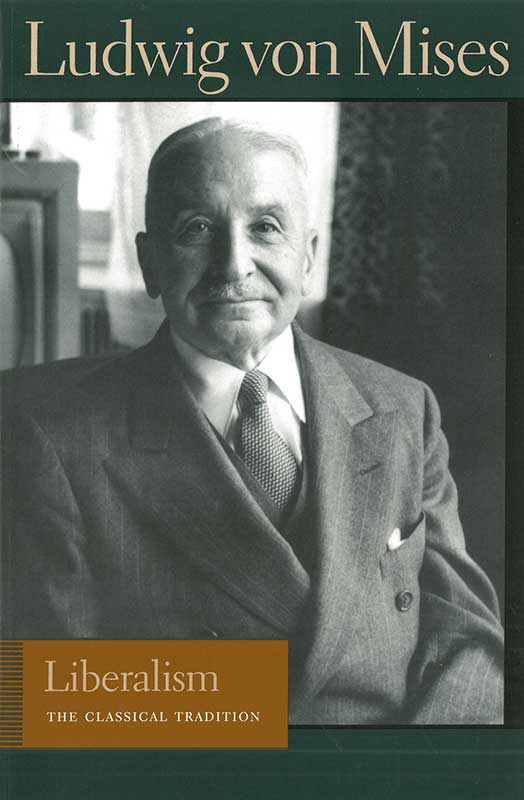
1: On the Literature of Liberalism - Ludwig von Mises, Liberalism: The Classical Tradition (LF ed.) [1962]

Edition used:

Liberalism: The Classical Tradition, trans. Ralph Raico, ed. Bettina Bien Greaves (Indianapolis: Liberty Fund, 2005).

About Liberty Fund:

Liberty Fund, Inc. is a private, educational foundation established to encourage the study of the ideal of a society of free and responsible individuals.


1

On the Literature of Liberalism

To prevent this book from becoming too long, I have tried to keep this bibliography short. This seems justified since I have already treated all the basic problems of liberalism thoroughly in a number of books and monographs.

For the reader who wishes to acquire a more exhaustive understanding of these matters, I append the following compilation of the most important literature.

Liberal ideas are already to be found in the works of many of the earlier writers. The great English and Scotch thinkers of the eighteenth and the beginning of the nineteenth century were the first to formulate these ideas into a system. Whoever wants to familiarize himself with the liberal mind must return to them:

  • David Hume, Essays Moral, Political, and Literary (1741 and 1742), and
  • Adam Smith, An Inquiry into the Nature and Causes of the Wealth of Nations (1776), but especially
  • Jeremy Bentham, numerous writings, beginning with Defence of Usury (1787), up to the Deontology, or the Science of Morality, published after his death in 1834. All his writings, with the exception of the Deontology, were published in the complete edition edited by Bowring between 1838 and 1843.

John Stuart Mill is an epigone of classical liberalism and, especially in his later years, under the influence of his wife, full of feeble compromises. He slips slowly into socialism and is the originator of the thoughtless confounding of liberal and socialist ideas that led to the decline of English liberalism and to the undermining of the living standards of the English people. Nevertheless—or perhaps precisely because of this—one must become acquainted with Mill’s principal writings:

  • Principles of Political Economy (1848)
  • On Liberty (1859)
  • Utilitarianism (1862)

Without a thorough study of Mill it is impossible to understand the events of the last two generations, for Mill is the great advocate of socialism. All the arguments that could be advanced in favor of socialism are elaborated by him with loving care. In comparison with Mill all other socialist writers—even Marx, Engels, and Lassalle—are scarcely of any importance.

One cannot understand liberalism without a knowledge of economics. For liberalism is applied economics; it is social and political policy based on a scientific foundation. Here, besides the writings already mentioned, one must familiarize oneself with the great master of classical economics:

  • David Ricardo, Principles of Political Economy and Taxation (1817).

The best introductions to the study of modern scientific economics are:

  • H. Oswalt, Vorträge über wirtschaftliche Grundbegriffe (many editions)
  • C. A. Verrijn Stuart, Die Grundlagen der Volkswirtschaft (1923).

The German masterpieces of modern economics are:

  • Carl Menger, Grundsätze der Volkswirtschaftslehre (first edition, 1871). [An English translation of this work was published as Principles of Economics (Glencoe, Ill.: The Free Press, 1950).]
  • Eugen von Böhm-Bawerk: The Positive Theory of Capital (New York, 1923). [Published in a new English translation as Volume II of Böhm-Bawerk’s 3-volume Capital and Interest (South Holland, Ill.: Libertarian Press, 1959). Also instructive is Böhm’s Karl Marx and the Close of His System (1896), available in English translation as “Unresolved Contradiction in the Marxian Economic System” in Shorter Classics of Böhm-Bawerk, Volume I. (Grove City, Pa.: Libertarian Press, 1962.)]

The two most important contributions that Germany made to liberal literature suffered a misfortune no different from that which befell German liberalism itself. Wilhelm von Humboldt’s On the Sphere and Duties of Government (London, 1854) lay completed in 1792. In the same year Schiller published an excerpt in the Neuen Thalia, and other excerpts appeared in the Berliner Monatsschrift. Since, however, Humboldt’s publisher feared to issue the book, it was set aside, forgotten, and, only after the death of the author, discovered and published.

Hermann Heinrich Gossen’s work, Entwicklung der Gesetze des menschlichen Verkehrs und der daraus fliessenden Regeln für menschliches Handeln, found a publisher, to be sure, but when it appeared in 1854 it attracted no readers. The work and its author remained forgotten until the Englishman Adamson came upon a copy.

Liberal thinking permeates German classical poetry, above all the works of Goethe and Schiller.

The history of political liberalism in Germany is brief and marked by rather meager success. Modern Germany—and this includes the defenders of the Weimar Constitution no less than their opponents—is a world apart from the spirit of liberalism. People in Germany no longer know what liberalism is, but they know how to revile it. Hatred of liberalism is the only point on which the Germans are united. Of the newer German writings on liberalism reference should be made to the works of Leopold von Wiese, Der Liberalismus in Vergangenheit und Zukunft (1917); Staatssozialismus (1916); and Freie Wirtschaft (1918).

Hardly a breath of the liberal spirit has ever reached the peoples of eastern Europe.

Although liberal thought is in decline even in western Europe and in the United States, one may yet call these nations liberal in comparison to the Germans.

Of the older liberal writers one should also read Frédéric Bastiat, Oeuvres Complètes (Paris, 1855) [The works of Frédéric Bastiat—Economic Sophisms, Economic Harmonies, and Essays on Political Economy—English translations published by D. Van Nostrand, 1964, are available from The Foundation for Economic Education, Irvington-on-Hudson, N.Y.]. Bastiat was a brilliant stylist, so that the reading of his writings affords a quite genuine pleasure. In view of the tremendous advances that economic theory has made since his death, it is not astonishing that his teachings are obsolete today. Yet his critique of all protectionist and related tendencies is even today unsurpassed. The protectionists and interventionists have not been able to advance a single word in pertinent and objective rejoinder. They just continue to stammer: Bastiat is “superficial.”

In reading the more recent political literature in English, one must not ignore the fact that in England today the word “liberalism” is frequently understood as denoting a moderate socialism. A concise presentation of liberalism is given by the Englishman L. T. Hobhouse, Liberalism (1911), and by the American Jacob H. Hollander, Economic Liberalism (1925). Even better introductions to the mind of the English liberals are:

  • Hartley Withers, The Case for Capitalism (1920).
  • Ernest J. P. Benn, The Confessions of a Capitalist (1925). If I Were a Labor Leader (1926). The Letters of an Individualist (1927). The last-named book includes a bibliography (pp. 74 et seq.) of the English literature on the basic problems of the economic system. The Return to Laisser Faire (London, 1928).

A critique of protectionist policy is presented by Francis W. Hirst in Safeguarding and Protection (1926).

Also instructive is the record of the public debate held in New York on January 23, 1921, between E. R. A. Seligmann and Scott Nearing on the topic: “That capitalism has more to offer to the workers of the United States than has socialism.”

Introductions to sociological thought are provided by Jean Izoulet, La cité moderne (first edition, 1890), and R. M. MacIver, Community (1924).

The history of economic ideas is presented by Charles Gide and Charles Rist, Histoire des doctrines économiques (many editions) [English translation of second revised and augmented edition of 1913 published as A History of Economic Doctrines: From the Time of the Physiocrats to the Present Day, D. C. Heath (New York, 1915)]; Albert Schatz, L’individualisme économique et social (1907); and Paul Barth, Die Philosophie der Geschichte als Soziologie (many editions).

The role of political parties is treated by Walter Sulzbach in Die Grundlagen der politischen Parteibildung (1921).

Oskar Klein-Hattingen, Geschichte des deutschen Liberalismus (1911/1912, two volumes) provides an essay on the history of German liberalism, and Guido de Ruggiero does the same for liberalism in Europe in The History of European Liberalism (Oxford, 1927).

Finally, I cite my own works in so far as they stand in close connection with the problems of liberalism:

  • Nation, State, and Economy (1919). [English translation, New York University Press, 1983; new publication scheduled by Liberty Fund.]
  • Socialism: An Economic and Sociological Analysis (1922). [English translation, Macmillan, 1938; Yale University Press, 1951; Jonathan Cape, 1969; Liberty Fund, 1981.]

* * * *

Editor’s Note: Mises’s major post-1927 works, listed here with the date and publisher of their first English editions, are also pertinent:

  • Critique of Interventionism (1929). English translation, Arlington House, 1977.
  • Epistemological Problems of Economics (1933). English translation, D. Van Nostrand, 1962.
  • Omnipotent Government, Yale University Press, 1944.
  • Bureaucracy, Yale University Press, 1944.
  • Human Action, Yale University Press, 1949; 3rd edition, Regnery, 1966.
  • The Anti-Capitalistic Mentality, D. Van Nostrand, 1956.
  • Theory and History, Yale University Press, 1957.
  • The Ultimate Foundation of Economic Science, Yale University Press, 1962.
  • Interventionism: An Economic Analysis (1940). English translation, Foundation for Economic Education, 1998.