Econlib

The Library

Other Sites

Front Page arrow Titles (by Subject) arrow ELEMENTOLOGY OF ETHICS. OF THE DUTIES OWED BY MAN TO HIMSELF. - The Metaphysics of Ethics

Return to Title Page for The Metaphysics of Ethics

Search this Title:

Also in the Library:

Subject Area: Philosophy

ELEMENTOLOGY OF ETHICS. OF THE DUTIES OWED BY MAN TO HIMSELF. - Immanuel Kant, The Metaphysics of Ethics [1796]

Edition used:

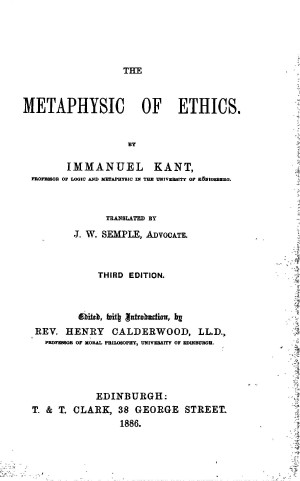
The Metaphysics of Ethics by Immanuel Kant, trans. J.W. Semple, ed. with Iintroduction by Rev. Henry Calderwood (Edinburgh: T. & T. Clark, 1886) (3rd edition).

About Liberty Fund:

Liberty Fund, Inc. is a private, educational foundation established to encourage the study of the ideal of a society of free and responsible individuals.


ELEMENTOLOGY OF ETHICS.

OF THE DUTIES OWED BY MAN TO HIMSELF.

INTRODUCTION.

Sec. 1.—The Notion of a Duty owed by Mankind to himself appears at first sight to involve a contradiction.

WHEN the obligating “I” is taken in exactly the same sense with the “I” obliged, then undoubtedly duty owed to myself imports an absurdity: for the idea Duty brings along with it the notion of passive necessitation (I am obliged or beholden); whereas in a matter of debt owed to myself, I figure myself to be the obliger, that is, in a state of active necessitation (I, the very same person with the former, am the Obligor). And a position announcing a duty owed by mankind to himself (I ought to oblige myself), would state an obligement to become obliged, i.e., a passive obligation, which were, notwithstanding, at the same time and in the same terms, an active one; a statement repugnant to itself, and contradictory. The contradiction contained in such a proposition may be set under a yet clearer light, by showing that the author of the obligation could always grant a dispensation to the obliged from the obligement; that is, by consequence, when the Author and the Subject of the obligation are the same, then, in such case, the obliger would not be at all beholden to any duty imposed by him upon himself; and this, again, is just the contradiction above insisted on.

Sec. 2.—There are Duties owed by Man to himself.

For, put the case, that there were in effect no such self-incumbent duties, then would all other duties, even the outward ones, be abolished; for I only acknowledge myself beholden and obliged to others, so far forth as I at the same time, along with the other, put that obligation upon myself; the law, by dint whereof alone I can recognise myself to be obliged, emanating in every instance from my own practical reason. By this reason I am necessitated, and so am at the same time my own necessitator.*

Sec. 3.—Solution of this Apparent Antinomy.

Man regards himself, when conscious of a duty to himself, in a twofold capacity: first, as a sensible being, i.e.,as a man, where he ranks only as one among other sorts of animals; but, second, he regards himself not only as an intelligent being, but as a very reason (for the theoretic function of reason may perhaps be a property of animated matter), resident in a region inscrutable to sense, and manifesting itself only in morally practical relations, where that amazing quality of man’s nature—freedom—is revealed by the influence reason exerts upon the determination of the will.

Mankind, then, as an intelligent physical being (homo phenomenon), is susceptible of voluntary determination to active conduct by the suggestions of his reason; but in all this the idea of obligation does not enter. The very same being, however, considered in respect of his personality (homo noumenon), i.e., cogitated as one invested with inward freedom, is a being capable of having obligation imposed upon him, and, in particular, of becoming obligated and beholden to himself, i.e., to the humanity subsisting in his person; and, so considered in this twofold character, mankind can acknowledge the obligations he stands under to himself, without incurring any contradiction, the notion man being now understood to be taken in a twofold sense.

Sec. 4.—On the Principle of subdividing the Duties owed by Man to himself.

This division can take place only according to the different objects incumbent on him, for there can be no room for it in respect of the self-obliging subject. The obliger and the obligated is always just one and the same person; and although we may theoretically distinguish betwixt man’s soul and his body, as distinct qualities of his system and known nature, yet it is quite disallowed to regard them as different substances, founding distinct obligations in respect of them, and so we cannot be entitled to divide our duties into those owed to the body, and those due to the soul. Neither experience nor the deductions of reason afford us any ground to hold that man has a soul (meaning by soul a spiritual substance dwelling in his material framework, distinct from the last, and independent of it); and we do not know whether life may or may not be a property of matter. However, even on the hypothesis that man had a soul, still a duty owed by man to his body (as the subject obliging) would be quite incogitable.

First. There can obtain, therefore, only one objective division, extending at once to the form and to the matter of the duties owed by man to himself,—the first whereof, the formal duties, are limitary or negative duties; the second, the material, are extensive and positive duties owed by man to himself. The former forbid mankind to act contrary to the ends and purposes of his being, and so concerns simply his ethical self-preservation; the latter ordain him to make a given object of choice his end, and command the perfecting of his own nature. Both these, as moral duties, are elements of virtue; the one as duties of omission (sustine et abstine), the other as duties of commission (viribus concessis utere). The first go to constitute man’s ethic health (ad esse), and to the preservation of the entireness of his system, both as objected to his exterior and to his interior senses (i.e., support his receptivity); the second constitute his ethic opulence (ad melius esse)—a wealth consisting in the possession of functions adapted for the realization of all ends, in so far as these powers and functions are matters of acquisition, and belong to self-culture as an active and attained perfection. The first principle of duty is couched in the adage, “Naturæ convenienter vive,i.e.,Maintain thyself in the original perfection of thy nature;” the second, in the position, “Perfice te ut finem, perfice te ut medium”—Study to perfect and advance thy being.

But second. There is, however, a subjective division of the duties owed by man to himself; that is, such a one, where mankind, the subject of the obligement, regards himself as an animal, though also at the same time moral being, or as a moral being singly.

Now, the instincts of man’s animal nature are threefold, viz. (1) the instinctive love of life, whereby nature preserves the individual; (2) that instinct whereby nature aims at the preservation of the kind; and (3), and lastly, those appetites of hunger and thirst which are intended for enlivening the frame,—keeping it fitted for its ends,—and at the same time for securing an agreeable, though only animal enjoyment of existence. The vices which are here subversive of the duty owed by man to himself, are (1) self-murder; (2) the unnatural use of the appetite for sex; (3) that excess in meat or drink which checks and lames the functions of the soul. As for the duty owed by man to himself as a moral being singly, it is formal, and consists in the coincidence of the maxims of his will with the dignity of the humanity subsisting in his person; by consequence, in the prohibition not to renounce the pre-eminence of his rank, which consists in his power of acting upon systematic principles and rules of life; that is, in the injunction not to despoil himself of his inward freedom,—that he become not thereby the toy and football of his own appetites and instincts, and so a mere thing. The vices subversive of this duty are lying, avarice, and spurious humility. These vices rest on maxims diametrically opposed, even already by their form, to the characters of mankind as a moral being; that is, they are formally repugnant to and subversive of the inborn dignity of man’s nature, his inward freedom, and make it, as it were, a man’s maxim to have none, and so no character; that is, to slattern himself down to zero, and so to sink beneath contempt. The virtue opposed to all these vices is self-reverence, and might be called the love of one’s own inward honour; a cast of thought having no common part with pride, which last is a love and ambition of outward honours, and may be, as it often is, abject and vile. This pride (superbia) is particularly treated of in the sequel, under this title, as a vice.

PART I.

OF THE DUTIES OF PERFECT AND DETERMINATE OBLIGATION.

CHAPTER I.

OF THE DUTY OWED BY MANKIND TO HIMSELF IN RESPECT OF HIS ANIMAL PART.

Sec. 5.

The first if not chiefest duty incumbent upon mankind, in respect of his brute nature, is his self-conservation in his animal estate. The antipart of this obligation is the deliberate and forethought destruction of his animality; and this may be considered as either total or partial. The total we call self-murder; the partial, again, is either material or formal,—material, when a man bereaves himself of any integrant part or organ of his body, by demembration or mutilation; formal, when by excess man suffers himself to be bereft, for a while or for ever, of the use of the physical functions of his system, and so likewise indirectly of his ethic rationality, self-obstupefaction.

Sec. 6.—Of Self-murder.

The voluntary divestiture of man’s animal part can be called self-murder, only then when it is shown that such an act is criminal. A crime which may be perpetrated, either simply on our own person, or also at the same time and by consequence upon the person of another, e.g., as when one in pregnancy kills herself.

Self-destruction is a crime—murder. Suicide may no doubt be considered as the transgression of the duty owed by any one to his fellow-men; as a violation of the conjugal obligations incumbent upon spouses; as a disregard of the duty owed by a subject to his government (the state); or, lastly, as a dereliction of one’s duty to God, the person quitting, without His permission, the post intrusted to him by God in the world. But none of these amount to the crime of murder; and the question at present to be considered is, whether or not deliberate self-destruction is a violation of man’s duty toward himself, even when abstraction is made from all those other considerations; that is, whether man ought to acknowledge himself beholden to the self-conservation of his animal part (nay, most strictly and exactly beholden so to act, and that too by force singly of his personality). That a man can injure himself, appears absurd (volenti non fit injuria); and this was the reason why the Stoics considered it to be a prerogative of the sage to walk with undisturbed soul out of life as out of a smoky room, not urged by any present or apprehended evils, but simply because he could no longer sustain with effect his part in life; and yet this very courage, this strength of soul to advance undauntedly to death, arguing his recognition of somewhat prized by him far higher than life, ought to have taught him not to despoil a being of existence possessing so mighty a mastery and control over the strongest forces in his physic system.

Mankind, so long as duty is at stake, cannot renounce his personality; that is, by consequence, never,—duty being always his incumbent debt; and it is a contradiction to hold that any one were entitled to withdraw himself from his obligations, and to act free, in such sense as to need no ground of warrant for his conduct. To abolish, then, in his own person the subject of morality, is tantamount to expunging with all his might the very being of morality from the world, which morality is, however, an end in itself. Whence we conclude, that to dispose of one’s life for some fancied end, is to degrade the humanity subsisting in his person (homo noumenon), and intrusted to him (homo phenomenon) to the end that he might uphold and preserve it.

For any one to deprive himself of an integral part of his frame, to dismember or mutilate his organs,—as when, for instance, any one sells or gifts a tooth to be transplanted into the jaw of another, or to submit to emasculation to gain an easier livelihood as a singer, and so on,—are acts of partial self-murder. The like observation, however, does not hold of the amputation of a decayed or mortified member, which it might be even dangerous to keep. Neither can we say that it is a violation of one’s person to remove what is a part and pertinent, but still no organ of the body, e.g., to cut one’s hair; but were this done with a view to making gain by the sale of one’s tresses, such an act could not be regarded as altogether devoid of blame.

Casuistics.—Is it self-murder to devote one’s self, like Curtius, to certain death for the liberation of his country? Is martyrdom—the deliberate offering of one’s self up for the benefit of mankind at large—capable of being regarded like the former, as a trait of a heroic character?

Is it allowed to anticipate an unjust sentence of death by suicide? Even were the sovereign to grant this permission, as Nero to Seneca?

Can we regard it as a crime, on the part of our late great monarch,* that he always bore about with him a poison, probably in order that if he should be taken in war, which he always carried on in person, he might not be compelled to accept conditions of ransom too burdensome to his country? A motive we are entitled to ascribe to him, as it is not likely he was impelled to it by mere arrogancy.

A patient, feeling decided symptoms of hydrophobia, after the bite of a mad dog, declared that as this complaint was incurable, he would destroy himself, lest, as he stated in his testament, he should, in a paroxysm of the disease, occasion some disaster to his fellow-men. It is demanded if he did wrong?

He who inoculates himself for smallpox, hazards his life on an uncertainty, even although he does so with a view to its more effectual preservation, and places himself in a much more ambiguous relation to the law, than the mariner, who does not excite the storm which he encounters, whereas this other is himself the cause of his running the risk of death. Is such inoculation lawful?

Sec. 7.—Of Self-defilement.

As the love of life is bestowed upon us for the preservation of our person, so the love of sex for the continuance of our kind. Either appetite is a last end purposed by nature; by end is to be understood that connection obtaining betwixt a cause and its effect, where the cause, although unintelligent, is nevertheless cogitated according to the analogy it bears to an understanding, that is, is spoken of and taken as if it intentionally and of design tended to the education of its own effect. In this way a question arises, if the power of propagating one’s species stands under a restrictive law; or if a person who exercises such a faculty may, without subverting any duty by doing so, overlook that end of nature, and employ his intersexual organs as the mere engine of brute pleasure.

In the elementary principles of law, we took occasion to show that mankind could not serve himself of the person of another, in order to this enjoyment, except subject to the limitary conditions of a particular legal contract (marriage), in which event two persons become mutually obliged to one another. But the question ethics undertakes is this, Whether there be or not a duty owed by man to himself, in respect of this appetite, the violation whereof attains (not merely degrades), the humanity inhabiting his person. The appetite itself is called lust, and the vice it gives birth to is called impurity. The virtue, again, raised upon this instinct of the sensory is termed chastity; and this chastity is now to be represented as a duty owed by man to himself. A lust is said to be unnatural, when a man is impelled to it, not by a real given matter objected to his sensory, but by the productive power of his imagination, depicting to him in fancy the object, contrary to the end aimed at by nature; for the power of appetition is then put into operation in such a manner as to evade or subvert the ends of nature; and, in truth, an end yet more important than the end proposed by nature in the instinctive love of life,—this tending only to the conservation of the individual, that to the upholding uninterrupted the succession of the species.

That this unnatural use (and so abuse) of one’s sexual organs is a violation, in the highest degree, of the duty owed by any to himself, is manifest to everybody; and is a thought so revolting, that even the naming this vice by its own name is regarded as a kind of immorality, which is not the case, however, with self-murder, which no one hesitates to detail in all its horrors, and publish to the world in specie facti; just as if mankind at large felt ashamed at knowing himself capable of an act sinking him so far beneath the brutes.

And yet, to prove upon grounds of reason the inadmissibility of that unnatural excess, and even the disallowedness of a mere irregular use of one’s sexual part, so far forth as they are violations (and in regard of the former, even in the highest possible degree) of the duty owed by man to himself, is a task of no slight or common difficulty. The ground of proving is to be sought, no doubt, in this, that man meanly abdicates his personality, when he attempts to employ himself as a bare means to satisfy a brutal lust. At the same time, the high and prodigious enormity of the violation perpetrated by man against the humanity subsisting in his person, by so unnatural and portentous a lust, which seems, as we have said, formally to transcend in magnitude the guilt of self-murder, remains unexplained upon this argument; unless, perhaps, it might be urged that the headlong obstinacy of the suicide, who casts away life as a burden, is no effeminate surrender to sensitive excitement, but shows valour, and so leaves ground for reverencing the humanity he represents; while this other resigns himself an abandoned outcast to brutality, enjoying his own self-abuse—that is, he makes himself an object of abomination, and stands bereft of all reverence of any kind.

Sec. 8.—Of Self-obstupefaction by Excessive Indulgence in Meats and Drinks.

The vice existing in this species of intemperance is not estimated by the prejudice or bodily pains mankind may entail upon himself as the sequents of his excess; for then we should regulate our judgment upon a principle of conveniency (i.e., on a system of eudaimonism), which, however, affords no ground of duty, but only of a dictate of expediency; at least such principle gives birth to no direct obligations.

The inordinate gratification of our bodily wants is that abuse of aliments which blunts the operations of the intellect: drunkenness and gluttony are the two vices falling under this head. The drunkard renounces, for the seductive goblet, that rationality which alone proclaims the superiority of his rank; and is, while in his state of intoxication, to be dealt with as a brute only, not as a person. The glutton, gorged with viands, blunts his powers for a while, and is incapacitated for such exercises as demand suppleness of body, or the reflections of the understanding. That the putting one’s self into such a situation is a grave violation of what a man owes to himself, is self-evident. The former state of degradation, abject even beneath the beasts, is commonly brought about by the excessive use of fermented liquors, or of stupefying drugs, such as opium, and other products of the vegetable kingdom; the betraying power whereof lies in this, that for a while a dreamy happiness, and freedom from solicitude, or perhaps a fancied fortitude, is begotten, which, after all, concludes in despondency and sadness, and so unawares, and by insensible and unsuspected steps, introduces the need and want to repeat and to augment the stupefying dose. Gluttony must be reputed still lower in the scale of animal enjoyment; for it is purely passive, and does not waken to life the energies of fancy,—a faculty susceptible for a long time of an active play of its perceptions during the obstupefaction of the former, upon which account gluttony is the more beastly vice.

Casuistics.—Can we, if not as the panegyrists, yet as the apologists of wine, accord to it a use bordering on intoxication, so far forth as it animates conversation, and combines the society by the frankness it produces? Can we, in any event, say of wine what Seneca has said when talking of Cato: Virtus ejus incaluit mero? But who is he who will assign a measure to one who stands on the brink of passing into a state, where all eyesight fails him to measure anything, nay, whose disposition is in full march to go beyond it? To employ opium or ardent spirits as instruments of one’s animal gratification, is very much akin to meanness; because these, by their soporific welfare, render the individual mute, reserved, and unsocial; upon which accounts it is that these are allowed only in medicine. Mahometanism has made but an injudicious selection, when it forbids wine, and allows the use of opium in its stead.

A banquet (Lord Mayor’s feast) is a formal invitation to a double intemperance in both kinds, although it has, over and above the stimulating of one’s physical existence, a reference to a moral end, viz., the advancing of man’s social intercourse with his species. Yet because, whenever the number of the guests exceeds, as Chesterfield says, the number of the muses, the very multitude obstructs the social exchange, and admits only the talking to one’s immediate neighbours,—i.e., since a feast is an institution subverting its own end,—it remains to be regarded only as a seduction to excess, i.e., to immorality, and to a violation of the duty owed by man to himself. To what extent is mankind ethically entitled to give ear to such invitations?

CHAPTER II.

OF THE DUTY OWED BY MAN TO HIMSELF, AS A MORAL BEING SINGLY.

THIS duty is opposed to the vices of lying, avarice, and false humility.

Sec. 9.—Of Lying.

The highest violation of the duty owed by man to himself, considered as a moral being singly (owed to the humanity subsisting in his person), is a departure from truth, or lying. That every deliberate untruth in uttering one’s thoughts must bear this name in ethics, is of itself evident, although in law it was only styled fraud or falsehood when it violated the rights of others—ethics giving no title to vice on account of its harmlessness; for the dishonour (i.e., to be an object of ethical disdain) it entails, accompanies the liar like his shadow. A lie may be either external or internal: by means of the former he falls under the contempt of others; but by means of the latter, falls, which is much worse, under his own, and violates the dignity of humanity in his own person. We say nothing here of the damage he may occasion to other people, the damage being no characteristic of the vice; for it would then be turned into a violation of the duty owed to others: nor yet of the damage done by the liar to himself; for then the lie, as a mere error in prudence, would contradict only the hypothetical, not the categorical imperative, and could not be held as violating duty at all. A lie is the abandonment, and, as it were, the annihilation, of the dignity of a man. He who does not himself believe what he states to another person (were it but an ideal person), has a still less value than if he were a mere thing; for of the qualities of this last some use may be made, these being determinate and given; but for any one to communicate thoughts to another by words intended to convey the contrary of what the speaker really thinks, is an end subversive of the purpose and design for which nature endowed us with a faculty of interchanging thought, and is upon these accounts a renunciation of one’s personality, after which the liar goes about, not as truly a man, but as the deceptive appearance of one only. Veracity in one’s statements is called candour; if such statements contain promises, fidelity: both together make up what is called sincerity.

A lie, in the ethical signification of the word, considered as intentional falsehood, need not be prejudicial to others in order to be reprobated, for then it would be a violation of the rights of others. Levity, nay, even good-nature, may be its cause, or some good end may be aimed at by it. However, the giving way to such a thing is by its bare form a crime perpetrated by man against his own person, and a meanness, making a man contemptible in his own eyes.

The reality of many an inward lie, the guilt whereof man entails upon himself, is easily set forth; but to explain the possibility of such a thing is not so easy; and it looks like as if a second person were required, whom we intended to deceive, since deliberately to deceive one’s self sounds like a contradiction.

Man as a moral being (homo noumenon) cannot use himself as a physical being (homo phenomenon), as a mere instrument of speech, nowise connected with the internal end of communicating his thoughts; but he is bound to the condition, under his second point of view, of making his declaration harmonize with his inward man, and so is obliged to veracity towards himself. Mankind thus perverts himself, when he bubbles himself into the belief in a future judge, although he find none such within himself, in the persuasion that it can do no harm, but may, on the contrary, be of service, inwardly to confess such faith before the Searcher of his Heart, in order, in any event, to insinuate himself into His favour. Or otherwise, supposing him to entertain no doubts on this point, still he may flatter himself that he is an inward reverer of His law, although he knows no other incentive than the fear of hell.

Insincerity is just want of conscientiousness, i.e., of sincerity in a man’s avowals to his inward judge, cogitated as a person different from himself. To take this matter quite rigidly, this would be insincerity, to hold a wish framed by self-love for the deed, because the end aimed at by it is good; and the inward lie told by a man to himself, although a violation of his duty towards himself, commonly goes under the name of, and is taken for, a weakness, pretty much in the same way as the wish of a lover to find only good qualities in his adored, seals his eyes to her most glaring defects. However, this insincerity in the statements declared by man to himself, deserves the most serious reprehension; for, from this rotten spot (which seems to taint the vitals of humanity), the evil of insincerity spreads into one’s intercourse with one’s fellow-men, the maxim of truth being once broken up.

Remark.—It is exceedingly remarkable that holy writ dates the original of evil, not from the fratricide of Cain (against which nature revolts), but from the first lie; and states the author of all evil under the denomination of the Liar from the beginning, and the Father of lies; although reason can give no account of this proneness of mankind to hypocrisy; which deflective tendency must, however, have preceded man’s actual lapse, an act of freedom not admitting, as physical effects do, a deduction and explanation from the law of cause and effect, this last law referring singly to phenomena.

Casuistical Questions.—Are falsehoods out of pure politeness (the most obedient servant at the end of a letter), lying? No one is deceived by them. An author asks, “How do you like my new work?” Now the answer might be given illusorily, by jesting upon the captiousness of such a question; but who has wit enough always ready? The smallest tarrying in replying must of itself mortify the author. Is it, then, allowed to pay him compliments?

If I lie, in matters of importance, in the actual business of life, must I bear all the consequences resulting from my falsehood? One gives orders to his servant, if any call for him, to say he is not at home: the domestic does so, and becomes in this way the cause of his master’s finding opportunity to commit a crime, which would otherwise have been prevented by the messenger-at-arms, who came to execute his warrant. On whom, according to ethic principles, does the blame fall? Unquestionably, in part upon the servant, who violated by his lie a duty owed by him to himself, the consequences of which, also, will he imputed to him by his own conscience.

Sec. 10.—Of Avarice.

I understand in this chapter not rapacious avarice, the propensity to extend one’s gains beyond one’s needs, in order to sumptuous fare; but the avarice of hoarding, which, when sordid, makes a man a miser, not so much because it disregards the obligations of charity, as because it narrows and contracts the proper enjoyment of the goods of life within the measure of one’s real wants, and so is repugnant to the duty owed by man to himself.

It is in the exposition of this vice that we can best display the inaccuracy of all those accounts of virtue and vice which make them differ in “degree,” and show clearly at the same time the applicability of Aristotle’s famous principle, that virtue is the mean betwixt two extremes of vice.

Thus, when for instance I regard frugality as the mean betwixt prodigality and avarice, and state this medium as one of degree, then the one vice could not pass into its opposite and contrary (which, however, is not unfrequent), except by passing through the intermediate virtue, and in this way virtue would come to be a diminishing vice, i.e., a vice at its vanishing quantity; and the true inference from this would be, in the present instance, that the perfect point of moral duty would consist in making no use at all of the bounties of fortune.

Neither the measure nor the quantum of acting upon a maxim, but that maxim’s objective principle, is what constitutes the act a vice or a virtue. The maxim of the avaricious and rapacious prodigal is to accumulate wealth, in order that he may enjoy it; that of the sordidly avaricious, or miser, is, on the contrary, to acquire and to keep accumulated his wealth, where he makes the bare possession of it his end, and dispense with the enjoyment.

The peculiar characteristic of the miser is this, that he adopts the principle of hoarding up the means conducive to many ends, with the inward reservation, never to apply such means to their destined uses, and so to bereave himself of all the amenities and sweets of life; a maxim utterly subversive of the duty a man owes to himself. Profusion and hoarding, then, differ not in degree, but they are specifically distinct in respect of their contrary and inconsistent maxims.1

Casuistical Question.—Since we treat here only of duties owed to one’s self, and rapacious avarice (insatiable cupidity of wealth), and the avarice of hoarding, rest on the common ground of self-love, and seem both objectionable, merely because they conclude in poverty, in the case of the former, issuing in unexpected, in that of the latter, in a voluntary indigence (by force of the determination to live in poverty)—since, I say, all this is the case, the question might be raised, if they are either of them at all vices, and not rather mere imprudences, and so not falling within the sphere of the duties owed by man to himself; but the sordid avarice is not a mere misunderstood economy,—it is an abject and servile enthralling of a man’s self to the dominion of money, and is a submitting to cease to be its master, which is a violation of the duty owed by man to himself: it is the opposite of that generous liberality of sentiment (not of munificent liberality, which is no more than a particular case of the former) which determines to shake itself free from every consideration whatever, the law alone excepted, and is a defraudation committed by man against himself. And yet, what kind of law is that, whereof the very inward legislator knows not the application? Ought I to retrench the outlays of my table, or the expenses of my dress? Should I in youth, or in my old age? Or is there, generally speaking, any such virtue as that of thrift?

Sec. 11.—Of False and Spurious Humility.

Man, as a part of the physical system (homo phenomenon, animal rationale), is an animal of very little moment, and has but a common value with beasts, and the other products of the soil. Even that he is superior to those by force of his understanding, gives him only a higher external value in exchange, when brought to the market along with other cattle, and sold as wares.

But man considered as a person, i.e., as the subject of ethico-active reason, is exalted beyond all price; for as such (homo noumenon), he cannot be taken for a bare means, conducive either to his own or to other persons’ ends, but must be esteemed an end in himself; that is to say, he is invested with an internal dignity (an absolute worth), in name of which he extorts reverence for his person from every other finite Intelligent throughout the universe, and is entitled to compare himself with all such, and to deem himself their equal.

The humanity of our common nature is the object of that reverence exigible by each man from his fellow, which reverence, however, he must study not to forfeit. He may, and indeed he ought, to estimate himself by a measure at once great and small, according as he contemplates his physical existence as an animal, or his cogitable being, according to the ethical substratum of his nature. Again, since he has to consider himself not merely as a person, but also as a man, that is, as such a person as has imposed upon him duties put upon him by his own reason, his insignificance as an animal ought neither to impair nor affect his consciousness of his dignity as a rational, and he ought not to forget his ethical self-reverence springing from his latter nature; that is to say, he ought not to pursue those ends which are his duties servilely, or as if he sought for the favour of any other person: he ought not to renounce his dignity, but always to uphold, in its integrity, his consciousness of the loftiness of the ethical substratum of his nature; and this self-reverence is a duty owed by man to himself.

The consciousness and feeling of one’s little worth, when compared with the law, is ethical humility: the over-persuasion that a man has a great deal of moral worth, owing only to his neglecting to quadrate himself with the law, is ethical arrogancy, and might be called self-righteousness. But to renounce all claim to any moral worth, in the hope of thereby acquiring a borrowed and another, is false ethical humility, and may be called spiritual hypocrisy.

Humility, understood as a low opinion of one’s self, when compared with other persons, is no duty (nor, generally speaking, in comparison with any finite being, although a seraph): the active endeavour, in such comparison, to find one’s self equal or superior to others, in the imagination of thereby augmenting his inward worth, is ambition,—a vice diametrically opposed to the duty we owe to others; but the studied declinature of all one’s proper ethic worth, considered as a mean for ingratiating one’s self into the favour of another (be that other who he may), is false and counterfeit humility—(hypocrisy, flattery)—and a degradation of one’s personality, subverting the duty he owes to himself.

Upon an exact and sincere comparison of a man’s self with the moral law (its holiness and rigour), true humility must infallibly result; but from the very circumstance that we can know ourselves capable of such an inward legislation, and that the physical man finds himself compelled to stand in awe of the ethical man in his own person, there results also at the same time a feeling of exaltation, and the highest possible self-estimation, as the consciousness of one’s inward worth, by force of which he is raised far beyond all price, and sees himself invested with an inalienable dignity, inspiring him with reverence for himself.

Sec. 12.

This duty, in respect of the dignity of our humanity, can be rendered more sensible by such precepts as the following.

Become not the slaves of other men. Suffer not thy rights to be trampled under foot by others with impunity. Make no debts thou mayest be unable to discharge. Receive no favours thou canst dispense with, and be neither parasites nor flatterers nor—for they differ but in degree—beggars. Live, then, frugally, lest one day thou come to beggary. Howling and groaning, nay, a mere scream at a bodily pain, is beneath thy dignity as a man, more especially when conscious that thou hast thyself merited it. Hence the ennoblement of (averting of ignominy from) the death of a malefactor, by the constancy with which he meets his fate. To kneel or prostrate thyself upon the earth, in order to depicture in a more lively image to thy fancy thy adoration of celestial objects, derogates from thy dignity as a man; as does also the worshipping of them by images: for then thou humblest thyself, not before an ideal, the handiwork of thy reason, but beneath an idol, the workmanship of thy hands.

Casuistics.—Is not the elation of mind in self-reverence, considered as a consciousness of the lofty destiny of man, too much akin to arrogance, i.e., to self-conceit, to make it advisable to summon up to it, not only in respect of the moral law, but even in respect of other men? or would not self-denial in this particular invite others to despise our person, and so be a violation of what is due by man to himself? Fawning and scraping to another is in any event unworthy of a man.

Are not the different styles of address, and the especial marks of respect, denoting, with such painful anxiety, difference of rank in society,—all which differs widely from politeness, a thing indispensable for mutually reverencing one another,—the thou, he, they, your high wisdom, your reverence, etc. etc., in which pedantry the Germans go beyond all nations on the earth, the Indian castes alone excepted,—are not, I say, these proofs of a widely-spread tendency among mankind to false and spurious humility? (hæ nugæ in seria ducunt.)—However, he who first makes himself a worm, does not complain when he is trampled under foot.

CHAPTER III.

OF THE DUTY OWED BY MAN TO HIMSELF AS HIS OWN JUDGE.

Sec. 13.

The idea Duty always involves and presents to the mind that of necessitation by law (law being an ethical imperative limiting our freedom), and belongs to our moral understanding which prescribes the rule. The inward imputation of an act, however, as of an event falling under the law, belongs to the judgment, which being the subjective principle of the imputation of an act, utters its verdict whether or not any given deed (i.e., act subsumible under law) has been done or not, after which reason pronounces sentence, i.e., connects the act with its legal consequences, and so absolves or condemns; all which is carried on before a court of justice, as if in the presence of an ethical person sitting to give effect to the law. The consciousness of an internal tribunal in man, before which his thoughts accuse or excuse him, is what is called Conscience.

Every man has Conscience, and finds himself inspected by an inward censor, by whom he is threatened and kept in awe (reverence mingled with dread); and this power watching over the law, is nothing arbitrarily (optionally) adopted by himself, but is interwoven with his substance. It follows him like his shadow, however he may try to flee from it. He may indeed deafen himself by pleasure or by business, or he may lull himself into a lethargy; but this is only for a while, and he must inevitably come now and then to himself: nor can he hinder himself from ever and anon awakening, whereupon he hears his dreadful and appalling voice. In the last stage of reprobation man may indeed have ceased to heed him, but not to hear him, is impossible.

This originary intellectual and ethical (for it refers to duty) disposition of our nature, called conscience, has this peculiarity, that although this whole matter is an affair of man with himself, he notwithstanding finds his reason constrained to carry on the suit, as if it were at the instigation of another person; for the procedure is the conduct of a cause before a court. Now, that he who is the accused by his conscience should be figured to be just the same person as his judge, is an absurd representation of a tribunal; since in such event the accuser would always lose his suit. Conscience must therefore represent to itself always some one other than itself as judge, unless it is to arrive at a contradiction with itself. This other may be either a real—or an ideal person the product of reason.*

Such an ideal person, authorized to sit as judge in the court of conscience, must be a searcher of the heart, for the tribunal is erected in the interior of man. Further, he must hold all-obligatory power,i.e., be such a person, or at least be figured as if he were a person, in respect of whom all duty may be represented as his commandments, because conscience is judge over all free actions. Lastly, he must have all power (in heaven and in earth) to absolve and to condemn, these properties being of the very essence of the functions of a judge: apart from his being endowed wherewith, he could give no effect to the law. But since he who searches the heart, and, having all-obligatory power, is able to absolve and condemn, is called God, it follows that conscience must be regarded as a subjective principle implanted in the reason of man, calling for an account of every action before God. Nay, this notion of responsibility is at all times involved, however darkly, in every act of moral self-consciousness.

This is not by any means to say that man is entitled, and still less that he is bound, to believe in, as real, any such Supreme Being, answering to the idea, to which conscience inevitably points; for the idea is given him not objectively by speculative reason, but subjectively only, by practical reason obliging itself to act conformably to this representation. And mankind is, by means of this idea, but merely from its analogy to that of a sovereign lawgiver of the universe, led to figure to himself conscientiousness (in the old language of the empire, religio), as a responsibility owed to a most holy being, different from ourselves, and yet most intimately present to our substance (moral legislative reason), and to submit ourselves to His will as if it were a law of righteousness. The notion of religionin genere is therefore just this, that it is a principle of esteeming of all our duties as if they were divine commandments.

1. In an affair of conscience, man figures to himself a preadmonitory or warning conscience before he decides on acting; and here the minutest scruple, when it refers to an idea of duty (somewhat in itself moral), and over which conscience is the alone judge, is of weight, nor is it ever regarded as a trifle; nor can what would be a real transgression be declared, according to the saying of minima non curat prætor, a bagatelle or peccadillo, and so left for an arbitrary and random determination. Hence, having a large conscience is the same with having none.

2. As soon as an act is determined on and completed, the accuser immediately presents himself in the court of conscience, and along with him there appears a defender, and the suit is never decided amicably, but according to the rigour of the law. After which follows—

3. The sentence of conscience upon the man, either absolving or condemning, which concludes the cause. As to which final judgment, we remark that the former sentence never decrees a reward as the gaining of something which was not there before, but leaves room only for satisfaction at escaping condemnation. The bliss, therefore, announced by the consoling voice of conscience is not positive (as joy), but only negative (tranquillization after previous apprehension); a blessedness capable of being ascribed to virtue only, as a warfare with the influences of the evil principle in man.

Sec. 14.—The first commandment of all Duties owed by Man to himself.

This is, know thyself, not after thy physical perfection, but after thy ethical, in reference to thy duty. Search, try thy heart, whether it be good or evil, whether the springs of thy conduct be pure or impure; and how much, either as originally belonging to thy substance or as acquired by thee, may be imputable to thy account, and may go to make up thy moral state.

This self-examination, which seeks to fathom the scarcely penetrable abysses of the human heart, and the self-knowledge springing from it, is the beginning of all human wisdom. For this wisdom, which consists in the accordance of the will of an Intelligent with the last end of his existence, requires in man, first, that he disembarrass himself of an inward impediment (an evil will, nestled in his person); and second, the unremitted effort to develop his originary inamissible substratum for a good one. Only the Avernan descent of self-knowledge paves a way to self-apotheosis.

Sec. 15.

This ethical self-knowledge guards, first, against the fanatical detestation of one’s self as a man, and against a disdain of the whole human race in general. It is only by force of the glorious substratum for morality within us—which substratum it is that renders man venerable—that we are enabled to find any man despicable, or to hand ourselves over to our own contempt, when seen to fall short of this august standard; an ethical disregard attaching to this or that man singly, never to humanity in general. And then it guards, secondly, against the fond and fatal self-delusion of taking a bare wish, however ardent, for any index of a good heart; and obviates irregular self-estimation. Even prayer is no more than a wish, inwardly uttered in the presence of a Searcher of the Heart. Impartiality, in judging of ourselves, when compared with the law, and sincerity in a man’s own self-confession of his own inward ethical worth or unworth, are the duties owed by man to himself, immediately founded on this first commandment of self-knowledge.

EPISODE.

Sec. 16.—Of an Amphiboly of the Reflex Moral Notions; whereby Mankind is led to regard what is only a Duty to wards himself, as if it were a Duty owed by him to others.

To judge on grounds of naked reason, man has no duties imposed upon him, except those owed by him to humanity in general (himself or others); for his obligement towards any person imports ethical necessitation by that person’s will. The necessitating (obliging) subject must then, in every instance, be, first, a person; and must, second, be a person presented to our knowledge in experience and observation; for, since man has to work towards the end of that person’s will, this is a relation possible only betwixt two given existing beings, no imaginary or barely cogitable persons becoming the final cause and scope of any one’s actions. But experience and observation teach a knowledge of no other being, except our fellow-men, capable of obligation, whether active or passive. Mankind can, therefore, have no duty toward any being other than his fellow-men, and when he figures to himself that there are such, this arises singly from an amphiboly of his reflex moral notions; and this fancied duty owed by him to others is no more than a duty to himself, he being misled to this misunderstanding by confounding what is duty to himself in regard of other beings, with a duty toward those others.

This fancied duty may extend, either to impersonals, or if to personal, yet to invisible beings, not presented to our sensory. The former will be either the physical matter of the universe, or else its organized but impercipient products; or, lastly, that part of nature which we see endowed with choice, motion, and perception (1. minerals, 2. plants, 3. animals). The latter will have a reference to superhuman beings, cogitated as spiritual substances (God, angels). And we now ask, does there obtain, betwixt these different kinds of beings and man, any relation of duty? and if so, what is the nature and extent of this obligation?

Sec. 17.

In regard of the beautiful but lifeless objects in nature, to indulge a propensity to destroy them, is subversive of the duty owed by man to himself. For this spirit of destruction lays waste that feeling in man, which, though not itself ethical, is yet akin to it, and aids and supports, or even prepares a way for a determination of the sensory, not unfavourable to morality, viz., the emotion of disinterested complacency in somewhat quite apart from any view of its utility, e.g., as when we find delight in contemplating a fine crystallization, or the unutterable beauties of the vegetable kingdom.

In regard of the animated but irrational part of the creation, it is undoubted that a savage and cruel treatment of them is yet more inly repugnant to what man owes to himself; for it blunts and obtunds our natural sympathy with their pangs, and so lays waste, gradually, the physical principle which is of service to morality, and assists greatly the discharge of our duty towards other men. But to kill them or to set them on work not beyond their strength (which labour man himself must undertake), is in nowise disallowed; although to torture them, with a view to recondite experiments subserving a mere speculation, which could be dispensed with, is detestable. Nay, gratitude for the services of an old horse or house-dog is indirectly, a duty, namely, an indirect duty in regard of these animals; for, directly, it is no more than what a man owes to himself.

Sec. 18.

In regard of a Being transcending all bounds of knowledge, but whose existence is notwithstanding given to us in idea, viz., the Godhead, we have in like manner a duty called religion, which is the duty of recognising all our duties as if they were divine commandments. But this is not the consciousness of a duty toward God. For since this idea rises singly upon our own reason, and is made by ourselves for the behoof of explaining theoretically the symmetry and fitness of means to ends observed in the fabric of the universe, or practically to give added force to the mainspring of action, it is manifest that we have nowhat given, toward whom an obligation could be constituted; and his reality would first need to be established by experience (or revealed). And the duty we have here is to apply this indispensable idea of reason to the moral law within us, where it proves of the greatest ethical fertility. In this practical sense it may be asserted, that to have religion is a duty owed by man to himself.

PART II.

OF THE INDETERMINATE MORAL DUTIES OWED BY MAN TO HIMSELF IN REGARD OF HIS END.

Sec. 19.—Of the Duty owed by him to himself of advancing his Physical Perfection.

The culture of all the different resources of mind, soul, and body, as means conducive to many ends, is a duty owed by man to himself. Man owes it to himself as a reasonable being, not to allow to go to rust and lie dormant the latent energies and native elements of his system, whereof his reason might one day make use. And even were he to rest contented with the measure of talent nature had endowed him with as his birthright, still it ought to be upon grounds of reason, that he should instruct such a remaining satisfied without so moderate a share of capacity; for, being a person capable of designing ends, or of proposing himself to others as an end, he ought to stand indebted for the development and amelioration of his powers, not to any physical instinct of his system, but to his own liberty, whereby he freely decides how far he will carry them. This duty, then, is altogether independent on any advantages the culture of his faculties as means to ends may procure to him,—for perhaps the advantage, according to Rousseau’s views, might lie in the uncultivated roughness of a savage life,—but is founded on a commandment of ethico-active reason, and a duty imposed on man by himself to advance and ameliorate the condition of his humanity, according to the diversity of the ends assigned him, and to make himself, in a practical point of view, adapted to the final destinies of his being.

Powers of mind we call those faculties whose exercise is possible by force of reason singly. They are creative, so far forth as their use is independent on experience and observation, and rests on principles à priori. Some of their products are, the mathematics, logic, and metaphysic of ethics, which two last fall under the head of philosophy, viz., the speculative philosophy, where this word is taken, not to signify wisdom, as it ought to do, but only science; which last, however, may be subservient to advancing the ends of practical wisdom.

Powers of soul, again, are those which stand at the command of the understanding, and of the rule this last prescribes in order to attain the end it designs, and so depend to a certain extent on observation and experience. Instances of such powers are, memory, imagination, and the like, from which learning, taste, the graces of outward and inward accomplishments take their rise, and which can be employed as instrumental to a vast variety of ends.

Lastly, the culture of our bodily powers (gymnastic properly so called) is the caring for the stuff and materials of the man, apart from which instrument and engine his ends could not be exerted into acts; consequently, the intentional and regular revivifying of man’s animal part is a duty owed by mankind to himself.

Sec. 20.

Which of these natural perfections may be the more eligible, and in what proportion, when compared with the remainder, it may be his duty to design them as his ends, must be left to the private reflection of each individual, who will decide according to his taste for this or that kind of life, and according to the estimate he may make of his ability, whether he should follow some handicraft, or a mercantile employment, or become a member of a learned profession. Because, over and above the necessity man stands in of providing for his livelihood, a necessity which never can of itself beget any obligation, it is a duty owed by man to himself to make himself of use to the world; this belonging to the worth of the humanity he represents, and which, therefore, he ought not to degrade.

But this duty owed by man to himself in regard of his physical perfection, is only of indeterminate obligation. Because the law ordains only the maxims of the action, not the act itself; and, in regard of this last, determines neither its kind nor its degree, but leaves a vast latitude for man’s free choice to roam or settle in.

Sec. 21.—Of the Duty owed by Man to himself of advancing his Ethical Perfection.

This consists, first of all, subjectively, in the purity of his moral sentiments, where, freed from all admixture of sensitive excitement, the law is itself alone the spring of conduct; and actions are not only conformable to what is duty, but are performed because it is so, — Be ye holy is here the commandment; and, second,objectively, consists in attaining his whole and entire moral end, i.e., the execution of his whole duty, and the final reaching of the goal placed before him as his mark,—the commandment here is Be ye perfect. The endeavour after this end is, in the case of mankind, never more than an advancement from one grade of ethical perfection to another. If there be any virtue, if there be any praise, that study and pursue.

Sec. 22.

The duty towards one’s self is, in its quality, determinate and strict; but in degree it is of indeterminate obligation, and that on account of the frailty of human nature; for that perfection which it is our constant and incumbent duty to pursue, but never (at least in this life) to attain, and the obeying which can by consequence consist only in urging after it with an unfaltering and progressive step, is no doubt, in regard of the object (the idea to realize which is end), determinate, strict, and given; but in regard of the subject, is but a duty of indeterminate obligation owed by mankind to himself.

The depths of the human heart are inscrutable. Who has such an exact of self-knowledge as to be able to say, when he feels the impelling force of duty, that the mobile of his will is swayed singly by the naked idea of the law, and to declare that other sensitive excitements may not work alongside of it and pollute it,—such as by-views of advantage, or of avoiding harm?—considerations which on occasion might serve the turn of vice. Again, as for that perfection which concerns the accomplishment of one’s end, there can, it is true, be only one virtue objectively in idea,—the ethical strength of one’s practical principles; but subjectively, in point of real fact and event, a vast number of virtues, of the most heterogeneous nature, amongst which it is not impossible some vice may lurk, although it escapes observation, and is not so called, on account of the virtues in whose company it appears. But a sum of virtues, the completeness or defects of which no self-knowledge can accurately detect, can beget only an indeterminate obligation to perfect our moral nature.

Whence we conclude, that all the moral duties, in respect of the ends of the humanity subsisting in our person, are duties of indeterminate obligation only.

OF THE MORAL DUTIES OWED BY MANKIND TOWARD HIS FELLOW-MEN.

CHAPTER I.

OF THE DUTY OWED TO OTHERS, CONSIDERED SIMPLY AS MEN.

PART I.

OF THE OFFICES OF CHARITY.

Sec. 23.

THE principal division of these obligations may be made into such duties as oblige our fellow-men, when we discharge them; and second, into those which, when observed, entail upon the other no obligation of any sort. To fulfil the former is, in respect of others, meritorious; to fulfil the latter, of debt only. Love and reverence are the emotions which go hand in hand with our discharge of these two kinds of offices. These emotions may be considered separately, and in practice they may subsist, each for itself and apart from the other. Love of our neighbour may take place even while he deserves but little reverence; as, on the contrary, reverence is due to every man, although deemed hardly worth our love. But, properly speaking, they are at bottom inseparably united by the law, in every duty owed by us, to our neighbour; but this in such a manner, that sometimes the one emotion is the leading principle of the duty of the person, along with which the other follows as its accessory. Thus we regard ourselves obliged to benefit the poor; but because this favour would imply his dependence for his welfare on my generosity, a case which would be humiliating for the other, it becomes my further duty so to behave to him who accepts my gift, as to represent this benefit either as a bare incumbent duty upon my part, or as a trifling mark of friendship, and to spare the other such humiliation, and to uphold his self-reverence in its integrity.

Sec. 24.

When we speak, not of laws of nature, but of laws of duty as regulating the external relation of man to man, we then regard ourselves in a cogitable ethic world, where, by analogy to the physical system, the combination of Intelligents is figured to be effected by the joint action and reaction of attractive and repellant forces. By the principle of mutual love, they are destined for ever to approach, and by that of reverence, to preserve their due elongation from one another; and were either of these mighty moral principles to be suspended, the moral system could not be upheld, and, unable to sustain itself against its own fury, would retrovert to chaos.

Sec. 25.

But love must not be here understood to mean an emotion of complacency in the perfection of other people, there being no obligation to entertain feelings; but this love must be understood as the practical maxim of goodwill issuing in beneficence as its result.

The same remark holds of the reverence to be demonstrated towards others, which cannot be understood simply to mean a feeling emerging from contrasting our own worth with that of another,—such as a child may feel for its parents, a pupil for his ward, or an inferior for his superior in rank,—but must be taken to mean the practical maxim of circumscribing our own self-esteem, by the representation of the dignity of the humanity resident in the person of another—that is, a practical reverence.

This duty of the free reverence owed to other men is properly negative only, viz., not to exalt ourselves above others. It is in this way analogous to the juridical duty “to do no wrong,” and so might be taken for a strict and determinate obligation; but, regarded as a moral duty, and a branch of the offices of charity, it is a duty of indeterminate obligation.

The duty of loving my neighbour may be thus expressed,—that it is the duty of making my own the ends and interests of others, in so far as these ends are not immoral. The duty of reverencing my neighbour is expressed in the formula, to lower no man to be a bare means instrumental towards the attaining my own ends, i.e., not to expect from any man that he should abase himself to be the footstool of my views.

By discharging the former duty, I at the same time oblige the other; I make myself well-deserving of him. But by the observance of the latter, I oblige only myself, and keep myself within my own bounds, so as not to withdraw from the other any of that worth he is entitled as a man to put upon himself.

Sec. 26.—Of Philanthropy in general.

The love of our fellow-men must, because we understand by it practical benevolence, be understood, not as a love of complacency in our species, but as a maxim actively to befriend them. He who takes delight in the welfare of his fellows, considered merely as belonging to his own species, is a philanthropist,—a Friend of Mankind in general. He who alone finds delight in the misery and woes of his neighbour, is a misanthrope. An egotist is he who beholds with indifference the good or the bad fortunes of his neighbour. While that person who shuns society because he is unable to regard his fellows with complacency, although he wishes them all well, would be an æsthetic misanthrope; and his aversion from his kind might be called anthropophoby.

Sec. 27.

Whether mankind be found worthy of love or not, a practical principle of goodwill (active philanthropy) is a duty mutually owed by all men to one another, according to the ethical precept of perfection, Love thy neighbour as thyself; for every ethical relation obtaining between man and man is a relation subsisting in the representation of pure reason, i.e., is a relation of mankind’s free actions, according to maxims potentially fit for law universal, which maxims can therefore, in no event, be founded on an emotion of selfishness. The constitution of my nature forces me to desire and will every other person’s benevolence; wherefore, conversely, I am beholden to entertain goodwill towards others; but, again, because all others, except myself, are not all mankind, a maxim expressing my active goodwill towards all others would want the absolute universality whereby alone the law has ethical virtue to oblige; consequently the ethical law of benevolence must include my own person likewise with others, as the object of the commandment announced by practical reason;—which is not to say, that I thereby become obliged to love myself, such self-love obtaining of its own accord, and inevitably, but states, that legislative reason, which embraces in its idea of humanity the whole race (i.e., me likewise), includes in its universal legislation myself likewise, under the duty of reciprocal benevolence; and so renders it allowed for me to wish well to myself, under the condition that I cherish goodwill towards every other person; my maxim being thus alone fitted for law universal, whereon is based every law of duty whatsoever.

Sec. 28.

The goodwill expressed in universal philanthropy is extensively the greatest possible, but intensively (in degree) the most contracted; and to say of any one that he is interested in the welfare of his neighbour, as a general philanthropist is to say that the interest he takes in him is just the smallest possible,—he is merely not indifferent.

But of my fellows, one stands nearer to me than another; and, so far as goodwill is concerned, I am nearest to myself: how does this harmonize with the formula, “Love thy neighbour as thyself? If one is more my neighbour (nearer to me in the obligation of benevolence) than another, and I thus am bound to more benevolence toward one person than toward another, and am, moreover, nearer to myself than to any other person; then it would appear that it cannot without contradiction be asserted that I ought to love all others as myself,—this measure, self-love, admitting no difference of degree. The smallest reflection, however, shows that the benevolence here intended is not a bare wish, which last is properly an acquiescence in the happiness of my neighbour, while I myself contribute nothing towards it, according to the adage, “Every one for himself, God for us all;” but that we have to understand an active practical beneficence, which makes the welfare of others its end: and so in wishes I may have an equal kind intent to all, while actively the degree may be carried to any extent or measure, according to the difference of the beloved persons, some of whom may stand nearer to me than others, and all this without violating the absolute universality of the maxim.

THE OFFICES OF CHARITY ARE: A. BENEFICENCE; B. GRATITUDE; C. SYMPATHY.

Sec. 29.

A.

Of the Duty of Beneficence.

To enjoy the bounties of fortune, so far as may be needful to find life agreeable, and to take care of one’s animal part, but short of effeminacy and luxury, is a duty incumbent on us to ourselves; the contrary of which would be, sottishly to deprive one’s self of the bounties of fortune,—either out of avarice, servilely, or out of an outrageous discipline of one’s natural appetities, fanatically,—things both of which are repugnant to the duty owed by mankind to himself.

But how comes it that, over and above the benevolent wish, which costs me nothing, my fellows are entitled to expect that this wish should become practical, and be exerted into action,—that is, how can we evince that beneficence is due to the necessitous, from him who is possessed of means empowering him to become kind? Benevolence or goodwill is the pleasure we take in the prosperity and happiness of our neighbour: beneficence, again, would be the maxim to make that happiness our end; and the duty to do so is necessitation by the subject’s own reason, to adopt this maxim as his universal law.

It is by no means evident that any such law is originated by reason; on the contrary, it would seem that the maxim, “Every one for himself, God for us all,” were far more natural.

Sec. 30.

To deal kindly toward our brethren of mankind who are in distress, without hoping for anything in return, and to aid them in extricating themselves out of it, is a mutual duty incumbent on us all.

For every one who himself is in difficulties, desires to be aided by other men; but if, on the contrary, he were to make the rule general, not to succour others when distressed, then would every one refuse, or at least be entitled, when such a law were announced as of catholic extent, to refuse to him all assistance; that is, a selfish principle of this kind would, when elevated to the rank of law universal, be self-contradictory and self-destructive, that is, would be contrary to duty; whence, conversely, we hold the social principle of mutual and joint assistance to one another in case of need a universal duty owed by man to man; for, as fellow-beings, i.e., necessitous (by the finite constitution of their natures), they ought to consider themselves as stationed in this one dwelling to be fellow-workers to one another.

Sec. 31.

Beneficence, where a man is rich, i.e., enjoys the means of happiness to superfluity and beyond his own wants, is to be looked upon by the benefactor, not even as a meritorious duty, although his neighbour be obliged by it. The pleasure which he procures to himself, and which, after all, costs him no sacrifice, is a kind of moral luxury. He must, likewise, studiously avoid all appearance of intending to oblige the other by this means, because, otherwise, it would not be truly a benefit done to, but an obligation thrust upon his neighbour, to come under which must needs make the latter stand a grade lower in his own eyes. He ought rather so to carry himself, as if he were the obliged and honoured by his neighbour’s acceptance of his kindness; that is, he ought so to figure to himself, and so to represent the favour, as if it were of mere debt, and rather, when possible, exercise his good deeds quite in private. This virtue might deserve a yet greater name, when the ability to give benefits is curtailed, and the soul of the benefactor is so strong as to take upon himself, in silence, the evils which he spares the other from undergoing; a case where he must be deemed ethically wealthy.

Casuistics.—How far ought the outlay expended by any one in deeds of charity to be carried? Surely not till we ourselves came to stand in need of our friends’ generosity? What may a benefit be worth, offered to us by a dead hand in his testament? Does he who uses the right conferred upon him by the law of the land, of robbing some one of his freedom, and then making the other happy, according to his own notions of enjoyment,—can, I say, such a man be regarded as a benefactor, in consequence of the parental care he may take of his slave’s welfare? or is not the unrighteousness of bereaving any one of his freedom so grave a violation of the rights of man, that all the advantages his master could bestow would cease to deserve the name of kindness? or can he become so well-deserving of his slave by kindness, as to counteract and redeem the violation committed by him against his slave’s person? It is impossible that I can act kindly toward any other (infants and madmen excepted) by force of my idea of his happiness, but only by studying his ideas of welfare, to whom I wish to exhibit my affection, no kindness being truly shown when I thrust upon him a present without his will.

Sec. 32.

B.

Of the Duty of Gratitude.

Gratitude is the venerating of another on account of a benefit we have received from him: the sentiment or emotion which goes hand in hand with such a judgment is that of reverence toward the benefactor we are beholden to; whereas this other stands toward the receiver in the relationship of love. A mere heartfelt, generous goodwill toward another, for a kindness shown us, even apart from any demonstrated regard, deserves the name of a moral duty; and this would indicate a distinction betwixt an affectionate gratitude and an active thankfulness for a favour.

Gratitude is a duty, i.e., not a mere maxim of prudence, to engage my benefactor to yet greater degrees of kindness, by professing my obligation for what he has already done; for that would be to use him as a means toward my by-ends; but gratitude is immediately made necessary by the moral law, i.e., it is a duty.

But gratitude must be regarded still further as a sacred duty, i.e., as such a duty, which to violate, would be to extinguish the moral principles of benevolence, even in their source; for that ethical object is sacred and holy, in regard of whom the obligation can never be adequately acquitted and discharged (that is, where the person who is indebted must always stand under the obligation). All other is only ordinary and vulgar duty. But there is no retribution which can acquit a person of a conferred benefit, the benefactor having always the good desert of being first in the benevolence, an advantage which the receiver cannot take away However, even without any active returns, a bare cordial goodwill toward the benefactor is of itself a kind of gratitude; in this state of mind, we say that a person is grateful.

Sec. 33.

As for the extent of gratitude, it is not by any means confined to contemporaries, but goes back to our ancestors, even to those whom we cannot certainly name. And this is the reason why it is considered indecorous not to defend the ancients as much as possible against all attacks, invective, and slights—the ancients being here considered as our teachers; although it were a ridiculous opinion to grant to them any superiority over the moderns, merely on account of their antiquity, either in their talents or in their kind intentions toward humanity, and to disregard what is new, in comparison of what is old, as if the world were continually declining from its primitive perfection.

Sec. 34.

But as to the intensity of this duty, i.e., the degree in which we may be obliged to this virtue, that is to be estimated by the advantage we have derived from the benefit, and the disinterestedness which prompted the benefactor to bestow it on us, the least degree of gratitude would be, when our benefactor is alive, to repay to him the identic service performed for us, or, when he is no more, to show like services to others. In all which, we must take good heed not to regard the benefit as a burden we would willingly be rid of and discharge, but rather to hold and to accept of the occasion as an ethical advantage, i.e., as an opportunity afforded us to exercise and practise this virtue of gratitude, which does, by combining the ardour of benevolence with its tenderness (perpetual unremitted attention to the minutest shades of this duty), invigorate the growth of philanthropy.

C.

Of the Duty of Sympathy.

To have a fellow-feeling with the joys and sorrows of our friends, is no doubt a physical emotion only; and is an æsthetic susceptibility of pleasure or pain, on perceiving these states obtain in another. There arises, however, from this disposition of our nature, a particular, but only conditionate duty, called humanity, to cultivate and employ these physical springs as means of advancing an effective and rational benevolence. The duty is called humanity, man being now regarded, not as a reasonable being, but as an animal endowed with reason. This sympathy may be regarded either as seated in the will and the ability to communicate to one another what we feel, or as seated in that physical susceptibility, which nature has implanted in us, for feeling in common the delights or misery of our neighbour. The former is free or liberal, and depends on practical reason; the second is unfree and illiberal, as in pity, and may be called contagious,—like a susceptibility for heat or for distempers. The obligation extends to the former only.

It was a lofty cogitation of the Stoic sages when they said, I would wish I had a friend, not to assist me in poverty, sickness, captivity, and so on, but whom I might be able to assist and rescue; and yet this very Sage again thus speaks, when the case of his friend is gone past remedy—What concern is it of mine? i.e., he rejected pity.

And, in truth, when another suffers, and I allow myself to be infected by his sorrow, which, however, I cannot mitigate nor avert, then two persons suffer, although naturally the evil affects one singly; and it is quite inconceivable that it can be any one’s duty to augment the physical evils in the world; and consequently there can be no obligation to act kindly out of pity. There is likewise an offensive variety of this pity called mercy, by which is meant that kind of benevolence shown to the unworthy; but such an expression of benevolence ought never to take place betwixt man and man, no one being entitled to boast of his worthiness to be happy.

Sec. 35.

But although it is no direct duty to take a part in the joy or grief of others, yet to take an active part in their lot is; and so by consequence an indirect duty, to cultivate the sympathetic affections, and to make them serve as instruments enabling us to discharge the offices of a humane mind, upon ethical principles. Thus it is a duty not to avoid the receptacles of the poor, in order to save ourselves an unpleasant feeling, but rather to seek them out. Neither ought we to desert the chambers of the sick nor the cells of the debtor, in order to escape the painful sympathy we might be unable to repress, this emotion being a spring implanted in us by nature, prompting to the discharge of duties, which the naked representations of reason might be unable to accomplish.

Casuistical Question.—Would it not be better for the world if all morality and obligation were restricted to the forensic duties, and charity left among the adiaphora? It is not easy to foresee what effect such a rule might have on human happiness. But, in this event, the world would want its highest ethical decoration—charity—which does by itself alone, even abstractedly from all its advantages, represent the world as one fair moral whole.

OF THE VICES SPRINGING FROM THE HATRED OF OUR FELLOWS, AND WHICH ARE OPPOSED TO THE DUTIES OF PHILANTHROPY.

Sec. 36.

These vices form the detestable family of envy, ingratitude, and malice; but the hate is in these vices not open and violent, but veiled and secret; and so, to the forgetfulness of one’s duty toward one’s neighbour, superadds meanness, that is, a violation of what a man owes to himself.

A. Envy is the propensity to perceive the welfare of our neighbour with a grudge, even though our own happiness does not suffer by it; and, when it rises to the extreme of tempting any one actively to diminish his neighbour’s happiness, is the highest and most aggravated kind of envy, although otherwise it is most commonly no more than jealousy, and is only indirectly a wicked sentiment, viz., an ill-will at finding our own happiness cast into the shade by the surpassing prosperity of our neighbour; and is a displeasure arising from not knowing how to estimate our own advantages by their own intrinsic worth, but singly by comparing them with those enjoyed by others: from hence come the expressions, the enviable concord and happiness of a married pair, or of a family, just as if these were cases where it were quite allowed to envy. The movements of envy are implanted in the human heart, and it is only their utterance which can raise it to the shocking and disgraceful spectacle of a peevish, self-tormenting passion, which aims, in its inward wish, at the destruction and ruin of the good fortune of another,—a vice alike contrary to what is due from us to our neighbour and to ourselves.

B. Ingratitude towards one’s benefactor is, according to the common judgment of mankind, one of the most odious and hateful vices; and yet our species is so notorious for it, that every one holds it for likely that he may create himself enemies by his benefits. The ground of the possibility of such a vice lies in the misunderstood duty owed to one’s self, not to come to need, or to summon up, others to assist us, which lays us under obligation to them; but rather to support alone the calamities of life, than to pester our friends with them, and so to stand in their debt, which places us to others in the relation of clients to a patron, a state subversive of a man’s proper self-estimation. And this is the reason why gratitude to those who have been by necessity before us and our antecessors, is always generously expressed,—but scantily to our contemporaries; or why even sometimes we invert the latter relation, and show the contrary of gratitude, to make insensible the unequal obligation. However, this is a vice at which humanity always revolts, not only on account of the prejudice which such an example must entail, by deterring mankind from benevolence (for this benevolence would, when the ethic sentiment is pure, be only so much the more worth, when disdaining even this hope of recompense), but because the duties of philanthropy are inverted, and the want of love is transmuted to a title to hate those by whom we have been first beloved.

C. Malice is the exact counterpart of sympathy, and denotes joy at the sorrow of another; nor is it any stranger to our frame; but it is only when it goes so far as to do ill, or to assist the miscreant in executing his nefarious designs, that it appears in all its horrors, and presents the finished form of misanthropy, or the hatred of our species. It is quite inevitable, by the laws of imagination, not to feel more vividly our own welfare or good deportment, when the miseries or the scandalous behaviour of others serve as a foil to set off the brighter hues of our own state; but to find immediate joy in the existence of such portentous disasters as subvert the general welfare of our kind, or to wish that such enormities should happen, is an inward hate of mankind, and the veriest antipart of the offices of charity which are incumbent on us. The insolence of some upon uninterrupted prosperity, and their arrogancy upon their good deportment (properly upon their good fortune to have escaped seduction to any public vice), both which advantages the selfish imputes to himself as his deserts, are the causes productive of this miserable joy on their reverse of fortune,—a joy quite opposed to the sympathetic maxim of honest Chremes: “I am a man, and I take an interest in all that relates to mankind.

Of this joy in the misery of another, there is a sort which is at once the sweetest, and which seems even to rest on some title of justice, nay, where it would appear that we stood under an obligation to pursue the misery of another as our end, abstracting from all views of our own advantage; and that is the case of the desire for vengeance.

Every act violating the rights of man deserves punishment, by which the sufferer is not only indemnified, but where the crime itself is avenged upon the transgressor. Punishment, however, is no act emanating from the private authority of the injured, but from that of a tribunal different from himself, which gives effect to the Laws of a Sovereign to whom all are subject; so that when we consider mankind as in a society (as Ethic demands of us) combined, not by civil laws, but by laws of reason singly, it remains that no one can be entitled to discern a punishment, and to avenge the insults received from mankind, except He who is the Supreme moral Lawgiver; and He alone, i.e.,God, can say, “Vengeance is mine; I will repay.” Upon this account it is a moral duty, not only not to pursue with avenging hatred the aggressions of another, but even not to summon up the Judge of the World to Vengeance,—partly because man has himself so much guilt as to stand too much in need of pardon, and also partly and principally because no vengeance or punishment ought to be inflicted out of hatred. Placability is therefore a duty owed by man to man, which, however, is not to be confounded with a soft tolerance of injuries. This last consists in abstaining from employing rigorous means to obviate the continued provocations offered us by others; and would be an abandonment of one’s rights, and a violation of the duty owed by man to himself.

Remark.—All those vices which make human nature hateful when they are practised upon system, are objectively inhuman; but, subjectively, experience teaches us that they belong to our species. So that though some people may, from their extreme horror of them, have called such vices devilish, and the opposite virtues angelic, yet such notions express only a maximum, used as a standard in order to compare the particular grade of morality an action has, by assigning to man his place in heaven or in hell, without allowing a middle station betwixt either for him to occupy. Whether Haller has hit it better, when he speaks of man being an ambiguous mongrel betwixt angel and brute, I shall here leave undecided; but to halve or strike averages when comparing heterogeneous things, gives birth to no definite conception; and nothing can assist us in classifying beings according to the unknown differences of their ranks. The first division into angelic virtues and devilish vices is exaggerated,—the second is objectionable; for though mankind do, alas! sometimes fall into brutal vices, yet that is no ground for assigning to their vices a root peculiar to our species, as little as the stunting of some trees in the forest justifies us in taking them for a particular kind of shrub.

PART II.

OF THE DUTY OF REVERENCE OWED TO OTHERS.

Moderation in one’s pretensions, i.e., the voluntary circumscription of a man’s own self-love by the self-love of others is modesty or discreetness. The want of this moderation in regard of the demands we make to be loved by others, is self-love; but this indiscreetness in pretending to the consideration of others, is self-conceit. The reverence I entertain toward any one, or that observance which another may demand from me, is the recognition and acknowledgment of a dignity in the person of another; i.e., of a worth exalted beyond all price, and admitting no equivalent, in exchange for which the object of my estimation could be bartered. The judgment that somewhat is possessed of no worth at all, is contempt.

Sec. 38.

Every man may justly pretend to be reverenced by his fellows, and he ought in turn to accord to them his. Humanity is itself a Dignity; for no man can be employed, neither by others nor by himself, as a mere instrument, but is always to be regarded as an end; in which point, in fact, his Dignity, i.e., his Personality, consists, and where he stands pre-eminent over all other creatures in the world,—not of his kind, and which yet may be used, and stand at his command. And as he cannot dispose of himself for any price (which would be subversive of his own self-reverence), neither is he at liberty to derogate from the equally necessary self-reverence of others as men, i.e., he is obliged practically to recognise the dignity of every other man’s Humanity, and so stands under a duty based on that reverential observance, which is necessarily to be demonstrated towards every other person.

Sec. 39.

To despise others, i.e., to refuse them that reverence we owe to mankind at large, is, in any event, contrary to duty: to think but little of them, when compared with others, is sometimes inevitable; but externally to demonstrate such disregard, is at all times offensive. What thing soever is dangerous is no object of disregard, and consequently the vicious is not so; and if my superiority to his attacks should authorize me to say I despise him, the only meaning such words can have is, that there is no danger to be apprehended from him, even though I take no precautions, because he shows himself in his full deformity. Nevertheless, I am not entitled to refuse, even to the vicious, all consideration in his capacity as a man, this last being inalienable, although the other make himself unworthy of it. Hence it comes that some punishments are to be reprobated, as dishonouring Humanity (such are drawing and quartering, to be devoured by wild beasts, demembration of the eyes and ears), which are often more grievous to the unhappy sufferer than the loss of goods and life, on account of the afflicting degradation they import (and impending his pretending to the reverence of others, which indeed every man must do); and they also make the spectator blush, to know that he belongs to a race which some dare to treat in such a manner.

Note.—Upon this is founded a duty of reverence for man, even in the logical use of reason; viz., not to reprehend his blunders under the name of absurdities, not to say that they are inept, but rather to suppose that there must be something true at bottom in them, and to endeavour to find out what this is; to which would be attached the still further duty of exerting ourselves to discover the false appearance by which the other was misled (i.e., the subjective of the judgment, which by mistake was taken for objective), and thus, by explaining to him the ground of his error, to uphold for him his reverence for his own understanding. And truly, when we deny all sense to an adversary, how can we expect to convince him that he is in the wrong? The same remark holds of the reproach of vice, which ought never to be allowed to rise to a complete contempt of the vicious, so as to refuse him all moral worth; this being a hypothesis according to which he never could redintegrate his moral character,—a statement repugnant to the very idea of a man, who being, as such, a moral being, can never lose the ordinary substratum for a good will.

Sec. 40.

Reverence for law, which subjectively was styled the moral sense, is identic with what is called the sense of duty; and this is the reason why the demonstration of reverence toward mankind as a moral agent (highly venerating the Law) is a duty owed by others towards him, and, in his case, a right which he cannot abdicate. The standing upon this right is called the love of honour, and the expression of it, in one’s external conduct, is decorum,—the infraction whereof is what is called “scandal,” and is a disregard of this right, which may be followed as an example by others, whence it is highly reprehensible to give any such; although, to take such scandal at what is merely paradoxical and a mere deviation from the common fashion, is a mere fantastic whim mistaking the uncommon for the disallowed, and an error highly prejudicial and perilous to virtue. For the reverence due to others, who display by their conduct an example, ought never to degenerate into a mere servile copying of their manners (which would be to raise a custom into the authority of a law), a tyranny of the popular use and wont, altogether subversive of the duty owed by man to himself.

Sec. 41.

To omit the offices of charity is merely non-virtue (a fault); but to neglect the duties founded on the incumbent reverence due to every man whatsoever, is a vice. When the first are disregarded, no one is offended; but by the breach of the latter, the just rights of mankind are affected: the one is merely negative of virtue; but that which not only is no moral acquisition, but which abolishes that worth which ought otherwise to belong to the subject, is vice. Upon this account, the duties owed toward one’s neighbour in respect of the reverence he is entitled to challenge, admit of a negative enunciation only; i.e., this moral duty is expressed indirectly, by forbidding its opposite.

Sec. 42.—Of the Vice subversive of the Reverence owed by us to others.

These Vices are: A. Pride; B. Backbiting; C. Sneering.

Pride (superbia), i.e.,the thirst to be always uppermost, is a kind of ambition, where we impute to others that they will think meanly of themselves when contrasted with us, and is a vice subverting that reverence for which every man has a legal claim.

Pride differs entirely from “fierté,” considered as a love of honour, i.e., care to abate nothing of one’s dignity as a man when compared with others; and which fierté is on that account often spoken of as noble, for the proud demands from others a reverence which he refuses to return them. But this fierté becomes faulty, and even insulting, when it presumes that others will occupy themselves with its importance.

That pride is unjust is manifest of itself; for it is a courting of followers by the ambitious, whom he deems himself entitled to handle contemptuously, and so is repugnant to the reverence due to humanity in general. It is also folly, since it uses means to attain somewhat as an end, which is nowise worth being followed as such. Nay, it is even stupidity, i.e., an insult upon common sense, to use such means as must produce directly the contrary effect; since every man refuses his reverence to the proud, the more the haughty endeavours after it. But it is perhaps not quite so obvious that the proud is always, at the bottom of his soul, mean and abject; for he never could impute to others that they would think lightly of themselves in comparison with him, were he not inwardly conscious that, on a reverse of fortune, he would have no difficulty to sneak in his turn, and to renounce every pretension to be reverenced by others.

Sec. 43.—B. Detraction.

To speak evil of one’s neighbour, or backbiting,—by which I do not mean calumny, a verbal injury which might be prosecuted before a court of justice, but by which I understand the appetite (apart from any particular purpose) to spread about reports to the disparagement of the reverence due to others,—is contrary to the reverence owed to mankind in general; because every scandal we give weakens this reverence, on which emotion, however, depends the spring toward the moral good, and in fact tends to make people disbelieve in its existence.

The studied and wilful propagation of anywhat impeaching the honour of another (not made judicially before a court), even allowing it were quite true, diminishes the reverence due to mankind at large, and goes to throw upon our species a shadow of worthlessness, and tends finally to make misanthropy or contempt the ruling cast of thinking, which mankind entertain for one another, and blunts away the moral sense, by habituating the person to the contemplation of scenes and anecdotes of his neighbour’s vileness. It is, therefore, a duty, instead of a malignant joy, in exposing the faults of others, so as thereby to establish one’s self in the opinion of being as good, at least not worse than others, to cast, on the contrary, a veil of charity over the faults of others, not merely by softening our judgments, but by altogether suppressing them; because examples of reverence bestowed on others may excite the endeavour to deserve it. Upon this selfsame account, the spying and prying into the customs and manners of others is an insulting pretext to a knowledge of the world and of mankind, against which every man may justly set himself, as violating the reverence due him.

Sec. 44.—C. Scorn.

The propensity to exhibit others as objects of ridicule, sneering (persiflage), i.e.,the making the faults of others the immediate object of one’s amusement, is wickedness, and quite different from jesting, where, amid familiar friends, certain peculiarities of one of their number are laughed at, but not to scorn; but to exhibit, as the object of ridicule, one’s real faults, or, still more, alleged faults, as were they real, with the intent of depriving any one of the reverence due to his person, and the propensity to do so by biting sarcasm, is a s