EconlibThe LibraryOther Sites |
Front Page Titles (by Subject) BOOK III.: INTRODUCTION TO THE METAPHYSICAL ELEMENTS OF JURISPRUDENCE. - The Metaphysics of Ethics
Return to Title Page for The Metaphysics of EthicsThe Online Library of LibertyA project of Liberty Fund, Inc.Search this Title:Also in the Library:
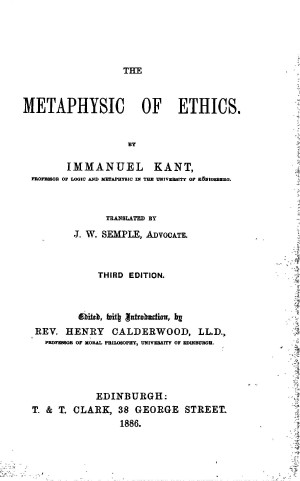
BOOK III.: INTRODUCTION TO THE METAPHYSICAL ELEMENTS OF JURISPRUDENCE. - Immanuel Kant, The Metaphysics of Ethics [1796]Edition used:The Metaphysics of Ethics by Immanuel Kant, trans. J.W. Semple, ed. with Iintroduction by Rev. Henry Calderwood (Edinburgh: T. & T. Clark, 1886) (3rd edition).
About Liberty Fund:Liberty Fund, Inc. is a private, educational foundation established to encourage the study of the ideal of a society of free and responsible individuals. Copyright information:The text is in the public domain. Fair use statement:This material is put online to further the educational goals of Liberty Fund, Inc. Unless otherwise stated in the Copyright Information section above, this material may be used freely for educational and academic purposes. It may not be used in any way for profit.
BOOK III.INTRODUCTION TO THE METAPHYSICAL ELEMENTS OF JURISPRUDENCE.PREFACE.THE Metaphysic of Ethics was intended to follow the dissertation on the à priori operations of the will. It divides itself into the metaphysical elements of law and the metaphysical elements of morals (ethics in the stricter sense), and constitutes the anti-part to my previous work, the metaphysical elements of natural philosophy. Jurisprudence is the first part of general ethics. The desideratum with regard to it, is to have a system evolved by pure reason from principles à priori, and such a system would be the metaphysic of law. But since law, although a pure notion, is intended to apply to cases presented in observation and experience, a metaphysic system of it must embrace the à posteriori diversities of such cases, to render it complete. Again, since no classification of what is merely à posteriori and contingent can be complete or certainly pronounced such, and an approximation only to systematic unity is possible, the à posteriori conceptions cannot be introduced as integral parts of the system, but can only be adduced by way of example in notes. This circumstance, however, induces me to term the first part of the Metaphysic of Ethics, the Metaphysical elements of Law only, because, in reference to such practical cases, no system, but merely an approximation to it, is to be looked for. I shall therefore here, as formerly in the Metaphysic Elements of Natural Philosophy, print in the text that part of law which is strictly systematic and à priori; and that part which regards given cases in experience, I shall discuss in notes, since otherwise it would not be clear what ought to be considered as metaphysics, and what as practical law. I do not know how I can remove, or how better anticipate, the reproach of obscurity with which I am so often taunted, and not simply of obscurity, but of a studied and affected depth of thought, than by using the words of Professor Garve, a philosopher in the true sense of the word, in whose opinion I heartily concur, and whose rule I will endeavour to follow, in so far as the nature of my subject may permit. Professor Garve desires (Vermischte Aufsätze, p. 352) that every philosophic doctrine be made capable of a popular exposition, otherwise the author is to be deemed chargeable with confusion in his own ideas. This I willingly admit, except with regard to an investigation into the reach and extent of the faculty of reason itself, and of such cognate inquiries as rest on the originary function and use of reason; for there the inquiry always turns on exactly discriminating betwixt the sensible and the supersensible, in so far as this last may be the product of reason. Distinctions like these can never be made popular, nor indeed any formal metaphysic, although the results and conclusions arrived at may be made quite apparent to every sound understanding. In such an investigation, popularity, i.e., talking to the people in their own language and way of thinking, is quite out of the question. Scholastic exactness is indispensable, for the author is talking in the Schools; and, without such rigid terminology, we cannot advance a step in an analysis of reason. But when pedants have the effrontery to address the public from the pulpit or the chair, in technical phraseology, calculated singly for the school, that cannot be properly charged on any philosophic system, any more than the follies of a logodædalist are to be charged on grammar. The absurdity attaches to the individual, not to the science he perverts. It is objected that it is extremely arrogant, egotistical, nay, contemptuous, to the followers of the old systems, to assert, that, previous to the publication of my own system, there was no metaphysic science. But, to give due weight to this plausible objection, I desire that it be considered, “Whether or no there can be more than one single system of metaphysic science.” There are no doubt different modes of philosophizing, and various ways of retracing the first principles of thought, upon which afterwards, with more or less success, systems are erected, all which prepare the way, and have contributed to the establishment, of my own. But since, in the nature of things, human reason is but one, there cannot be various systems of philosophy. In other words, there is in the nature of things only one true system possible, however different and contradictory the assertions may have been with regard to each proposition in it. In the same way, the moralist asserts, and with justice, there is but one virtue, and only one doctrine of it, i.e., a single and alone system, establishing all virtues on one common principle. In like manner, the chemist maintains that there is but one chemistry; the physician, there is one alone principle of classifying diseases (that according to Brown); and each of these, although excluding the prior and elder systems, does not deny the intrinsic merits of former moralists, chemists, and physicians,—since, without their discoveries and unsuccessful essays at system, no one could have arrived at a true principle, giving systematic unity to the whole philosophy. Whenever, therefore, any one announces a system of metaphysic as the result of his own excogitation, it is exactly the same thing as if he were to say, hitherto there has been no true system; for, were he to admit a second and true system, then would there be two systems of opinion on the same subject;—different and yet true propositions—which is a contradiction. So that, when the Kantic system announces itself as that before which there was no real true philosophy, it is merely in the situation of every new system, and pretends to no more than every person must in fact pretend to, who projects a system according to his own plan. There is an objection of still less moment, and yet not entirely to be passed over, that one of the leading features of the Kantic system is not its own, but borrowed from some cognate system of philosophy (or mathematics); for such is the discovery proclaimed by the Tübingen reviewer concerning the author’s definition of philosophy, which he had proposed as his own, and as very important, but which, it seems, had been given long ago by another in almost the same words.* I must here leave it to the private judgment of each, whether or not the words intellectualis quædam constructio could have suggested my doctrine of Time and Space, by which I distinguish so broadly betwixt mathematics and philosophy. I am confident Hausen would himself have refused to acknowledge this interpretation of his words; for the possibility of intuitions à priori, and that space is such intuition, are positions he would willingly have avoided, as, in consequence, he would have felt himself entangled in labyrinthic questions of unknown and sight-outrunning extent and intricacy. A representation made, as it were, by the understanding, was intended by this learned mathematician to signify nothing else than the drawing of lines corresponding to the conception,—where the rule alone is attended to, and the trivial errors which must be made in the actual construction are totally abstracted from, as every one may understand who considers the making lines equal in geometry. Least of all is that objection worthy of regard which attacks the spirit of my system, by considerations drawn from the confusion wrought by those who attempt to ape it, by using some of those peculiar words which are really not capable of being supplied by any others in more common use; for the using them in common conversation deserves high reprehension, and such castigation has been administered by Mr. Nicolai, although I cannot agree with his remark, that they are to be dispensed with even in their proper field, as being a mere disguise for poverty of thought. However, the unpopular pedant is a better object of sarcasm than an ignorant dogmatist; for, in truth, the metaphysician who is strictly wedded to his system, belongs to the latter class, even though he is willingly ignorant of everything not belonging to his own school. But if, according to Shaftesbury, it is no small test of truth, that a system, particularly a practical one, can hold out against the assaults of ridicule, then, I think, the time will come when the Kantic system may laugh in turn, and with the greater justice, when it beholds the fair but airy castles of its opponents crumble to pieces at its touch, and their defenders taking fright amidst the ruins,—a destiny which inevitably awaits them. INTRODUCTION TO THE METAPHYSIC OF ETHICS.I.—OF THE RELATION SUBSISTING BETWIXT THE POWERS OF THE HUMAN MIND AND THE MORAL LAW.THE power of desire, or appetitive faculty, is the power man has of becoming, by his representations, the cause of the existence of the object represented. The ability of any being to act conformably to its representations, is called life. With desire or aversion is invariably connected, first, pleasure or dislike, the susceptibility for which is called feeling; but these last may be unattended by the former; for there are pleasures (e.g., of taste) independent of desire, originating from the bare representation, formed in the mind, of an object, while the percipient may be indifferent to its existence. Secondly, the liking or dislike of an object desired need not precede the desire, and cannot always be regarded as the cause, but must sometimes as the effect, of the appetition. Pleasure or dislike accompanying a representation is, for this reason, called feeling, that it is merely subjective, and has no relation to an object so as to beget any knowledge of it, nay, not even a knowledge of our own state; whereas even sensations, when considered apart from the peculiar modifications of our own subject (as red, sweet, etc.), refer, as elements of knowledge, to an object. But the pleasure or dislike we have at red or sweet denotes nothing whatever with regard to the object,* but simply its relation to my own subject. This is also the reason why the phenomena, pleasure and dislike, admit of no further explanation; and the utmost that can be done is to register and classify the consequences they may produce, in order to apply these to use in practice. That pleasure which is necessarily connected with desiring, may be called practical pleasure, irrespective of its being cause or effect of the desire. On the other hand, that pleasure which is not necessarily connected with the desire of the object represented, and which, therefore, is no pleasure in the existence of the object of the representation, but singly in the representation itself, may be called contemplative pleasure, or inactive complacency. A pleasurable feeling of this latter sort is called taste: this last is properly no part of a practical system, but may episodically be introduced. The practical pleasure, however, which, as a cause, precedes and determines the power of desire, is itself called desire in the strictest sense. A habitual desire is called appetite or inclination; and since the combination of pleasure with the power of desire is called (in so far as this conjunction is deemed by the understanding subjectively valid according to a general rule) interest, the practical pleasure is in such a case an appetitive interest. But, on the contrary, when pleasure is of such a sort as can follow solely upon a previous determination of the appetitive faculty, it is intellectual, and not sensitive; and the interest taken in the object represented is an interest of reason; for, were the interest sensitive, and did it not rest exclusively on principles of reason, then sensation must be connected with the pleasure, so as to determine the power of appetition. Further, although, when a pure interest of reason is granted, no appetitive interest is allowed to be surreptitiously introduced, yet we may, out of compliance with common parlance, speak of an inclination,—a habitual desire,—even towards that which can alone be an object of intellectual complacency: yet such habitual desire must not be mistaken for the cause, but must be taken for the effect, of the rational interest; in which case, the appetite is liberal and free, and is called a pure insensitive inclination.* Concupiscence—or lusting after—is different from desiring, and is a stimulus tending to awaken it; it is always sensitive, but is a state of mind short of producing any act on the part of the appetitive faculty. The power of desiring, conformably to intellectual representations, is, in so far as the grounds of the determination to act exist in the mind itself, and not in the object, called a power of optional pursuit or avoidance. When the appetitive faculty is combined with the consciousness of this ability of its own act to produce the object represented, it is called choice; if such consciousness is awanting, the act of the faculty is a mere wish. Appetition, when its inward ground of determination, consequently when the option, depends upon the reason of the subject himself, is called will.* Will is therefore the appetitive faculty, not so much in respect of the action (that was choice), as in respect of the ground determining the choice of the action; and it has itself no prior determinative, but is, in so far as it determines choice, practical reason itself. Subordinate to Will, may be classed choice and wish, in so far as reason can determine the power of desire. Choice, when determined by pure reason, is a liberal, a free choice; whereas that determinable singly by sensitive excitement is a mechanical or brute choice. The human choice is one affected by such stimuli, but not determined by them, and is therefore in itself, although it may be determined to actions emanating from pure will, prior to such acquired facility, impure.†Freedom of choice is the independency of its determination on sensitive stimulants. This is the negative conception of freedom; the positive, the power of pure reason to be itself practical or active. But this is no otherwise possible than by subordinating the maxim of every action to the condition of its fitness for law universal; and since the maxims of men do not always coincide with this requisition, reason can only prescribe this law by an imperative ordaining or forbidding. This Law of Freedom is, in contradistinction to physical laws of nature, called moral. When directed to external actions and their legitimateness, it founds jurisprudence; but when this law is applied to human conduct, and is itself the ground determining an action, so as to ascertain and fix its inward, and therefore also its outward, conformity to the law, then the knowledge à priori resulting from this formal determination of the maxims of the will is the science of ethics; and this is what is meant when it is said that actions in harmony with the first are legal, while actions in harmony with the last are moral. The freedom regarded in the first is external, i.e., personal liberty, singly; but that freedom concerned in the last, embraces both a man’s external freedom (of body) and internal freedom (of choice), in so far as both his phenomenal and real freedom are subjected to a law of reason. Thus, in our inquiry into the reach and extent of the faculty of reason, we said objects of the external senses are in Space, but in Time, all whatever, whether of the internal or external senses, the representations of both being perceptions embraced under the conditions of the faculty of internal intuitions. In the same way may freedom be regarded as modifying the external or internal use of choice; but still its law, as a pure practical principle, must be always valid as its inward determinator, although not always contemplated in that particular point of view. II.—ON THE IDEA AND THE NECESSITY OF HAVING A METAPHYSIC OF ETHICS.That a system of the metaphysical principles of natural philosophy is possible à priori, and that such a system should precede that mixed physics which is applied to observation and experience, has been shown elsewhere. But natural philosophy can receive many propositions, on the evidence of experience, as quite general, and admitting no exception, although such universality of extent ought strictly to be deduced from positions à priori. As an instance of this, Newton adopted, as founded on experience, the principle of the equality of action and reaction, and yet he extended it over the whole material universe. Chemistry goes still further, and founds its laws of combination and solution singly on experience, and yet relies on their universality and necessity so as to apprehend error impossible. But with the laws of morals the case is different,—they are valid as laws only in so far as they are foundedà priori,and are seen to be so; nay, our judgments and opinions of ourselves and our actions are quite devoid of ethic import if they contain singly what experience teaches of them; and if any one allowed himself to make anything taken from experience a moral rule of acting, he would be in danger of the most ruinous errors. If Ethics were a mere doctrine of Eudaimonism, then it would be absurd to support it on principles à priori. For how plausible soever it may seem to say that reason could have investigated beforehand the means of attaining a permanent enjoyment of real happiness and of the amenities of life, still experience has shown that all theories à priori on that subject are either tautological, or void of foundation. Experience and observation alone show in what delight is taken. The natural instincts—the desire of rest—of motion—the love of fame—of knowledge—teach each individual separately what he is to look to for his chief gratification; and from these instincts he learns the means of reaching what he likes. All reasoning à priori towards founding a theory of general happiness is, when narrowly examined, no more than general observations founded on induction; and since generals are not universals, the propositions admit of so many exceptions in order to adapt the choice to each man’s likings that, after all, the individual is left to grow wise by experience of his own or his neighbour’s damage. The constitution of the precepts of morals is totally different: they are laws for every one, and have no respect for his appetites or inclinations; and that simply because man is free, and reason is practical. The instruction given in its laws is not drawn from inductive observations of himself and his animal part—not from considering the causes of the physical system, or taking heed to that which happens and is acted. But reason commands how man is to act, although no example of such action could be adduced. It also disregards the advantage resulting from our conduct, which indeed experience can alone teach. For although reason allows and approves our seeking our advantage in every possible way, and does, moreover, supported by experience, lead us to hope, especially if we go hand in hand with prudence, upon the whole, for greater advantages than can probably be counted on from violating her laws; still the authority of her behests, as Law, does not depend on any such contingency, and she uses such facts merely as a counterpoise to weigh against the inducements leading to an opposite course, in order, by thus adjusting the equilibrium of an otherwise undue balance, to secure for herself the full weight of her à priori reason. And since a system of à priori knowledge deduced from notions is called metaphysic,* Practical Philosophy, which treats not of the physical system, but of the cogitable, would require and presuppose a metaphysic of freedom, or of the moral system. To have such a system is therefore itself a duty; nor is any man destitute of this first Philosophy, however darkly conscious of it he may be to himself; for how could he, if destitute of à priori principles, fancy himself possessed of the ground of a law fit for all Intelligents? But as, in the metaphysic of the physical system, there were principles required for applying the supreme à priori positions to objects of experience; so, in the metaphysic of the moral system, the particular nature of man comes to be considered, which is known singly from experience, in order, on it, to indicate the conclusions resulting from the supreme moral law; by all which the purity of this last is noways affected, nor is its à priori original rendered at all doubtful: in other words, the metaphysic of ethics cannot rest on anthropology, but it must apply to it. The anti-part of a metaphysic of ethics, as the second member of a division of practical philosophy in general, would be moral anthropology, which would contain the subjective obstacles or assistances the moral law might meet with in the human constitution. It would treat of the founding moral maxims in the individual; of propagating them, and strengthening their action among the people; and such other matters as rest on experience, and indeed cannot be dispensed with, but which must not precede the first elements, or be mixed up with them: since then great risk is run of extracting false or at least indulgent moral laws, which give out that to be unattainable which for this very reason is not attained, the law not being held up in its purity, in which alone its strength consists; or is not attained, because ungenuine and sophisticated motives towards good and duty are employed, which ultimately sap and overthrow morality. Moral Anthropology dare not, therefore, be employed as any standard of judging in morals, nor as a discipline for the mind in assisting it to discharge its duty. Here the law itself must be resorted to, as it emanates directly from pure reason. With regard to the division, just mentioned, of philosophy into theoretical and practical, and that this last could be no other than moral science, I have elsewhere explained myself at length (Disquisition on the à priori Functions of the Judgment). Every practical investigation, teaching what may possibly be reached, by help of the physical system, is art, and depends singly on mechanic forces and their laws; only those practical investigations which rest on laws of freedom can have principles independent on any prior theory. For as to what transcends nature, there is no theory. Philosophy, therefore, can contain no technical, but singly a moral-practical part; and if the acquired facility of the choice, conformable to laws of freedom, should, in contradistinction to nature, be here called art, it would be such art as behoved to be establishable in a system of freedom analogous to that of nature; and, in truth, a divine art, were we always to exactly perform what reason enjoins, and to realize its Ideal. III.—OF THE DIVISION OF A SYSTEM OF THE METAPHYSIC OF ETHICS.*To all legislation (which may prescribe inward or outward actions, and these either à priori by pure reason, or by the will of another), there are two things requisite: first, a Law representing the action as objectively necessary, i.e., making it a duty; secondly, a spring of action, which subjectively connects the determination of the choice with the representation of the law. By the first, the action is represented as duty, and is a mere theoretic acquaintance with a possible determination of choice; but, by the second, the obligation so to act is conjoined with a subjective ground of the determination of choice. Every legislation, therefore (no matter whether the action prescribed be the same or not), may be divided, in respect of the spring of action employed. That legislation, constituting an action Duty, and making the representation Duty itself the spring, is ethical. But that legislation which does not include this last in the law, and admits of other springs than the naked idea Duty, is juridical. As to what such springs may be, it is quite obvious, that since they differ from the idea Duty, they must be taken from pathological inclinations and aversions bearing on the human choice, and more particularly from the latter, singly because the legislation necessitates, and does not persuade. The coincidence of an action with the law, abstracted from any regard to the motive whence it sprang, is its legality. But such coincidence—when the idea Duty, founded on the law, is at the same time the inward spring—forms its morality. The duties of forensic obligation are outward only; for the juridical legislation does not require that the idea Duty, which is inward, should become likewise the determinator of the choice of the agent; and yet, since a motive is required, adequate, and calculated to give purchase to the law, the motives to be combined with the law can, from the nature of the case, be external singly. The ethical legislation takes under its cognisance inward mental acts; but it comprehends also all outward ones, and so is extended over everything that can be called Duty. But, upon this very account, since ethical legislation includes in its law the inward spring of acting (viz. the idea Duty), a particular noway entering into any external legislation, it follows that ethical legislation cannot be external9 (not even that of a divine will), although it may adopt actions prescribed by other systems of legislation into its own, as duties, and make the consideration of them, as such, a spring of conduct. From this it is evident that all duties must fall under the head of Ethics, even while the law giving them birth may not. Thus ethic requires that I fulfil a promise, although the other party could not compel me to do so. Ethics adopts the law pacta sunt servanda, and adopts also the thence arising duty. It is therefore not in ethics, but in law, that the legislation enjoining fidelity to one’s promise is contained. Ethics only teaches that, even if the external coercion connected juridically with the action were awanting, the idea of its being duty were still sufficient as a spring; for, were it not so, and the legislation not juridical, and the duty not one of law, but one of conscience, then fidelity in adhering to engagements would come to be classed with duties of benevolence, which is very wide of truth. It is essentially a legal obligation to which a man can be externally compelled; yet it is a virtuous action (a proof of virtuous sentiments) to act in that manner, even when no force can be apprehended. Law and morals are therefore not so much distinguished by the duties they enjoin, as by the different genius of the legislation connecting this or the other motive with the injunction. Ethical legislation is that which cannot be external, although the duties may be so. Juridical is that which can also be external. Thus it is an external duty to keep one’s promise; but the commandment to do so singly because it is duty, and disregarding every other motive, belongs simply to an inward legislation. It is therefore not as a particular act of duty (a peculiar kind of act, to which we are bound),—for, both in ethics and law, question is made of external duties,—but because in the given case the legislation is inward, and can have no external lawgiver, that therefore the obligation is deemed ethical. For the same reason, the duties of benevolence, in so far as they consist of external actions (or rather of obligations thereunto), are reckoned to belong to ethics,—the legislation being internal singly. Ethics has no doubt its peculiar duties, e.g., those towards one’s self; but it has also several in common with law, only the mode of the obligation is different; for to do actions barely because they are duties, and to make the principle of duty, no matter whence that duty spring, the all-sufficient spring of the will, is the peculiar characteristic of ethical obligation. Hence there are direct-ethical duties, but indirectly all others come to be so too. IV.—PRELIMINARY IDEAS ENTERING INTO THE METAPHYSIC OF ETHICS.
The idea Freedom is a product of pure reason,* and, owing to that very circumstance, transcends the grasp of speculative philosophy; i.e., is such a conception as has no example in the course of experience and observation,—is therefore no object of theoretic knowledge: it is not a constitutive, but simply regulative, and, moreover, negative principle of speculative reason. But, in the use of reason as a practical or active faculty, the reality of this idea is evinced in practical propositions, which, being laws, point to a causality of reason, independent on any sensitive condition—determine the choice—and show a pure will, in which the moral ideas and laws have their seat.† Upon this idea of freedom, which is positive in so far as practice is concerned, are founded unconditional practical laws, called moral, which, in respect of us, who are affected by sensitive determinatives, and whose choice therefore swerves from pure will, are imperatives (categorical commands or prohibitions); and this it is which distinguishes them from mere technical rules, which last are valid on certain conditions singly. By these imperatives some actions are allowed or disallowed,i.e., are morally possible or impossible; others, again, are morally necessary, i.e., obligatory, whence arises the idea of duty, the adhering to or transgressing which is connected with a peculiar feeling of pain or pleasure (the moral sense): this feeling, however, since it is not the foundation of the practical laws, but only an effect produced in our mind when the choice is determined by them, which may be very different in different individuals, without affecting the truth of any moral judgment, cannot be taken notice of in a system treating of the mere practical laws of reason. The following notions are common to both parts of ethics. Obligation is the necessity of a free action, falling under a categorical imperative of reason. An imperative is a practical rule, by which an action, in itself contingent, is rendered necessary, and differs in this point from a practical law, that whereas this last represents the necessity of an action, yet it does so irrespective of the consideration that such action may, of inward necessity, belong to an agent (e.g., a holy one), and yet, in the case of man, be merely fortuitous; for, where the action is already necessary, there no imperative can be expressed. An imperative is therefore a rule making necessary a subjectively contingent action, and thereby representing the subject affected by it as one who must necessitate his actions to harmonize with the rule. The categorical (i.e., absolute or unconditional) imperative is not one which commands mediately, or by the representation of any ulterior end whitherward the action might point, but is one which, by the bare representation of the act, cogitates it as immediately-incumbent, and makes it objectively-necessary. Imperatives of this sort, no practical doctrine, which treats of obligations, save Ethic singly, can present. All other imperatives are technical and conditioned. The ground of the possibility of categorical imperatives is this, that they rest on no determinator of choice, which would require an ulterior end to be had in view, but on its originary freedom singly. An action is allowed which is not contrary to obligation; and this freedom, limited by no opposing imperative, is a moral title or faculty: from this is obvious what is disallowed. Duty is that action to which a person is bound. Duty is hence the matter of obligation; and there may be one duty, in so far as the act is concerned, although different modes in which the obligation may be constituted, i.e., juridical or ethical. The Categorical Imperative, expressing obligation in regard of a given action, is a moral practical law. But since obligation implies not merely practical necessity (that being expressed by all law), but necessitation, the imperative is either a command or a prohibition, as it may happen. An action neither commanded nor forbidden is allowed, merely because, with regard to it, there exists no law limiting the freedom of the subject, and therefore no duty: such an action is morally indifferent. A further question may be moved, If there are any such adiaphorous actions? and if so, is it open to any one to will or eschew them at pleasure, without a particular permissive law? Were this question answered negatively, then would the faculty of acting not respect an action indifferent, for to such, morally considered, no particular law can be required. A deed or action is an event falling under the laws of obligation, i.e., it is called an act, when regard is had to its originator,—the freedom of the acting subject. The actor is considered the author of the event; and when he is supposed to know the law applying to his conduct, and by virtue of which law he is bound, both the act and its consequences can be imputed to him. He to whom actions can be imputed is called person; moral personality, man’s independent individuality, is nothing else than the freedom of agent-intelligents, who rank under moral laws. Whence it is evident that a person is subjected to no law except such as he, either alone, or sometimes in conjunction with others, imposes on himself. That is called a thing to which no event can be imputed as an action. Hence every object devoid of freedom is regarded as a thing. Right, wrong, denote actions consistent or inconsistent with duty; and these terms are so applied in whatever way the duty may have been constituted: an act repugnant to duty is called transgression. An unintentional transgression is called (for it is imputable) a fault; but a deliberate transgression (e.g., one accompanied with the consciousness of its being so) is a crime or sin: whatever coincides juridically with the external requirements of law is called just; what is not so, unjust. A collision of duties would imply such a condition of ethical obligation, that one duty annihilated the other. But because duty and obligation are ideas involving the objective practical necessity of certain actions, and since two contradictory and inconsistent imperatives cannot both be necessary, it follows that a collision of duties is perfectly inconceivable. There may, however, be different grounds towards an obligation, one or other or all of which may be insufficient to beget a perfect obligation (rationes obligandi non obligantes), and one and the same individual may come to be affected by the rule prescribed by them, but duty is not established in such a case. Whence practical philosophers express themselves by saying, not that the major obligation retains its place, but the more extensive ground towards that obligation takes precedence of the less. External Laws are understood to comprehend and include these obligations which are recognised by reason à priori; and although not promulgated, they are held to be so, and compose what is called the law of nature. Those, again, which, until promulgated, have no force, and which could not oblige but by reason of their proceeding from the legislator, are, in contradistinction, called positive or statutable law. An external legislation is therefore possible, containing simply the law of nature; but then this natural law must antecede and establish the authority of the lawgiver (i.e., his title to oblige).* An ultimate principle of reason, binding us to certain actions, is a practical law. The rule an agent chooses himself to follow is his peculiar maxim of conduct, and of such maxims the variety is plainly endless. The categorical imperative, which is merely a general formula expressing what obligation is, announced the necessity of adopting such maxims as might serve for common laws for all. Conduct is therefore to be examined so as to detect the private maxim from which it sprang; and whether it be a principle possessed of objective validity, can only be recognised by inquiring if reason can represent itself as pronouncing law universal by means of it. The simplicity of this law, contrasted with the variety and gravity of the consequences following upon it, as also its majesty and supremacy, unattended by any visible sanctions, is at first exceedingly surprising. But when, in the midst of this admiration, the power of reason is pointed out to sway our choice by the idea of a formal law, and we are guided by it to the further cogitation of that property of will, its freedom, which no force of speculation, no train of experience, could have reached, we then observe how it is that this law should, like mathematic postulates, be indemonstrable, and yet most apodictically certain, and, like them, open up a vista into a long and spacious field of scientific practical propositions,—a field where, theoretically, reason found every avenue barred up, and saw the idea Freedom, together with every other idea of the supersensible, removed to a distance altogether inaccessible. The harmony of an action with the Law of Duty is its legality; that of its maxim with the law is its morality. Maxim is the subjective principle of acting, and is made by the Subject his own rule, viz., how he wills to act; whereas, on the contrary, the Law of Duty commands objectively, viz., how he ought to act. The supreme principle of ethics therefore is: Act upon a maxim at all times fit for law universal. Every maxim repugnant to the above is immoral. The law proceeds from will, maxims from choice, which in mankind is free.*Will, with respect singly to the relation obtaining betwixt it and the law, is, properly speaking, neither free nor unfree, for it does not regard actions, but the ideal legislation itself, i.e., is itself practical reason.†Choice alone is, strictly speaking, free. Liberty of choice cannot be explained to be a power of adhering to or deserting the law, although, as phenomenon, this is often the fact; we only mean by liberty that negative property of our thinking frame not to be determined to act by physical excitements. What it is really, and how freedom positively co-acts the sensory, is beyond the bounds of human speculation; and the phenomenal observance or transgression of the law can never serve to give any insight into the nature and essence of a supersensible object.* It is one thing to note as true that experience has taught; another to make such experience and observation the principle of a definition, and the mark and general criterion by which to distinguish free and mechanic choice; for experience and observation do not inform us that the mark defined by, necessarily adheres to the notion, which, however, is essential for a sound and unerring criterion. Finally, liberty cogitated as an ability of acting on the representation of the law, is alone a power, and to swerve from the law is not a power, but weakness; and it is clearly absurd to explain the former by the latter,—a power by the want of it. A law is a proposition enouncing a categorical imperative. He who commands by law is a lawgiver, and is the author of juridical obligation, although not necessarily the author of the law itself; for if he is, then it is a positive and arbitrary enactment. That law which imposes on us its unconditioned obligation à priori, may be cogitated as emanating from the will of a supreme lawgiver, i.e., of God (to whom rights are owed, but of whom no duty can be predicated); but this is merely the idea of a moral agent, whose will is law for all, and does not mean that he is the author of the law itself. Imputation, in a moral sense, is that judgment whereby some one is stated to be the author of an event, which is then called his act or deed; and if such judgment is accompanied by legal sequents, then the imputation is judiciary. If no legal effects follow, then the judgment is no more than a private judgment, and the imputation is invalid or dijudicatory only. That person who has a title to pronounce judiciary imputation is called the judge or court (forum, tribunal). What any one does over and above what he can be compelled to, is meritorious, or of well-desert; what actions do no more than tally with the legal standard are of debt singly, and when they fall short of it are of demerit or ill-desert. The legal consequence of demerit or guilt is punishment; that of merit is reward, provided the reward promised in the law was the motive inciting to action. Conduct precisely exhaustive of what we were indebted to, is unattended by any judicial effect. Benignity or favour stands in no legal relationship to any action. The good or evil results consequent on an indebted action, likewise the consequences of neglecting a meritorious, cannot be imputed to the agent. They may tell upon the actor, but cannot be deemed effects of the law. The good springing from an action of well-desert, and the evil following on an unjust action, are imputable. However, subjectively, the grade of the imputability of an action is to be estimated by the magnitude of the obstacles overcome. The greater hindrance from without, and the less the hindrance to duty from within, so much the higher rises the moral honesty and well-deservingness of the act; e.g., if I rescue from great wretchedness one who is a stranger and unknown to me, and that at great personal inconvenience to myself. Conversely: The less the impediment is from without, and the greater the obstacles are within, so much greater is the demerit in the scale of guilt. The state of mind, therefore, in which a bad action is perpetrated, whether unagitated or inflamed, will greatly change the imputation both of the deed and its consequences. INTRODUCTION TO THE METAPHYSIC OF LAW.SEC. A.—WHAT THE SCIENCE OF LAW IS.THE aggregate of those laws which may be externally promulgated is law (jus). If really so announced by a lawgiver, such legislation becomes real, and composes positive law (jus scriptum). He who knows this, is a jurisconsult; and is even jurisperitus when he can dexterously apply the law to occurring cases,—a skill which, if great, may even entitle a man to rank among the jurisprudents. When, however, we abstract from such jurisperitia and jurisprudentia, what remains is merely the scientific theory of law. By the science of law is meant the systematic knowledge of the principles of the law of nature (from which positive law takes its rise), which is for ever the same, and carries its sure and unchanging obligations over all nations and throughout all ages. SEC. B.—WHAT IS LAW?This is a question which may embarrass the lawyer as much as the celebrated question, “What is truth?” does the logician; for he must avoid tautology, and give a general explanation abstracted from the particular legislation obtaining in any one country. What the law in any instance is (quid sit juris), the jurisconsult can easily tell; but whether it is right or just that it should be so, is what he wants a criterion to determine. But this criterion can only then be found when, abandoning all posteriori principles, he ascends to the sources of reason, and discovers on what all legislation whatsoever can alone be based; in which analysis positive law is doubtless a great help and guide. But laws founded singly on experience, are like the mask in the fable, beautiful, but hollow. The notion of law, in so far as it imports obligation—i.e., annexes the predicate, “forbidden” or “allowed,” to an action—regards, first, the external practical relation of person to person, in so far as the actions of one may affect or influence another; second, it does not regard the relation betwixt the choice of one and the wishes or wants of another, as in deeds of benevolence or severity, but merely respects the relationship of choice to choice; thirdly, in this reciprocal relationship of choices, no question is made as to the matter chosen. The form of the choice, i.e., the choice considered as free, is alone regarded, i.e., whether the action of one man is consistent with, and does not impair, the free choice of another. Law—the rule of right—is therefore the aggregate of those conditions, according to which personal choices may harmonize and not destroy one another by being subordinated to freedom’s law universal. SEC. C.—SUPREME PRINCIPLE OF LAW.Every action isright and just,the maxim of which allows the agents freedom of choice to harmonize with the freedom of every other,according to a universal law. If, therefore, my deportment, or, generally, my condition is not inconsistent with the universal freedom of every other person, he does me a wrong who hinders such state, or obstructs my actions; for such obstruction is inconsistent with a universal law of liberty. From this it follows, that no one is legally entitled to demand that I make this principle of universal legality the maxim or spring of my conduct. Another’s freedom may be indifferent to me,—nay, I may wish to evade it; but so long as I do it not, I am juridically just. That justice should be itself my maxim, belongs to the second part of Ethics. The law or universal rule of right is, So act that the use of thy freedom may not circumscribe the freedom of any other (i.e. if thy act or maxim were made imperative on all),—a law imposing no doubt obligation, but which does not exact the determination of choice by the contemplation of the obligation. Reason singly announces, that it in idea so limits freedom, and that others may in real fact and event co-act such limitation; and this it announces as a postulate incapable of further proof. As we here treat not of offices of virtue, but explain what is just and right, it is impossible to represent this law as the spring moving us to action. SEC. D.—LAW CARRIES WITH IT A TITLE OF CO-ACTION.An obstacle opposed to that which hinders an effect, advances that effect, and tends to that end. But everything unjust is a hindrance to freedom, according to law universal. Again, co-action is a hindrance put upon freedom. Therefore, if a certain use of freedom is a hindrance to freedom universal, i.e., unjust and wrong, then co-action preventing such misuse of freedom goes to establish freedom according to a universal law, i.e., is just or right; and consequently law has in itself a right to co-act him who attempts to violate it. SEC. E. —LAW MAY LIKEWISE BE STRICTLY DEFINED AS THAT BY WHICH MUTUAL CO-ACTION IS MADE CONSISTENT WITH UNIVERSAL FREEDOM.The purport of this sentence is, that Law is not to be regarded as made up of two parts, the one obligation, the other a title to co-act; but that the very notion of law consists in that of the possibility of combining universal mutual co-action with every person’s freedom. For since law respects that only which is external and phenomenal in an action, strict law, i.e., law in which no ethical consideration is introduced, can require no internal, but merely external, determinators of choice, even although co-action be required to do so. All law whatever rests, it is true, on the consciousness of obligation under the moral law itself; but pure or strict law, in the sense now taken, does not expect that this consciousness should be the spring of conduct; but supports itself as a legislation for external actions, on its principle of co-action. When, therefore, it is said a creditor is entitled to demand payment from his debtor, that never implies that he may represent to the latter that his own reason imposes that obligation; but it signifies that external co-action physically forcing the payment of debt consists with universal freedom, and so even with the debtor’s. This position of reciprocal action and co-action throughout the whole system of Intelligents, gives, if I may so speak, a lively image of the notion Law in a sensible figure à priori, and carries us by analogy to the law of action and reaction in the communicating of external motion; and as by virtue of it the quantity of motion remained undiminished, so here, by virtue of this reciprocal co-active mechanism, the quantum of personal freedom is preserved undiminished throughout the system, in the intercourse and exchange of man with man. Again, as in the Mathematics, the truths of that science are not deduced from the naked notion, but by help of the configurations of space answering to the given notion; so it is not so much the notion Law, as that equal and mutual co-action corresponding to the idea, by means of which a deduction, and, as I may say, delineation of its truths are possible (i.e., the propositions are not taken from the originary moral idea of the law, but from this subjected mechanism). (Beck. Com. 107.) And because to this dynamic notion co-action three corresponds a formal one, taken from the Mathematics previously spoken of, it comes to pass, that what is right is cogitated and spoken of as we do of right lines, where “right,” the rectilineal, are opposed to “curves” and oblique lines. That kind of rightness which is opposed to “curve,” is that inward property of a line, whereby it is the only one possible betwixt two points; and that rightness opposed to obliquity takes place where, betwixt two intersecting segments, one only perpendicular can be drawn, inclining to neither segment, but dividing equally the enclosed space. In like manner, law insists that there be rigidly and equally given to every man his own; a mathematical precision not exigible in the offices of virtue, these last often admitting a certain latitude of application. However, without wandering into the domain of Ethics, there are two cases demanding solution, but which no Œdipus seems willing to resolve, and look as if they belonged to the “Intermundia” of Epicurus. Such two stumbling blocks1 must forthwith be removed from the domain of jurisprudence proper, lest their uncertainties should be imagined to have any common part with the firm and stable principles of law. APPENDIX TO THE INTRODUCTION.
Law, strictly so called, always implies the power to co-act. But people have fancied to themselves law in some broader sense, where the title to co-act is indefinite, and quite indeterminable. Of this kind there have been usurped two sorts, equity and necessity: the former is alleged to be a law which has no co-action, but the latter is a co-action (necessity) which has no law; and the difficulty springs from this, that they are cases of opaque law, to decide which no judge can be constituted. I.—EQUITY.Equity, considered in itself, does not in any wise address itself to the ethical duty of another; for he who vindicates his property on this head, stands upon his own right; but he is unable to assign the data which would empower the judge to decide his cause: for example, a servant who has contracted with his superior for a certain hire, may, at the expiry of his service, come to receive wages in coin greatly depreciated, though nominally the same in value; and the same would occur in loans, or in any other money contract, where the debtor holds himself entitled to exact payment higher in proportion to the depreciation of the currency; but he has no claim in law, and sees himself forced to call on equity for aid, a mute goddess, who returns no response: and unless parties have guarded against contingencies by the specific stipulations of their contract, a judge can give no relief, for he cannot pronounce sentence upon vague and indefinite conditions. Hence it follows, that a court of equity (in a question about the rights of man) is a contradiction and absurdity. There alone, where the proper rights of the judge are involved, ought he to give ear to the dictates of equity. Thus the Crown may equitably take upon itself the losses sustained by others on its behalf, and ought, when called upon to do so, to indemnify the subject; although, in point of law, the Crown might urge that the subject had, at his own risk singly, undertaken its defence. The motto of equity is, Summum jus summa injuria, extreme law is extreme injustice; but this inconvenience cannot be remedied by law, although the claim is a claim of right. The other part of Ethic alone teaches, to deem the rights of man sacred and inviolable. II.—NECESSITY.This alleged right is that title which a man is supposed to have, of killing another who has done him no harm, provided he cannot otherwise extricate himself from danger. And here it seems that law is repugnant to itself. For this is not the case of an assassin whom I am allowed to anticipate, by consigning him to death; but of alleged violence which I am entitled to use against another from whom I have received no wrong. This assertion, it is plain, does not refer to any given law, but respects the sentence which judges must pronounce when such a case of necessity is carried before them; for there can be no law adjudging death to him who in a case of shipwreck knocks another from an oar, which is barely sufficient to save himself. The punishment threatened by the law cannot be made higher than the loss of life, already impending over him. A statute can, therefore, have no effect in such a crisis; for the punishment being uncertain, cannot outweigh the dread of death, which is instant and certain. The law sees itself in this way forced to consider violent self-preservation, not as devoid of blame, but as incapable of being punished. And this impunity, resulting entirely from the accidental nature of the case, has been constantly mistaken by jurists for an impunity founded in the nature of the law itself, i.e., the action has been regarded as just and blameless. The motto of necessity is, Necessity has no law. However, there never can be any case, making the unjust and wrong justifiable before the law. GENERAL DIVISION OF JURISPRUDENCE.A.—DIVISION OF JURIDICAL OFFICES.In this division we may follow Ulpian, by slightly modifying our understanding of his legal formulæ,—a meaning perhaps darkly present to his own mind, and which can be evolved from them with great ease and elegance. 1. Honeste vive—(be an honest man).—Juridical honesty or uprightness consists in upholding one’s personal worth, as a man, against all others,—an obligation capable of being expressed by the following formula:—“Suffer thyself not to become the bare mean of others; and if thou serve them, be also their end.” This obligation is afterwards explained, as founded on the rights of humanity in a man’s own person—(lex justi). 2. Neminem læde—(do no man wrong)—even though as a consequence thou must abandon all connections with others, and go out of society—(lex juridica.) 3. Suum cuique tribue—(give each man his own).—Understood literally, these words are void of meaning, for that cannot be given to another which he already has. The formula can therefore alone signify, Enter with thy fellow-men into that state—society—where each man’s own is defended from the violence of his neighbour—(lex justitiæ). These three classical formulæ make up one entire division of the principles of law, and found a division of juridical obligation into internal—external—and that composite obligation, which is constituted by subsuming the second under the principle of the first. B.—DIVISION OF RIGHTS.A system of rights is called law, and is either natural, or statutable and positive. In the first case, law rests entirely on pure principles à priori; in the latter, it is considered as based on the will of a lawgiver. 2. Right is the ethical faculty or title of obliging another, and is the legal ground on which the latter sort of law is based; and of such right there are two kinds, originary and derived: the first is that birthright of man which subsists independently of any legal act; the second is that which is acquired to him by such an act. The congenital mine and thine may be also called the inward or intrinsic right, for external right must always be acquired. There is but one Birthright, Freedom.Freedom is the alone unoriginated birthright of man, and belongs to him by force of his humanity; and is independence on the will and co-action of every other in so far as this consists with every other person’s freedom. Subordinate to this supreme idea, and included under it, are the rights,—1. of Equality,i.e., the title not to be held bound to others beyond what they are in their turn bound to; consequently the right of every one to be his own master (sui juris): 2. The right to be regarded as legally innocent and guiltless, in so far as no one has been injured by his use of his freedom: 3. Lastly, the right to do to every man whatever implies nothing derogatory to that other’s rights, as, for example, to exchange one’s ideas and opinions with another, to tell or promise somewhat, and that whether true or untrue, whether sincerely or insincerely; for it is the province of the other to believe or discredit what is said—to accept or decline what is promised.* The reason why this division, breaking up the conception Freedom into its subordinate parts, has obtained among systems of natural law, is this, that when a question arises as to any derived right, and the question arises on whom the burden lies to prove either the fact, or to establish the law of his case, the party who declines the obligation, and asserts it to be with the other, does in fact appeal to his birthright, and so declares, that to impute to him an obligation to prove, is inconsistent with some part or other (e.g., equality, innocence) of his character freedom; and this may be carried through all the different relations into which freedom can specifically enter. Further, because this birthright is one and indivisible, the division of rights consists of two members of most unequal dimensions; and therefore this right is discussed now in the introduction, and the subdivisions of natural law restrained to the external rights of mine and thine. FUNDAMENTAL DIVISION OF THE METAPHYSIC OF ETHICS.I. All obligations incumbent on man to fulfil, are either juridical, for which outward laws are admissible to co-act their observance, or ethical, where no such legislation is conceivable; and these ethical offices cannot fall under any outward co-active legislation, because such offices depend on certain ends and designs which it is the imperative duty of man to propose to himself. But no outward compulsion can give any person certain intentions, for these depend on himself alone; for even though outward actions can be extorted, tending to that end, still the subject himself may be disinclined to it. II. Man, as a subject of obligation, is considered singly with reference to his freedom, which is supersensible, that is, his humanity, in which consists his personality, exempting him from every phenomenal determinator (homo noumenon), and requires to be contradistinguished from himself, as the same person subjected to the conditions of time and space (homo phenomenon); and these, when applied to those two kinds of offices, resting on the notions right and end, give birth to the following division of all moral science, and is a division founded on the relations subsisting betwixt the law and the matter of obligation.
Besides the above division, the subjects mutually obliging one another may stand in different relations, and these relationships would afford the ground-plan of another division, according to the relation betwixt the obliger and the obliged.
Where we have exhibited at once the materials and the architectonic form of the science. The law of nature ought not to be divided, as is often done, into natural and social, but into natural and civil or municipal: the first is called private, the second public law; for to the state of nature, not social institutions, but the civil or municipal, are to be opposed. In the state of nature, society need not be awanting, but only that civil society, securing by public institutions the rights of man; and that is the reason why the natural is called private law (jus privatum).* [* ]Porro de actuali constructione hic non quæritur, cum ne possint quidem sensibiles figuræ ad rigorem definitionum effingi; sed requiritur cognitio eorum, quibus absolvitur formatio, quæ intellectualis quædam constructio est.—(C. A. Hausen, Elem. Mathem. pars i. p. 86, a. 1734.) [* ]The sensory may be defined the subjective of our representations, for it is the understanding which refers these representations to an object, i.e., it alone thinks to itself somewhat by means of them. Now, the subjective of a representation may be of such a sort as to be capable of being referred to an object, so as to constitute knowledge of it, and that with respect either to the form, or to the matter. In the first case it is called intuition à priori; in the second, sensation. In these cases, the receptivity is called the sensory, and is divided into the internal sense and the external. Or, otherwise, the subjective of a representation cannot become any element of knowledge, but refers singly to the subject, in which case the receptivity is called feeling. Feeling, then, is the effect of a representation, and is of the sensory, no matter whether or not the representation causing it belong to the intellect or the sensory. [* ]Inclination is here obviously used figuratively, and a distinction may be taken betwixt physical and ethical inclination (Neigung). An inclination to do what the law commands is no doubt morally possible, but then it must not be figured as antecedent to the law; it can only follow upon the representation of the law, when the law has determined the will. [* ]Ref. 6, from p. 57. [† ]Not morally, but psychologically, as mixed.—C. [* ]Ref. 1, from p. 3.—C. [* ]The deduction of the division of a system, i.e., the proof of its completeness, and also of its continuity, i.e., that the transition from the divided notion to its subdivisions be not per saltum, is one of the most difficult tasks imposed on the architect of a system. And there is room for hesitation as to the ultimate notion, which is divided into right and wrong. It is, however, that of an act of free choice in general. Teachers of ontology generally begin with the representations, something,—nothing,—not adverting to the circumstance that these opposed conceptions are already members of a division, and presuppose a higher notion, which can be no other than that of any object whatsoever. [9 ]As to the possibility of external legislation, v. p. 173.—C. [* ]Ref. 6, from p. 57. [† ]Ref. 5, from p. 45.—C. [* ]Ref. 9, from p. 167.—C. [* ]Ref. 5, from p. 45.—C. [† ]The meaning is, practical reason or pure will is the substratum of man’s moral nature, i.e., is the ground of the possibility of his freedom and independency on every sensitive determinator, and therefore freedom is not so much a predicate, as a consequence, of will. (Ref. 5, from p. 45.—C.) [* ]Ref. 6, from p. 57; and Ref. 7, from p. 67.—C. [1 ]Viz., Equity and Necessity. [* ]To utter a deliberate untruth is in common speech called lying or falsehood; for it may injure the person to whom it is told, if he good-naturedly repeat it, and so render himself the laughing-stock of others. But, juridically, that alone is falsehood which directly violates the rights of man, e.g., the false narrative of a contract, instituted for the purpose of attaching the property of another. Nor is this distinction between these two kindred conceptions ill-founded; for, in any statement made by one man to another, it is entirely at the option of this last what weight he will give to what he hears. And yet, to say of any one that he is a man not to be believed, borders so near on the charge that he is a liar, that the line marking out what falls within the domain of law and what within that of ethics, is all but imperceptible. [* ]After this follows a course of theoretic law, which omitting, we arrive at ethics or morals strictly so called.—Tr. |
|||||||||||||||||||||||||||||||||||||||||||||||||||

Titles (by Subject)