EconlibThe LibraryOther Sites |
Front Page Titles (by Subject) INTRODUCTION. - The Metaphysics of Ethics
Return to Title Page for The Metaphysics of EthicsThe Online Library of LibertyA project of Liberty Fund, Inc.Search this Title:Also in the Library:
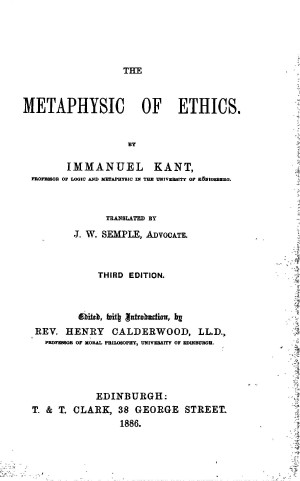
INTRODUCTION. - Immanuel Kant, The Metaphysics of Ethics [1796]Edition used:The Metaphysics of Ethics by Immanuel Kant, trans. J.W. Semple, ed. with Iintroduction by Rev. Henry Calderwood (Edinburgh: T. & T. Clark, 1886) (3rd edition).
About Liberty Fund:Liberty Fund, Inc. is a private, educational foundation established to encourage the study of the ideal of a society of free and responsible individuals. Copyright information:The text is in the public domain. Fair use statement:This material is put online to further the educational goals of Liberty Fund, Inc. Unless otherwise stated in the Copyright Information section above, this material may be used freely for educational and academic purposes. It may not be used in any way for profit.
INTRODUCTION.THE special value of the writings of Kant is so fully acknowledged, that there is no need to insist upon it here. In the literature of Moral Philosophy there is certainly nothing more important than the contributions which Kant has made to Ethical Science. Even those who hold a Utilitarian theory of morals, must wish to see the works of the great upholder of Intuitionalism placed within the reach of students. This may be readily believed when a leading representative, Mr. John S. Mill, allows that Kant “has become one of the turning-points in the history of Philosophy.” The chief significance of the ethical writings of Kant is found in the prominence given to these two positions:—the à priori source of Moral Law,—and Freedom of Will, as essential to morality. In making such a work as the present accessible to students, a few introductory observations, explanatory of Kant’s system, may be desirable, for the guidance of those who are just beginning the study of Moral Philosophy. I.STRUCTURE OF KANT’S PHILOSOPHY.Kant’s Philosophy is known as critical and transcendental. The former designation has reference to the method; the latter applies to the matter or materials of the system. As he insists that philosophy must proceed by a critique of the mental powers, the result is a critical philosophy; and as, in prosecuting this critique, he finds everywhere certain elements superior to experience which constitute the main features of his philosophy, it is denominated transcendental. Thus, in the terminology of Kant, the transcendental is that which transcends experience, being à priori in origin, in contrast to empirical. When from these general features we pass to a more minute examination of the philosophic system, there is a marked distinction between the Intellectual, or theoretic part, and the Moral, or practical part. The system is not a unity, which must be wholly accepted or entirely rejected. If one part of the system fall, the whole is not thereby laid in ruins. In this will be found the permanent gain to philosophy which attends upon the use of the critical method, in contrast to the dialectic. The speculative or theoretic part of Kant’s philosophy, full as it is of the most valuable contributions to mental philosophy, ends in a negative result. The moral or practical part takes a form altogether different, and ends in high positive results, affording to the Kantian system the only deliverance from scepticism. Nothing more than a bare outline of the intellectual system can be given here. The main feature of Kant’s philosophy is the affirmation of the presence of an à priori element in all knowledge. He holds that while all knowledge begins with experience, it always includes what is superior to experience. Knowledge thus involves two elements, the one empirical, the other pure or à priori,—the one the matter, the other the form. Knowledge is obtained through the senses, through the understanding, or through the reason; and there is an à priori element connected with all the three. The product of the sensory is intuition; of the understanding, conception; of the reason, idea. The à priori form belonging to the senses are the intuitions of space and time; the à priori element belonging to the understanding consists in pure conceptions, which are the categories; and highest of all are the ideas of pure reason. Beginning, then, with the lowest, the senses give us empirical knowledge, but this they do only under the à priori forms of time and space provided by the intellect. Rising above this, we come to judgments, among which there is an essential distinction between analytic and synthetic judgments. Analytic judgments may be described as identical judgments, gained by explication or analysis of a knowledge already possessed, as all body is extended, the notion body clearly involving the notion extended. Synthetical judgments are such as add to our knowledge, and are either à posteriori or à priori, that is to say, they are obtained either from a wider experience, e.g., some body is heavy, or from the pure reason, e.g., the law of causality. In all this it is apparent to what admirable purpose Kant has employed the critical method. When, however, we consider the bearing of this theory on the grand question as to the certainty of our knowledge, the negative and sceptical result is painfully evident. Holding that knowledge cannot be obtained except under the forms which reason supplies, Kant accounts this as proving that knowledge is only what appears to us as beings subjected to these conditions, that is, knowledge is only of the phenomenal. What we regard as objects of our experience have no existence apart from our experience. Consequently, we can have no knowledge of things-in-themselves (noumena). Even the à priori discoveries of pure reason are only regulative of thought, not assertive of reality. Essential as they are for the exercise of human intellect, they lead into a series of paralogisms and antinomies from which there is no escape. These are the avowed negative results of Kant’s Critique of Pure Reason. From this Critique, Kant passes to another, the Critique of Practical Reason, by means of which he reaches a certainty unattained in the earlier. Practical Reason reveals the Moral Law as a categorical imperative, discovering the dignity of man as a Person. From this Categorical Imperative, by transcendental deduction, and not as a thing known in conscious ness, he reaches the Freedom of the Will. In this relation it is discovered that man is both phenomenon and noumenon,—he belongs at once to the sensible state, and to the supersensible or cogitable,—in the former he is necessitated, in the latter he is free,—a moral being,—a personality. In all this we have a philosophy rich in critical results, and full of the most suggestive thought, though not cleared of the evil influence of those negative elements which cling to the preceding intellectual system. Into this Practical Philosophy of Kant, the student is here introduced. II.CHARACTER OF KANT’S ETHICAL WRITINGS.The tone of Kant’s ethical writings is of the loftiest kind. A perusal of the present volume may explain how it should have happened, that in his own country he was charged with writing in a manner too abstruse, and at the same time developing a system of morals too lofty and stern. The general character of his Moral Philosophy may be inferred from such affirmations as these:—A good will is the only thing which is absolutely and altogether good. Nothing is dutifully done which is not done under a regard to duty. The moral law is a categorical imperative, leaving no option to the will. The moral law has no exceptions. The moral law makes self-esteem dependent on morality; it elevates our worth as intelligences, and yet derogates infinitely from self-conceit, inevitably humbling every man. The fundamental positions of Kant’s Moral Philosophy may be stated in these three propositions:—First, Goodness of Will is the only absolute good on earth; Second, Practical Reason, as the revealer of moral law, is the governor of will to constitute it good; Third, Will is essentially free in order to goodness. From these positions it will be seen, that with Kant freedom of will is the grand essential for morality. III.CONTENTS OF THE PRESENT VOLUME.The work now reprinted under the name of Metaphysic of Ethics was not published by Kant in the form in which the translator presented it to English readers. The first part, Groundwork of the Metaphysic of Ethics (Grundlegung zur Metaphysik der Sitten, Sämmtliche Werke, Rosencranz, Th. viii.), was published in 1785. The second portion of the book, that on the Will, constitutes part of the Critique of Practical Reason (Kritik der Praktischen Vernunft, Sämmtliche Werke, Rosencranz, Th. viii.), published in 1788. The third part is the Introduction to the Metaphysical Elements of Jurisprudence (Metaphysische Anfangsgründe der Rechtslehre, S. W. Rosencranz, Th. ix.) published in 1797. The last portion is the Metaphysical Elements of the Doctrine of Virtue (Metaphysische Anfansgründe der Tugundlehre, S. W. Rosencranz, Th. ix.), also published in 1797. As a consequence of gathering into one volume portions of the writings of Kant, published so far apart from each other, there will be found at times a repetition of arguments and doctrines. This, which is apt to be disagreeable to a mere reader, will not prove unsatisfactory to students who wish to compare different statements made by the same author on the same questions. The translation is reprinted as it at first appeared, with the exception of slight verbal alterations. IV.KANT’S PLACE IN THE HISTORY OF PHILOSOPHY.The position of Kant in the history of philosophy may be briefly indicated. In the seventeenth century Hobbes had reduced morality to political expediency, and Locke, despite the valuable labours of Descartes, regarded all knowledge as empirical. On the other hand, Malebranche, stimulated by the writings of Descartes, was developing a higher philosophy, in which work he was followed by Leibnitz, who rejected the philosophy of Locke. The systems of Malebranche and Leibnitz were, however, burdened with hypotheses which ensured their downfall. In the early part of the eighteenth century the philosophy of Locke was triumphant in Britain. Condillac was promulgating the same philosophy in France; while Leibnitz, under serious and self-created difficulties, was supporting in Germany a philosophy of a different type. In Britain, Shaftesbury, Butler, and Hutcheson maintained a Moral Philosophy based on a foundation antagonistic to the psychology of Locke. But the writings of these philosophers contained little more than a protest from the ethical side of mental science, against the results of Locke’s system. Then it was that Hume appeared to apply sceptical tests to the popular philosophy. Hume’s success occasioned temporary dismay. Scepticism proved potent to raze the Sensational Philosophy to its foundations. Occasioning thus, however, a demand for something more durable, it prepared the way for the most important contributions to mental science of which recent times can boast. Reid set himself in a plain, common-sense way to meet the claim. With philosophical caution, high ability, and much sagacity, to which the criticisms of Kant hardly do justice, he performed his task, though within a limited area, and in a manner singularly unsystematic. Kant, according to his own express acknowledgment, was awakened from dogmatic slumber by Hume’s criticism of the common philosophic faith. Thus awakened, he gave himself to profound thought, the results of which were poured from the press with amazing rapidity. In a series of volumes, wonderful for their rigidly philosophic style, and far-reaching insight, Kant has given us at once more to be rejected, and more to be retained, both in method and in doctrine, than any other thinker of modern times. In the line of antagonism to a philosophy based exclusively on experience, there have followed, Stewart, Hamilton, and Cousin,—Stewart expounding and amplifying the teaching of Reid; Hamilton blending the doctrines of Reid and Kant, there by complicating the discussion, as by independent research he has cleared it; Cousin supporting Reid, and at one time criticising, at another time upholding, both Kant and Hamilton. In the line taken by Kant in his speculative writings as to the relation of the subjective and objective, and specially as to the absolute, there have followed him in Germany, Fichte, Schelling, and Hegel. The theories of these philosophers come directly and visibly as developments out of the speculative philosophy of Kant. In these successive theories, as I venture to think, philosophy runs itself out, by running up to abstractions in the effort to attain a philosophy of real existence. Germany, in order to make a fresh start in philosophy, must return upon the way by which she has recently advanced, and abandon the dialectic method of Hegel, notwithstanding the splendid combinations which the Hegelian Logic presents. From Hegel, we must, I think, still return upon Kant, seeking fresh hope for Philosophy in a continued use of the critical method. V.QUESTIONS SUGGESTED BY THE WRITINGS OF KANT.The leading questions which the student of Kant’s works must endeavour to answer are these:—How far has Kant, in the Critique of Pure Reason, been successful in seeking a philosophy capable of resisting the assaults of scepticism? In the search for a Moral Philosophy, how far has he escaped the negative result of his intellectual system? Is Practical Reason not also Pure Reason; and if it be, how does the ethical theory of Kant stand related to the speculative? (v. pp. 130-132.) If Freedom of Will is by Kant set in its proper place in Moral Philosophy, is the doctrine legitimately established by him? And, as fundamental to all, what is the true doctrine of Consciousness? Such questions as these remain to be answered by the student, who may set to work on the writings of Kant, with the assurance of being amply repaid for all the labour required in subjecting them to rigid scrutiny. VI.PLAN OF STUDY FOR THIS VOLUME.For explanation of terms, and general guidance towards an accurate understanding of the author, the student may turn first to the Introduction to the Metaphysical Elements of the Doctrine of Virtue, from page 158 to page 176; and, in conjunction with this, to the Prerequisites of a Moral Nature, from page 215 to page 220. In the last-named passage, special attention should be given to the explanation of the nature of Moral Sense and of Conscience. After these preliminary portions have been taken, the main points in the theoretic part of the work are the Categorical Imperative, or the Moral Law; and the Freedom of the Will, as the essential feature of a moral nature. These are to be studied as developed first in the Groundwork, Book I.; next in the extract from the Critique of Practical Reason, Book II.; and lastly, in the Metaphysical Elements of the Doctrine of Virtue, Book IV., 193-231. These should be taken successively in the order named; and, as they were published at different dates, it will be of consequence to compare carefully the statements bearing on the leading features of the theory. After these parts, with the addition of the portion treating of Law and Jurisprudence, the more simple and popular division of the book, dealing with Applied Ethics, under the heads Elementology and Methodology, will be found very valuable, not in only itself, but as throwing fresh light on the more abstruse theoretical dissertations. H. C. |

Titles (by Subject)