EconlibThe LibraryOther Sites |
Front Page Titles (by Subject) bibliography - Essays on the Principles of Morality and Natural Religion
Return to Title Page for Essays on the Principles of Morality and Natural ReligionThe Online Library of LibertyA project of Liberty Fund, Inc.Search this Title:Also in the Library:
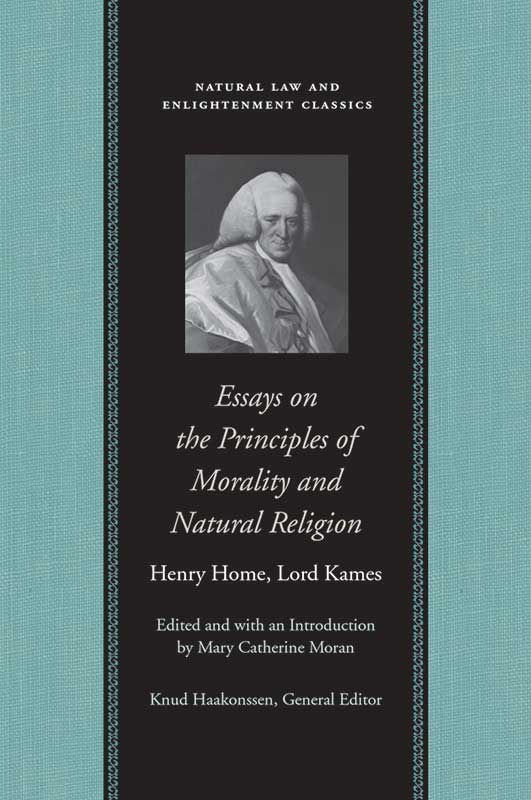
bibliography - Henry Home, Lord Kames, Essays on the Principles of Morality and Natural Religion [1779]Edition used:Essays on the Principles of Morality and Natural Religion, Corrected and Improved, in a Third Edition. Several Essays Added Concerning the Proof of a Deity, Edited and with an Introduction by Mary Catherine Moran (Indianapolis: Liberty Fund, 2005).
About Liberty Fund:Liberty Fund, Inc. is a private, educational foundation established to encourage the study of the ideal of a society of free and responsible individuals. Copyright information:The copyright to this edition, in both print and electronic forms, is held by Liberty Fund, Inc. Fair use statement:This material is put online to further the educational goals of Liberty Fund, Inc. Unless otherwise stated in the Copyright Information section above, this material may be used freely for educational and academic purposes. It may not be used in any way for profit.
bibliographyWorks Cited or Alluded to by KamesAesop. Fables. Retold by Joseph Jacobs. Vol. 17, The Harvard Classics. New York: Collier & Son, 1909–14. Aristotle. On the Soul. Translated by J. A. Smith. Vol. I, The Complete Works ofAristotle. Edited by Jonathan Barnes. Princeton: Princeton University Press, 1984. Berkeley, George. A Treatise Concerning the Principles of Human Knowledge. 1710. Edited by Jonathan Dancy. New York: Oxford University Press, 1998. Bolingbroke, Henry St. John, Viscount. Reflections Concerning Innate MoralPrinciples. 1752. Buffon, Georges Louis Leclerc, Comte de. De L’Homme. Vols. 2 and 3, Histoire naturelle, générale et particuliére. 15 vols. Paris, 1749. Butler, Joseph. Fifteen Sermons Preached at the Rolls Chapel. 1726. In The Works of Joseph Butler, 3 vols. Oxford: Clarendon Press, 1896. Reprint, Bristol, England: Thoemmes Press, 1995. Calvin, Jean. Tractatus Theologici Omnes. Geneva, 1576. Chesterfield, Philip Dormer Stanhope, 4th Earl of. Letters written by the lateRight Honourable Philip Dormer Stanhope, Earl of Chesterfield, to his son, Philip Stanhope, Esq., 2 vols. London, 1774. Cicero. On Fate (De Fato). Edited and translated by R.W. Sharples. Warminster, England: Aris & Phillips, 1991. ———. On the Nature of the Gods (De Natura Deorum). Translated by P. G. Walsh. Oxford: Clarendon Press, 1997. Clarke, Samuel. A Discourse concerning the Being and Attributes of God, the Obligations of Natural Religion, and the Truth and Certainty of Christian Revelation. 9th ed., London, 1738. Descartes, René. Discourse on Method. 1637. Translated by Donald A. Cress. Indianapolis: Hackett Publishing, 1998. Dubos, Jean-Baptiste. Réflexions critiques sur la poésie et sur la peinture. Paris, 1719. Edwards, Jonathan. A Careful and Strict Inquiry into the Modern Prevailing Notions of That Freedom of Will, Which Is Supposed to Be Essential to Moral Agency, Virtue and Vice, Reward and Punishment, Praise and Blame. Boston, 1754; London, 1762. Euclid. The Thirteen Books of Euclid’s Elements. Edited and translated by Thomas L. Heath. Cambridge: Cambridge University Press, 1925. Helvétius, Claude-Adrien. De l’esprit. Paris, 1758. Hobbes, Thomas. Leviathan or the Matter, Forme and Power of a CommonwealthEcclesiastical and Civill. 1651. Edited by Richard Tuck. Cambridge: Cambridge University Press, 1996. Horace. Epistles. Satires. Arts Poetica. Translated by H. Rushton Fairclough. Loeb Classical Library, No. 194. Harvard: Harvard University Press, 1926. Hume, David. Dialogues Concerning Natural Religion. 1779. Edited by Richard H. Popkin. Indianapolis: Hackett Publishing, 1980. ———. An Enquiry Concerning Human Understanding. First published as Philosophical Essays concerning Human Understanding. 1748. Edited by Tom L. Beauchamp. Oxford: Oxford University Press, 1999. ———. An Enquiry Concerning the Principles of Morals. 1751. Edited by Tom L. Beauchamp. Oxford: Oxford University Press, 1998. ———. A Treatise of Human Nature. 1739. Edited by David Fate Norton and Mary J. Norton. Oxford: Oxford University Press, 2000. Hutcheson, Francis. An Inquiry concerning the Original of Our Ideas of Virtue orMoral Good. Inquiry II of An Inquiry into the Original of Our Ideas of Beauty and Virtue. London, 1725. Livy. History of Rome. Translated by Rev. Canon Roberts. New York: E. P. Dutton, 1912. Locke, John. An Essay Concerning Human Understanding. 1690. Edited by Peter H. Nidditch. Oxford: Clarendon Press, 1975. ———. Locke’s Reply to the Right Revered the Lord Bishop of Worcester’s Answer to his Letter. 1697. ———. Some Familiar Letters between Locke and several of his Friends. In Vol. 8 of The Works of John Locke, 10 vols. 12th ed. London, 1823. Milton, John. Paradise Lost. 1674. Edited by Scott Elledge. New York: W. W. Norton, 1993. Newton, Isaac, Sir. Opticks: or, A treatise of the reflexions, refractions, inflexions and colours of light. London, 1704. Pictet, Benedict. Theologia Christiana. 2 vols. Geneva, 1696. Porterfield, William. “An essay concerning the motions of our eyes. Part I. Of their external motions” (1737). In Medical Essays and Observations, Published by a Society in Edinburgh, 5 vols. 5th ed. London and Edinburgh, 1771. ———. A Treatise on the Eye, the Manner and Phaenomena of Vision, 2 vols. London: A. Miller, and Edinburgh: G. Hamilton and J. Balfour, 1759. Reid, Thomas. Correspondence of Thomas Reid. Edited by Paul Wood. University Park, Pa.: Pennsylvania State University Press, 2002. Rousseau, Jean-Jacques. Emile, or, On Education. 1762. Edited and translated by Allan Bloom. New York: Basic Books, 1979. Shaftesbury, Anthony Ashley Cooper, Third Earl of. Inquiry Concerning Virtue or Merit. In Characteristics of Men, Manners, Opinions, Times. 1711. Edited by Lawrence E. Klein. Cambridge: Cambridge University Press, 1999. Smith, Adam. The Theory of Moral Sentiments. 1759. Edited by D. D. Raphael and A. L. Macfie. Indianapolis: Liberty Classics, 1982. Swift, Jonathan. “Thoughts on Various Subjects.” In Vol. I of Alexander Pope, Jonathan Swift and John Gay, Miscellanies in Prose and Verse. 1727–32. Terence. Heautontimorumenos: The Self-Tormentor. In The Comedies of Terence. Edited by Henry Thomas Riley. New York: Harper & Brothers, 1874. Turrettini, François. Institutio theologiae elencticae, 3 vols. Geneva, 1679–85. Virgil. The Aeneid. Translated by Robert Fitzgerald. New York: Vintage Books, 1990. Voltaire, François Marie Arouet de. La Henriade. Rouen, 1723. English translation 1728. Wollaston, William. The Religion of Nature Delineated. London, 1724. Secondary LiteratureEmerson, Roger L. “Henry Home, Lord Kames.” In British Prose Writers, 1660–1800, 2nd series, Dictionary of Literary Biography, vol. 104. Edited by Donald T. Siebert. Detroit: Gale Research Company, 1991, pp. 224–25. Haakonssen, Knud. Natural Law and Moral Philosophy: From Grotius to the Scottish Enlightenment. Cambridge: Cambridge University Press, 1996. Helo, Ario. “The historicity of morality: Necessity and necessary agents in the ethics of Lord Kames.” History of European Ideas, 27 (2001): 239–55. Lehmann, William C. Henry Home and the Scottish Enlightenment: A Study inNational Character and in the History of Ideas. The Hague: Martinus Nijhoff, 1971. McGuiness, Arthur E. Henry Home, Lord Kames. New York: Twayne Publishers, 1970. Moore, James, and Michael Silverthorne. “Gershom Carmichael and the natural jurisprudence tradition in eighteenth-century Scotland.” In Virtue and Commerce: The Shaping of Political Economy in the Scottish Enlightenment. Edited by Istvan Hont and Michael Ignatieff. Cambridge: Cambridge University Press, 1983, pp. 73–87. Ross, Ian Simpson. Lord Kames and the Scotland of His Day. Oxford: Oxford University Press, 1972. Ross, Trevor. “Copyright and the invention of tradition.” Eighteenth-CenturyStudies, 26 (Autumn 1992): 1–27. Smellie, William. “The Life of Henry Home, Lord Kames.” In Literary andCharacteristical Lives. 1800. Reprint, edited by Stephen Brown, Bristol: Thoemmes Press, 1997. Stewart, M. A. “Religion and rational theology.” In The Cambridge Companion to the Scottish Enlightenment. Edited by Alexander Broadie. Cambridge: Cambridge University Press, 2003. Stocking, George W. “Scotland as the model of mankind: Lord Kames’s philosophical view of civilization.” In Toward a Science of Man: Essays in the History of Anthropology. Edited by Timothy H. H. Thorensen. The Hague: Mouton, 1975, pp. 65–89. Tytler, Alexander Fraser, Lord Wordhouselee. Memoirs of the Life and Writing of the Honourable Henry Home of Kames. 1814. Reprint, Bristol: Thoemmes Press, 1996. This book is set in Adobe Garamond, a modern adaptation by Robert Slimbach of the typeface originally cut around 1540 by the French typographer and printer Claude Garamond. The Garamond face, with its small lowercase height and restrained contrast between thick and thin strokes, is a classic “old-style” face and has long been one of the most influential and widely used typefaces. Printed on paper that is acid-free and meets the requirements of the American National Standard for Permanence of Paper for Printed Library Materials, z39.48-1992 (archival) Book design by Louise OFarrell Gainesville, Florida Typography by Apex Publishing, LLC Madison, Wisconsin Printed and bound by Edwards Brothers, Inc. Ann Arbor, Michigan [† ]Chap. Identity and Diversity, from the 9th Section downward. [Locke, An Essay Concerning Human Understanding, II.xxvii.9–29, pp. 335–48.] [2. ]This letter has not survived. |

Titles (by Subject)