Econlib

The Library

Other Sites

Front Page arrow Titles (by Subject) arrow essay iv: Personal Identity i - Essays on the Principles of Morality and Natural Religion

Return to Title Page for Essays on the Principles of Morality and Natural Religion

Search this Title:

essay iv: Personal Identity i - Henry Home, Lord Kames, Essays on the Principles of Morality and Natural Religion [1779]

Edition used:

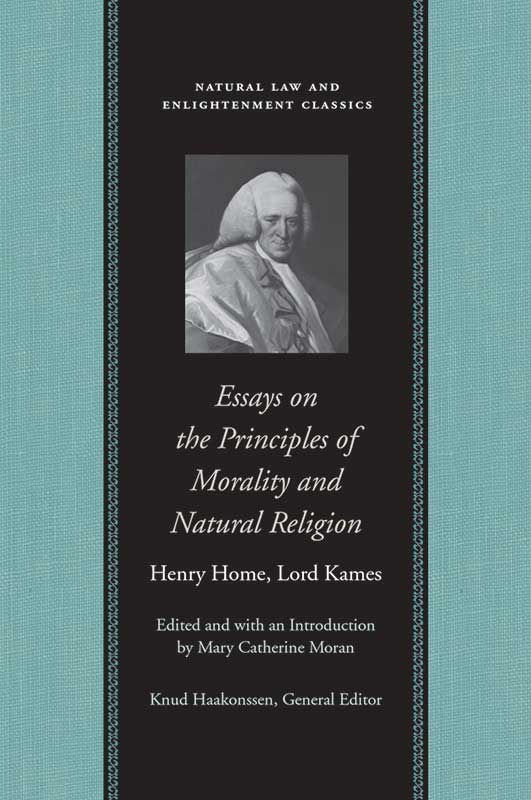
Essays on the Principles of Morality and Natural Religion, Corrected and Improved, in a Third Edition. Several Essays Added Concerning the Proof of a Deity, Edited and with an Introduction by Mary Catherine Moran (Indianapolis: Liberty Fund, 2005).

About Liberty Fund:

Liberty Fund, Inc. is a private, educational foundation established to encourage the study of the ideal of a society of free and responsible individuals.


essay iv

Personal Identityi

Every man by nature has a sense of himself and of his own existence; which, for the most part, accompanies every thought and action. I say, for the most part, because this sense does not always operate. In a dead sleep we have no consciousness of self. And even some of our waking thoughts pass without it: during a reverie, the mind never thinks of itself. Without this sense, mankind would be in a perpetual reverie: ideas constantly floating in the mind without ever being connected with self. Neither would there be any notion of personal identity; for a man cannot consider himself to be the same person at different times, when he has no consciousness of himself at all.

This consciousness is of a lively kind. Self-preservation is every one’s peculiar care; and the vivacity of that consciousness makes us attentive to our own interest, particularly to shun every appearance of danger: a man in a reverie has no attention to himself. It is remarkable, that one seldom falls asleep till this consciousness vanisheth: its vivacity preserves the mind in motion so as to bar sleep. A purling stream disposes to sleep: it fixes the attention both by sound and sight; and without creating any agitation in the mind, occupies it so much as to make it forget itself. The reading of some books, by similar means, produces the same effect.

The consciousness of self leads me to attribute self to others as I do to myself. When I talk to a person, I say yourself. When I talk of a person, I say his self. When I talk of a thing, I say itself.

I know not by what wrong bias many learned men have been led to think that nothing is to be believed but what can be demonstrated logically. How came they to overlook the evidence of their senses, internal and external, which in instances without number produces conviction superior to that of the strictest demonstration? The celebrated Des Cartes was a great mathematician; and so much accustomed to demonstration, that he would admit no truth but what could be demonstrated in form. So arrant a Quixote was he on this subject, that he was pleased to doubt even of his own existence, till he discovered that notable argument cogito, ergo sum.1 Had he not as good reason to doubt of his thinking as of his existing? Strange! that in a long life the absurdity of this argument never occurred to him. A plain man would have informed him, that every human being has as thorough a conviction of his existence without reasoning, as the most expert mathematician can have with it.

So much for self. We proceed to personal identity. Animals are divided by nature into kinds or species, the individuals of each kind having uniformly the same external figure and internal disposition; but differing in both from the individuals of other kinds. Hence identity of kind in contradistinction to every other kind. Next, though the corporeal part of an animal is continually changing by perspiration and admission, yet it continues the same animal from birth to dissolution, the same with respect to its life, its faculties, its temper and disposition. Thus identity is predicated of an animal in contradistinction to every other animal. What is here said with respect to animals is equally applicable to plants.

Identity is also attributed to works of art, changes in the component parts notwithstanding. A ship may have been repaired at different times, till not a single original rope or plank be left. It is however held to be the same ship, not now from its component parts, but from the same idea being applied to it in all its changes. Law conforms itself to this sort of identity: a man is entitled to have a watch he had lost restored to him, considerable alterations in its constituent parts notwithstanding. The identity of a river cannot depend on the water, which is continually flowing; nor on the bed, which frequently changes, but on the same idea being invariably attributed to it in all its changes. The name of a ship, of a river, or of any work of art, tends to keep the mind steady in its idea of their identity. The identity of an animal or of a plant is the work of nature, independent of our ideas: the identity of a work of art through its different changes, depends intirely on our ideas.

Every one knows that there are different species of animals and plants, and can readily apply identity to one species in contradistinction to others. It is still more obvious to apply identity to an individual, in contradistinction to any other individual of whatever species. The means by which that knowledge is obtained, require to be explained, for they are not obvious. There is no difficulty with respect to works of art, the identity of which depends on our own ideas. But the identity of the works of nature is independent of our ideas, and is not obvious to any of our external senses. To explain our knowledge of that identity, I begin with the knowledge that every man hath of his own identity, as the simplest case. The consciousness that every man hath of himself and of his own existence, qualifies all his actions. I am eating, I am walking, I am speaking. This is so natural, that even children distinguish themselves from others. Now, if self qualify every present thought and action, it must also qualify every idea of memory; because that faculty recals to the mind things as they happened: I was present at the King’s coronation; and, at a greater distance of time, I saw the first stone laid of the Ratcliff library at Oxford. It is thus that I am made acquainted with my personal identity; that is, with being the person who saw the things mentioned above, and every other thing recorded in my memory as said, done, or suffered by me; the same person, without regard to what changes my body may have undergone.

The same sense that by the help of memory discovers to me my own identity, discovers to me also the identity of other beings. A child who sees a dog of a certain shape and colour, knows it to be the same it saw yesterday. I am assured of my own identity by connecting every thing I thought and did with myself. The knowledge I have of the identity of other beings is from remembering their appearance to be the same at different times.

Our knowledge of the identity of a species is derived from the same sense. The eye serves us to distinguish a horse from a cow, as different individuals; but it can carry us no farther. It is nature that teaches us, that the horse belongs to one species and the cow to another. Other animals can distinguish one individual from another, as well as we can; but it is not probable, that brute animals have any conception of different species.

The knowledge I have of my personal identity, is what constitutes me a moral agent, accountable to God and to man for every action of my life. Were I kept ignorant of my personal identity, it would not be in my power to connect any of my past actions with myself: I could not think myself accountable for them, more than if done by another person. It would answer no good purpose, to reward me for a benevolent act or to punish me for a crime, if I could not connect them with myself as the author. The reward would be considered by me as foolish or whimsical: the punishment, as grossly unjust. Personal identity therefore is the corner-stone of morality, and of laws human and divine.

As I have a sense of my own identity, I have a conviction from the light of nature, that all of my own species have the same sense of their identity. From that conviction it is, that magistrates and judges have authority to reward and to punish.

Will the reader here indulge me a short episode, connected intimately with the principal subject? That man is finely adjusted internally as well as externally to his situation on this earth, is made evident from a thousand instances. I give one more, not a little interesting. Did every individual animal differ from every other in shape and nature, deplorable would be the condition of man. His experience of one would afford him no light with respect to others: he would be utterly at a loss to distinguish the noxious from the innocent, or to select what are proper for food and for other uses. But the author of nature leaves nothing disjointed in his works. He himself has taught man to know animals, and to bring under subjection such as can serve his purposes. The means employed for that important end, merit our attention. Animals are divided into kinds or species, differing in their internal character as well as external figure; and the individuals that compose a species have all of them the same character and figure. Unless we were made acquainted with these particulars, we would be left to starve in the midst of plenty. Experience evidently would be an instructor by far too slow: it would require ages to give us the perfect knowledge of animals by that means. Instruction is conveyed to us by an internal sense as above mentioned; a most compendious method of opening to us all the knowledge of animals that is necessary for our well-being.

We have an innate sense of a common nature, not only in our own species, but in every species of animals. And our conviction holds true; there being a remarkable uniformity in creatures of the same kind, and a disformity no less remarkable in creatures of different kinds.*

This subject leads to a thought, which will be more fully displayed in handling the veracity of our senses. Any doctrine that tends to a distrust of our senses, must land in absurd scepticism. If our senses be not admitted as the evidence of truth, I see not that we can be certain of any fact whatever: from what is now observed it appears, that we cannot be certain even of our own existence, nor of our being the same person at different times.

[1. ]René Descartes, Discourse on Method (1637; reprint, trans. Donald A. Cress, Indianapolis: Hackett Publishing, 1998), pt. 4, p. 18.

[* ]Sketches of Man, edition 2d, Vol. IV. page 20. [From the sketch on the “Principles and progress of morality,” Sketches, vol. 4, bk. 3, sketch 2.]