Econlib

The Library

Other Sites

Front Page arrow Titles (by Subject) arrow PART I - Essays on the Principles of Morality and Natural Religion

Return to Title Page for Essays on the Principles of Morality and Natural Religion

Search this Title:

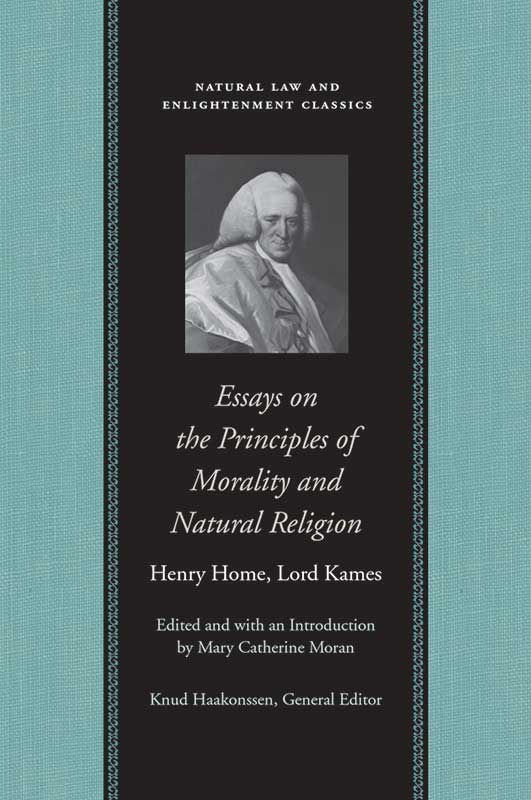
PART I - Henry Home, Lord Kames, Essays on the Principles of Morality and Natural Religion [1779]

Edition used:

Essays on the Principles of Morality and Natural Religion, Corrected and Improved, in a Third Edition. Several Essays Added Concerning the Proof of a Deity, Edited and with an Introduction by Mary Catherine Moran (Indianapolis: Liberty Fund, 2005).

About Liberty Fund:

Liberty Fund, Inc. is a private, educational foundation established to encourage the study of the ideal of a society of free and responsible individuals.


PART I

essay i

Our Attachment to Objects of Distress

A noted French critic,* treating of poetry and painting, undertakes a subject attempted by others unsuccessfully, which is, to account for the strong attachment we have to objects of distress, imaginary as well as real.

It is not easy (says he) to account for the pleasure we take in poetry and painting, which has often a strong resemblance to affliction, and of which the symptoms are sometimes the same with those of them ostlively sorrow. The arts of poetry and painting are never more applauded than when they succeed in giving pain. A secret charm attaches us to representations of this nature, at the very time our heart, full of anguish, rises up against its proper pleasure. I dare undertake this paradox, (continues our author), and to explain the foundation of this sort of pleasure which we have in poetry and painting; an undertaking that may appear bold, if not rash, seeing it promises to account to every man for what passes in his own breast, and for the secret springs of his approbation and dislike.

Let us attend him in this difficult undertaking. The following proposition is laid down by him as fundamental:

That man by nature is designed an active being: that inaction, whether of body or mind, draws on languor and disgust: and that this is a cogent motive to fly to any sort of occupation for relief. Thus (adds he) we fly by instinct to every object that can excite our passions, and keep us in agitation, notwithstanding the pain such objects often gives, which causes vexatious days and sleepless nights: but man suffers more by being without passions, than by the agitation they occasion.1

This is the sum of his first section. In the second he goes on to particular instances. The first he gives is compassion; which makes us dwell upon the miseries and distresses of others, though thereby we are made to partake of their sufferings; an impulse that he observes is entirely owing to the foregoing principle, which makes us chuse occupation, however painful, rather than be without action. Another is public executions.

We go in crouds (says he) to a spectacle the most horrid that man can behold, to see a poor wretch broken upon the wheel, burnt alive, or his intrails torn out. The more dreadful the scene, the more numerous the spectators. Yet one might foresee, even without experience, that the cruel circumstances of the execution, the deep groans and anguish of a fellow-creature, must make an impression, the pain of which is not effaced but in a long course of time. But the attraction of agitation prevails more than the joint powers of reflection and experience.

He goes on to mention the strange delight the Roman people had in the entertainments of the amphitheatre; criminals exposed to be torn to pieces by wild beasts, and gladiators in troops hired to butcher one another. He takes this occasion to make the following observation upon the English nation.

So tender-hearted are that people, that they observe humanity towards their greatest criminals. They allow not of torture; alledging it better to leave a crime unpunished, than to expose an innocent person to those torments authorised in other Christian countries to extort a confession from the guilty. Yet this people, so respectful of their kind, have an infinite pleasure in prize-fighting, bull-baiting, and such other savage spectacles.

He concludes with showing, that it is this very horror of inaction, which makes men every day precipitate themselves into play, and deliver themselves over to cards and dice.

None but fools and sharpers (says he) are moved to play by hope of gain. The generality are directed by another motive. They neglect those diversions where skill and address are required, chusing rather to risk their fortunes at games of mere chance, which keep their minds in continual motion, and where every throw is decisive.2

Here is our author’s account, fairly stated. It has, I acknowledge, an air of truth; but the following considerations made me doubt. In the first place, if the pain of inaction be the motive which carries us to the spectacles above mentioned, we must expect to find them frequented by none but those who are oppressed with idleness. But this does not hold. All sorts of persons flock to them. Pictures of danger, or of distress, have a secret charm which attracts men from the most serious occupations, and operate equally upon the active and the indolent. In the next place, were there nothing in these spectacles to attract the mind, abstracting from the pain of inaction, there would be no such thing as a preference of one object to another, upon any other ground than that of agitation; and the more the mind was agitated, the greater would be the attraction of the object. But this is contrary to experience. There are many objects of horror and distaste that agitate the mind exceedingly, which even the idlest fly from. And a more apt instance need not be given, than what our author himself cites from Livy;* who, speaking of Antiochus Epiphanes, has the following words. Gladiatorum munus Romanae consuetudinis, primo majore cum terrore hominum insuetorum ad tale spectaculum, quam voluptate dedit. Deinde saepius dando, et familiare oculis gratumque id spectaculum fecit, et armorum studium plerisque juvenum accendit. This spectacle we see was at first so far from being attractive to the Greeks, that it was their aversion, till custom rendering it familiar, and less agitating, it came at last to be relished. Upon the same account, the bear-garden, which is one of the chief entertainments of the English, is held in abhorrence by the French, and other polite nations. It is too savage an entertainment, to be relished by those of a refined taste.

Were man a being whose only view, in all his actions, is either to attain pleasure, or to avoid pain; which our author lays down as a preliminary, borrowed from Mr Locke (chap. Of Power, sect. 37 and 43.);3 it would, upon that supposition, be hard if not impossible, to give any satisfactory account why we should incline, with our eyes open, to frequent entertainments that must necessarily give us pain. But when we more attentively examine human nature, we discover many and various impulses to action, independent of pleasure and pain. Let us prosecute this thought, because it may probably lead to a solution of the problem.

When we attend to the emotions raised in us by external objects, or to any of our emotions, we find them greatly diversified. They are strong or weak, distinct or confused, &c. There is no division of emotions more comprehensive than into agreeable or disagreeable. It is unnecessary, and would perhaps be in vain, to search for the cause of these differences. More we cannot say, but that such is the constitution of our nature, so contrived by the Author of all things, in order to answer wise and good purposes.

There is another circumstance to be attended to in these emotions; that affection enters into some of them, aversion into others. To some objects we have an affection, and we desire to possess and enjoy them: other objects raise our aversion, and move us to avoid them. No object can move our affection but what is agreeable, nor our aversion but what is disagreeable. Whether it be the effect of every agreeable object to raise affection, we have no occasion at present to inquire. But it is of importance to observe, that many objects are disagreeable, perhaps painful, that raise not aversion in any degree. Objects of horror and terror, loathsome objects, and many others raise aversion. But there are many emotions or passions, some of them of the most painful sort, that raise no aversion. Grief is a most painful passion, and yet is not accompanied with any degree of aversion. On the contrary, it is attractive, no less so than many of our pleasant emotions: we cling to the object that raises our grief, and love to dwell upon it. Compassion is an instance of the like nature. Objects of distress raise no aversion in us, though they give us pain. On the contrary, they draw us to them, and inspire us with a desire to afford relief.

During infancy, appetite and desire are our sole impulses to action. But in the progress of life, when we learn to distinguish the objects around us as productive of pleasure or pain, we acquire by degrees impulses to action of a different sort. Self-love is a strong motive to search about for every thing that may contribute to happiness. Self-love operates by means of reflection and experience; and every object, as soon as discovered to contribute to our happiness, raises in us of course a desire of possessing. Hence it is, that pleasure and pain are the only motives to action, as far as self-love is concerned. But our appetites and passions are not all of them of this kind. They frequently operate by direct impulse, without the intervention of reason, in the same manner as instinct does in brute creatures. As they are not influenced by any sort of reasoning, the view of shunning misery or acquiring happiness, makes no part of the impulsive motive. It is true, that the gratification of our passions and appetites, is agreeable; and it is also true, that, in giving way to a particular appetite, the view of pleasure may, by a reflex act, become an additional motive to the action. But these things must not be confounded with the direct impulse arising from the appetite or passion; which, as I have said, operates blindly, and in the way of instinct, without any view to consequences.

To ascertain the distinction betwixt actions directed by self-love and actions directed by particular appetites and passions, it must be further remarked, that the aim of self-love is always to make us happy, but that other appetites and passions have frequently a very different tendency. This will be plain from induction. Revenge gratified against the man we hate, is agreeable. It is a very different case, where we have taken offence at a man we love. Friendship will not allow me, however offended, to hurt my friend. “I cannot find in my heart to do him mischief; but I would have him made sensible of the wrong he has done me.” Revenge thus denied a vent, recoils, and preys upon the vitals of the person offended. It displays itself in peevishness and bad humour; which must work and ferment, till time or acknowledgment of the wrong, carry it off. This sort of revenge is turned against the man himself who is offended; and examples there are of persons in this pettish humour, working great mischief to themselves, in order to make the offenders sensible of the wrong. Thus, no example is more common, than that of a young woman disappointed in love, who prone to augment her distress, throws herself away upon any worthless man that will ask her the question. My next example will be still more satisfactory. Every one must have observed, that when the passion of grief is at its height, the very nature of it is to shun and fly from every thing that tends to give ease or comfort. In the height of grief, a man rushes on to misery, by a sort of sympathy with the person for whom he is grieved. Why should I be happy when my friend is no more, is the language of this passion. In these circumstances, the man is truly a self-tormentor. And here we have a singular phaenomenon in human nature; an appetite after pain, an inclination to render one’s self miserable. This goes farther than even self-murder; a crime that is never perpetrated but in order to put an end to misery, when it rises to such an height as to be insupportable.

We now see how imperfect the description is of human nature, given by Mr Locke, and by our French author. They acknowledge no motive to action, but what arises from self-love; measures laid down to attain pleasure, or to shun pain. Many appetites and passions, with the affection and aversion involved in them, are left entirely out of the system. And yet we may say, with some degree of probability, that we are more frequently influenced by these than by self-love. So various is human nature, and so complicated its acting powers, that it is not readily to be taken in at one view.

We return to our subject, after havin gun folded those principles of action with which it is connected. It may be gathered from what is above laid down, that nature, which designed us for society, has linked us together in an intimate manner, by the sympathetic principle, which communicates the joy and sorrow of one to many. We par take the afflictions of our fellows: we grieve with them and for them; and, in many instances, their misfortunes affect us equally with our own. Let it not therefore appear surprising, that, instead of shunning objects of misery, we chuse to dwell upon them; for this is truly as natural as indulging grief for our own misfortunes. And it must be observed at the same time, that this is wisely ordered by providence: were the social affections mixed with any degree of aversion, even when we suffer under them, we should be inclined, upon the first notice of an object in distress, to drive it from our sight and mind, instead of affording relief.

Nor must we judge of this principle as any way vitious or faulty: for besides that it is the great cement of human society, we ought to consider, that, as no state is exempt from misfortunes, mutual sympathy must greatly promote the security and happiness of mankind. That the prosperity and preservation of each individual should be the care of many, tends more to happiness in general, than that each man, as the single in habitant of adesert island, should be left to stand or fall by himself, without prospect of regard or assistance from others. Nor is this all. When we consider our own character and actions in a reflex view, we cannot help approving this tenderness and sympathy in our nature. We are pleased with ourselves for being so constituted: we are conscious of inward merit; and this is a continual source of satisfaction.

To open this subject a little more, it must be observed, that naturally we have a strong desire to be acquainted with the history of others. We judge of their actions, approve or disapprove, condemn or acquit; and in this the busy mind has a wonderful delight. Nay, we go farther. We enter deep into their concerns, take a side; we partake of joys and distresses with those we favour, and show a dislike to others. This turn of mind makes history, novels, and plays, the most universal and favourite entertainments. It is natural to man as a sociable creature; and we venture to affirm, that the most sociable have the greatest share of this sort of curiosity, and the strongest attachment to such entertainments.

Tragedy is an imitation or representation of human characters and actions. It is a feigned history, which commonly makes a stronger impression than what is real; because, if it be a work of genius, incidents will be chosen to make the deepest impressions; and will be so conducted as to keep the mind in continual suspense and agitation, beyond what commonly happens in real life. By a good tragedy, all the social passions are excited. We take a sudden affection to some of the personages represented: we come to be attached to them as to our bosom-friends; and we hope and fear for them, as if the whole were a true history.

To a dry philosopher, unacquainted with theatrical entertainments, it may appear surprising, that imitation should have such an effect upon the mind, and that the want of truth and reality should not prevent the operation of our passions. But whatever may be the physical cause, one thing is evident, that this aptitude of the mind of man to receive impressions from feigned as well as from real objects, contributes to the noblest purposes of life. Nothing contributes so much to improve the mind and confirm it in virtue, as being continually employed in surveying the actions of others, entering into the concerns of the virtuous, approving their conduct, condemning vice, and showing an abhorrence at it; for the mind acquires strength by exercise, as well as the body. But were this sort of discipline confined to scenes in real life, the generality of men would be little the better for it, because such scenes rarely occur. They are not frequent even in history. But in compositions where liberty is allowed of fiction, it must be want of genius, if the mind be not sufficiently exercised, till it acquire the greatest sensibility, and the most confirmed habits of virtue.

Thus, tragedy engages our passions, no less than true history. Friendship, concern for the virtuous, abhorrence of the vitious, compassion, hope, fear, and the whole train of the social passions, are roused and exercised by both of them equally.

This may appear to be a fair account of the attachment we have to theatrical entertainments: but when the subject is more narrowly examined, some difficulties occur, to which the principles above laid down will scarce afford a satisfactory answer. It is not wonderful that young people flock to such entertainments. The love of novelty, desire of occupation, beauty of action, are strong attractions: and if one be once engaged, of whatever age, by entering into the interests of the personages represented, the attraction becomes strong; and the foresight of running into grief and affliction will not disengage us. But we generally become wise by experience; and it may appear surprising, when distress is the never-failing effect of such entertainments, that persons of riper judgment do not shun them altogether. Doth self-love lie asleep in this case, which is for ordinary so active a principle? One should naturally think, that as repeated experience must make us sufficiently wise to keep out of harm’s way; deep tragedies would be little frequented by persons of reflection. Yet the contrary is true in fact; the deepest tragedies being the most frequented by persons of all ages, by those especially of delicate feelings upon whom the strongest impressions are made. A man of that character, who is scarce relieved from the deep distress he was thrown into the night before by a well-acted tragedy, does, in his closet, coolly and deliberately resolve to go to the next entertainment of the kind, without feeling the smallest obstruction from self-love.

This leads to a speculation, perhaps one of the most curious that belongs to human nature. Contrary to what is generally understood, the foregoing speculation affords a palpable proof, that even self-love does not always operate to avoid pain and distress. In examining how this is brought about, there will be discovered an admirable contrivance in human nature, to give free scope to the social affections. Keeping in view what is above laid down, that of the painful passions some are accompanied with a version, some with affection; we find, upon the strictest examination, that those painful passions, which, in the direct feeling, are free from any degree of aversion, have as little of it in the reflex act. Or, to express the thing more familiarly, when we reflect upon the pain we have suffered by our concern for others, there is no degree of aversion mixed with the reflection, more than with the pain itself which was raised by a sight of the object. For illustration’s sake, let us compare the pain which arises from compassion with any bodily pain. Cutting one’s flesh is not only accompanied with strong aversion in the direct feeling, but with an aversion equally strong in reflecting upon the action afterward. We feel no such aversion in reflecting upon the mental pains above described. On the contrary, when we reflect upon the pain which the misfortune of a friend gave us, the reflection is accompanied with an eminent degree of satisfaction. We approve ourselves for suffering with our friend, value ourselves the more for that suffering, and are ready to undergo chearfully the like distress upon the like occasion. Self-love gives no opposition.

When we examine those particular passions, which, though painful, are yet accompanied with no aversion; we find they are all of the social kind, arising from that eminent principle of sympathy, which is the cement of human society. The social passions are accompanied with appetite for indulgence when they give us pain, no less than when they give us pleasure. We submit willingly to such painful passions, and reckon it no hardship to suffer under them. In being thus constituted, we have the consciousness of regularity and order, and that it is right and meet we should suffer after this manner. Thus the moral affections, even such of them as produce pain, are none of them attended with any degree of aversion, not even in reflecting upon the distress they often bring us under. Sympathy in particular attaches us to an object in distress so powerfully as even to overbalance self-love, which would make us fly from it. Sympathy accordingly, though a painful passion, is attractive; and in affording relief, the gratification of the passion is not a little pleasant. And this observation tends to set the moral affections in a very distinguished point of view, in opposition to those that are either malevolent, or selfish.

Many and various are the springs of action in human nature, and not one more admirable than what is now unfolded. Sympathy is an illustrious principle, which connects persons in society by ties stronger than those of blood. Yet compassion, the child of sympathy, is a painful emotion; and were it accompanied with any degree of aversion, even in reflecting upon the distress it occasioned, that aversion would by degrees blunt the passion, and at length cure us of what we would be apt to reckon a weakness or disease. But the Author of our nature hath not left his work imperfect. He has given us this noble principle entire, without a counterbalance, so as to have a vigorous and universal operation. Far from having any aversion to pain occasioned by the social principle, we reflect upon such pain with satisfaction, and are willing to submit to it upon all occasions with chearfulness and heart-liking, just as much as if it were a real pleasure. And, thus, tragedy is allowed to seize the mind with all the different charms which arise from the exercise of the social passions, without the least obstacle from self-love.

Had the principle of sympathy occurred to our author, he would have found it sufficient to explain our voluntarily partaking with others in their distress, without having need of so imperfect a cause as aversion to in action. Without entering deep into philosophy, he might have had hints in abundance from common life to explain it. In every corner, persons are to be met with of such a sympathising temper, as to chuse to spend their lives with the diseased and distressed. They partake with them in the irafflictions, enter heartily into their concerns, and sigh and groan with them. These pass their lives in sadness and despondency, without having any other satisfaction than what arises upon the reflection of having done their duty.

And if this account of the matter be just, we may be assured, that those who are the most compassionate in their temper, will be the fondest of tragedy, which affords them a large field for indulging the passion. Admirable indeed are the effects brought about by this means: for passions, as they gather strength by indulgence, so they decay by want of exercise. Persons in prosperity, unacquainted with distress and misery, are apt to grow hard-hearted. Tragedy is an admirable resource in such a case. It serves to humanize the temper, by supplying feigned objects of pity, which have nearly the same effect to exercise the passion that real objects have. And thus, we are carried by a natural impulse to deal deep in affliction, occasioned by representations of feigned misfortunes; and the passion of pity alone would throng such representations, were there nothing else to attract the mind, or to afford satisfaction.

It is owing to curiosity, that public executions are so much frequented. Sensible people endeavour to correct an appetite, the indulging of which produces pain; and upon reflection is attended with no degree of self-approbation. Hence it is, that such spectacles are the entertainment of the vulgar chiefly, who allow themselves blindly to be led by curiosity with little attention whether it will contribute to their good or not.

With respect to prize-fighting and gladiatorian shews, nothing animates and inspires us more than examples of courage and bravery. We catch the spirit of the actor, and turn bold and intrepid as he appears to be. On the other hand, we enter into the distresses of the vanquished, and have a sympathy for them in proportion to the gallantry of their behaviour. No wonder then that such shews are frequented by persons of the best taste. We are led by the same principle that makes us fond of perusing the lives of heroes and of conquerors. And it may be observed by the bye, that such spectacles have an admirable good effect in training up the youth to boldness and resolution. In this therefore I see not that foreigners have reason to condemnthe English taste. Spectacles of this sort deserveen couragement from the state, and to be made an object of public police.

As for gaming, I cannot bring myself to think that there is any pleasure in having the mind kept in suspense, and as it were upon the rack, which must be the case of those who venture their money at games of hazard. Inaction and idleness are not by far so hard to bear. I am satisfied that the love of money is at the bottom. Nor is it a solid objection, That people will neglect games of skill and address, to venture their money at hazard; for this may be owing to indolence, diffidence, or impatience. There is indeed a curious speculation with regard to this article of gaming, that pleasure and pain attend good and bad success at play, independent of the money lost or win. It is plain, that good luck raises the spirits, as bad luck depresses them, without regard to consequences: and to that is owing our concern at game, when we play for trifles. To what principle in our nature that concern is owing, I leave to be investigated by others, as it is not necessarily connected with the subject of the present Essay.

I lay hold of the present edition to investigate the point left open in the former. This earth produces little for the use of man but what requires the preparation both of art and industry; and man, by nature artful and industrious, is well fitted for his situation. Were every thing furnished to his hand without thought or labour, he would sink below the lowest of the brute creation. I say, below, because the lowest creature perfect in its kind, is superior to a creature of whatever kind that is corrupted. Self-love moves us to labour for ourselves; benevolence to labour for others. And emulation is added to enforce these principles. Emulation is visible even in children, striving for victory without knowing what moves them. Instriving for fame, power, riches, emulation makes a splendid figure: it operates vigorously in works of skill, nor does it lye dormant in competitions that depend mostly or intirely on chance, such as playing with cards or dice. It is true, that the pleasure of victory without a view to gain, is extremely faint; and it pains me to observe that the desperate risks voluntarily submitted to in games of chance, are mostly, if not intirely instigated by avarice.

essay ii

Foundation and Principles of Moralityi

introduction

Superficial knowledge produces the boldest adventurers, because it gives no check to the imagination when fired by a new thought. Shallow writers lay down plans, contrive models, and are hurried on to execution by the pleasure of novelty, without considering whether, after all, there be any solid foundation to support the spacious edifice. It redounds not a little to the honour of some late inquirers after truth, that, subduing this bent of nature, they have submitted to the slow and more painful method of experiment; a method that has been applied to natural philosophy with great success. The accurate Locke, in the science of logics, has pursued the same method, and has been followed by several ingenious writers. The mistress-science alone is neglected; and it seems hard that less deference should be paid to her than to her hand-maids. Every author gives a system of morals, as if it were his privilege to adjust it to his own taste and fancy. Regulations for human conduct are daily framed, without the least consideration, whether they arise out of human nature, or can be accommodated to it. And hence many airy systems, that relate not to man nor to any other being. Authors of a warm imagination and benevolent temper, exalt man to the angelic nature, and compose laws for his conduct, so refined as to be far above the reach of humanity. Others of a contrary disposition, forcing down all men to a level with the very lowest of their kind, assign them laws more suitable to brutes than to rational beings. In abstract science, writers may more innocently indulge their fancies. The worst that can happen is, to mislead us in matters where error has little influence on practice. But they who deal in moral philosophy ought to be cautious; for their errors seldom fail to have a bad tendency. The exalting of nature above its standard, is apt to disgust the mind, conscious of its weakness, and of its inability to attain such an uncommon degree of perfection. The debasing of nature tends to break the balance of the affections, by adding weight to the selfish and irregular appetites. Beside these bad effects, clashing opinions about morality are apt to tempt men who have any hollowness of heart, to shake off all principles, and to give way to every appetite: and then adieu to a just tenor of life, and consistency of conduct.

These considerations give the author of this essay a just concern to proceed with the utmost circumspection in his inquiries, and to try his conclusions by their true touchstone, that of facts and experiments. Had this method been strictly followed, the world would not have been perplexed with that variety of inconsistent systems, which unhappily have rendered morality a difficult and intricate science. An attempt to restore it to its original simplicity and authority, must be approved, however short one falls in the execution. Writers differ about the origin of the laws of nature, and they differ about the laws themselves. As the author is not fond of controversy, he will attempt a plan of the laws of nature, drawn from their proper source, laying aside what has been written on this subject.

chapter i

Foundation of Morality

In searching for the foundation of the laws of our nature, the following reflections occur. In the first place, two things cannot be more intimately connected than a being and its actions: for the connection is that of cause and effect. Such as the being is, such must its actions be. In the next place, the several classes into which nature has distributed living creatures, are not more distinguishable by an external form, than by an internal constitution, which manifests itself in an uniformity of conduct, peculiar to eachspecies. In the third place, any action conformable to the common nature of the species, is considered by us as regular and proper. It is according to order, and according to nature. But if there exist a being of a constitution different from that of its kind, the actions of this being, though conformable to its own peculiar constitution, will, to us, appear whimsical and disorderly. We shall have a feeling of disgust, as if we saw a man with two heads or four hands. These reflections lead us to the foundation of the laws of our nature. They are to be derived from the common nature of man, of which every person partakes who is not a monster.

As the foregoing observations make the groundwork of all morality, it may not be improper to enlarge a little upon them. Looking around, we find creatures of very different kinds, both as to external and internal constitution. Each species having a peculiar nature, ought to have a peculiar rule of action resulting from its nature. We find this to hold in fact; and it is extremely agreeable to observe, how accurately the laws of each species are adjusted to the frame of the individuals which compose it, so as to procure the conveniencies of life in the best manner, and to produce regularity and consistency of conduct. To give but one instance: the laws which govern sociable creatures, differ widely from those which govern the savage and solitary. Among solitary creatures, who have no mutual connection, there is nothing more natural nor more orderly, than to make food one of another. But for creatures in society to live after that manner, must be the effect of jarring and inconsistent principles. No such disorderly appearance is discovered upon the face of this globe. There is, as above observed, a harmony betwixt the internal and external constitution of the several classes of animals; and this harmony affords a delightful prospect of deep design, effectively carried into execution. The common nature of every class of beings is perceived by us as perfect; and if, in any instance, a particular being swerve from the common nature of its kind, the action produces a sense of disorder and wrong. In a word, it is according to order, that the different sorts of living creatures should be governed by laws adapted to their peculiar nature. We consider it as fit and proper that it should be so; and it is beautiful to find creatures acting according to their nature.

The force of these observations cannot be resisted by those who admit of final causes. We make no difficulty to pronounce, that a species of beings who have such or such a nature, are made for such or such an end. A lion has claws, because nature made him an animal of prey. A man has fingers, because he is a social animal made to procure food by art not by force. It is thus we discover for what end we were designed by nature, or the Author of nature. And the same chain of reasoning points out to us the laws by which we ought to regulate our actions: for acting according to nature, is acting so as to answer the end of our creation.

chapter ii

Moral Sense

Having made out that the nature of man is the foundation of the laws that ought to govern his actions, it will be necessary to trace out human nature, so far as regards the present subject. If we can happily accomplish this part of our undertaking, it will be easy, in the synthetical method, to deduce the laws that ought to regulate our conduct. And we begin with examining in what manner we are related to beings and things around us; a speculation that will lead to the point in view.

As we are placed in a great world, surrounded with beings and things, some beneficial, some hurtful; we are so constituted, that scarce any object is indifferent to us: it either gives pleasure or pain; witness sounds, tastes, and smells. This is the most remarkable in objects of sight, which affect us in a more lively manner than objects of any other external sense. Thus, a spreading oak, a verdant plain, a large river, are objects that afford delight. A rotten carcase, a distorted figure, create aversion; which, in some instances, goes the length of horror.

With regard to objects of sight, whatever gives pleasure is said to be beautiful: whatever gives pain, is said to be ugly. The terms beauty and ugliness, in their proper signification, are confined to objects of sight. And indeed such objects, being more highly agreeable or disagreeable than others, deserve well to be distinguished by a proper name. But, as it happens with words that convey a more lively idea than ordinary, the terms are applied in a figurative sense to almost every thing that gives a high relish or disgust. Thus, we talk of a beautiful theorem, a beautiful thought, and a beautiful passage in music. And this way of speaking has become so familiar, that it is scarce reckoned a figurative expression.

Objects considered simply as existing, without relation to any end orany designing agent, are in the lowest rank or order with respect to beauty and ugliness; a smooth globe for example, or a vivid colour. But when external objects, such as works of art, are considered with relation to some end, we feel a higher degree of pleasure or pain. Thus, a building regular in all its parts, pleases the eye upon the very first view: but considered as a house for dwelling in, which is the end purposed, it pleases still more, supposing it to be well fitted to its end. A similar sensation arises in observing the operations of a well-ordered state, where the parts are nicely adjusted to the ends of security and happiness.

This perception of beauty in works of art or design, which is produced not barely by a sight of the object, but by viewing the object as fitted to some use, and as related to some end, includes in it what is termed approbation: for approbation, when applied to works of art, means our being pleased with them or conceiving them beautiful, in the view of being fitted to their end. Approbation and disapprobation are not applicable to the lowest class of beautiful and ugly objects. To say, that we approve a sweet taste, or a flowing river, is really saying no more but that we are pleased with such objects. But the term is justly applied to works of art, because it means more than being pleased with such an object merely as existing. It imports a peculiar beauty, which is perceived, upon considering the object as fitted to the use intended.

It must be further observed to avoid obscurity, that the beauty which arises from the relation of an object to its end, is independent of the end itself, whether good or bad, whether beneficial or hurtful: it arises from considering its fitness to the end purposed, whatever that end be.

When we take the end itself under consideration, there is discovered a beauty or ugliness of a higher kind than the two former. A beneficial end strikes us with a peculiar pleasure; and approbation belongs also to this feeling. Thus, the mechanism of a ship is beautiful, in the view of means well fitted to an end. But the end itself, of carrying on commerce and procuring so many conveniencies to mankind, exalts the object, and heightens our approbation and pleasure. By an end, I mean what it serves to procure and bring about, whether it be an ultimate end, or subordinate to something farther. Considered with respect to its end, the degree of its beauty depends on the degree of its usefulness. Let it be only kept in view, that as the end or use of a thing is an object of greater dignity and importance than the means, the approbation bestowed on the former rises higher than that bestowed on the latter.

These three orders of beauty may be blended together in many different ways, to have very different effects. If an object in itself beautiful be ill fitted to its end, it will, upon the whole, be disagreeable. This may be exemplified in a house regular in its architecture and beautiful to the eye, but incommodious for dwelling. If there be in an object an aptitude to a bad end, it will, upon the whole, be disagreeable, though it have the second modification of beauty in perfection. A constitution of government formed with the most perfect art for enslaving the people, may be an instance of this. If the end be good but the object not well fitted to the end, it will be beautiful, or ugly, as the goodness of the end, or unfitness of the means, is prevalent. Of this instances will occur at first view, without being suggested.

The foregoing modifications of beauty and deformity, apply to all objects, animate and inanimate. A voluntary agent produceth a peculiar species of beauty and deformity, which may be distinguished from all others. The actions of living creatures are more interesting than the actions of matter. The instincts and principles of action of the former, give us more delight than the blind powers of the latter; or, in other words, are more beautiful. No one can doubt of this fact, who is in any degree conversant with the poets. In Homer every thing lives: even darts and arrows are endued with voluntary motion. And we are sensible, that nothing animates a poem more than the frequent use of this figure.

Hence a new circumstance in the beauty and deformity of actions, considered as proceeding from intention, deliberation, and choice. This circumstance, which is of the utmost importance in the science of morals, concerns chiefly human actions: for we discover little of intention, deliberation, and choice, in the actions of inferior creatures. Human actions are not only agreeable or disagreeable, beautiful or deformed, in the different views above mentioned, but are further distinguished in our perception of them, as fit and meet to be done, or as unfit and unmeet. These are simple perceptions, capable of no definition. But let any man attentively examine what passeth in his mind, when the object of his thought is an action proceeding from deliberate intention, and he will soon discover the meaning of these words, and the perceptions which they denote. Let him reflect upon a signal act of generosity to a person of merit, relieving him from want or from a cruel enemy: let him reflect on a man of exemplary patriotism bearing patiently rank oppression, rather than break the peace of society. Such conduct will not only be agreeable to him, and appear beautiful, but will be agreeable and beautiful, as fit and meet to be done. He will approve the action in that quality, and he will approve the actor for his humanity and disinterestedness. This distinguishing circumstance intitles the beauty and deformity of human actions to peculiar names: they are termed moral beauty and moral deformity. Hence the morality and immorality of human actions; founded on a faculty termed the moral sense.

It gives no clear notion of morality, to rest it upon simple approbation, as some writers do. I approve a well constructed plough or waggon for its usefulness. I approve a fine picture or statue for the justness of its representation; and I approve the maker for his skill. I approve an elegant dress on a fine woman; and I approve her taste. But such approbation is far from being the same with that which is occasioned by human actions deliberately done in order to some end. If the end be beneficial, the action is approved as right and fit to have been done: if hurtful, it is disapproved as wrong and unfit to have been done. None of these qualities are applicable to the instances first given.ii

Of all objects whatever, human actions are the most highly delightful or disgustful, and possess the highest degree of beauty or deformity. In these every circumstance concurs: the fitness or unfitness of the means, the goodness or badness of the end, the intention of the actor; which give them the peculiar character of fit and meet, or unfit and unmeet.

Thus we find the nature of man so constituted, as to approve certain actions, and to disapprove others; to consider some actions as fit and meet to be done, and others as unfit and unmeet. What distinguisheth actions to make them objects of the one or the other perception, will be explained in the following chapter. And with regard to some of our actions, another circumstance will be discovered, different from what have been mentioned, sounding the well known terms of duty and obligation, directing our conduct, and constituting what in the strictest sense may be termed a law. With regard to other beings, we have no data to discover the laws of their nature, other than their frame and constitution. We have the same data to discover the laws of our own nature; and over and above, a peculiar sense of approbation or disapprobation, termed the moral sense. And one thinge xtremely remarkable will be explained afterwards, that the laws which are fitted to the nature of man and to his external circumstances, are the same that we approve by the moral sense.

chapter iii

Duty and Obligation

Though these terms are of the utmost importance in morals, I know not that any author hath attempted to explain them, by pointing out those principles or perceptions which they express. This defect I shall endeavour to supply, by tracing these terms to their proper source, without which the system of morals cannot be complete; because these terms point out to us the most precise and essential branch of morality.

Lord Shaftesbury, to whom the world is greatly indebted for his inestimable writings, has clearly and convincingly made out, “that virtue is the good, and vice the ill of every one.”1 But he has not proved virtue to be our duty, other ways than by showing it to be our interest; which comes not up to the idea of duty. For this term plainly implies somewhat indispensable in our conduct; what we ought to do, what we ought to submit to. Now, a man may be considered as foolish for acting against his interest; but he cannot be considered as wicked or vitious. His Lordship indeed, in his essay upon virtue,* approaches to an explanation of duty and obligation, by asserting the subordinancy of the self-affections to the social. But though he states this as a proposition to be made out, he drops it in the subsequent part of his work, and never again brings it into view.

Hutcheson, in his essay upon beauty and virtue,* founds the morality of actions on a certain quality of actions, that procures approbation and love to the agent. But this account of morality is also imperfect, as it makes no distinction between duty and simple benevolence. It is scarce applicable to justice; for the man who, confining himself strictly to it, is true to his word and avoids harming others, is a just and moral man, is in titled to some share of esteem; but will never be the object of love or friendship. He must show a disposition to the good of mankind, of his friends at least and neighbours, he must exert acts of humanity and benevolence; before he can hope to procure the affection of others.

But it is chiefly to be observed, that in this account of morality, the terms obligation, duty, ought and should, have no distinct meaning; which shows, that the entire foundation of morality is not taken in by this author. It is true, that toward the close of his work, he attempts to explain the meaning of the term obligation; but without success. He explains it to be, either, “a motive from self-interest, sufficient to determine those who duly consider it to a certain course of action;” which surely is not moral obligation; or “a determination, without regard to our own interest, to approve actions, and to perform them; which determination shall also make us displeased with ourselves, and uneasy upon having acted contrary to it;” in which sense, he says, there is naturally an obligation upon all men to benevolence.2 But this account falls short of the true idea of obligation; because it makes no destinction betwixt it and that simple approbation of the moral sense which can be applied to heroism, magnanimity, generosity, and other exalted virtues, as well as to justice. Duty however belongs to the latter only; and no man reckons himself under an obligation to perform any action that belongs to the former.

Neither is the author of the treatise upon human nature more successful, when he endeavours to resolve the moral sense into pure sympathy.* According to that author, there is no more in morality, but approving or disapproving an action, after we discover by reflection that it tends to the good or hurt of society. This would be too fainta principle to control our irregular appetites and passions. It would scarce be sufficient to restrain us from in croaching upon our friends and neighbours; and, with regard to strangers, would be the weakest of all restraints. We shall by and by show, that morality has a more solid foundation. In the mean time, it is of importance to observe, that, upon this author’s system, as well as Hutcheson’s, the noted terms of duty, obligation, ought and should, &c. have no meaning.

We shall now proceed to explain these terms, by pointing out the perceptions which they express. And, in performing this task, there will be discovered a wonderful and beautiful contrivance of the Author of our nature, to give authority to morality, by putting the self-affections in a due subordination to the social. The moral sense has in part been explained above; that by it we perceive some actions to be fit and meet to be done; and others to be unfit and unmeet. When this observation is applied to particulars, it is an evident fact, that we have a sense of fitness in kindly and beneficent actions: we approve ourselves and others for performing actions of this kind; as, on the other hand, we disapprove the unsociable, peevish, and hard-hearted. But in one class of actions, an additional circumstance is regarded by the moral sense. Submission to parents, gratitude to benefactors, and the acting justly to all, are perceived not only as fit and meet, but as our indispensable duty. On the other hand, the injuring others in their persons, in their fame, or in their goods are perceived not only as unfit to be done, but as absolutely wrong to be done, and what, upon no account, we ought to do. What is here asserted, is a matter of fact, which can admit of no other proof than an appeal to every man’s own perceptions. Lay prejudice aside, and give fair play to what passes in the mind: I ask no other concession. There is no man, however irregular in his life and manners, however poisoned by a wrong education, but must be sensible of these perceptions. And indeed the words which are to be found in all languages, and which are perfectly understood in the communication of sentiments, are an evident demonstration of it. Duty, obligation, ought and should, would be empty sounds, unless upon supposition of such perceptions. We do not consider actions that come under the notion of duty or obligation, or prohibited by them, as in any degree under our own power. We have the consciousness of necessity, and of being bound and tied to performance, as if under some external compulsion.

It is proper here to be remarked, that benevolent and generous actions are not objects of this peculiar sense. Hence, such actions, though considered as fit and right to be done, are not however considered to be our duty, but as virtuous actions beyond what is strictly our duty. Benevolence and generosity are more beautiful, and more attractive of love and esteem, than justice. Yet, not being so necessary to the support of society, they are left upon the general footing of approbatory pleasure; while justice, faith, truth, without which society cannot subsist, are objects of the foregoing peculiar sense, to take away all shadow of liberty, and to put us under a necessity of performance. The virtues that are exacted from us as duties, may be termed primary: the other which are not exacted as duties, may be termed secondary.

Dr. Butler, a manly and acute writer, hath gone farther than any other, to assign a just foundation for moral duty. He considers conscience or reflection,*

as one principle of action, which, compared with the rest as they stand together in the nature of man, plainly bears upon it marks of authority over all the rest, and claims the absolute direction of them all, to allow or forbid their gratification.

And his proof of this proposition is, “that a disapprobation or reflection is in itself a principle manifestly superior to a mere propension.” Had this admirable writer handled the subject more professedly than he had occasion to do in a preface, it is more than likely he would have put it in a clear light. But he has not said enough to afford that light the subject is capable of. For it may be observed, in the first place, that a disapprobation of reflection is far from being the whole of the matter. Such disapprobation is applied to moroseness, selfishness, and many other partial affections, which are, however, not considered in a strict sense as contrary to our duty. And it may be doubted, whether a disapprobation of reflection be, in every case, a principle superior to a mere propension. We disapprove a man who neglects his private affairs, and gives himself up to love, hunting, or any other amusement: nay, he disapproves himself. Yet from this we cannot fairly conclude, that he is guilty of any breach of duty, or that it is unlawful for him to follow his propension. We may observe, in the next place, what will be afterward explained, that conscience, or the moral sense, is none of our principles of action, but their guide and director. It is still of greater importance to observe, that the authority of conscience does not consist merely in an act of reflection. It arises from a direct perception, which we have upon presenting the object, without the intervention of any sort of reflection. And the authority lies in this circumstance, that we perceive the action to be our duty, and what we are indispensably bound to perform. It is in this manner that the moral sense, with regard to some actions, plainly bears upon it the marks of authority over all our appetites and passions. It is the voice of God within us, which commands our strictest obedience, just as much as when his will is declared by express revelation.

What is here stated will I hope clearly distinguish duty or moral obligation from benevolence: I know of no words in our language to make the distinction more clear. The overlooking this distinction is a capital defect in the writers who acknowledge morality to be founded on an innate sense: it has led them to reduce the whole of virtue to benevolence; and consequently, to hold mankind as bound to perform the highest acts of benevolence, because such acts produce the highest approbation. This doctrine cannot be altogether harmless, because it converts benevolence into indispensable duty, contrary to the system of nature. A young man who enters the world full of such notions soon discovers it to be above his power to conform his conduct to them. Will he not be naturally led to consider morality as a romance or chimera? If he escape that conclusion, he may justly consider himself as remarkably fortunate.iii

A very important branch of the moral sense remains still to be unfolded. In the matters above mentioned, performing of promises, gratitude, and abstaining from harming others, we have the peculiar sense of duty and obligation: but in transgressing these duties, we have not only the sense of vice and wickedness, but we have further the sense of merited punishment, and dread of its being inflicted upon us. This dread may be but slight in the more venial transgressions. But, in crimes of a deep dye, it rises to a degree of anguish and despair. Hence remorse of conscience, which, upon the commission of certain crimes, is a dreadful torture. This dread of merited punishment operates for the most part so strongly upon the imagination, that every unusual accident, every extraordinary misfortune, is by the criminal judged to be a punishment purposely inflicte dupon him. During prosperity, he makes a shift to blunt the stings of his conscience. But no sooner does he fall into distress or into any depression of mind, than his conscience lays fast hold of him: his crime stares him in the face; and every accidental misfortune is converted into a real punishment. “Andthey said one to another, We are verily guilty concerning our brother, in that we saw the anguish of his soul, when he besought us; and we would not hear: therefore is this distress come upon us. And Reuben answered them, saying, Spake I not unto you, saying, Do not sin against the child; and ye would not hear? therefore behold also, his blood is required.”*

One material circumstance is here to be remarked, which widens the difference still more betwixt the primary and secondary virtues. As justice, and the other primary virtues, are more essential to society, than generosity, benevolence, or any other secondary virtue, they are more indispensable. Friendship, generosity, softness of manners, form peculiar characters, and serve to distinguish one person from another. But the sense of justice and of the other primary virtues, belongs to man as such. Though it exists in very different degrees of strength, there perhaps never was a human creature altogether void of it. And it makes a delightful appearance in the human constitution, that even where this sense is weak, as it is in some individuals, it notwithstanding retains its authority as the director of their conduct. If there be a sense of justice, it must distinguish right from wrong, what we ought to do from what we ought not to do; and, by that very distinguishing faculty, justly claims to be our guide and governor. This consideration may serve to justify human laws, which make no distinction among men, as endued with a stronger or weaker sense of justice.

And here we must pause a moment, to indulge some degree of admiration upon this part of the human system. Man is evidently intended to live in society; and because there can be no society among creatures who prey upon one another, it was necessary, in the first place, to provide against mutual injuries. Further, man is the weakest of all creatures separately, and the very strongest in society; therefore mutual assistance is the chief end of society; and to this end it was necessary, that there should be mutual trust and reliance upon engagements, and that favours received should be thankfully repaid. Now, nothing can be more finely adjusted than the human heart, to answer these purposes. It is not sufficient that we approve every action that is essential to the preservation of society: it is not sufficient, that we disapprove every action that tends to its dissolution. Approbation or disapprobation merely, is not sufficient to subject our conduct to the authority of a law. These sentiment shave in this case the peculiar modification of duty, that such actions are what we ought to perform, and what we are indispensably bound to perform. This circumstance converts into a law, what without it can only be considered as a rational measure, and a prudential rule of conduct. Nor is any thing omitted to give it the most complete character of a law. The transgression is attended with apprehension of punishment, nay with actual punishment; as every misfortune which befals the transgressor is considered by him as a punishment. Nor is this the whole of the matter. Sympathy is a principle implanted in the breast of every man; we cannot hurt another without suffering for it, which is an additional punishment. And we are still further punished for our injustice or ingratitude, by incurring the aversion and hatred of all men.

chapter iv

Different Ranks of Moral Virtues

It is a truth universally admitted, that no man thinks so highly of himself or of another, for having done a just, as for having done a generous action: yet every one must be sensible, that justice is to society more essential than generosity; and why we should place the greater merit upon the less essential action, may appear unaccountable. This matter deserves to be examined, because it discloses more and more the science of morals; and to this examination we shall proceed, after making some further observations upon the subject of the preceding chapter.iv

The primary virtues, as observed in that chapter, being duties essential to the subsistance of society, are entirely withdrawn from our election and choice. They are perceived as indispensably obligatory upon us; and the transgression of them as laws of our nature, is attended with severe and never-failing punishment. In a word, there is not a characteristic of positive law which is not applicable, in the strictest sense, to the selaws of our nature; with this material difference, that the sanctions of these laws are greatly more efficacious than any that have been invented to enforce municipal laws. The secondary virtues, which contribute to the improvement of society, but are not strictly necessary to its subsistence, are left to our own choice. They have not the character of necessity impressed upon them, nor is the forbearance of them attended with a sense of guilt. On the other hand, the actions which belong to this class, are objects of the strongest perceptions of moral beauty; of the highest degree of approbation, both from ourselves and others. Offices of undeserved kindness, requital of good for evil, generous toils and sufferings for the good of our country, come under this class. These are not made our duty. There is no motive to the performance, which in any proper sense can be called a law. But there are the strongest motives that can consist with perfect freedom. The performance is rewarded with a consciousness of self-merit, and with the praise and admiration of all the world, which are the highest and most desirable rewards human nature is susceptible of.

There is so much of enthusiasm in this branch of moral beauty, that it is not wonderful to find persons of a free and generous turn of mind captivated with it, who are less attentive to the primary virtues. The magnanimous, who cannot bear restraint, are guided more by generosity than by justice. The sense however of strict duty is, with the bulk of mankind, a more powerful incitement to honesty, than praise and self-approbation are to generosity. And there cannot be a more pregnant instance of wisdom than in this part of the human constitution; it being far more essential to society, that all men be just and honest, than that they be patriots and heroes.

From what is above laid down, the following observation naturally arises, that with respect to the primary virtues, the pain of transgressing our duty is much greater than the pleasure which results from obeying it. The contrary holds in the secondary virtues. The pleasure which arises from performing a generous action is much greater than the pain of neglect. Among the vices opposite to the primary virtues, the most striking appearances of moral deformity are found; among the secondary virtues, the most striking appearances of moral beauty.

We are now prepared to carry on the speculation suggested in the beginning of this chapter. In ranking the moral virtues according to their dignity and merit, one would readily imagine, that the primary virtues should be intitled to the highest class, as being more essential to society than the secondary. But, upon examination, we find that this is not the order of nature. The first rank in point of dignity is assigned to the secondary virtues, which are not the first in point of utility. Generosity, in the sense of mankind, hath more merit than justice; and other secondary virtues, undaunted courage, magnanimity, heroism, rise still higher in our esteem. Is not nature whimsical and irregular, in ranking after this manner the moral virtues? One at first view would think so. But, like other difficulties that meet us in contemplating the works of nature, this arises from partial and obscure views. When the whole is surveyed as well as its several parts, we discover, that nature has here taken her measures with peculiar foresight and wisdom. Let us only recollect what is inculcated in the foregoing part of this essay, that justice is enforced by natural sanctions of the most effectual kind, by which it becomes a law in the strictest sense, a law that never can be transgressed with impunity. To extend this law to generosity and the other secondary virtues, and to make these our duty, would produce an in consistency in human nature. It would make universal benevolence a strict duty, to which the limited capacity and more limited abilities of man, bear no proportion. Generosity, therefore, heroism, and all the extraordinary exertions of virtue, must be left to our own choice, without annexing any punishment to the forbearance. Day-light now begins to break in upon us. If the secondary virtues must not be enforced by punishment, it becomes necessary that they be encouraged by reward; for without such encouragement, examples would be rare of sacrificing one’s own interest to that of others. And after considering the matter with the utmost attention, I cannot imagine any reward more proper than that actually bestowed, which is to place these virtues in the highest rank, to give them a superior dignity, and to make them productive of grand and lofty emotions. To place the primary virtues in the highest rank, would no doubt be a strong support to them. But as this could not be done without displacing the secondary virtues, detruding them into a lower rank, and consequently depriving them of their reward, the alteration would be ruinous to society. It would indeed more effectually prevent injustice and wrong; but would it not as effectually prevent the exercise of benevolence, and of numberless reciprocal benefits in a social state? If it would put an end to our fears, so it would to our hopes. And, to say all in one word, we would, in the midst of society, become solitary beings; worse if possible than being solitary in a desart. Justice at the same time is not left altogether destitute of reward. Though it reaches not the splendor of the more exalted virtues, it gains at least our esteem and approbation; and, which is still of greater importance, it never fails to advance the happiness of those who obey its dictates, by the mental satisfaction it bestows.

chapter v

Principles of Action

In the three chapters immediately foregoing, we have taken pains to inquire into the moral sense, and to analyze it into its different parts. Our present task must be to inquire into those principles in our nature which move us to action. These must be distinguished from the moral sense; which, properly speaking, is not a principle of action. Its province, as shall forthwith be explained, is to instruct us, which of our principles of action we may indulge, and which of them we must restrain. It is the voice of God within us, regulating our appetites and passions, and showing us what are lawful, what unlawful.

Our nature, as far as concerns action, is made up of appetites and passions which move us to act, and of the moral sense by which these appetites and passions are governed. The moral sense is not intended to be the first mover: but it is an excellent second, by the most authoritative of all motives, that of duty. Nature is not so rigid to us her favourite children, as to leave our conduct upon the motive of duty solely. A more masterly and kindly hand is visible in the architecture of man. We are impelled to motion by the very constitution of our nature; and to prevent our being carried too far, or in a wrong direction, conscience is set as at the helm. That such is our nature, may be made evident from induction. Were conscience alone, in any case, to be the sole principle of action, it might be expected to be so in matters of justice, of which we have the strongest sense as our indispensable duty. We find however justice not to be an exception from the general plan. For is not love of justice a principle of action common to all men; and is not affection between parents and children equally so, as well as gratitude, veracity, and every primary virtue? These principles give the first impulse, which is finely seconded by the influence and authority of conscience. It may therefore be safely pronounced, that no action is a duty, to the performance of which we are not prompted by some natural motive or principle. To make such an action our duty, would be to lay down a rule of conduct contrary to our nature; or that has no foundation in our nature. This is a truth little attended to by those who have given us systems of natural laws. No wonder they have gone astray. Let this truth be kept close in view, and it will put an end to many a controversy about these laws. If, for example, it be laid down as a primary law of nature, That we are strictly bound to advance the good of all, regarding our own interest no farther than as it makes a part of the general happiness; we may safely reject such a law, unless it be made appear, that there is a principle of benevolence in man prompting him to pursue the happiness of all. To found this disinterested scheme wholly upon the moral sense, would be a vain attempt. The moral sense, as above observed, is our guide only, not our mover. Approbation or disapprobation of those actions, to which, by some natural principle, we are antecedently directed, is all that can result from it. If it be laid down on the other hand, That we ought to regard ourselves only in all our actions; and that it is folly, if not vice, to concern ourselves for others; such a law can never be admitted, unless upon the supposition that self-love is our only principle of action.

It is probable, that in the following particular, man differs from the brute creation. Brutes are entirely governed by principles of action, which, in them, obtain the name of instincts. They blindly follow their instincts, and are led by that instinct which is strongest for the time. It is meet and fit they should act after this manner, because it is acting according to the whole of their nature. But for man to suffer himself to be led implicitly by instinct or by his principles of action, without check or control, is not acting according to the whole of his nature. He is endued with a moral sense or conscience, to check and control his principles of action, and to instruct him which of them he may indulge, and which of them he ought to restrain. This account of the brute creation is undoubtedly true in the main: whether so in every particular, is of no importance to the present subject, being suggested by way of contrast only, to illustrate the peculiar nature of man.

A full account of our principles of action would be an endless theme. But as it is proposed to confine the present short essay to the laws which govern social life, we shall have no occasion to inquire into any principles of action, but what are directed to others; dropping those which have self alone for their object. And in this inquiry, we set out with the following question, In what sense are we to hold a principle of universal benevolence, as belonging to human nature? This question is of importance in the science of morals: for, as observed above, universal benevolence cannot be a duty, if we be not antecedently promp[t]ed to it by a natural principle. When we consider a single man, abstracted from all circumstances and all connections, we are not conscious of any benevolence to him; we feel nothing within us that prompts us to advance his happiness. If one be agreeable at first sight and attract any degree of affection, it is owing to looks, manners, or behaviour. And for evidence of this we are as apt to be disgusted at first sight, as to be pleased. Man is by nature a shy and timorous animal. Every new object gives an impression of fear, till upon better acquaintance it is discovered to be harmless. Thus an infant clings to its nurse, upon the sight of a new face; and this natural dread is not removed but by experience. If every human creature did produce affection in every other at first sight, children, by natural instinct, would be fond of strangers. But no such instinct discovers itself. The fondness of a child is confined to the nurse, the parents, and those who are most about it; till by degrees it opens to a sense of other connections. This argument may be illustrated by a low, but apt instance. Dogs have by nature an affection for the human species; and puppies run to the first man they see, show marks of fondness, and play about his feet. There is no such general fondness of man to man by nature. Certain circumstances are always required to produce and call it forth. Distress indeed never fails to beget sympathy. The misery of the most unknown gives us pain, and we are prompted by nature to afford relief. But when there is nothing to call forth our sympathy; where there are no peculiar circumstances to interest us or beget a connection, we rest in a state of indifference, and are not conscious of wishing either good or ill to the person. Those moralists therefore who require us to lay aside all partial affection and to act upon a principle of equal benevolence to all men, require us to act upon a principle, which has no place in our nature.

In the manner now mentioned, a principle of universal benevolence does certainly not exist in man. Let us next inquire if it exist in any other manner. The happiness of mankind is an object agreeable to the mind in contemplation; and good men have a sensible pleasure in every study or pursuit by which they can promote it. Benevolence, not equally directed to all men, gradually decreaseth according to the distance of the object, till it dwindles away to nothing. But here comes in a happy contrivance of nature, to supply the want of benevolence to distant objects; which is, to give power to an abstract term, such as our religion, our country, our government, or even mankind, to raise benevolence or public spirit. The particular objects under each of these classes, considered singly and apart, may have little or no force to produce affection; but when comprehended under one general view, they become an object that dilates and warms the heart. In this manner, a man is enabled to embrace in his affection all mankind: and in this sense man is endued with a principle of universal benevolence.

Any person who can reflect upon this branch of human nature without some degree of emotion, must be of a very cold temperament. There is perhaps not one scene to be met with in the natural or moral world where more of design and of consummate wisdom are displayed, than in this under consideration. The authors, who, impressed with reverence for human nature, have endeavoured to exalt it the highest, could none of them stretch their imagination beyond a principle of equal benevolence to every individual. And a very fine scheme it is in idea; but, unluckily it is entirely of the Utopian kind, altogether unfit for life and action. It hath escaped the consideration of these authors, that man is by nature of a limited capacity; and that his affection, by multiplication of objects, instead of being increased, is split into parts, and weakened by division. A principle of universal equal benevolence, by dividing the attention and affection, instead of promoting benevolent actions, would be an obstruction to them. The mind would be distracted by the multiplicity of objects that have an equal influence, so as to be eternally at a loss where to begin. But the human system is better adjusted than to admit of such disproportion betwixt ability and affection. The chief objects of a man’s love are his friends and relations. He reserves some share to bestow on his neighbours. His affection lessens gradually, in proportion to the distance of the object, till it vanish altogether. But were this the whole of human nature with regard to benevolence, man would be but an abject creature. By a very happy contrivance, objects which, because of their distance, have little or no influence, are gathered together in one general view, and made to have the very strongest effect; exceeding, in many instances, the most lively affection that is bestowed on a particular object. By this happy contrivance, the attention of the mind, and its affections are preserved entire, to be bestowed upon general objects, instead of being dissipated among an endless number of individuals. Nothing more ennobles human nature than this principle of action: nor is there any thing more wonderful, than that a general term which has no precise meaning, should be the foundation of a more intense affection than is bestowed, for the most part, upon particular objects, even the most attractive. When we talk of our country, our religion, our government, the ideas annexed to these general terms, are obscure and indistinct. General terms are extremely useful in language; serving, like mathematical signs, to communicate our thoughts in a summary way. But the use of them is not confined to language: they serve for a much nobler purpose, that of exciting us to generous and benevolent actions of the most exalted kind; not confined to individuals, but grasping whole societies, towns, countries, kingdoms, nay all mankind. By this curious mechanism, the defect of our nature is amply remedied. Distant objects, other ways invisible, are rendered conspicuous: accumulation makes them great; and greatness brings them near the eye: affection is preserved, to be bestowed entire, as upon a single object. And, to say all in one word, this system of benevolence, which is really founded on human nature and not the invention of man, is infinitely better contrived to advance the good and happiness of mankind, than any Utopian system that ever has been produced by the warmest imagination.

Upon the opposite system of absolute selfishness, there is no occasion to lose a moment. It is evidently chimerical, because it has no foundation in human nature. It is not more certain that there exists the creature man, than that he hath principles of action directed entirely upon others; some to do good, and others to do mischief. Who can doubt of this, when friendship, compassion, gratitude, on the one hand; and on the other, malice and resentment, are considered? It hath indeed been observed, that we indulge such passions and affections merely for our own gratification. But no person can relish this observation, who is in any measure acquainted with human nature. The social affections are in fact the source of the deepest afflictions, as well as of the most exalted pleasures, as has been fully laid open in the foregoing essay. In a word, we are evidently formed by nature for society, and for indulging the social as well as the selfish passions; and therefore to contend, that we ought to regard ourselves only and to be influenced by no principles but what are selfish, is directly to fly in the face of nature, and to lay down a rule of conduct inconsistent with it.

These systems being laid aside, as deviating from the nature of man, the way lies open to come at what are his true and genuine principles of action. The first thing that nature consults, is the preservation of her creatures. Hence the love of life is made the strongest of all instincts. Upon the same foundation, pain is in a greater degree the object of aversion, than pleasure is of desire. Pain warns us of what tends to our dissolution: pleasure is often sought after unwarily, and by means dangerous to health and life. Pain comes in as a monitor of our danger; and nature, consulting our preservation in the first place and our gratification in the second only, wisely gives pain more force to draw us back, than it gives pleasure to push us on.

The second principle of action is self-love, or desire of our own happiness and good. This is a stronger principle than benevolence, or love bestowed upon others: wisely so ordered; because every man has more power, knowledge, and opportunity, to promote his own good than that of others. Thus individuals are mostly left to their own care. It is agreeable to the limited nature of such a creature as man, that it should be so; and, consequently, it is wisely ordered, that every man should have the strongest affection for himself.

The foregoing principles having self for their object, come not properly under the present undertaking. They are barely mentioned, to illustrate, by opposition, the following principles, which regard others. Of this sort, the most universal is the love of justice, without which there can be no society.v Veracity is another principle, no less universal. Fidelity, a third principle, is circumscribed within narrower bounds; for it cannot exist without a peculiar connection betwixt two persons, to found a reliance on the one side, which requires on the other a conduct corresponding to the reliance. Gratitude is a fourth principle, universally acknowledged. And benevolence possesses the last place, diversified by its objects, and exerting itself more vigorously or more faintly, in proportion to the distance of particular objects, and the grandeur of those that are general. This principle of action has one remarkable quality, that it operates with much greater force to relieve those in distress, than to promote positive good. In the case of distress, sympathy comes to it said; and, in that circumstance, it acquires the name of compassion.

These several principles of action are ordered with admirable wisdom, to promote the general good in the best and most effectual manner. When we act on these principles, we act for the general good, even when it is not our immediate aim. The general good is an object too remote, to be the sole impulsive motive to action. It is better ordered, that in most instances individuals should have a limited aim, what they can readily accomplish. To every man is assigned his own task; and if every man do his duty, the general good will be promoted much more effectually, than if it were the aim in every single action.

The above-mentioned principles of action belong to man as such, and constitute what may be called the common nature of man. Many other principles exert themselves upon particular objects in the instinctive manner, without the intervention of any sort of reasoning or reflection; appetite for food, animal love, &c. Other particular appetites, passions, and affections, such as ambition, avarice, envy, &c. constitute the peculiar nature of some individuals; being distributed in different proportions. It belongs to the science of ethics, to treat of these particular principles of action.

chapter vi

Justice and Injustice

Justice is that moral virtue which guards the persons, the property, and the reputation of individuals, and gives authority to promises and covenants. And as it is made out above, that justice is one of those primary virtues which are enforced by the strongest natural laws, it would be unnecessary to say more upon the subject, were it not for a doctrine espoused by the author of a treatise upon human nature, that justice, so far from being one of the primary virtues, is not even a natural virtue, but established in society by a sort of tacit convention, founded upon a notion of public interest.3 The figure this author deservedly makes in the learned world, will not admit of his being passed over in silence. To people beside who live in society, it cannot but be agreeable to learn how solidly founded the principle of justice is, and how finely contrived to protect them from injury.

Our author’s doctrine, as far as concerns that branch of justice by which property is secured, comes to this: That, in a state of nature, there can be no such thing as property; and that the idea of property arises, after justice is established by convention, securing every one in their possessions. In opposition to this singular doctrine, there is no difficulty to make out, that property is founded on a natural sense independent altogether of agreement or convention; and that violation of property is attended with remorse, and a perception of breach of duty. In prosecuting this subject, it will appear how admirably the springs of human nature are adapted one to another, and to external circumstances.

The surface of this globe, which scarce yields spontaneously food for the wildest savages, is by labour and industry made so fruitful, as to supply man, not only with necessaries, but even with materials for luxury. Men originally made shift to support themselves, partly by prey, and partly by the natural fruits of the earth. In this state they in some measure resemble beasts of prey, who devour instantly what they seize, and whose care is at an end when the belly is full. But man was not designed by nature to be an animal of prey. A tenor of life where food is so precarious, requires a constitution that can bear long fasting and immoderate eating, as occasion offers. Man is of a different make. He requires regular and frequent supplies of food, which could not be obtained in his original occupations of fishing and hunting. He found it necessary therefore to abandon this manner of life, and to become shepherd. The wild creatures, such of them as are gentle and proper for food, were brought under subjection. Hence herds of cattle, sheep, goats, &c. ready at hand for sustenance. This contrivance was succeeded by another. A bit of land is divided from the common; it is cultivated with the spade or plough; grain is sown, and the product is stored for the use of a family. Reason and reflection prompted these improvements, which are essential to our well-being, and in a good measure necessary even for bare subsistence. But self-preservation, is of too great moment to be left entirely to the conduct of reason. To secure against neglect or indolence, man is provided with a principle that operates instinctively without reflection; and that is the hoarding appetite, common to him with several other animals. No author, I suppose, will be so bold as to deny this disposition to be natural and universal, considering how solicitous every man is for a competency, and how anxious the plurality are to swell that competency beyond bounds. The hoarding appetite, while moderate, is so natural and so common as not to be graced with a proper name. When it exceeds just bounds, it is known by the name of avarice.

The compass I have taken is wide, but the shortest road is not always the smoothest or most patent. I come now to the point, by putting a plain question, What sort of creature would man be, endued as he is with a hoarding appetite, but with no sense or notion of property? He hath a constant propensity to hoard for his own use; conscious at the same time that his stores are no less free to others than to himself;—racked thus perpetually betwixt the desire of appropriation, and consciousness of its being in vain. I say more: the hoarding appetite is an instinct obviously contrived for assisting reason, in moving us to provide against want. This instinct, like all others in the human soul, ought to be a cause adequate to the effect intended to be accomplished by it. But this it cannot be, independent of a sense of property. For what effectual provision can be made against want, when the stores of every individual are, without any check from conscience, left free to the depredations of the whole species? Here would be a palpable defect or inconsistency in the nature of man. If I could suppose this to be his case, I should believe him to be a creature made in haste, and left unfinished. I am certain there is no such inconsistency to be found in any other branch of human nature; nor indeed, as far as we can discover, in any other creature that is endued with the hoarding appetite. Every bee inhabits its own cell, and feeds on its own honey. Every crow has its own nest; and punishment is always applied, when a single stick happens to be pilfered. But we find no such inconsistency in man. The cattle tamed by an individual, and the field cultivated by him, were held universally to be his own from the beginning. A relation is formed betwixt every man and the fruits of his own labour, the very thing we call property, which he himself is sensible of, and of which every other is equally sensible. Yours and mine are terms in all languages, familiar among savages, and understood even by children. This is a fact, which every human creature can testify.

This reasoning might be illustrated by many apt analogies. I shall mention but one. Veracity, and a disposition to believe what is affirmed for truth, are corresponding principles, which make one entire branch of the human nature. Veracity would be of no use were men not disposed to believe; and, abstracting from veracity, a disposition to believe, would be a dangerous quality; for it would lay us open to fraud and deceit. There is precisely the same correspondence betwixt the hoarding appetite and the sense of property. The latter is useless without the former; witness animals of prey, who having no occasion for property, have no notion of it. The former again, without the latter, is altogether insufficient to produce the effect for which it is intended by nature.

Thus it is clear, that the sense of property owes not its existence to society. But in a matter of so great importance in the science of morals, I cannot rest satisfied with a successful defence. I aim at a complete victory, by insisting on a proposition directly opposite to that of my antagonist, namely, That society owes its existence to the sense of property; or at least, that without this sense no society ever could have been formed. In the proof of this proposition, we have already made a considerable progress, by evincing that man by his nature is a hoarding animal and loves to store for his own use. In order to the conclusion, we have but one farther step to make; which is, to consider what originally would have been the state of man, supposing him destitute of the sense of property. The answer is extremely obvious, That it would have been a state of universal war—of men preying upon each other—of robbing and pilfering the necessaries of life where ever found, without regard to industry, or the connection that is formed betwixt an individual and the fruits of his own labour. Courage and bodily strength would have stood in place of right, and nothing left for the weak, but to hide themselves and their goods. And to do Hobbes justice, who, as well as our author, denies the sense of property to be natural, he fairly owns this reasoning to be just, and boldly asserts that the state of nature is a state of war, all against all. In a word, destitute of the sense of property, men would naturally be enemies to each other, no less than they are to wolves and foxes at present. Now, if this must have been the original condition of man, let our author say, by what over-ruling power, by what miracle, individuals so disposed ever came to unite in society. We may pronounce with great assurance, that so signal a revolution in the state of man could never have been compassed by natural means. Nothing can be more evident than that relying upon the sense of property and of justice, a few individuals ventured at first to unite for mutual defence and mutual support; and finding the manifold comforts of such a state, that they afterward gradually united into larger and larger societies.vi

It must not be overlooked, that the sense of property is fortified by another principle. Every man has a peculiar affection for what he calls his own. He applies his skill and industry with great alacrity to improve his own subject: his affection to it grows with the time of his possession; and he puts a much greater value upon it, than upon any subject of the same kind that belongs to another.vii

But this is not all that is involved in the sense of property. We not only suffer pain in having our goods taken from us by force; for that would happen were they destroyed or lost by accident: we have the sense of wrong and injustice. The person who robs us has the same sense; and every mortal who beholds the action, considers it as vitious, and contrary to right.

Holding it not altogether sufficient to have overturned our author’s doctrine, we proceed to make some observations upon it, in order to show how ill the parts of it hang together.

And, in the first place, he appears to reason not altogether consistently in making out his system. He founds justice on a general sense of common interest.* And yet, at no greater distance than a few pages, he endeavours to make out, and does it successfully, that public interest is a motive too remote and too sublime to affect the generality of mankind, and to operate with any force in actions so contrary to private interest, as are frequently those of justice and common honesty.4

In the second place, abstracting from the sense of property, it does not appear that a sense of common interest would necessarily lead to such a regulation, as that every man should have the undisturbed enjoyment of what he hath acquired by his industry or good fortune. Supposing no sense of property, I do not see it inconsistent with society to have a Lacedemonian constitution, that every man may lawfully take what by address he can make himself master of, without force or violence.5 The depriving us of that to which we have no right, would be doing little more than drinking in our brook, or breathing in our air. At any rate, a regulation so refined would never be considered of such importance as to be established at the very commencement of society. It must come late, if at all, and be the effect of long experience and great refinement in the art of living. It is very true, that, abstaining from the goods of others, is a regulation, without which society cannot subsist. But the necessity of this regulation ariseth from the sense of property, without which a man would suffer little pain in losing his goods, and would have no notion of wrong or injustice. There appears not any way to evade the force of this reasoning, but to deny the reality of the sense of property. Others may, but our author cannot with a good grace. An appeal may be safely made to his own authority. For what else but that sense has suggested to him the necessity in the institution of every society, to secure individuals in their possessions? He cannot but be sensible, that, abstracting from the affection for property, the necessity would be just nothing at all. But our perceptions operate calmly and silently; and there is nothing more common, than to strain for far-fetched arguments in support of conclusions which are suggested by the simplest and most obvious perceptions.

A third observation is, that since our author resolves all virtue into sympathy, why should he with-hold the same principle from being the foundation of justice? Why should not sympathy give us a painful sensation, in depriving our neighbour of the goods he has acquired by industry, as well as in depriving him of his life or limb? For it is a fact too evident to be denied, that many men are more uneasy at the loss of their goods, than at the loss of a member.

And, in the last place, were justice founded on a general sense of common interest only, it would be the weakest sense in human nature; especially where in justice is committed against a stranger, with whom we are not in any manner connected. Now, this is contrary to all experience. The sense of injustice is one of the strongest that belongs to humanity, and is also of a peculiar nature. It involves a sense of duty transgressed, and of punishment merited for the transgression. Had our author but once reflected upon these peculiarities, he never could have been satisfied with the slight foundation he gives to justice; for these peculiarities are altogether unaccountable upon his system.

I shall close this reasoning with a reflection upon the whole. The subject debated is a strong instance how dangerous it is to erect schemes and assert propositions, without regard to facts and experiments—no less dangerous in morals than in natural philosophy. Had our author examined human nature, and patiently submitted to the making a complete collection of facts, before venturing upon general propositions; I am positive he would have been as far as any man from maintaining that justice is an artificial virtue, or that property is the child of society. Discovering this edifice of his to be a mere castle in the air, without the slightest foundation, he would have abandoned it without any reluctance.

If a man’s property be guarded by justice against the violence of others, still more his person and reputation.

That branch of justice which regards promises and covenants, hath also a solid foundation in human nature; notwithstanding what is laid down by our author in two distinct propositions,* “That a promise would not be intelligible, before human conventions had established it; and, That, even if it were intelligible, it would not be attended with any moral obligation.”6 As man is framed for society, mutual trust and confidence, without which there can be no useful society, enter into the character of the human species. Corresponding to these, are the principles of veracity and fidelity. Veracity and fidelity would be of no significancy, were men not disposed to have faith, and to rely upon what is said to them, whether in the way of evidence or engagement. Faith and trust, on the other hand, would be very hurtful principles, were mankind void of veracity and fidelity. For upon that supposition, the world, as observed above, would be over-run with fraud and deceit. If that branch of justice which restrains us from harming each other, be essential to the very existance of society, fidelity and veracity are not less essential to its well-being: for from them spring mostly the advantages that are peculiar to the social life. It is justly observed by our author, that man in a solitary state is the most helpless of beings; and that by society only he is enabled to supply his defects, and to acquire a superiority over his fellow-creatures; that, by conjunction of forces, our power is augmented; by partition of employments, we work to better purpose; and, by mutual succour, we acquire security. But, without mutual fidelity and trust, we could enjoy none of these advantages; without them, we could not have any comfortable intercourse with each other. Hence it is, that treachery is the vilest of crimes, held in utter abhorrence. It is worse than murder, because it forms a character, and is directed against all mankind; whereas murder is but a transitory act, directed against a single person. Infidelity is of the same species with treachery. The essence of both crimes is the same, to wit, breach of trust. Treachery has only this aggravating circumstance, that it turns the confidence reposed in me against the friend who trusts me. Now, breach of promise is a species of infidelity; and therefore our author has but a single choice: he must maintain either that treachery is no crime, or that breach of promise is a crime. And, in fact, that it is so, every man can bear evidence from his own feelings. The performance of a deliberate promise has, in all ages, been considered as a duty. We have that sense of a promise, as what we are strictly bound to perform; and the breach of promise is attended with the same natural stings which attend other crimes, namely remorse, and a sense of merited punishment.

Our author’s notion of a promise is extremely imperfect, as he takes under consideration the person only who makes the promise.* In this act two persons are concerned; the person who makes the promise, and the person to whom the promise is made. Were there by nature no trust nor reliance upon promises, breach of promise would be a matter of indifferency. The reliance upon us, produced by our own act, constitutes the obligation. We feel ourselves bound to perform; we consider it as our duty. And when we violate our engagement, we have a sense of moral turpitude in disappointing the person who relied upon our faith.

We shall close this subject concerning the foundation of justice, with a general reflection. Running over every branch of our duty, what concerns ourselves as well as our neighbours, we find, that nature has been more provident than to trust us entirely to the guidance of cool reason. If man be a social being, and justice essential to society, it is not agreeable to the analogy of nature, that we should be left to investigate this branch of our duty by a chain of reasoning; especially where the reasoning, according to our author, turns upon so remote an object as public good. May we not apply to justice, what is so beautifully reasoned concerning society, in a dialogue upon happiness,* “If society be thus agreeable to our nature, is there nothing within us to excite and lead us to it? no impulse; no preparation of faculties? It would be strange if there should not.” If we be fitted by our nature for society; if pity, benevolence, friendship, love, dislike of solitude and desire of company, be natural affections, all of them conducive to society, it would be strange if there should be no natural affection, no preparation of faculties, to direct us to do justice, which is so essential to society. But nature has not failed us here, more than in the other parts of our constitution. We have a sense of property; we have a sense of obligation to perform our engagements; and we have a sense of wrong in incroaching upon property, and in being untrue to our engagements. Society could not subsist without these affections, more than it could subsist without the social affections, properly so called. We have reason, a priori, to conclude equally in favour of both; and we find upon examination that our conclusion is just.

chapter vii

Primary Laws of Nature

We are now arrived at what is chiefly the purpose of the present essay; and that is, to give a slight sketch, or cursory view, of the primary laws of nature, deduced from human nature, their true source. This task I undertake as a specimen merely of that sort of reasoning which belongs to the subject; for a complete treatise is far beyond my reach. Action ought to be the object of all our inquiries; without which, moral as well as met a physical reasonings are but empty speculation. And as life and manners are more peculiarly the object of the moral science, the weight and importance of the subject, one would imagine, should have brought authors to one way of thinking. But it is lamentable to find the world divided about these primary laws, almost as much as they commonly are about the most airy and abstract points. Some authors acknowledge no principle in man, and consequently no duty, but what is altogether selfish; and it is curious to observe how they wrest and torture every social principle to give it the appearance of selfishness. Others exalt human nature much above its just standard, give no quarter to selfishness, but consider man as bound to direct every action to the good of the whole, and not to prefer his own interest to that of others. The celebrated Lord Shaftesbury goes so far, as not to admit of any thing like partial benevolence; holding, that if it be not entire and directed to the whole species, it is not benevolence at all.7 It is not difficult to assign a cause for such difference in opinion; though it may appear strange, that authors should differ so widely about the nature of man, which every man ought to be acquainted with. There is nothing more common in philosophy, as well as in action, than to build castles in the air. Impatient of the slow and cold method of induction, every writer takes the liberty of framing systems according to his own taste and fancy. Fond of the fabric which he hath erected, it is far from his thoughts to try whether it will stand the test of stubborn facts. Men of narrow minds and contracted principles, naturally fall in with the selfish system. The system of universal benevolence attracts the generous and warm-hearted. In the midst of various and opposite opinions, the purpose of this essay is, by the patient method of induction, to search for truth; and, after what is above laid down, it will not be difficult to find it.

Let us only recapitulate, that the principles of action impel to action, and that the moral sense is given as an instructor to regulate our actions, to enforce one principle, to restrain another, and to prefer one to another when they are in opposition. Hence the laws of nature may be defined to be, Rules of our conduct founded on natural principles approved by the moral sense, and enforced by natural rewards and punishments.