EconlibThe LibraryOther Sites |
Front Page Titles (by Subject) INTRODUCTION AND BIOGRAPHY - Some Love Songs
Return to Title Page for Some Love SongsThe Online Library of LibertyA project of Liberty Fund, Inc.Search this Title:Also in the Library:
INTRODUCTION AND BIOGRAPHY - Francesco Petrarch, Some Love Songs [1915]Edition used:Some Love Songs of Petrarch, translated and annotated with a Biographical Introduction by William Dudley Foulke (Oxford University Press, 1915).
About Liberty Fund:Liberty Fund, Inc. is a private, educational foundation established to encourage the study of the ideal of a society of free and responsible individuals. Copyright information:The text is in the public domain. Fair use statement:This material is put online to further the educational goals of Liberty Fund, Inc. Unless otherwise stated in the Copyright Information section above, this material may be used freely for educational and academic purposes. It may not be used in any way for profit.
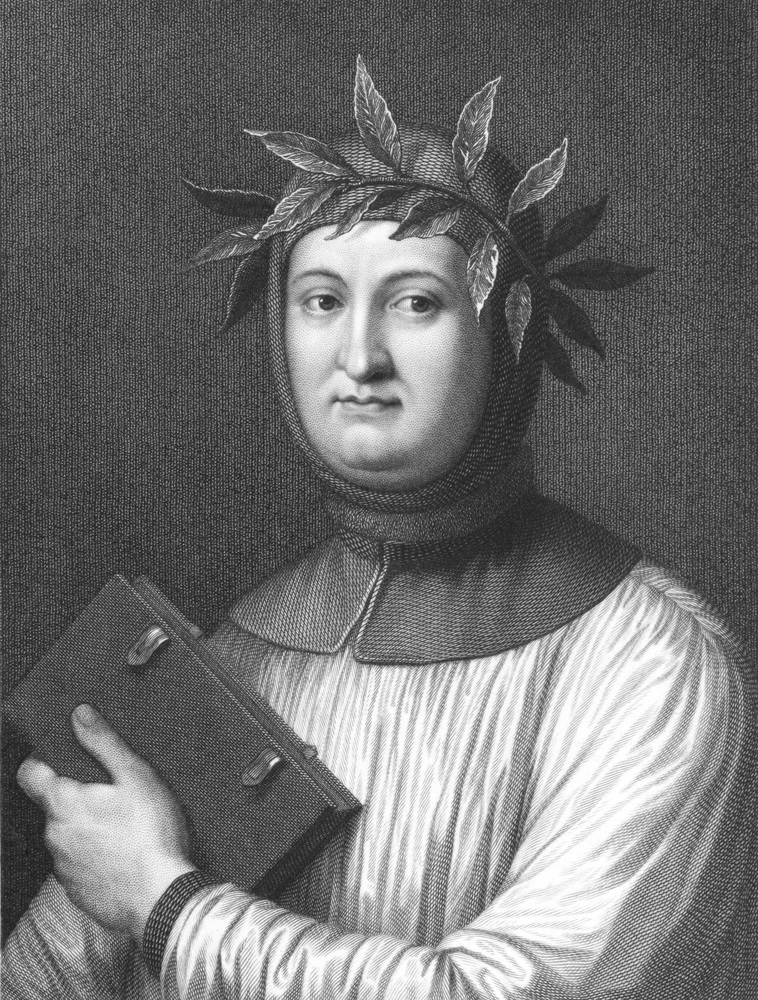
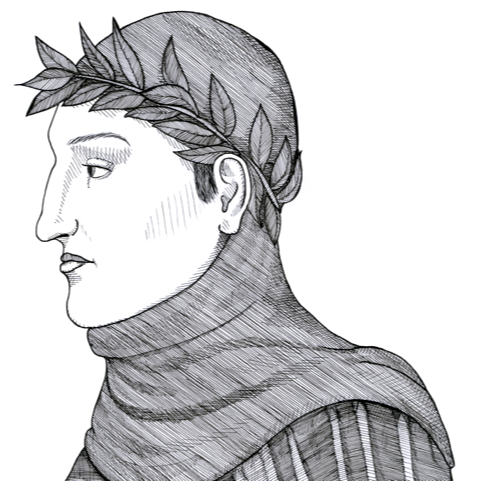
INTRODUCTION AND BIOGRAPHYHis reputation.Few names in literature have been more widely and permanently distinguished than that of Petrarch. Crowned with the laurel upon the Capitol at Rome as a great poet and historian, honoured above all others of his time, the chosen guest, companion, ambassador, and adviser of prince, pontiff, king, and emperor, he has come down to us after six centuries as second only to Dante among the five great classic authors of Italy and as worthy of the companionship of Homer, Virgil, Horace, Cervantes, Shakespeare, Milton, and Goethe on the world’s roll of fame. He was one of the great poets, and yet, except to those who are conversant with the Italian language, Petrarch is little more than a bright name. Few have read his works. Doubtless, much of his fame is due, not to his writings, but to the fact that he was foremost among the great scholars who awakened the world to the knowledge and the literature of antiquity after the long sleep of the Middle Ages. He loved the Roman poets, orators, and philosophers—Virgil, Cicero, Seneca—with a perfect love. He was indefatigable in his search for manuscripts, rummaging in libraries and archives and copying the texts with his own hand, and he discovered among other works the Institutes of Quintilian and some of the letters and orations of Cicero. Of his voluminous writings all except the Canzoniere or Song Book are in Latin, but although these constituted, during his lifetime, his chief title to distinction in scholarship and literature, they are now, with the exception of his personal letters, mostly forgotten. It is those poems in the Italian tongue, which he at one time depreciated, that are still read and admired wherever that tongue is spoken. Its causes. What is there in this collection of poems which gave to their author such widespread and lasting renown? Macaulay insists that their popularity is largely due to a curious tendency of human nature to enjoy in literature that egotism and revelation of personal characteristics and sufferings which we detest in conversation and of which the popularity of Rousseau, Wordsworth, and Lord Byron are such obvious illustrations. The poems of Petrarch are little more than the expression of his feelings upon a subject in which the world is greatly interested—the love of a woman. He was, moreover, if we except Dante, the first distinguished writer of amatory verse in modern times, after woman had assumed that new claim to veneration and respect which had been allowed to her by Christianity, by chivalry, by the tourney, and by the courts of love. Not that Petrarch’s poems were strikingly original. He imitates in many places the formal and artificial style of the troubadours as well as the more natural methods of some of his Italian predecessors, and he engrafts upon this modern poetry much that he has drawn from his rich classical resources. But at their best, the lyrics of Petrarch are indescribably beautiful and entitle him to a high place among the immortals. Petrarch lived, moreover, close to the dawn of Italian literature; he had much to do with giving to the Italian language its present poetical and polished character. ‘No term which he employed is become obsolete, and each of his phrases may be, and still is, written without quaintness.’1 He was followed for more than a century by imitators who were greatly his inferiors. He had also the good fortune, which even Dante did not possess, to have such distinguished commentators and critics as Muratori, the creator of critical and diplomatic history in Italy, and four poets of distinction, Tassoni, Foscolo, Leopardi, and Carducci.2 It is undoubtedly true, as in the case of Dr. Samuel Johnson, that the interest which attaches to the man has greatly enhanced the reputation earned by the merit of his writings. It seems singular, considering this reputation, that except among those who are acquainted with the Italian language, there are comparatively few to-day who have any considerable personal acquaintance with his works. The knowledge of Homer and the Greek dramatists, of Virgil and Horace, of Dante and Boccaccio, of Cervantes and Goethe, is widely disseminated in every civilized country, but the poems of Petrarch are still largely unknown in other lands than his own. The main reason undoubtedly is that the beauty of these poems has not been and perhaps cannot be adequately communicated by any translation.Difficulties of translation. Commentators assure us that ‘there is no other language capable of rendering them’, and that ‘he will never be disfigured by translators without soul and without ears’.1 Even Muratori doubts whether his poetry will ever succeed ‘on the other side of the mountains’.2 Why is it that his songs cannot be readily rendered in another tongue? No kind of literature is more difficult to translate than lyric poetry, and this is because its beauty depends so largely upon its form, including the metre and the rhyme employed. In epic and dramatic poetry (as well as in all prose) other things predominate—the story to be told, the thing to be described, the character to be delineated. The translation of Homer may be almost equally good whether made in rhyme, in blank verse, or in rhythmical prose, and if made in verse, the particular kind of metre is not very essential. But lyric poetry cannot be well rendered in a prose translation nor even in verse which differs very greatly from that of the original. This is no doubt one of the reasons why Pindar, one of the greatest of the Greek poets, is not so widely known as the dramatists. The difficulty of adequate translation is especially great in the case of lyrics in rhyme, and most of all in the case of those where the system of rhyme employed is complex and artificial. Unless the translation reproduces something of this, it cannot faithfully represent the original. Now no lyric poems ever depended more for their beauty upon their form and the metre and the rhymes employed than those of Petrarch. He was not so much distinguished for originality of conception, liveliness of narrative, wealth of imagery or faithful portraiture of character, as for his delicate taste and the exquisite form in which his thoughts are embodied. It is said of him that each of his poems is like an enamel. He revised them again and again, some of his corrections being made years after the first composition, until in his old age he said, ‘I could correct my works and improve them all except my Italian poems, where I think I have reached the highest perfection I can attain.’1 Form of the verse. The translator of Petrarch, therefore, if he would seek to give a true notion of these lyrics, should employ forms of verse and rhyme similar to the original, yet the restrictions which this involves are often fatal to an adequate rendering of the poetry itself. Too many repetitions of the same rhyme are required. The Italian language lends itself to the rhymes demanded by the Petrarch sonnet in a way that English does not, and certain licences are permitted in Italian and forbidden to us; for instance, the so-called equivocal rhymes or the use of identical words with different meanings for rhyming purposes. These were often employed in the Canzoniere. Petrarch himself occasionally varies the form of his sonnets, but all the forms he employs are usually difficult to reproduce exactly in English, and the effect in most cases seems to be quite well retained in the Shakespearean sonnet. I have therefore generally used the latter. In the one sestine translated, the form of the original has been exactly reproduced, although it is extremely artificial and not at all adapted to modern poetry. In two of the madrigals I have followed the original metre exactly. In the canzoni the original form has in some cases been closely, and in one or two instances exactly imitated. In the ‘Hymn to the Virgin’ this is the case except that the seventh and tenth lines, although they rhyme with each other, do not also rhyme with the third and sixth as they do in Italian. There seemed no object in giving this double assonance, and the stanza is quite as harmonious in English without it. Methods of translation. In the celebrated canzone ‘Clear, fresh, sweet waters,’ more liberty has been taken, since the poetry of this wonderful ode would be too greatly cramped by attempting to translate it in the exact metre of the original. The same is true of some of the other canzoni. In the original those vary considerably in form, but the following rules are observed. The lines are either of eleven or seven syllables each (rendered in English by the iambic pentameter or trimeter), and each stanza corresponds with the others in rhymes, measures, and pauses. The canzoni must contain no more than fifteen stanzas (they usually contain not more than seven) and the stanza must have no more than twenty lines (usually it has about fourteen), and the poem terminates with a conclusion or ‘envoi’ containing fewer lines than the other stanzas, and in which the poet addresses his own ode. ‘It rarely happens’, says Sismondi,1 ‘that this addition, which brings the poet himself upon the scene, does not destroy, with some trifle of vanity or gallantry, the impression made by the rest of the poem with its loftier thoughts and more lyrical movement.’ Some of Petrarch’s concluding stanzas, however, are exceedingly graceful and appropriate. BIOGRAPHY1304. Birth of Petrarch.Francesco Petrarca was born at Arezzo, Italy, July 20, 1304. He was the son of Ser Petracco di Parenzo, a notary of Florence, and Eletta Canigiani, his wife. On January 27, 1302, in the struggle between Guelphs and Ghibellines, or between the ‘Blacks’ and ‘Whites’, as they were then called, the former finally triumphed and banished from Florence some six hundred of their leading adversaries. Among these were the poet Dante and the notary Petracco.1 Some of the exiles fled to Pistoia, some to Pisa, some to Arezzo. Among the latter were the notary Petracco and his wife. After a period of about two years and a half, the ‘Whites’ attempted to recapture Florence and a small detachment actually entered the town, but owing to a succession of blunders the attempt failed. It was on the very day of this attack, in which his father took part, that Petrarch was born. Early life at Incisa. But the child did not remain long at Arezzo. In the little city of Incisa, south-east of Florence, the notary possessed a piece of property which had escaped confiscation. His wife was not included in the decree of banishment, and seven months after his birth, the boy was taken thither by his mother, and was almost drowned in the Arno on the way. Despite the decree of banishment, the husband and wife were sometimes together, for two other children were born to them at that place, one who died in infancy and one Gherardo, born in 1307. The family were reunited in 1312 in Pisa, where the father was then established in business.1312. Pisa. In the following year, however, the notary determined to leave Italy and seek his fortune beyond the Alps, at Avignon.Avignon. Pope Clement V, who had wandered from place to place, was then at that city, although it had not yet been established as the permanent seat of the papal court. On the way thither the vessel which carried the notary and his little family narrowly escaped shipwreck near Marseilles, and Petrarch was filled with an aversion and terror of the sea from which he never recovered. Avignon at this time was a constituent part of the earldom of Provence, and King Robert of Naples was its hereditary lord. It was a city situated upon a bluff on the east bank of the Rhône, and, as Petrarch afterwards wrote to Guido Settimo, his youthful friend, ‘The town was small for the Roman pontiff and the Church which had but newly wandered with him thither, at that time poor in houses and overflowing with inhabitants. Our elders determined that the women and children should move to a neighbouring spot. We two, then boys, went with the others, but were sent to a different destination, namely, to the schools of Latin.Carpentras. Carpentras was the name of the place, a small city, but the capital of a little province. Do you remember those four years? What happiness we had there; what safety, what peace at home, what liberty abroad, what leisure, and what silence in the fields!’1 1312. Convenevole. One Convenevole, a native of Prato, near Florence, who had also emigrated to Provence, was Petrarch’s schoolmaster, and instructed the boy, first in reading and afterwards in rhetoric and Latin. In this school, where many who were subsequently distinguished received their education, Petrarch was the favourite of his master, for he afterwards writes,2 ‘Cardinal Giovanni, of blessed memory, used to joke with him, for he delighted in the conversation of this simple old man and excellent grammarian, and would ask him when he came to visit him, “Tell me, master, among so many great scholars of yours whom I know you love, is there some place for our Francesco?” And he, with his eyes full of tears, either kept silence or went away, or, if he could speak, would solemnly swear that he had never loved any of them all so much as poor wretched me. ‘As long as my father lived he helped him generously, for poverty and old age, importunate and difficult companions, were pressing on him. After my father’s death, he placed all his hopes on me. But I, albeit little able, feeling myself nevertheless bound by faith and duty, helped him to the utmost of my resources, so that, when money fell short (as was frequent) I succoured his poverty among my friends by standing surety, or by prayers, and with the usurers, by pledges. Thousands of times he took from me for this purpose books and other things, which he always brought back to me until poverty drove out fidelity. Hampered more than ever, he treacherously took from me two volumes of Cicero, one of which had been my father’s and the other a friend’s, and other books, pretending that they were necessary to him for a work of his. For he used daily to be beginning some book, and he would make a magnificent frontispiece and a consummate preface (which, although it stands first in the book, is wont to be composed last), and then he would transfer his unstable imagination to some other work. But why do I thus prolong the tale? When the delay began to arouse my suspicions (for I had lent him the books for study, not to relieve his indigence), I asked him point blank what had happened to them, and on hearing that they had been put in pawn, I besought him to tell me who it was who had them, that I might redeem them. Tearful and full of shame, he refused to do this, protesting that it would be too disgraceful to him if another should do what was his bounden duty. If I would wait a little longer he would fulfil his duty quickly. Then I offered him all the money which the transaction required, and this also he refused, begging me to spare him such a disgrace. Though trusting little to his promise, I held my tongue, being unwilling to give sorrow to him whom I loved. In the meanwhile, driven by his poverty, he returned to Tuscany, whence he had come, and I, remaining in my transalpine solitude near the source of the Sorgue, as I was wont to do, did not know that he had gone away, until I knew of his death by the request of his fellow citizens that I would write an epitaph to be placed on the tomb of him whom they had tardily honoured by bearing him to the grave crowned with laurel. Nor afterwards, in spite of every diligence, could I ever find the least trace of the lost Cicero, for the other books mattered to me much less, and thus I lost books and master together.’ It was in this way that the De Gloria of Cicero vanished from the world. Under Convenevole, Petrarch learned to admire that author very greatly. Indeed, he tells us that even before he could understand the meaning of Cicero’s sentences ‘the sweetness and the sonorous sound of the words so held him captive that every other book he read or listened to appeared to him harsh and discordant’. Early visit to Vaucluse. Petrarch’s father was detained by business at Avignon most of the time, but frequently came to see his family at Carpentras, and being there on one occasion with the uncle of Guido Settimo, they determined to visit Vaucluse, a narrow valley where the river Sorgue rushes forth from a cavern in the rock at the foot of a steep and lofty mountain. The boys begged to accompany them, and were put on horseback with a trusty servant who rode behind to protect them. When they reached the beautiful spot, Petrarch, as he afterwards wrote to his friend Settimo, was so impressed by its loveliness that he said to himself, ‘Here is a place most suited to my nature which, if the opportunity be given me, I shall some day prefer to the greatest city.’ 1319. Montpellier. In 1319 Petrarch’s father, impressed with the necessity of giving the boy an education which would enable him to make a living, sent him with his brother Gherardo to the law school at Montpellier not far away. Here, however, Francesco devoted himself not so much to the law as to the great writers of ancient Rome. He had indeed managed to collect a small library of classical authors. His father once visited him unexpectedly, and the poet thus describes what happened. ‘All the books I had been able to collect of Cicero and of some of the poets, as enemies to lucrative study, were in my very sight dragged out of the secret places in which I (fearing what soon came to pass) had hidden them, and committed to the fire as though they were the works of heretics, which spectacle I lamented as though I myself were being cast into the flames.His father burns his books. Then my father, as I remember, seeing me so unhappy, straightway snatched two books, already half-scorched by the fire, and holding Virgil in the right hand and Cicero’s Rhetoric in the left, he held out both to me, smiling as I wept. “Keep this”, he said, “for an occasional solace to your mind, and the other to help you in your law studies.” And being comforted by these companions, so few but so great, I restrained my tears.’1 1323. Bologna. After remaining four years at Montpellier, Petrarch, at the command of his father, went with his brother Gherardo to the University of Bologna (which was then, next to Paris, the most celebrated in the world) in order to continue his studies. Here, too, he attended lectures upon the civil law. While he was at this university he made an excursion with one of his instructors to Venice and saw the pride and prosperity of the republic of the lagoons at its highest point before it became weakened by the destructive wars with Genoa. 1326. After three years at Bologna, the news of their father’s death, which took place April 6, 1326, recalled the two brothers to Avignon. Their mother survived her husband only a short time and died at the age of thirty-eight years. Petrarch wrote her eulogy in a poem of thirty-eight hexameters, one for each year of her life. The slender estate left by Petracco was dissipated by the dishonesty of his trustees, and the two brothers, now in straitened circumstances, appear to have taken holy orders, because it opened to them the best path to a livelihood.1 Early life at Avignon. In such a city as Avignon, however, this did not involve the renunciation of worldly pleasures, and the poet, writing long afterwards to his brother, thus speaks of their habits and their personal vanity: Frivolities. ‘Do you remember that excessive display of most elegant attire which still, I confess, holds me captive, though growing less day by day? That trouble over putting on and putting off, a labour repeated morning and evening; that dread lest when, once arranged, our hair should get loose, or a light breeze should ruffle the elaborate arrangement of our locks; how we fled from advancing or retreating horses lest our perfumed and brilliant raiment should receive any adventitious dirt! Truly how vain are the cares of men, but especially of youths! . . . What shall I say of our shoes? See with how grievous and continuous a war they pressed that which they seemed to protect! . . . What shall I say of the curling irons and the business of our hair-dressing?1326. How often did that labour put off our sleep, and then disturb it! What slave-driver would inflict more cruel tortures than we inflicted with our own hands? What nocturnal scars did we see in the morning in our mirror burned across our red foreheads, so that we, who wished to make a show of our hair, were compelled to cover our faces!’1 1327. Meets Laura. But now an event occurred which controlled the whole course of Petrarch’s life. On April 6, 1327, he first saw the lady Laura in the church of Santa Clara at Avignon, and became enamoured of the beautiful vision. His passion was the inspiration of nearly all his poetry, both during the twenty-one years she lived and more than ten years afterwards. Indeed his hopes of rejoining her in Paradise were expressed in his corrections to one of his ‘Trionfi’ only a few weeks before his death. There is much controversy among his commentators upon the question who this lady Laura really was. The matter is carefully considered in Appendix I. Friends. Petrarch had in Avignon a number of learned and estimable friends—among others, one Soranzio, a celebrated lawyer and the owner of an excellent library, who placed his books at Petrarch’s disposal and lent him a number of valuable works, including some by Varro and Cicero. In return Petrarch copied manuscripts for him. But the most important friendship which he formed was that of James Colonna, son of Stephen, who was the head of the great house of Colonna in Rome.James Colonna. James had been a student at Bologna while Petrarch was there, but their acquaintance had not ripened into intimacy until they met again at Avignon. 1328. James Colonna had won the favour of John XXII, who was then pope, by the following circumstance. On January 17, 1328, King Louis of Bavaria, in spite of the opposition of the Holy See, was crowned as emperor, and on April 18, in an assembly which he had illegally summoned, he caused the pope to be denounced as a heretic and Antichrist. Four days later, the young Colonna, who was a papal chaplain and canon of the Lateran, suddenly appeared with four masked retainers on the place in front of the church of San Marcello in Rome, read to the multitude there assembled a papal bull against the emperor and his adherents, and offering to maintain with his sword the truth of the accusations therein contained, with his own hands he nailed the bull to the door of the church. Thereupon he mounted his horse and rode away with his companions, and the armed troops of the emperor were unable to capture him. The pope rewarded this bold deed by bestowing upon him the bishopric of Lombez, a little city south-west of Toulouse on one of the northern spurs of the Pyrenees.1330. Journey to Lombez. In the spring of 1330, the new bishop prepared to visit his diocese and invited Petrarch to go with him.1 Petrarch attributed his invitation partly to the keen interest which the bishop took in the poetry of the country. A halt was made at Toulouse. This city was the literary centre of the troubadours whose poetry, although then in its decline, was still held in honour.Troubadours. 1323. In 1323, ‘The Gay Company of the Seven Troubadours’ of that city wrote a circular letter in Provençal verse to the various poets of Languedoc inviting them to come to Toulouse on May 1, 1324, with their productions, and promising to give a golden violet to him whose verses should be considered the most worthy of the prize.1324. The poets appeared on the day appointed, the prize was given to Arnaud Vidal for a poem on the Blessed Virgin, and the magistrates, wishing to perpetuate these contests, promised to distribute every year the same prize at the expense of the city.2 1330. Petrarch has been called ‘the first of the humanists and the last and greatest of the troubadours’. He is indebted to the latter for many of his metres and systems of rhyme. A number of his metaphors, similes and conceits are taken from their poems, and in some places he has imitated their style, transforming it, however, into something far better than the original. While there is no direct evidence, it is probable that he acquired much of his knowledge of their poetry upon this journey. Socrates and Laelius. On the way from Toulouse to Lombez the weather was bad and the roads frightful. Petrarch found the country and the manners of the people rude and unattractive, and yet he afterwards spoke of his happiness during his sojourn, and it was at Lombez that he formed two of his most lasting and intimate friendships. One was with Lewis of Campinia, a Fleming, whom the poet called ‘Socrates’ and to whom he dedicated long afterwards his ‘Familiar Letters’. The other was with Lello Stefani, a Roman, whom Petrarch called ‘Laelius’ after the name of the follower and companion of his hero, Scipio Africanus. The Colonnas. When the poet returned to Avignon from Lombez, in the fall of 1330, the bishop presented him to others of his family: to his brother, Cardinal John Colonna, and later to his father, Stephen, who came to Avignon in 1331 to visit his two sons; also to Stephen’s brother, John of San Vito, lord of Gensano, who had travelled in Persia, Arabia, and Egypt, but whose passion for the Eternal City was shared by the young poet and formed a close bond of sympathy between them.1331. Petrarch soon entered the service of Cardinal Colonna and became a member of his household. He wrote of him long afterwards in his ‘Letter to Posterity’: ‘I lived under him for many years, not as under a master but a father, nay not even that, but as with a most affectionate brother or indeed as if I had been in my own home.’ The patronage of the powerful house of Colonna did much to advance the fortunes of the young poet. 1333. Paris and the Netherlands. Nothing in Petrarch’s character was more marked than his eagerness to see new things, and in the spring of 1333 he set out on his first important journey, visiting Paris and the Netherlands. Paris was then the first seat of learning in Europe. Here Petrarch enjoyed the congenial society of scholars—of Robert de’ Bardi, chancellor of the University, and of the Augustinian monk, Dionysius, professor of divinity and philosophy, who became the poet’s intimate friend and probably his confessor.Dionysius. Petrarch confided to him his passion for Laura. Dionysius counselled him to struggle earnestly against it, and gave him a small but beautiful manuscript of the Confessions of St. Augustine for his instruction. From this time began the struggle in Petrarch’s soul between his religious convictions and his passion, a battle which remained undecided for many years. St. Augustine, who was a scholar like himself, was Petrarch’s favourite among the Fathers of the Church. This book of confessions being easily portable, was constantly with him on his journeys; he often referred to it, and its influence appears in one of the most important of his works, The Secret, containing his own similar confessions in the form of a dialogue.1 After leaving Paris, Petrarch visited Ghent and other places in Flanders; Brabant, famous for woollen manufactures and weaving, and Liège, where he went book-hunting and discovered two orations of Cicero, of which he transcribed one and got a friend to copy the other, though ‘ink was almost impossible to obtain, and what there was, was as yellow as saffron’. 1334. Cologne. Thence he visited Aix-la-Chapelle, which had been the capital of Charlemagne’s empire, and having bathed in the warm waters of its springs, he proceeded to Cologne. ‘It happened to be the vigil of St. John the Baptist’, he writes, ‘when I arrived, and it was near sunset. According to the wish of some friends of mine (for I have friends here whom my fame rather than my merit has procured for me), I was immediately conducted from the inn to the edge of the river to behold an extraordinary sight. Nor was I disappointed. All the river bank was covered with an immense and splendid concourse of women. I was astonished! Good God! what lovely forms and faces! And what dresses! Whoever had been heart-free must have fallen in love with one of them. I had taken my stand upon a bit of rising ground from which one had a good view of what was going on. The crowd was unbelievable and yet there was no disorder. I saw them all, half hidden by the sweet-scented grass, joyously turn up their sleeves above the elbow and bathe their hands and white arms in the stream, holding pleasant talk in their foreign tongue.’1 Petrarch asked the meaning of all this, and was informed that it was a common belief that any misfortunes impending during the coming year would be washed away in the stream. Ardennes. On his return to France he traversed alone the Forest of Ardennes, and this, too, in time of war. ‘It was already known to me from books,’ he writes, ‘and is a truly wild and dreadful place, but, as they say, God takes care of the unwary.’2 When he reached Lyons he was greatly disappointed to learn that the Bishop of Lombez, with whom he was to go to Rome, had already set out alone for that city, and Petrarch wrote him a letter of bitterreproaches, but learned afterwards that the bishop had been called thither suddenly to support his family in a critical feud which had broken out with their hereditary enemies, the Orsini. Petrarch was compelled to renounce his journey and to resume his wonted literary occupations in the house of the Cardinal Colonna at Avignon. In December 1334, Pope John XXII died and was succeeded by Benedict XII. Petrarch addressed to this pontiff two poetical epistles urging him to restore the Holy See to Rome, and the pope (no doubt at the instance of the Colonnas) bestowed upon the poet the office of Canon of Lombez.Canon of Lombez. This was his first preferment in the Church. Although Petrarch had renounced the profession of the law, yet this year he was unexpectedly called upon to become an advocate and he accepted the task. Orlando Rossi had been tyrant of Parma, and Mastino della Scala, lord of Verona, had driven him from the government of that city and confided it to Guido da Correggio. Rossi appealed to the pope, and Correggio sent his brother Azzo, with William of Pastrengo, to defend his claim to the city before the papal consistory.Azzo da Correggio. Azzo, young, handsome, and a friend of letters, though an unprincipled man, won the favour of Petrarch, and secured his services. They were successful. The Scaligers were confirmed as lords of the city and Correggio continued to administer its affairs. Azzo and Pastrengo remained for many years intimate and devoted friends of the poet. 1336. Mont Ventoux. In April 1336, Petrarch with his brother, Gherardo, did a thing quite unusual in those days—they climbed for pleasure and curiosity a mountain not far from Avignon, called Mont Ventoux, an isolated peak some 6,200 feet in height. The ascent was rough and difficult, but the summit gave wonderful views of the Alps, the Rhône, and the Mediterranean. 1336. Mont Ventoux. Petrarch thus describes, in a letter to his confessor, Dionysius, what he saw and how he felt. ‘The highest peak of all’, he says, ‘is called “The Grandson” by a sort of contradiction, for it seems rather to be the father of all the mountains in the neighbourhood. There is a little plot upon the summit, where we were all very glad to sit down. . . . At first, I was so affected by the unaccustomed spirit of the air, and by the free prospect, that I stood as one stupefied. I looked back; clouds were beneath my feet. I began to understand Athos and Olympus since I found that what I heard and read of them was true of a mountain of far less celebrity. I turned my eyes to that Italian region to which my soul most inclines and the great rugged Alps seemed quite close to me, though they really were at a great distance. I confess that I sighed for that Italian air, more sensible to the soul than to the eyes, and an intense longing came upon me to behold my friends and my country once more. Then a new reflection arose in my mind, I passed from place to time. I recollected that on this day ten years had elapsed since I terminated my youthful studies in Bologna, and, O immortal God! O immutable Wisdom! how many changes had that interval witnessed!1 . . . I wished to recollect my past uncleanness, and the carnal corruptions of my soul, not because I love them, but because I love Thee, O my God. I no longer love what I used to love; nay, that is not true; I do love still, but with more modesty and a deeper melancholy. Yes, I still love, but unwillingly, in spite of myself, in sorrow and tribulation of heart.1 . . . I could very clearly see the mountains about Lyons on the right, and on the left the Bay of Marseilles, which is distant some days’ journey. The Rhône flowed beneath our eyes. But whilst I was admiring so many objects of the earth, and my soul rose to lofty contemplations by the example of the body, it occurred to me that I would look into the book of Augustine’s Confessions, which I owe to your kindness, and which I generally carry about with me, as it is a volume of small dimensions, though of great sweetness. I opened it at a venture, meaning to read whatever might present itself, for what could have presented itself that was not pious and devout? The volume opened at the tenth book. My brother was expecting to hear the words of Augustine from my lips, and he can testify that in the first place I lighted upon it was thus written: “There are men who go to admire the high places of mountains, the great waves of the sea, the wide currents of rivers, the circuit of the ocean, and the orbits of the stars, and who neglect themselves.” I confess that I was amazed; I begged my brother, who was anxious to hear more, not to interrupt me, and I shut the book, half angry with myself, that I, who was even now admiring terrestrial things, ought already to have learnt from the philosophers that nothing is truly great except the soul.1336. Mont Ventoux. I was sufficiently satisfied with what I had seen upon the mountain, and I turned my eyes back into myself, so that from that hour till we came to the bottom, no one heard me speak. . . . You see, most beloved father, that there is nothing in me which I desire to conceal from your eyes, since I not only disclose to you my whole life, but even my individual reflections. Father, I crave your prayers, that whatever in me is vague and unstable may be strengthened, and that the thoughts I waste abroad on many things, may be turned to that one thing, which is true, good and secure. Farewell.’1 First Journey to Rome. At the end of this same year, 1336, Petrarch was able to set out upon his journey to Rome, a city which had long been the object of his enthusiastic devotion. On his way thither he halted for about three weeks, on account of the dangerous condition of the roads, at Capranica, thirty miles away, where he was the guest of Count Orso del Anguillara, the husband of Agnes, sister of the Bishop of Lombez. The bishop joined him here on January 26, 1337, and they presently started for Rome accompanied by a troupe of a hundred horsemen to protect them from the hostile Orsini and from the robbers who infested the country. During his stay in Rome, he visited the aged Stephen Colonna and wandered about the city under the guidance of his brother John of San Vito. The Baths of Diocletian used to be their favourite restingplace, and they would climb to its vaulted roof to enjoy the prospect and discuss together the history of the glorious past and the ignoble present of the Eternal City. Journey to the English Channel. In the month of August the poet had returned to Avignon. In the interval it would appear that he again visited Lombez, where he now had a canonicate, and from a poetical letter to the Bishop of Lombez about this time it would seem that he had made a sea-trip to some point from which he could see ‘the mountain hardened by Medusa’s eye’, that is, some part of the Mount Atlas chain, and proceeding northward came to the place ‘where the swollen wave of the British sea wears away with its tide the shores that stand doubtful which shall receive its stroke’. The allusions to this journey are so obscure, however, that many critics believe it to be imaginary. Vaucluse. Petrarch had always an abhorrence of the bustle and confusion of the city, and he especially detested Avignon, which he called Babylon and considered as the abode of every foul and wicked thing, so he determined to seek another home. He says long afterwards, in his ‘Letter to Posterity’, ‘I looked for some retreat to which I could escape for shelter, and at fifteen miles from that city is the very small but solitary and pleasant valley which is called Chiusa (Vaucluse), where, queen of all fountains, the Sorga gushes forth.1337. Vaucluse. Charmed by the beauty of the place, I brought my books thither and there fixed my abode.’ Jerrold thus describes this wonderful valley:1 ‘It is shut in by limestone rocks, one of which rises so tall and sheer at the end of the defile as to appear like the impassable gateway of some giant’s prison. Before we have advanced thus far, however, we are in a land of fruit-trees and gardens, through which the river wins its rapid, turbulent way, and as we learn from Petrarch, often holds its own against the gardeners, destroying in one night the work of months. As we proceed, figs and mulberries, vines and olives, give place to a growth of small shrubs, to the box and the ilex, that wizard tree which seems to have woven into its branches the immemorial magic of the world. The valley narrows, the aspect becomes more threatening, we have reached the imprisoning barrier whose arching pent-roof seems to frown upon us, and lo! beneath it is the famous speco, the grotto of the fountain of the Sorgue. The water is wonderfully dark in hue; no one seems to satisfy himself in describing its colour; it is not green, or violet, or blue, or black; it seems to be as elusive as the eyes of Laura, and perhaps best corresponds to Shelley’s ‘firmament of purple light’; it wells up pure and still into an untroubled lake, and, when it has reached the brim, it overflows and rushes on its impetuous course. The forbidding sternness of the grotto, the mysterious calm of the rising water, the force and fury of the torrent, the austere hillside, gradually lending itself to cultivation, and dimpling down the valley, almost a poem in itself, was surely no inadequate setting for a poet’s soul.’ In this valley Petrarch now lived, devoting himself in part to the studies of which he was so fond and in part to the enjoyment of nature, a simple, comfortable, and idyllic life which he himself has repeatedly described. ‘In the middle of the night’, he says, ‘I arise. In the early morning I leave the house and think, study, read, and write under the open sky just as if I were at home. So far as is possible I keep sleep from my eyes, softness from my body, the desire of the senses from my soul, and indolence from my work. I wander around for whole days upon the sunny mountains and through the valleys and grottos, fresh with dew.’1 And again (this is written long afterwards): ‘I never see the face of a woman, except that of my bailiff’s wife, and if you saw her, you might suppose yourself to be looking on a patch of the Libyan or Ethiopian desert. ’Tis a scorched, sunburnt countenance, with not a trace of freshness or juice remaining. Had Helen worn such a face, Troy would still be standing; had Lucretia and Virginia been thus dowered, Tarquinius had not lost his kingdom, nor Appius died in his prison. But let me not, after this description of her aspect, rob the goodwife of the eulogy due to her virtues. Her soul is as white as her skin is swarthy. . . . There never was a trustier, humbler, more laborious creature. In the sun’s full blaze, where the very grasshopper can scarce bear the heat, she spends her whole days in the fields and her tanned hide laughs at Leo and Cancer. At evening the old dame returns home, and busies her unwearied, invincible little body about household work, with such vigour that you might suppose her a lass fresh from the bedchamber. Not a murmur all this time, not a grumble, no hint of trouble in her mind, only incredible care lavished on her husband and children, on me, on my household, and on the guests who come to see me, and at the same time an incredible scorn for her own comfort. . . . Well, this is my eyes’ discipline. What shall I say of my ears? Here I have no solace of song or flute or viol, which, elsewhere, are wont to carry me out of myself; all such sweetness the breeze has wafted away from me. Here the only sounds are the occasional lowing of cattle and bleating of sheep, the songs of birds, and the ceaseless murmur of the stream. What of my tongue, by which I have often raised my own spirits, and sometimes perhaps those of others?Life at Vaucluse. Now it lies low and is often silent from dawn to dusk, for it has no one except me to talk to. As to my gullet and belly, I have so disciplined them, that my herdsman’s bread is often enough for me, and I even enjoy it, and I leave the white bread, brought me from a distance, to be eaten by the servants who fetched it. To such an extent does custom stand me in the stead of luxury. . . . Here I have fashioned me two little gardens, the most apt in the world to my fancy and desire; should I try to picture them to you, this letter would be long drawn out. In a word, I think the world scarce holds their like, and if I must confess my womanish frivolity, I am in a huff that such beauty should exist anywhere out of Italy. The one I always call my Transalpine Helicon, for it is bowered in shade, made for study as for nothing else, and consecrated to my Apollo. It lies close to the pool in which the Sorgue rises, beyond which is only a trackless crag, quite inaccessible except to wild animals and birds. My other garden lies close to my house; it has a better-tilled appearance and Bromê’s nursling (Bacchus) has his favourite plant there. This, strange to say, lies in the middle of the beautiful swift river, and close by, separated only by a little bridge at the end of the house, hangs the arch of a grotto of natural rock, which under this blazing sky makes the summer heat imperceptible. It is a place to fire the soul to study, and I think not unlike the little court where Cicero used to declaim his speeches, except that his place had no Sorgue flowing by it. Under this grotto, then, I sit at noon; my morning is spent on the hills, my evening in the meadows, or in that wilder little garden, close to the source where design has embellished nature, where there is a spot in mid-stream overshadowed by the lofty crag, a tiny spot indeed, but full of lively promptings by which even a sluggard soul may be goaded to high imaginings.’1 Philip of Cabassoles. Petrarch had a neighbour who came from time to time to a castle on the heights overlooking Vaucluse, whom he often visited and to whom he soon became bound by ties of intimate friendship. This was Philip of Cabassoles, the Bishop of Cavaillon, a town not many miles away. Literary Work in Vaucluse. It was at Vaucluse that Petrarch’s most important literary work was done. Here he began his ambitious Latin epic Africa, in honour of Scipio Africanus. It was at this place that a great part of his letters were written, as well as nearly all his eclogues. Here he conceived his project of a great work on the ‘Illustrious Men of Roman History’. It was here that he developed the outlines of his work on the ‘Repose of the Cloister’ and ‘Concerning the Life of Solitude’. All these productions were written in Latin, but it was also here that the greater part of his Italian love songs were composed, since the solitude by which he had hoped to heal his passion had inflamed it anew.11337. From 1337 to 1353, although his residence was interrupted by a number of voyages and sojourns in other places, Vaucluse was Petrarch’s home. It was in this same year 1337 that Petrarch became the father of a boy to whom he gave the name John. Who was the boy’s mother is unknown. We learn through the bull of Pope Clement VI, by which, in September 1348, the child was made legitimate, that she was an unmarried woman, and it is probable she was the same by whom he had a daughter in 1343. From what he says in his ‘Letter to Posterity’ it would seem that his heart was not engaged. She may have been a woman of low origin with whom he became associated in Avignon. There is no evidence that she ever came to Vaucluse. The connexion seems to have attracted little attention, doubtless because such relations were common enough at this time even among the clergy, a mistress having been attributed to Pope Clement VI himself. Petrarch’s bitterest enemies never appear to have criticized or censured him on this account. Robert of Naples. 1338. As we have already seen, Robert, King of Naples, was Count of Provence, and therefore hereditary lord of Avignon and Petrarch’s suzerain. He was a lover of literature and a patron of learning. He had lived in Avignon from 1318 to 1324, while Petrarch was at Montpellier and Bologna, and in 1338 he sent to Petrarch an epitaph which he had composed upon his niece, the widow of King Louis X of France, and he asked Petrarch’s judgement upon it. The reply of the poet was full of enthusiasm if not of fulsome flattery. ‘An unwonted gleam’, he said, ‘has dazzled my eye. Blessed the pen to which such words were entrusted. What shall I first admire, the classical brevity of expression, the sublimity of thought, or the godlike charm of its eloquence?’1 1339. It must be said in justice to Petrarch, that to the end of his life he remained an extravagant admirer of King Robert. It is likely that Dionysius, Petrarch’s confessor, had first called Robert’s attention to the poet. Dionysius had stopped at Avignon on his way from Paris to Naples, where he afterwards lived at the court of this king, who in March 1339 appointed him Bishop of Monopoli. The agency of the bishop is also suspected in the subsequent efforts made (in which the poet himself participated) to obtain for Petrarch the laurel crown which was offered to him the following year. The Laurel Crown. The Roman emperor Domitian, in imitation of the Panathenaea and the Pythian festivals,2 had decreed that every five years a contest in musical and gymnastic arts should be held, including literature and poetry. These festivals continued as long as the western empire existed, and a dim recollection of the coronation of the poets on the Capitol was preserved during the Middle Ages, and was renewed during the thirteenth century in laurel crowns (substituted for the oak leaves of Domitian), which were conferred upon poets at various times and places. This was the commencement of a title that is still perpetuated in the designation of a poet laureate in England. Petrarch had an intense longing for this laurel crown. Intertwined with this desire was his love for Laura, with whose name the laurel seemed in his imagination to be identified. He founded his claims to this classic honour principally upon his Latin productions, especially upon the great epic Africa, on which he was then working. But very little of this epic had yet been written, and, as he himself afterwards confessed, his reputation was hardly ripe for such an honour. At first he desired to receive this crown from King Robert, and wrote to Dionysius in 1339 that he would not wish it bestowed by any other hand, adding, ‘If I am of sufficient merit to be invited, well; if not, I shall pretend to have heard something, or as doubting the sense of the letter which he sent me in his supreme and most kindly condescension toward an unknown man, I shall go into those parts that I may seem to have been invited!’1 Dionysius at Naples, the Colonna family at Rome, and his friends in Paris, all appear to have been enlisted in the cause, and the result was that in September 1340, while he was wandering alone in a meadow at Vaucluse, he received a letter from the Roman Senate inviting him to be crowned in that city, and at six in the evening of that day a messenger from Paris brought a letter from Robert de’ Bardi, chancellor of the University, inviting him to receive the laurel in that city.1340. He conferred with Cardinal Colonna as to which invitation he should accept. Naturally Colonna urged the claims of Rome, which was Petrarch’s own preference, and he accordingly accepted the invitation of the Senate, and proceeded to that city, but by way of Naples, where he visited King Robert. He thus describes what occurred.1341. ‘When we had talked together of a thousand different things, I showed him my poem Africa, which pleased him so much that he begged me, as a singular favour, to dedicate it to him. I could not but consent to such an honourable request, nor indeed had I any wish to refuse. And for that which was the object of my journey, he fixed a day on which he examined me continuously from midday till evening.Examination at Naples. And because the time was too short for the many matters which arose for discussion, he continued the examination during the two following days. So for three days he put my poor abilities to the proof, and at last pronounced me worthy to receive the laurel. He offered it to me there in Naples, and earnestly besought me to accept it there, but the love of Rome had more power over my mind than even the august wishes of that great king.’1 Therefore Petrarch resumed his journey to Rome. King Robert would have accompanied him, to place the crown upon his head with his own hand, but the infirmities of age forbade it. When Petrarch left Naples, the king kissed him, and threw around him his own purple mantle, so that the poet should have the appropriate apparel for the ceremony. The crown was placed upon his head by the Senator Orso del Anguillara, upon the Capitol, on Easter Day, April 8, 1341, and a contemporary writer thus describes the event.The Coronation. ‘Twelve boys arrayed in scarlet, each fifteen years old, and all sons of distinguished nobles and citizens, declaimed many verses composed by Petrarch in praise of the Roman people. After them came six citizens dressed in green cloth, and wearing wreaths of flowers of various kinds. Then the Senator strode forward, his head decorated with a laurel wreath, and after he had seated himself on the chair in the Hall of the Assettamento, Francesco Petrarca was summoned by trumpet and fife, and advanced clothed in a long garment and cried three times, “Long live the Roman people, long live its Senators, and God maintain it in its freedom;” and then he kneeled before the Senator, who said, “I first crown merit”, and took the wreath from his own head and put it on that of Master Francesco, who declaimed a beautiful sonnet in praise of the brave old Romans, and the festival was ended with great praise of the poet, since the whole people cried, “Long live the Capitol and the poet!” ’11341. Besides the sonnet, which is now no longer extant, Petrarch delivered a short speech describing the difficulties of the art of poetry and its reward, the laurel, possessing and conferring immortality. He was then conducted to St. Peter’s, where he deposited the crown as an offering.2 In his diploma, as Gibbon says, ‘the title and prerogatives of poet laureate are revived after the lapse of thirteen hundred years, and he receives the perpetual privilege of wearing at his choice a crown of laurel, ivy, or myrtle, of assuming the poetic habit and of teaching, disputing, interpreting, and composing in all places whatsoever, and on all subjects of literature’.3 The crown undoubtedly added greatly to Petrarch’s reputation, because it was the recognized symbol of distinction, and it gave him much greater power than he would otherwise have possessed, of disseminating among mankind the ‘new learning’ of which he was the foremost apostle. On leaving Rome, armed robbers fell upon him not far from the walls, and the escaped with difficulty back into the city. On the following day he departed again, protected by a troop of armed men, and from Pisa he wrote an account of the ceremony to King Robert.Parma. Thence he proceeded to Parma, and entered that city with Azzo da Correggio, who, with his brothers, had revolted against the Scaligers, to whom they owed their position, and had assumed the sovereignty of the city themselves. Here Petrarch remained for a year, and continued his work upon his epic Africa with such goodwill that he brought it near its completion.Blind man of Pontremoli. It was at this place that he was visited by an old blind man, who kept a school at Pontremoli, and who was filled with such ardent enthusiasm for the poet that, guided by his son, he followed him to Naples. Petrarch had already left that city, and the blind man then followed him to Rome, but found him gone, and returned home; but hearing afterwards that Petrarch was at Parma, he crossed the Apennines, found the object of his devotion, and for three days never left the poet’s side. It was while he was at Parma that Petrarch lost his early friend, the bishop, James Colonna. On the night of his death the poet had a dream of that event.1342. In January 1342 his confessor Dionysius died at Naples. Although the Correggi treated him with the utmost consideration during his stay, and he was reluctant to leave Italy, he was called back to Avignon, probably by Cardinal Colonna, in the spring of 1342.1342. Or perhaps another motive actuated him. On April 25, Pope Benedict XII died, and Clement VI succeeded him. Petrarch may well have been anxious to acquire the favour of the new pontiff, since his livelihood was largely dependent on papal patronage. The Romans sent an embassy to congratulate Clement on his accession, to solicit the return of the papacy to Rome, and to ask permission for a jubilee in that city in 1350. It is said that Petrarch was made a member of this embassy. This is not certain, but it is known that Cola di Rienzi was its spokesman, and that Petrarch formed his acquaintance while on this mission.Meets Rienzi. The poet also addressed to Clement a long epistle in verse, urging his return to the Holy City; but if he would not, then asking him to restore the churches there, and to celebrate the great jubilee therein. The latter favour was conceded, and the poet appears to have been rewarded for his effort by the grant of the priorate of Migliarino, in the diocese of Pisa. Debauchery in papal court. With the accession of Clement, the appearance of the papal court was greatly changed, and a magnificence and luxury were introduced theretofore unknown. Clement was a great lover of horses, and celebrated for his gallantries. Promotions in the Church went by favour, and were distributed largely by Cécile de Commenges, Viscountess of Turenne, who apparently governed the papal curia in much the same way that Pompadour and Du Barry reigned in the Court of Louis XV. The immoralities which prevailed were afterwards denounced by Petrarch in unmeasured terms, not only in his eclogues and letters, but in three sonnets, the publication of which was subsequently forbidden by the Index. One of these sonnets, Fiamma dal Ciel (written probably between 1347 and 1351), is as follows:
His personal relations with Clement, however, were always friendly. The pope was uniformly kind and generous, whether it was that he did not know of these invectives, or was magnanimous enough to overlook them, or whether it was on account of the feeling of reverence and almost of sanctity which a great poet and scholar at that time inspired. 1342. Returns to Vaucluse. Petrarch betook himself again to his solitude at Vaucluse, where, however, his studies were interrupted by floods of letters from all parts of Europe, and by frequent visits from hosts of admirers.Epidemic of versemaking. A mania for composing poetry became epidemic. Ecclesiastics, artisans, and peasants felt the call of the Muses, and began to write in rhyme, sending their verses to Petrarch for his judgement and criticism. An old man reproached him because his son, misled by the poet’s example, had given up his legal studies and consumed his time in making verses.1 In this same year of 1342 Petrarch’s brother Gherardo abandoned his worldly life, and entered the Carthusian monastery at Montrieu, near Marseilles.Gherardo enters convent. The occasion for this step is said to have been the death of the woman to whom he had been deeply devoted. Petrarch appears to have sympathized with his brother’s misfortune, and one of his tenderest sonnets2 is believed to have been inspired by this circumstance. 1343. In January 1343 King Robert died, leaving as his heir his granddaughter, Joanna, a girl of sixteen, married to her cousin Andrew, son of the King of Hungary, also a minor. A wild factional struggle broke out in Naples concerning her guardianship, and the pope, as the over-lord of the kingdom, selected Petrarch, as his representative, to go to Naples and maintain the rights of the Papal See.Embassy to Naples. Petrarch found everything in confusion and disorder. A crafty Franciscan monk, the former teacher of Andrew, ruled the kingdom in the name of the youthful pair. Cruel gladiatorial sports were openly given, from which Petrarch fled in horror; crime was rampant everywhere; a dreadful storm wrought havoc in the harbour and the city. Near the close of the year he departed from Naples, having failed to accomplish the mission which the pope had entrusted to him. He did not return at once to Avignon, but stopped on the way at Parma, and remained there more than a year.Parma. Second visit. 1344. During his stay there were quarrels among the Correggi, and in November 1344 the lords of Milan and Mantua laid siege to the city. For some three months Petrarch endured the discomforts of a beleaguered town, and then determined to escape.1345. On the night of February 23, after passing successfully through the camp of the besiegers with a small unarmed escort, he was attacked by a troop of robbers and was only saved by flight. His horse fell and threw him, the guides lost their way, and Petrarch, wounded from the fall, spent the night upon the ground in the midst of a raging storm. By this storm, however, his little company avoided an ambush which had been prepared for them, and the next day proceeded over the mountain paths to Modena, and thence to Bologna. Verona. Letters of Cicero. Later he visited Verona, at which place he had the good fortune to find in a church library a valuable manuscript of the letters of Cicero, probably his letters to Atticus.1 He immediately made with his own hand a copy of this new treasure. Near the close of this year we find him again in Vaucluse, where he writes to Cardinal Colonna, giving a lively description of his struggles with the water-nymphs, who had broken a dam he had built for the protection of his garden. 1346. Refuses papal secretaryship. In 1346 Pope Clement offered him the influential and lucrative position of papal secretary, but the poet declined on the ground that he could not give up his liberty, as he would have to do if he accepted such a place. The pope was not offended at his refusal, but bestowed upon him a canonicate at Parma, and later (probably in 1348) the office of archdeacon in the same city. According to the ecclesiastical custom of the time, it was not necessary that these offices should be personally administered by those who held them. They were sinecures granted by the pope as a pure matter of patronage. Rienzi inspires Petrarch. We have seen that Petrarch first met Cola di Rienzi when the latter had come to Avignon, in 1342, as the spokesman of the embassy to Clement VI. It was during this visit that Rienzi first inspired the poet with his own ardent zeal for the regeneration of Rome, until Petrarch was moved to tears by Rienzi’s picture of the miseries and oppressions inflicted upon the Eternal City, the city that, as they both believed, had been designed by God to be the capital of the world, the pope and emperor being the representatives, the one of its spiritual, the other of its temporal dominion. Petrarch’s mind was fertile soil for the sowing of Rienzi’s propaganda. From his classical studies the poet had imbibed even the prejudices and aspirations of the ancient Romans, until he had almost come to consider as barbarian all things that were not Roman.1 In a letter, written almost immediately after Rienzi’s departure from Avignon, Petrarch says, ‘When I recall to my mind the most holy and weighty discourse which you held with me three days ago . . . I become all enkindled, and am as though I deemed an oracle had issued from the divine sanctuary, and seem to myself to have listened to a god rather than a man. So prophetically did you seem to deplore the present state, nay rather, the downfall and ruin of the republic, so penetratingly to put the fingers of your eloquence upon our wounds, that, as often as the sound of your words returns to my ears in memory, tears rise to my eyes, and grief comes back into my soul. . . . Often, with my mind wavering between one emotion and the other, I say to myself, Oh, if ever! Oh, if it might happen in my days! Oh, if I might be a partaker in such a splendid work and in so much glory!’1 1347. Rienzi becomes Tribune. On May 20, 1347, Rienzi accomplished that remarkable yet bloodless revolution by which it was believed that Rome was to be delivered from the tyranny of its nobles, the old freedom of the city re-established, and all Italy reunited in a single commonwealth. This too was Petrarch’s dream, the dream of united Italy, not realized until five hundred years later, when it became an accomplished fact under Cavour, Garibaldi, and Victor Emmanuel. But it seemed then as if it were on the eve of accomplishment. Rienzi became master of Rome under the ancient and honoured title of Tribune of the People, and caused new ordinances to be established by acclamation for reforming many of the abuses which existed. The domination of the noble houses, with the Colonna and Orsini at their head, had been sheer brigandage. But now every murder was to be punished with death; trials must be completed within fifteen days; guards were to be placed in every part of the city and upon the roads around it; widows and orphans were to be befriended, and cloisters and churches protected by the State; the nobles were forbidden to fortify their dwellings or to give asylum to malefactors. Rienzi demanded a colleague, and chose for that office the vicar of the Pope, in order to conciliate the Holy See. Absolute power was given to the tribunes; the nobles themselves were compelled to swear allegiance to the Commonwealth; strict justice was administered without regard to the rank of the offender; public tranquillity was restored; the cities and communes of Italy were invited to send representatives to a general parliament to consider the peace and freedom of the whole peninsula; the pope himself at first confirmed the election of the two tribunes, and the sovereigns of Europe sent ambassadors to confer with them. Petrarch’s enthusiasm. Petrarch was dazzled by the delightful illusions which these things promised. He sent to Rienzi numerous letters of advice, congratulation, and encouragement. His exasperation against the nobles who had oppressed the city was unbounded. Fearing lest the Romans should again fall under their yoke, he even advised that no quarter be given them, since mercy to them was cruelty to the State. But among these nobles were his own friends of the house of Colonna, of whom he declared at a later time that no princely house in the world was so dear to him, yet added, ‘Dearer to me is Italy, dearer Rome, dearer the public good.’1 He seemed to fancy himself another Brutus, and denounced the Orsini and Colonna families as usurpers and barbarians, the former coming from Spoleto, and the latter from the banks of the distant Rhine. It is easy to see that a continuance of his former relations with Cardinal Colonna would now become impossible. Even his presence at the papal court at Avignon became embarrassing, for the pope soon repudiated Rienzi, whose messenger was beaten and insulted on his way to Avignon. Petrarch determined, therefore, to leave Provence, and betake himself to Italy. 1347. Petrarch leaves for Italy. On November 20, 1347, he set out from Avignon for Rome. But in the very beginning of his journey, news came that things were going ill with Rienzi. His sudden rise to power had turned his head.Rienzi’s follies. He appeared in public with great splendour. He bathed in the porphyry vase where Constantine was baptized; he placed on his head the ‘seven spiritual crowns’; he coined money in his own name; he remained seated while the nobles stood bareheaded before him; he summoned the two claimants to the imperial throne, Louis the Bavarian and Charles IV, that he might decide between them; he demanded that the papal court should return to Rome, and he declared that even the right of proclaiming pope or emperor belonged to the Roman people.1 Petrarch remonstrated, begging Rienzi not to destroy his own work nor tarnish his fame, nor make of himself a spectacle at which his friends must weep and his enemies laugh. ‘I was hastening toward you’, he wrote, ‘with all my heart, but I have changed my plan.’ After a short stay at Genoa he proceeded, not to Rome, but to Parma, and there he awaited the outcome.Parma. Third visit. Rienzi’s troops had won in a fierce fight with the barons, close to the walls of Rome, in which the leading members of the Colonna family were killed, so that the aged Stephen was left almost the only survivor, yet the tribune frittered away his victory in vain triumphant processions, and a month later, after having been excommunicated by the papal legate, he was deserted by the people, when a small band of reactionaries under the Count of Minorbino took possession of the city.Rienzi. His overthrow. Rienzi became panic-stricken, laid aside the insignia of his office, took refuge in the castle of St. Angelo, and thence fled in disguise to Naples, while the nobles re-entered and took their revenge. ‘At least’, said Petrarch, ‘he might have died gloriously in the Capital which he had freed.’2 Two of the Colonnas who had been killed in the fight with Rienzi had been friends of Petrarch, and after many months’ embarrassing delay, urged by his friends, the poet wrote a letter of condolence to the Cardinal which, although beginning with a feeling acknowledgement of all that he owed to his princely patron, continued and concluded like a ‘rhetorical exercise upon death’.1 1354. Five years later, when Rienzi was a prisoner at Avignon, Petrarch urged the Roman people to demand his liberation, which Rienzi afterwards secured, not on the merits of the case, but (as Petrarch relates the incredible tale) because it was rumoured and believed that the tribune was a poet! The papal court was unwilling to destroy a thing so precious! So Rienzi, in 1354, was sent back to Rome with the title of senator, but after four months of unsuccessful administration he was massacred in a tumult of the people, which had been fomented by the barons. 1347. At Parma, Petrarch took possession of the canonicate which had been conferred upon him in that city, and afterwards learning of Rienzi’s overthrow, he determined upon a longer stay, built himself a house, and busied himself with the completion of his Latin epic Africa. 1348. In the beginning of 1348 he went to Verona, where he was the guest of Pastrengo and of Azzo da Correggio, and where, on January 25, he was witness to a terrible earthquake. The Plague. But a more dreadful calamity than this was close at hand. In the beginning of 1348 the plague appeared, brought by merchants out of India through Constantinople. Whole cities were depopulated, fertile districts were laid waste, and the bonds of social order were dissolved. It spread rapidly. As early as January it appeared at Avignon, and lasted for seven months. Those who were attacked generally died at the end of three days. It was at its height in Lent, and during the three days which preceded the fourth Sunday thereof 1,400 persons died in that city.1Laura’s death. Among its victims was Laura. She fell ill, probably about April 2 or 3, and died upon the 6th of that month, as appears from Petrarch’s note on the margin of his manuscript of Virgil, written by him when the news reached him on May 19, on his return to Parma. The note is as follows: Note in Virgil MS. ‘Laura, distinguished by her own virtues and long celebrated in my songs, first appeared to my eyes in the days of my youth, in the year of our Lord 1327, on the 6th day of the month of April, in the church of Santa Clara at Avignon, in the morning hour; and in the same city, on the same month of April, on the same 6th day and at the same first hour, but in the year 1348, that light was withdrawn from the light of day, when I by chance was then at Verona, ignorant, alas! of my fate. But the unhappy news reached me at Parma by the letter of my Lewis, in that year, in the month of May, on the 19th day, in the morning. That most chaste and beautiful body was buried in the Franciscan church, on the same day of her death, in the evening. But I persuade myself that her soul indeed (as Seneca says of Africanus) returned to heaven from whence it came. And it seemed fitting that with bitter sweetness I should write this in mournful memory of the event, and particularly in this place which often comes under my eyes, so that I may realize by frequently looking at it that there ought to be nothing more that will please me in this life, and now since this, my greater bond is broken, that it is time for me to flee from Babylon, and that under the guidance of God I may be moved by this reflection on my most fleeting life, that it will consist (to one who thinks of the past in a clear and manly way) of nothing but empty cares, vain hopes and events that are wholly unexpected.’1 Other friends die. Nor was this the only loss Petrarch sustained during this dreadful year. The pest counted many of his friends among its victims—Robert de’ Bardi in Paris, who sought to bring the poet thither to receive in that city the laurel crown; Sennuccio del Bene, to whom Petrarch had written, and from whom he had received many a sonnet, and who had been his confidant regarding Laura and his love; also Cardinal Colonna, in whose house the poet had so long been an inmate. In spite of their estrangement during the preceding year, Petrarch was deeply affected. Only three of his intimate friends now remained, Settimo, Laelius, and Socrates. The poet could no longer remain at Parma, and he set forth upon his journeys. We find him with the Gonzagas at Mantua, visiting the birthplace of Virgil; at Verona, renewing his companionship with Pastrengo; and in March 1349 at Padua, where James II of Carrara, a type of the Italian tyrant common at that time, had been ruling the city since 1345, after putting to death his cousin Marsilio, who was lawfully entitled to the throne.1349. Padua. James II of Carrara. He was, however, an able ruler, and a patron of literature and the sciences. He had pressingly invited Petrarch to reside at Padua, and had bestowed upon him a canonicate in that city. Petrarch, who could see little evil in those who were personally kind to him, accordingly took up his abode there, and his relations with Carrara soon became those of the most intimate friendship. On June 20 he took possession of his new office, and he made short visits to other places. For instance, he was entertained at a banquet on June 28 by the Gonzagas at their castle of Luzzera, which he describes as ‘a home of flies and fleas, enlivened by the croaking of an army of frogs’. But the time was now approaching for the great jubilee at Rome, and the poet determined to betake himself with other pilgrims to the Holy City.1350. He visited Verona on the way thither, he stopped at Parma during the heat of summer, and in October he paused for a few days at Florence, the city from which his father had been exiled, which he himself had never seen, and into which, according to the decree of expulsion, he was forbidden to enter.Florence. But no one thought of enforcing the prohibition, and among those who came to welcome him was Boccaccio, who was the third with Petrarch and Dante in the great trinity of the founders of Italian literature.Boccaccio. There began an intimacy, the most important in Petrarch’s later years. Here, too, began his attachment to Francesco Nelli, prior of the church of the Holy Apostles in Florence, whom Petrarch nicknamed ‘Simonides’. The Jubilee. On his way from Florence to Rome, Petrarch injured himself so seriously by a fall from his horse, that he was laid up at Rome for a fortnight. Of this visit he writes, ‘It is fourteen years since I first went to Rome from a desire to see its wonders; after a few years’ interval I was drawn there for the second time by the sweet, but perhaps immature desire for the laurel; my third and fourth journeys were occasioned by compassion for my illustrious friends;1 this, my fifth, and it may be my last Roman pilgrimage, is so much happier than the others, as the care of the soul is more excellent than that of the body, and eternal salvation more to be desired than human glory.’ The Colonna family at this time was wellnigh extinct. Stephen was still living, after the death of all his sons, but he had fallen into the dementia that so often accompanies old age. Petrarch did not stay long at Rome among the multitudes of pilgrims that thronged the city.Arezzo. On his return journey he stopped at Arezzo, his native town, where the citizens were delighted to welcome a man who had given such honour to his birthplace, and the multitude marched before him in the street as they would have done if he had been a king. He was shown the house where he was born. ‘A little house,’ he calls it, ‘and one fit for an exile,’ and he was told that the city had forbidden any change to be made in it. Padua. He stopped a short time a Florence, and proceeded thence to Padua, where he found to his horror that his friend James of Carrara had been murdered in his palace by one whom he had made a member of his household. Invitation from Florence. Soon after his arrival in Padua, the government of Florence determined to revoke the decree of exile and of confiscation of Petrarch’s property. An interested motive was behind this tardy act of justice. The Florentines desired to establish a university in their city, and were anxious that it should be honoured by this distinguished poet and representative of the new culture in Italy. The decree of restoration to civil rights was brought to him by his friend Boccaccio, with the invitation to a chair in this new institution of learning. Petrarch wrote an elaborate letter of thanks which, however, was quite indefinite as to accepting the chair, and later the Florentines, finding he did not come, revoked the decree restoring his property! The poet justly observed, that other cities had treated him far better than his own, and he visited Florence no more. Padua had lost its attraction for him now that his friend was no longer living, and although Francesco, the new lord of Carrara, continued toward him the same favourable disposition that his father had shown, yet Petrarch’s restless nature was not inclined to remain in that city.1351. Return to Vaucluse. He resolved to return to Vaucluse, where he had left the greater part of his library. He departed from Padua on the 4th of May, 1351, and on the 27th of June we find him again at his home, in the narrow valley of the Sorgue. Here amid the scenes with which Laura was closely connected, the recollections of the past, and visions of the cherished image which he would see no more in life, again beset him, and destroyed his peace of mind, and many of his most exquisite sonnets and canzoni bear testimony to the depth of his sorrow. Papal secretaryship. It was about this time that another offer was made to him of the position of secretary to the pope. Two cardinals, friends of his, pressed him so earnestly to accept it, that he unwillingly consented. It was always hard for him to say ‘no’. But he wrote the necessary Latin thesis required of candidates as a trial of skill, in such an elaborate and elegant style, that it was considered ‘unfit for the humble and simple correspondence of the Holy See’! and Petrarch, being asked to simplify it, ‘spread the wings of his spirit to lift himself so high as to vanish from the sight of those who would make him a slave.’ He afterwards wrote to his friend Simonides: ‘They wanted to send me to school at my age, to teach me to write in a low and crawling manner.’ And again, ‘I am well pleased that those who thought themselves high up, found I was flying quite above their sphere. But I shall not expose myself another time to the same danger.’1 1352. Quarrel with the physicians. In 1352 Clement fell ill, and Petrarch wrote him a letter filled with flattering and friendly expressions but warning him against his physicians. The pope told his doctors of this, and one of them wrote a personal attack upon the poet, to which he replied, first in a letter filled with abuse, and afterwards in an elaborate polemic denouncing the profession. The medicine of that day was for the most part ignorant quackery, yet for all this, it was a most unedifying squabble in which Petrarch was engaged, quite unworthy of his reputation. His ‘Invectives against a Certain Physician’ were composed in part at Avignon and in part afterwards at Milan. At the latter place the poet had been suffering from the tertian fever, and its effects can be seen in these unfortunate productions. They sound as if a sudden madness had overtaken him. They are filled with vilification, and in one of them occurs a passage which, if it were not inconsistent with the rest of his life and writings, would condemn his character to the charge of unfeeling brutality. For he says, ‘Doctors can no longer deceive and murder the educated, but only the ignorant masses, and there is very little need to weep over the destruction of these.’1 And this from the enthusiast who was sharing Rienzi’s dreams of popular liberty! If the two things are to be reconciled, it must be because Petrarch’s sympathy was for the Roman citizen rather than for the human being. 1352. Resolves to return to Italy. Petrarch’s restless disposition again induced him to depart from Avignon; possibly these controversies hastened his determination. He set forth upon his journey to Italy, November 16, 1352, and stopped on the way at Cavaillon to bid good-bye to his friend the bishop. A terrific storm came on, and after passing a sleepless night and learning that the road to Nice and Genoa was beset with armed bands, he followed the bishop’s counsel and delayed his departure, returning in the meantime to Vaucluse. On December 3, Pope Clement died and Innocent VI succeeded, a pontiff who reformed many of the abuses of the Church, but a man of limited intelligence who had considered Petrarch a sorcerer on account of his intimate acquaintance with the poems of Virgil! Before his final departure, Petrarch determined to visit his brother, Gherardo, in the Carthusian monastery of Montrieu, and there the brothers met for the last time. It was April 26, 1353, before the poet finally left Vaucluse for Italy.1353. On passing through Avignon he did not go to the palace to pay his respects to the pope. Cardinal Talierand urged him not to leave without performing this duty, but Petrarch refused. ‘I feared’, he said, ‘to do him harm by my sorceries, or else that he would do me harm by his credulity.’1 Final departure from Vaucluse. Petrarch appears to have undertaken this final journey to Italy without any specific destination in view. He had already a house at Parma, and possessed a canonicate at that city as well as one near Pisa and one at Padua. His son and some of his dearest friends were at Verona, and at all these places he would have been more than welcome. But when on his way he halted at Milan, he met John Visconti, archbishop and ruler of that city and then the most powerful of the princes of Italy.1353. Milan and Visconti. Visconti saw the advantage of having a man so distinguished in learning and literature as an ornament of his court, and in the most flattering terms he asked the poet as a personal favour to remain at Milan. He anticipated Petrarch’s objection that he desired quiet and an opportunity to work by offering to place at his disposal a house in a retired situation and amid healthful surroundings, close to the church of St. Ambrose and with a delightful view of the Alps, as peaceful a retreat as he could find in the country. Petrarch should be the master of his own time and no service was expected of him, the poet’s presence alone being sufficient honour. His friends remonstrate. Petrarch could not resist these flattering importunities. He yielded and thereby incurred the reproaches of some of his closest friends, for Visconti was a tyrant who ruled his subjects and his dominions with despotic power. That Petrarch should become a satellite at his court was utterly inconsistent with the poet’s championship of the popular liberties of the people of Rome when he espoused the cause of Rienzi. From Petrarch’s Florentine friends, Nelli and Boccaccio, the remonstrances were emphatic. Boccaccio employed Petrarch’s own device of allegory and upbraided Sylvanus (Petrarch) for betraying Amaryllis (Italy) and aiding the oppressor, Egon (Visconti), the false priest of Pan, a monster of treachery and crime. Petrarch’s replies to his friends were quite inconclusive, and give the impression that he could not resist the solicitations of the great and of those who were kind to him, and that he had been overcome by the stronger will and the tactful methods of Visconti.1 Visconti. When this powerful family once got the laureate in its possession it used him not only for display but also for actual service. He was in the cortège that went to meet Cardinal Albornoz, the Pope’s ambassador, when his horse shied and landed him on the edge of an embankment, where he might have been killed but for the courageous aid of Galeazzo Visconti, nephew of the archbishop, a man with whom in after years the poet lived on terms of intimacy. The Genoese, overthrown by the Venetians in a naval war, offered their city to Visconti, and Petrarch was asked by the archbishop to deliver to the embassy that came to convey the offer, a speech of acceptance, but he deemed it more fitting that this should be done by the archbishop himself. Visconti now sought peace with Venice, and Petrarch was sent as an ambassador to the Venetians to secure it.Embassy to Venice. On November 8 he delivered before the Doge and Council a speech filled with humanitarian sentiments and classical allusions. But the practical statesmen of the victorious republic (which was now allied with a number of independent cities of northern Italy and had sought with good promise of success the support of the Emperor Charles IV) rejected the overtures of Milan, and Petrarch’s mission was without result. 1354. Archbishop Visconti dies. Archbishop Visconti died on October 5 of the following year. His three nephews, Matteo, Bernabò, and Galeazzo, succeeded to the sovereignty. Matteo was a debauchee who took little part in the government and died soon afterwards, murdered, it was charged, by his brothers, who shared in the succession. Bernabò was a monster of cruelty. Galeazzo was a brilliant but unscrupulous man, who so dazzled Petrarch that he won his close friendship and his most unrestrained admiration and praise. Petrarch announces the succession. On October 7, 1354, the new lords of Milan took formal possession of their inherited domain. Petrarch was commissioned to announce the change of government, and proceeded to deliver an address containing a eulogy of the archbishop and an admonition to his hearers that they should now serve the new sovereigns with equal devotion. His speech was interrupted by the court astrologer, who declared that the favourable moment had come for executing the deed of partition between the heirs of the throne. Petrarch accordingly desisted. In a few moments the astrologer learned that the conjunction of the planets was still not precisely what was desired and asked him to resume, but the orator laughingly answered that he had finished, so the multitude waited in silence for the auspicious moment.1 Since the fall of Rienzi had blighted all hope of delivering Rome from oppression by means of a popular tribune, Petrarch had become insistent that the emperor should re-establish his authority in the imperial city. He had written to Charles IV as early as February 1351, imploring him to come to Rome to receive the imperial crown.Charles IV comes to Italy. This letter had been followed by others, and in the fall of 1354 came the welcome news that the emperor was on his way to Italy, whereupon Petrarch sent him still another epistle comparing him to Aeneas seeking his father Anchises in Hades! The lords of Milan were perhaps not unwilling that their poet laureate should be on friendly terms with Charles, as they themselves desired amicable relations with him, since his friendship with Venice and her allied cities in northern Italy boded them no good. When Charles arrived at Mantua, in November, they sent an embassy to him. Petrarch was not among the ambassadors. Probably his fruitless mission to Venice and his impractical character admonished the Visconti that a more skilled diplomat was needed. Charles, who had little ambition, showed a strong inclination for peace and a desire to replenish his exhausted treasury for his own kingdom of Bohemia, so it was settled that the Visconti were to be his vicars and representatives in Milan and Genoa, and were to pay him a large sum of money. A few days after the return of this embassy to Milan, Petrarch received a formal invitation from the emperor to visit him at Mantua.Petrarch visits him. The poet did not delay, but set forth on December 12. Charles received him in a most friendly manner, and long conferences followed night after night. Charles asked the poet about his writings and especially concerning his book The Lives of Illustrious Men, and requested that it might be dedicated to him. Petrarch told him that he would be worthy of this when he should have joined the ranks of the great, not by the splendour of a name or the glitter of a crown alone, but by noble actions and a virtuous soul.1 He presented to the emperor a number of coins bearing the effigies of the Caesars and asked him to emulate their deeds. Charles took all this in good part and invited Petrarch to accompany him to Rome, since he said he wished to see the city with the poet’s eyes and not merely with his own. This invitation, however, Petrarch was unable to accept. Possibly the Visconti would not have it so. Presently the emperor visited Milan and became their guest, and was crowned with the iron crown of Lombardy in the church of St. Ambrose. Then, proceeding to Rome, he received the imperial crown on Easter Day in that city.1355. Coronation. Charles IV had owed his election to papal support, and his presence in Italy was with the approval of the pope, to whom the emperor was uniformly submissive. He had secretly agreed long before with the predecessor of the present pontiff, that he would depart from Rome on the very day of his coronation, and he kept his word, returning by way of Pisa, where on May 14 he bestowed the laurel crown on Zanobi da Strada, a former friend and correspondent of Petrarch. His act in making this respectable but commonplace versifier a rival to our poet has never been explained. Possibly the emperor was piqued because Petrarch would not go to Rome with him; perhaps he wanted a laureate of his own and Zanobi was the only one available. Charles IV leaves Italy. The emperor proceeded northward in June, to Petrarch’s intense disgust and mortification, and returned to Germany. The poet now addressed to him a long letter filled with reproaches. ‘A noble thing have you accomplished, great Caesar, by your march through Italy, so long postponed, and by your hasty return. You bring home the iron and the golden crown, but at the same time a mere empty name of imperial authority. You will be called emperor of the Romans, while in truth you |

Titles (by Subject)