Econlib

The Library

Other Sites

Front Page arrow Titles (by Subject) arrow LETTER CIV.: Usbek to the Same. - Complete Works, vol. 3 (Grandeur and Declension of the Roman Empire; A Dialogue between Sylla and Eucrates; Persian Letters)

Return to Title Page for Complete Works, vol. 3 (Grandeur and Declension of the Roman Empire; A Dialogue between Sylla and Eucrates; Persian Letters)

Search this Title:

Also in the Library:

Subject Area: Political Theory
Subject Area: History
Collection: Banned Books

LETTER CIV.: Usbek to the Same. - Charles Louis de Secondat, Baron de Montesquieu, Complete Works, vol. 3 (Grandeur and Declension of the Roman Empire; A Dialogue between Sylla and Eucrates; Persian Letters) [1721]

Edition used:

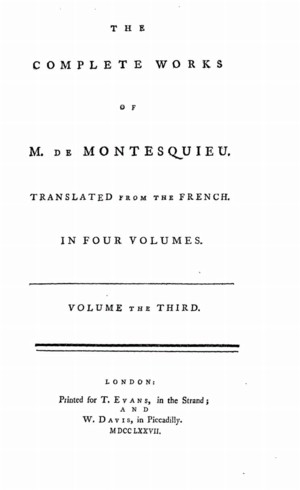
The Complete Works of M. de Montesquieu (London: T. Evans, 1777), 4 vols. Vol. 3.

Part of: Complete Works of Montesquieu, 4 vols.

About Liberty Fund:

Liberty Fund, Inc. is a private, educational foundation established to encourage the study of the ideal of a society of free and responsible individuals.


LETTER CIV.

Usbek to the Same.

ALL the people of Europe are not equally subject to their princes: for instance, the impatient humour of the English seldom give their king time to make his power heavy. Passive obedience and non-resistance are no virtues in their esteem. They say upon this head very extraordinary things. According to them, there is but one tie that can bind men, which is that of gratitude: a husband, a wife, a father and son, are not bound to each other, but either by the love they bear to one another, or by mutual services: and these different motives of acknowledgment are the origin of every kingdom, and of all societies. But if a prince, very far from making his subjects live happy, endeavours to oppress and ruin them, the foundation of obedience ceases; nothing ties them, nothing attaches them to him, and they return to their natural liberty. They maintain that no unlimited power can be lawful, because it never could lawfully commence. For we cannot, say they, give to another more power over us, than we have ourselves: now we have not an unlimited power over ourselves; for instance, we cannot take away our own lives, no person then upon earth, conclude they, hath a right to such a power. High treason is nothing, according to them, but a crime committed by the weaker against the stronger, by disobeying him, in whatever manner he does so. Accordingly the people of England, when they found themselves strongest in opposition to one of their kings, declared it to be high treason in a king to make war upon his subjects. They have therefore good reason to say, that the precept in their Koran, which enjoins obedience to the powers, is not very difficult to be followed, as it is impossible for them not to observe it; since it is not to the most virtuous that they are obliged to submit, but to the strongest. The English say, that one of their kings having overcome, and taken prisoner, a prince who disputed the crown with him, and reproaching him with his treachery and perfidiousness; it is not above a moment, replied the unfortunate prince, since it was decided which of us two is the traitor. An usurper declares all those to be rebels, who have not, like him, oppressed their country: and, believing there are no laws where he sees no judges, forces respect to the caprices of chance and fortune, as to the decrees of heaven.