Econlib

The Library

Other Sites

Front Page arrow Titles (by Subject) arrow LETTER XI.: Usbek to Mirza, at Ispahan. - Complete Works, vol. 3 (Grandeur and Declension of the Roman Empire; A Dialogue between Sylla and Eucrates; Persian Letters)

Return to Title Page for Complete Works, vol. 3 (Grandeur and Declension of the Roman Empire; A Dialogue between Sylla and Eucrates; Persian Letters)

Search this Title:

Also in the Library:

Subject Area: Political Theory
Subject Area: History
Collection: Banned Books

LETTER XI.: Usbek to Mirza, at Ispahan. - Charles Louis de Secondat, Baron de Montesquieu, Complete Works, vol. 3 (Grandeur and Declension of the Roman Empire; A Dialogue between Sylla and Eucrates; Persian Letters) [1721]

Edition used:

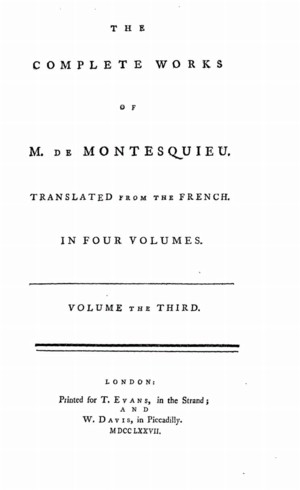
The Complete Works of M. de Montesquieu (London: T. Evans, 1777), 4 vols. Vol. 3.

Part of: Complete Works of Montesquieu, 4 vols.

About Liberty Fund:

Liberty Fund, Inc. is a private, educational foundation established to encourage the study of the ideal of a society of free and responsible individuals.


LETTER XI.

Usbek to Mirza, at Ispahan.

THOU renouncest thy own reason to try mine: thou condescendest even to consult me; thou think est me capable of instructing thee. My dear Mirza, there is one thing which flatters me more than the good opinion thou hast conceived of me; it is what has procured it me, thy friendship. I do not think that there is need to use very abstracted reasons, to sulfil the task which thou hast prescribed to me. There are some certain truths, of which it is not sufficient to be persuaded, but men must be made even to feel them; moral truths are of this kind. Probably this historical piece may affect thee more than a philosophical subtlety. In Arabia there were a few people, named Troglodites, descendants of the ancient Troglodites, who, if we can believe our historians, resembled beasts rather than men. They were not so deformed; they were not hairy like bears; they did not hiss; they had two eyes: yet they were so wicked and brutish, that they were strangers to the principles of justice and equity. A foreign king, who reigned over them, willing to correct their natural wickedness, treated them with severity; but they conspired against him, murdered him, and exterminated all the royal family. Having struck this blow, they met to chuse a government, and after much dissention, appointed magistrates, but they were scarcely elected when they became intolerable, and were massacred. The people, freed from this new yoke, consulted only their own savageness. Every one agreed to submit to no person: that each should follow his own interest, without any attention to that of others. This general resolution was extremely pleasing to all.—They reasoned thus: “Why should I destroy myself in labouring for those who do not concern me; I will take care for myself only; I shall live happily; what is it to me how others live? I shall provide for my own wants; and if they are satisfied, what care I if all the rest of the Troglodites are miserable?”—This was seed-time: each man said, “I will only manure as much land as will supply corn sufficient for myself; a greater quantity would be useless to me; I shall not take the trouble to work in vain.” The lands of this little kingdom were not all alike; some parts were dry and mountainous; others, in the low grounds, were well watered by rivulets. This year there was a great drought, insomuch that the upper grounds failed greatly, whist those which were watered proved very fertile; the consequence was, that almost all the people who lived in the mountains perished by famine, through the hard-heartedness of those who refused to share their harvest with them. The following year was very rainy; the higher grounds proved extraordinary fruitful, whilst the lower grounds were drowned. Now the other half of the people complained of famine; but these miserable people found the mountaineers as hard-hearted as they themselves had been. One of the chief inhabitants had a very handsome wise, of whom his neighbour became in love, and forced her from him; this occasioned a strong contest, and, after many blows and outrages, they consented to submit the decision to a Troglodite, who, whilst the republic subsisted, had been in some esteem. They came to him, and were going to plead their cause before him.—“What does it concern me, said the umpire, whose wife she is, yours, or yours; I have my land to till; I cannot spend my time in determining your quarrels, not busy myself in your affairs to the neglect of my own; pray let me be quiet, and do not trouble me with your disputes.”—Having so said, he left them, and went to work on his land. The ravisher, who was the stronger man, swore he would sooner die than restore the woman; whilst the husband, penetrated with the injustice of his neighbour, and the hardness of his judge, returned home in despair; when meeting in his way a handsome young woman, returning from a fountain, and having now no wife of his own; being pleased with her, and much more so, when he learned she was the wife of him whom he had chosen for his judge, and who had been so little sensible of his affliction; he seized on her, and forced her to go to his house. There was another man who possessed a fruitful field, which he had cultivated wich great labour; two of his neighbours united together, forced him out of his house, and took possession of his field; they formed a compact to defend themselves against all those who should endeavour to take it from them, and did really support themselves several months. But one of them, tired of sharing what he might possess alone, murdered the other, and became sole master of the field; his reign was not long; two other Troglodites attacked him; and he was massacred, being too weak to defend himself. Another Troglodite, who was almost naked, asked the price of some cloth, which he saw, and wanted to buy; the draper reasoned thus with himself: “I indeed ought not to expect more money for my cloth than will buy two measures of wheat; but I will sell it for four times that advantage, that I may purchase eight measures.”—The man must needs have the cloth, and pay the price demanded; “I am very well contented, said the draper, I now shall have some wheat.” “What is it you say, replied the buyer, do you want wheat? I have some to sell, however the price perhaps may surprise you; for you know wheat is extremely dear, and that the famine is extended almost every where; but return me my money and you shall have a measure of wheat, and though you should perish by the famine, you should not have it otherwise.” In the mean time the country was ravaged by a mortal distemper; a skilful physician arrived from a neighbouring country, who administered his medicines so properly, that he cured all who put themselves under his care. When the distemper ceased, he went to those whom he had cured, to demand his pay, but refusals were all he received. He returned to his own country, tired with the fatigue of so long a journey. But a short time after, he heard that the same distemper had returned again, and more grievously afflicted those ungrateful people. They did not now wait for his coming, but went to him themselves. “Unjust men, said he, go; you have in your souls a more deadly poison than that of which you desire to be cured; you are unworthy to enjoy a place upon earth, for you are void of humanity, and the laws of equity are unknown to you. I should think it an offence against the gods, who punish you, should I oppose their just anger.”