Econlib

The Library

Other Sites

Front Page arrow Titles (by Subject) arrow CHAP. III.: On the Usage of Nations, under the fundamental Laws of Civil Society. - The Claim of the American Loyalists

Return to Title Page for The Claim of the American Loyalists

CHAP. III.: On the Usage of Nations, under the fundamental Laws of Civil Society. - Joseph Galloway, The Claim of the American Loyalists [1788]

Edition used:

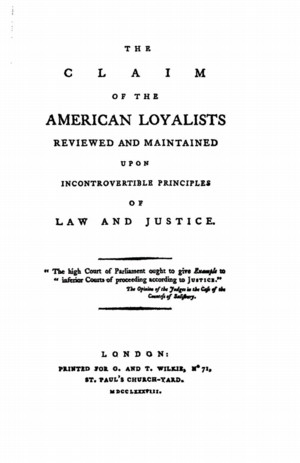
The Claim of the American Loyalists reviewed and maintained upon incontrovertible Principles of Law and Justice (London: G. and T. Wilkie, 1788).

About Liberty Fund:

Liberty Fund, Inc. is a private, educational foundation established to encourage the study of the ideal of a society of free and responsible individuals.


CHAP. III.

On the Usage of Nations, under the fundamental Laws of Civil Society.

THE Sovereigns of Europe, well understanding the obligation they are under, to protect the property of the subject in all events, and in the last extreme, have not failed to do it whenever it has been possible in every pacification. To this end, they have insisted on, and always obtained, a stipulation, that the individuals of the district ceded should be restored to their property, if taken from them; if not, that they might dispose of it to the best advantage, and return with the proceeds to the society of which they were subjects* .—This usage has been adopted for many centuries, in order to save the expence of making the compensation due, which otherwise the States could not avoid, without violating the sacred and essential laws of their respective societies.

In the civil war of the fifteenth century, which happened in the dominions of Spain, and ended in the independence of Holland, this principle of national justice was fulfilled. The war had continued near half a century. The attainders and proscriptions were numerous; the enmity of the parties during the war was violent, and yet the sovereign parties to the pacification, conscious of their duty to obtain all possible protection for their subjects who had suffered by the war, expressly stipulated, “That all real estates which had been seized, exposed to sale, or proscribed on account of the war, should be restored to their former owners; and that for all goods seized and sold by the public officers, the owners should have return or receive (a perpetual annuity of) six and one quarter yearly, for every hundred pounds.”

In the Treaty of Utrecht, care was taken by Great Britain to have the honours and domain of Chattelherault restored to the family of Hamilton, and the honours and domain of Aubigne to the family of Richmond.

In the definitive Treaty between the Emperor and the States General, the city and castle of Dalheim, and other towns and territories, were ceded to the Emperor, and other towns and territories were ceded by the Emperor to the States of Holland. But the high contracting parties, well knowing that they could have no right to sacrifice the interest of individuals to the emolument of society, without ample indemnification, agreed that the officers and others on duty in the country of Dalheim, should have pensions equal to their salaries at the charge of the country—and the Mayor or Greffier of the High Court of Dalheim, as also of the Lordships ceded to his Imperial Majesty, who were not continued in their employments, should receive a reasonable compensation, or have the liberty of selling their places under the approbation of the Government of the Netherlands.

At the termination of the war in 1763, when the King of France ceded the province of Canada to Great Britain, he was so sensible of the protection due to his subjects, that it was insisted on, and it was accordingly agreed by the Treaty, that the Canadians should retain their property, and that such as did not chuse to become the subjects of Great Britain, but wished to return to their former allegiance, should have a right to dispose of it to the best advantage, and to transport its produce unmolested to France.

At the same time the like stipulation was made by the French Monarch in the cession of New Orleans to Spain.

By the same Treaty, in the cession of the Floridas to Great Britain, the same stipulation was obtained by the King of Spain, in behalf of his subjects.

Upon this occasion the conduct of the Spanish Monarch is an illustrious instance of royal attention to the laws of civil society, which regard the protection and security of the subject: for after the surrender of the territory, finding that the English settlers would give little or nothing for the property of his subjects reserved by the Treaty, and that of course they were ruined by his own act, the act of cession, and therefore that he had not afforded them the protection due by the fundamental laws of society, he ordered them to retire to his own dominions, and on their arrival gave to every officer, civil and military, salaries equal to those they enjoyed before the Treaty. He further made them compensation for the property they had lost; and to the common labourer, his wife and children, even to the infant at the breast, he allowed pensions for their support. These pensions, being in their nature perpetual, would have been yet continued, had not this Monarch obtained, by the last treaty of Paris, the Floridas from Great Britain. Upon this event the Spaniards, in their turn, refused to purchase of the British settlers, and in manner compelled them to leave their property, which they had greatly improved. His Catholic Majesty, by a late proclamation, has generously restored these improved estates to his subjects, the former owners, their children and grand-children. Thus the wings of the Sovereign hovered over his subjects, and protected them in all their distress. He felt the high obligation he was under to do it. He considered the value of a number of subjects to the society over which he presided. He saw the force with which this example of sovereign justice would secure the confidence of his people, and bind their fidelity to him on all future occasions. Nor did he for a moment put the sum, though large, he was obliged to draw from his public treasury, in competition with the public benefits which would be derived from it.

Such has been the usage of States, whenever a cession of territory, and with it the property of the subject, has been found necessary to the common safety. There was no such reservation or restoration of the property of the Loyalists, no indemnity whatever obtained; and had there been nothing mentioned respecting them in the treaty, it would have been more to the honour of the British government, than that humiliating stipulation, by which it was agreed, that the Loyalists should have “the liberty to go to the United States, and there to remain twelve months unmolested in their endeavours to obtain restitution, and that the Congress should recommend to the States, to restore their estates, they refunding the bona fide price which the purchaser may have paid.”

Here the British State, which was bound to obtain a restitution of their property, if it could possibly be done, procured “a liberty” for them to solicit for it. They were sent by the State which had granted their property for a valuable consideration, to ask it of those whose right to hold it the State itself had solemnly confirmed. They were sent by the State, which they had faithfully served, and which was bound to protect them, to seek for that protection from States to which they were aliens, whose existence they had fought to prevent, and who, from a principle of self-preservation, were naturally led to refuse it. And they were sent by the State, which had deprived them of their fortunes, and made them bankrupts indeed, to bargain and pay in ready money for those fortunes which it had appropriated to its own emolument. For the stipulated condition of the restitution, supposing it to be made, was, “refunding the bona side price, which the purchaser of the state had paid for it;” and this extraordinary boon was to be humbly solicited for, of their implacable enemies, without the least hope of success, and without any possibility of deriving any advantage from it, had it been obtained.

The advantage which was so repeatedly and sanguinely described, and expected from those recommendations, has, however, been long since fully essayed. A number of Loyalists have gone to the United States to obtain restitution of their property, under the recommendations of Congress; and the effect has been what the Loyalists, and many Members of Parliament, in their debates on the peace, foretold. Instead of restoring them to their property, the American States have not only treated the solicitations for it with insult and contempt, but have imprisoned the persons of the claimants, and afterwards banished them under the pain of death.

As to the great body of Loyalists, who were not within the districts in the possession of his Majesty’s arms, and who had equally demonstrated their fidelity and zeal in support of the rights of Parliament, and rendered services equally important, there was no stipulation whatever made in their behalf. They were not even mentioned in the treaty; they therefore could have nothing to expect from the recommendations of the Congress or from any other quarter whatever, but from the honour and justice of hisMajesty and Parliament.

[* ]The case of the Loyalists only excepted.